How to Build an SEO Strategy from Scratch
Without a documented SEO strategy, you're relying on guesswork instead of data. Most founders and marketing teams at growing companies understand that organic traffic compounds faster than any paid channel, yet 53% of website traffic already comes from organic search. The problem? Building and maintaining an SEO strategy requires consistent research, content production, and optimization work that doesn't fit into an already-packed schedule. The fix is a framework you can set up once, then systematize—whether manually or with automation tools that handle the legwork.
Key Takeaways
- 53% of website traffic comes from organic search today—and organic-driven leads have a 14.6% close rate vs. 1.7% for outbound (2026, SeoProfy)
- Median SEO ROI is 748% ($7.48 returned per $1 spent), with B2B SaaS reaching 702% ROI and breaking even in roughly 7 months
- Build your strategy around three core pillars: keyword research, content planning, and technical foundation—then automate the repetitive work
- Define Your SEO Vision and Goals: Start with measurable targets for organic traffic, leads, and revenue to align your team and measure progress over time.
- Run Keyword Research to Understand Search Demand: Identify high-intent keywords your audience actually searches, then organize them into content clusters.
- Audit Your Technical Foundation: Ensure your website's crawlability, indexation, and performance support SEO growth before content strategies matter.
- Create a Content Plan Aligned to Keywords: Map content to keyword intent and build internal link networks that distribute authority across the site.
- Implement On-Page Optimization Standards: Standardize title tags, meta descriptions, headers, and structured data across your site to maximize SERP visibility and click-through rates.
- Build Your Link Strategy and Topical Authority: Earn backlinks from authoritative sources and create clusters of related content to dominate your niche.
- Measure, Track, and Iterate: Set up dashboards that track keyword rankings, traffic, and conversions, then adjust your strategy quarterly based on what's working.
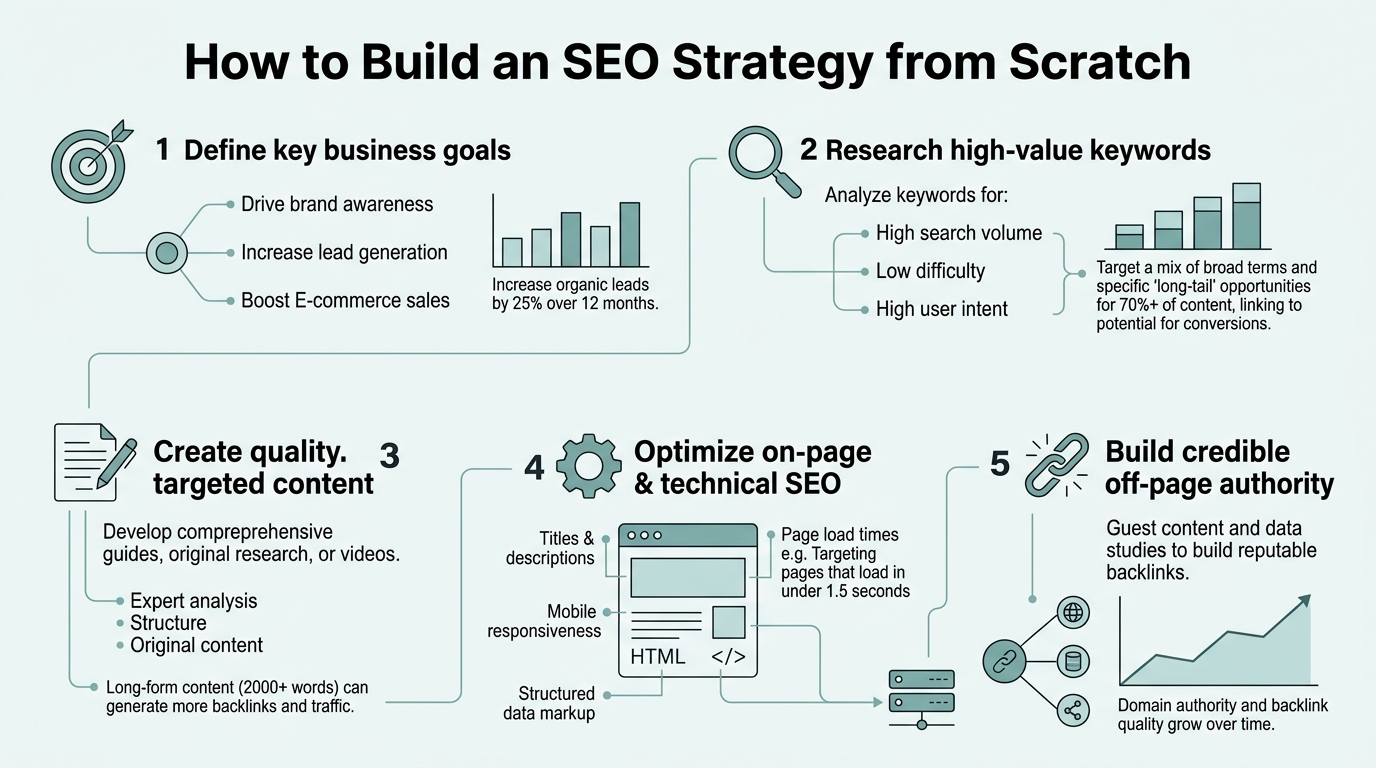
Define Your SEO Vision and Goals
The first step in building an SEO strategy from scratch is deciding what success looks like for your business. Without clear targets, you'll chase traffic without purpose. Your SEO goals should ladder up to broader business outcomes: revenue, qualified leads, or market share in your niche. According to SeoProfy's 2026 research, companies that define clear SEO benchmarks see 60% better lead quality than those tracking only traffic volume.
"Companies that define clear SEO benchmarks see 60% better lead quality than those tracking only traffic volume. Strategic alignment from the start prevents months of wasted effort on vanity metrics."
Start by mapping your business objectives to SEO-specific metrics. If your goal is $2M in annual revenue from organic channels, work backward: How many qualified leads do you need? What's your average deal size? How many conversions come from organic traffic at your current conversion rate?
Key performance indicators (KPIs) to define include:
- Organic traffic target: A 20–40% year-over-year increase is aggressive but achievable for most growing companies with a solid strategy.
- Keyword ranking targets: Aim to rank on the first page for 50–100 high-intent keywords within 12 months, depending on your niche competitiveness.
- Lead volume and quality: Track not just leads, but qualified leads (those that match your ICP and advance the sales cycle).
- Conversion rate: Most sites see 2–4% conversion rates from organic traffic; benchmark yours against your industry.
- Customer acquisition cost (CAC) from organic: Because organic is compound, your CAC from an article published in month 1 may not show returns until month 6–9.
Once you've set these targets, document them in a single-page strategy brief that you share with your team. Align stakeholders early—sales, product, and marketing all benefit from organic growth, so making SEO a shared priority prevents misalignment later.
Run Keyword Research to Understand Search Demand
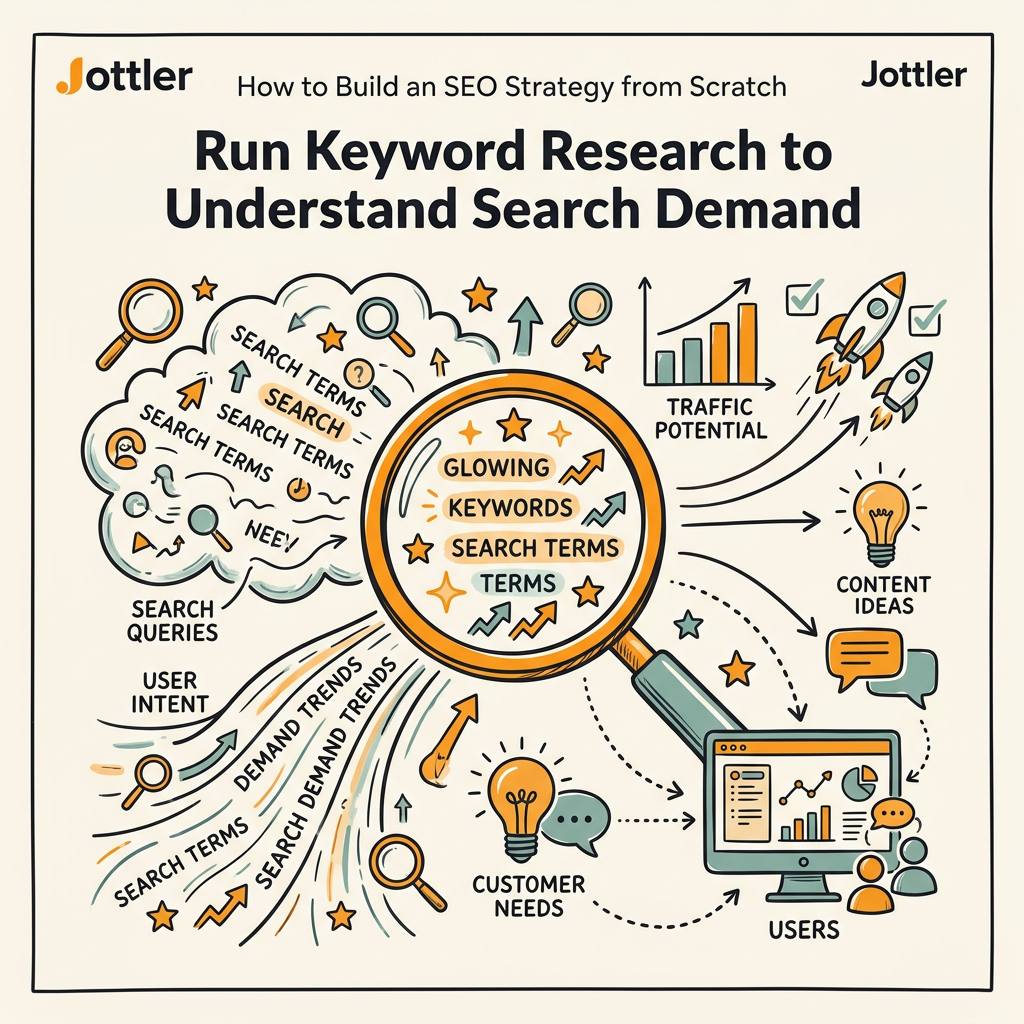
Keyword research is the foundation of every SEO strategy worth executing. You're not guessing what your audience cares about; you're discovering the exact language they use to search for solutions. Google processes roughly 9.1–13.6 billion searches per day, and your job is to claim the tiny fraction that matches your business. According to G2's 2026 SEO statistics, teams that execute keyword research spend 30% less time on unproven content topics.
Start with high-level theme discovery. List 10–15 core topics related to your business, product, or service. If you run a SaaS HR tool, topics might be: employee scheduling, shift management, compliance tracking, team communication. These themes become the backbone of your content clusters later.
Next, use keyword research tools to expand each theme into keyword variations. Tools like SEMrush, Ahrefs, or Google Keyword Planner return search volume, difficulty, and intent for each keyword. Look for keywords that match three criteria:
- Search volume: Aim for keywords with 100+ monthly searches (for niche B2B, 30+ is acceptable). Zero-volume keywords are guesses, not data points.
- Low-to-medium keyword difficulty: Target KD under 50 initially; once you've built topical authority, attack harder keywords.
- Commercial or informational intent: Commercial intent keywords (with words like "best," "vs.," "pricing") drive conversions faster. Informational intent builds authority and inbound links.
"The teams that win at SEO organize keywords into clusters before they start writing. A cluster-first approach cuts content production time by 40% and improves internal linking naturally."
Organize your keywords into clusters based on topic relevance. A cluster might look like: "How to" articles (informational), "Best X" comparisons (commercial), and "What is X" definitions (educational). Each cluster becomes a pillar of content supporting a main topic. For busy teams, autonomous SEO agents now handle keyword research at scale, discovering high-intent keywords and organizing them into clusters automatically. This removes the manual spreadsheet work and lets your team focus on strategy rather than data entry.
Audit Your Technical Foundation
Technical SEO is the invisible layer that determines whether search engines can even crawl and index your site. A stunning content strategy built on a broken technical foundation is like constructing a mansion on quicksand. Your technical audit should answer one question: Can Google index my content?
Run a full technical audit using tools like Google Search Console (free), Screaming Frog, or Semrush. Focus on these critical areas:
- Indexation status: How many pages does Google know about? Are there blocked pages you want indexed? Check Search Console's Coverage report.
- Core Web Vitals: Google ranks sites partly on performance. Your largest contentful paint (LCP) should be under 2.5 seconds, cumulative layout shift (CLS) under 0.1, and first input delay (FID) under 100ms.
- Mobile-first indexing: Over 60% of Google searches come from mobile devices. Your site must be mobile-responsive and fast on slower connections.
- XML sitemaps and robots.txt: Ensure your sitemap includes all indexable pages and your robots.txt doesn't block search engines from crawling important content.
- Canonical tags: Use canonical tags to prevent duplicate content issues, especially if you have multiple versions of the same page.
- SSL/HTTPS: Your site must run on HTTPS. If it doesn't, migrate immediately—Google penalizes non-secure sites.
Document issues in a prioritized list. Critical issues (site not indexable, broken crawl paths) get fixed first. Medium-priority issues (slow page speed, missing alt text) get scheduled into your roadmap.
Create a Content Plan Aligned to Keywords
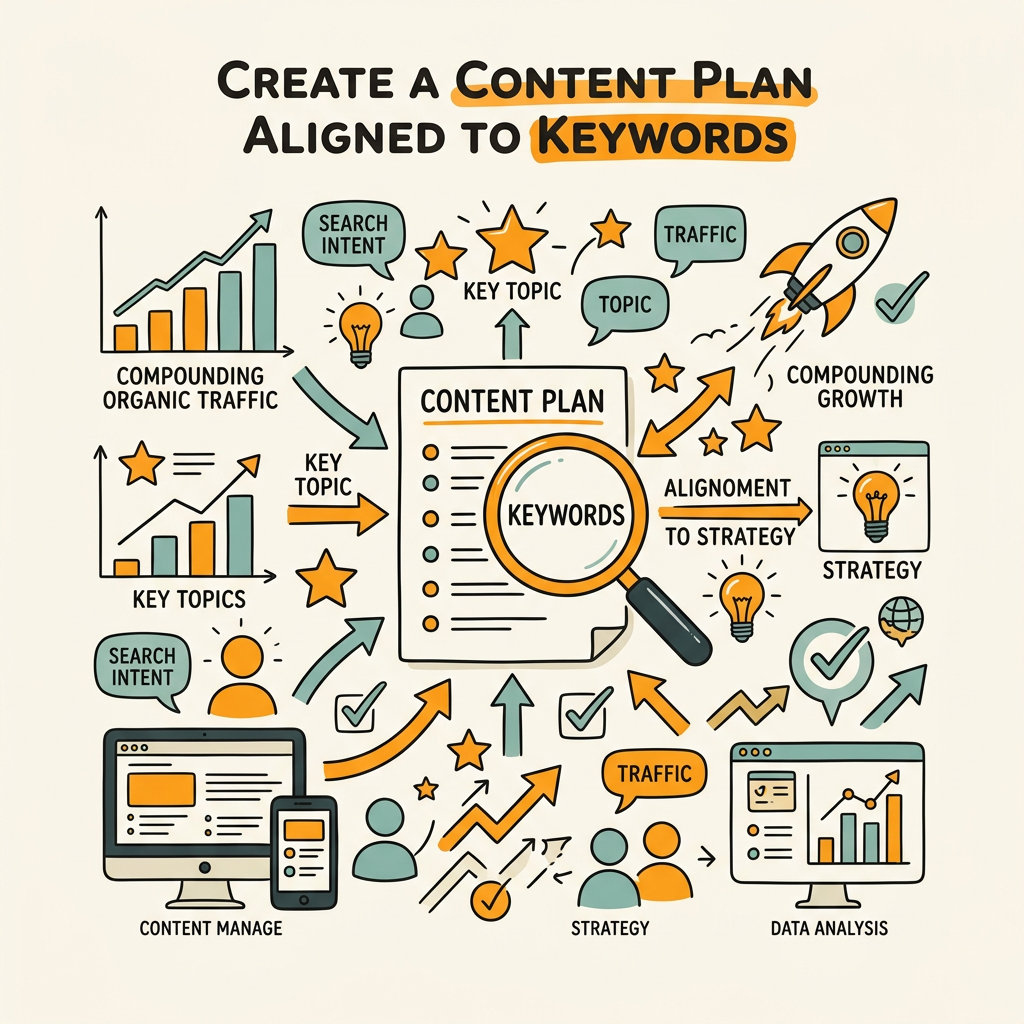
Content is where SEO compounds. Each article you publish can generate traffic, leads, and links for years. But unplanned content is scattered—you write what feels urgent, not what moves the needle for your strategy. Research on content planning best practices shows that companies with documented content roadmaps see 3x more conversions than those publishing ad-hoc.
Map your keyword research to a 12-month content calendar. For each keyword cluster, assign content pieces by format and intent:
- Pillar pages: Comprehensive, 3,000+ word articles covering the entire topic (e.g., "Complete Guide to Shift Management for Retailers").
- Cluster content: Deeper dives into subtopics that link back to the pillar (e.g., "How to Create a Fair Shift Schedule," "Shift Scheduling Best Practices").
- Quick-reference pages: Shorter, highly specific answers to "how-to" and "what-is" questions (e.g., "What Is FIFO Scheduling?").
"Most successful content strategies publish 1–4 pieces per week. Below that frequency, you're fighting compound decay. Above that without automation, you burn out your team."
Within each piece, plan your internal links. If your pillar is "Shift Management," your cluster articles should link back to it with anchor text like "shift management software" or "shift management best practices." This concentrates authority and helps Google understand your topical depth.
Publication frequency matters. Most successful content strategies publish 1–4 pieces per week. If you're producing content manually, that's unsustainable. AI content strategy tools can automate research and drafting, compressing what takes an agency weeks into days. Jottler, for example, publishes 3,000+ word articles daily—each fully researched, fact-checked, and optimized for SEO. For teams without that bandwidth, tools eliminate the bottleneck.
Implement On-Page Optimization Standards
On-page SEO means optimizing each article for both humans and search engines. The fundamentals—title tags, meta descriptions, headers, keyword placement—remain critical in 2026, even as AI reshapes how content surfaces.
Standardize your on-page checklist:
- Title tags (50–60 characters): Include your primary keyword in the first 8 words. Example: "How to Build an SEO Strategy from Scratch: Complete Guide" works because the keyword is first and it's benefit-oriented.
- Meta descriptions (150–160 characters): Include your primary keyword, a benefit, and a reason to click. Example: "Learn to build an SEO strategy from scratch in 7 steps. Get keyword research, content planning, and link-building tactics that drive organic traffic."
- H1 tag (one per page): Your H1 should match your title tag or be a slight variation. Only one H1 per page—it's your main headline.
- Headers (H2, H3): Use headers to structure content logically. Headers should include your target keyword naturally, but don't keyword-stuff. Readers and search engines should see clear hierarchy.
- Keyword placement: Your primary keyword should appear in the first paragraph, at least one H2, and naturally 3–5 times throughout a 2,000-word article. Aim for 0.5–1.5% keyword density—more feels spammy.
- Structured data (schema markup): Add schema for FAQs, articles, and products so Google understands your content type. This helps you rank in rich snippets and AI summaries.
Compare how different SEO approaches handle on-page optimization:
| Approach | Time to Implement | Consistency | Scalability | Best For |
|---|---|---|---|---|
| Manual (spreadsheet + checklist) | 20–30 mins per article | Medium (depends on team discipline) | Low (breaks at 2+ pieces/week) | Small teams publishing infrequently |
| SEO tools + manual review | 10–15 mins per article | High (tools enforce standards) | Medium (still requires review) | Teams publishing 1–2x weekly |
| Automated optimization (Jottler) | 2–3 mins per article | Very High (AI-driven consistency) | Very High (scales to daily publishing) | Fast-scaling companies targeting 3000+ articles/year |
For high-volume content operations, on-page optimization becomes tedious. AI-powered SEO tools now handle title generation, meta descriptions, and schema markup automatically, ensuring every piece meets your standards without manual review.
Build Your Link Strategy and Topical Authority
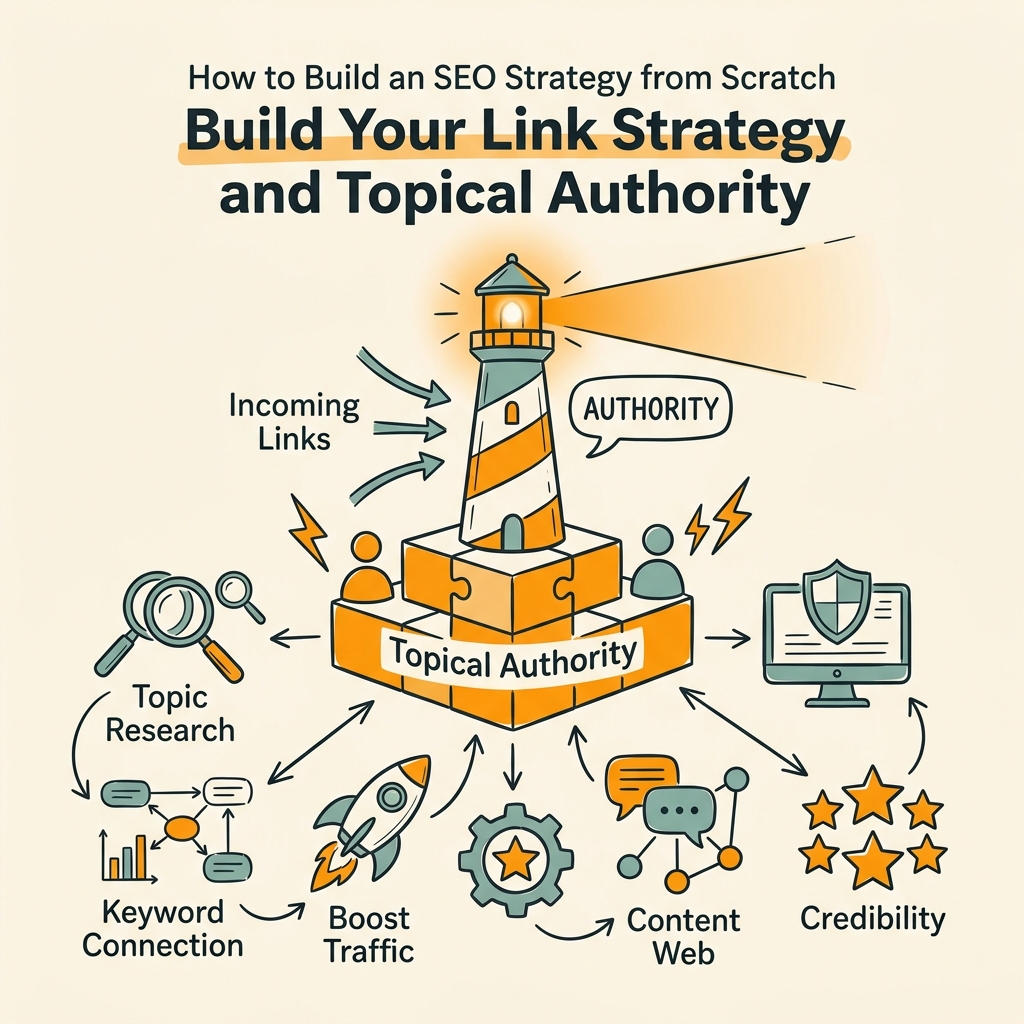
Backlinks are still one of the strongest ranking signals Google uses. Your content can be brilliant, but without links pointing to it, fewer people will find it. A link strategy has two parts: earning links to existing content, and building topical authority through internal linking.
Topical authority means Google sees your site as the go-to expert on a specific topic. To build it, create dense clusters of related content that all link to each other and to a central pillar page. If you have 15 articles about "shift management," they should form a web where readers and search engines see your site as the authority.
For external links, focus on these high-ROI tactics:
- Original research and data: Create proprietary research or surveys related to your niche. Journalists and other bloggers link to original data.
- Competitor analysis: Publish "vs." articles comparing your solution to competitors. These naturally attract links and rank for commercial keywords.
- Resource pages and guides: "Ultimate guides" to your niche attract citations and backlinks because they're comprehensive and link-worthy.
- Industry interviews: Interview thought leaders in your space. They'll promote the article, bringing visibility and links.
- Guest articles: Write for industry publications and high-authority sites. Include a link to your resource back in your author bio or article body.
On average, the top organic result on Google captures 27.6% of clicks—not because it's the only good resource, but because Google's ranking signal (partly based on link authority) identified it as the best fit. Your job is to be that top result for your keywords.
Building link pipelines requires consistent outreach, relationship management, and content distribution—activities that are high-effort but essential. Many teams let this slide because it's not "writing." Protect time for it.
Measure, Track, and Iterate
Without measurement, your SEO strategy is a guess pretending to be a plan. Set up dashboards that track five core metrics: keyword rankings, organic traffic, conversion rate, bounce rate, and revenue from organic leads.
Use Google Analytics 4 (GA4) as your traffic baseline. Set up event tracking to measure what matters: demo requests, content downloads, account signups. Connect GA4 to your CRM so you can track how many organic leads become customers.
For keyword rankings, use SEMrush, Ahrefs, or a smaller tool like Rank Tracker. Monitor 50–100 primary keywords (the ones your business depends on) and review movement monthly. Expect rankings to fluctuate; focus on trends over 12 weeks, not daily noise.
Create a quarterly review process:
- Which keywords moved up? Double down on the topics and formats that rank.
- Which pages drive the most revenue? Repurpose them into linked content or spin them into new articles.
- Where is your bounce rate high? Improve content relevance or call-to-action clarity.
- Which content formats perform best? If "how-to" articles convert at 8% while guides convert at 3%, publish more how-tos.
Most growing companies struggle with iteration because the effort to publish content already stretches them thin. This is where automation pays off: automated SEO systems can measure and report on strategy performance, surfacing insights monthly without manual data compilation. Tools eliminate the busywork, leaving your team time to act on the insights.
Conclusion
Building an SEO strategy from scratch doesn't require advanced degrees or years of experience. It requires a structured approach: defining goals, researching keywords, fixing technical issues, planning content, optimizing pages, earning links, and measuring results. Median SEO ROI is 748%—meaning every dollar invested in SEO returns $7.48—making it one of the highest-ROI channels available to growing companies.
The challenge isn't understanding SEO. It's executing consistently at scale. Teams without dedicated resources quickly fall behind because SEO compounds—you must publish regularly, optimize ruthlessly, and iterate based on data. This is where Jottler's autonomous SEO engine changes the equation. It automates keyword research, writes and optimizes articles daily, publishes directly to your CMS, and builds internal link networks automatically. Instead of spending 40 hours per week on SEO operations, your team can focus on strategy and customer conversations. Start your SEO agent today.
FAQs
How long does it take to see results from an SEO strategy?
Most SEO strategies begin generating positive results in 6–12 months, with B2B SaaS teams typically breaking even around month 7. The timeline depends on your niche competitiveness, publishing frequency, and initial domain authority. Highly competitive niches (e.g., fintech, insurance) may take 18+ months to see first-page rankings, while less competitive sectors can see traction in 3–4 months. Publishing 3–4 articles per week accelerates results compared to publishing once monthly.
What is the difference between SEO strategy and content strategy?
A content strategy defines what you'll write, when, and for whom—it's about audience fit. An SEO strategy defines how your content will be discovered organically and what keywords you'll target. The two must align: you'll fail if you publish great content nobody is searching for. The strongest approach combines both—writing content that solves real audience problems while targeting high-intent keywords that drive traffic and conversions.
Should I build an SEO strategy myself or hire an agency?
Build the strategy in-house because only your team understands your business, market, and goals deeply enough to make strategic choices. Hiring an agency to execute (write content, build links, manage technical SEO) can make sense if your team lacks bandwidth or expertise. The ideal model for growing teams is to own strategy and outsource execution—whether to an agency or to automation tools that handle research and writing daily without requiring constant oversight or expensive team hires.