How to Identify High-Intent Keywords for Organic Traffic
High-intent keywords are the difference between attracting browsers and attracting buyers. High-intent traffic converts 2x to 5x more often than generic keyword traffic, yet many teams waste time chasing high-volume terms that never move the needle toward revenue. The stakes are clear: companies that prioritize intent over volume in their keyword research see 15%–25% average conversion rates compared to just 2%–5% for broad, informational queries (2025, First Page Sage). This guide shows you how to identify which keywords your ideal customers are actually searching for when they're ready to buy, and how to build a framework that scales this discovery process without overwhelming your team.
Key Takeaways
- High-intent keywords drive 2x–5x higher conversion rates than generic traffic (2025, ContentRare). Long-tail, high-intent keywords can reach 36% conversion rates in specific contexts.
- Commercial and transactional intent modifiers—buy, pricing, demo, trial, alternatives, near me—signal readiness to convert and should form the foundation of keyword selection.
- Manual SERP analysis and live validation matter more than tool labels alone; Google's ranking results are the ultimate arbiter of intent.
- Understanding Search Intent: Intent separates high-conversion keywords from traffic traps; informational queries rank at top-of-funnel while commercial and transactional terms indicate buyer-ready users.
- Intent Modifiers and Keywords: Specific word patterns—buy, pricing, demo, cost, alternatives, near me—reliably indicate purchase and signup intent across industries.
- SERP Analysis as Validation: Ranking pages reveal Google's interpretation of intent; if competitors rank product pages and pricing pages, the keyword is high-intent regardless of its label.
- Data-Driven Prioritization: Combine volume, difficulty, and business fit to score keywords; focus on terms that both rank achievable and drive revenue, not just clicks.
- Scaling Intent Discovery: Pulling phrases from sales calls, CRM notes, and support tickets accelerates keyword brainstorming and captures real buyer language automatically.
What Is Search Intent and Why Does It Matter for Organic Traffic?
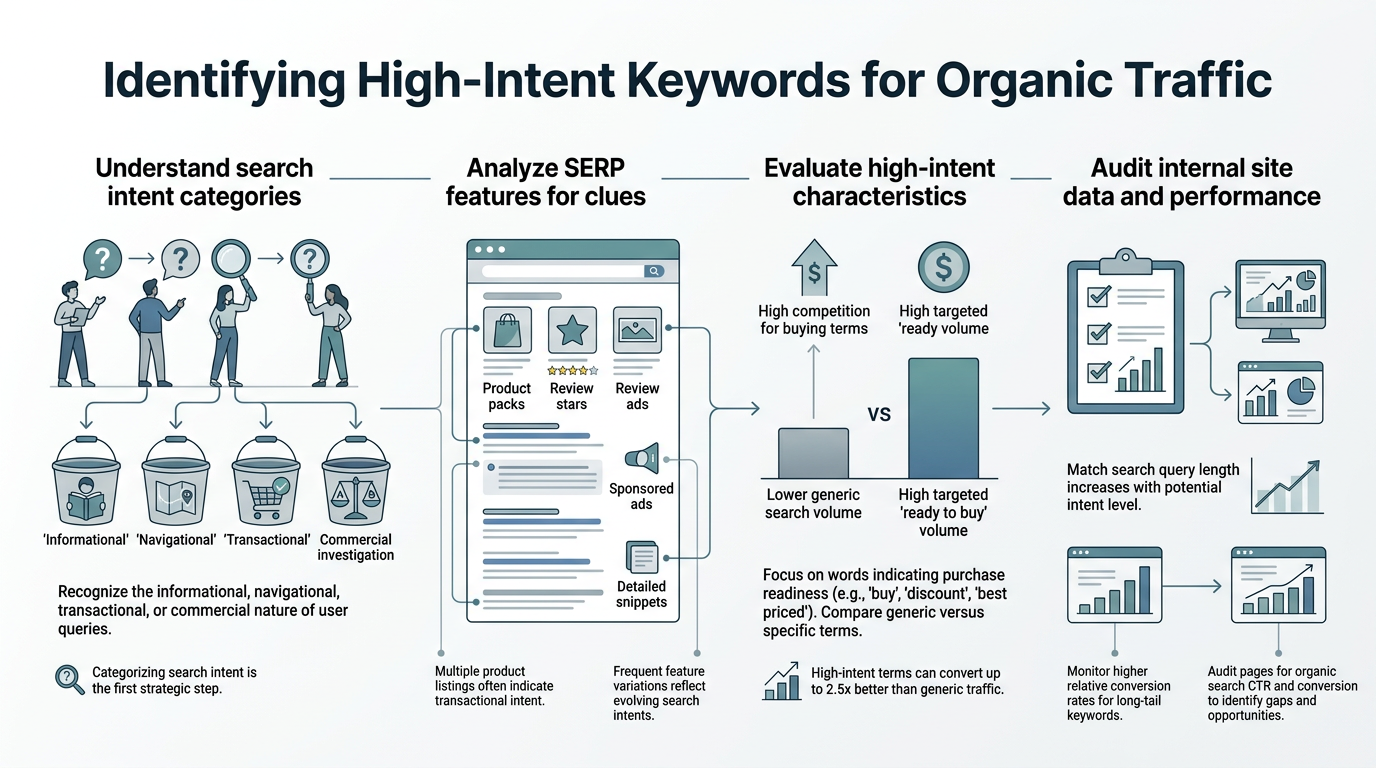
Search intent is the underlying reason a user types a keyword into Google. Understanding it determines whether your content ranks and converts or just sits on page 10. Google rewards pages that match the intent behind the search, so targeting keywords without understanding what the searcher actually wants is like throwing darts in the dark. The four main intent categories are informational (learning about a topic), navigational (finding a specific site), commercial (researching products), and transactional (ready to buy now). High-intent keywords fall into the commercial and transactional categories, where users have demonstrated readiness to take an action—whether that's signing up for a demo, requesting a quote, or completing a purchase.
"When you target informational keywords meant for top-of-funnel awareness but land users on a product page, they bounce immediately, your engagement metrics plummet, and Google learns that your page doesn't satisfy that query. Conversely, ranking a blog post for a commercial keyword like 'best project management software' attracts qualified prospects actively evaluating solutions."
The cost of misaligned intent is significant. When you target informational keywords meant for top-of-funnel awareness but land users on a product page, they bounce immediately, your engagement metrics plummet, and Google learns that your page doesn't satisfy that query. Conversely, ranking a blog post for a commercial keyword like "best project management software" (where users want comparison content and pricing info) attracts qualified prospects actively evaluating solutions. Your conversion rate climbs, your engagement signals strengthen, and you compound organic traffic growth by feeding high-value visitors back into your sales funnel.
The Four Intent Categories and Their Conversion Patterns
Informational intent queries ("how to," "what is," "why") rank lowest for conversion because the user is in learning mode. These keywords typically convert under 1% and are best used for brand-building and authority. Navigational intent ("brand name," "website + location") is intent-neutral; users already know where they want to go, so organic traffic here often just mirrors direct traffic. Commercial intent ("best X," "X review," "X vs Y") signals research and comparison; users are narrowing choices and convert at 5%–10% when matched with comparison or review content. Transactional intent ("buy X," "pricing," "free trial," "demo request") indicates the user is closest to action, converting at 2%–5%+ or higher depending on landing page quality. For organic growth targeting revenue, transactional and commercial keywords are your most efficient spend of content effort.
How Intent Shapes Your Content Strategy and Ranking Potential
Intent alignment directly impacts your ability to rank. If you target a transactional keyword like "accounting software pricing" but publish a blog post titled "The History of Accounting Software," Google will rank a pricing page from a competitor above you, and the searcher will leave frustrated. Intent also shapes internal linking and site architecture; building topical clusters around high-intent commercial and transactional keywords creates a conversion funnel. A user landing on your "vs" comparison page can link to product pages, pricing pages, and demo pages, each optimized for the next stage of decision. Teams using autonomous SEO agents to automate this linking benefit from the fact that intent-aligned clusters compound traffic growth by signaling topical authority to Google while keeping qualified visitors inside your conversion paths.
How Do You Identify High-Intent Keywords Using Modifiers and Language Patterns?
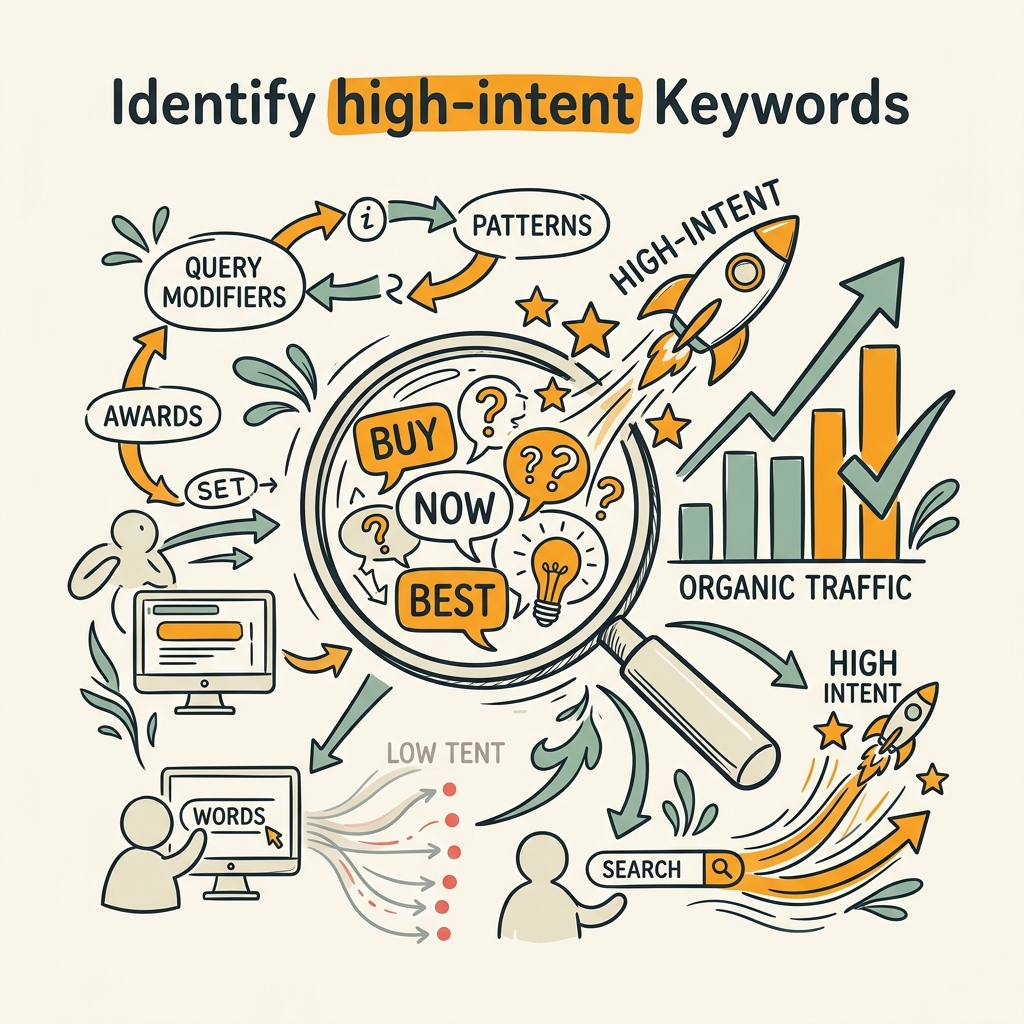
The fastest way to identify high-intent keywords is to recognize and systematically apply intent modifiers. These are specific words and phrases that buyers include when they're ready to convert. Modifiers cluster into actionable categories:
- Purchase modifiers: buy, order, discount, coupon, purchase
- Pricing modifiers: pricing, cost, price comparison, how much, quote
- Evaluation modifiers: demo, trial, free trial, review, alternatives, vs, comparison
- Urgency/location modifiers: near me, ASAP, urgent, 24-hour, same-day
- Action modifiers: hire, book, request, signup, contact
When you add these modifiers to your core product keywords, you shift from "CRM" (which could be any intent) to "CRM pricing" (commercial) or "CRM demo" (transactional). According to Prospeo's buyer intent keywords framework, the most reliable modifier sets include: buy, pricing, demo, near me, best, vs, review, cost, quote, hire, and book.
The power of modifiers is that they're learnable and scalable. Instead of guessing which keywords your customers search, you can apply a modifier framework to any core term. "Project management software" alone is too broad. Apply modifiers and you get: "project management software pricing," "best project management software," "project management software demo," "project management software free trial," and "project management software alternatives." Each variation signals a different stage of buying, and each is more likely to convert than the unmodified head term. The key is to start with modifiers that reflect real buyer language—not invented terms—which brings us to extracting intent directly from your customers.
Mining High-Intent Language from Sales Calls, CRM Data, and Support Tickets
The most reliable source of high-intent keywords is your own customer data. Sales teams, support logs, and CRM notes contain the exact phrases your customers use when they're close to deciding. A 2026 B2B recommendation is to pull closed-won deal notes, recorded sales calls, and support ticket conversations and identify the specific terms buyers used before they committed. For example, instead of guessing that "affordable invoicing" is a keyword worth targeting, you discover it directly because five customers mentioned affordability in their pre-sale conversations. This approach takes your keyword research out of the abstract and roots it in actual buyer behavior.
The workflow is straightforward:
- Export your last 50–100 closed deals or qualified leads from your CRM
- Scan the conversation history and notes for repeated phrases and questions
- Highlight patterns like "How much does X cost?" "Does your X work with Y?" "Who else uses your X?" and "What's the alternative to Z?"
- Track competitor names mentioned in objection handling or "vs" comparisons
- Review support tickets for specific problems that signal intent
- Extract and prioritize high-frequency phrases as keywords to target
Sales teams should also track which competitor names come up in objection handling or in "vs" comparisons; if customers ask "How do you compare to Competitor X?" then "your product vs Competitor X" is a high-intent commercial keyword you need to own. Support tickets reveal the same data—customers reaching out with a specific problem are signaling intent. Automating this extraction using site search logs and tools like AI-powered SEO research platforms reduces the manual work and accelerates discovery at scale.
Using Competitor Landing Pages to Validate High-Intent Keywords
Competitors reveal which keywords they're betting are high-intent by the landing pages they've optimized. If a competitor has a dedicated pricing page, product page, demo page, or comparison page ranking for a keyword, that keyword is almost certainly high-intent in their industry. You can use this as a shortcut: export the top 20–30 keywords your competitors rank for, then filter by the landing page type. Competitors will typically rank their highest-intent keywords on product pages, pricing pages, feature pages, and comparison pages, not on blog content. This tells you that those keywords are transactional or commercial intent. A practical 2026 tactic is to run a reverse SERP analysis using these validation methods:
- Search "site:competitor.com/pricing" or "site:competitor.com/product" in Google
- Collect the keywords ranking on those dedicated pages
- Note the SERP positions and page authority for each result
- Cross-reference with your current keyword list for coverage gaps
- Add proven high-intent terms to your priority list
These are proven high-intent terms in your space, and targeting them immediately puts you in direct competition with established players—which is exactly what you want for revenue-generating keywords.
How Do You Validate High-Intent Keywords Using SERP Analysis?
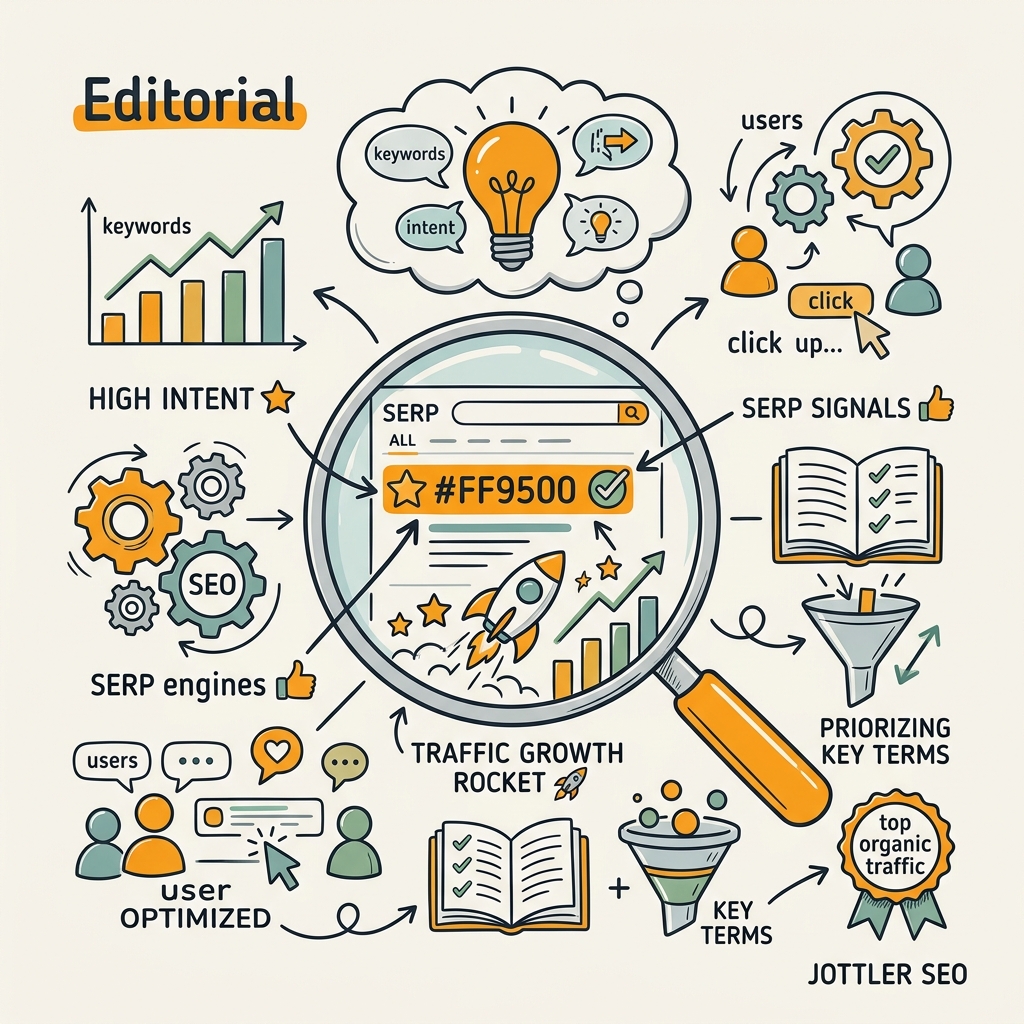
Tool labels and intent classifications are useful starting points, but the ultimate arbiter of intent is what Google actually ranks. SERP (Search Engine Results Page) analysis is the validation layer that confirms whether a keyword is truly high-intent or whether the tool got it wrong. Searching a keyword in incognito mode and examining the top 10 results tells you what Google believes the user intent is for that query. If the results are product pages, pricing pages, demo signup pages, and shopping carousels, the keyword is high-intent. If the results are blog articles, Wikipedia entries, and educational resources, the keyword is informational regardless of what a keyword tool label says. Research from ContentRare on high-intent keyword strategies confirms that SERP-first validation methods are now replacing volume-first research in modern 2026 keyword workflows.
"SERP-first validation methods are now replacing volume-first research in modern 2026 keyword workflows. The ranking results are the ultimate arbiter of intent—more reliable than any tool label."
A practical 2026 validation checklist includes:
- Search the keyword in incognito to avoid personalization bias
- Note the page types ranking in positions 1–5: are they blog posts, product pages, pricing pages, comparison pages, local packs, or shopping results?
- Check for SERP features like AI Overviews, product carousels, and local results, which signal intent type
- Look at the URL structure: competitor domains ranking deep product pages or pricing URLs indicates commercial intent
- Scan the meta descriptions and titles for action language (buy, pricing, demo, free trial)
- Estimate organic CTR potential by counting ads and SERP feature placement
This 10-minute SERP audit is far more reliable than trusting a keyword tool's intent label. Many tools lag behind live SERP changes, especially when AI Overviews have shifted how Google displays results.
What SERP Features Signal High-Intent Keywords
Specific SERP features reliably correlate with intent type. Shopping carousels and product listing ads indicate transactional intent; Google only shows these when it's confident the user wants to buy. Local business packs ("near me" results) signal high-intent local services. Pricing pages, demo pages, and contact form pages ranking in the top 10 clearly show high-intent. AI Overviews are a newer signal: their presence often indicates informational intent, meaning the user is asking Google for information rather than looking for a product to buy. If the SERP is dominated by AI Overview answers, video results, and educational content, that keyword is lower-intent and unlikely to drive conversions. Conversely, if the top results are product pages with "Add to Cart" buttons, pricing tables, and comparison pages, you've found a high-intent goldmine.
The Role of CTR and Organic Click Potential in Validating Keywords
High intent means nothing if organic clicks are suppressed by ads or other SERP features. A 2026 best practice is to evaluate click potential alongside intent. A keyword might show high commercial intent, but if the SERP is crowded with four paid ads and a shopping carousel taking the top real estate, your organic CTR will suffer even if you rank #1. Tools like Clickrank and some SEO platforms now surface estimated organic CTR alongside keyword intent, allowing you to filter for keywords that are both high-intent and high-opportunity in terms of actual click potential. The practical takeaway is this: validate intent with SERP analysis, but don't stop there; also check whether organic listings have breathing room to capture clicks. Keywords with fewer ads and cleaner SERPs often deliver better ROI despite similar difficulty scores.
How Do You Prioritize High-Intent Keywords When You Have Limited Content Capacity?
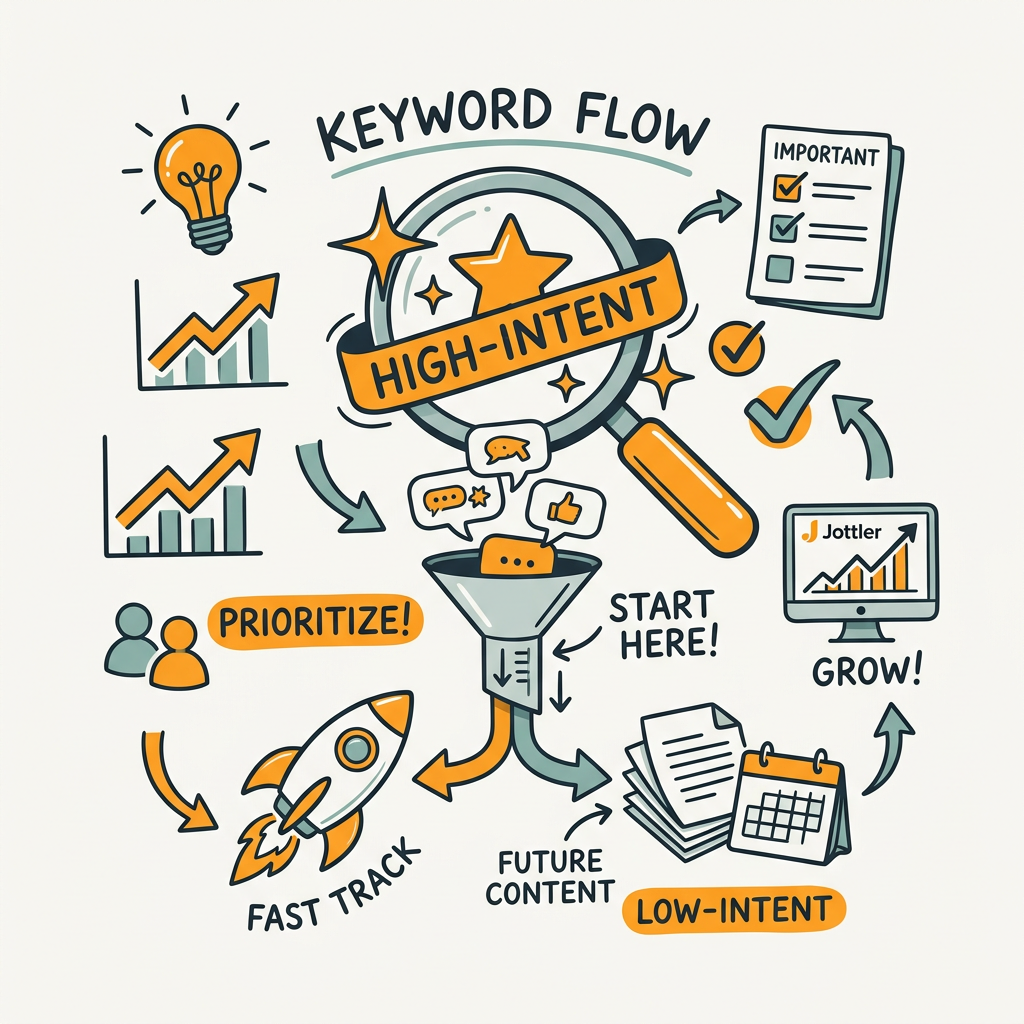
Identifying high-intent keywords is only the first half of the problem. Most teams have limited time and resources, so you can't target every high-intent keyword at once. Prioritization means applying a scoring framework that balances search volume, keyword difficulty, business value, and your team's capacity. The recommended 2026 approach combines three factors: (1) search volume and traffic opportunity, (2) keyword difficulty and ranking feasibility, and (3) business fit and conversion value. A keyword with zero search volume is pointless even if it's high-intent. A keyword with high difficulty might not be winnable in your first 90 days. But a low-volume keyword with low difficulty that maps to a high-value conversion (like a $10k annual contract) might be your fastest path to ROI.
| Scoring Factor | Intent-Driven Approach | Traditional Manual Approach | Impact on Priority |
|---|---|---|---|
| Search Volume | Automated discovery across 14+ sources; intent-first filtering to eliminate low-conversion volume | Tool estimate + manual SERP audit; labor-intensive validation | Identifies opportunity size; high-intent volume compounds faster |
| Keyword Difficulty (KD) | Real-time KD scoring with domain authority thresholds; targets KD 0–35 for faster wins | Tool-based KD; often underestimates due to domain backlink advantage | KD < 30 means ranking in 60–90 days; KD > 50 requires 6+ months for most new domains |
| Business Fit | Automated mapping of keyword intent to product/service offering; prioritizes revenue-driving keywords | Manual review; subjective assessment of revenue potential | A $2 CPL keyword beats a $0.50 CPL keyword; revenue > traffic |
| Conversion Value (Est.) | Score based on deal value and close rates from internal data; AI scores buyer-stage fit automatically | Guesswork or historical averages; rarely updated | High-value keywords get more content investment even if volume is lower |
| Content Capacity Constraint | AI agents publish 3,000+ word articles daily; removes bottleneck; scales content to volume | Manual writing limits coverage to 1–3 articles per week | Capacity unlock means you can target top 100 keywords instead of top 20 |
Building a Scoring Framework: Volume, Difficulty, and Business Value
A simple but effective 2026 framework scores each keyword on three axes, each on a 1–10 scale: Search Volume (how many monthly searches?), Keyword Difficulty (how hard to rank?), and Business Value (how much revenue if you convert?). Multiply the three scores and prioritize keywords with totals above a threshold. For example, a keyword with 500 monthly searches, KD 25, and high business value (a $5k minimum contract) scores 500 × 7 × 9 = 31,500. Compare that to a keyword with 5,000 searches, KD 60, and low business value ($200 contract value): 5000 × 3 × 3 = 45,000. The second keyword has higher raw volume, but the first delivers faster ranking wins and higher-value conversions. If your team can only publish two articles this month, the first keyword is the better bet.
For B2B and service businesses, business value often outweighs volume. A single demo request from a $100k contract keyword beats 100 generic traffic from a low-intent volume keyword. This is where sales and marketing alignment becomes critical. Your sales team must feed estimated deal value and close rates for different customer segments back to your keyword prioritization. If "CRM for nonprofits" converts to higher-value customers than "affordable CRM," prioritize it even if it has lower search volume. SEO content planning frameworks that incorporate revenue signals outperform volume-first approaches by 3–5x in ROI.
Quick-Win Keywords: Low Difficulty, High Intent, Immediate Revenue Potential
Quick wins are high-intent keywords with keyword difficulty under 30. These are the keywords your team should target first because they're winnable in 60–90 days and begin driving conversions before your harder targets even rank. Look for these characteristics in your quick-win keywords:
- 3–5 word long-tail commercial phrases (not single-word head terms)
- 100–500 monthly search volume (high-intent even at moderate volume)
- KD 0–25 (winnable within 90 days for most domains)
- Clear transactional intent modifiers (pricing, demo, trial, alternatives)
- Specific use-case or vertical focus (e.g., "for startups," "for remote teams")
- Low ad competition (fewer than 3 paid results in top 4 positions)
Examples: "affordable accounting software for startups" (long-tail, high-intent, lower volume), "project management tool pricing" (comparison intent, moderate volume), "best HR software for remote teams" (specific use-case, high-intent). These keywords are often overlooked because SEO tools flag them as "low volume," but they're gold for small teams. Ranking 20 quick-win keywords means you're capturing 2,000–10,000 monthly visitors from high-intent queries within your first 90 days. Each visitor has a higher chance of converting than a visitor from a generic head term.
Building Your Near-Term Content Roadmap with Keyword Prioritization
The practical output of prioritization is a ranked list of the top 15–25 keywords you'll target in your first 90 days. This becomes your content roadmap. Each keyword should have one dedicated piece of content—a blog post, product page, pricing page, or comparison page optimized for that specific keyword and intent. If you're targeting "CRM for small business" (commercial intent), your page should be a comparison guide, feature overview, or customer story, not a blog on "What Is a CRM?" If you're targeting "free CRM demo" (transactional intent), your page should be a demo signup form or a detailed walkthrough of your product, not a blog post about CRM benefits. Content-to-keyword mapping is the second-order critical task; mismatched content and keywords waste months of effort. Teams automating this process with SEO automation tools report 40% faster ranking wins because the AI matches content type to intent automatically.
What Tools and Workflows Help You Identify High-Intent Keywords at Scale?
Manual keyword research becomes unsustainable around 50–100 target keywords. Scaling requires tools and workflows that automate intent classification, SERP analysis, and prioritization. The modern 2026 workflow combines three layers: (1) keyword discovery and modifier expansion, (2) SERP analysis and intent validation, (3) prioritization and content roadmap generation. Most traditional keyword tools (Ahrefs, SEMrush, Moz) excel at discovery and difficulty scoring but are weak on the validation layer. You end up trusting tool intent labels, which lag behind live SERP changes. The most effective teams now use a hybrid: tools for volume and difficulty, live SERP audit for intent confirmation, and a prioritization spreadsheet or dashboard that layers business value on top.
For automation at scale, a few high-performing approaches emerge:
- Use your keyword tool to surface modifier combinations, then batch-process them through a SERP analysis step
- Pull competitor terms from their paid search campaigns or organic rankings, validate with SERP audit, then prioritize
- Export sales and support data, extract buyer language, build keyword variations, then validate
- Use a dashboard or scoring template to calculate business value and prioritize based on revenue potential
- Combine these with AI agents that handle discovery, SERP analysis, and prioritization end-to-end
The most advanced teams now combine these with AI agents that handle discovery, SERP analysis, and prioritization end-to-end. An autonomous SEO agent can research 100+ keywords daily, score them by intent and business fit, and build a ranked content roadmap—work that would take a human team weeks.
Keyword Research Tools and Their Strengths for Intent Identification
Popular tools each have different strengths. Ahrefs and SEMrush excel at volume, difficulty, and competitor keyword discovery but label intent based on broad heuristics, missing nuance. Semrush's Intent Classifier is improving but still tool-driven rather than SERP-driven. Google Keyword Planner and Google Ads search terms show real intent from paid search data. Prospeo specializes in intent-first frameworks and modifier lists, which is valuable for brainstorming but still requires manual SERP validation. For B2B, tools that connect to LinkedIn or CRM data (like Firmographic tools) help validate business fit. No single tool dominates intent identification; the strongest teams use a workflow rather than a single tool. Start with Ahrefs or SEMrush for discovery, then layer Prospeo's modifier framework for commercial keywords, then hand-validate with live SERP audit in incognito, then prioritize using your business data (deal value, close rates, customer segment). That workflow is manual but reliable. Automation platforms now compress this into single-agent workflows.
Building a Simple Spreadsheet Template for Keyword Prioritization
You don't need a complex tool if you have a template. A basic spreadsheet tracks these core columns:
- Keyword (exact search term)
- Search Volume (monthly searches)
- Keyword Difficulty (0–100 scale)
- Intent Type (Transactional/Commercial/Informational/Navigational)
- Landing Page Type Needed (Blog / Product / Pricing / Comparison / Demo)
- Business Value (deal value or CPL estimate)
- Estimated Ranking Timeline (30/60/90/180 days)
- Priority Score (calculated formula)
- Status (Not Started / In Progress / Published / Ranking)
- Current Ranking Position (updated monthly)
Use a formula to calculate Priority Score: (Search Volume/10,000) + (10 – KD) + (Business Value Score / Max Value). This gives you a simple 1–30 scale. Keywords scoring 15+ are your immediate targets. Create separate tabs for quick wins (KD 0–30) and long-term targets (KD 31–60). Update the spreadsheet monthly with ranking progress and conversion data; this feedback loop improves your scoring over time. The template itself takes an hour to build, but it becomes your single source of truth for keyword strategy, and it forces your team to discuss business fit, not just traffic opportunity.
Conclusion
Identifying high-intent keywords is the foundation of organic growth that actually generates revenue. High-intent keywords drive 2x–5x higher conversion rates than generic traffic, and they're not hard to find once you know where to look. Start with intent modifiers (buy, pricing, demo, alternatives), validate with live SERP analysis, and prioritize based on business value and ranking feasibility. Pull real buyer language from your sales calls and CRM data to accelerate discovery. Skip the low-intent informational keywords your competitors are fighting over, and focus instead on the commercial and transactional terms that indicate purchase intent. A well-prioritized list of 15–25 high-intent keywords, published consistently, compounds into substantial organic traffic within 90 days. The most successful teams aren't the ones with the biggest keyword lists; they're the ones that ruthlessly focus on intent alignment and business fit, then scale content to cover their prioritized keywords consistently.
Building and maintaining a high-intent keyword strategy at scale requires publishing velocity. If you're manually researching, validating, and writing one article per week, you'll never cover your top 50 keywords. That's where automated SEO platforms like Jottler accelerate results. Jottler's AI agents handle keyword research across 14+ sources, validate intent via SERP analysis, score by business fit, and publish research-backed articles daily—removing the bottleneck that keeps most teams from scaling intent-focused content. Instead of managing spreadsheets and publishing constraints, you focus on strategy and business alignment. Your organic traffic doesn't plateau because you finally have the capacity to target all your high-intent keywords consistently. That's how modern SEO compounds.
FAQs
What are the best modifiers for identifying high-intent keywords?
The strongest intent modifiers cluster into five categories: purchase modifiers (buy, order, purchase, discount, coupon), pricing modifiers (pricing, cost, price, how much, quote), evaluation modifiers (demo, trial, free trial, review, alternatives, vs, comparison), location modifiers (near me, in [city]), and urgency/action modifiers (hire, book, request, signup). The most reliable single set is: buy, pricing, demo, near me, best, vs, review, cost, quote, and alternatives. These modifiers work across most industries and consistently signal buyer-ready intent. When you add one of these modifiers to a core product keyword, you shift the intent from exploratory to transactional.
How can I tell if a keyword is high-intent just by looking at the SERP?
Search the keyword in incognito mode and examine what Google ranks in the top 10. If the results are product pages, pricing pages, demo pages, shopping carousels, or local business listings, the keyword is high-intent. If the results are blog posts, educational articles, or Wikipedia pages, the keyword is informational and lower-intent. Also note SERP features: product carousels and local packs indicate strong commercial intent; AI Overviews usually indicate informational queries. Spend 10 minutes doing this audit for every keyword before you commit content resources to it.
Should I focus on high-volume or high-intent keywords first?
Start with high-intent, low-difficulty keywords first. A 500-search-volume keyword with KD 20 and high-intent (transactional) will drive conversions faster and rank quicker than a 10,000-search-volume keyword with KD 60 and informational intent. Your goal is revenue and compounding growth, not traffic vanity metrics. Rank 20 high-intent, low-difficulty keywords in 90 days and you'll have a revenue-generating funnel. Chase high-volume keywords without intent alignment and you'll spend six months ranking for keywords that barely convert.