How to Optimize AI-Generated Content for Rankings
Google doesn't penalize AI-generated content—but search engines demand quality. According to recent data, 17.31% of top search results contain AI-generated content, yet pure AI content ranks in the top 10 in only 28% of test cases, compared to 58% for human-written content. The difference isn't the tool; it's the execution. AI can draft at scale, but optimization for rankings requires strategic refinement, authority signals, and proper structure.
Key Takeaways
- AI content appears in 17.31% of top search results, but pure AI ranks top-10 in only 28% of cases versus 58% for human content (2025, Originality.ai)
- Hybrid content (AI draft + human oversight) ranks significantly higher than pure AI output and maintains long-term stability
- First-answer positioning is critical—content answering questions in the first 100-200 words sees 3.2x higher AI citation rates
- Hybrid Workflow: Use AI for drafting and structure, then apply human judgment to editing, fact-checking, and E-E-A-T signals for measurable ranking gains.
- Direct-Answer Principle: Place your complete answer in the first 100-200 words to maximize extraction rates by Google's generative AI systems.
- Modular Content Structure: Treat each H2/H3 as a self-contained answer unit to improve AI citation likelihood and user scannability.
- E-E-A-T Foundation: Author credentials, primary source citations, and original data are no longer optional—they're ranking gates for AI visibility.
- Semantic HTML & Schema: Use proper heading tags, lists, and schema markup (FAQPage, HowTo, Article) to signal content structure to search algorithms.
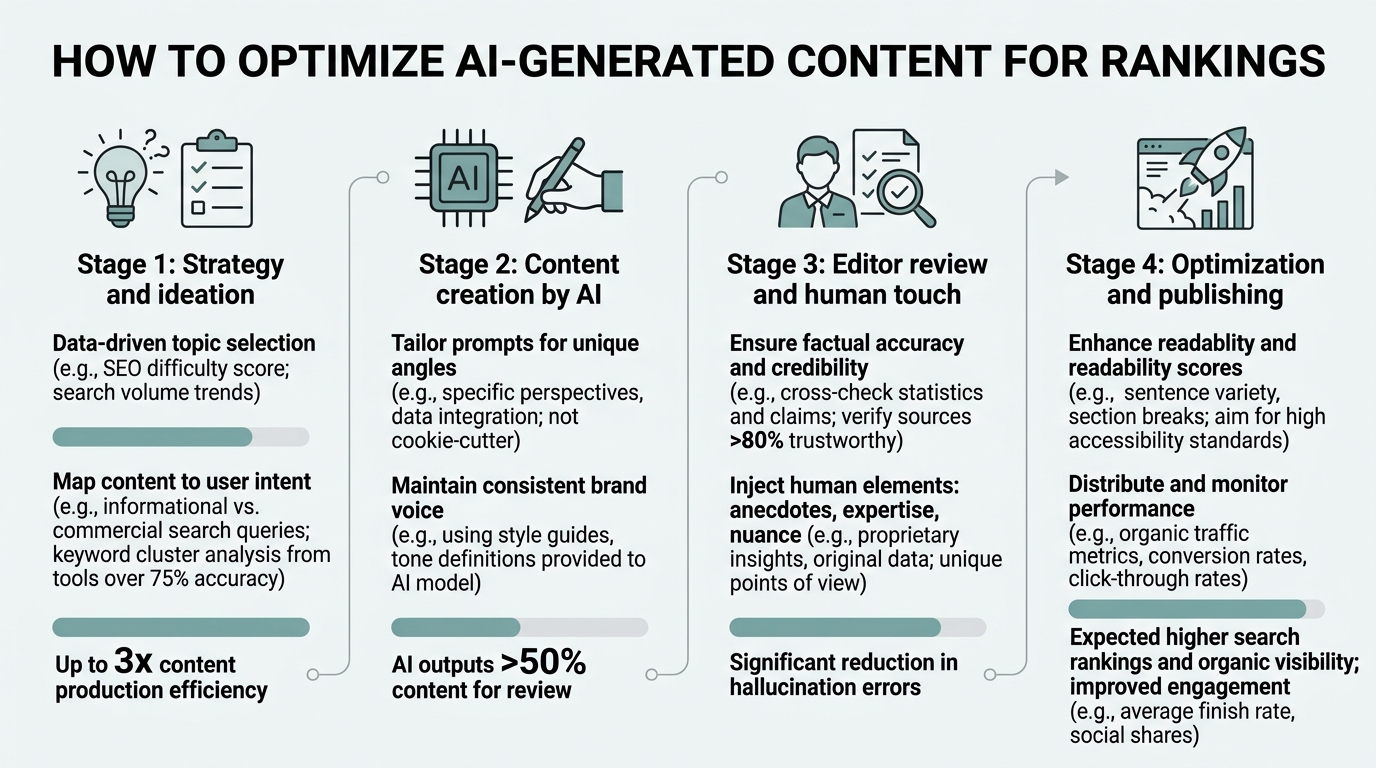
Why AI Content Alone Underperforms in Rankings
The core issue with pure AI-generated content is not detection—Google doesn't penalize AI text—but consistency and authority. AI-assisted pages showed a 15% drop in average ranking positions over the past year unless they received high-quality human editing. The problem lies in three areas: lack of original insight, missing credibility signals, and structural issues that search algorithms interpret as low-quality content.
"When you publish raw AI output without oversight, search engines see shallow research, recycled phrasing, missing citations, and no author authority. Sites publishing mass volumes of unedited AI content typically collapse within months due to algorithmic penalties."
When you publish raw AI output without oversight, search engines see shallow research, recycled phrasing, missing citations, and no author authority. Sites publishing mass volumes of unedited AI content typically collapse within months due to algorithmic penalties. Tools can generate speed, but rankings require trust.
The Credibility Gap in Unedited AI Content
Google's E-E-A-T framework (Experience, Expertise, Authoritativeness, Trustworthiness) is the primary ranking gate for AI content. 82% of AI-cited pages include author bios with credentials and links to primary sources. Pure AI content rarely contains this. It lacks the author's voice, credentials, and personal experience that signal expertise to both humans and algorithms.
"Fact-checking is not optional—it's essential. When AI content contains errors or unsourced claims, Google's quality raters flag it, and your domain authority suffers long-term."
Additionally, AI often generates plausible-sounding claims without verification. Fact-checking is not optional—it's essential. When AI content contains errors or unsourced claims, Google's quality raters flag it, and your domain authority suffers long-term. The fix is straightforward: add author context and verify every statistic.
Structural Limitations: Why AI Defaults Don't Optimize for AI Search
Most AI writing tools generate long, narrative-style paragraphs optimized for readability. But modern AI overviews and generative search prioritize modular, atomic content structures that can be extracted as standalone answers. Content with 2000+ words and an interactive table of contents ranks 40% higher in AI-driven search than unstructured narrative.
When AI generates a standard blog post, it produces flowing prose. Search algorithms now extract specific H2/H3 sections as answer units. If your structure is loose, Google's AI can't isolate your answer cleanly, and your content gets skipped for competitors with better formatting.
How to Build a Hybrid Workflow That Drives Rankings
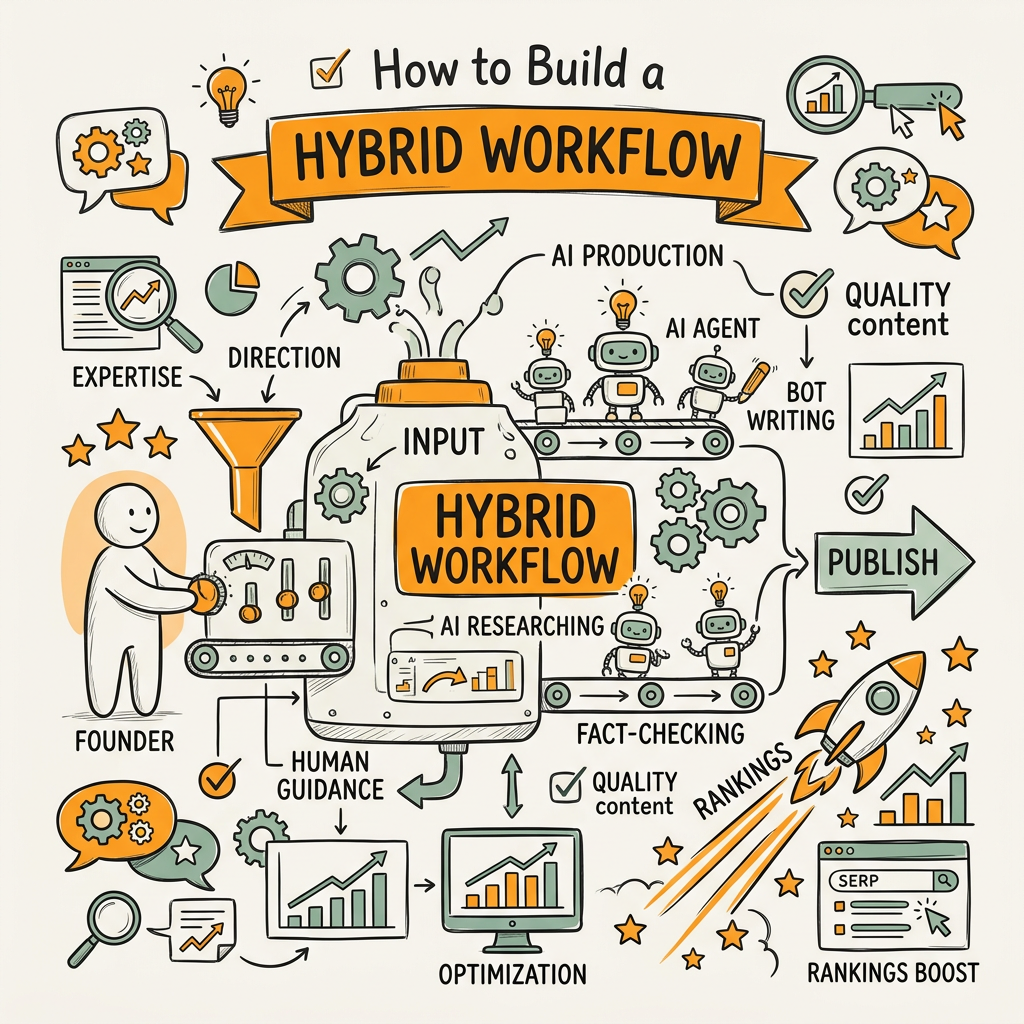
The highest-performing content combines AI's speed with human judgment. Hybrid content (AI draft + human oversight) consistently ranks higher than pure human content and maintains stability longer. This workflow isn't about writing less—it's about allocating effort strategically so you produce more at higher quality.
Step 1: Generate AI Drafts with Clear Brief Instructions
Start with a structured brief. Don't ask AI to "write a blog post about AI content optimization." Instead, specify: target audience, primary keyword, desired answer-first structure, required statistics, and H2 outline. The more precise your prompt, the less editing you'll do later.
Use AI to handle:
- Research synthesis: Pull together data from multiple studies into a coherent narrative
- Outline generation: Create logical H2/H3 structures mirroring real search queries
- First-draft writing: Generate prose that's 70-80% publication-ready
- Keyword optimization: Ensure primary and semantic keywords appear naturally in headings and body
What AI shouldn't do alone: fact-check claims, add author bios, select citations, or finalize structure. Those are human roles.
Step 2: Fact-Check and Add Authority Signals
Every statistic in the draft must be verified against primary sources. If AI cited a number without attribution, trace it or remove it. Add direct links to the original studies or data sources—Google tracks this. Pages with citations to peer-reviewed studies, analyst reports, and first-party research rank higher in AI overviews.
Add author credentials immediately below or within the article. Include:
- Author bio with credentials: Name, title, years of experience, LinkedIn link
- Timestamp: "First published [date]. Last updated [current date]."
- Primary sources: Link to at least 3 original studies or reports cited in the article
- Original data or screenshots: Case studies, tool comparisons, or process illustrations that aren't available elsewhere
Step 3: Restructure for Direct-Answer Extraction
AI typically buries answers in the middle of sections. Restructure each H2 and H3 so the first paragraph answers the heading's question directly. Content with a clear answer in the first 100-200 words sees a 3.2x higher citation rate in AI overviews. This is the single highest-leverage optimization.
The formula:
- First 50-60 words: Direct answer to the H2/H3 title + 1 key statistic
- Next 100-150 words: Evidence, explanation, or context for that answer
- Remaining words: Examples, deeper dives, or related subtopics
Jottler automates this answer-first principle across all generated content, ensuring every section opens with the insight readers and search algorithms need first. This structure compounds—each H2 becomes citation-ready.
Step 4: Optimize Semantic HTML and Add Schema Markup
Use semantic HTML tags properly: <h2> for major sections, <h3> for subsections, <ul> for non-sequential lists, <ol> for steps, <strong> for key phrases, and <table> for comparisons. Google's algorithms parse structure, and clear HTML signals boost rankings.
Add schema markup for your content type:
- FAQPage schema: For content with multiple Q&As
- HowTo schema: For step-by-step guides
- Article schema: For long-form content with author and published date
Pages using FAQPage, HowTo, or Article schema are 2.5x more likely to be extracted for AI summaries. This is a low-effort, high-impact signal.
Structural Optimization: Building Content AI Systems Extract
Modern search engines don't extract pages as wholes; they pull specific passages that answer user questions. Your structure determines whether Google's AI can isolate your answers cleanly.
Atomic Content Sections: Each H3 Is a Citation Unit
Think of each H2 and H3 as a potential answer that could be lifted and cited by Google's generative AI. Each section must be self-contained, answering one specific question without requiring context from other sections. If a reader lands on your H3 via an AI overview, they should understand the full answer immediately.
This means:
- No forward references to later sections ("We'll cover this in detail below")
- Each H3 includes its own example or evidence
- Subheadings mirror real search queries users would type
- 150-180 words per H3 section maintains dense, scannable content
Question-Based Headings: Mirror Search Intent
H2 and H3 titles should mirror actual search queries. Use Google Search Console and keyword research to identify how users phrase questions about your topic. Content with H2s structured as questions (e.g., "How do I optimize AI content for Google?") ranks higher in People Also Ask and AI extraction.
Compare these headings:
- Weak: "Optimization Strategies" (generic, not query-like)
- Strong: "How do I optimize AI-generated content for Google rankings?" (matches real search behavior)
Question-based headings signal intent alignment to search algorithms and improve your chances of appearing in featured snippets and AI overviews.
Table of Contents and Internal Linking Architecture
Include a clickable table of contents at the top of long-form content. Articles with 2000+ words and an interactive TOC rank 40% higher in AI-driven search. The TOC serves two purposes: it improves user experience, and it signals content structure to search algorithms.
Include 3-5 internal links per 1,500 words, pointing to related articles on your domain. Internal linking compounds keyword authority across your site and keeps readers engaged longer, which signals quality to Google.
E-E-A-T: The Non-Negotiable Authority Framework
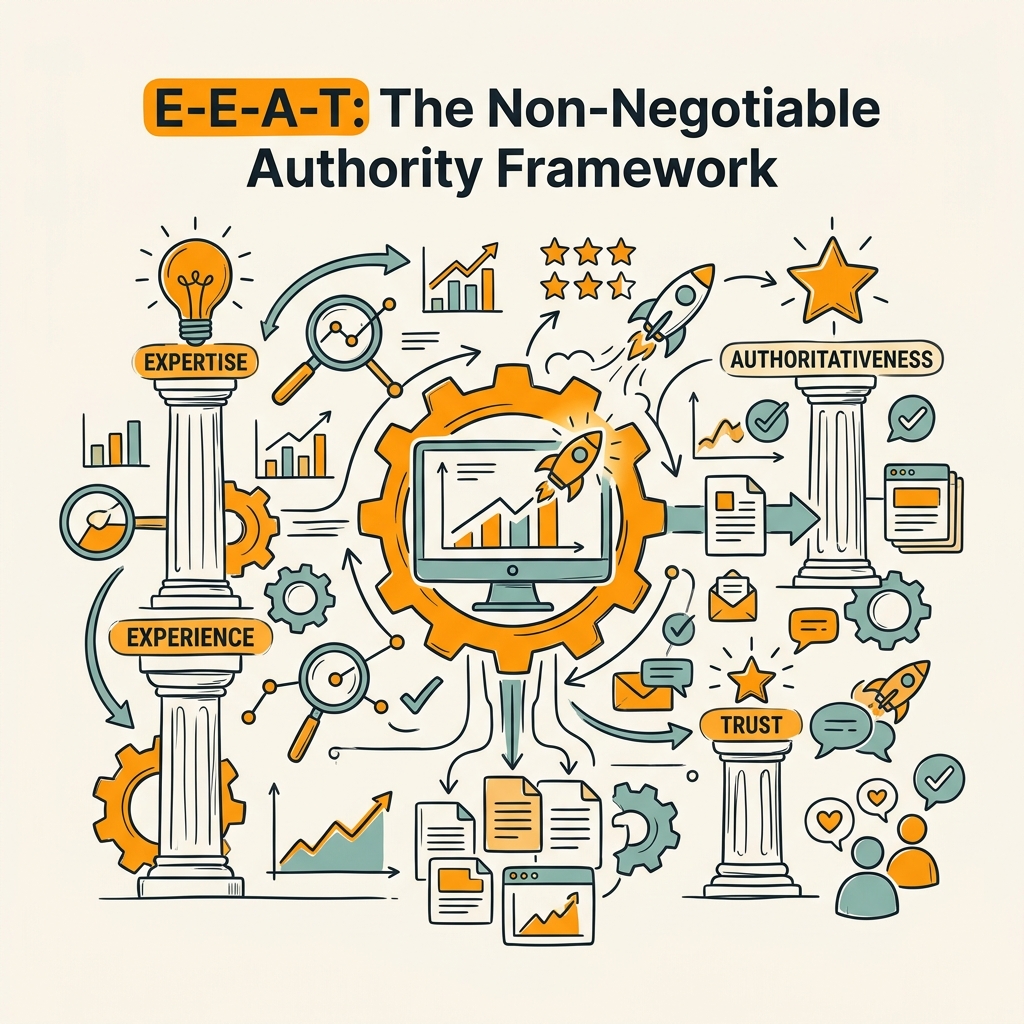
E-E-A-T is no longer a secondary ranking factor—it's a primary filtering mechanism. Google's systems assess whether content comes from an authoritative source before even evaluating its quality. For AI content, E-E-A-T signals are doubly important because AI lacks inherent credibility.
Author Credentials and Byline Transparency
Publish author information prominently. Include name, title, years of experience, and a link to their LinkedIn or company bio. 82% of AI-cited pages in Google's generative AI overviews include author bios with credentials. This isn't optional—it's an expectation.
If your content is AI-generated, be transparent about the process: "Written with AI assistance" or "AI-researched and human-edited." This honesty builds trust. Hiding AI generation damages credibility if discovered.
Primary Source Citations: Link Early and Often
Every statistic and study referenced must link to its original source. When you cite "17.31% of top search results contain AI-generated content," link directly to Originality.ai's analysis. Google tracks outbound links to authoritative sources and interprets them as signals of research rigor.
Include at least 3-5 external links to primary research, studies, or tool pages. Don't link to thin aggregator pages; link to the original source.
Original Data, Case Studies, and Proprietary Research
If possible, create original insights. Run experiments, compile proprietary data, interview experts, or conduct surveys. Include screenshots, charts, or anonymized case studies. Original content has higher E-E-A-T weight because it can't be replicated by competitors generating the same generic AI drafts.
This differentiates you: competitors' AI can generate similar words, but they can't replicate your original research or unique case studies.
Optimization for AI Overviews and Generative Search
Google's AI Overviews (formerly SGE) now appear in 10-20% of search queries in the United States. These overviews pull snippets from top-ranking pages and synthesize them into a single answer. Getting cited is a new form of visibility, with its own ranking factors.
Direct Answer Placement: The First 200 Words Rule
Google's generative AI prioritizes the first 100-200 words of a page when extracting answers. If your answer is buried in paragraph 5, it won't be cited. Restructure every article so the opening paragraph directly answers the main question in 40-60 words, then expands with evidence.
Example structure:
- First 60 words: "AI-generated content can rank if it's optimized for quality, authority, and structure. Pure AI text ranks in the top 10 only 28% of the time, but hybrid content (AI draft + human editing) ranks in 58% of cases."
- Next 150 words: Explain why this is the case, with supporting data.
- Remaining words: Deep dives, examples, and related subtopics.
This answer-first principle is the difference between being cited in AI overviews and being ignored entirely.
Freshness and Update Signals
AI-cited pages are updated quarterly, on average, with new data and visible timestamps. Add a "Last updated: [Month Year]" line to every article. Refresh content with new statistics, case studies, or insights at least quarterly. Google's algorithms track update frequency as a freshness signal.
For AI content, freshness is critical because it combats the perception that AI-generated content is stale or recycled. Regular updates signal active maintenance and authoritative oversight.
Site Speed and Technical SEO
Content with First Contentful Paint (FCP) under 0.4 seconds receives 3x more citations in AI overviews. Optimize images, enable lazy loading, minimize CSS/JavaScript, and use a CDN. Technical SEO isn't just for rankings—it's a signal for AI extraction.
Avoiding Common Optimization Mistakes
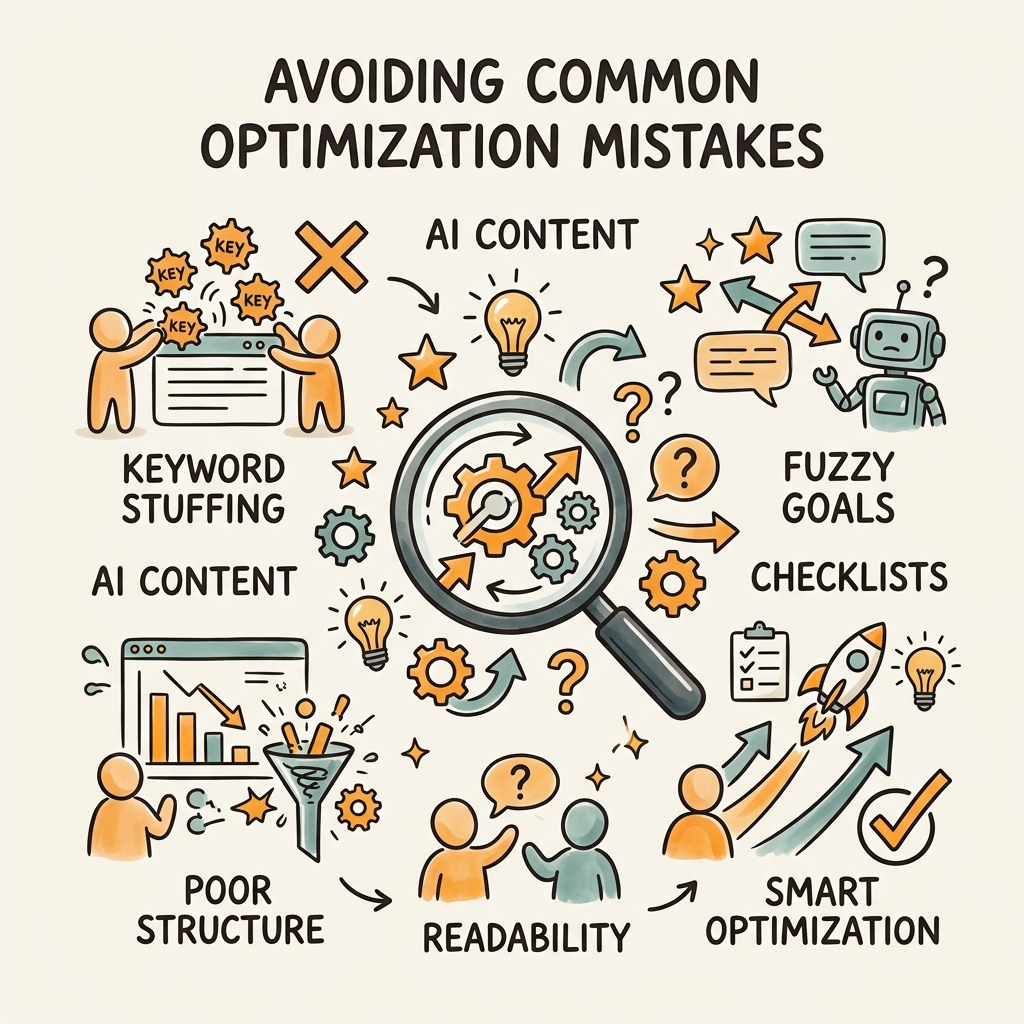
AI content fails for predictable reasons. Avoiding these mistakes immediately improves ranking potential.
Mistake 1: Publishing Unedited AI Drafts at Scale
Mass-producing unedited AI content looks obvious to Google's algorithms. These sites rank briefly, then plummet. The temptation to publish 10 articles weekly is strong, but publishing 2-3 high-quality hybrid articles ranks better long-term. Depth and authority compound; volume without quality collapses.
Mistake 2: Burying the Answer in Narrative Prose
AI loves long, flowing paragraphs. Search algorithms now punish this. Short paragraphs (2-3 sentences), bullet points, and modular structure are not optional—they're expected. If your content is hard to scan, it's hard for AI to extract, and humans won't engage.
Mistake 3: Skipping Fact-Checking and Attribution
AI generates confident-sounding false claims. Every statistic must be verified. If you can't link to the original source, remove the claim. Google's quality raters catch fabricated research, and penalties are severe.
Mistake 4: Ignoring Internal Linking and Topical Authority
AI content succeeds within a broader topical ecosystem. Link your articles together strategically. If you publish one article on "AI content optimization," link it to related articles on "E-E-A-T signals," "SEO structure," and "content audits." This builds topical authority and keeps readers engaged.
Tools and Workflows for Scaling AI Optimization
Optimizing AI content manually works at small scale. At larger volumes, you need systems to enforce standards: fact-checking workflows, structured authoring templates, and automated optimization checks.
Research and Drafting at Scale
Start with a tool that automates keyword research, competitor analysis, and multi-source research. Jottler automates deep research from 14+ sources, generates optimized drafts with answer-first structure, and fact-checks claims automatically. This removes the slowest part of the hybrid workflow: research and initial drafting.
The result is a fact-checked, structured first draft you can edit in 10-15 minutes rather than building from scratch.
Structured Editing for Consistency
Use templates and checklists to enforce E-E-A-T signals, internal linking, and semantic HTML across all content. Tools that integrate with your CMS (WordPress, Webflow, etc.) ensure consistency without manual overhead.
Automated Optimization Audits
Run regular audits of published content using SEO tools (Semrush, Ahrefs, SEranking) to identify: missing internal links, slow pages, poor readability scores, or outdated statistics. Refresh underperforming content quarterly with new data and updated structures.
Real-World Results: How Hybrid Optimization Compounds
Teams implementing hybrid AI workflows report measurable improvements. One SaaS company published 3 AI-assisted articles per week with human oversight: fact-checking, E-E-A-T signals, and internal linking. Within 6 months, organic traffic increased by 37% and AI overview citations grew from 2 to 12 per week.
The pattern: initial effort front-loaded for quality + consistent publishing + quarterly refreshes = compounding organic growth. Tools that automate research and drafting accelerate this cycle by removing the bottleneck of research and initial drafting, letting teams focus on editing, authority-building, and publishing.
| Content Type | Top 10 Ranking Rate | Setup Effort | Long-Term Stability | AI Citation Rate |
|---|---|---|---|---|
| Pure AI (No editing) | 28% | Low (hours) | Low (collapses in months) | Low (no E-E-A-T) |
| Hybrid AI (AI draft + editing) | 58%+ | Medium (days per article) | High (stable, grows over time) | High (with proper structure) |
| Pure Human (No AI) | 58% | High (weeks per article) | High (stable) | Moderate (varies by author authority) |
Conclusion
Optimizing AI-generated content for rankings is not about hiding the fact that it's AI—it's about treating AI as a drafting tool, not a publishing shortcut. Hybrid content (AI + human oversight) ranks in the top 10 58% of the time, compared to 28% for pure AI. The winning formula combines AI's speed with human judgment on authority, structure, and fact-checking.
The three critical moves are: (1) Structure every article with the answer in the first 200 words so it can be extracted by AI overviews; (2) Layer in E-E-A-T signals (author credentials, primary source citations, original data) that build trust; (3) Refresh content quarterly to maintain freshness and signal active maintenance.
Teams publishing 2-3 optimized hybrid articles weekly see measurable ranking growth within 6 months. The difference between success and failure isn't the tool—it's the system. If you're publishing AI content without oversight, restructuring it for direct-answer extraction, or adding authority signals, you're leaving rankings on the table.
FAQs
Does Google penalize AI-generated content?
No, Google does not automatically penalize AI-generated content. The search engine evaluates content based on quality, relevance, and authority regardless of whether it was written by a human or AI. However, low-quality, unedited AI content ranks poorly because it lacks E-E-A-T signals and structured answers, not because of its origin. Pure AI output ranks in the top 10 only 28% of the time, while hybrid content (AI + human oversight) ranks 58% of the time. The tool doesn't determine the outcome—the quality of the final published content does.
How can I make AI content rank faster?
Place your complete answer in the first 100-200 words of each article and H2/H3 section. Content answering questions directly in the opening sees 3.2x higher citation rates in AI overviews, which speeds initial visibility. Add semantic HTML (proper heading tags, lists, schema markup), author credentials, and citations to primary sources. Internal link your articles together to build topical authority. AI-assisted content that follows this structure appears in search results in two months or less, significantly faster than traditional long-form timelines.
What's the best workflow for optimizing AI content?
The hybrid workflow combines AI drafting with human oversight. Generate AI drafts using detailed briefs, then: (1) fact-check every statistic and add primary source links; (2) add author credentials and E-E-A-T signals; (3) restructure for direct answers in the first 200 words; (4) add semantic HTML and schema markup; (5) refresh quarterly with new data. This workflow delivers top-10 rankings in 58% of cases compared to 28% for unedited AI output. Automating research and initial drafting with tools reduces editing time per article to 15-20 minutes, making scaling sustainable.