How to Use AI Writing Tool Tone and Voice Features
Tone inconsistency ruins credibility. When AI writes generic, flat content without your brand's personality, readers notice. That's why 88% of marketers say tone and voice features are critical for maintaining brand alignment—yet most teams don't know how to properly configure them. The good news: modern AI tools now offer dedicated tone training and voice customization that can match your writing style in seconds. Here's how to set it up and get consistent results every time.
Key Takeaways
- 88% of marketers rely on AI tone features to maintain voice consistency (2024, Stealth Agents)
- Pre-set single-word tone descriptors (like "witty" or "serious") outperform compound phrases in accuracy
- Brand voice training via URL scanning or text upload takes seconds and automates tone across all future content
- What Tone and Voice Mean in AI Writing: The emotional character and brand personality embedded in generated text that shapes how readers perceive your message.
- Pre-Set vs. Custom Tones: Select from built-in options like "excited" and "formal," or train custom voices by uploading writing samples.
- Brand Voice Training: Import URLs, text, or files to teach AI your specific writing style, then apply it as a default across all documents.
- Jasper vs. ChatGPT Approaches: Jasper uses a dedicated Brand Voice dashboard; ChatGPT relies on system instructions and custom GPT configuration.
- Tone Refinement Workflow: Integrate tone review alongside fact-checking and SEO optimization for consistent brand alignment.
What Is Tone and Voice in AI Writing?
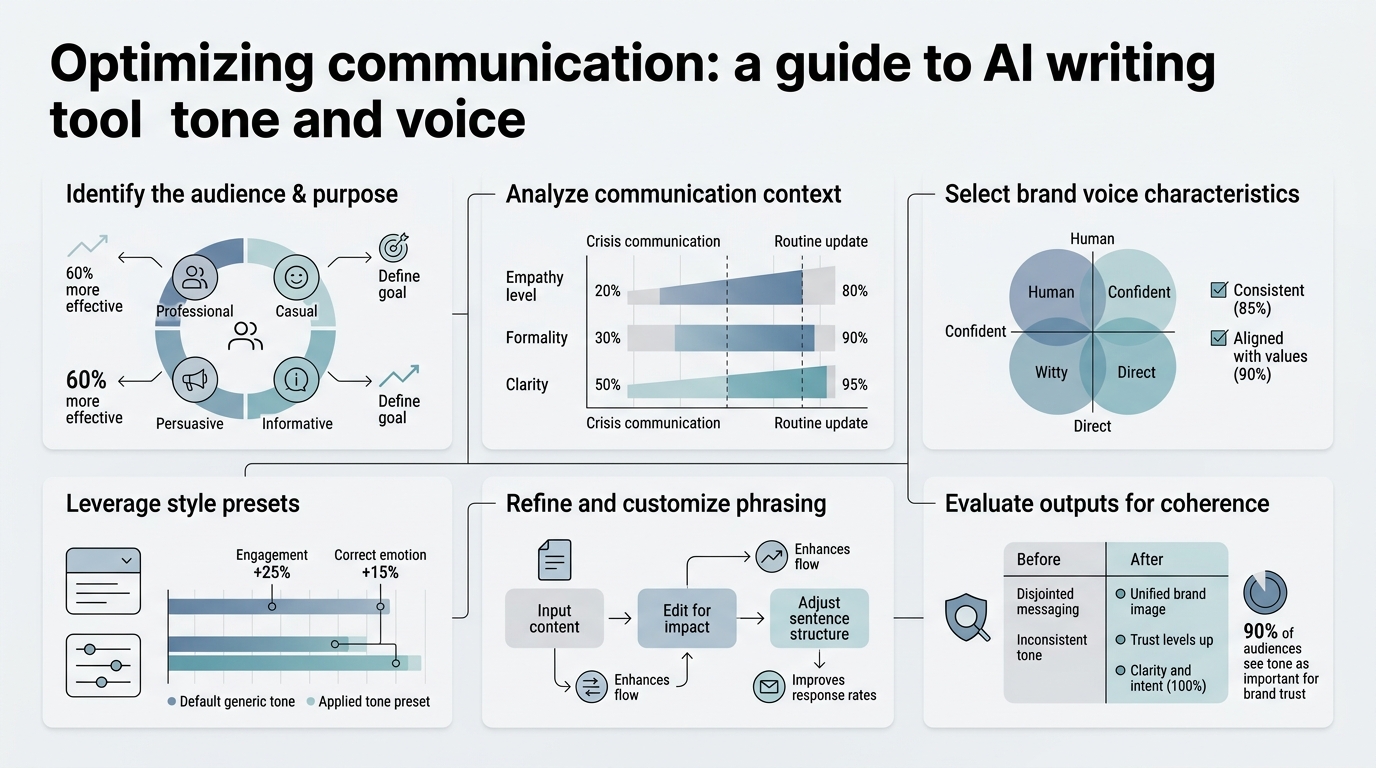
Tone and voice in AI writing refers to the emotional character and personality embedded in generated text. It's not just grammar or vocabulary—it's the attitude your words convey. A financial advisory firm's tone is authoritative and measured. A fitness brand's tone is energetic and motivational. AI tools without tone control produce content that sounds generic and robotic, regardless of how accurate it is.
"Generic AI content erodes reader trust faster than you can publish. The solution is defining your brand voice upfront, then letting AI respect those parameters from the first draft."
65% of users still manually review AI content for tone and nuance, which means relying solely on the tool's default output creates rework and delays. The solution is to define and train your brand voice upfront, then let AI respect those parameters from the first draft.
Why Tone Matters for Brand Authority
Inconsistent tone erodes trust. When your email reads differently from your blog post, readers sense a lack of cohesion. Reader trust increases by 38% when AI-generated content undergoes structured tone refinement before publication. That's not just a nice-to-have—it's a competitive advantage.
For teams scaling content, manual tone adjustments become unsustainable. You publish one piece today, another tomorrow, and suddenly your voice drifts across channels. Tone control features ensure every document maintains your brand DNA automatically.
Tone vs. Voice: The Core Distinction
Tone is the mood or attitude in a single piece (serious, witty, supportive). Voice is your brand's overall personality across all content. A tool with tone control lets you adjust individual pieces. A tool with voice training lets you enforce your personality across the entire output stream.
The strongest AI writing platforms offer both: pre-set tones for one-off adjustments, and custom brand voice for long-term consistency.
How to Use Pre-Set Tone Features in AI Writing Tools
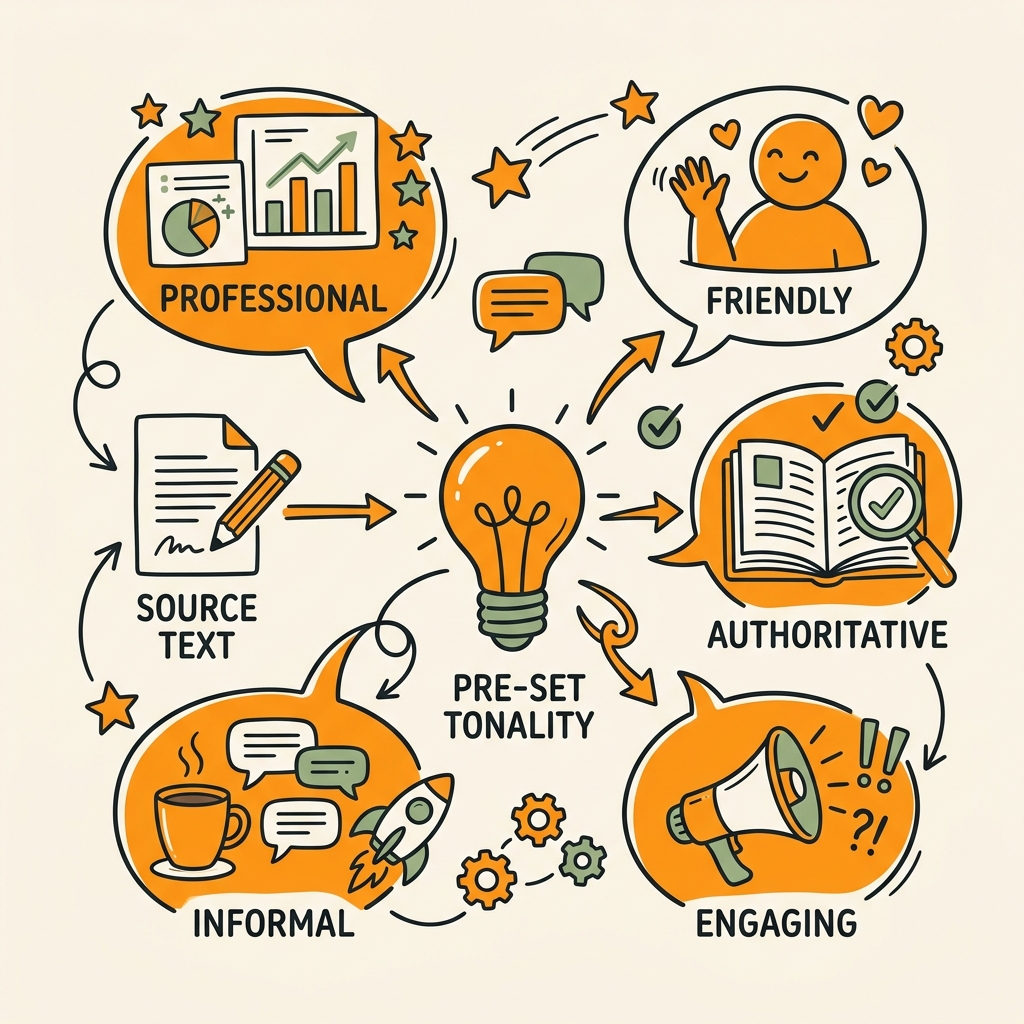
Most AI writing tools ship with tone controls built into their templates or document editor. Using them correctly is simple—but the details matter. Single-word descriptors work best; compound phrases confuse the model and reduce accuracy.
Understanding Pre-Set Tone Options
Tools like Jasper provide dropdowns or input fields where you specify tone before generating content. Examples include: "serious," "excited," "witty," "dramatic," "casual," "formal," "supportive," "sarcastic." The best practice is to use single-word descriptors rather than complex phrases like "funny and sarcastic."
"When you input 'funny,' the AI interprets that clearly. When you input 'funny and sarcastic and a bit irreverent,' the model struggles to weight each attribute equally, often defaulting to its most common interpretation."
Stick to one dominant tone per piece.
Selecting the Right Tone for Your Content Type
Different content types demand different tones. A product comparison needs "analytical" or "informative." A testimonial needs "authentic" or "enthusiastic." An internal memo needs "direct" or "formal."
Create a simple reference document mapping content types to preferred tones:
- Blog posts: "conversational" or "engaging"
- Email campaigns: "persuasive" or "friendly"
- LinkedIn articles: "professional" or "insightful"
- Product descriptions: "compelling" or "descriptive"
- Support docs: "helpful" or "clear"
This mapping ensures your team uses tones consistently and doesn't waste time guessing. Over time, these choices compound into a recognizable brand voice.
How to Train and Apply Custom Brand Voice Profiles
Pre-set tones work for isolated pieces, but teams that scale content rely on custom brand voice training. This is where AI tools truly shine. You upload your best writing samples, the tool analyzes your style, and then it reproduces that voice in every new document.
The Brand Voice Training Workflow (Jasper AI Example)
Jasper's Brand Voice feature exemplifies this approach. Here's the exact process: First, navigate to the Brand Voice section in your dashboard and click "Add voice." You'll see three import options: "From URL" (scan your website), "From text" (paste copy), or "Upload a file" (PDF, Word, etc.).
Choose the URL option if you have published articles or web copy that already reflect your voice. Jasper analyzes the content in seconds and extracts patterns about sentence length, vocabulary, tone, and formatting. Name the voice (e.g., "Company Blog Voice") and save it.
Once saved, that voice appears in a dropdown menu when creating new documents. Select it before generating content, and the AI applies your training profile to every piece. For maximum automation, set the voice as your workspace default in Settings > AI Settings. Now all new documents automatically use your brand voice without manual selection.
Building a Multi-Voice Framework for Complex Brands
Larger organizations often need multiple brand voices. An enterprise might have one voice for customer-facing marketing, another for internal communications, and a third for technical documentation. Modern tools allow unlimited custom voices.
Best practice: create a governance document listing approved voices and their use cases. Tag each voice clearly (e.g., "Marketing," "Support," "Engineering") so team members select the right profile without confusion. Jasper's tone of voice guide recommends appointing "tone guardians"—team members who review content and ensure it aligns with guidelines—to enforce consistency at every stage.
Training on the Right Source Material
The quality of your voice training depends entirely on the source material you upload. Import your recent, high-quality articles—not your oldest or weakest content. If you train on outdated material, the AI learns outdated voice patterns.
For URL-based training, point the tool to your blog's best-performing articles or your company website's most polished pages. Avoid importing content from different teams or external sources that don't match your actual brand voice. The more representative the training data, the more accurate the voice profile.
Tone and Voice Configuration in ChatGPT and Claude
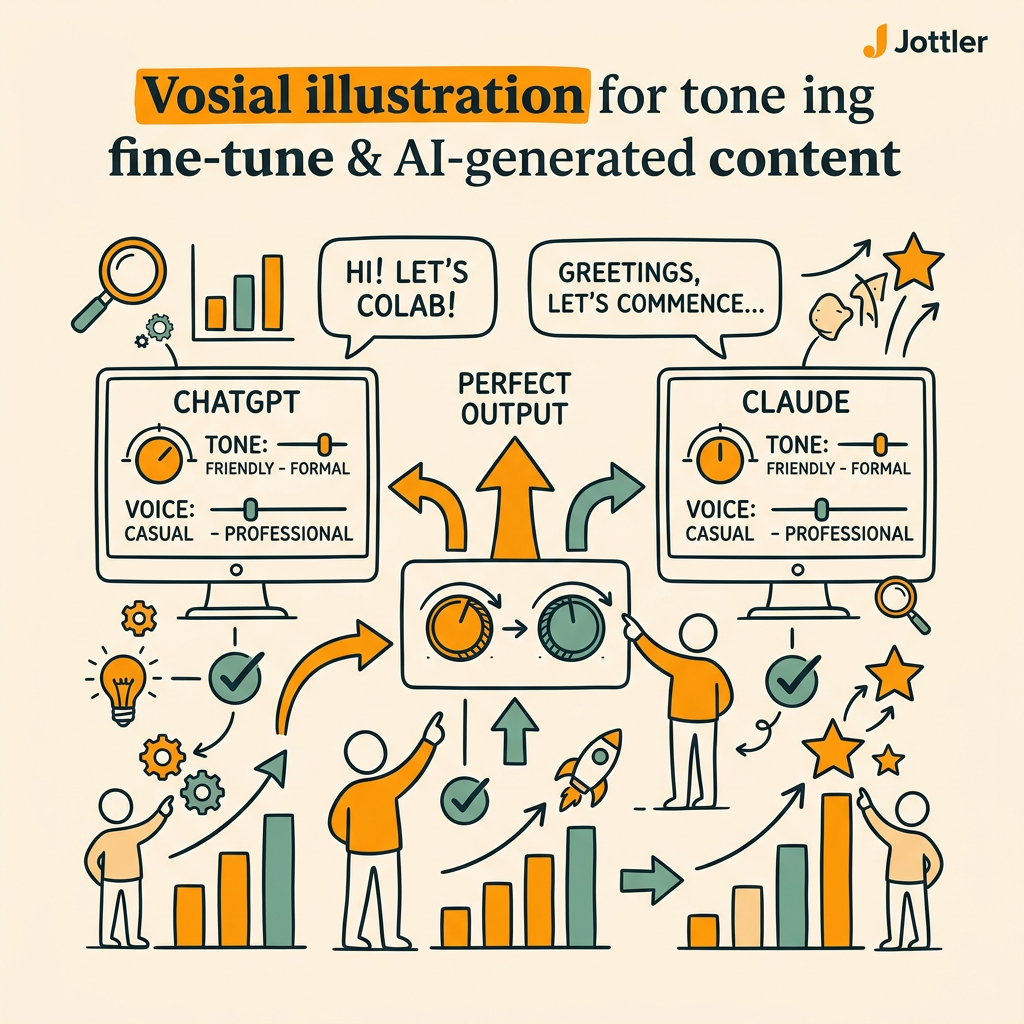
ChatGPT and Claude don't have dedicated Brand Voice dashboards like Jasper. Instead, they rely on prompt engineering and custom GPT configuration. This approach is more flexible but requires more manual setup.
Using System Instructions to Define Tone in ChatGPT
In ChatGPT, define tone explicitly in your system message or initial prompt. Example: "Write this blog post in a witty and conversational tone, avoiding jargon and technical complexity." The AI follows these instructions more accurately than generic requests.
For repeating needs, create a Custom GPT where you configure the system instructions permanently. In the GPT builder, set the "Instructions" field with your tone guidelines, brand personality, and any writing rules. Now every conversation with that Custom GPT automatically applies your tone preferences.
This approach is powerful because it's infinitely flexible—you can instruct ChatGPT to adopt any persona or tone combination. The downside is that it requires more upfront work and carries higher risk of inconsistency if team members use different prompts.
Comparing Prompt Engineering vs. Brand Voice Training
Prompt engineering (ChatGPT's approach) gives you precision but demands discipline. You control every nuance, but consistency depends on remembering to include tone instructions every time. Brand voice training (Jasper's approach) sacrifices some flexibility for consistency—you train once, then apply everywhere.
For solo writers who adjust tone frequently, ChatGPT's prompt-based approach may work. For teams publishing dozens of articles daily, Jasper's automated voice training compounds consistency without extra work. Jasper's May 2026 review notes that its Brand Voice tool lets users "scan your website to understand your brand's tone of voice" in seconds—a capability ChatGPT doesn't offer.
Integrating Tone Control Into Your Editorial Workflow
Tone features only matter if they're embedded into your actual publishing process. Teams that win treat tone review as seriously as fact-checking and SEO optimization.
Adding Tone Review as a Workflow Step
After the AI generates a draft, don't skip straight to publishing. Insert a tone review checkpoint where a designated team member reads the piece and asks: "Does this sound like us?" If the answer is no, request a regeneration with a different tone setting or refine the training profile.
This step takes minutes but prevents tone drift that erodes brand credibility over weeks. For teams using content automation tools like autonomous SEO agents, tone consistency is baked into the system—the agent maintains your voice across all generated content without manual intervention.
Creating a Tone and Context Guide
Document how your tone flexes across contexts. Good news requires an "optimistic" tone; service issues require a "helpful" tone. LinkedIn content needs "insightful"; email subject lines need "curiosity-driven." This framework prevents confusion and ensures the team applies tones contextually rather than arbitrarily.
- Prospect-facing content: Tone = educational, confident
- Customer support: Tone = empathetic, solution-focused
- Internal communications: Tone = direct, clear
- Thought leadership: Tone = authoritative, insightful
This guide becomes your north star for consistency. New team members use it to understand expectations without asking "which tone should I pick?"
Common Mistakes and How to Fix Them
Even with best practices, teams stumble. Here are the most common tone-related mistakes and how to correct them.
Mistake: Using Compound Tone Descriptors
Instructing AI to write in a "funny, sarcastic, and irreverent" tone almost always backfires. The model struggles to balance three competing tones and defaults to a muddled middle ground that isn't actually funny or sarcastic or irreverent—just confusing.
Fix: Stick to one primary tone per piece. If multiple tones matter, generate the piece once, then use the tool's "Change tone" feature to refine. Jasper and other modern tools include built-in tone refinement buttons in the editor that let you regenerate sections with a different tone—a much more effective approach than trying to embed complexity upfront.
Mistake: Training Brand Voice on Weak Source Material
Uploading your oldest blog posts or inconsistent external articles teaches the AI to reproduce inconsistency. The resulting voice profile drifts from your actual current brand identity.
Fix: Audit your content library. Identify your best 5-10 recent articles—pieces that received engagement, ranked well, and truly represent how you want to sound. Import only those. Your voice profile will be infinitely more accurate.
Mistake: Setting a Brand Voice and Never Refining It
Brand identity evolves. If you trained a voice profile a year ago and never revisited it, the AI is reproducing a stale version of your personality.
Fix: Review and update your brand voice every quarter. Upload newer content. Adjust the profile based on recent performance feedback. Treat voice as a living thing, not a set-and-forget setting.
Advanced Tone Features and Premium Capabilities
For teams serious about voice consistency, premium tiers unlock powerful tools. Jasper's premium plans include 100+ pre-built tone recipes and advanced knowledge base integration that ensures the AI writes with both your voice and your facts.
Premium Tone Recipe Libraries
Rather than guessing at tone names, premium tools ship with categorized tone recipes: "compelling book blurb," "witty product explainer," "authoritative white paper," etc. These recipes combine tones with stylistic guidance, producing more nuanced output than single-word tone inputs.
For brands that publish across multiple content types, recipe libraries dramatically reduce iteration. You don't experiment with tone—you select a recipe that matches the content goal and generate accordingly.
Knowledge Base Integration With Tone
The newest generation of AI tools combines brand voice profiles with knowledge bases. You upload your product documentation, brand guidelines, customer FAQs, and policy information. The AI then writes with both your voice AND your facts, eliminating hallucinations and ensuring accuracy.
This is where content quality compounds. The tool learns your personality and your proprietary information simultaneously, producing content that sounds authentically like your company while including data only your company knows.
| Tool | Voice Training Method | Pre-Set Tones | Default Workspace Voice | Best For |
|---|---|---|---|---|
| Jasper AI | URL, text, or file upload | 100+ recipes (premium) | Yes (AI Settings) | Teams prioritizing brand consistency at scale |
| ChatGPT Plus | Custom GPT instructions (manual) | Unlimited via prompt engineering | Via persistent system message | Solo writers, flexible one-off tone adjustments |
| Claude Pro | System instructions (manual) | Unlimited via prompt engineering | No native default | Creative writers prioritizing natural-sounding output |
| Copy.ai | Brand guidelines input | 50+ pre-built tones | No | Quick copy generation, lower brand consistency needs |
For busy founders and marketing teams that need content at scale, tools with automated voice training eliminate the friction of manual prompt engineering. You set it once and the system respects your voice on every single piece.
Tone and Voice Best Practices for SEO Content
Tone matters just as much for SEO content as it does for marketing copy. 51% of marketers use AI to adapt tone specifically for SEO optimization, because search engines increasingly reward content that sounds human and authoritative—not generic.
How Tone Impacts Search Rankings and Readability
Search algorithms now evaluate content quality partially through language patterns that signal expertise, authority, and trustworthiness. Bland, generic AI tone triggers low quality signals. Distinct, authoritative tone signals expertise.
Additionally, readers spend more time on pages that sound authentic and relatable. That engagement signals search engines that your content is valuable, improving click-through rates and dwell time—both ranking factors.
When you use tone features to infuse your content with brand personality, you're not just making it more enjoyable—you're making it more likely to rank.
Combining Voice Consistency With Topical Authority
Topical authority—the idea that your site dominates a subject area through depth and consistency—compounds when your voice is consistent. Readers recognize your articles immediately. They know your style. They associate quality with your brand.
Use your trained brand voice across all content in a topic cluster. Your core pillar article, all supporting subtopics, and all internal links should sound like they're written by the same expert. That consistency strengthens topical authority signals.
Conclusion
Tone and voice features in AI writing tools are no longer luxuries—they're requirements for teams that want consistent, credible content at scale. Whether you use pre-set tones for one-off pieces or train custom brand voices for automation, the principle is the same: define your personality upfront, enforce it throughout your process, and let the AI amplify your voice across every document.
The gap between generic AI content and branded AI content is simple configuration. 88% of marketers already recognize that AI tone features drive consistency, and 38% reader trust increases when tone is refined before publication. These aren't marginal gains—they're foundational improvements to content authority.
The fastest way to compound tone consistency across high-volume content production is to use platforms that automate voice training and apply it universally. Tools like Jottler's autonomous SEO engine handle brand voice maintenance across all generated content, eliminating the friction of manual tone management. Start your SEO agent today and let AI write at your scale without sacrificing your voice.
FAQs
What's the difference between tone and voice in AI writing?
Tone is the mood or attitude in a single piece of writing, like "witty," "serious," or "supportive." Voice is your brand's overall personality across all content. You can adjust tone piece-by-piece, but voice is meant to remain consistent across everything you publish. Think of it this way: tone is what you sound like in one conversation; voice is how people know it's you, no matter the context. AI tools let you control both, but voice training (uploading writing samples) is what truly compounds consistency over time.
How long does it take to train a custom brand voice in AI writing tools?
Brand voice training takes seconds to minutes, not hours. In tools like Jasper, you paste a URL, upload a file, or copy-paste text into the voice training field, and the AI analyzes it instantly to extract your writing patterns. The analysis itself happens in under a minute. What takes longer is gathering high-quality source material—identifying your best articles or web copy that truly represent your voice. Once you've selected that material, the actual training is nearly instant, and the voice profile is ready to use immediately.
Can tone and voice features work for technical or industry-specific content?
Yes, tone features work exceptionally well for technical content when configured correctly. Technical writing needs clarity and precision, which means your tone might be "direct," "professional," or "authoritative"—not conversational or casual. Train your brand voice on technical documentation or white papers you've written, and the AI reproduces that same precision and vocabulary. The key is using source material that matches your content type. If you're writing SaaS documentation, train on your best SaaS docs, not your marketing blog. Tone profiles are only as good as the samples you train them on.