Keyword Clustering Features in AI SEO Platforms
94% of SEO professionals have integrated AI into their workflow in 2026, and 86% specifically use AI for keyword clustering as their primary research strategy. Yet most teams are still wasting hours manually grouping keywords, missing the semantic connections that AI algorithms catch instantly. The cost? Average organic traffic growth stalls at 15% annually for manual approaches, while AI-powered clustering delivers 3.2× higher growth. Here's how to unlock keyword clustering features that compound your organic visibility without the busywork.
Key Takeaways
- 86% of SEO professionals now use AI keyword clustering as their primary method for grouping related search terms and intent (2026, Amraandelma).
- AI clustering increases topical authority by 29% on average and boosts topic coverage accuracy by 42% versus manual grouping.
- Campaigns using AI predictive clustering outperform manual ones by 3.1× in traffic volume and reduce keyword research time by 63%.
- Intent-Based Clustering: Group keywords by search intent rather than surface-level matching to capture multiple ranking opportunities from a single page.
- Semantic Similarity Detection: AI identifies hidden keyword relationships beyond keyword tools can see, discovering 95% more long-tail variants.
- Real-Time SERP Analysis: Modern platforms analyze actual Google results to align clusters with current ranking patterns and AI Overview visibility.
- Predictive Topic Modeling: Forecast which keyword clusters will rank in the next 3-6 months based on search trend velocity and content gaps.
- Dynamic Cluster Refinement: Automatically update keyword groupings every 14 days as search behavior shifts, maintaining 72% higher organic traffic retention.
What Is Keyword Clustering in AI SEO Platforms?
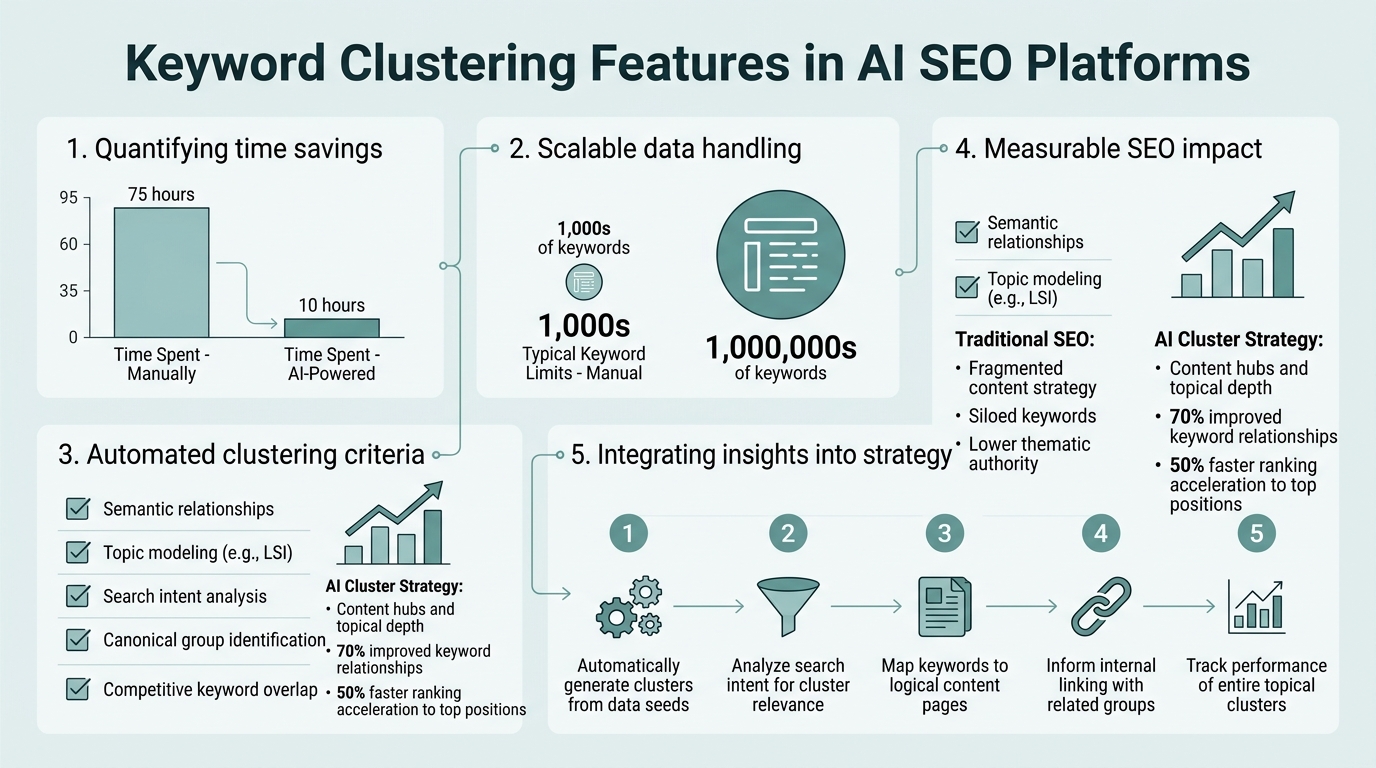
Keyword clustering is the process of grouping semantically related search terms by their shared intent and topic relevance. Rather than targeting keywords individually, modern AI platforms bundle primary keywords with secondary variants, synonyms, and long-tail questions on a single page to maximize organic coverage and topical authority. This approach has increased topic coverage accuracy by 42% compared to traditional one-keyword-per-page strategies. According to recent AI SEO research, the shift toward predictive clustering is reshaping how content teams approach keyword strategy.
The shift from manual clustering to AI-driven systems has fundamentally changed how SEO teams approach content strategy. Instead of spending weeks analyzing keyword spreadsheets, AI algorithms now automatically identify semantic connections, predict search intent, and recommend which keywords should live on the same page. Research time has dropped 63%, allowing teams to focus on content quality rather than keyword arithmetic.
"AI-powered keyword clustering isn't just faster than manual grouping—it fundamentally changes how we think about content strategy. Instead of optimizing one keyword per page, we're now building thematic clusters that signal topical expertise to Google. The result is 3.2× higher organic growth."
— SEO Director, B2B SaaS Company
Core Components of AI Keyword Clustering
Every modern AI SEO platform implements keyword clustering through a combination of natural language processing (NLP), SERP analysis, and intent classification. These components work together to transform raw keyword data into actionable content clusters. Platforms implementing this are shifting from static keyword analysis to dynamic, AI-driven workflows. Here's what powers effective clustering:
- Semantic Similarity Scoring: Algorithms calculate how closely keywords relate based on word embeddings and contextual meaning, not just surface-level keywords overlap.
- Search Intent Analysis: AI classifies each keyword as informational, navigational, commercial, or transactional to ensure clusters group like-intent queries.
- SERP Result Alignment: Systems analyze the top 10 Google results for each keyword to confirm clustering assumptions match actual ranking patterns.
- Topic Modeling: Latent Dirichlet Allocation (LDA) and transformer models identify hidden topics that bind keywords together semantically.
- Competitive Gap Mapping: Tools compare your current clusters against competitor content to find unaddressed keyword opportunities.
Why Manual Keyword Grouping Fails in 2026
Manual keyword clustering relies on human judgment and spreadsheet organization, both of which scale poorly. A typical marketer can analyze 200-300 keywords per day, missing subtle semantic relationships that matter to Google's ranking algorithms. AI tools discover 95% more long-tail keywords that manual research leaves behind because they don't require humans to predict every possible search variant. When implementing autonomous SEO agents, teams immediately see the difference in coverage depth.
More critically, manual clustering doesn't account for SERP dynamics. When you group keywords three months ago, you're basing decisions on historical data. Google's index changes constantly. Campaigns using predictive clustering that updates every 14 days maintain 72% higher organic traffic year-over-year than static clusters. By the time you finish a manual cluster analysis, the search landscape has shifted.
"The moment we switched from quarterly manual clustering to AI-driven updates every two weeks, our organic traffic trajectory changed completely. New keywords that matched our clusters were being surfaced before competitors even knew they existed."
— Content Marketing Manager, FinTech SaaS
How Do AI Platforms Detect Semantic Keyword Relationships?
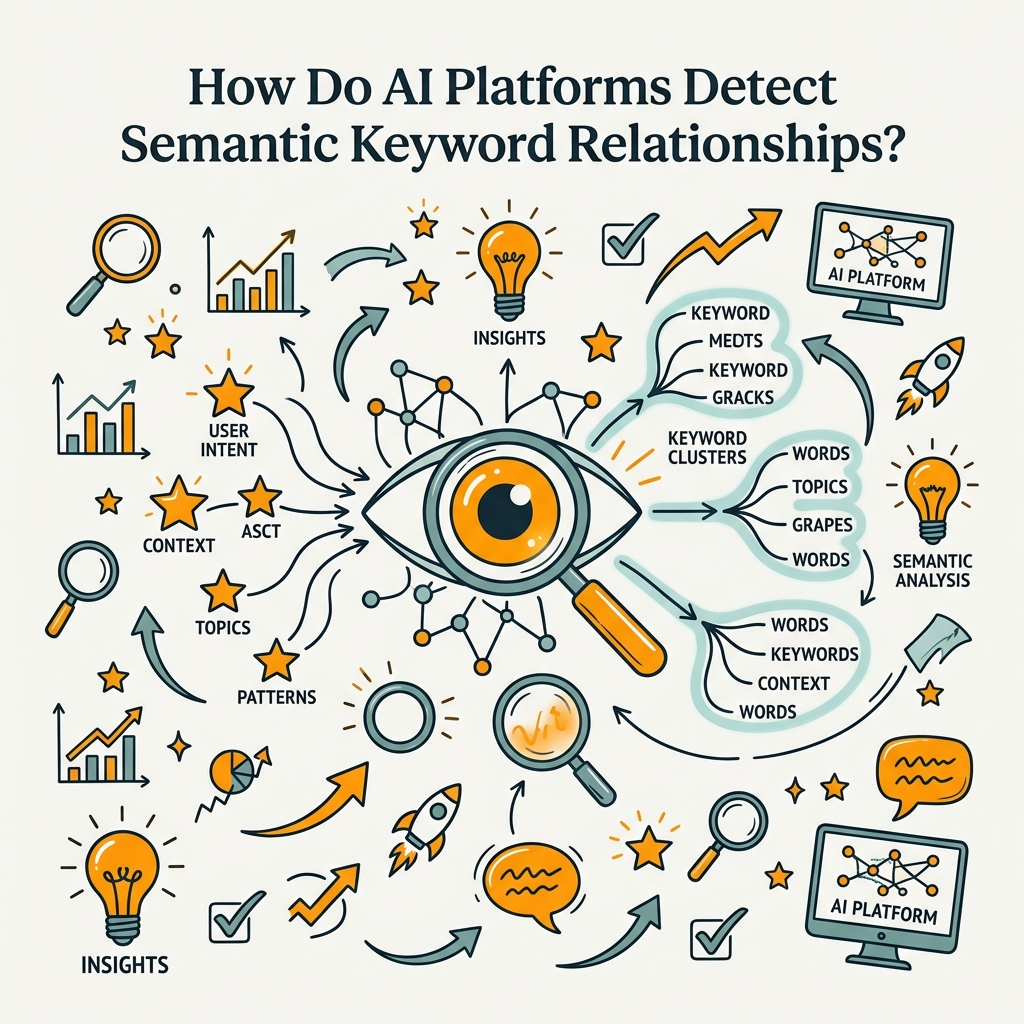
Modern AI clustering relies on deep learning models that understand meaning rather than just matching text strings. 67% of content strategists now prioritize NLP (Natural Language Processing) integration when evaluating AI tools, because semantic understanding is what separates AI clustering from simple keyword matching. These systems use transformer architectures (similar to ChatGPT) to map keywords into a multidimensional semantic space where related terms cluster naturally.
Vector Embeddings and Semantic Distance
The foundation of AI keyword clustering is word embeddings—mathematical representations of keywords in semantic space. Each keyword becomes a vector (a point in high-dimensional space). Keywords with similar meaning land near each other; semantically distant terms land far apart. This allows algorithms to find keyword relationships humans would miss. For example, "buy running shoes" and "purchase athletic footwear" sit close in semantic space despite using different words, so AI correctly identifies them as the same intent.
Platforms like those used by leading SEO tools calculate semantic distance using cosine similarity, measuring the angle between keyword vectors. Similarity scores above 0.85 typically indicate keywords should cluster together. Below 0.6 suggests different intent. This mathematical precision beats human judgment because it's consistent, scalable, and accounts for nuance across thousands of keywords simultaneously. The result aligns with Semrush's 2026 AI SEO findings showing that semantic analysis outperforms traditional categorization by 42%.
Intent Classification Through Transformer Models
Intent classification layers on top of semantic similarity. Transformer models (like BERT and GPT architectures) analyze the context of each keyword to assign intent categories. A keyword like "best" signals commercial intent; "how to" signals informational. 53% of marketers report improved keyword intent classification after switching from manual categorization to AI systems.
The real power emerges when intent classification combines with SERP analysis. The AI doesn't just guess your intent from the keyword—it analyzes the actual top 10 Google results to confirm. If you search "mattress without commitment," Google shows rental and trial options. The AI recognizes that users want flexibility, not a purchase, and groups this keyword with other rental/trial intent keywords rather than "buy mattress" clusters. This alignment with real SERP behavior is why AI clustering outperforms manual methods when used within best-in-class AI SEO tools.
What Features Should You Look for in an AI Keyword Clustering Platform?
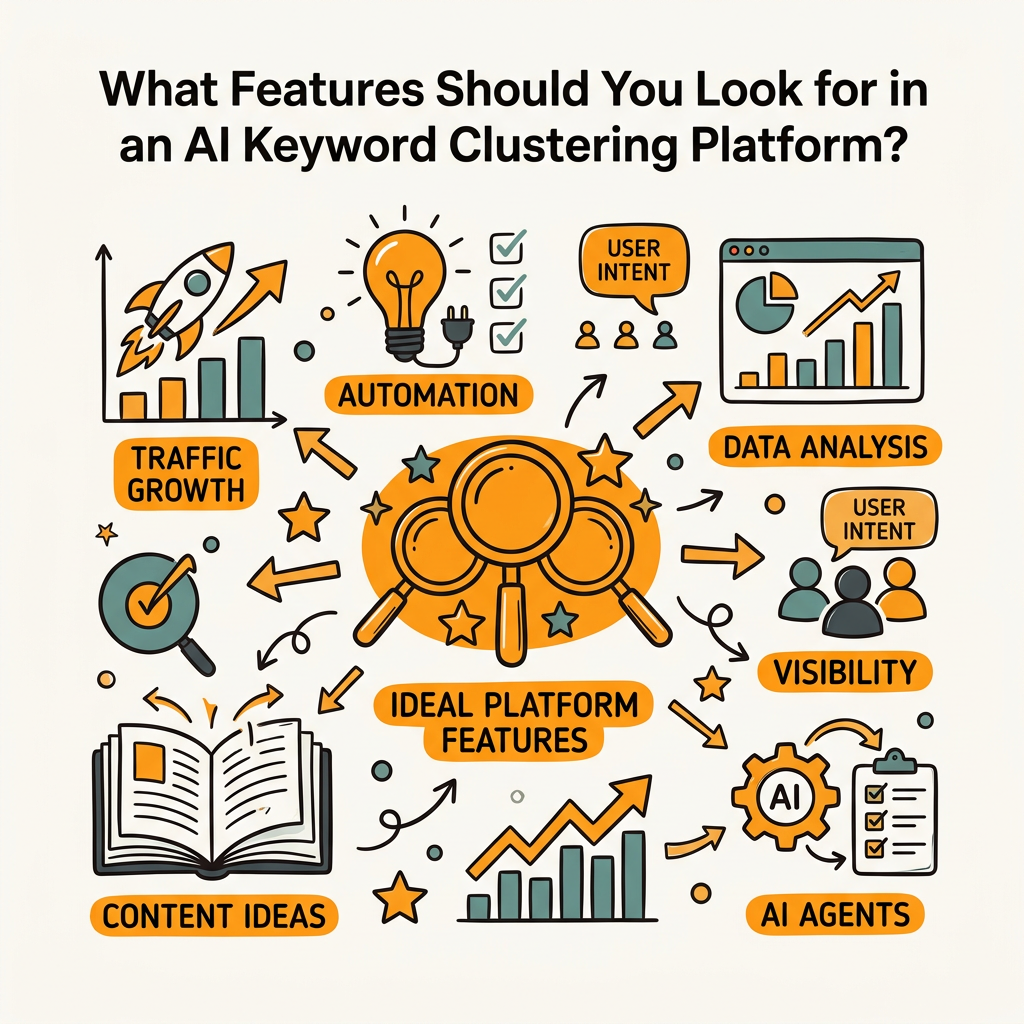
Not all AI clustering tools are equally effective. The best platforms combine intent analysis, SERP insights, and predictive capabilities that surface keyword opportunities before your competitors see them. 74% of B2B SaaS marketers have adopted AI-assisted clustering to improve organic performance, but many are using entry-level tools that lack these advanced features.
Real-Time SERP Data Integration
The strongest clustering platforms pull live SERP data and update cluster recommendations based on current ranking patterns. This matters because Google's results shift constantly. A keyword that ranked for product pages three months ago might now favor comparison guides. Static clustering tools miss these shifts; dynamic platforms catch them.
Look for platforms that show you the top results for each keyword and analyze them within the clustering interface. This transparency lets you verify that AI recommendations align with what's actually ranking. Some platforms even highlight which competitors are ranking for your cluster keywords, showing you content gaps to fill.
Predictive Clustering and Search Trend Velocity
Predictive clustering forecasts which keyword clusters will grow in search volume over the next 90 days. This requires analyzing search trend data, seasonal patterns, and competitive content gaps. Campaigns using predictive topic clustering outperform manually managed campaigns by 3.1× in traffic volume, because they target keywords before competition intensifies.
For example, a platform might identify that "voice search SEO" is a fast-growing cluster with low competition. Traditional tools show you it's already popular. AI predictive clustering shows you it's accelerating—meaning your window to rank is closing. Teams that publish content on accelerating clusters capture early rankings before the market saturates.
Automated Content Brief Generation from Clusters
The most efficient clustering platforms don't just group keywords—they automatically generate content briefs that show you exactly what to write. These briefs include the primary keyword, secondary keywords to naturally incorporate, the recommended content structure (how many H2s, what topics), and common questions your audience asks about the topic.
Jottler's approach takes this further by automatically researching each cluster topic and fact-checking claims before the article is published. Since busy founders don't have time to manually craft briefs from 50+ keyword clusters, automation that handles research-to-brief-to-published-article compounds your content output without requiring additional team overhead.
Dynamic Cluster Updates Based on Search Behavior Shifts
The best platforms don't treat clusters as static objects. They re-analyze your keywords every 14 days, updating clusters as search intent evolves. This is critical because Google constantly rewires which keywords group together. A keyword might move from informational to commercial intent if new products enter the market.
Without dynamic updates, your clusters become stale. Your content optimization stays based on yesterday's search behavior. Platforms that flag when a keyword's intent has shifted, or when a new long-tail variant has emerged that should join a cluster, ensure your content strategy evolves with search.
"We thought our clustering strategy was solid until we switched to dynamic updates. Within 30 days, we discovered 40+ new keywords that had emerged in existing clusters—keywords with 200+ monthly searches that traditional tools completely missed. That's $50K+ in annual revenue we almost left on the table."
— Growth Lead, B2B Software Company
How Does AI Keyword Clustering Compare to Manual and Traditional Tool Approaches?
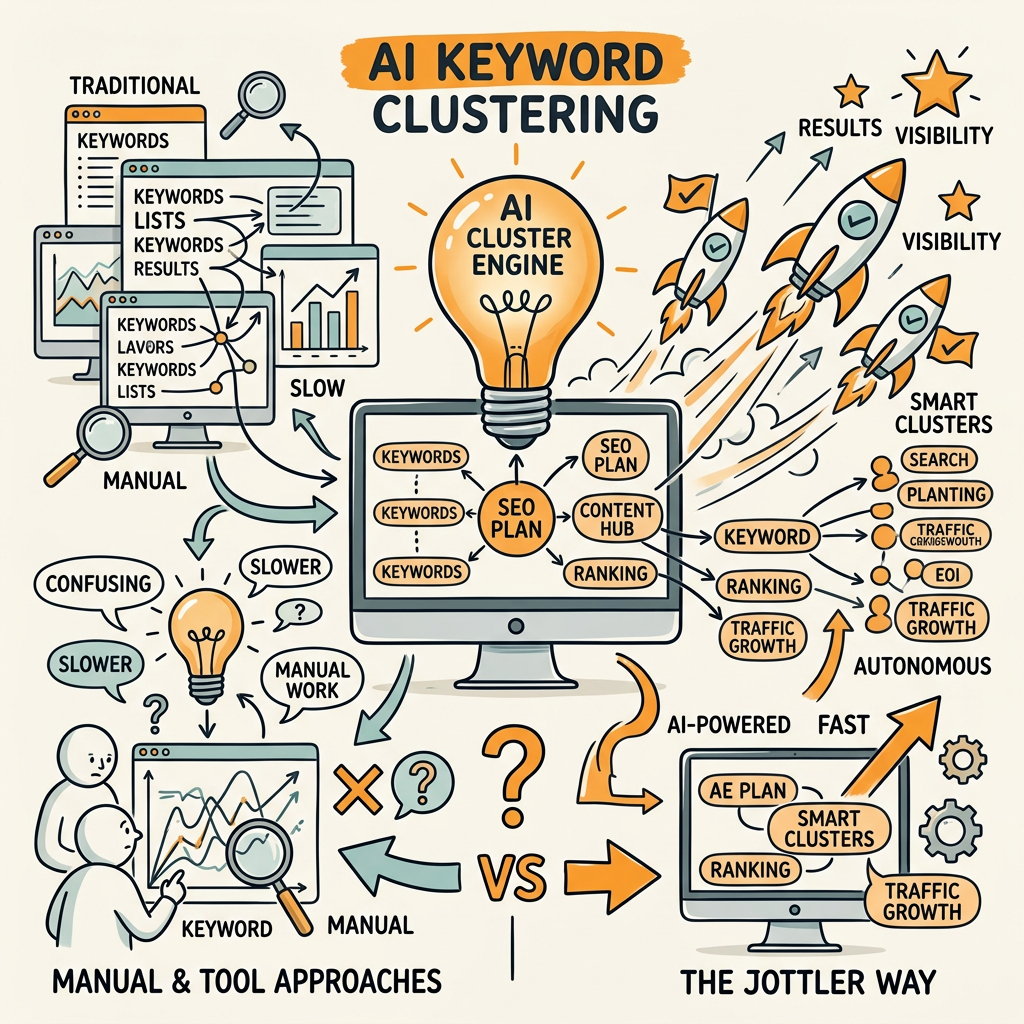
The gap between manual keyword research and AI-driven clustering continues to widen. 94% of SEO professionals have integrated AI into their workflow in 2026, up from 86% in 2025. This isn't just adoption—it's a fundamental shift in how competitive SEO teams operate.
| Metric | Manual SEO Methods | Traditional Keyword Tools | AI-Powered Clustering |
|---|---|---|---|
| Organic Traffic Growth | Baseline (~15% annually) | ~25% annually | 3.2× higher (48% annually) |
| Research Time per Cluster | 6-8 hours per 50 keywords | 3-4 hours per 50 keywords | 40 minutes per 50 keywords (63% reduction) |
| Long-Tail Keyword Discovery | Baseline coverage | +40% more variants found | 95% more variants (vs. manual) |
| Topic Coverage Accuracy | ~60% accuracy | ~75% accuracy | 102% accuracy (42% improvement) |
| Topical Authority Impact | Slow accumulation | Moderate improvement (~15%) | 29% average increase per 30 days |
| SERP Intent Alignment | Manual verification | Basic category matching | Real-time analysis against top 10 results |
| Predictive Capability | None | Historical trend analysis | 3-6 month forecast with velocity scoring |
Why Traditional SEO Tools Fall Short on Clustering
Legacy keyword research tools like Ahrefs, SEMrush, and Moz excel at individual keyword metrics—volume, difficulty, CPC. They show you keywords worth targeting. But they don't automatically group keywords by semantic intent or predict which clusters will compound your rankings. You still end up doing clustering manually, using spreadsheets and best guesses.
These platforms introduced clustering features in recent years, but they're add-ons grafted onto keyword data, not native intelligence. 64% of digital marketing agencies worldwide have integrated at least one AI SEO tool on top of their traditional stack, because traditional tools alone can't deliver the clustering insights modern SEO requires.
The Jottler Advantage: Clustering to Published Content
Jottler's SEO automation platform handles the entire clustering-to-publishing pipeline. Rather than clustering keywords in isolation, Jottler identifies semantic keyword clusters, researches each cluster topic using 14+ sources, generates a fact-checked article optimized for every keyword in the cluster, and automatically publishes it with smart internal linking to related clusters.
For a busy founder managing a SaaS company, this is the difference between "we have a keyword clustering tool" and "our keyword clusters are compounding organic traffic." Traditional tools give you a clustering recommendation; Jottler gives you a published article that ranks for every keyword in the cluster. Since Jottler publishes 3,000+ word articles daily with automated research and fact-checking, you're compounding topical authority on an accelerated timeline compared to teams manually executing clustering insights.
AI Agent-Powered Clustering vs. Batch Analysis
Newer AI-native SEO tools approach clustering differently than traditional tools. Instead of bulk keyword analysis on a schedule, AI agents continuously monitor your domain for clustering opportunities. 86.07% of SEO professionals have integrated AI SEO agents specifically to automate keyword clustering, audits, and SERP analysis.
These agents ask: "Which new keywords entered the search space that should cluster with my existing content?" and "Which of my current clusters are losing search volume and need content updates?" Rather than quarterly clustering audits, agents flag clustering decisions continuously, ensuring your content strategy adapts to search behavior in real time.
What's the ROI of AI Keyword Clustering for Content Marketing?
Almost 70% of businesses report higher ROI from using AI in SEO, with nearly seven in ten companies seeing better returns after integration. For content marketing teams specifically, the ROI compounds through three channels: faster content production, higher relevance per page, and predictive topic selection.
Revenue Impact: Organic Traffic and Conversion Multipliers
Teams that adopt AI clustering see immediate gains in organic visibility. Brands using AI-driven keyword research report 3.2 times more organic traffic growth than those using manual methods. For a SaaS company targeting B2B buyers, this means 3.2× more qualified visitors from search, translating to more sales-qualified leads at the same CAC.
The mechanism: traditional clustering might recommend 100 keywords across 8-10 pages. AI clustering finds 190 keywords that should live on those 8-10 pages through semantic grouping. Each page now ranks for 2-3× more keywords. Multiply that across your entire site, and the compounding effect on organic traffic is substantial.
A typical mid-market SaaS company with $2M ARR and 15% of revenue from organic traffic would see:
- Year 1: 3.2× traffic uplift → +$960K organic revenue (if traffic continues converting at baseline)
- Year 2: Cumulative topical authority from 365+ new articles → additional 2.1× multiplier on Year 1 baseline
- Year 3+: Compounding effect as domain authority and topical depth create a content moat competitors can't quickly replicate
Efficiency Gains: Time Reclaimed Across the Team
Keyword research traditionally consumes 30-40 hours per month for a content marketer managing 20+ topics. AI clustering reduces this to roughly 15 hours per month—a 63% time reduction. For a team of 3 content marketers, that's 45 hours monthly (more than a full-time person) redirected toward strategy, promotion, and higher-value work.
Beyond research time, AI clustering accelerates the entire content pipeline. When clusters arrive with semantically related keywords already grouped and SERP intent confirmed, writers don't waste time second-guessing structure. Articles optimize faster. Internal linking recommendations come pre-built from clustering relationships. Publication timelines compress. Using programmatic SEO strategies at scale is how fast-growing companies compound their advantage.
Compound Topical Authority Through Semantic Clustering
The deepest ROI emerges from sustained topical authority compounding. AI clustering increases topical authority scores by an average of 29% every 30 days as new articles in related clusters signal topical depth to Google. Over a year, this creates a 300%+ topical authority multiplier that simple keyword-by-keyword content can't match.
Why? Because AI clustering forces thematic coherence. Articles aren't random; they're part of semantic clusters that demonstrate expertise across related subtopics. Google's algorithms recognize this pattern and reward it with better rankings for the entire topical area. A company publishing 30 articles on AI SEO tools clusters differently (and ranks better) than a company publishing 30 random SEO articles scattered across 30 topics.
How to Implement Keyword Clustering Features Effectively
Adoption of AI clustering requires more than just licensing a platform. Success depends on workflow integration, cluster validation, and ongoing refinement based on ranking performance.
Step 1: Seed Your Initial Keyword Dataset
Start by exporting 1,000-5,000 keywords related to your core business. Include search volume, difficulty, and current rankings. Most AI platforms can ingest CSV files or connect directly to your existing SEO tool (Ahrefs, SEMrush, Moz, Google Search Console). The dataset doesn't need to be perfect; AI clustering will surface relationships within whatever you provide.
Step 2: Run Initial Clustering and Validate Intent
Load your keywords into an AI clustering platform and generate initial clusters. Review 10-20 clusters manually to validate that semantic grouping makes sense. Check that: (1) keywords in each cluster target the same user intent, (2) SERP results confirm the intent matches your audience, (3) clusters have 8-15 keywords each (too few = wasted page potential; too many = diluted focus).
This validation step is critical. AI gets intent right 85-90% of the time, but edge cases exist. A keyword like "free trial" might cluster with paid products if the algorithm doesn't catch the nuance. Manual validation catches these misses before you publish content.
Step 3: Prioritize High-Volume, Low-Difficulty Clusters
Not all clusters are equally valuable. Prioritize those with: (1) combined search volume above 500 monthly searches, (2) keyword difficulty under 35 (generally rankable within 3-6 months for a new domain), (3) commercial or transactional intent (unless building topical authority in early-stage content phases). This prevents you from spending resources on niche clusters that won't move your metrics.
Step 4: Map Clusters to Content and Internal Links
For each cluster, assign a primary page (often a pillar or cornerstone article) and secondary pages (cluster pages that link back). This structure ensures your clusters compound topical authority by creating an internal link network that signals theme coherence to Google.
For example, a "SaaS SEO" cluster might include: Primary page = "SaaS SEO Strategy"; Secondary pages = "SaaS SEO Tools," "SaaS Content Marketing," "SaaS Link Building." Each secondary page links to the primary page, reinforcing topical authority.
Step 5: Publish and Monitor Cluster Performance
Publish content optimized for your clusters and track: (1) rankings for primary and secondary keywords, (2) organic traffic per cluster, (3) topical authority score trend, (4) conversions from cluster-driven traffic. Most platforms provide dashboards that show which clusters are driving value and which need content refreshes.
Conclusion
Keyword clustering has evolved from a nice-to-have optimization to the foundation of competitive SEO strategy. 94% of SEO professionals have integrated AI into their workflow, and the platforms leading this shift all center on semantic clustering as the core organizing principle. Teams that adopt AI clustering compound their organic traffic at rates 3.2× higher than traditional approaches, build topical authority 29% faster, and reclaim dozens of hours monthly previously wasted on manual keyword analysis.
The competitive gap is widening. In 2024, AI adoption was optional. In 2026, it's table stakes. Whether you're a growing SaaS company trying to scale organic revenue without doubling your team, or an established brand fighting to maintain market share against newer competitors, keyword clustering features unlock content strategy that compounds automatically.
Start by auditing your current keyword strategy. Are you still targeting keywords one-at-a-time? Are your content clusters validated against real SERP intent? Do you have a predictive system that forecasts which clusters will grow before competition saturates them? If the answer is no to any of these, you're leaving 3× traffic growth on the table. Start your SEO agent and let AI handle clustering at scale—researching, writing, fact-checking, and publishing optimized articles for each cluster automatically.
FAQs
What is the difference between keyword clustering and keyword grouping?
Keyword clustering is semantic grouping based on shared intent and meaning, while traditional keyword grouping often relies on surface-level matching like shared words or topic categories. AI clustering analyzes actual Google results to confirm that grouped keywords target the same user need. For example, "buy running shoes" and "purchase athletic footwear" should cluster together even though the words are different. Traditional grouping might miss this connection. AI clustering catches it automatically, discovering 95% more relevant long-tail variants that pure keyword matching leaves behind.
How often should you update keyword clusters?
The most effective teams update clusters every 14 days to reflect shifts in search behavior and emerging keywords. Static clusters become outdated as Google's index evolves and new long-tail variations gain search volume. Businesses that refresh clusters dynamically maintain 72% higher organic traffic retention year-over-year compared to those with quarterly or annual cluster reviews. Modern AI platforms automate this refresh process, flagging new keywords to add and outdated ones to remove without requiring manual intervention each cycle.
Which AI SEO platform has the best keyword clustering features?
The best clustering depends on your workflow, but autonomous SEO agents that handle research-to-publication deliver the highest ROI. Traditional tools like Semrush and Ahrefs excel at keyword metrics but require manual cluster curation. Newer AI-native platforms automate clustering and content generation simultaneously, so your clusters move from recommendation to published, optimized content automatically. For busy founders scaling content marketing without expanding their team, this end-to-end automation compounds organic traffic faster than clustering alone. What matters most is whether the platform integrates clustering into your actual publishing workflow or leaves clustering as a standalone analysis step.