Keyword Clustering for SEO Content Strategy
Keyword clustering transforms how content teams organize and prioritize their SEO efforts. Instead of creating isolated pages for individual keywords, you group related queries by intent and build interconnected content that signals topical authority to Google and AI search engines alike. The result? Topic-clustered content drives approximately 30% more organic traffic and maintains rankings 2.5× longer than standalone pages, according to 2026 B2B keyword research data. Yet most founders and growing marketing teams still chase volume keywords in isolation, squandering the compound benefits of a clustered approach. Here's how to build a keyword clustering strategy that actually scales your organic traffic.
Key Takeaways
- Topic clusters drive 30% more organic traffic and 2.5× longer ranking durability than standalone pages (2026 B2B Guide)
- 91.8% of all searches are long-tail keywords that convert at 2.5× higher rates when grouped by intent rather than chased individually
- Intent-first clusteringorganized by user need, not search volumeis now the foundation of SEO strategy that works for both Google and AI search platforms
- Smart clustering requires mapping semantic relationships, identifying pillar topics, and building internal link architecture before writing any content
- What keyword clustering is: Grouping related search queries by user intent and semantic relevance, then building pillar and cluster content that covers the entire topic comprehensively.
- Why clustering beats isolated keywords: It shows Google topical authority, improves user experience with interconnected content, and captures multiple intent variations from a single content investment.
- How to map your clusters: Start with core business topics, identify search queries within each topic, segment by intent, and organize into pillar (core) and supporting (cluster) pages.
- Building pillar and cluster architecture: Create one authoritative pillar page per core topic, supported by 10–15 specific cluster articles that link back to the pillar and internally reference each other.
- Optimizing clusters for AI search: Structure content with clear H2/H3 hierarchy, standalone answer blocks, comparison tables, and specific sourced data so AI systems can extract and cite your content.
- Automating clustering and publishing: Use AI-powered tools to research, write, and publish cluster content at scale while maintaining quality and internal linking consistency.
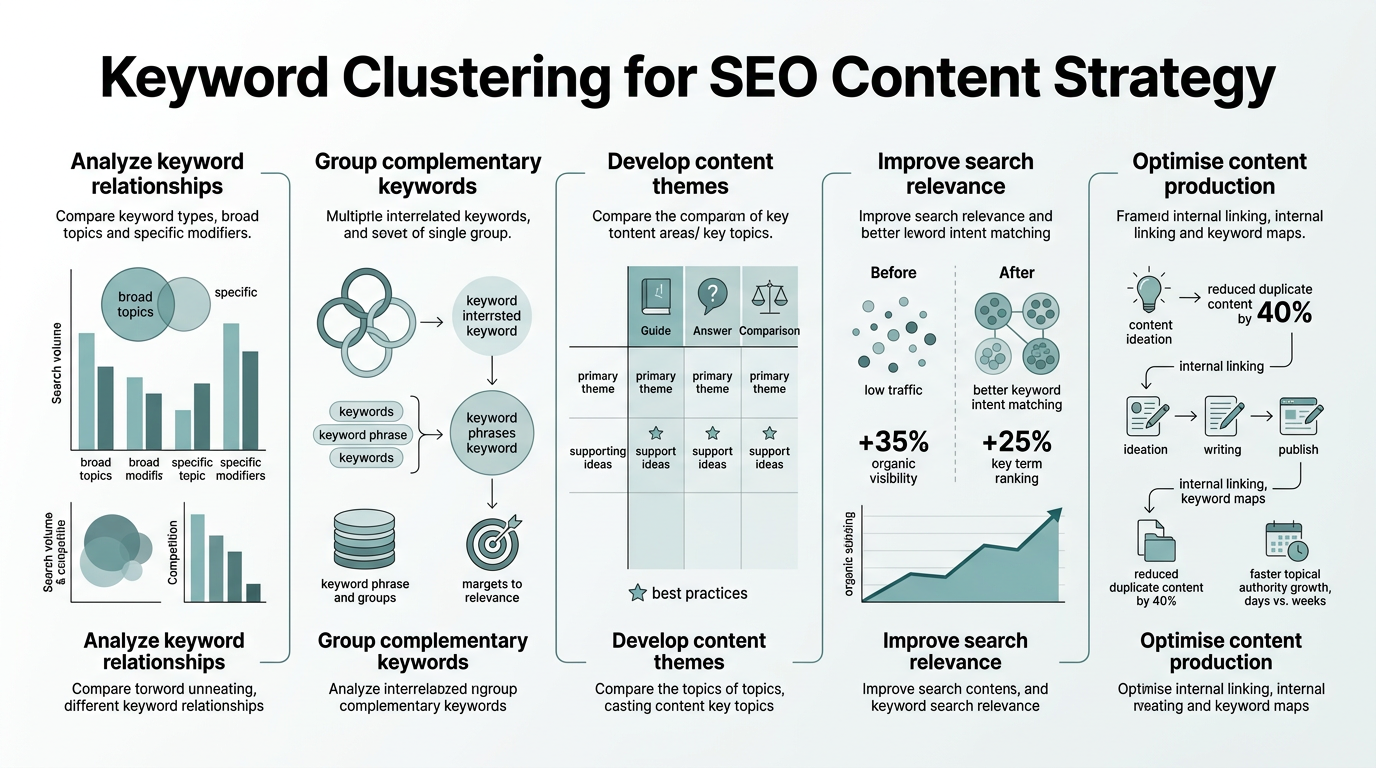
What Is Keyword Clustering and Why Does It Matter for SEO?
Keyword clustering is the practice of grouping similar, related search queries based on intent and semantic meaning, then organizing your content strategy around those clusters rather than individual keywords. Organic search now accounts for over 50% of website traffic on average, making this foundational decision critical to your growth. A single pillar page covers the core topic at a high level, while supporting cluster articles target specific questions, use cases, and intent variations within that topic. The internal linking architecture creates a web of topical authority that search engines reward with higher rankings and better visibility across all related queries.
The Traditional Approach Versus Topic Clustering
The old way: pick high-volume keywords, create one page per keyword, hope for traffic. The result is fragmented content, poor user experience, and weak topical signals to Google. You rank for the keyword you optimized formaybebut you leave dozens of related queries unresolved across scattered pages that don't reinforce each other.
Keyword clustering flips this. You identify a core topic (e.g., "SEO content strategy"), map all the related queries users are actually searching (intent, not volume), and build a content hub where one pillar page anchors the strategy and 10–15 cluster articles address specific questions, use cases, and variations. Internal links connect these pages, and the combined authority of the cluster pushes all of them higher in rankings. This approach drives approximately 30% more organic traffic than standalone pages and keeps rankings live 2.5× longer because the content reinforces itself over time.
How Clustering Aligns with Modern Search: Google and AI
Today's search landscape is split: traditional Google results and AI-powered systems like ChatGPT, Perplexity, and Google AI Overviews. Keyword clustering benefits both channels. For Google, clustering demonstrates topical deptha key ranking factor. For AI search, clustering provides the structured content these systems need to extract and cite your work: clear definitions, comparison tables, original data, step-by-step answers, and stand-alone answer blocks that AI can pull directly into an overview or conversational response.
When you cluster strategically, your content becomes citation-worthy to AI engines. Tools like SEO automation platforms now embed keyword clustering into their research and publishing workflows, automatically building internal link networks across clustered articles so every piece reinforces the others. This is no longer a manual process for teams with unlimited timeit's an operational requirement for scaling organic traffic.
How to Map and Identify Your Core Topics and Keyword Clusters
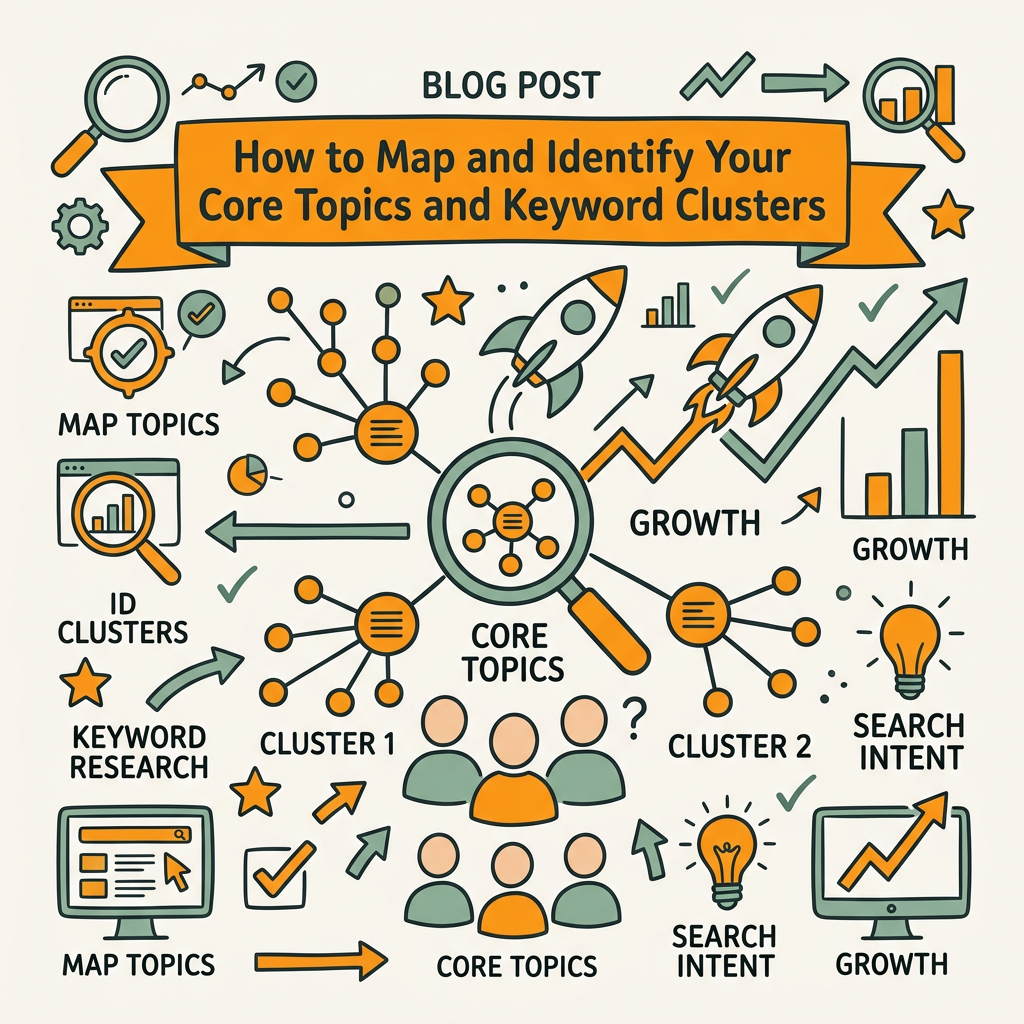
The foundation of a clustering strategy is identifying which core topics your business should own and which search queries align with each. This step requires a shift from volume-obsession to intent-obsession. You're not just looking for high-volume keywords; you're identifying the topics your audience cares about and the specific questions they ask at each stage of their journey. Whitehat SEO's 2026 B2B guide recommends scoring keywords by business impact, not just search volume, considering difficulty, ranking position, conversion potential, and product fit.
Define Your Core Business Topics First
Start with your business. What core topics does your company own expertise in? For a B2B SaaS marketing platform, that might be: SEO strategy, content automation, keyword research, organic traffic growth, AI-powered content. For an e-commerce brand, it could be: product categories, care guides, buying comparisons, sustainability practices. Each core topic becomes the foundation of a pillar page and the anchor for 10–15 cluster articles.
This exercise is not about chasing trending keywords. It's about mapping the semantic space your business naturally occupies. Your clusters should align with your product, your audience's journey, and the problems you solve. When they don't, ranking becomes harder and conversion drops.
Generate and Segment Keywords by Intent, Not Just Volume
Next, identify all the search queries related to each core topic. This is where tools that analyze keyword research and intent classification become essential. Use keyword research tools to pull a comprehensive list, then segment by intent:
- Informational intent: "What is keyword clustering?", "How does semantic search work?" (awareness stage)
- Commercial intent: "Best keyword clustering tools", "Keyword clustering software comparison" (consideration stage)
- Transactional intent: "Buy keyword clustering tool", "Start free keyword clustering trial" (decision stage)
- Navigational intent: "Semrush keyword clustering", "Ahrefs clustering feature" (brand-specific)
A single cluster might target all four intents. For example, a pillar on "SEO Keyword Research" could support cluster articles answering "What is long-tail keyword research", "Best keyword research tools 2026", "How to use keyword research for content planning", and "Free vs paid keyword research tools." Each cluster article targets a specific intent, and the pillar page ties them all together with high-level guidance and internal links to deeper content.
Analyze Competitor Cluster Structures for Gaps
Look at which competitors rank for your target topics. What content structure do they use? Do they have pillar pages? How many supporting articles? What gaps exist? If your competitor ranks #1 for "SEO keyword research" with a pillar page plus 8 cluster articles, and you have none, that's a competitive gap. If they're missing a cluster on "keyword research for AI search optimization," that's an opportunity.
Use SEO analysis tools to audit competitor content and their internal linking patterns. This gives you a roadmap for the depth and breadth of your own cluster strategy.
Building Your Pillar and Cluster Content Architecture
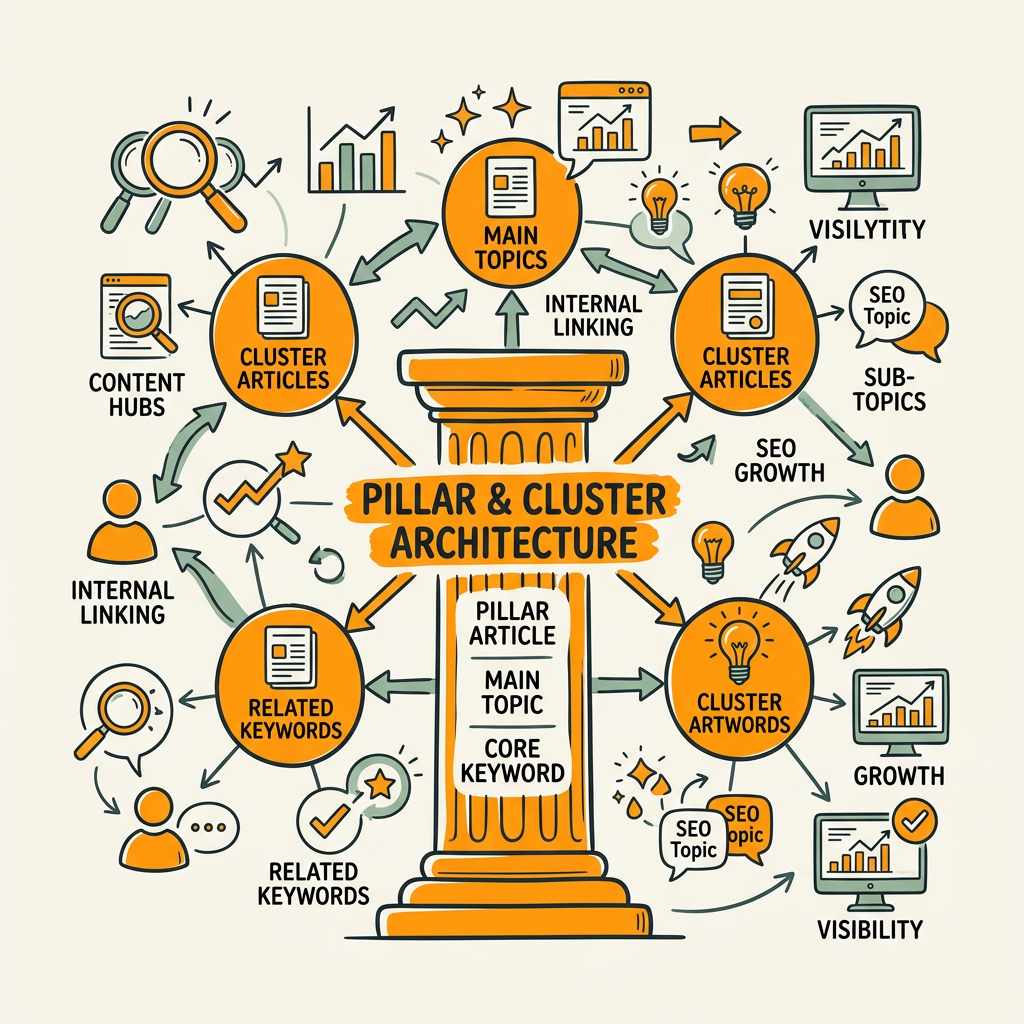
Once you've mapped your topics and identified the keywords within them, you design the content architecture. This is where keyword clustering becomes tangible. A pillar page is a comprehensive, authoritative guide to a broad topictypically 3,000–5,000 words. Cluster articles (1,500–2,500 words) explore specific subtopics, questions, and use cases, all linking back to the pillar and to each other. The result is a topically connected hub that search engines recognize as authoritative coverage of the entire subject.
Pillar Page Structure and Content Guidelines
Your pillar page is the hub. It should answer the core question of your topic at a high level, introduce all the major subtopics, and link internally to each cluster article. The pillar doesn't need to be exhaustive on every subtopicthat's what cluster articles do. Instead, it provides an overview, establishes expertise, and funnels readers to deeper content.
A strong pillar page includes: a clear definition of the core topic, the "why it matters" section with business impact, an overview of major subtopics with summaries, and a table of contents with internal links to each cluster article. For example, a pillar on "SEO Content Strategy" would define the topic, explain why it drives ROI, preview key strategies like keyword clustering and topical authority, and then link to cluster articles on each subtopic. The pillar itself doesn't dive deep into how to build a clusterthat's cluster article work. But it signals to Google that you own the entire topic.
Cluster Article Depth and Linking Strategy
Each cluster article targets a specific long-tail keyword or user intent within the broader topic. It's deep, specific, and highly useful on its ownbut it's also connected to the pillar and to related cluster articles.
A cluster article on "How to Use Keyword Clustering for E-Commerce SEO" would:
- Link to the pillar page in the introduction ("This is part of our complete guide to keyword clustering")
- Provide step-by-step guidance specific to e-commerce use cases
- Link to related cluster articles ("See also: keyword clustering for B2B SaaS", "Competitor analysis for cluster planning")
- Use specific data and examples (not generic advice)
- Include a CTA that drives readers back to the pillar or to a conversion point
Internal linking is the connective tissue. Every cluster article should link to the pillar at least once. Cluster articles should also cross-link to 2–3 related cluster articles that share audience intent. Over time, this creates a web of topical authority that Google crawls and ranks across the entire cluster.
Balancing Breadth and Depth in Your Cluster
A common mistake: creating 50 shallow cluster articles instead of 10–15 deep ones. Breadth matters, but depth wins rankings. A cluster of 12 detailed, well-researched articles with strong internal linking outranks a cluster of 40 thin, generic articles every time.
Plan for quality. Each cluster article should be original, specific, backed by data or examples, and genuinely useful to the reader. If you're using automation tools like autonomous SEO agents to scale content production, they should be researching deeply, citing sources, and building internal link architecture automaticallynot just spinning generic paragraphs.
Optimizing Clusters for AI Search and Citations
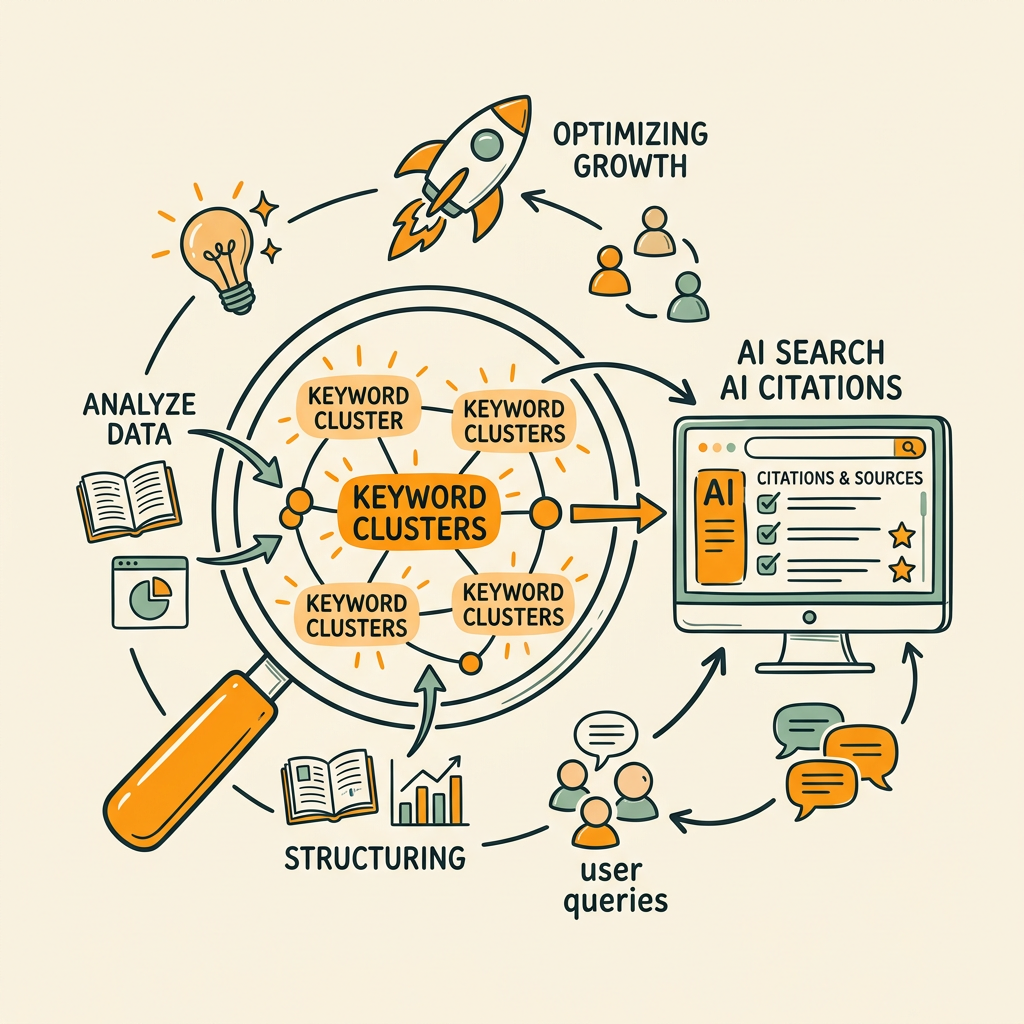
Keyword clustering used to be purely a Google ranking tactic. Now, AI search platforms like ChatGPT, Perplexity, and Google's AI Overviews are major discovery channels. They need different content signals than traditional search. Matt Diggity's 2026 SEO strategy emphasizes that AI platforms cite pages with clear H2/H3 hierarchy, first-party data, specific sourced statistics, and stand-alone answer blocks. If your clustered content doesn't have these elements, you're not optimizing for the 2026 search landscape.
Structuring Content for AI Extraction and Citation
AI systems prioritize extractable, structured content. Here's what works:
- Standalone answer blocks: The first paragraph under each H2 should directly answer the question posed in the heading, in 40–60 words, with a specific data point.
- Clear hierarchy: H1, H2, H3 tags in logical order. AI systems scan heading structure to understand the article's organization.
- Comparison tables: When comparing approaches, tools, or strategies, use HTML tables. AI systems extract and cite tables frequently.
- Specific statistics: Include numbers, percentages, timeframes, and always cite the source. "77% of marketers" is more citeable than "most marketers".
- Definitive lists: Ordered or bulleted lists of steps, criteria, or examples are AI-friendly and often featured in AI Overviews.
Jottler's autonomous SEO agents automatically structure content this waybuilding answer blocks for each heading, embedding data-backed claims, and adding comparison tables where relevant. The result is content that ranks in Google and gets cited in AI overviews.
Metadata and Snippet Optimization Within Clusters
Each cluster article needs its own optimized title tag (50–60 characters, keyword front-loaded) and meta description (150–155 characters, including a specific number or benefit). These aren't just for Google clicks anymoreAI systems read snippets and metadata to decide whether a page is worth citing. A vague title gets skipped. A specific, data-backed title gets cited.
Within the cluster architecture, each article's metadata should be unique and specific to its cluster topic, not a generic rewrite of the pillar. This signals to AI systems that you have specialized content on a subtopic, making you more citeable for queries within that subtopic.
Scaling Cluster Production and Maintenance
Building a keyword cluster manually is time-intensive. Mapping topics, generating keywords, writing 12–15 articles, building internal links, optimizing for both Google and AIthis is a 3–4 month project for a single cluster if done by hand. Most growing companies can't afford that timeline. They need clustering done at scale, weekly, without sacrificing quality.
Automating Cluster Research and Topic Mapping
Start with automation for research. AI tools can now crawl competitor content, analyze SERP results, and suggest cluster structures in hours instead of weeks. They can identify content gaps, rank clusters by business impact, and recommend which topics to prioritize first. This removes the guesswork and accelerates the planning phase.
The best cluster automation goes beyond keyword suggestions. It maps semantic relationships, identifies topic adjacencies, and recommends cross-cluster linking opportunities. For example, if you're building clusters for "SEO content strategy" and "internal linking," an intelligent automation system will recognize the overlap and suggest which articles should link between clustersnot just within them.
Writing and Publishing Cluster Content at Scale
Once the structure is mapped, you need to write and publish 2–5 cluster articles per week to compound your organic growth. This is where most teams hit a wall: writers are bottlenecked, editing is slow, internal linking is inconsistent, and publishing delays pile up.
Autonomous SEO engines like Jottler handle this by fully automating the write-and-publish workflow. The system researches each cluster article (pulling from 14+ authoritative sources), writes the full article with proper structure (answer blocks, data citations, tables, lists), fact-checks every claim, optimizes for both Google and AI, and publishes directly to your CMS with internal links already built. One founder can manage the publication of 15–20 cluster articles per week across multiple topics without a writing team.
Maintaining Cluster Cohesion and Internal Link Quality
As your clusters grow, maintenance becomes critical. Broken internal links, outdated statistics, missing cross-referencesthese are death by a thousand cuts. A cluster with 50 articles where only 60% of the internal links are active becomes less effective over time.
Use automation to audit your clusters quarterly: check for broken links, identify articles that haven't been updated in 6+ months, flag statistics with outdated years, and recommend new cluster articles based on emerging search trends. This keeps your clusters fresh and your internal linking network strong.
Conclusion
Keyword clustering is no longer optional for scaling organic traffic. The evidence is clear: topic-clustered content drives 30% more organic traffic and ranks 2.5× longer than scattered, isolated pages. Combined with the shift toward AI search, clustering becomes even more criticalyou need deep, structured, interconnected content that works for both Google and ChatGPT. With organic search now accounting for over 50% of website traffic and the SEO market projected to exceed $83 billion by 2026, companies that cluster effectively will dominate their categories while competitors chase individual keywords in isolation. The clusters that win are built on intent-first research, deep pillar and article architecture, AI-optimized content structure, and consistent publishing at scale. Whether you're building clusters manually or using automation, start with one core topic, map 10–15 related queries, write the pillar and first 5 cluster articles, and let the internal linking and compound authority work. Start your SEO agent to automate cluster research, writing, and publishingso your team can focus on strategy instead of execution.
FAQs
How many keywords should be in a single cluster?
A healthy cluster typically contains 10–15 target keywords organized by intent. This includes one primary keyword for the pillar page and 9–14 long-tail keywords for supporting cluster articles. Too few keywords means you're not capturing enough semantic demand; too many means you're diluting focus and likely covering topics that don't belong together. The rule is: if the keywords share a common intent and user journey, they belong in the same cluster. If they diverge into different use cases or problems, split them into separate clusters. Focus on depth over breadtha cluster with 12 well-researched articles outperforms one with 40 shallow ones.
How do I organize keywords by search intent within a cluster?
Segment keywords into four intent buckets: informational (awareness stage, "What is X?", "How does X work?"), commercial (consideration, "Best X tools", "X comparison"), transactional (decision stage, "Buy X", "Start X free trial"), and navigational (brand-specific, "Brand X", "Brand X login"). A single cluster can target all four intents with different articles. For example, a "SEO keyword research" cluster would have an informational article ("What is keyword research"), a commercial comparison article ("Best keyword research tools 2026"), a transactional article ("How to start with Semrush keyword research"), and navigational pieces. This organization makes sure each article captures its target intent without cannibalizing others in the cluster.
Should I build multiple clusters in parallel or focus on one cluster at a time?
Build your first cluster end-to-end before starting the second. A complete cluster (pillar + 12–15 cluster articles + internal linking) takes 8–12 weeks to build, test, and refine manually. By completing one fully, you learn the process, establish your voice, and build momentum. Once that cluster is ranking and generating traffic, you've proven the method and can accelerate the second cluster. If you're using automation tools, you can run 2–3 clusters in parallel because the research, writing, and publishing are happening simultaneously without manual bottlenecks. The key is ensuring each cluster is complete and cohesive before moving ona partially built cluster with gaps in content and internal linking underperforms compared to a fully built one.