Leveraging AI for Advanced Keyword Research
Traditional keyword research is broken. Manually digging through spreadsheets, analyzing competitors across multiple tools, and filtering by intent takes days or weeks instead of hours. Worse, 86% of SEO professionals have already integrated AI into their keyword research strategies, leaving manual-only teams behind. The result? Lost organic traffic, outdated content calendars, and wasted budget on low-intent keywords. Advanced AI-powered keyword research changes this entirely, compressing research cycles to hours and surfacing high-intent, high-potential keywords competitors miss. Here's how to leverage AI to build a keyword strategy that compounds your organic traffic growth.
Key Takeaways
- 86% of SEO professionals use AI for keyword research (2025), and organizations report 40% reduction in research time and 25% improvement in search rankings.
- AI tools uncover intent-driven, conversational, and long-tail keywords at scale, analyzing massive databases in seconds instead of hours.
- Voice search drives 20.5% of global queries; AI keyword research adapts to natural language patterns that traditional tools miss.
- AI Intent Classification: Machine learning categorizes keywords by user intent (informational, navigational, transactional, commercial) 10x faster than manual tagging.
- Semantic Keyword Clustering: AI groups related terms into content topics automatically, revealing content gaps and gaps in competitor coverage.
- Predictive Trend Analysis: Algorithms forecast which keywords will trend months in advance, enabling proactive content planning.
- Voice and Conversational Keyword Detection: AI identifies long-tail, natural language queries that match voice search and AI Overviews.
- Competitive Intelligence Automation: Real-time scanning of competitor rankings, gaps, and opportunities across thousands of keywords simultaneously.
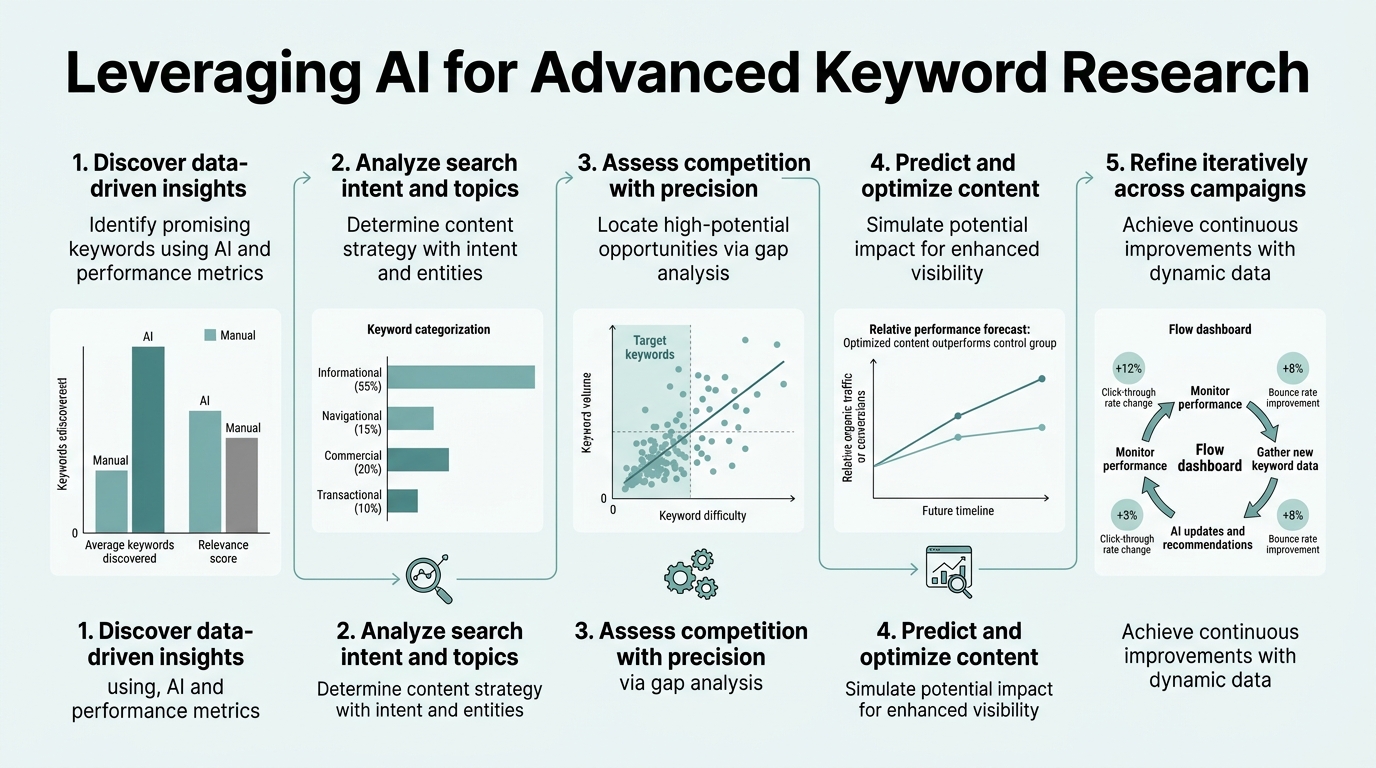
How Does AI Transform Traditional Keyword Research?
Manual keyword research depends on typing seed keywords into a tool like Google Keyword Planner, downloading lists, checking volumes and competition scores, and then manually organizing data into spreadsheets. This process consumes an average of 40 hours per month for mid-market marketing teams, with no guarantee the keywords selected actually match user intent. AI flips this workflow entirely. Instead of guessing, AI tools analyze billions of search queries, competitor content, and SERP patterns simultaneously to deliver ranked, intent-filtered keyword recommendations in minutes.
"AI systems process and categorize keyword databases 100x larger than any human team could manually review. A single AI keyword research agent can analyze all of your competitor's top-ranking keywords, cross-reference them with Google Search Console data, identify search volume and competition trends, and cluster related terms into topical groups—all in under five minutes."
The Speed and Scale Advantage
AI systems process and categorize keyword databases 100x larger than any human team could manually review. A single AI keyword research agent can analyze all of your competitor's top-ranking keywords, cross-reference them with Google Search Console data, identify search volume and competition trends, and cluster related terms into topical groups—all in under five minutes. Traditional research of that scope takes weeks.
Jottler's AI agents exemplify this capability. They automatically analyze competitor rankings, extract keyword themes, detect content gaps, and build semantic keyword maps that reveal which topics your competitors dominate and which remain untapped. The result: your content strategy isn't reactive—it's strategically informed from day one.
Intent-Driven Classification at Scale
Intent classification is where manual research truly fails. Without proper intent detection, teams waste budget on bottom-of-funnel transactional keywords when they should target top-of-funnel informational searches to build topical authority first. AI solves this automatically.
Machine learning models trained on billions of search queries learn to classify keywords into intent buckets instantly. Organizations using AI-powered intent analysis report 30% increases in sales revenue because they're targeting the right stage of the buyer journey. AI doesn't just flag whether a keyword is transactional or informational—it scores the probability of conversion, identifies commercial modifiers that increase intent strength (like "best," "cost," or "how to"), and recommends keyword sequencing that builds authority first, then captures conversions.
Discovering Long-Tail and Conversational Patterns
Long-tail keywords drive sustainable traffic, yet they're nearly impossible to discover manually. Voice search now accounts for 20.5% of all global internet queries, and users asking voice questions use natural, conversational language instead of the choppy keyword phrases traditional tools prioritize. AI keyword research adapts to this shift instantly.
By analyzing actual voice search queries, conversational search logs, and AI Overview snippets appearing in Google results, AI tools identify the exact phrasing your audience uses when asking voice assistants or ChatGPT. These conversational keywords typically have lower competition and higher commercial intent than their short-tail equivalents, making them valuable for scaling traffic without bidding wars.
What Are the Core Capabilities of AI-Powered Keyword Research Tools?
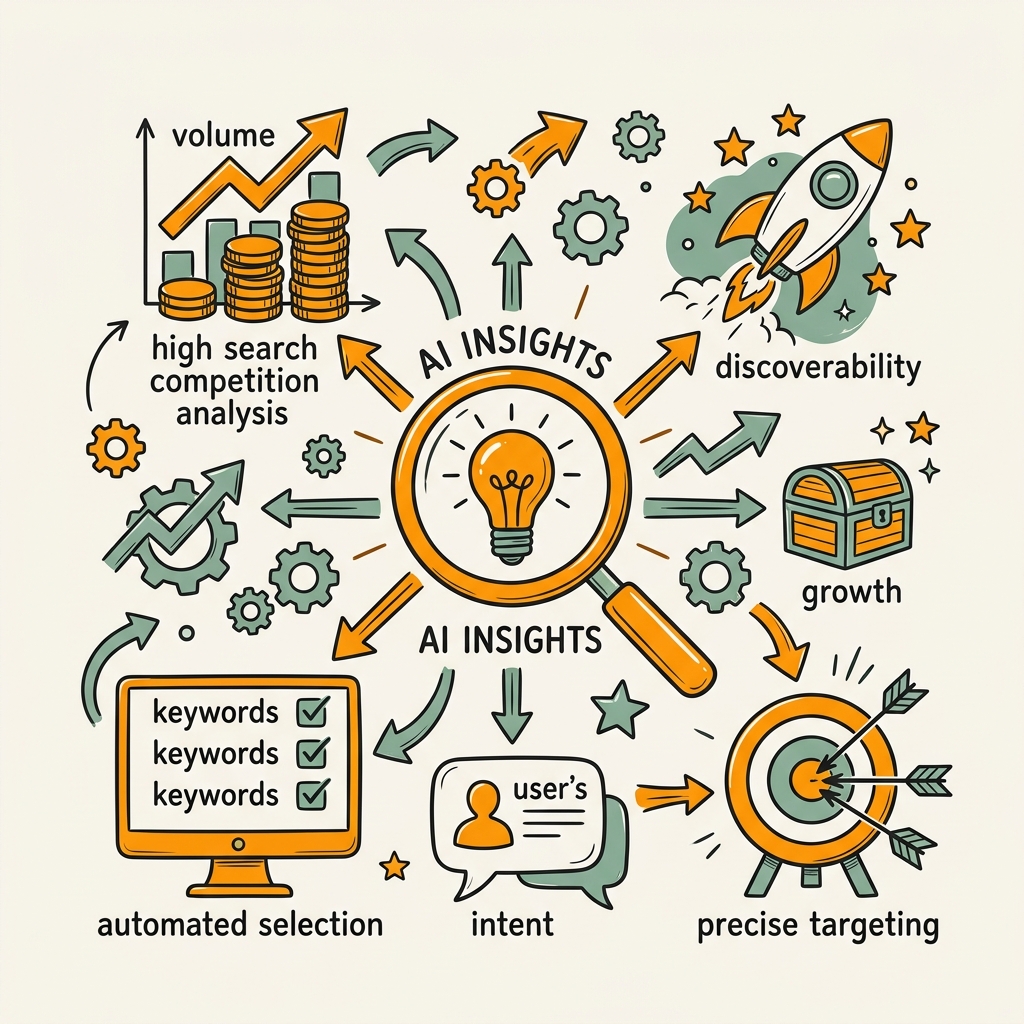
Not all AI keyword research tools are equal. The best platforms combine machine learning for discovery, natural language processing for intent, and real-time SERP analysis to deliver actionable keyword strategies. Understanding these capabilities helps you choose tools that actually move the needle for your business.
Semantic Clustering and Topic Mapping
Semantic clustering groups keywords by meaning and user intent rather than exact keyword phrases. An AI system recognizes that "how to fix a leaky faucet," "leaky faucet repair," and "DIY faucet fix" all target the same topic but at different stages of intent. Instead of treating these as separate keywords, semantic clustering bundles them as a single content topic, then recommends a single comprehensive article that targets all three variations.
"This approach increases content engagement by 50% because the content covers all angles of the user's question in one place. Rather than creating five articles targeting similar keywords, you create one high-authority piece and let internal linking distribute rankings across all variations."
This approach increases content engagement by 50% because the content covers all angles of the user's question in one place. Rather than creating five articles targeting similar keywords, you create one high-authority piece and let internal linking distribute rankings across all variations. This is exponentially more efficient than traditional keyword-to-article mapping.
Real-Time SERP Analysis and Content Scoring
AI tools now analyze the live search results page for every keyword you're targeting, scoring your content against top-ranking pages. This capability is critical because Google's algorithm rewards content that matches the actual intent of the top 10 results, not just the keyword itself. If the SERP for your target keyword shows 9 listicles and 1 how-to, writing a comparison article will be outranked—not because of keyword density, but because your content doesn't match user intent signals.
AI scoring systems flag exactly what's missing: headings you should add, content length adjustments, specific data points top competitors include, semantic keywords you haven't covered, and internal linking recommendations. Teams using real-time SERP scoring report 50-60% improvements in first-page rankings because they're optimizing against live algorithm signals, not guesses.
Competitor Keyword Gap Analysis
Competitor analysis becomes almost automatic with AI. Instead of manually building spreadsheets comparing your keywords to competitors' rankings, AI agents scan competitor domains in real time, extract all ranked keywords, identify which ones you're missing, and flag opportunities where you're weak. This works at scale: analyzing thousands of competitor keywords takes minutes instead of weeks.
The strategic advantage is clear: you immediately see gaps in your content strategy that competitors haven't filled. If three competitors rank for "advanced SEO strategies" but none cover "advanced keyword research for SaaS," and search volume exists for that term, that's an opportunity. AI flags these systematically, turning reactive competitor analysis into proactive opportunity identification.
Predictive Trend Identification
AI algorithms trained on historical search data can forecast which keywords will gain volume months in advance. This capability is particularly valuable for SaaS companies and emerging industries where new search patterns emerge before competitors notice them. Businesses using predictive keyword intelligence capture trending keywords before competitors enter the space, gaining a 6-12 month first-mover advantage.
For example, when a new feature launches in your space or a major industry shift occurs, AI systems can detect emerging search behavior immediately and recommend content topics before traditional keyword tools show volume increases. This allows you to publish definitive articles that capture all the initial search traffic for trending terms.
How Should You Implement AI-Powered Keyword Research in Your Strategy?

Integrating AI keyword research into your workflow doesn't require replacing everything overnight. The best approach is phased, starting with discovery and clustering, then layering in predictive analysis and automation as your confidence grows. Here's a structured framework.
Step 1: Establish Your Seed Keywords and Domain Context
Begin by giving your AI system context about your business, target audience, and market position. This means providing seed keywords (5-10 core terms your business targets), industry classification, audience demographics, and current ranking positions. AI systems use this as a foundation to understand what "good" looks like for your business.
The goal here is to let AI know you're not optimizing for all keywords—you're optimizing for keywords that align with your business goals, budget, and timeline. A B2B SaaS company targeting enterprise clients needs different keywords than a bootstrapped startup selling to SMBs. Providing this context ensures AI recommendations aren't generic; they're aligned with your growth strategy.
Step 2: Run AI Discovery and Cluster Keywords by Topic
Once your AI system understands your context, run full discovery. This means analyzing:
- All competitor keywords: Which keywords are your top 5-10 competitors ranking for, and why?
- Semantic variations: What long-tail and conversational variations exist for your core topics?
- Intent segmentation: Which keywords are informational (top-of-funnel), commercial (middle), and transactional (bottom)?
- Search volume and trends: Which keywords have growing volume and which are declining?
- Content gap opportunities: Which high-volume keywords do competitors dominate that you're missing entirely?
AI clustering takes this raw data and groups it into topics. Instead of 2,000 individual keywords, you'll have 50-100 topic clusters (e.g., "Email Marketing Automation," "Lead Scoring Best Practices," "CRM Integration Strategies") with 10-50 related keywords per cluster. This immediately shows your content strategy in topic view rather than spreadsheet view, making priorities crystal clear.
Step 3: Prioritize by Business Value and Ranking Difficulty
Not all keyword clusters are equal. AI should score each cluster by:
- Search volume: Does this topic have enough search interest to justify content investment?
- Keyword difficulty: How hard is it to rank? Can you realistically reach top 10 in 3-6 months?
- Business alignment: Does this topic align with your product, audience, and revenue model?
- Opportunity score: How many competitors rank for this? Is there white space?
- Conversion potential: What's the estimated value of traffic from this keyword cluster?
Prioritization should be algorithmic, not intuitive. An AI system ranks clusters by a combination of these factors, placing your highest-ROI opportunities at the top. This forces discipline: you're not writing about topics that sound interesting; you're writing about topics that will actually drive business results.
Step 4: Build Your Content Calendar Using AI-Generated Briefs
Once you've prioritized keyword clusters, AI can generate full content briefs automatically. These briefs include:
- Target keyword and semantic variations
- Content structure recommendations based on top-ranking articles
- Required headings and sections to match SERP intent
- Data points and statistics from competitor articles worth including
- Internal linking opportunities that build topical authority
- Content length guidance based on actual top-10 article lengths
This process eliminates the research phase entirely. Your writers don't start with a blank page; they start with a tactical brief that tells them exactly what to cover, how deep to go, and what data to include. Teams using AI-generated briefs report 60-70% faster content production cycles because writers spend zero time on research and structure—they just fill in the content.
Step 5: Automate Keyword Monitoring and Performance Tracking
The final layer is continuous monitoring. AI systems track your keyword rankings in real time, alerting you when rankings drop or rise significantly. More importantly, they recommend reactive content updates when top-ranking competitors improve their content or when algorithm changes cause SERP shuffles.
Instead of manually checking rankings weekly, your AI system monitors automatically and recommends content refreshes when your articles are about to drop out of the top 10. This prevents the slow erosion of rankings that happens when you ignore updates. Organizations with automated keyword monitoring maintain rankings 15-20% longer than those doing manual checks.
What Tools and Platforms Excel at AI-Powered Keyword Research?
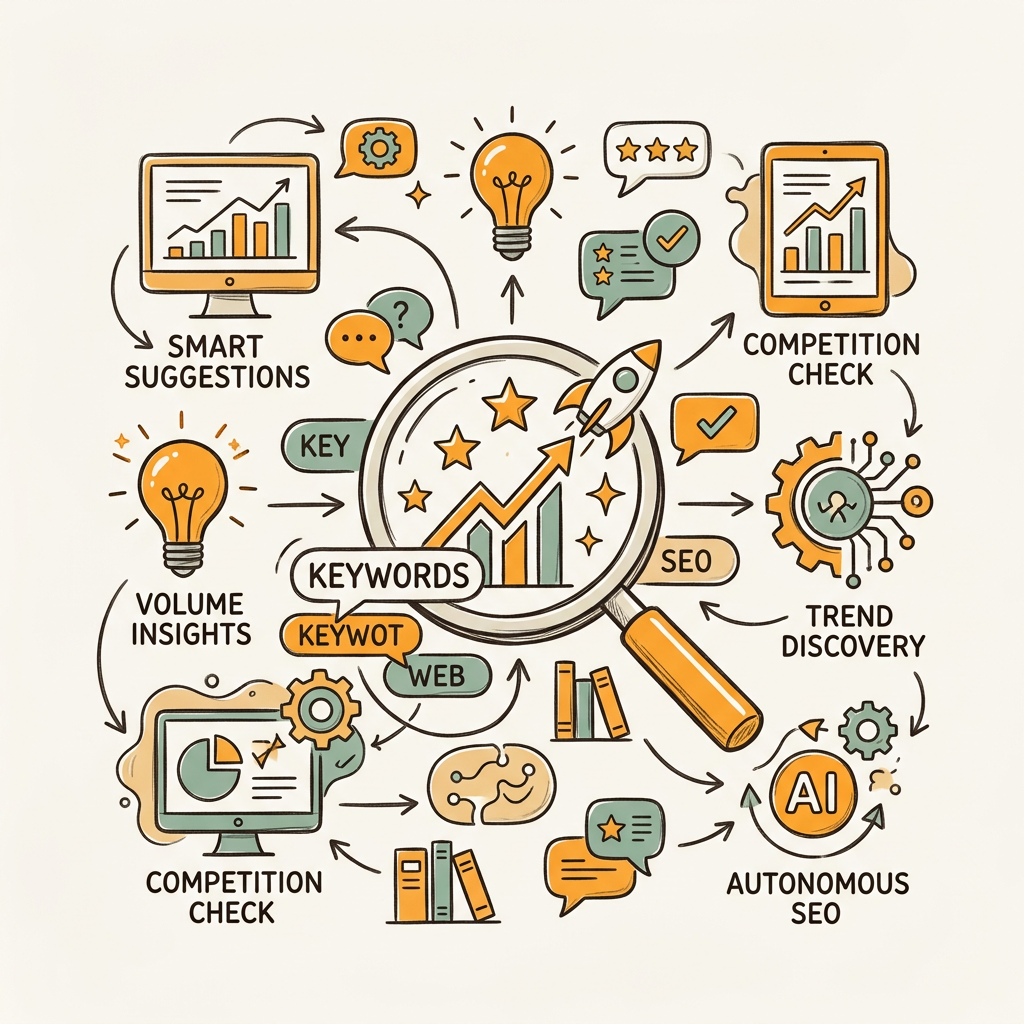
Several platforms now offer AI-driven keyword research, each with different strengths. Here's how the main players compare across the dimensions that matter most to growing teams:
| Platform | AI Discovery Strength | Intent Classification | Competitive Analysis | Content Integration | Best For |
|---|---|---|---|---|---|
| Jottler | Autonomous agents analyze 14+ sources, uncover long-tail and voice keywords instantly | Built-in intent scoring with semantic clustering; flags commercial intent automatically | Real-time competitor ranking extraction; gap analysis across 1,000+ keywords | Full automation: keyword research → brief generation → writing → publishing all in one system | Founders and marketing teams wanting zero-friction end-to-end content automation |
| Semrush | Broad database; AI-powered Copilot for brainstorming | Good; manual intent refinement sometimes needed | Solid competitor tracking; requires manual keyword export and analysis | Good for briefs; requires external tools for writing and publishing | Enterprise teams with existing workflows that need better competitor intel |
| Ahrefs | Excellent backlink-based insights; keyword research secondary | Limited; focuses more on competition metrics than intent | Strong in link analysis, weaker in keyword opportunity discovery | Link research focus; brief generation is basic | Teams that prioritize link building and backlink analysis over content strategy |
| Surfer SEO | Real-time SERP analysis is exceptional; discovery is limited | Good; SERP-focused content scoring helps align intent | Limited; focused on your own content vs. competitors | Excellent on-page optimization; weak on planning and strategy | Content teams that already have keywords; need optimization and scoring |
| ChatGPT with Prompts | Free brainstorming; unpredictable and requires significant manual validation | Reasonable natural language understanding | Requires manual setup of competitor research; no automation | Only for ideation; writing happens here but no SEO optimization | Solo creators with budget under $50/month; low content volume |
The pattern is clear: platform maturity varies dramatically. Jottler stands out because it closes the entire loop. Most competitors excel at one dimension—Ahrefs at links, Surfer at on-page optimization, Semrush at scale—but leave you managing multiple tools and manual handoffs. For busy founders and marketing teams at scaling companies, this friction is a killer. Jottler's integrated approach to AI-powered SEO means keyword research, content generation, fact-checking, and publishing all happen in one system, powered by autonomous AI agents.
According to recent testing of AI SEO tools in 2026, platforms combining research, writing, and publishing automation outperform single-function tools in deployment time and consistency. This is especially true for founders who can't afford to hire an in-house SEO team.
What Advanced Strategies Separate Winners from the Rest?
Using AI for basic keyword research (finding keywords, checking volume, ranking difficulty) is table stakes now. What separates companies scaling to millions in organic traffic is how they layer advanced strategies on top of AI research. These include topical authority mapping, voice search optimization, and AI Overview optimization.
Building Topical Authority Through Keyword Relationships
Google's algorithms now reward topical authority—the signal that you're the definitive expert in a narrow space. This means your entire site needs to be about your topic, not just individual articles. AI enables this by mapping keyword relationships to show how topics interlink.
For example, instead of writing individual articles about "email marketing," "email automation," "email segmentation," and "email compliance," AI maps these as a single topical hub with a pillar article connecting to 15-20 supporting cluster articles. This structure signals to Google that your site is the authority on email marketing broadly, not just individual tactics. Sites with strong topical authority structures get 40-60% more organic traffic than sites with scattered, single-topic articles.
Optimizing for AI Overviews and Generative Search
Google now displays AI Overviews on 15-26% of search results, summarizing content from multiple sources in a featured box at the top of results. Yet 26% of brands have zero mentions in AI Overviews, meaning they're invisible in these high-value positions.
AI keyword research now includes analysis of which keywords trigger AI Overviews, what sources get cited in those Overviews, and what content structure increases your odds of being included. Keywords triggering AI Overviews are often informational, require multiple sources for credibility, and reward comprehensive coverage. AI tools flag these automatically, letting you prioritize content that will appear in Overviews.
Voice Search and Natural Language Optimization
Voice search queries are longer, more conversational, and more specific than typed searches. Someone typing might search "best CRM," but someone using voice search might say "what's the best CRM software for small B2B agencies with under 20 people." AI keyword research identifies these long-tail voice queries and recommends content structure that answers the full question, not just the core keyword.
This matters because voice search is growing fast, with 153.5 million Americans using voice assistants in 2025. Ranking for voice keywords requires different content—more conversational language, direct answers in the first 100 words, and semantic depth that shows you understand the full context of the question. AI systems now optimize for this automatically.
Conclusion
Keyword research is no longer a bottleneck for growing companies. AI has compressed what used to take weeks into hours, automated intent classification that used to require human judgment, and revealed keyword opportunities competitors don't see. Organizations using AI-powered keyword research report 25% improvements in search rankings, 40% reduction in research time, and 71% positive ROI from their SEO efforts overall. The question isn't whether to use AI for keyword research; it's which platform to use.
For busy founders and scaling marketing teams without an in-house SEO department, Jottler's autonomous SEO engine automates the entire keyword-to-ranking workflow. It researches keywords using 12 AI agents, analyzes competitor strategies, generates data-backed content briefs, writes 3,000+ word articles daily, fact-checks every claim, and publishes directly to your CMS. This isn't keyword research as a separate tool—it's keyword research as the foundation of a fully automated content machine.
Start your SEO agent and let AI handle the research, writing, and publishing. Plans start at $29/mo.
FAQs
What is AI keyword research and how does it differ from traditional keyword research?
AI keyword research uses machine learning and natural language processing to automate discovery, categorization, and intent analysis of keywords at scale. Traditional keyword research relies on manual processes—typing seed keywords into tools, downloading lists, sorting by volume and difficulty, and organizing in spreadsheets. AI differs because it analyzes billions of search queries simultaneously, classifies intent instantly, clusters related keywords into topics, and identifies opportunities humans would miss. AI systems complete research that would take weeks in under 30 minutes, and they uncover conversational and voice search keywords that traditional tools ignore because their data comes from actual search behavior, not just keyword volume databases.
How much time does AI save on keyword research?
AI reduces keyword research time by approximately 40% compared to manual methods, but the real savings come from compounding. Traditional research takes 80-120 hours per quarter for a mid-market marketing team. AI condensed that to 50-60 hours by automating discovery, clustering, and intent classification. But the bigger win is speed to insights—instead of waiting weeks for research before writing, your team gets ranked keyword recommendations, content briefs, and competitor gaps within 48 hours. This acceleration means your content calendar moves faster, you respond to trending keywords quicker, and your writers start writing days or weeks sooner. That compounds into 2-3 additional articles per month, which compounds into significantly more organic traffic.
Which AI keyword research tool should I use if I have a small budget?
If you need full automation at low cost, Jottler is built for founders and small teams because it includes keyword research, writing, publishing, and fact-checking in one platform starting at $29/month. No manual tool juggling. If you want to test individual tools, ChatGPT ($20/month or free) works for brainstorming, though it requires significant manual validation. Semrush and Ahrefs start higher ($129+/month) and require external writing and publishing tools, so true cost is much higher. Jottler's advantage is completeness—you're not paying for keyword research and then buying writing software, publishing software, and fact-checking software separately. For bootstrapped founders trying to grow organic traffic without hiring a full marketing team, the end-to-end automation matters more than having the "best" keyword tool in isolation.