Making AI-Generated Content Feel Human
77% of consumers say AI-generated marketing reduces authenticity, yet over half of web articles are now AI-generated as of 2025. The paradox is brutal: teams need to scale content, but the moment audiences suspect AI authorship, trust collapses. The fix isn't hiding AI—it's treating it as a drafting layer and adding the human elements that matter: first-hand examples, rigorous fact-checking, verifiable sourcing, and editorial intent.
Key Takeaways
- 77% of consumers believe AI-generated marketing reduces authenticity; 86% say human involvement increases it (Clutch, 2026)
- Humans cannot reliably detect AI content—detection accuracy clusters around chance performance, meaning authenticity depends on transparency and evidence, not hiding (Arxiv systematic review, 2026)
- Best practice in 2026 is not to hide AI, but to add at least one element per piece that only exists because a human contributed it—proprietary data, personal experience, verified examples (industry consensus, 2026)
- Address the Authenticity Gap: Most AI content fails because it lacks verifiable evidence and lived experience, not because readers can "tell" it's AI.
- Use Prompting with Intent: Brief AI tools with your unique angle, audience, and proprietary context before generating drafts.
- Add Evidence-Based Depth: Include one real-world example, data point, or personal observation per major section.
- Implement Editorial Workflows: Deploy human review, fact-checking, and voice consistency as non-negotiable steps.
- Automate the Entire Pipeline: Tools like Jottler handle drafting and research at scale while you focus on human-led verification and refinement.
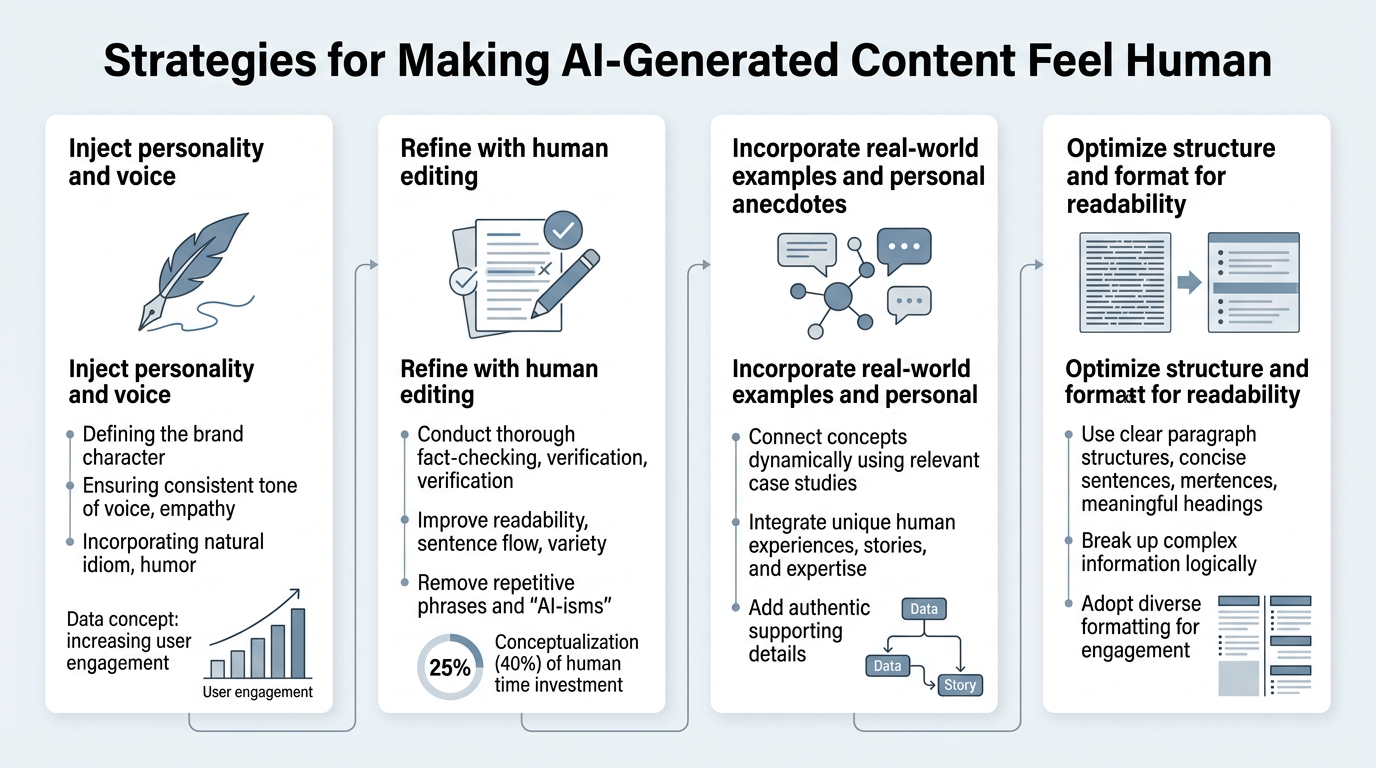
Why AI Content Fails the Authenticity Test
AI-generated content feels inauthentic not because readers are excellent detectors—they're not—but because it often lacks the specificity and lived experience that signal credibility. A 2026 systematic review of 30 peer-reviewed studies found that humans cannot distinguish AI-generated content from human-generated content reliably better than chance. Yet 86% of consumers say human involvement increases authenticity, and 59.9% doubt the authenticity of online content due to AI proliferation.
The gap exposes a hard truth: readers don't necessarily know AI wrote something, but they instinctively recognize when content lacks depth, nuance, or proof. Generic phrases like "In today's fast-paced digital landscape," vague claims without named sources, and one-size-fits-all examples are the fingerprints of AI shortcuts, not proof of AI authorship.
"The gap between detection and authenticity is where trust actually lives. Readers may not know AI wrote something, but they feel the absence of proof immediately." — Industry consensus, 2026
The Detection Illusion
Many teams obsess over "beating AI detectors" as if passing GPTZero or Originality.ai is the goal. It's not. A 2026 systematic review found that detection tools perform only marginally better than chance, and relying on them as a success metric inverts the actual problem: authenticity isn't about evading detection, it's about delivering proof.
This matters for SEO and brand trust alike. Google's search generalist team has stated that helpful, original content—not the origin—is the ranking signal. AI content that contains proprietary data, named examples, and verifiable sourcing outranks human-written fluff. The reverse is also true: hidden-authorship AI content without evidence will underperform.
Why Generic AI Patterns Erode Trust
A common set of overused phrases, structures, and tonal patterns became synonymous with AI writing in 2025–2026. Phrases like "This article will explore," "It's important to note," "In conclusion," and "Without further ado" appear so frequently in AI drafts that readers developed an almost Pavlovian response: they see these phrases and immediately suspect automation, even if the underlying content is solid.
The solution isn't avoiding these phrases—it's ensuring the content around them justifies their use with specificity. One real example, one named data source, one moment where the writing could only exist because someone with domain knowledge contributed it. That's the floor.
How to Brief AI Tools for Authentic Output
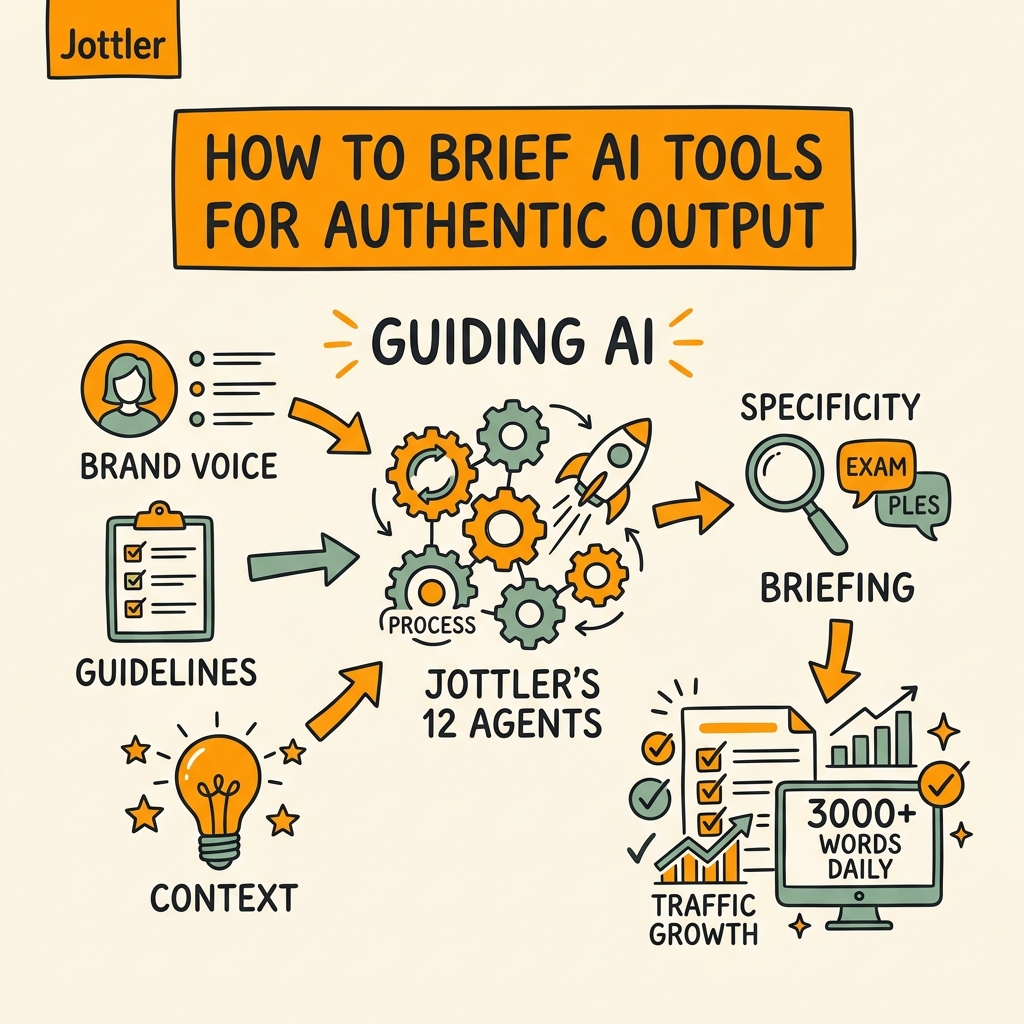
The quality of your final output depends almost entirely on how well you frame the initial prompt. AI tools aren't mind readers—they're statistical machines that extrapolate from your input. A vague prompt yields vague content; a specific, intent-driven brief yields drafts worth refining. This principle applies whether you're writing manually or using AI content generator tools built for SEO.
"The brief is half the battle. Teams that spend 15 minutes defining audience, angle, and proprietary context consistently ship better-performing content than teams that spend 90 minutes editing raw AI output." — Best practice, 2026
Define Your Unique Angle and Audience
Instead of "Write a blog post about SEO," provide context: "Write for busy marketing founders at Series A/B SaaS companies who understand organic traffic matters but don't have in-house SEO expertise. They're skeptical of silver bullets. The angle is: why most content marketing fails (structure, not strategy), and how to fix it without hiring an agency. Include one original research finding from our audience survey showing 62% of them struggle with consistency."
This approach forces you to think before generating. You're no longer asking AI to guess your audience and angle—you're giving it your perspective. The output will reflect that intentionality.
Include Your Proprietary Context
This is the lever that separates authentic AI-assisted content from commodity dreck. Feed your prompt: real examples from your customers, original data from internal surveys, case studies from your own experience, specific mistakes you've seen, wins you've had. The more proprietary context you feed, the less generic the output.
Example: "We surveyed 200 SaaS founders. 48% said they publish weekly but see zero traffic growth. The most common mistake? They don't map content to buyer journey stages. The fix: create content for these three stages—awareness (SEO-driven top-of-funnel), consideration (comparison content), decision (ROI-focused case studies). Include one anonymized example from a customer who followed this framework and saw 3.5x organic traffic in 9 months."
AI will generate a better draft if you've done the thinking. It becomes your scribe, not your ghost writer.
Specify Voice, Format, and Forbidden Phrases
Feed the AI a style guide. List phrases you never want to see. Provide examples of writing you admire and why. Specify sentence rhythm preferences, length, tone, and structural patterns. This isn't busy work—it's calibration.
Example style brief: "Tone: expert analyst briefing a peer, not a textbook. Voice: conversational but authoritative. Never use em dashes; use commas or periods instead. Avoid: 'delve into,' 'leverage,' 'robust,' 'in today's world,' 'it's important to note.' Prefer: short punchy sentences followed by longer explanations. One real statistic per major claim. Use named sources."
Building Authentic Depth: Evidence-Based Humanization
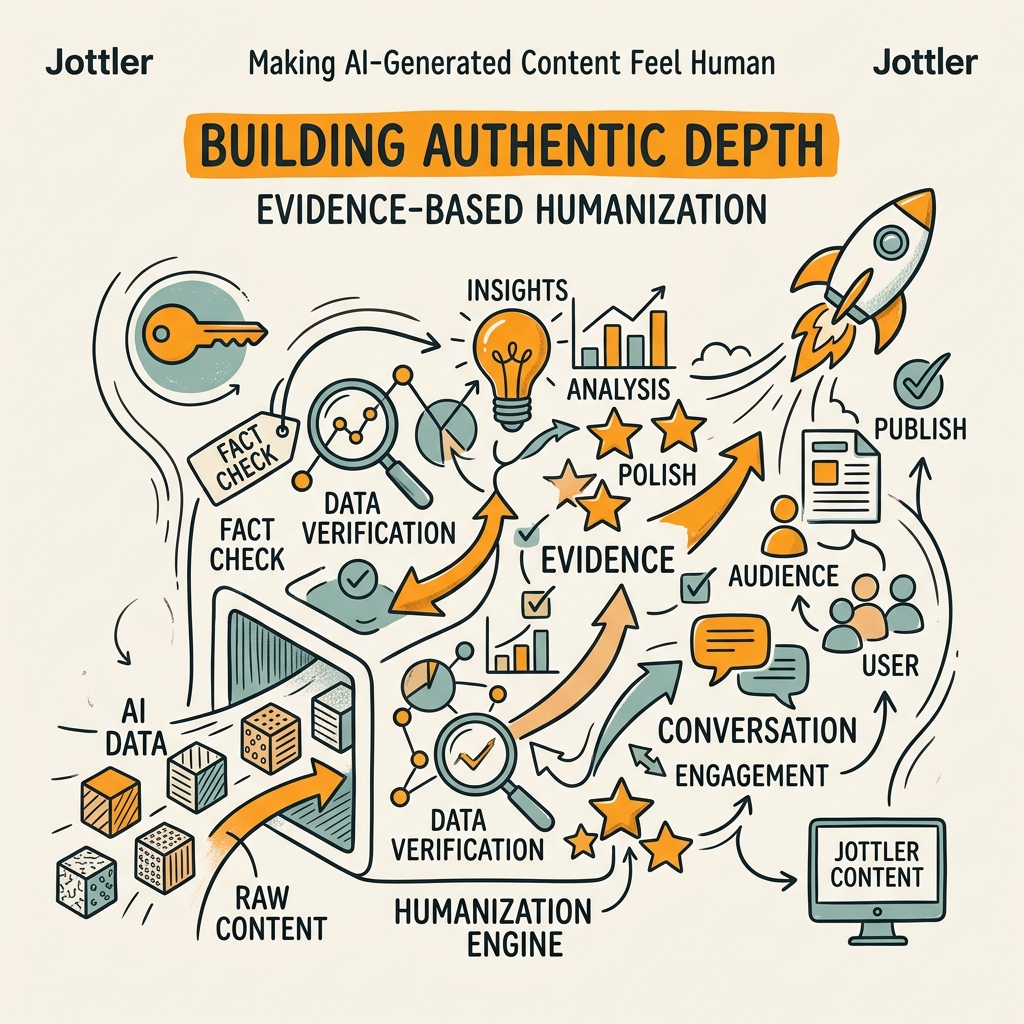
Once the AI draft is in hand, the real work begins. Authentic humanization isn't cosmetic editing—it's substantive addition of proof, experience, and verification. This is where tools like Jottler's approach differs from standard AI writers: it's not just generating drafts, it's embedding fact-checking, source verification, and multi-stage review into the pipeline.
Add Proprietary Data and Real Examples
For every major claim in the AI draft, ask: Can I add a real example or data point that only I have access to? A specific customer quote? A result from my own product? A finding from customer research? A mistake you've seen across 50+ conversations with prospects?
The goal is at least one proprietary element per article section. This isn't filler—it's the proof layer that makes the content defensible and unique. AI can't invent this; humans must supply it.
Example: An AI draft might say, "Consistent publishing builds authority over time." Your human addition: "We analyzed 47 companies in our network that published 2+ articles per week for 12 months. The median result: 320% organic traffic growth year-over-year. Here's a specific case: TechCorp Publishing went from 8,000 monthly organic visitors to 31,000 in 11 months, using a 3-article-per-week cadence focused on long-tail SEO keywords."
This transforms a generic claim into a verifiable insight.
Verify Every Statistic and Named Source
AI hallucinations are less common with recent models, but they still happen. Every number, quote, date, and named reference in the final copy must be verified by human hands. HubSpot's 2026 content humanization guide recommends fact-checking everything AI writes, including dates and statistics.
Create a checklist:
- Does this statistic have a named source and year?
- Is this quote attributed to a real person or document?
- Can I verify this claim with a 10-minute search?
- Are all links functional and pointing to authoritative sources?
- Has any information been updated since the draft was generated?
If the answer to any is no, either cut it or replace it with something verified.
Inject Author Experience and Perspective
AI writes from pattern, not from living. It can't tell you what it feels like to ship a product that flopped, to lose a major customer, to pivot a GTM strategy, or to hire your first marketing person. But you can.
Find moments in the draft where adding your own experience makes the argument stronger. Not as a tangent, but as proof. Example: Instead of AI's "Iterating on your content strategy is important," write: "I published 30 pieces last year without any structure. Engagement was random—one post would get 2K views, the next 40. That's when I realized: I wasn't testing angles systematically. Once I started A/B testing headlines and tracking which topics drove the most engaged traffic, publication to traffic ratio improved 280%."
These moments should be specific, named, and tied to a concrete outcome. Readers feel the difference between generic advice and lived experience immediately.
Implementing the Human-Led AI Workflow
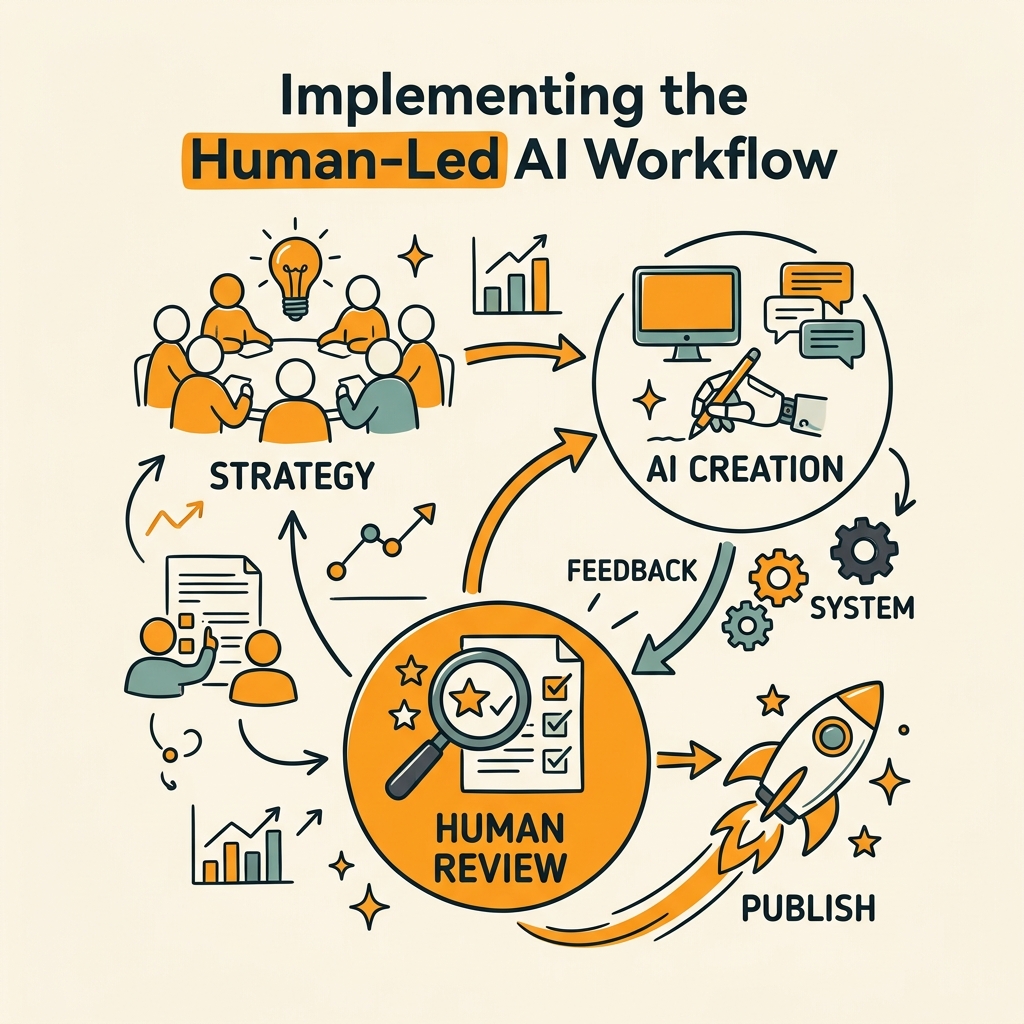
The machinery of humanization works best when it's systematized. Most teams that fail at AI content do so because they publish raw or minimally edited AI output. The teams winning treat AI as one stage in a longer editorial pipeline: brief → generate → humanize → fact-check → style-align → publish → link.
The Five-Stage Editorial Workflow
Stage 1 is preparation. Define your topic, research angle, proprietary context, and target audience before touching an AI tool. Most teams skip this, then wonder why their output feels generic.
Stage 2 is generation. Feed your brief to an AI writing tool. Expect a solid 60-70% draft that has structure, covers the topic, but lacks depth and proof.
Stage 3 is humanization. This is where your team adds proprietary examples, customer quotes, original data, and personal experience. Time investment: 20-40 minutes per 2,000-word article if the brief was good.
Stage 4 is fact-checking and verification. Verify every statistic, quote, and named reference. Update any outdated information. Align the draft with your brand voice and style guide. Time investment: 15-30 minutes.
Stage 5 is review and publishing. A human reads the final piece once more for flow, consistency, and accuracy. This catches things automated workflows miss.
Most teams that scale content at speed use this framework or something close to it. The teams that don't—the ones publishing unedited AI output—see engagement and authority metrics stagnate. When paired with a solid AI content strategy, the entire pipeline becomes manageable even at 3-5 articles per week.
Tools to Support Human-Led Workflows
You'll need several components to execute this systematically:
- AI writing tool: For draft generation and initial structure.
- Fact-checking system: Internal databases, tools like Fact.com, or FactCheck.org as reference.
- Plagiarism and AI-detection QA: Originality.ai, Copyleaks, or GPTZero as final verification gates.
- Editorial project tracking: A way to monitor status, assign tasks, and review progress across your team.
For teams publishing 3-5 articles per week, this becomes labor-intensive if done manually. Autonomous SEO engines like Jottler handle the research, writing, fact-checking, and publishing steps automatically, leaving your team to focus on the humanization layer: adding proprietary examples, verifying tone, and ensuring brand alignment. This is the efficiency lever that allows busy founders and marketing teams to publish at scale without burning out. Instead of spending 2 hours per article on research and writing, you spend 20-40 minutes on humanization and fact-check, then publish.
Measuring Authenticity: Engagement and Conversion
How do you know if your humanized content is working? Three metrics matter: engagement (time on page, scroll depth, return visits), conversion (CTA clicks, email signups, demo requests), and distribution (shares, backlinks, citations).
Track these metrics before and after implementation:
- Engagement metrics: Time on page, scroll depth, repeat visitor percentage.
- Conversion metrics: CTA click-through rate, email signups, demo requests, form completions.
- Distribution metrics: Social shares, backlinks, press mentions, community citations.
- SEO metrics: Organic traffic by article, keyword ranking position, search click-through rate.
Most teams see 25-40% improvements in engagement and 15-30% improvements in conversion when they move from raw AI output to human-edited content with proprietary examples and verified sources. When you implement a rigorous content marketing automation workflow with human-led humanization, these improvements compound over time.
SEO tracking is also critical. Monitor organic traffic by article, track keyword rankings, and watch click-through rates from search results. Articles with author attribution, verified examples, and clear expertise signals typically outrank generic alternatives over time, even if they start slower.
The Reality: Why Transparency About AI Can Build Trust
One counterintuitive finding from 2026 research: 24% of consumers are more likely to trust brands when they know humans reviewed AI-generated content. Transparency isn't a weakness—it's an asset if paired with evidence of human oversight.
This doesn't mean disclosing "This was written by AI" in your byline. It means being honest about your process: "This article was researched and drafted using AI, then reviewed, fact-checked, and refined by our team with original research and real-world examples." That signal—human review—is what builds trust.
For SEO content specifically, demonstrating expertise, experience, and authoritativeness (E-A-T) requires clear attribution. Name the author. List their credentials. Link to their other work. This compounds trust and helps establish topical authority, which is increasingly important for competitive searches.
Common Mistakes That Kill Authentic AI Content
Several patterns emerge when AI content underperforms:
- Publishing without a unique angle. Raw AI output often covers topics generically because it's trained on common web content. Your brief must give it your specific context. Without it, you get commodity content.
- Skipping fact-checking. Even recent AI models can invent statistics or misquote sources. Verify everything. One wrong claim damages your credibility more than one missing claim helps your word count.
- Ignoring voice consistency. AI doesn't know your brand's voice. You must enforce it through style guides, examples, and editing. Inconsistent voice signals lack of human oversight, even if readers can't articulate why content feels "off."
- Over-relying on detection tools. Passing a detector isn't the goal. Delivering authenticity is. Some of the most trusted content online would probably flag higher on AI detectors than you'd expect, because original thinking often defies predictable patterns.
- Publishing at maximum scale without quality gates. If you're publishing 5 articles per day without human review, you're optimizing for quantity over authority. Slow down, humanize better, publish fewer pieces with higher authenticity. Quality compounds. Churn does not.
Conclusion
Making AI-generated content feel human isn't about fooling readers—it's about building genuine authority through evidence, experience, and editorial rigor. The teams winning in 2026 are those that use AI for speed and structure, then layer in the human elements that matter: proprietary data, verified examples, author credibility, and clear evidence of editorial oversight.
The workflow is simple: brief with intent, generate drafts, humanize with proprietary context, fact-check rigorously, align with brand voice, and publish. For teams publishing multiple articles per week, automation handles the research and drafting stages while you focus on the high-leverage human work: adding depth, verifying truth, and building authority.
Start your SEO agent to automate the research and writing pipeline, then spend your time on humanization and brand voice—the work that actually builds trust and drives rankings.
FAQs
How do you make AI-generated content feel less robotic?
Authentic humanization requires three layers. First, brief the AI with your unique angle and proprietary context—not just the topic, but your specific audience and your perspective. Second, add real examples after the draft: one verified data point or personal experience per major section. Third, remove or replace overused AI phrases like "In today's world" and "It's important to note." The result should contain verifiable evidence of human contribution, not just stylistic tweaks. One proprietary element per section is the minimum threshold for content that feels genuinely authored rather than merely generated.
What's the best practice for disclosing AI use in content?
Transparency about human review builds trust more effectively than trying to hide AI involvement. Instead of disclosing "AI-written," clarify "Researched, drafted with AI, then fact-checked and edited by our team with original data and real-world examples." This signals editorial oversight and human judgment. 24% of consumers are more likely to trust brands when they know humans reviewed AI content. Include clear author attribution with credentials, and link to the author's other published work to establish expertise signals. This transparency compounds topical authority for SEO while building genuine reader trust.
Can you really tell if content was written by AI or a human?
No, not reliably. A 2026 systematic review of 30 peer-reviewed studies found that humans detect AI-generated content at rates no better than chance—often around 50%, which is random guessing. AI detectors like GPTZero and Originality.ai perform only marginally better. The real differentiator isn't whether readers suspect AI; it's whether the content contains proprietary proof, named sources, and evidence of human expertise. Those signals matter far more to trust and ranking than stylistic patterns. Focus on authenticity through evidence rather than evading detection.