Marketing Automation Platform Comparison: HubSpot vs Marketo vs Pardot
Choosing a marketing automation platform is one of the highest-leverage decisions a growing company can make. Your choice determines how efficiently your team scales campaigns, nurtures leads, and measures revenue impact. Yet 33% of marketing professionals cite lack of know-how as the main barrier to adoption, and 20% struggle to select the right tool in the first place. The difference between HubSpot, Marketo, and Pardot isn't subtle. One platform prioritizes ease and speed; another demands operational sophistication; the third locks you into the Salesforce ecosystem. Understanding which fits your team's stack, budget, and operational maturity is critical. Here's a breakdown of each platform's real strengths and tradeoffs.
Key Takeaways
- 87% of marketing teams are already using marketing automation or plan to adopt it, with clear platform winners emerging by company size (2026, Market.us)
- HubSpot wins for speed and transparency; Marketo wins for enterprise sophistication; Pardot wins for Salesforce-native organizations
- Time-to-value ranges from 4–6 weeks (HubSpot) to 3–6 months (Marketo), directly impacting your ability to drive results quickly
- HubSpot's All-in-One Advantage: Transparent pricing, native CRM, and 4–6 week deployment make it the fastest route to productivity for teams under 500 employees.
- Marketo's Enterprise Depth: Advanced automation, token-driven personalization, and multi-brand governance justify the complexity and 3–6 month implementation for large organizations.
- Pardot's Salesforce Alignment: Native CRM sync and B2B workflow integration appeal to companies already standardized on Salesforce.
- Pricing Transparency Matters: First-year TCO ranges from ~$80,000 (HubSpot) to $200,000+ (Marketo), making cost modeling essential.
- AI is Table Stakes: All three platforms now embed predictive analytics, content assistance, and conversational tools—the market shifted in 2025.
HubSpot: Speed and Simplicity for Growing Teams
HubSpot dominates the mid-market because it solves the wrong-platform problem most elegantly. You get a unified CRM, marketing automation, sales tools, and built-in reporting without cobbling together separate systems. The typical professional plan runs around $890/month, with transparent per-seat and per-contact pricing that scales predictably. Implementation takes 4–6 weeks, which means your team goes live while the decision still feels fresh.
"HubSpot doesn't go as deep into enterprise-grade automation as Marketo, but for most B2B teams under 500 employees, those features are overkill. You'll spend less time configuring and more time shipping campaigns."
The trade-off is that HubSpot doesn't go as deep into enterprise-grade automation as Marketo. You won't find token-driven personalization or multi-model lead scoring. But for most B2B teams under 500 employees, those features are overkill. You'll spend less time configuring and more time shipping campaigns.
When to Choose HubSpot
HubSpot is the right call when your team values speed over operational complexity. You're building a go-to-market engine that needs to move fast. HubSpot's native CRM means your sales and marketing teams work from the same data, reducing integration friction. The interface is built for marketers, not engineers. Setup doesn't require a dedicated marketing operations hire.
You'll want HubSpot if:
- Budget for quick time-to-value: Your board wants results in 6 weeks, not 6 months.
- All-in-one stack matters: You'd rather add seats to one platform than manage Salesforce + MAP + BI tool integrations.
- Transparent pricing is non-negotiable: You need predictability in your tech spend, not surprise implementation costs.
- Your team is under 500 people: HubSpot's architecture scales well up to mid-market; beyond that, enterprise platforms often win on sophistication.
HubSpot's Real Limitations
If Salesforce is your system of record and you have a large, established CRM footprint, HubSpot's Salesforce integration works but lacks the bidirectional sync depth that Marketo offers. You also can't do token-driven personalization or run program-level cloning at Marketo's scale. Lead scoring in HubSpot is functional but less nuanced than Marketo's multi-model approach.
HubSpot's pricing can creep up as your contact database grows. If you're managing 1 million contacts across multiple brands, HubSpot's per-contact model becomes expensive fast compared to Marketo's enterprise licensing. For teams committed to content marketing automation, this scaling cost matters more than most realize.
Marketo: Enterprise Automation for Complex B2B Motions

Marketo (Adobe Marketo Engage) is the sophisticated sibling. It's built for large organizations with dedicated marketing operations teams and complex go-to-market machinery. You get advanced lead scoring, token-driven personalization, program cloning, and multi-touch attribution. Marketo integrates deeply with Adobe Experience Cloud and Salesforce, making it the default choice for enterprises already in that ecosystem.
"Marketo doesn't publish pricing, and implementation typically runs 3–6 months. First-year total cost of ownership can exceed $200,000, including implementation, onboarding, and internal ops staffing. The platform demands operational sophistication that mid-market teams often underestimate."
The catch? Marketo doesn't publish pricing, and implementation typically runs 3–6 months. Mid-market deployments commonly land $3,000–$5,000/month once database and feature tier are factored in. First-year total cost of ownership can exceed $200,000, including implementation, onboarding, and internal ops staffing.
When to Choose Marketo
Marketo wins when complexity is a feature, not a bug. You have multiple business units, brands, or regions running simultaneous campaigns. Your sales and marketing organizations are large enough to justify a dedicated marketing operations person (or team). You need multi-touch attribution, advanced segmentation, and campaign governance. Your data lives in Salesforce, and bidirectional campaign sync is non-negotiable.
Choose Marketo if:
- Enterprise scale: Your organization has 500+ employees and complex go-to-market workflows.
- Salesforce is foundational: You need deep Salesforce integration with program-to-campaign syncing.
- Multi-brand governance: You run multiple brands or business units with distinct automation rules.
- Implementation capacity: You have the internal or agency resources to manage a 3–6 month rollout.
- Advanced analytics: You need multi-touch attribution, journey analytics, and BI-style customization.
Marketo's Real Limitations
Marketo has a steep learning curve. The UI and architecture assume users understand marketing operations at a professional level. Setup requires specialized knowledge. There's no free tier or trial—you need to sign a contract to even test the platform.
Marketo's time-to-value is long. Most teams take 3–6 months to see meaningful automation benefits. If your board expects results in the first quarter, Marketo creates political friction. The platform also doesn't include a native CRM, which means you're running Salesforce + Marketo + potentially a BI tool, increasing total cost and integration complexity.
Pardot: The Salesforce Native Option

Salesforce Pardot (now called Salesforce Marketing Cloud Account Engagement) occupies a middle ground. It's purpose-built for Salesforce organizations. If Salesforce is your system of record, Pardot's native integration is seamless. Lead scoring, grading, and engagement studio workflows feel like native Salesforce features. No separate data sync required.
"Pardot pricing starts around $1,250/month for the Growth tier. Implementation typically takes 6–12 weeks, depending on your Salesforce maturity. It's cheaper than Marketo but more expensive than HubSpot's entry-level tiers, and it doesn't include the broad marketing suite that HubSpot offers."
Pardot pricing starts around $1,250/month for the Growth tier. Implementation typically takes 6–12 weeks, depending on your Salesforce maturity. It's cheaper than Marketo but more expensive than HubSpot's entry-level tiers, and it doesn't include the broad marketing suite that HubSpot offers (no content management, no social, no email builder as robust as HubSpot's).
When to Choose Pardot
Pardot is the obvious choice if Salesforce is your platform of record and you're already committed to the ecosystem. You want marketing automation that feels like an extension of Salesforce, not a separate system. Your team is comfortable with Salesforce's UI and workflow philosophy. You prioritize revenue operations alignment over marketing-suite breadth.
Choose Pardot if:
- Salesforce is your CRM: You've standardized on Salesforce and want native automation without a separate platform.
- Lead scoring + grading are core: Pardot's native scoring and grading are strong and deeply integrated with Salesforce opportunities.
- Reporting lives in Salesforce: You prefer reporting within Salesforce or via Tableau rather than in a separate platform.
- B2B fundamentals matter most: You don't need the full marketing suite—email, landing pages, analytics—you want solid automation and tight Salesforce alignment.
Pardot's Real Limitations
Pardot's email builder and landing page builder are functional but less intuitive than HubSpot's. Reporting depth is limited within Pardot itself; you often need to pull data into Salesforce or Tableau for serious analysis. The platform doesn't include a content management system or social publishing tools, so you're managing content separately.
Pardot also assumes your team is already fluent in Salesforce. If you're moving from another CRM, there's a learning curve. And if you later decide to move away from Salesforce, Pardot goes with it—you're locked into the ecosystem, which limits future flexibility. This is why many growing teams pair Pardot with AI content writer tools to maintain independence over content strategy.
Head-to-Head: Feature and Pricing Comparison
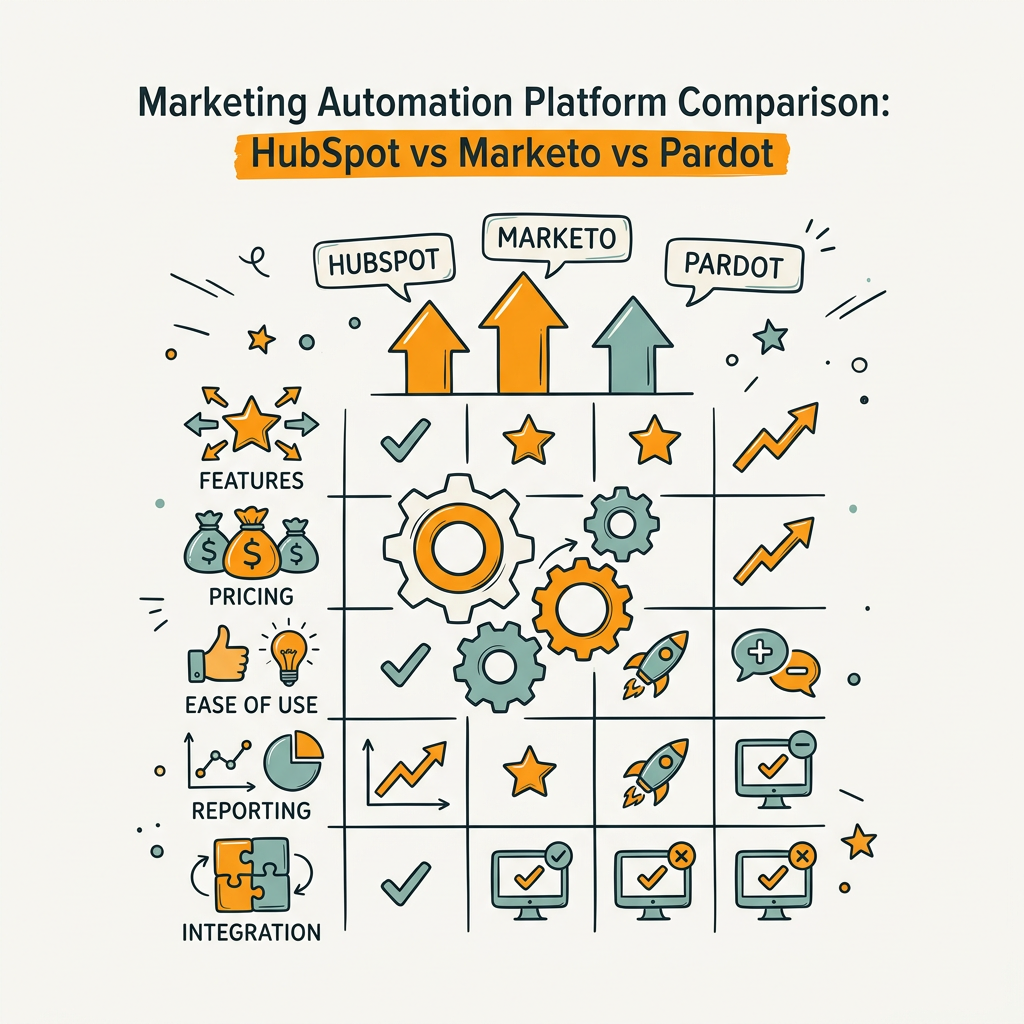
The clearest way to compare these platforms is side-by-side across the dimensions that matter most: ease of use, CRM integration, automation depth, price, and time-to-value. Here's the breakdown:
| Feature / Dimension | HubSpot Marketing Hub | Adobe Marketo Engage | Salesforce Pardot / Account Engagement |
|---|---|---|---|
| Best For | Mid-market B2B teams under 500 people | Enterprise organizations with complex automation | Salesforce-standardized B2B teams |
| Starting Price | $20–$890/month (transparent per-contact/seat pricing) | $895–$1,000+/month (quote-based; often $3,000–$5,000 mid-market) | $1,250/month (Growth tier) |
| Time to Value | 4–6 weeks | 3–6 months | 6–12 weeks |
| Native CRM Included | Yes (full-featured) | No (requires Salesforce or other CRM) | No (assumes Salesforce) |
| Lead Scoring | Good (functional, not multi-model) | Advanced (predictive, multi-model, tokens) | Good (native Salesforce integration) |
| Salesforce Integration | Functional (one-directional, limited campaign sync) | Deep (bidirectional, program-to-campaign sync) | Native (seamless, zero friction) |
| Email / Landing Pages | Excellent (intuitive, powerful, AI-assisted) | Excellent (advanced, tokens, cloning) | Functional (less intuitive than competitors) |
| Automation / Workflows | Good (visual, easy to configure, limited depth) | Advanced (templates, cloning, complex logic) | Good (Salesforce-native, limited breadth) |
| Reporting & Analytics | Built-in (good for mid-market, no extra tools) | Advanced (custom BI, multi-touch attribution) | Limited (often requires Tableau or Salesforce) |
| Ease of Use | High (built for marketers, minimal ops burden) | Medium-Low (requires marketing ops expertise) | Medium (Salesforce-familiar, but limited breadth) |
| Content Management System | Yes (included) | No | No |
| Free Trial / Free Tier | Yes (free CRM + limited trial) | No | No |
| First-Year TCO (Typical) | ~$80,000 (mid-market estimate) | ~$200,000+ (mid-market estimate, with implementation) | ~$120,000 (mid-market estimate, with Salesforce) |
The data is clear: HubSpot delivers speed and transparency. Marketo delivers sophistication. Pardot delivers Salesforce native alignment. For busy founders and growing marketing teams, there's also a fourth option worth considering.
The Case for Automating Marketing Automation Itself
There's an underrated dimension to this comparison: how much human effort goes into keeping these platforms productive. HubSpot requires less setup but needs constant attention to nurture campaigns and reporting. Marketo requires sophisticated ops work to unlock its potential. Pardot requires Salesforce expertise to maximize ROI.
For growing companies with limited marketing operations bandwidth, the real win isn't choosing the "best" platform—it's automating the platform itself. That's where SEO automation and content production tools come in. Rather than spending months configuring lead scoring models in Marketo or months building nurture sequences in HubSpot, you can automate the research, writing, and publishing that feeds those workflows.
The three platforms compared here are all strong at execution once campaigns are built. But building and maintaining those campaigns takes time. Marketing teams report 92% use automation for data analysis and reporting, yet many still spend weeks building the content and segments that make those workflows valuable.
The most efficient organizations don't pick the "most sophisticated" platform. They pick the platform that best fits their team size and CRM ecosystem, then automate everything upstream—research, content creation, segmentation—so they can focus on orchestration and measurement.
How to Choose: A Decision Framework
Stop debating platforms in abstract terms. Use this framework instead:
- Start with your CRM: Is Salesforce your system of record? If yes, seriously evaluate Pardot. If no, Marketo and HubSpot are peers. If you don't have a CRM yet, HubSpot includes one—instant advantage for speed.
- Assess team size and maturity: Do you have dedicated marketing operations staff? If yes, Marketo's sophistication is worth the complexity. If no, HubSpot's simplicity wins. If you have 1–2 ops people, Pardot's Salesforce alignment saves them time.
- Model total cost over 3 years: Don't compare list prices. Build a spreadsheet including platform fees, implementation, onboarding, ongoing services, additional seats, CRM licensing, and BI tools. HubSpot's transparency usually reveals lower TCO for mid-market. Marketo's custom pricing often hides higher costs.
- Benchmark time-to-value: If you need marketing campaigns running in 6 weeks, HubSpot wins. If you can wait 3–6 months for enterprise-grade automation, Marketo is defensible. Pardot is the middle ground: 6–12 weeks, assuming Salesforce maturity.
- Test with real data: Don't sign a 2-year contract based on a 30-minute demo. Request a trial or proof-of-concept that includes data migration and at least one end-to-end workflow. How hard is it actually to set up lead scoring? How intuitive is the automation builder?
Conclusion
The marketing automation space consolidated around three clear leaders, each with distinct strengths. HubSpot dominates the mid-market because 4–6 week implementations and transparent pricing reduce organizational friction. Marketo remains the enterprise standard where advanced automation, multi-touch attribution, and dedicated ops teams justify the complexity and higher cost. Pardot holds ground with Salesforce-standardized organizations because native CRM integration eliminates data sync headaches.
But the platform itself is just infrastructure. The real competitive advantage goes to teams that automate not just campaign execution, but campaign creation. That means investing in content marketing strategy that feeds your platform, rather than building strategies inside the platform.
The best choice depends on your CRM ecosystem, team size, and operational maturity. Use the decision framework above. Model total cost of ownership honestly. And don't underestimate the compounding value of automating the upstream work—research, content, segmentation—that makes any platform truly productive. Start your SEO agent at https://jottler.co/auth/signup and automate the research and writing that feeds your lead generation engine.
FAQs
Which marketing automation platform is best for small teams?
HubSpot is the clear winner for teams under 100 people. It combines a free CRM, intuitive automation, and transparent pricing that scales with your headcount. You can launch campaigns in 4–6 weeks without a dedicated marketing operations hire. Marketo requires too much sophistication for teams that size, and Pardot assumes Salesforce maturity that smaller organizations often haven't reached. Start with HubSpot's Professional plan around $890/month and scale up as you grow.
Is Marketo worth the cost for mid-market companies?
Marketo justifies its cost only if you have complex automation needs that HubSpot can't solve. If you're running multi-touch attribution across dozens of simultaneous campaigns, need token-driven personalization at scale, or have dedicated marketing operations staff, Marketo's sophistication pays for itself. But if your workflow is straightforward nurture sequences and lead scoring, HubSpot typically delivers better ROI at half the cost. Model both platforms with your actual contact volume and integration needs—the true cost gap often emerges in implementation, not pricing.
Should we switch to Pardot if we're on Salesforce?
Only if Salesforce is truly your system of record and your team is already fluent in Salesforce workflows. Pardot eliminates data sync friction and keeps your revenue operations tightly integrated. But it doesn't include the full marketing suite that HubSpot offers—no native content management, no social publishing, and weaker email builders. If you're also managing brand content, website hosting, or social campaigns outside Salesforce, HubSpot's all-in-one approach may actually save you time and cost despite looser CRM integration. Evaluate the full marketing tech stack, not just the CRM layer.