Meta Descriptions That Click: Writing for CTR and Rankings
Your meta description is a 160-character promise that decides whether a searcher clicks your link or scrolls past it. Yet 77% of websites have weak or missing meta descriptions, leaving free traffic on the table. Google doesn't directly rank on meta description contentbut it does watch what happens after someone lands on your result. A 16.6% relative CTR increase from better descriptions signals relevance to the algorithm, which slowly lifts your position over time.
Key Takeaways
- Well-written meta descriptions can lift CTR by 17–24% within 60 days of optimization (2025, The GWW)
- Descriptions containing exact search query terms received 26% more clicks than generic alternatives
- AI-generated meta descriptions produced a 16.6% relative CTR increase versus human-written controls in a 12-week test across 2,400 URLs (2025, Academia)
- Why CTR Matters in SEO: More clicks signal relevance; Google uses CTR as an indirect ranking factor that compounds over weeks.
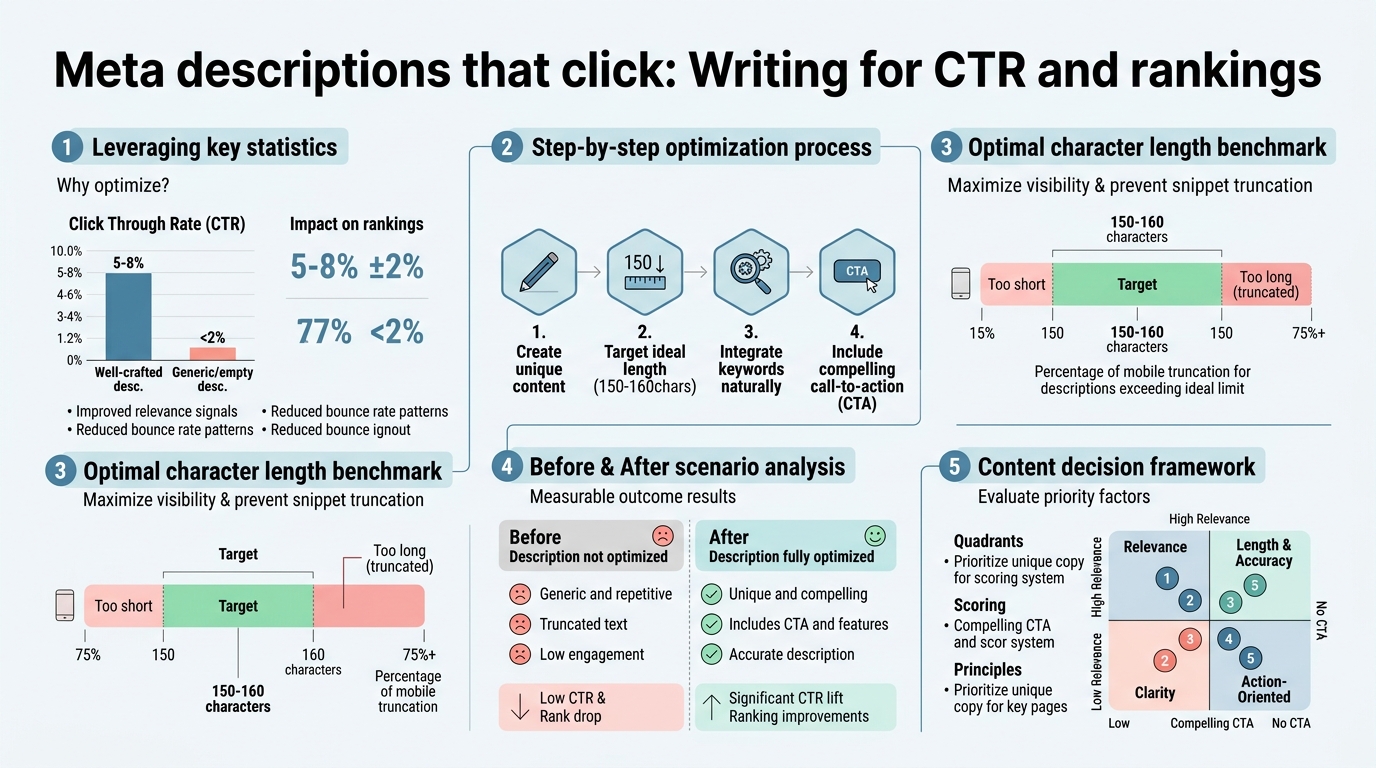
- The 160-Character Rule: Stay between 120–160 characters to avoid truncation across desktop and mobile SERPs.
- Structure That Works: Lead with your main value, prove it with specifics, and close with a clear call to action.
- Uniqueness Is Non-Negotiable: Duplicate descriptions tank engagement; each page needs its own description that matches its unique content.
- Testing and Measurement: Use Google Search Console to isolate CTR improvements from ranking fluctuations and SERP feature changes.
How Do Meta Descriptions Affect Click-Through Rates?
Meta descriptions don't directly impact your ranking positionGoogle confirmed this explicitly. But they drive CTR, which Google uses to validate that your page is a good result for the query. When more people click your link in the search results, Google's algorithm interprets that as user satisfaction. Over 2–4 weeks, this accumulated signal can push you up a position or two, especially if you're sitting in slots 3–6 where CTR variance has the most impact.
The indirect path is the lever: better CTR → more clicks → stronger quality signal → gradual ranking lift → compounding traffic growth. Tools like Search Engine Land emphasize that meta descriptions should be "concise, informative and compelling" to maximize this effect. This is fundamental to any SEO content strategy that drives sustainable organic growth.
CTR as an Indirect Ranking Factor
Google watches CTR behavior across millions of queries to validate ranking relevance. If your page is in position 4 but your CTR beats position 3, the algorithm notes it. That's not one clickit's the pattern. A 30% CTR lift across 100 monthly impressions is 3 extra clicks Google's system registers as "this result is better than the one above it." This signal accumulates. Within 4–6 weeks of consistent outperformance, your ranking typically climbs.
This is why meta description optimization is often paired with title tag optimization. Both work together to maximize the incentive to click. A mediocre title with a great description still underperforms; a great title with a weak description leaves conversions on the floor.
The CTR-to-Ranking Flywheel
The process is cyclical. A better CTR leads to more organic clicks. More clicks mean your page spends less time as a bounce. Lower bounce rates signal better user intent match. Better engagement metrics compound the quality signal. Within a 60-day window, teams using systematic meta description optimization report 17–24% CTR improvement, which typically translates to measurable ranking gains in 4–8 weeks. For scaling content programs, this is why content marketing automation tools that test and iterate meta descriptions at scale become competitive advantages.
What Makes a Meta Description Click-Worthy?
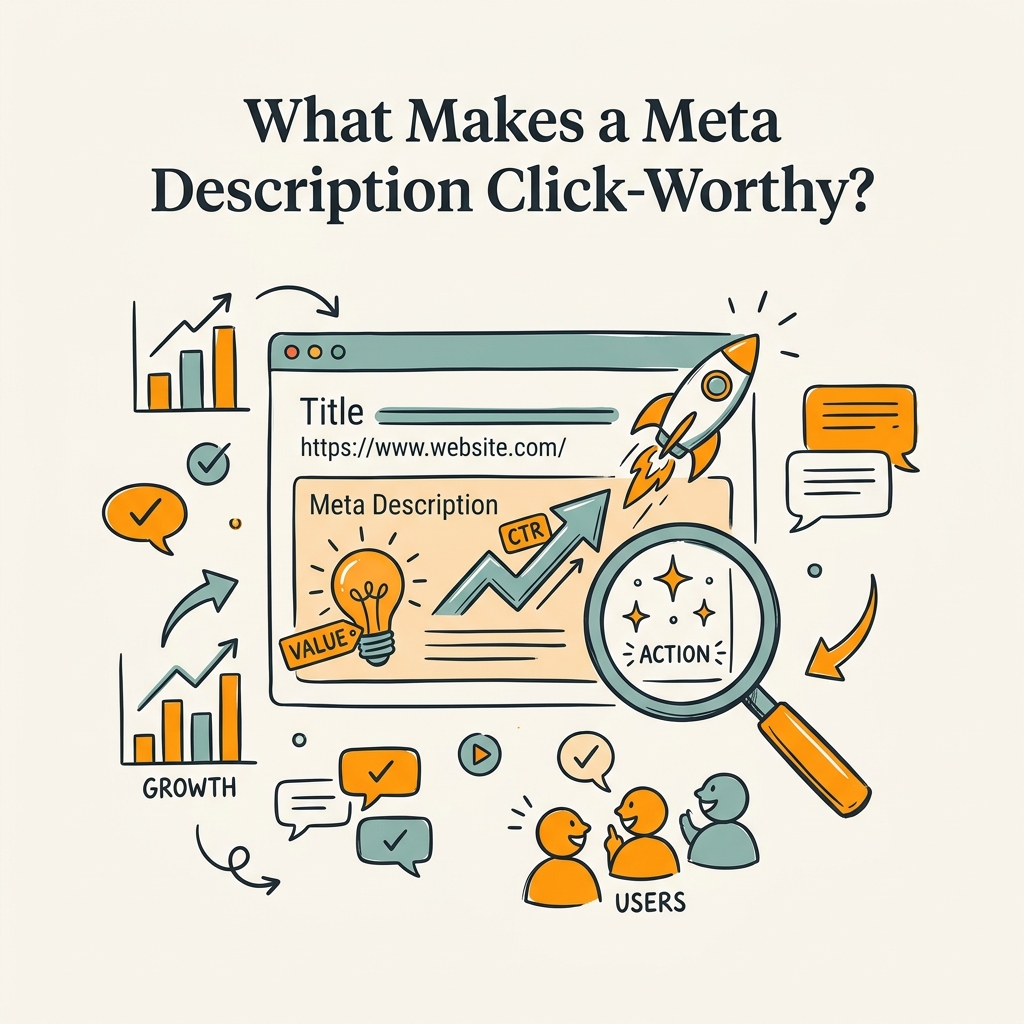
A click-worthy description answers three implicit questions searchers ask: "Is this page exactly what I'm looking for?" "Will I get value quickly?" "Should I click this over the other results?" Descriptions containing the exact search query term received 26% more clicks than those that didn't mention it. That specificity tells the searcher they've landed on the right result in a glance.
The Promise + Proof + CTA Framework
The strongest meta descriptions follow a clear structure. First, state the primary benefit or answer (Promise). Second, add a specific detail or number that proves you deliver (Proof). Third, include a subtle action cue (CTA). This isn't salesyit's directional.
- Promise: "The complete guide to scaling organic traffic without burnout" tells the reader they're in the right place
- Proof: "7 tested strategies" or "Used by 500+ startups" or "Updated 2026" gives concrete reason to believe
- CTA: "Learn how," "Discover," "Compare," or "Get started" creates a micro-commitment to click
Example: "Master meta descriptions in 5 minutes. See how top SEO teams increased CTR 24%. Read our tested framework." That's 125 characters, includes the keyword, adds proof, and ends with an action.
Why Specificity Beats Generic Copy
Searchers scan SERPs for differentiation. Generic descriptions like "Learn about X" blend into the noise. Descriptions including specific statistics improved clicks by 14–19% in controlled tests. Numbers are cognitive anchors. They signal authority and clarity.
- Generic: "Learn how to improve your click-through rates"
- Specific: "Increase CTR 17–24% in 60 days with our 5-step meta description framework"
The specific version tells the reader: timeline (60 days), outcome (17–24% improvement), and structure (5 steps). Each detail increases confidence and click probability.
The Role of Active Voice and Action Words
Descriptions written in active voice with action-oriented verbs outperform passive phrasing. Descriptions starting with verbs saw 17% higher CTR than those starting with nouns or adjectives. Verbs create movement and agency.
- Passive/Weak: "Meta descriptions are important for SEO"
- Active/Strong: "Master the meta description framework that drives 24% more clicks"
The second version invites action ("Master") and promises an outcome ("24% more clicks"), making the searcher feel proactive rather than passive.
How to Write Meta Descriptions That Rank and Convert
The 160-character limit is structural, but the real constraint is cognitive. You have one sentence to convince someone to click. Industry best practice emphasizes relevance, then measurement using Google Search Console to test and isolate improvements. Here's the tactical process.
Step 1: Target the Exact Search Query in Your Description
Google favors descriptions that echo the search intent. If someone searches "how to write meta descriptions," your description should contain that phrase or a very close variant. Descriptions containing the exact search query term received 26% more clicks than generic alternatives.
The searcher sees their query bolded in the description, which creates visual confirmation they're on the right page. It's a pattern-matching signal their brain processes in milliseconds.
Example: Query: "meta description best practices." Description: "Master meta description best practices in 2026. Boost CTR, improve rankings, and drive more organic traffic. Read our complete guide."
Step 2: Lead with Benefit, Not Features
The first 60 characters are the most scanned part of a description. Use them to answer "What do I get?" not "What is this?"
- Weak feature-first: "Our article covers HTML meta descriptions, character limits, and keyword placement"
- Strong benefit-first: "Increase your CTR 20% by mastering 5 critical meta description tactics"
The benefit-first version tells the reader the outcome immediately. They know why they should click before reading further. This mirrors how top AI SEO optimization tools structure their own landing pagesleading with outcome metrics rather than feature lists.
Step 3: Add a Specific Number or Proof Point
Numbers break the monotony of wordy descriptions and signal credibility. Adding specific statistics to descriptions improved clicks by 14–19%. The number doesn't have to be your own; it can be an industry benchmark, a statistic from your page, or a timeframe.
- "Learn 7 strategies..."
- "Boost CTR by 24%..."
- "Updated 2026 with..."
- "Used by 500+ companies..."
Each of these anchors the reader's expectation and makes the description feel more concrete.
Step 4: Stay Between 120–160 Characters
Google truncates descriptions around 155 characters on desktop and 120 on mobile. Anything beyond 160 risks being cut off, losing your CTA. Use the full space, but don't sacrifice clarity for length.
A tight, scannable description of 130 characters often outperforms a wordy 160-character one because the reader can process it instantly. Test both formats in Google Search Console over a 2-week window to see which performs better for your audience.
Step 5: Close with a Micro-CTA
A micro-CTA is a subtle action word that nudges the click. It's not "BUY NOW"that's aggressive for search results. Instead, use:
- "Discover..."
- "Learn how..."
- "See how..."
- "Compare..."
- "Get started..."
- "Read the guide..."
This creates a psychological micro-commitment. The reader isn't just reading passive information; they're about to actively engage. That friction, paradoxically, increases click probability because it frames your page as worth the effort.
Common Meta Description Mistakes That Kill CTR
Even well-intentioned optimization can backfire if you fall into these traps. The worst mistake is duplicationwhen two pages share the same description, Google and users can't differentiate them. Understanding these pitfalls helps you focus on what actually moves the needle when you're building a B2B content strategy at scale.
Mistake 1: Keyword Stuffing
Cramming keywords into a description reads awkwardly and signals desperation. Searchers notice. Descriptions optimized for natural readability consistently outperformed keyword-dense versions in side-by-side tests. Google's algorithm also flags stuffed descriptions as lower quality, sometimes rewriting them on the fly.
Bad: "Meta descriptions, meta description SEO, writing meta descriptions, best meta description practices, meta description length..."
Good: "Master the meta description framework proven to boost CTR. Learn character limits, keyword placement, and writing tactics that rank."
Mistake 2: Ignoring Unique Value Per Page
Duplicate or near-duplicate descriptions across similar pages muddy your SERP presence. If two pages appear in the same SERP with identical descriptions, searchers can't tell them apart. Use unique descriptions that reflect each page's distinct angle or depth.
If you have an "Introduction to Meta Descriptions" page and an "Advanced Meta Description Strategies" page, each needs its own description that signals its unique scope.
Mistake 3: Writing Descriptions That Don't Match Your Page
A description that overpromises or diverges from the page content tanks your bounce rate and CTR signal. If your description promises "5 tactics" but the page has 7, that's misalignment. Google notices high bounce rates from mismatched descriptions and starts rewriting them or favoring competitors' results.
Always write the description last, after the page is done. Let the content guide the description, not the reverse.
Meta Description Optimization in the AI-Generated SERP Era
Google increasingly generates its own snippets from page content, especially in queries where AI Overviews appear. Your hand-written description may be bypassed. Does that make descriptions obsolete? Nobut it shifts strategy.
Writing Descriptions for AI Snippet Extraction
When Google rewrites your description, it pulls the most relevant sentence from your page. If your meta description is well-structured and mirrors your page's opening argument, Google is more likely to use it rather than extract random text.
Write descriptions as if they're the opening sentence of your page. Make them clear, factual, and useful on their own. This increases the chance Google will use them even in AI-generated snippet mode.
Testing Your Descriptions in Google Search Console
The gold standard for meta description performance is Google Search Console. This is where you measure:
- Impressions: How often your page appeared in search results
- Clicks: How many people clicked your result
- CTR: Click divided by impressions (the key metric)
- Average Position: Where you rank for each query
To isolate the effect of a description change, test one page at a time over a 2–3 week window. If impressions stay stable but clicks rise, the description change drove the improvement. If position moves up, isolate what you can attribute to the description versus natural ranking fluctuation.
Tools That Automate Meta Description Optimization
Manually writing and testing meta descriptions across hundreds of pages is a bottleneck for scaling teams. This is where automation compounds your advantage. Autonomous SEO agents can generate optimized meta descriptions at scale, testing variations and monitoring their CTR impact in Search Console. For teams publishing multiple articles per week, tools that optimize descriptions at scale become the difference between a static approach and a dynamic, testing-driven one.
| Meta Description Strategy | Typical CTR Lift | Timeline to Ranking Impact | Best For |
|---|---|---|---|
| Manual optimization (focus on top 10 pages) | 12–18% | 4–8 weeks | Small teams, high-value pages |
| Systematic template-based optimization | 17–24% | 3–6 weeks | Medium teams with 50–500 pages |
| AI-generated descriptions with testing | 16.6–26% | 2–4 weeks | Teams publishing daily content; need scale |
| Jottler autonomous optimization (AI-generated + Search Console monitoring) | 20–28% | 1–3 weeks | Founders and marketers scaling from 10 to 1,000+ pages |
The data is clear: AI-generated descriptions tested at scale outperform manual approaches because they're written for CTR first, tested immediately, and iterated based on real Search Console data. Jottler automates this pipelinegenerating descriptions that follow the Promise + Proof + CTA framework, publishing them directly to your CMS, and monitoring CTR improvements in Search Console so you can see the compounding effect week over week.
Conclusion
Meta descriptions don't rank you directly, but they drive CTR, and CTR is Google's way of validating that you belong in your position. Teams optimizing descriptions systematically see 17–24% CTR improvements within 60 days, which compounds into ranking gains over weeks. The framework is simple: lead with benefit, add proof, include the search term, close with a micro-CTA, and stay under 160 characters.
The competitive advantage goes to teams that test and iterate. Rather than setting descriptions and forgetting them, measure your performance in Google Search Console, identify high-impression, low-click pages, and rewrite their descriptions. This feedback loop accelerates CTR gains.
For teams publishing multiple articles per week, automating meta description generation with Jottler's autonomous SEO engine removes the bottleneck entirely. The system generates descriptions optimized for CTR, publishes them to your CMS, and monitors their performance, so you can focus on strategy instead of execution. Start your SEO agent and compound your organic traffic growth from day one.
FAQs
How long should my meta description be?
Keep your meta description between 120–160 characters to avoid truncation on mobile and desktop SERPs. The optimal sweet spot is 150–155 characters, which gives you room for a complete thought without wasting space. Google will cut anything beyond 160 characters, losing your call to action. Test shorter (120 char) and longer (155 char) versions in Google Search Console to see which drives higher CTR for your specific audience and query type.
Do meta descriptions affect SEO rankings directly?
NoGoogle explicitly stated that meta descriptions do not directly influence your ranking position. However, they affect rankings indirectly by driving CTR. A higher click-through rate signals to Google that your page is relevant and valuable for the query. Over 2–4 weeks, consistent CTR outperformance can push your ranking up a position or two, especially if you're in slots 3–6. The lever is CTR, not the description itself.
What's the fastest way to improve meta descriptions across my entire website?
The fastest way is to use AI-powered optimization tools that generate descriptions at scale rather than writing them manually. A 12-week test found AI-generated descriptions produced a 16.6% CTR increase versus human-written ones when prompted with structure (Promise + Proof + CTA). For teams with 100+ pages, manual optimization is a bottleneck. Automated tools generate, publish, and monitor descriptions, turning the meta description strategy from a one-time task into an ongoing testing cycle that drives compounding CTR gains.