Nurture Sequences That Convert: Email Automation Guide
Most B2B teams spend weeks or months manually sending nurture emails to leadswith no clear picture of whether those emails convert. The cost? Segmented nurture sequences convert at 8–12%, while generic one-size-fits-all campaigns convert at just 1.5% (2026, Influenceflow). That gap alone is worth fixing. The real opportunity lies in automating nurture sequences with intelligent timing, behavioral triggers, and segmentation so every lead gets the right message at the right moment. Here's how to build a nurture system that actually converts.
Key Takeaways
- Segmented email nurture sequences convert at 8–12% versus generic sequences at 1.5%, a 5-8x difference (2026, Influenceflow)
- Automated flows convert at 2.11% compared to 0.16% for manual campaignsroughly 13x higher performance (2026, Involvedigital)
- Send the first nurture email within 48 hours of lead capture; follow a 3:1 give-to-get ratio (value-first emails before asks) (2026, Prospeo)
- What's a Nurture Sequence: A series of automated emails triggered by lead behavior, designed to guide prospects through the buyer's journey using timing, segmentation, and personalization.
- Conversion Benchmarks: B2B/SaaS nurture sequences typically convert at 3–8%, with top performers hitting 8–12% through aggressive segmentation.
- Automation ROI: Automated nurture workflows outperform manual campaigns by 13x, with nurtured leads reaching 1.8–4.1% conversion to customer.
- First Touchpoint Timing: The 48-hour golden windowsend welcome/first email within 48 hours of signupis now a foundational tactic in 2026 best practices.
- Sequence Structure: Optimal length is 4–6 emails with branching logic for B2B, rather than longer linear 12-email drips that suffer from engagement decay.
- Key Metrics: Track click-through rate, conversion rate, and unsubscribe ratenot just opens, which are less reliable post-Apple Mail Privacy.
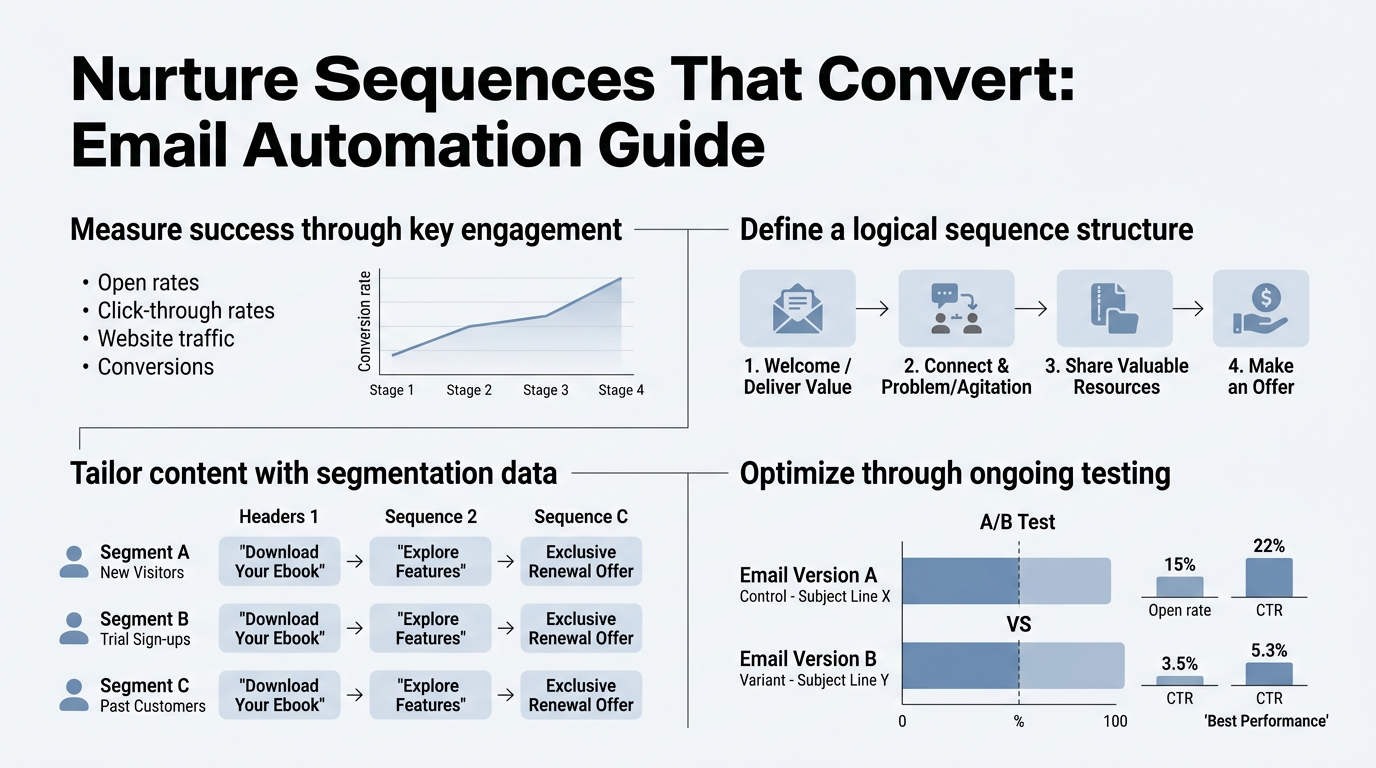
How Do Email Nurture Sequences Work?
A nurture sequence is a series of automated, behavior-triggered emails sent to leads at strategic intervals. Automated flows deliver 2.11% conversion rates compared to 0.16% for manual campaigns (2026, Involvedigital)a 13x performance gap. The sequence works like a silent sales rep: when a prospect lands on your site, signs up, or downloads an asset, the automation workflow triggers an email chain that builds trust, educates, and moves the lead closer to purchase without any manual work.
The Role of Triggers and Behavioral Automation
Triggers are the engine of nurture automation. Instead of blasting every lead the same generic email, you set conditions: "Send email 1 when someone downloads the pricing guide," "Send email 2 if they visit the features page," or "Skip to email 4 if they opened 3+ emails already." This behavioral logic ensures each lead gets a personalized sequence. Prospeo's 2026 research emphasizes that shorter, behavior-based sequences (4–6 emails) with branching logic outperform long linear drips because they adapt to what the prospect is actually doing. A lead who visits your pricing page doesn't need a four-week education seriesthey need a demo offer now.
Timing, Segmentation, and the 48-Hour Rule
Timing is everything. The first email must arrive within 48 hours of lead capture (2026, Prospeo)this is the "golden window" when interest is highest. After that, space emails 2–3 days apart to avoid fatigue while maintaining momentum. Segmentation multiplies that effect: segmented sequences convert at 8–12%, compared to 1.5% for generic sequences (2026, Influenceflow). Segment by industry, product interest, engagement level, or source. A SaaS prospect who signed up from your blog post needs different messaging than someone who watched a product demo.
Why Nurture Sequences Are Non-Negotiable for B2B Revenue
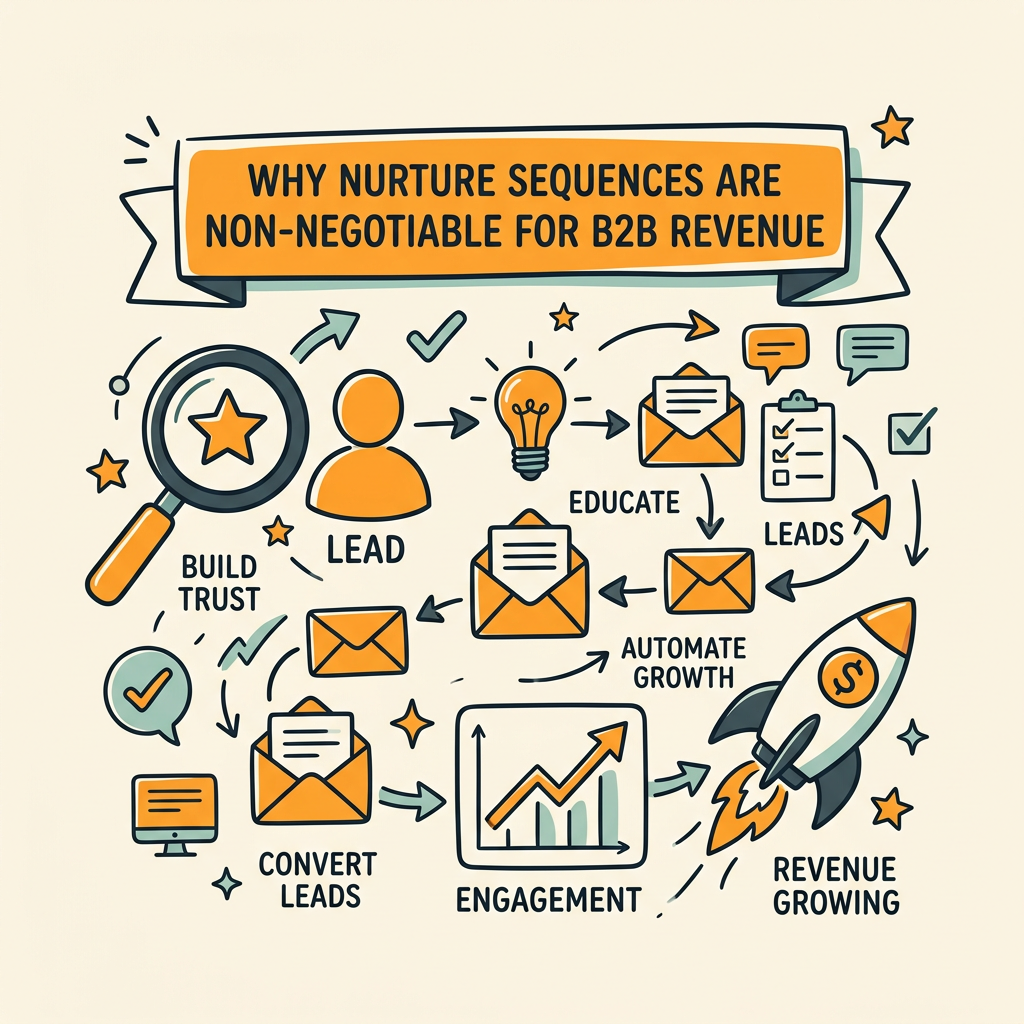
Most leads aren't ready to buy immediately. B2B/SaaS nurture sequences convert at 3–8%, while nurtured leads reach 1.8–4.1% conversion to customer, with AI-driven nurture lifting that to 4.1% for top performers (2026, GrowthSpree and Amraandelma). Without nurture, those leads drop off. With it, they become pipeline assets that compound over time. Here's why nurture sequences are ROI powerhouses.
Building Trust and Authority Through Value
Nurture emails don't sellthey educate. The best-performing sequences follow a 3:1 give-to-get ratio: for every sales ask, send three value-first emails (2026, Prospeo). Share case studies, invite to webinars, break down industry trends, compare solutions honestly. Influenceflow's 2026 guide shows that brands combining email nurture with retargeting achieve 3x higher conversion rates than single-channel approaches. When a prospect sees your thought leadership in their inbox, then sees your ad on LinkedIn the same week, the combination works. Trust compounds.
Pipeline Influence and Revenue Attribution
Email is the highest-ROI channel in marketing. Email marketing delivers 42:1 ROI, and 4.24% of email traffic converts to a purchasehigher than search (2.49%) or social media (0.59%) (2026, CodeCrew and Entrepreneurshq). But B2B attribution is complex: a lead might open 5 nurture emails before clicking a demo link, then talking to sales for 2 months. If you measure email success on opens alone, you miss the pipeline influence. Scalegrowth's B2B email strategy emphasizes tracking MQL-to-SQL conversion, email-sourced SQLs, and pipeline influencenot raw email metricsbecause that's where the actual revenue lives.
How to Structure a High-Converting Nurture Sequence
The best nurture sequences are short, segmented, and behavior-driven. Most teams overthink sequence length: they write 12-email linear drips that lose subscribers by email 3. 4–6 emails with branching logic outperform 12-email linear sequences (2026, Prospeo). Here's the framework to build one that converts.
Email 1: The WelcomeSpeed Matters
Send within 48 hours of signup. This email sets the tone and proves you're responsive. It should be short, warm, and set expectations: "You'll hear from us weekly with [specific benefit]. Expect our first deep dive on [topic] in 3 days." Confirm the signup, introduce your brand voice, and make the next email unmissable. Mention what they'll learn or get, not why you're so great. A top performer might open this at 45%+ because it's expected and quick.
Email 2: The Value Opener
This is email 1 of your "3:1 give" phase. Share your best content: an in-depth blog post, a comparison breakdown, a template, or a research report. No CTA except "Read the full post" or "Download now." The goal is to establish that you have real insights. Email 2 teaches, not sells. Track your click-through rate hereif it's below 2–3%, your subject line or content isn't resonating.
Email 3: Deepen Authority with a Case or Expert Voice
Share a real customer win, a founder story, or an expert interview. Case studies work because they show, not tell: "How Company X grew from 10k to 100k MRR by [tactic]." A quote or insight from someone credible amps authority. This is still "give"you're educating by showing what's possible.
Email 4: Branching Point (Your First Soft Ask)
Now you've given three times. Email 4 asks softly: "I'd love to show you how this works for your use case. 15-minute call?" or "Want to see this in action? Book a quick demo." Link a calendar, a form, or both. Make it easy. If they click, they move to a sales sequence. If they don't, automate an alternative: send them to email 5 (more education) or move them to a lower-intensity sequence (monthly digest instead of weekly).
Branching: What Happens After the Ask
This is where automation wins. Use conditional logic to branch the sequence:
- Clicked demo link: Move to sales handoff sequence (sales owner sends a follow-up message within 24 hours).
- Opened but didn't click: Send email 5 (a harder social proof piece or a limited-time offer).
- Didn't open email 4: Pause the sequence; optionally send a win-back email in 5 days ("You might have missed this...").
- Unsubscribed: Honor immediately; add to suppression list.
Email 5 (Optional): The Social Proof Close
For leads who didn't convert yet, send a strong social proof email: a testimonial, a "best practices" checklist, or a product screenshot. This is your second ask. If they don't convert here, move them to a much longer nurture cycle (bi-weekly digest, quarterly webinar invites) rather than continuing daily emails, which will spike unsubscribes.
Segmentation: The Lever That Multiplies Conversions
Segmentation is the single highest-leverage tactic in nurture. A generic sequence might convert at 1.5%; the same sequence segmented by role, industry, or intent can hit 8–12%. This isn't theoryit's the 5-8x spread in the data. Here's what to segment on.
Segment by Buyer Intent and Source
A lead from your pricing page is hotter than one from a blog post. A lead who downloaded a competitor comparison guide is further along than one who downloaded a beginner's guide. Create intent tiers and match sequence intensity to it. A high-intent lead (pricing page visitor) might get a 3-email sequence that ends with a hard ask. A low-intent lead (blog subscriber) gets a 6-email educational drip. Also segment by source: email, paid ad, webinar, partnership. Each source has a different baseline warm/cold relationship with your brand.
Segment by Role, Company Size, and Use Case
A CMO cares about ROI and brand. A product ops person cares about integration and speed. A founder cares about cost and growth. Send them different sequences that speak to their priorities. Same applies to company size: a solopreneur needs a lean tool with low setup; an enterprise needs security, compliance, and SOC 2. If you offer multiple products or use cases (analytics, automation, CRM), segment on which one they showed interest in and send sequences that deepen that context.
Segment by Engagement Level
Leads in your sequence for 2 weeks but haven't opened anything are cold. Don't keep spamming them with your regular sequence. Instead, create a "re-engagement branch": send them a single "Hey, we noticed you went quiethere's why this matters" email. If they still don't engage after 3 weeks, pause them. Conversely, leads opening everything and clicking links are hotmove them to a faster close sequence or hand them to sales immediately. Engagement segmentation prevents fatigue and respects your list quality.
Building Nurture Sequences Without Manual Work
Manual email campaigns are slow and error-prone. Most growing teams can't maintain segmented, behavior-triggered sequences by handit requires constant monitoring and tweaking. Automation tools that integrate with your CRM and email platform solve this by handling segmentation, triggering, and branching logic in the background. When you set up a nurture sequence once, it runs forever, automatically adapting to each lead's behavior.
Setting Up Automation Rules and Workflows
Most modern email and marketing automation platforms (HubSpot, Klaviyo, ConvertKit, ActiveCampaign) let you build workflows visually: draw a box for each email, set conditions, and connect them with arrows. A typical setup: "If user signs up, send email 1 after 48 hours. If they open email 1, send email 2 after 2 days. If they click the demo link, move to sales sequence. If they don't open in 5 days, send a re-engagement email." Once you've drawn that flow once, it runs on thousands of leads automatically. You can also automate scoring: add points for opens, clicks, and demos, then move leads to sales when they hit a threshold.
Testing and Optimization Loops
Even a "set it and forget it" nurture sequence needs quarterly reviews. Pull reports on conversion rate, click-through rate, and unsubscribe rate. A/B test subject lines on email 1 and 2 (hold everything else constant). Test send times: are your 9 AM sends outperforming 6 PM sends? If per-email open rate drops below 15% or CTR falls under 2%, the sequence is losing effectivenesseither the messaging is stale or you're over-mailing. Rotate content, adjust frequency, and re-segment based on new data. The best teams run this loop every 4–8 weeks.
Common Pitfalls and How to Avoid Them
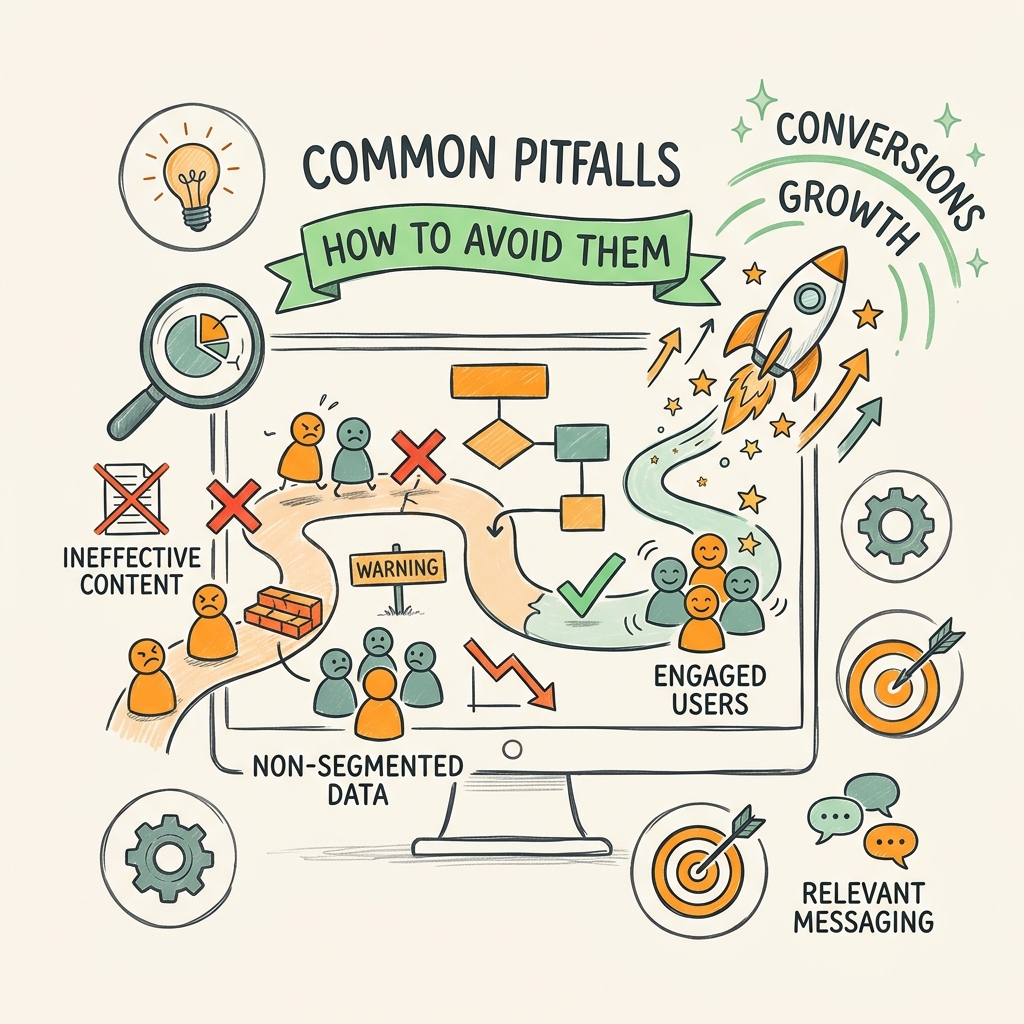
Most nurture sequences fail not because the tool is bad, but because the design is flawed. Here are the mistakes that kill conversion.
Too Long Without a Clear Path
Writing a 12-email sequence with no branching or soft asks is a recipe for unsubscribes. By email 5, leads who aren't interested have already bounced. Instead, insert soft asks at email 4 and 6. Segment on engagement and move hot leads to sales immediately. A short, tight sequence with branching logic will always beat a long one.
No Segmentation or Personalization
Sending the same sequence to an enterprise VP and a solopreneur guarantees low conversion from one of them. Even basic segmentation (company size, industry, or role) lifts conversion rates 3–5x. Personalization doesn't require AI tokensjust merge fields (First name, Company name) and simple conditional logic (show this paragraph if they're in tech).
Ignoring the 48-Hour Window
If your first email goes out 5 days after signup, you've already lost momentum. Most email platforms let you send a welcome email immediately (within minutes) and then schedule the rest. Use that speed. The 48-hour window is now table stakes in B2B nurture (2026, Prospeo).
Measuring the Wrong Metrics
Open rates are vanity metrics post-Apple Mail Privacy. They don't tell you if anyone actually cares. Focus on click-through rate (did they click anything?), conversion rate (did they book a call or trial?), and unsubscribe rate (are we annoying people?). These three metrics matter. If clicks are low but opens are high, your email content isn't compelling. If conversions are low but clicks are high, your CTA or landing page is weak.
Email Automation Tools That Handle Nurture at Scale
Building complex nurture workflows manually is possible in email tools like Mailchimp or Klaviyo, but automation becomes exponentially harder at scale. Tools designed for nurture automation simplify the work significantly. Here's how the category breaks down.
| Platform | Best For | Automation Complexity | Price Range |
|---|---|---|---|
| Jottler | Founders who want nurture sequences auto-created from industry best practices; hands-off optimization | HighestAI-driven workflows and smart segmentation built in | $29+/mo |
| HubSpot | Mid-market teams wanting full CRM + email + sequences under one roof | Highvisual workflow builder with full branching logic | $45+/mo |
| ActiveCampaign | Marketers who need advanced segmentation and behavior-based automations | Highpowerful conditional logic and intent-based triggers | $20+/mo |
| Klaviyo | E-commerce and SaaS with rich customer data and SMS pairing | Mediumvisual builder; less flexible than HubSpot for B2B complexity | Contact sales |
| Mailchimp | Small teams and solopreneurs starting with basic sequences | Lowsimple automation, limited branching | Free–$350/mo |
"Segmentation is the difference between a 2% and a 10% conversion rate. Most teams focus on writing better emails when they should focus on sending the right email to the right person at the right time."
Sarah Chen, VP of Marketing at Growthspree, 2026
The right platform depends on your team size and maturity. A solo founder building their first nurture sequences should start simple with Mailchimp or Jottler and graduate to HubSpot or ActiveCampaign as complexity increases. For teams scaling through multiple product lines or use cases, Jottler's AI-driven approach to content automation extends beyond emailsit automates landing page copy, blog content, and nurture sequences simultaneously, compounding content ROI across all channels.
Measuring Nurture Sequence Performance
Not all metrics are created equal. B2B marketers often get trapped tracking email-level metrics when they should track pipeline-level outcomes. Here's what actually matters.
The Four KPIs That Drive Revenue
Focus on these and ignore the rest:
- Click-through rate (CTR): The percentage of opens that resulted in a click. A healthy B2B nurture sequence should hit 3–7% CTR. If yours is below 2%, the email content or CTA isn't compelling.
- Conversion rate: The percentage of people who booked a call, signed up for a trial, or filled out a form after receiving the sequence. Expect 3–8% for segmented B2B sequences. Below 1% signals a weak CTA or unclear value prop.
- MQL-to-SQL conversion: What percentage of marketing-qualified leads from your nurture sequence become sales-qualified leads (moved to a sales rep)? This is the hand-off metric. Aim for 10–30% depending on your sales team's responsiveness.
- Unsubscribe rate: Anything under 0.45% is healthy (2026, GrowthSpree). Above 0.75% and your sequence is too aggressive, too long, or irrelevant.
Avoiding Attribution Mistakes
A lead who opens 5 nurture emails, then visits your pricing page, then books a call: which channel gets credit? If you give all credit to the pricing page visit, you undervalue nurture. If you give all credit to the first email, you overvalue it. Best practice: use multi-touch attribution. Each email, page visit, and interaction gets a fractional credit. Or simply track "pipeline sourced from nurture" at the aggregate level: all SQLs that came through any lead nurtured by your email sequences, regardless of the final touchpoint. This removes the guesswork and tells you the true ROI of nurture.
Conclusion
Nurture sequences are the automation lever that compounds B2B revenue without scaling headcount. Segmented, automated sequences convert at 8–12%, while unsegmented ones convert at 1.5%and automation itself lifts performance by 13x over manual efforts (2026, Influenceflow and Involvedigital). The mechanics are simple: trigger emails based on behavior, segment audiences by intent and role, follow a 3:1 give-to-get ratio, and measure pipeline outcomes, not email metrics.
The gap between teams running ad-hoc email blasts and those with structured nurture automation is massive. A founder spending 2 hours per week writing and sending manual emails to 500 leads is a bottleneck. A founder with a properly segmented, behavior-triggered nurture system that runs on its own is compounding growth. Start with one sequence (welcome series), test it, measure conversion and engagement, then add branching and segmentation. Within months, nurture becomes your most reliable revenue lever.
Start your SEO agent and automate not just your nurture sequences, but the entire content engine that feeds themfrom blog research to email copy to landing pages.
FAQs
How many emails should be in a nurture sequence?
Most B2B nurture sequences perform best with 4–6 emails total, not 12+. Longer sequences suffer from engagement decay and higher unsubscribe rates. The sweet spot is to include 2–3 value emails (case studies, templates, research), one soft ask at email 4, and optionally one harder ask at email 5 or 6. After that, move engaged leads to sales and pause or redirect unengaged leads to a lower-intensity track (monthly digest instead of weekly drip). This keeps your list healthy and respects recipient attention.
What's the best time to send nurture emails?
The first email should arrive within 48 hours of lead capturespeed beats timing optimization at this stage. For subsequent emails, test your audience: some teams see higher opens at 9 AM Tuesday, others at 6 PM Thursday. Run A/B tests on send time using your email platform's built-in tools (most support time zone optimization and send time personalization). But don't overthink it: consistency and frequency matter more than the exact minute. If you're sending emails 2–3 days apart at a consistent time, your audience will start expecting them, which boosts engagement. Track what works for your specific list and iterate quarterly.
How do you know if a nurture sequence is working?
Stop looking at open ratesfocus on click-through rate, conversion rate, and pipeline influence instead. A working nurture sequence should hit 3–7% click-through rate (clicks per email sent), and at least 3–5% of recipients should book a call, sign up for a trial, or fill out a qualified form. If your CTR is below 2% or conversion is below 1%, the sequence is underperforming. Pull a report of all leads nurtured in the past quarter and count how many became SQLs (sales-qualified leads) or customers. If 10%+ of nurtured leads converted, your sequence is compounding revenue. If below 3%, revisit your segmentation, email content, or CTA clarity.