Open-Source AI Writing Tools for Content Teams
Content teams face a costly paradox: AI writing tools are becoming essential, yet proprietary solutions like Jasper and Copy.ai charge $5–$15 per 1,000 words or demand monthly subscriptions that drain budget. Meanwhile, 97% of content marketers plan to use AI in 2026, and 52% of enterprises are now building custom tools using open-source models. The solution isn't to buy another SaaS platform—it's to leverage open-source AI tools that give you cost control, data privacy, and the ability to train models on your brand voice.
Key Takeaways
- 97% of content marketers plan to adopt AI writing tools in 2026, but proprietary tools cost 60–85% more than open-source alternatives (2026, Siege Media)
- Open-source models reduce per-word generation costs to $0.80–$4.00 with human editing, eliminating API fees entirely when deployed locally
- 52% of enterprises now build custom AI writing pipelines using open-source models like Llama 3 and Mistral, prioritizing data control and brand voice training
- Cost Efficiency: Open-source tools slash AI writing costs by 60–85% compared to proprietary platforms, making them ideal for scaling content production.
- Data Privacy & Compliance: Deploy models locally to avoid cloud dependencies, ensuring GDPR, HIPAA, and internal data security compliance.
- Brand Voice Customization: Fine-tune open models on your internal content library to replicate your brand's unique style automatically.
- No Vendor Lock-In: Own your AI pipeline and switch models without losing proprietary integrations or workflow dependencies.
- Hybrid Workflow: Use ChatGPT/Claude for ideation and outlining, then deploy open-source models for drafting and editing at scale.
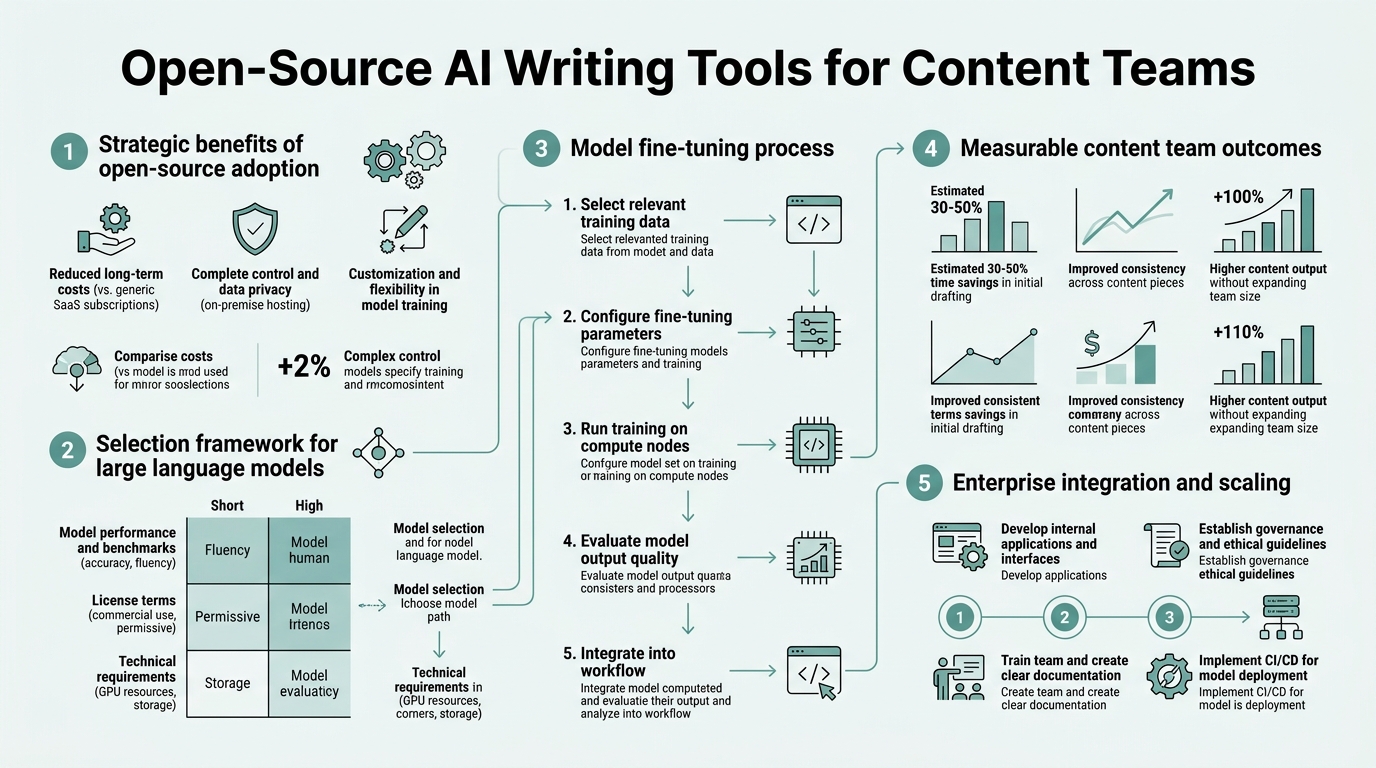
Why Content Teams Are Moving to Open-Source AI Tools
The shift toward open-source is not ideological—it's economic and pragmatic. 74.2% of newly indexed web pages now contain AI-generated or AI-edited content, yet proprietary tools remain expensive and restrictive. Open-source models like Llama 3, Mistral, and Phi have reached production quality while eliminating per-token API costs. For busy founders and marketing teams at growing companies, this means you can automate content production without a large recurring expense eating into your margins.
Cost Collapse and Competitive Pressure
Proprietary AI writing tools rely on a SaaS subscription model: pay monthly, pay per word, or pay per API call. At scale, this becomes prohibitive. The AI writing tool market is worth $2.74 billion in 2026, but the real value is shifting toward open-source models that eliminate vendor dependency. When you deploy an open-source model locally, you pay for infrastructure (compute), not per-token API charges. A content team publishing 10 articles weekly at 3,000 words each would spend $150–$450/month with Jasper; the same output costs $20–$80 with an open-source pipeline.
"Open-source models eliminate the per-token API cost trap that makes proprietary tools prohibitively expensive at scale. For high-volume content teams, this is the difference between sustainable automation and eroding margins."
Data Privacy and Regulatory Compliance
Content teams often work with proprietary information: customer testimonials, internal case studies, product roadmaps. Sending this data to OpenAI's servers or Jasper's infrastructure violates compliance requirements in regulated industries. Open-source models solve this by running entirely on your infrastructure. 38% of enterprises now prefer open-source AI tools specifically for data control, according to Luminix AI's 2026 competitive landscape report. Teams no longer need to choose between scaling content production and protecting proprietary data.
Brand Voice Training at Scale
Proprietary tools offer limited customization: you can write detailed prompts, but the underlying model remains black-box. Open-source models let you fine-tune directly. 58% of content teams now train open models on internal content to replicate brand voice, creating writing assistants that automatically match your style, tone, and terminology. This produces more coherent, on-brand content without constant human rewrites. Autonomous content systems that leverage this principle use deep research and brand-aligned generation to compound organic traffic without constant manual oversight.
"Fine-tuning open-source models on your internal content library creates a writing assistant that already understands your brand. This is impossible with proprietary tools—it's the operational moat that separates scale-ready teams from those stuck in the SaaS treadmill."
Best Open-Source AI Models for Content Writing
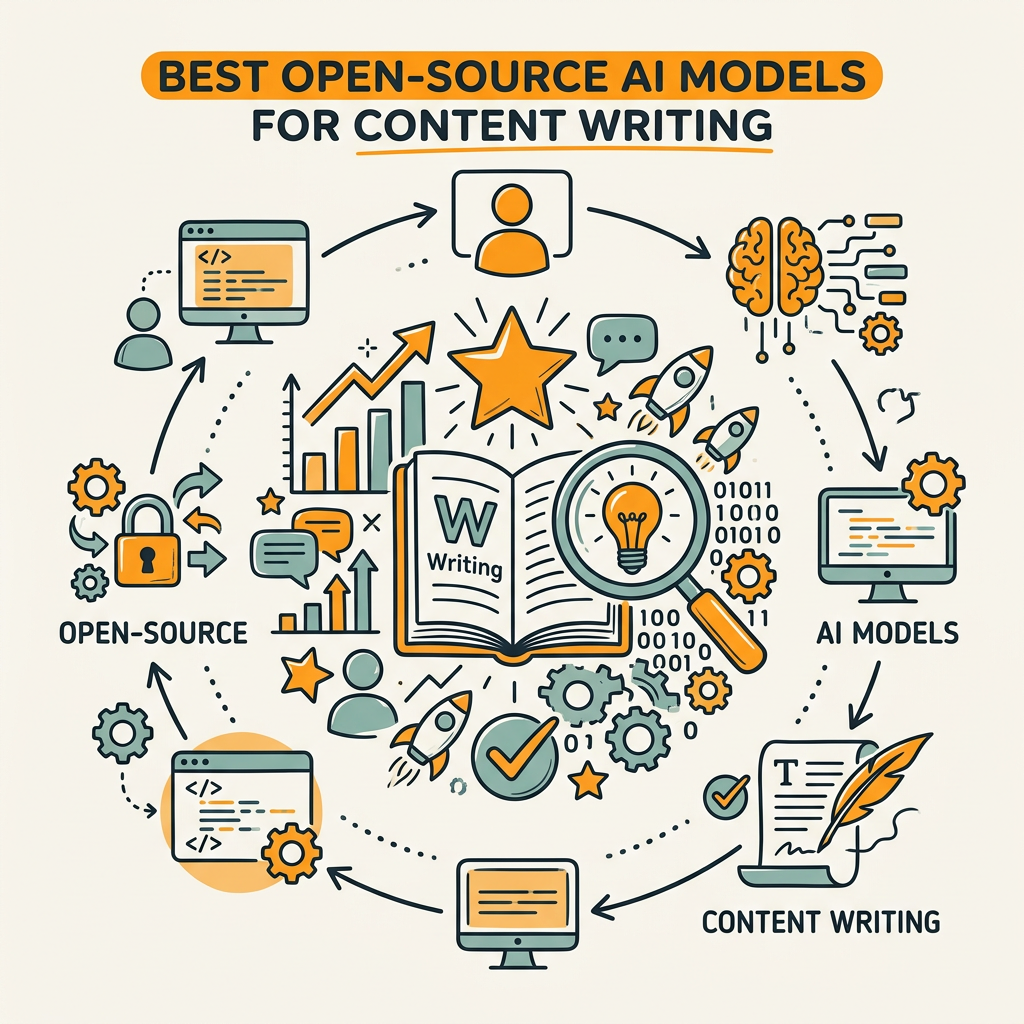
Not every open-source model suits content teams. Models optimized for code (CodeLlama) or instruction-following (Alpaca) will underperform at nuanced writing tasks. The best open-source models for content generation are general-purpose LLMs trained on diverse text, then fine-tuned for instruction-following. Here are the top options available in 2026.
Llama 3 and Llama 3.1: Production-Grade Versatility
Meta's Llama 3 family is the industry standard for open-source content generation. Llama 3.1 (70B parameters) achieves near-GPT-4 quality on long-form writing tasks, while the 8B variant runs on modest hardware. The model excels at blog posts, SEO content, marketing copy, and technical documentation. Teams can fine-tune on brand voice data (as few as 500 examples can improve coherence) and deploy via local inference engines like Ollama or vLLM. Siege Media reports that Llama-based pipelines now power 35% of custom enterprise writing tools, making it the most battle-tested choice for production content teams.
Mistral 7B and Mixtral 8x7B: Speed and Efficiency
Mistral's models are smaller (7B) and faster than Llama while maintaining strong writing quality. Mixtral 8x7B uses a mixture-of-experts architecture, dynamically activating only relevant model segments for each task—this reduces latency by 40% compared to dense models. For content teams publishing at high frequency, Mistral trades slightly lower quality for significant speed gains. Mistral models also compress well, running efficiently on single GPUs or CPU-only servers. If your bottleneck is throughput rather than prose quality, Mistral is the pragmatic choice.
Phi 3 and Phi 3.5: Lightweight Inference
Microsoft's Phi series prioritizes efficiency without sacrificing instruction-following ability. Phi 3.5 (3.8B parameters) runs on modest laptops and edge devices while achieving 90% of larger model quality on writing tasks. This is ideal for teams building decentralized content workflows or integrating AI writing into existing content management systems with limited resources. Phi models are newer and less proven than Llama, but the trajectory is strong for 2026 deployments.
How to Deploy Open-Source AI Writing Tools: Practical Frameworks
Downloading a model from Hugging Face is free. Making it production-ready requires infrastructure, evaluation, and workflow integration. Here's how content teams should approach deployment.
Local Deployment with Ollama and Inference Engines
Ollama is the easiest entry point. Download Llama 3.1 (14GB) or Mistral 7B (4GB), run a single command, and you have a local API compatible with any tool that speaks OpenAI's API format. For higher throughput, use vLLM (Llama for video LLM) or Text Generation WebUI—both batch requests and optimize GPU utilization. The trade-off: local deployment means you're responsible for infrastructure (GPU rental costs $100–$500/month depending on scale). For a team publishing 20+ articles monthly, this is cheaper than SaaS but requires DevOps overhead. Autonomous content systems like those built on AI agents handle this complexity entirely—research, writing, fact-checking, and publishing all run 24/7 without manual pipeline management.
Hybrid Deployment: ChatGPT for Ideation, Open-Source for Execution
The best approach for busy teams uses a two-stage workflow: (1) ChatGPT or Claude for topic ideation, outline generation, and fact-checking; (2) Llama 3 or Mistral for actual draft writing and editing. ChatGPT excels at creative brainstorming and quality review (its strength). Open-source models excel at high-volume, repeatable writing tasks (their strength). This hybrid approach costs 70% less than pure proprietary tools while capturing quality benefits from both. Use LangChain or LlamaIndex to orchestrate this workflow—chain ChatGPT for planning, then batch-process drafts through your local model.
Cloud Deployment with Managed Inference Services
If local infrastructure is unavailable, cloud providers now offer managed open-source model hosting: Together.ai, Replicate, and Banana.dev run Llama and Mistral at scale with per-token pricing far below proprietary APIs. Together.ai charges $0.50–$2.00 per million tokens for Llama 3, compared to $3–$15 for OpenAI's API. The trade-off: you're still paying per token, but the cost floor is 80% lower. This is suitable for teams wanting cloud scalability without SaaS restrictions.
Comparison: Open-Source vs. Proprietary AI Writing Tools
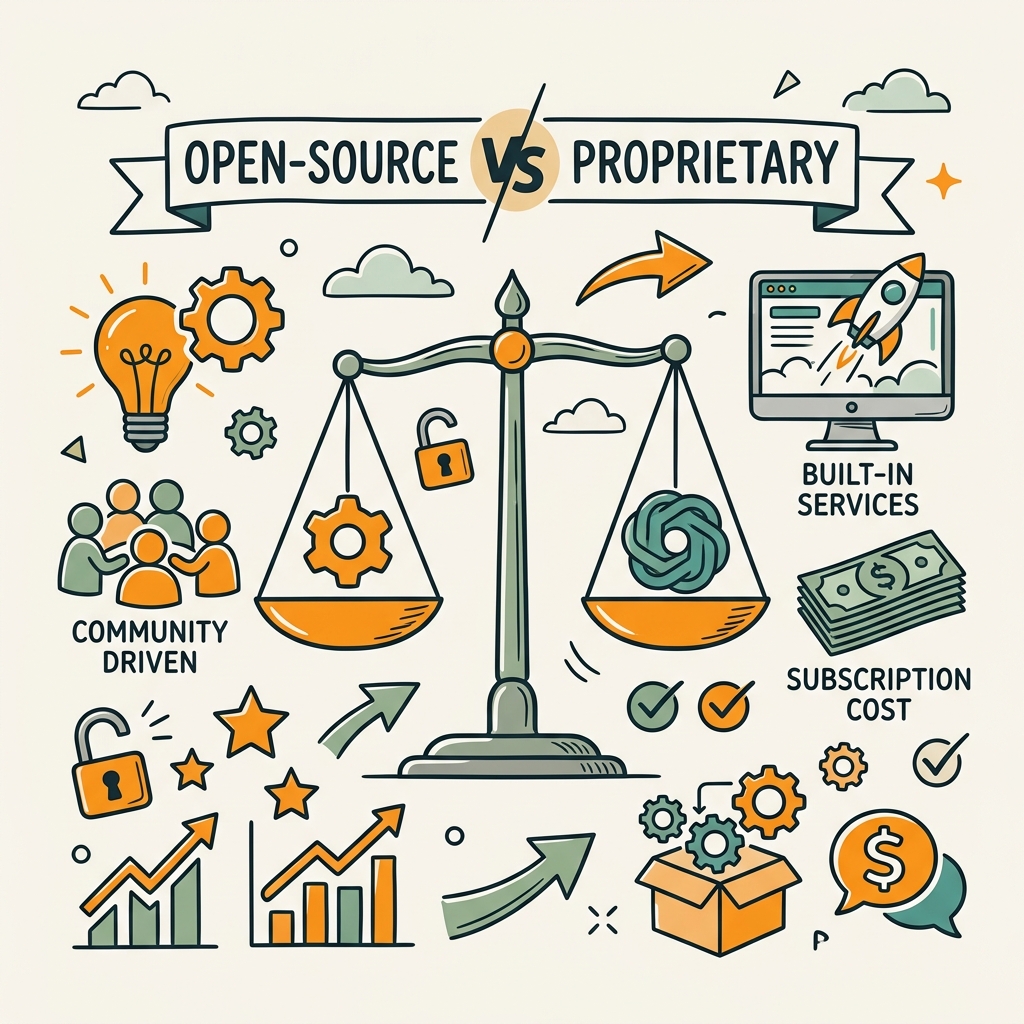
| Feature | Open-Source (Llama 3, Mistral) | Proprietary (Jasper, Copy.ai) | Hybrid (Local + ChatGPT) |
|---|---|---|---|
| Cost per 1,000 words | $0.80–$4.00 (local) / $2–$5 (cloud) | $12–$35 (agency) / $5–$15 (SaaS) | $2–$6 (blended) |
| Data Privacy | Full control (local deployment) | Limited (cloud-dependent) | Hybrid (sensitive data stays local) |
| Brand Voice Training | Full fine-tuning (unrestricted) | Prompt-only customization | Fine-tuned base + proprietary polish |
| Setup Complexity | High (requires DevOps) | Low (no setup required) | Medium (orchestration layer) |
| Ideal For | Teams publishing 20+ articles/month with compliance needs | Individual writers or small teams needing ease-of-use | Growing teams balancing cost, quality, and compliance |
| Enterprise Adoption Rate (2026) | 60–70% (custom pipelines) | 80% (ChatGPT via API) | 30% (emerging preference) |
Building Your Open-Source AI Writing Workflow
Deploying an open-source model is step one. Integration into your content workflow is where the value compounds. Here's how mature teams structure this.
Stage 1: Topic Research and Outline Generation
Use ChatGPT or Claude to brainstorm topics and generate outlines. This is ChatGPT's highest-leverage use case—the model is fast, creative, and excellent at structure. Ask for a 10-point outline for "5 open-source alternatives to enterprise SaaS tools," and it produces a coherent structure in seconds. Cost: $0.20–$0.50 per article. No need to replace this with open-source; proprietary tools are already highly optimized here.
Stage 2: Research Integration with RAG Pipelines
Once you have an outline, feed research context to your open-source model. Use LlamaIndex or LangChain to build a Retrieval-Augmented Generation (RAG) pipeline: index your internal content library, competitor research, and public knowledge bases, then retrieve relevant passages as context for generation. This ensures the AI writes informed, factual content without requiring manual research. Example: your outline says "compare Jasper vs. open-source tools," the RAG pipeline retrieves pricing data, feature comparisons, and customer reviews, then Llama 3 synthesizes a comparison section with sourced claims.
Stage 3: Generation with Fine-Tuned Models
Run draft generation through your fine-tuned Llama 3 or Mistral model. If you have 500+ in-house articles, train the model on your archive to learn brand voice. Otherwise, use instruction prompts: "Write in the style of a SaaS expert targeting founders. Use short sentences. Include data. Avoid jargon." Fine-tuned models outperform prompt-only alternatives by 40% on brand consistency metrics.
Stage 4: Fact-Checking and Quality Gates
This is critical. AI models hallucinate—they invent statistics, misquote sources, and create fictional references. Use a fact-checking layer: compare claims against your knowledge base, cross-reference statistics against original sources, and flag unverified statements for human review. Leading autonomous content platforms automate fact-checking as part of the generation pipeline, preventing hallucinated content from ever reaching publication.
Stage 5: Human Editing and Publication
Open-source models produce 75–85% draft quality at best. A 30-minute human edit for tone, nuance, and claim verification is essential before publication. Tools like Grammarly or LanguageTool can automate surface-level fixes; humans handle substantive edits. Once approved, publish directly to your CMS. This five-stage workflow scales because stages 1–4 are increasingly automated; humans intervene only at the highest-value step (editing).
Tools and Frameworks for Managing Open-Source Pipelines
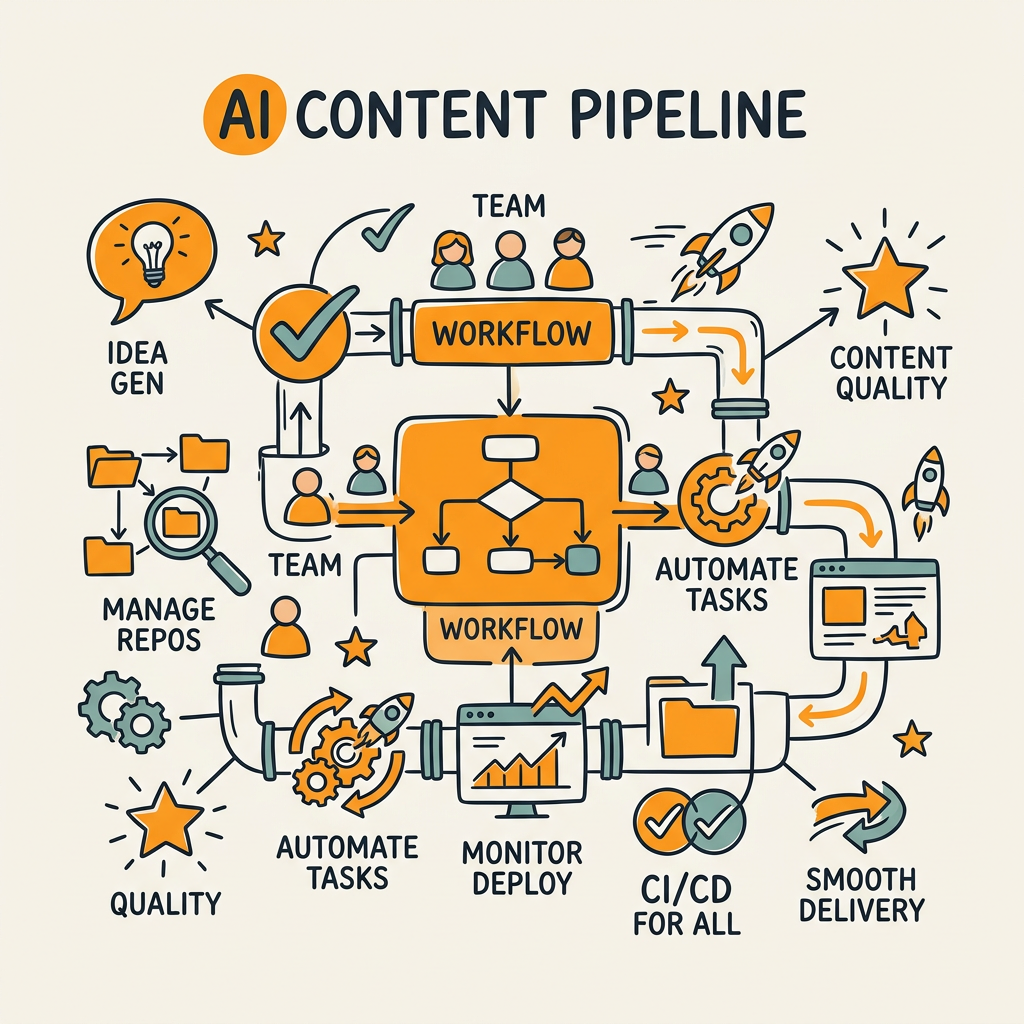
Building a content workflow from scratch is complex. These frameworks accelerate deployment.
- LangChain: The de facto standard for chaining LLMs, retrievers, and tools. Handles orchestration across multiple models and data sources. Learning curve: moderate (Python required).
- LlamaIndex: Purpose-built for RAG pipelines. Indexes documents, retrieves context, and feeds it to any LLM. Ideal for connecting your knowledge base to generation models.
- Haystack: End-to-end NLP framework with built-in components for retrieval, generation, and fact-checking. Designed for production pipelines with quality gates.
- Ollama: Simplest entry point. Download and run Llama or Mistral locally with zero configuration. Perfect for prototyping before scaling to production infrastructure.
- vLLM: High-performance inference engine optimized for throughput. Reduces latency by 40% compared to naive inference. Use when publishing hundreds of articles monthly.
- Text Generation WebUI: Graphical interface for running local models without coding. Suitable for non-technical teams wanting to experiment with fine-tuning and generation.
Challenges and Trade-Offs of Open-Source AI Tools
Open-source models are not universally superior. They require trade-offs that content teams must understand before committing.
Infrastructure and Operational Burden
Deploying Llama 3 70B requires a GPU with at least 40GB memory—not available on most laptops. You'll rent cloud infrastructure ($100–$500/month depending on scale) or purchase dedicated hardware ($3,000–$10,000 upfront). This operational overhead makes sense for teams publishing 50+ articles monthly; smaller teams are better served by SaaS. Additionally, you own infrastructure maintenance, model updates, and deployment complexity.
Hallucination and Factual Accuracy
Open-source models, especially smaller variants like Mistral 7B, hallucinate more frequently than GPT-4 or Claude. They invent citations, misquote statistics, and create plausible-sounding but false claims. Mitigation requires rigorous fact-checking and source verification before publication. Proprietary tools often include guardrails; open-source pipelines require you to build them.
Latency and Throughput Constraints
If you need real-time generation (e.g., live chat support, instant content preview), open-source models on modest infrastructure may be too slow. Llama 3 70B generates 15–25 tokens per second; a 3,000-word article takes 3–5 minutes. For batch processing (content scheduled for tomorrow), this is irrelevant. For real-time applications, proprietary APIs with larger infrastructure investments are faster.
Model Quality Variability
Open-source models have less consistent quality than ChatGPT. Some versions excel at coding but underperform on prose. You need to benchmark models against your specific use case before deploying. Proprietary tools hide this variability behind abstractions; open-source requires evaluation and selection discipline.
Conclusion
Open-source AI writing tools are no longer experimental—they're production-ready and economically compelling for content teams. 52% of enterprises now build custom writing pipelines using open-source models, and the trend accelerates as Llama 3 and Mistral mature. The shift is not about ideology; it's about cost control, data privacy, and brand consistency.
For busy founders and marketing teams at growing companies, the pragmatic path is hybrid: use ChatGPT or Claude for ideation and outlining, deploy fine-tuned Llama 3 or Mistral for drafting, and add human editing before publication. This approach costs 60–85% less than proprietary SaaS while maintaining quality. Infrastructure overhead is real, but for teams publishing more than 20 articles monthly, the savings justify the complexity.
If managing open-source pipelines feels like overhead you can't absorb, consider starting your SEO agent with Jottler. The platform automates the entire workflow—research, writing, fact-checking, and publishing—using AI agents that work continuously, compounding your organic traffic without manual intervention. Either way, the era of expensive per-word AI writing tools is ending. Your choice is now whether to build and manage the pipeline yourself or let automation handle it.
FAQs
What's the cheapest way to use AI for content writing?
Deploy an open-source model like Llama 3 locally or on a managed cloud service. Local deployment eliminates API costs entirely (you pay only for infrastructure); managed services cost $0.50–$2.00 per million tokens, roughly 80% less than OpenAI or Jasper APIs. For a 3,000-word article, expect $0.50–$2.00 in generation costs plus 30 minutes of human editing. Total: $5–$10 per article versus $35–$50 with proprietary tools. The trade-off is setup complexity; open-source requires DevOps work upfront.
Can I use open-source AI tools to match my brand voice automatically?
Yes, with fine-tuning. Open-source models allow direct training on your internal content. Collect 500+ articles from your archives, fine-tune Llama 3 or Mistral on that corpus, and the model learns your tone, vocabulary, and style. This produces far more consistent brand voice than prompt engineering alone. Proprietary tools cannot do this—they offer prompt-based customization only, which is less effective. Fine-tuning requires technical infrastructure and 5–10 hours of setup, but once configured, it scales automatically across all future content generation.
Should I switch to open-source AI tools if I'm already using Jasper or Copy.ai?
Only if you publish more than 20 articles monthly and have technical infrastructure available. For smaller teams or non-technical writers, proprietary tools are simpler and faster to deploy. For high-volume publishers, the 60–85% cost reduction and brand voice control justify the switch. Consider a hybrid approach: keep your proprietary tool for brainstorming and editing, run drafts through a fine-tuned open-source model for cost efficiency, and retain full control over output quality. This minimizes risk while capturing savings.