Organic Traffic Growth Strategies That Work
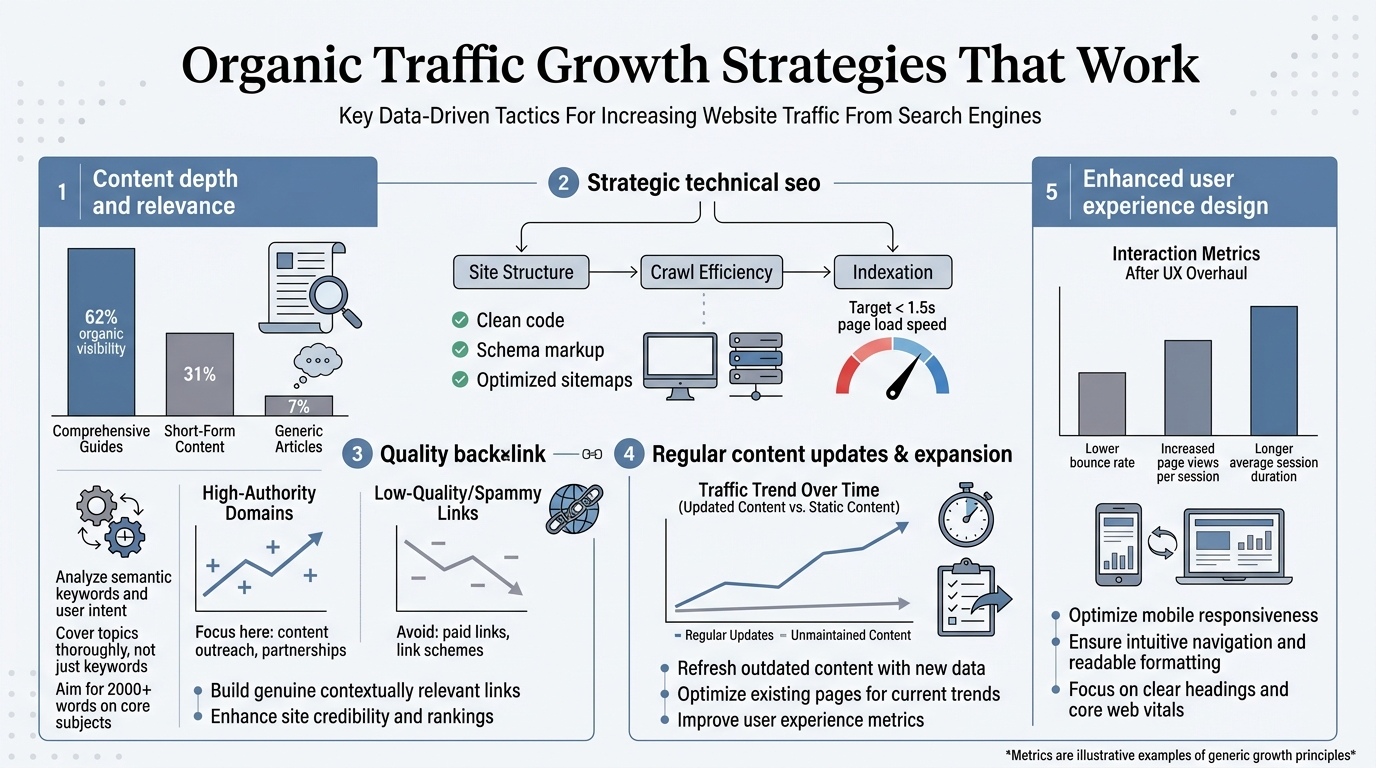
Organic search drives 53% of all website traffic, yet most teams struggle to scale it consistently. The challenge isn't understanding SEO anymoreit's execution at scale. Manually researching keywords, writing content, optimizing pages, and building internal links creates bottlenecks that kill momentum. Organic traffic growth declined 2.5% year-over-year in 2025, a signal that outdated approaches no longer compete. But teams that systematize content production see 6x higher conversion rates than their peers. Here's how to build organic traffic growth that compounds.
Key Takeaways
- Organic search captures 53% of all website traffic; long-tail keywords drive 69-70% of that volume (2026 data)
- Content marketing leaders achieve 6x higher conversion rates by scaling production and optimizing for intent
- AI-driven automation improves content production speed by 52%, enabling teams to publish optimized articles in days, not weeks
- Keyword Research Precision: Target long-tail keywords with high intent; they drive the majority of organic search traffic at lower competition.
- Content Production at Scale: Automate research, writing, and optimization to publish 3+ high-quality articles per week instead of manually grinding through 1-2.
- Technical SEO Foundations: Fix crawlability, page speed, and mobile responsiveness firstthese block all other growth.
- Strategic Internal Linking: Build topical clusters and link architecture to boost domain authority and ranking velocity.
- Measurement and Iteration: Track rankings, CTR, and qualified traffic; optimize content monthly based on Search Console data.
How Keyword Research Powers Organic Traffic Growth
Keyword research is the foundation of organic growth. Long-tail keywords drive 69-70% of all search traffic, yet most teams ignore them to chase high-volume head terms they'll never rank for. The fix? Identify keywords where you already rank 11-20 (the "striking distance" zone), then refresh and expand that content with new data and internal links. This low-friction strategy compounds quickly, especially when paired with a systematic SEO content plan that targets the right keywords from the start.
Long-Tail Keywords and Search Intent Alignment
Long-tail keywords are specific phrases like "best digital marketing agency for SaaS startups in Austin." They have lower search volume but dramatically higher intent. A prospect searching "digital marketing agency" might browse casually. One searching your long-tail variant is ready to buy. Question-based keywords convert 4.1x better due to precise intent alignment, because the searcher has already articulated their exact need. Your content answers it directly, earning the click and the conversion.
Start by exporting your top 500 keywords from Google Search Console. Filter for positions 11-30. These are your quick winsyou're already getting impressions, but not clicks. Update these pages with:
- Fresh statistics: Replace 2023 data with 2025-2026 numbers; Google rewards recency
- Semantic keywords: Add related terms and LSI keywords (synonyms, variations) without keyword stuffing
- Internal links: Link from pillar pages to this content, signaling topical authority
- Structured data: Add FAQ schema, article schema, and breadcrumbs for rich snippets
Building Topic Authority with Keyword Clusters
Topic authority signals to Google that your site is the expert on a subject. Rather than writing one 3,000-word article on "digital marketing strategy," create a cluster: a pillar page plus 8-12 supporting articles linking back to it. This structure tells Google, "This site understands digital marketing deeply across multiple angles." Ranking velocity accelerates and ranking positions improve across the cluster.
Effective clusters follow this pattern: pillar page covers the broad topic (e.g., "The Complete Guide to Digital Marketing Strategy"). Subtopic pages go deeperemail marketing, content marketing, paid advertising, SEO, social mediaeach linking back to the pillar. Internal links form a web that distributes authority throughout the cluster and keeps users on your site longer, reducing bounce rate and signaling engagement to Google. Learning how to build topical authority systematically accelerates this process significantly.
Why Content Production at Scale Drives Exponential Growth
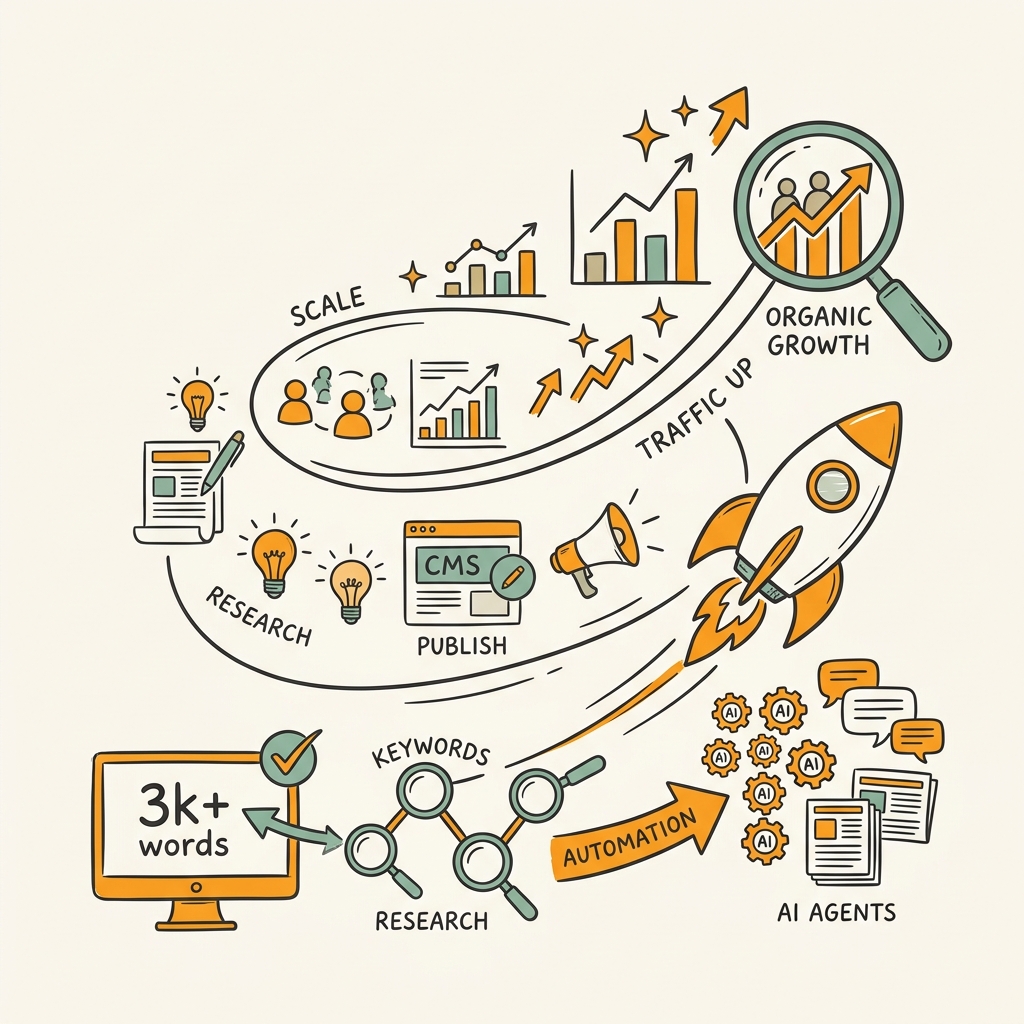
Most teams produce 1-2 articles per week. That's roughly 50 pieces per year. At your current keyword ranking velocity, that's 5-10 new rankings monthlymeaningful but slow. Teams using AI-driven automation improve speed by 52%, shipping 3-5 optimized articles per week without burning out your team. The math is simple: more content = more keywords ranking = more organic traffic.
The Bottleneck: Manual Research and Writing
Here's where most teams choke: keyword research (2-4 hours), outline creation (1-2 hours), drafting (3-5 hours), SEO optimization (1-2 hours), fact-checking (1-2 hours), internal linking (1 hour), CMS publishing (30 minutes). Total: 10-17 hours per article. That's why teams publish slowly. When you automate researchpulling data from 14+ sources automaticallyand use AI agents to draft, optimize, fact-check, and link internally, you compress that timeline to 2-3 hours of human review and approval, then publishing. One person can oversee 15-20 articles per week instead of writing 1.
The key is end-to-end automation. Tools that only write or only research create extra workyou're still doing keyword research elsewhere, still optimizing manually, still linking by hand. That defeats the purpose. Platforms automating the complete SEO pipeline handle research deeply from 14+ sources, write 3,000+ word articles, fact-check every claim, build smart internal links, and publish directly to your CMS. No manual steps. This compounds fastpublish 20 articles in the time you used to publish 2.
Quality Standards in Automated Content
The fear: "AI content is thin and doesn't rank." That was true in 2023. Now, the best AI-driven systems research better than humans. They pull from government reports, academic papers, industry studies, competitor content, and real user behavior data. They fact-check every statistic. They structure content with proper headers, internal links, and schema markup from day one. The result: articles that are publication-ready without rewriting.
The rule: use automation to handle the repetitive, time-consuming work (research, drafting, basic optimization), then have one expert reviewer spend 20-30 minutes tightening, adding a point-of-view, and approving. This workflow 3-4x your output without losing quality. A data-driven AI content strategy ensures every piece contributes to your organic growth objectives from publication day one.
Technical SEO: The Foundation You Can't Skip
You can write perfect content, but technical debt will tank your rankings. 61% of organic search visits come from mobile devices, yet most sites have slow mobile speeds, poor responsive design, and crawlability issues. Core Web Vitalspage speed, interactivity, visual stabilityare confirmed ranking factors. Fix these first.
Core Web Vitals and Page Speed Optimization
Google's Core Web Vitals measure three things: Largest Contentful Paint (LCP, loading speed), First Input Delay (FID, responsiveness), and Cumulative Layout Shift (CLS, visual stability). Pages with poor vitals rank lower and get fewer clicks even when they rank, because users bounce on slow, janky pages. Audit your site with Google PageSpeed Insights and fix the top issues:
- Image optimization: Compress and serve responsive images; lazy-load below-fold content
- CSS and JavaScript: Minify and defer non-critical scripts; split code by route
- Server response time: Upgrade hosting or use a CDN to reduce Time to First Byte (TTFB)
- Browser caching: Set cache headers to serve repeat visitors static assets from local storage
A 1-second improvement in load time can lift conversion rate by 7%. In organic traffic, faster pages get more clicks and lower bounce rate, signaling quality to Google.
Mobile-First Indexing and Responsive Design
Google now indexes the mobile version of your site first. If your mobile experience is an afterthought, you're bleeding rankings. Ensure:
- Responsive layout: No horizontal scroll; text readable without pinch-to-zoom
- Touch targets: Buttons and links are at least 48x48 pixels (easy to tap)
- Viewport meta tag: Set properly to prevent shrinking on mobile
- Mobile menus: Hamburger or tap-friendly navigation, not dropdowns
Crawlability and Indexation
Make sure Google can crawl your site efficiently. Check robots.txt to confirm you're not blocking critical resources. Verify your XML sitemaps are current and submitted to Google Search Console. Fix 404 errors and broken internal linksthey waste Google's crawl budget and frustrate users. If you have a lot of duplicate content or parametrized URLs (e.g., ?filter=price), use canonical tags and URL parameters in Search Console settings to tell Google which version to index.
Strategic Internal Linking: Build Authority and Engagement
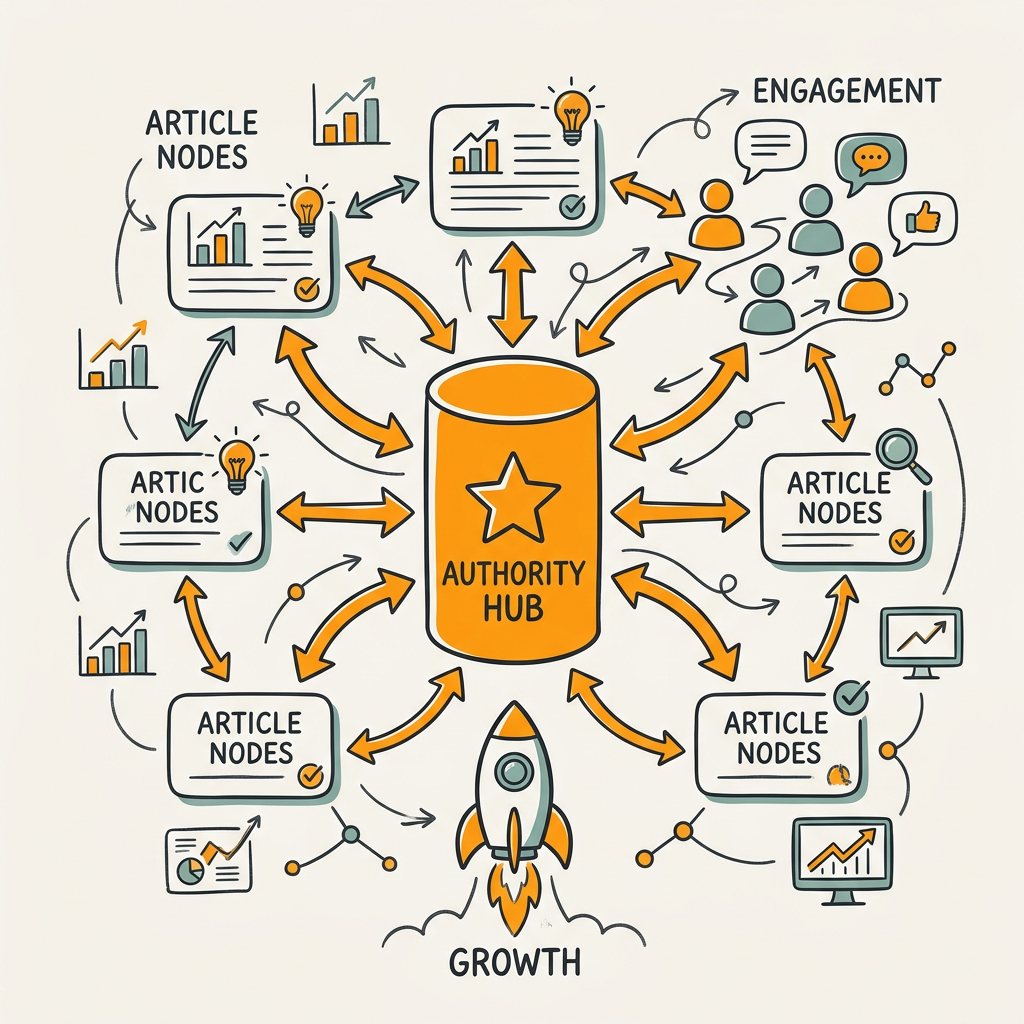
Internal links are how you distribute authority across your site and guide users to conversion pages. A smart internal linking strategy boosts time-on-site, reduces bounce rate, helps new pages rank faster, and compounds topical authority. Yet most teams link ad-hoc. Here's the systematic approach.
Creating Content Clusters with Strategic Linking
Group related content into clusters: one pillar page (broad, comprehensive) and 8-12 cluster pages (specific subtopics). All cluster pages link back to the pillar with anchor text like "learn more about digital marketing strategy." The pillar links to each cluster page. This architecture tells Google, "This entire cluster is about X topic. The pillar is the main authority page, and these supporting pages reinforce expertise."
Practically: your pillar might rank for "digital marketing strategy." Your cluster pages rank for "email marketing strategy," "content marketing strategy," "paid advertising strategy." Each one links back to the pillar. Users land on the paid advertising article, click through to email marketing, then to the pillar. They spend 15+ minutes on your site, which Google interprets as engagement. Plus, all that link juice flows to the pillar, boosting its ranking velocity.
Anchor Text Best Practices
Anchor text is the clickable text in a link. It tells Google and users what the linked page is about. Use descriptive anchor text: "Learn how to build a content marketing strategy" (good) vs. "click here" (bad) vs. "strategy" (too thin). Vary your anchor text to avoid over-optimization. A good mix: 40% branded anchors (your brand name), 30% generic anchors ("learn more"), 20% exact-match or phrase-match anchors (the target keyword), 10% LSI anchors (semantic variants).
Intelligent internal linking removes the manual bottleneck of finding opportunities across your content. When you automate keyword research and content production, you gain the ability to intelligently link new articles to existing authority pages without extra effort. This ensures every new piece contributes to your topical authority network immediately upon publishing.
How to Measure and Iterate for Continuous Growth
Publishing content without tracking its performance is like throwing darts in the dark. Measure what matters: rankings, organic traffic, qualified leads. Use data to inform your next 10 articles.
Key Performance Indicators for Organic Growth
Track these in Google Search Console and Google Analytics:
- Organic impressions and CTR: How many times did your site appear in search results, and what percentage clicked through? Aim for 5%+ CTR on featured keywords.
- Average ranking position: Where do you rank for your target keywords? Track weekly. Expect 90-180 days to move from position 20 to position 1.
- Organic traffic growth: Month-over-month sessions from organic search. Benchmark against industryaim for 10-20% monthly growth initially, then 5-10% as you scale.
- Qualified traffic: Use UTM parameters and goal tracking in Analytics to measure not just sessions, but conversionsemail signups, demos booked, customers acquired.
Create a simple dashboard: organic sessions, top 20 ranking keywords, pages with highest organic traffic, pages with highest bounce rate, conversion rate by traffic source. Update weekly. At month-end, review trends and adjust strategy.
Content Optimization Based on Performance Data
Identify your "striking distance" pagesarticles ranking 11-30 for high-intent keywords. These are your quick wins. Refresh them with new data, better structure, more internal links, and richer content. Many teams see a 2-3 position jump within 30 days. That's a traffic lift without months of waiting.
Also look at high-traffic, low-conversion pages. Why are they attracting visits but not conversions? Often, the CTA is buried, the page doesn't align with user intent, or it's not credible. Add customer testimonials, case studies, or trust badges. Move the CTA higher. Test variations.
Adapting to AI Search and Evolving User Behavior
Search behavior is shifting. AI Overviews in Google search reduce CTR by 35% when present. ChatGPT and Perplexity are becoming discovery tools. Your strategy must adapt to stay ahead of this trend. The goal is twofold: rank in traditional search AND appear in AI model summaries.
Optimizing for AI Overviews and Generative Search
Google's AI Overviews synthesize multiple sources into a concise answer. To get cited, your content must be:
- Structured clearly: Use headers, lists, tables, and short paragraphs. AI systems extract structured content more effectively than prose.
- Authoritative: Back claims with data and citations. Cite studies, reports, expert quotes. AI values sourced information.
- Comprehensive: Cover the full question from multiple angles. If you only address half the topic, a competitor will fill the gap.
- Recent: AI systems prefer fresh data. Update articles with 2025-2026 statistics annually.
Additionally, optimize for AI visibilityensuring your brand appears in AI model responses and semantic discovery. This means:
- Publishing detailed, answer-first content that directly addresses user questions in the opening paragraph
- Using schema markup (FAQ schema, Article schema) to signal content structure to AI indexers
- Building brand authority so your domain gets cited as a trusted source
The teams winning in 2026 treat traditional SEO and AI discovery as complementary strategies, not competing ones.
Building Sustainable Organic Growth Systems
The scalable approach to organic traffic isn't hiring more writers or running Facebook ads. It's building systems that compound. Organizations using AI-driven automation improve production speed by 52%, meaning a small team can scale from 50 to 200+ articles per year without burnout. But only if the system is designed right.
Automation Without Sacrificing Quality
Automation gets a bad rap because poor implementations cut corners on research and fact-checking. The solution: automate the right parts. Let AI handle research (pulling from 14+ authoritative sources), outlining (creating logical flow), drafting (writing in your brand voice), and basic optimization (SEO formatting, headers, internal links). Have humans review for brand alignment, add strategic point-of-view, fact-check sensitive claims, and approve for publishing.
This workflow keeps quality high while dropping per-article time from 12-15 hours to 2-3. Multiply that across 50 articles per month, and you're reclaiming 400-500 hours annually. That's time your team can spend on strategy, customer research, and high-impact initiatives instead of grinding through content production.
Balancing Speed with Strategic Depth
Not every article needs to be a 10,000-word treatise. Mix your content mix: some deep guides (2,500-3,500 words), some quick answers (800-1,200 words), some resource roundups (1,500-2,000 words). Deeper content ranks slower but builds authority. Quicker content ranks faster and captures short-tail traffic. Balanced mix compounds faster than all-or-nothing.
The other lever: timing. Predictive AI models identify trending topics 60-90 days before peak search volume, enabling you to publish early and dominate when demand peaks. This shortens time-to-rank from 6-12 months to 6-12 weeks. That's the edge fast movers get in 2026.
Conclusion
Organic traffic growth isn't complicated. It's systematic: research keywords where you're already close, produce content at scale, fix technical bottlenecks, link strategically, and measure relentlessly. The teams scaling organic traffic do all five. The bottleneck for most is production velocitythey publish too slowly to compound momentum. Automation improves speed by 52% while maintaining quality, letting a small team behave like a content agency without the headcount or cost.
The market leader in organic growth isn't always the largest team. It's the team with the best system. That's why starting your SEO agent matters. Jottler automates the entire pipelineresearch, writing, optimization, linking, publishingletting busy founders and marketing teams scale from 1-2 articles weekly to 15-20 without hiring. The cost savings are real. The time savings are dramatic. The organic traffic compounds predictably.
FAQs
How long does it take to see results from organic traffic strategies?
Most teams see traffic improvements within 30-45 days when they refresh striking distance content (articles ranking positions 11-30). Full results from new content take 90-180 days, depending on keyword difficulty and competition. However, with automated workflows and predictive AI, the time-to-rank for new articles can shrink to 6-12 weeks, because you're publishing optimized, well-linked content from day one. Manual approaches take twice as long because research, drafting, and linking are done sequentially.
What's the best content strategy for sustainable organic growth?
A sustainable strategy combines three parts: (1) long-tail keywords with high intenttarget specificity, not volume; (2) topic authority clustersinterconnected content signaling expertise; (3) consistent production velocitypublish 3+ optimized articles weekly instead of 1-2 manually. Content marketing leaders achieve 6x higher conversion rates, and that advantage comes from publishing volume plus relevance plus internal structure. The blocker for most teams is production speed. Automation removes that bottleneck, enabling sustainable growth without hiring additional writers.
Do I need technical SEO to grow organic traffic?
Yes, technical SEO is foundational. Page speed and mobile responsiveness rank above content quality in Google's algorithm. You can write the world's best article, but if it takes 5 seconds to load or doesn't work on mobile, it will rank poorly and bounce users away. Fix crawlability, page speed, Core Web Vitals, and mobile responsiveness first. Then layer in keyword strategy and content production. Teams that skip technical SEO max out at 30-40% of their traffic potential, regardless of content quality.