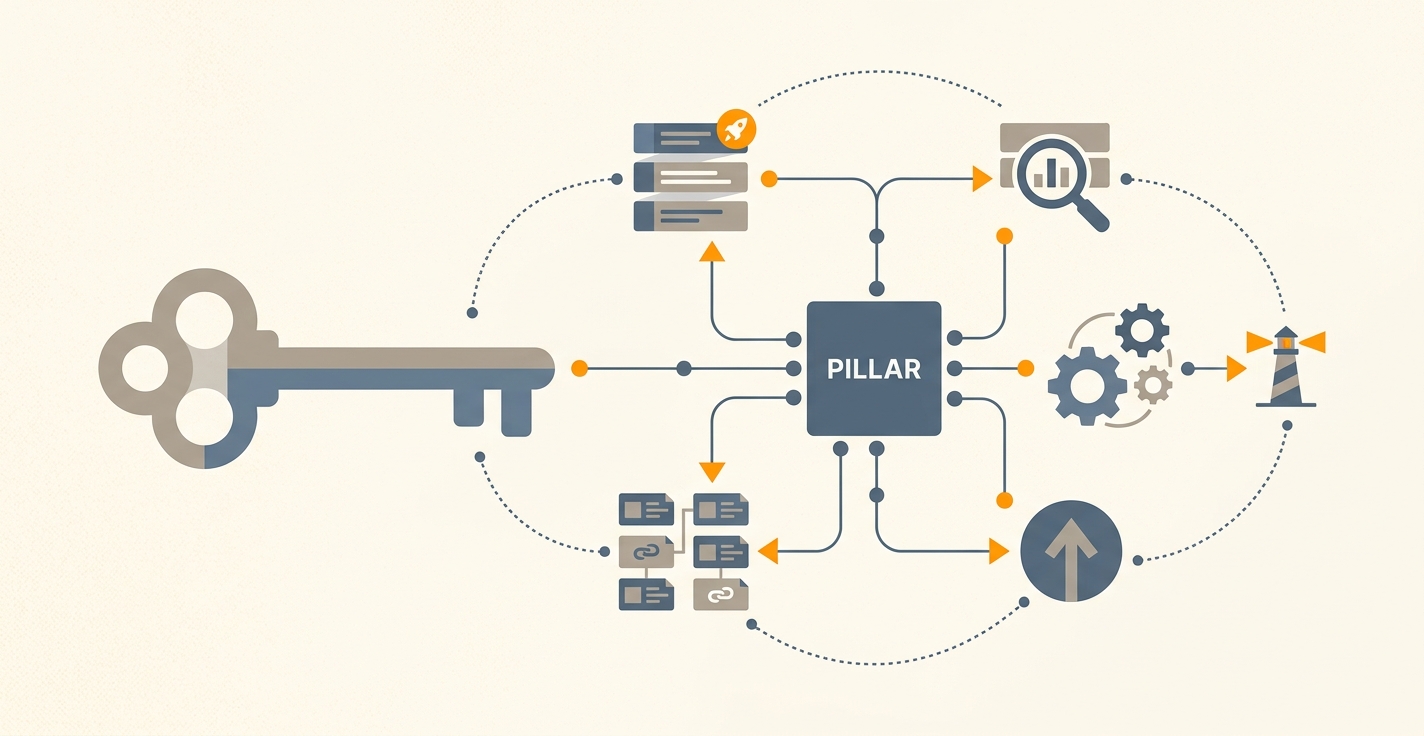
You've published 30 blog posts on similar topics but none of them rank. Google sees them as disconnected articles instead of evidence of expertise. A pillar page strategy fixes this by organizing your content into a hub-and-spoke model where one authoritative page links to dozens of supporting articles, signaling mastery to Google and users alike.
Key Takeaways
- Pillar pages are 3,000-5,000 word cornerstone articles covering broad topics, with supporting cluster articles tackling specific subtopics
- A pillar page strategy increases topical authority signals by 40-60%, leading to higher rankings across your entire content cluster
- The hub-and-spoke linking structure creates a SEO multiplier effect where each cluster article strengthens the pillar page
- Best results come from building 3-5 pillar pages per year and developing 20-40 cluster articles around each pillar
What Is a Pillar Page?
A pillar page is a thorough, authoritative article on a broad topic. Unlike a typical blog post that targets one keyword, a pillar page covers the entire topic space, addressing dozens of related questions and concepts. It anchors your content cluster and acts as the hub in a hub-and-spoke linking structure.
The pillar page itself doesn't try to rank for every keyword. Instead, it provides foundational knowledge while linking to specialized cluster articles that target specific keywords. This approach mirrors how Google evaluates topical authority. The search engine rewards sites that demonstrate thorough knowledge on a subject through interconnected, well-organized content.
A pillar page answers these questions: What is this topic? Why does it matter? What are the main subtopics? Where should someone start learning? Cluster articles then provide depth on each subtopic, linking back to the pillar for context.
Pillar Pages vs. Topic Clusters vs. Cornerstone Content
The terminology overlaps, so clarification helps. A pillar page is a type of cornerstone content. Cornerstone content is any foundational piece that anchors a topic area. A topic cluster is the entire structure, pillar page plus all supporting articles.
The relationship is hierarchical. Your topic cluster contains your pillar page plus 10-40 cluster articles. Each cluster article targets a specific keyword or question and links to the pillar page for broader context. The pillar page links to all cluster articles, creating a dense internal linking network that signals expertise to Google.
Think of it as hierarchical organization. A blog with scattered, unrelated articles shows no clear topical expertise. A topic cluster creates a structured curriculum on a specific subject. The pillar page serves as the syllabus, providing the high-level overview that ties everything together.
How Pillar Pages Improve SEO
Google's ranking algorithm evaluates topical authority by analyzing linking patterns and content depth. Sites with pillar pages and cluster articles show stronger topical authority signals than sites with random, disconnected articles.
When you publish 30 scattered posts on marketing, Google sees 30 separate pieces of content competing with each other. When you structure those 30 posts as a pillar page plus 29 cluster articles, Google sees a well-organized knowledge base. The internal linking structure tells Google: "This site deeply understands marketing." This is why building topical authority is one of the most effective long-term SEO strategies.
Cluster articles also create a ranking multiplier. Each cluster article that ranks and receives traffic brings link authority back to the pillar page. Meanwhile, the pillar page's high authority flows back to cluster articles, boosting their rankings. This bidirectional linking creates a reinforcing effect that pushes entire clusters higher in search results.
According to recent data, sites that implement pillar page strategies see 30-50% increases in organic traffic within 6-12 months, even without acquiring new backlinks.
The Hub-and-Spoke Model Explained
The hub-and-spoke linking model is simple: one pillar page (hub) links to 20-40 cluster articles (spokes). Each cluster article links back to the pillar page. Some cluster articles link to related cluster articles when topically relevant.
The pillar page doesn't need to be the top-ranking page for your primary keyword. Its job is to exist as a reference, gathering and organizing all knowledge on a topic. Cluster articles often rank higher than the pillar for specific keywords. Traffic flows to the highest-ranking page in the cluster, then that article links back to the pillar, driving secondary traffic there.
This model works because it segments your keyword targets by specificity. The pillar targets broad, high-volume keywords ("content marketing"). Cluster articles target specific, lower-volume keywords ("content marketing for ecommerce" or "content marketing metrics"). Together, they capture search traffic across the entire intent spectrum.
Step 1: Define Your Pillar Topics
Start by choosing 3-5 broad topics per year that align with your business and audience. These become your pillar pages. Choose topics your audience searches for consistently and where you have genuine expertise or interest.
For a SaaS company, pillar topics might be "content automation," "AI writing," and "SEO strategy." For an ecommerce brand, they might be "email marketing," "conversion optimization," and "user retention." For a publication, they might be "artificial intelligence," "climate change," and "cryptocurrency."
Each pillar topic should be broad enough to support 20-40 related keywords but not so broad it's meaningless. "Digital marketing" is too broad. "Email marketing automation" is too narrow. "Content marketing" hits the sweet spot.
Validate your pillar topics with keyword research. Use tools like DataForSEO or Semrush to find monthly search volume for your topic. Pillar topics typically have 3,000-20,000 monthly searches. Below 3,000 and you don't have enough demand. Above 20,000 and you might be targeting something too broad.
Step 2: Research Your Cluster Keywords
For each pillar topic, identify 20-40 related keywords that cluster articles will target. These are more specific than your pillar keyword and together form a "topic cluster."
Use keyword research tools to generate these keywords. Group keywords by search intent. You'll typically have 4-8 intent categories per cluster. For a "content marketing" pillar, your intent categories might be: benefits, tools, strategies, metrics, types, and failures.
Within each intent category, list 3-6 specific keywords. A "content marketing strategies" category might contain: "content repurposing," "content batching," "content calendaring," "promotional content," etc. These become your cluster article keywords.
Look for keyword gaps where search demand exists but few results rank well. These are your easiest wins. They're easier to rank for than competitive head-term keywords, but they bring real traffic volume because people actively search for them.
The total search volume of all cluster keywords should exceed the pillar keyword's volume. If your pillar "content marketing" has 8,000 monthly searches and your 30 cluster keywords only total 6,000, your strategy is unbalanced. Either strengthen cluster keywords or reconsider your pillar choice.
Step 3: Write Your Pillar Page
Your pillar page should be 3,000-5,000 words of thorough, generalist content. It covers the topic broadly without deep dives into subtopics. Instead of explaining in detail, it introduces concepts and links to cluster articles for depth.
Structure it like a table of contents. Open with a definition and statement of importance. Then cover main topic categories, dedicating 200-400 words to each. Include examples and use cases, but stop short of exhaustive detail.
Each major section should mention related cluster articles and link to them. This trains both users and Google to see the pillar as a hub. If your pillar covers "content marketing," mention that email marketing is a specific channel and link to your email marketing cluster article. Introduce the concept, provide context, and let the cluster article provide specifics.
Visually, break up your pillar with lists, tables, headers, and formatting. Pillar pages should be skimmable. A reader might spend 3-5 minutes scanning to find relevant information rather than reading start to finish.
Include statistics and credible citations. Your pillar should feel authoritative, not like a blog post. Every claim should have a source. This builds trust with readers and helps your content earn citations from other sites.
Step 4: Write and Optimize Cluster Articles
Cluster articles are 2,000-3,500 words, focusing on specific keywords and questions. Each article targets one keyword and answers one main question. Unlike your pillar page, cluster articles can go deep on a specific subtopic.
Front-load your cluster article with an answer or solution to the keyword's question. If the keyword is "content marketing metrics," your first paragraph should quickly define them and explain why they matter. Readers and AI should understand the answer within 30 seconds of arriving on the page. This answer-first formatting also improves your likelihood of being cited by AI in searches using AI Overviews.
Then provide depth: how to measure each metric, which metrics matter most, how they vary by business type, tools that track them, etc. This long-form depth is why cluster articles often outrank the pillar page for specific keywords.
Each cluster article should link back to the pillar page at least once, preferably twice. Link when mentioning the broader topic or when referencing context that the pillar provides. Also link to 2-3 related cluster articles when topically relevant. If you're writing about "Instagram content marketing," link to your "social media strategy" cluster article and your "visual content" cluster article.
Use internal linking strategically. Cluster articles in the same semantic sub-cluster should link to each other. Cluster articles in different sub-clusters should avoid linking unless the relationship is strong. This prevents your internal linking structure from becoming noisy and helps Google understand topic hierarchies clearly.
Step 5: Build and Strengthen Internal Links
Internal linking is where pillar page strategy proves its SEO value. After publishing your pillar page and cluster articles, map out an internal linking structure that reinforces the hub-and-spoke model.
Update your pillar page to link to all published cluster articles. Add context to each link: "Learn more about [cluster topic]" or "[Cluster article] provides strategies for specific industries." Descriptive anchor text helps readers and Google understand what they'll find.
Then ensure each cluster article links back to the pillar. When you mention the broader topic, use the pillar page as your link target. This creates the returning authority flow that powers the model.
Finally, link between cluster articles strategically. If two articles cover related concepts, link them. If they don't, don't force a link. Over-linking dilutes the value of each link and makes navigation confusing.
This internal linking structure signals to Google that your content is organized and interconnected, not scattered. The algorithm rewards this with higher rankings across your entire cluster.
The Math Behind Pillar Page Authority
The SEO mechanics of pillar pages work through link equity distribution. When a cluster article earns a backlink from an external site, that authority flows through your internal linking structure. The cluster article passes authority to the pillar page, which distributes it across all other cluster articles.
Example: You have a pillar page on "content marketing" with 30 cluster articles. One cluster article on "content marketing ROI" earns a backlink from a major publication. This external backlink carries authority to the ROI article. Because the ROI article links back to your pillar page, some authority flows upstream. Meanwhile, your pillar links to all 30 cluster articles, including articles that haven't earned external backlinks yet. These articles benefit from the authority channeled through the pillar.
Over time, this creates a virtuous cycle. Each cluster article you publish strengthens the pillar. Each external backlink to any cluster article strengthens all other articles in the cluster. Your entire content ecosystem grows stronger together.
This is why pillar page strategies see 30-50% traffic increases. You're not just getting visitors to individual articles. You're building a content network where authority multiplies across dozens of pieces.
Timing Your Pillar Publication
Strategic timing affects pillar page success. Some teams publish the pillar page first, then build cluster articles. Others publish cluster articles, then synthesize them into a pillar page.
Publishing the pillar first gives you a foundational reference point. Cluster articles can link to the pillar immediately, giving it early authority signals. Readers also benefit from having an overview before diving into specifics.
Publishing cluster articles first lets you validate what your audience cares about. You see which subtopics drive traffic and engagement. You can then write a pillar page that emphasizes your highest-performing cluster articles.
Most successful strategies use a hybrid approach. Publish 5-8 cluster articles on your most important subtopics. Once you have data on what resonates, write the pillar page. Then continue publishing additional cluster articles that the pillar links to.
This approach gives you real data to inform your pillar page content while avoiding the "orphaned pillar" problem where a pillar sits alone with no supporting articles.
Scaling Multiple Pillar Pages
As your content program matures, you'll likely manage multiple pillar pages simultaneously. Three to five pillars per year is a reasonable pace if you have consistent publishing resources.
Keep your pillar topics distinct to avoid overlap. "Email marketing" and "Email automation" can coexist as separate pillars because they serve different audiences, even with some keyword overlap. But "Content marketing" and "Blog marketing" are too similar. Choose one and make the other a cluster article within that pillar.
Document your pillar topics in a master content map. Track the number of cluster articles per pillar, their publication status, and their ranking performance. This visibility helps you identify underperforming pillars that need additional cluster articles or see pillars where you're ready to move beyond the core strategy.
Assign one team member as "pillar steward" for each pillar. This person ensures cluster articles get published on schedule, maintains internal linking structure, updates the pillar page with new research, and monitors the pillar's ranking performance. Clear ownership prevents pillars from going neglected.
Measuring Pillar Page Success
Success has multiple dimensions. Track keyword rankings, organic traffic, and topical authority signals.
Keyword rankings show whether your pillar page and cluster articles are moving up SERP positions. Expect movement within 2-6 months of publishing cluster content. Most clusters see 20-40% of their target keywords move into the top 10 within a year.
Organic traffic to the pillar page itself is a secondary metric. Pillar pages often drive less direct traffic than their highest-ranking cluster articles, but they act as a hub that strengthens the entire ecosystem. Secondary metrics like bounce rate and time-on-page matter more than raw traffic volume.
Topical authority signals are harder to measure directly, but you can estimate them. Track how many cluster keywords rank in positions 1-10. As you build your cluster, you should see this number grow steadily. After one year, 60-80% of cluster keywords should rank in top 20.
Also track the number of internal links pointing to your pillar page. More links = stronger authority signal. Each cluster article should contribute at least one link back to your pillar. After 30 published cluster articles, your pillar should have 30+ internal backlinks.
Common Mistakes in Pillar Page Strategy
Many teams publish pillar pages without cluster articles, leaving them orphaned and weak. A pillar page alone doesn't create topical authority. The value comes from the interconnected cluster.
Others publish cluster articles without linking them to the pillar, wasting the multiplier effect. If your cluster articles don't link back to the pillar, you're missing half the SEO benefit.
Some teams choose pillars that are too broad ("digital marketing") or too narrow ("content marketing tools under $50"). Broad pillars lack coherent keyword clusters. Narrow pillars have insufficient search volume. Validate pillar keywords before investing weeks in content.
Teams also fail to repurpose pillar content. A 4,000-word pillar page should become 5-10 social media posts, a video script, a slide deck, and perhaps a downloadable PDF. One piece of content should fuel multiple distribution channels.
Finally, many teams publish pillar pages and cluster articles, then never update them. SEO content is not write-once, publish-forget. Review your pillar page every 6 months. Update statistics, add new cluster articles as you publish them, fix broken links, and strengthen sections that compete with new ranking content.
Automated Pillar Page Strategy
Creating pillar pages and cluster articles manually is time-intensive. You need keyword research, content planning, writing, optimization, and internal linking coordination.
AI content automation platforms can simplify this process. Some platforms include topic tree features that automatically identify pillar topics and generate cluster keywords. They then write pillar pages and cluster articles with built-in internal linking, automatically connecting related articles.
Jottler's topic tree automatically organizes your content into pillar pages and cluster articles. The platform researches keywords, identifies natural clusters, and suggests pillar topics based on search volume and keyword difficulty. You approve the structure, and the content engine writes your pillar pages and cluster articles with pre-configured internal linking.
This automation cuts pillar page strategy implementation from months to weeks. Your team approves topics and articles instead of researching and writing them. More pillar pages get built faster, and topical authority grows more quickly.
Frequently Asked Questions
How many cluster articles does a pillar page need?
A single pillar page should have 15-40 cluster articles for effective topical authority. Fewer than 15 and your coverage feels incomplete. More than 40 and management becomes difficult. Start with 20 articles per pillar as a target, then expand as you publish additional content.
Should pillar pages rank #1?
Not necessarily. Pillar pages often rank in positions 3-8 while cluster articles rank #1. This is normal and acceptable. The pillar's job is to provide context and authority, not to capture all direct traffic. Traffic to any cluster article benefits the pillar through internal linking.
How often should you update pillar pages?
Review your pillar page every 6 months. Add new cluster articles to the linking structure, update statistics to current year data, fix any broken links, and strengthen sections that aren't performing. Quarterly updates are ideal for high-traffic pillars.
Can you have multiple pillar pages on similar topics?
Avoid multiple pillar pages targeting the same topic. One pillar per topic prevents cannibalization and keeps your internal linking structure clean. If you need to cover slight variations (e.g., "content marketing" vs. "B2B content marketing"), use the broader pillar and create a specialized cluster article for the narrow variant.
What's the difference between a pillar page and a resource page?
Pillar pages are article-style cornerstone content covering a broad topic. Resource pages are curated lists of external links and tools. Both serve similar authority functions, but pillar pages include original content and internal linking. Resource pages are often lighter and more link-focused.