Pillar Pages: Core Topic Authority Strategy
Organizations implementing pillar page structures see an average 43% increase in organic traffic, and sites with well-structured topic clusters receive 3.2× more AI citations than single-page competitors (HubSpot, 2025). Yet most marketing teams still publish scattered content without building toward topic authority. Pillar pages fix this. They create a central hub that signals expertise to both search engines and AI systems, pulling related content into a coherent network that compounds your organic reach. Here's how to build pillar pages that establish core topic authority and consistently rank.
Key Takeaways
- Organizations using topic clusters see 43% higher organic traffic than traditional single-page strategies (HubSpot, 2025)
- Sites with comprehensive pillar pages receive 3.2× more AI citations, a critical metric as generative search grows
- Covering "fan-out queries" (what, why, how, examples) increases citation probability by 161% (Surfer SEO, 2025)
- Effective pillar pages are 2,500–4,500 words and serve as hubs linking to 8–12 supporting cluster articles
- What Pillar Pages Are: Comprehensive hub pages (2,500–4,500 words) covering a broad topic at strategic depth, linked to 8–12 supporting cluster articles.
- Topical Authority & AI Visibility: Pillar pages signal expertise to AI systems; well-linked clusters receive 161% higher citation probability for answering sub-questions.
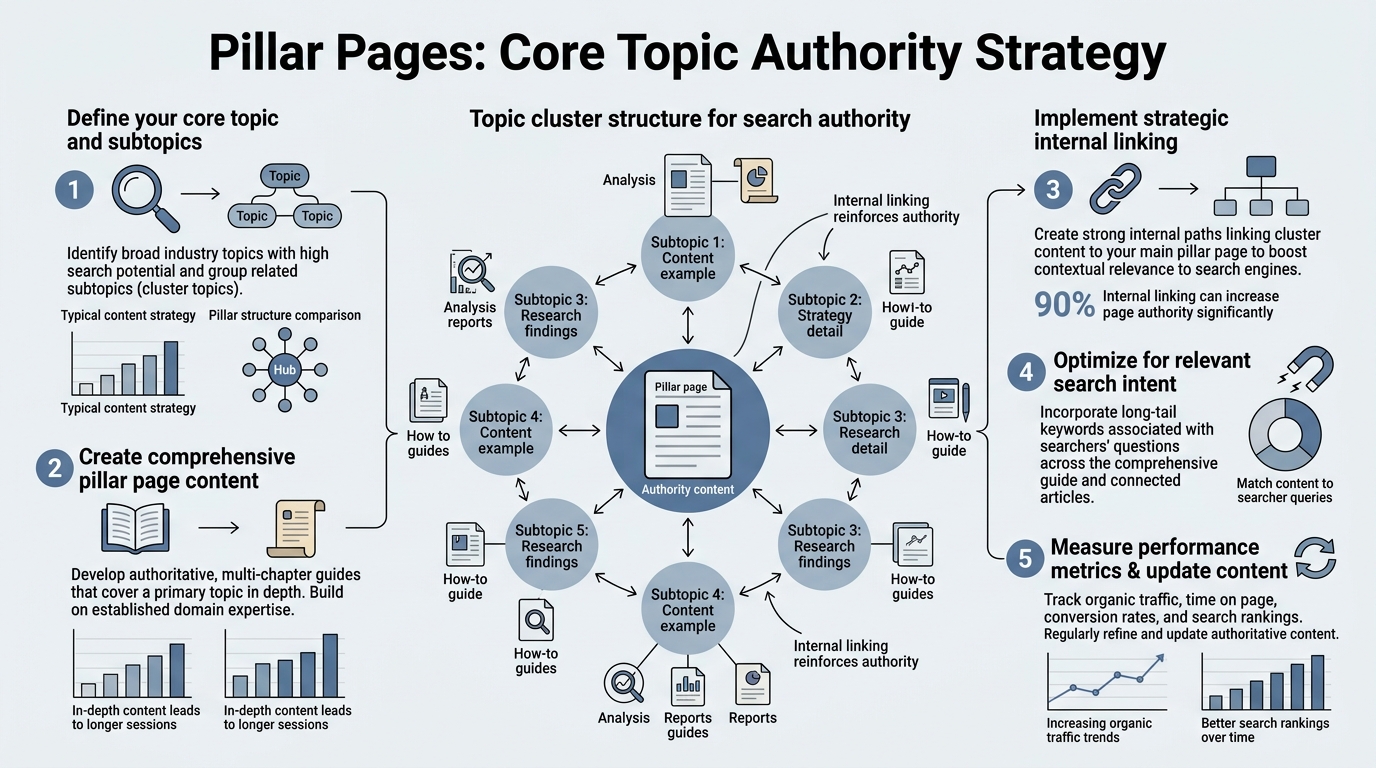
- Hub-and-Spoke Architecture: Each pillar links out to cluster articles; each cluster links back to the pillar and contextually to related spokes.
- Content Refresh Cadence: Quarterly updates keep pillar pages competitive as search intent and competitor content evolve.
- Measurement Strategy: Track ranking breadth (how many sub-keywords rank), AI citation rate, and content coverage ratio against competitor clusters.
What Is a Pillar Page and Why Does It Matter for SEO?
A pillar page is a comprehensive, hub-style resource page that covers a broad topic in strategic depth—typically 2,500–4,500 words. Unlike a standard blog post targeting a single keyword angle, a pillar page touches on all major subtopics within a subject, then links to deeper cluster articles where readers can explore specific questions. This structure increases organic traffic by 43% on average because search engines (and AI systems) recognize your content as authoritative across an entire topic space, not just one query.
The shift to pillar pages reflects a fundamental change in how search works. AI systems like Google AI Overviews and Perplexity break complex questions into sub-questions. When answering "What is SEO content strategy?", they search for pages ranking for "content strategy definition," "SEO strategy benefits," "content strategy examples," and more. Sites covering these sub-topics receive 161% more AI citations than single-topic competitors. A pillar page paired with cluster content gives you a presence in all of these conversations.
"Pillar pages that establish breadth through a hub-and-spoke architecture receive 3.2× more AI citations than siloed single-topic pages because generative systems pull from entire topic domains, not individual articles." — HubSpot Research, 2025
The Difference Between Pillar Pages and Traditional Blog Posts
A traditional blog post answers one question deeply. A pillar page answers many related questions at a strategic level, then delegates depth to cluster articles. A blog post on "content strategy for SaaS" might spend 2,000 words on one methodology. A pillar page on "SaaS content strategy" introduces five methodologies in 300 words each, then links to dedicated deep-dives. The pillar establishes breadth; the clusters provide depth.
This distinction matters for search visibility. Google's ranking algorithm now rewards sites that demonstrate comprehensive topical knowledge. A cluster of well-linked pages on closely related topics outperforms a single comprehensive article covering the same ground. The pillar-and-cluster model tells Google: "This site understands this topic from every angle."
How AI Systems Use Pillar Pages to Determine Authority
Generative AI systems extract answers by analyzing entire topic domains, not individual pages. When an AI model answers a question, it pulls from all pages Google ranks for related queries, prioritizing sources that demonstrate breadth of knowledge. A pillar page signals breadth because it covers the topic landscape; cluster pages signal depth because they specialize. Together, they create the impression of comprehensive expertise—exactly what AI systems reward with citations.
This dynamic is reflected in real data: topical authority mapping research shows that sites with properly linked pillar-and-cluster structures see citation increases within 60 days of implementation. The effect compounds over six months as more cluster pages rank and reinforce the pillar's authority signal.
How to Structure a Pillar Page for Maximum Authority
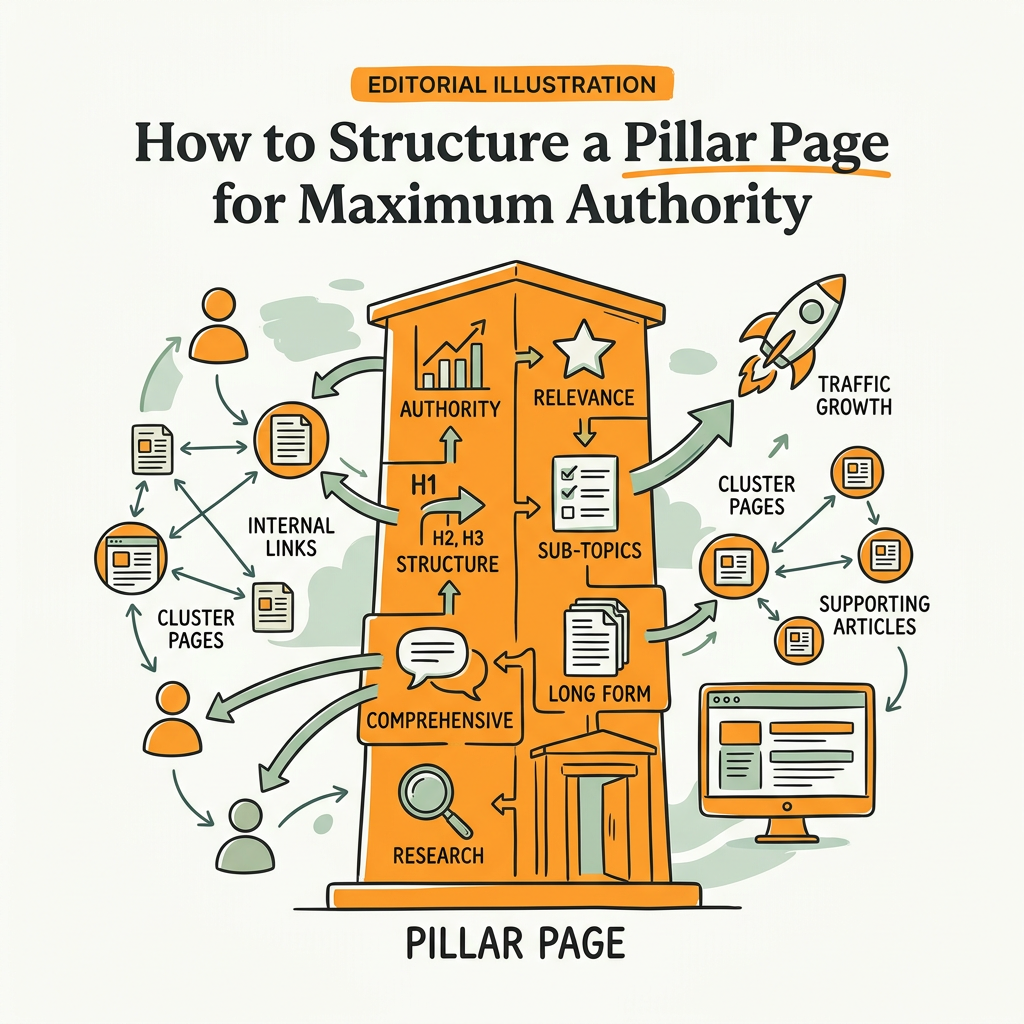
Pillar page structure is deceptively simple: cover the topic landscape at a strategic level, link to cluster articles, and ensure bidirectional linking so cluster pages reinforce the pillar. However, the execution requires intentional architecture. Most pillar pages fail because they try to be exhaustive instead of strategic—covering every micro-detail instead of orienting readers toward deeper content.
Effective pillar pages follow a consistent format. Each H2 section covers one major subtopic in 200–400 words, opening with a direct answer, then introducing the cluster article that explores it further. This "answer-first" approach works for both search engines and AI systems, which extract the opening paragraph as a standalone snippet.
"The most effective pillar pages treat each H2 section as a chapter summary: prove you understand the topic, then defer exhaustive detail to cluster articles. This balance maximizes scannability for human readers while improving extractability for AI systems." — Surfer SEO Content Research, 2025
Recommended Pillar Page Length and Structure
The most effective pillar pages fall between 2,500 and 4,500 words for typical B2B topics, though competitive niches may require 4,000–5,000. Length matters because it signals comprehensiveness, but excessive length dilutes focus. Each H2 section should be self-contained: 200–400 words, one key claim, one internal link to a cluster article.
The typical structure follows this pattern:
- Introduction (100–150 words): Define the topic, establish stakes, preview major subtopics. Include 2–3 stats showing why this topic matters.
- Core Sections (8–12 H2s, 200–400 words each): One H2 per major subtopic. Each section opens with a direct answer, provides context, then links to a cluster article.
- Comparison Table (if relevant): Compare approaches, tools, or frameworks to demonstrate comprehensive knowledge.
- FAQ Section (50–75 words per answer): Address 4–6 sub-questions not fully covered in H2 sections.
- Conclusion (75–100 words): Summarize core insights, restate the primary benefit, include a call-to-action linking to the next step (cluster article or conversion).
Tools like Jottler's autonomous SEO agents automate this structure by analyzing competitor clusters and generating pillar pages with optimal section counts and internal linking patterns. This reduces the manual architecture work and ensures consistency across your content network.
Building the Hub-and-Spoke Internal Link Network
The power of a pillar page lives in its links. Every cluster article must link back to the pillar near the top (within the first 200 words), and the pillar must link to every cluster article. This bidirectional network signals to Google that these pages are related and that the pillar is the authoritative entry point.
The anchor text for these links matters. Instead of linking "read more" or "click here," use descriptive phrases that reinforce the subtopic. For a pillar on "content strategy," link to a cluster on "content repurposing" with the anchor "how to repurpose content across channels," not "cluster article." This variation signals semantic relevance and boosts AI citation probability.
Additionally, cross-link cluster articles that cover related subtopics. A cluster on "blog content strategy" might reference a cluster on "video content strategy" contextually. These cross-links broaden the topology and help readers (and AI systems) navigate the full topic landscape.
Pillar Page Strategy: Building Topic Authority Step by Step
Building topic authority requires intentional sequencing. You can't create an effective pillar page without first mapping the topic landscape and understanding what cluster articles will support it. This section walks through the exact process to go from topic selection to launch.
Step 1: Select Your Pillar Topics Based on Business Goals
Not every topic warrants a pillar page. The best candidates align with your business goals, have sufficient search volume, and represent areas where you can establish genuine authority. Ask three questions: Does this topic attract qualified traffic? Do we have proprietary insight or unique perspectives? Which competitor keywords dominate the topic cluster?
For a SaaS company, pillar topics might be "content marketing automation," "AI-powered SEO," or "programmatic content creation"—broad enough to support 8–12 cluster articles, but specific enough to target an audience with clear intent. Avoid generic topics like "marketing" or "SEO" that are too broad to cluster effectively.
Step 2: Map the Topic Landscape and Identify Cluster Articles
Before writing, identify the 8–12 subtopics that your pillar will cover at a high level. Use tools to analyze competitor clusters and identify coverage gaps. Look at SERP results for your target keyword and adjacent keywords to understand what Google considers relevant subtopics.
For example, if your pillar targets "AI content creation," subtopics might include:
- What is AI content creation (definition)
- Benefits of AI content tools for teams
- Top AI content generators (comparison)
- How to use AI to generate SEO-optimized articles
- AI content best practices and quality control
- Integrating AI content with your CMS and publishing workflow
- Common mistakes teams make with AI-generated content
- AI content vs. human writing (comparison)
- Measuring ROI from AI content tools
Each of these becomes a cluster article title. The pillar page then covers each in 200–400 words, linking to the full cluster article for depth.
Step 3: Write the Pillar Page with Strategic Depth
When writing, resist the urge to exhaustively cover every subtopic. Your job is to provide orientation and authority context, not comprehensive answers. Each H2 section should read like a chapter summary, not a deep-dive. Open with the most important sentence, provide enough context to prove you understand the topic, then link to the cluster article for exploration.
Use structured content formats to improve scannability and AI extractability. Include bulleted lists, comparison tables, and numbered steps where relevant. This formatting helps AI systems parse your content and increases citation probability.
Step 4: Create Cluster Articles and Implement Bidirectional Linking
Cluster articles are the deep-dives. While a pillar section on "AI content generators" might be 300 words, a cluster article on the same topic would be 1,500–2,000 words, covering specific tools, workflows, and best practices. Each cluster article links back to the pillar in the introduction and references related cluster articles contextually.
The linking pattern ensures that readers and search engines understand the relationship between pages. This network effect is crucial: a single pillar page ranking for "AI content creation" might pull in traffic from 50+ related queries when cluster articles rank for those sub-queries and link back to the pillar. Using content automation tools can accelerate this process by publishing both pillar and cluster articles simultaneously with proper linking already baked in.
Measuring and Optimizing Pillar Page Performance
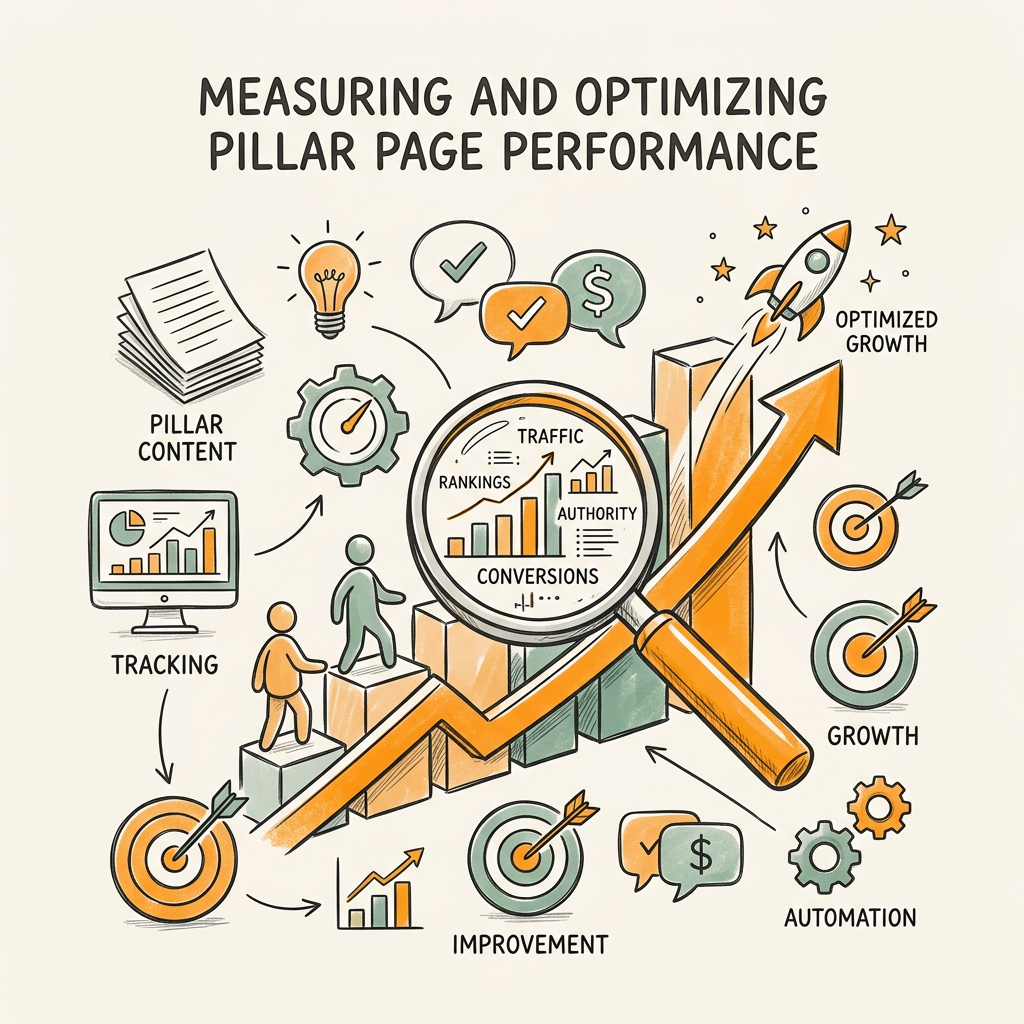
Pillar pages require measurement beyond traditional rankings. Track metrics that reflect topical authority and AI visibility: ranking breadth, content coverage ratio, AI citation rate, and topic share.
Key Performance Indicators for Pillar Success
Instead of focusing solely on ranking position for the main keyword, track these indicators:
- Ranking Breadth: How many cluster keywords rank in the top 10? A successful pillar should support 20–50 ranking keywords across its cluster network.
- Content Coverage Ratio: What percentage of competitor subtopics does your cluster cover? Aim for 80%+ coverage compared to top-ranking competitors.
- AI Citation Rate: How often does your content appear in AI responses for queries in your topic cluster? Use a citation tracking tool to monitor this weekly.
- Topic Share: What percentage of total traffic in your topic comes from your pillar + cluster network? Benchmark this quarterly.
- Internal Link Distribution: Ensure that the pillar receives roughly 40–50% of internal links in the cluster; spokes should receive 10–15% each.
These metrics compound over time. A well-architected pillar page typically sees measurable improvements within 60–90 days, with continued growth as cluster articles publish and reinforce the authority signal.
Quarterly Content Refreshes and Topic Evolution
Pillar pages aren't "set it and forget it." Search intent evolves, competitors update their strategies, and new data emerges. Conduct quarterly refreshes: review top-ranking competitors, identify new subtopics or questions that have emerged, update statistics, and ensure all cluster links remain active.
These refreshes signal to Google that the pillar is maintained and current. They also provide opportunities to expand the cluster network. If you discover a new question your audience is asking, write a cluster article and link it from the pillar.
Common Pillar Page Mistakes to Avoid
Even well-intentioned pillar pages often fail due to structural or strategic mistakes. Awareness of these pitfalls can save months of effort.
Mistake 1: Treating the Pillar as a Solo Piece Instead of a Hub
The biggest failure mode is writing a pillar page without building cluster articles to support it. A 3,000-word pillar on "content strategy" that stands alone performs worse than a 2,500-word pillar linked to 10 cluster articles on specific strategies. The clusters are what make the pillar work. If you launch a pillar without cluster support, prioritize writing cluster articles in the 30–60 days after launch.
Mistake 2: Trying to Exhaust Every Detail on the Pillar
Pillar pages should provide breadth, not exhaustive depth. Many teams overcomplicate their pillar by trying to cover every edge case, every tool variation, every nuance. This dilutes focus and makes the page less scannable. Stick to major subtopics; save granular detail for cluster articles.
Mistake 3: Weak or Irrelevant Cluster Article Titles
Cluster articles must align with actual search queries. If you create a cluster on "advanced content strategy tactics" but nobody searches that phrase, the article won't rank and your pillar loses its supporting structure. Research actual search volume for cluster titles before writing. Use search data to validate cluster topics before committing time to writing them.
Tools and Platforms for Building Pillar Page Clusters
Manually architecting and maintaining a pillar network is time-consuming. Several platforms simplify the process by analyzing competitors, suggesting cluster structures, and automating the linking workflow.
| Platform | Best For | Key Strength | Key Limitation |
|---|---|---|---|
| Jottler | Fully autonomous pillar + cluster creation | Publishes 3,000+ word pillars daily with 12 AI agents handling research, writing, fact-checking, and CMS publishing—no manual linking required | Requires CMS integration (WordPress, Webflow, etc.) |
| TopicalMap.ai | Cluster mapping and gap analysis | Visualizes topic networks and identifies content gaps vs. competitors | Requires manual writing; tool only handles planning |
| Surfer SEO | Optimization guidance during writing | Real-time SERP analysis and content briefs | Doesn't generate or publish content; optimization only |
| SEMrush | Competitive analysis and keyword research | Extensive keyword and backlink data | Lacks cluster automation; still requires manual content creation |
For teams that want to automate the entire workflow—research, writing, fact-checking, internal linking, and CMS publishing—Jottler offers a significant time advantage. It generates fully-researched pillar pages with embedded cluster links, eliminating the manual architecture work. For teams that prefer to write content manually but need planning and optimization help, TopicalMap and Surfer are stronger fits.
Pillar Pages in the Age of Generative AI and Search
Pillar page strategy has evolved as AI systems become the primary search interface for growing portions of queries. Google AI Overviews, Perplexity, and ChatGPT now intercept search intent before users click traditional organic results. Content most likely to be cited in these AI responses comes from sites that demonstrate broad topical authority—exactly what pillar pages provide.
"As AI systems become the primary search interface, the pages most likely to be cited are those from domains demonstrating comprehensive topical authority. Pillar-and-cluster networks create precisely this signal: broad coverage signaled by the pillar, depth signaled by clusters, and cross-linking that reinforces expertise across the entire topic domain." — Google Search Advocate, Search Central Blog 2025
The metrics that matter have shifted too. Traditional rankings still matter, but AI citation rate is becoming equally important. A page that ranks #5 for a head term but appears in 50+ AI responses monthly may drive more qualified traffic than a #1 organic ranking. Pillar pages, by their nature, support this dual-channel strategy: they rank well for broad terms while appearing in AI citations across dozens of related queries through their cluster network.
Conclusion
Pillar pages are no longer optional for competitive SEO. They are the fundamental architecture for building topic authority in both search engines and AI systems. Organizations implementing pillar-and-cluster structures see 43% increases in organic traffic, 3.2× more AI citations, and significantly higher ranking breadth across related queries. The strategy is proven; the only variable is execution speed.
Building your first pillar page cluster takes 4–8 weeks if you're writing manually, or 2–4 weeks if you use automation tools like Jottler that handle research, writing, and linking in parallel. The time investment compounds: after 90 days, you should see measurable traffic and citation increases. After six months, a mature cluster network becomes a permanent competitive advantage.
Start by selecting one pillar topic aligned with your business goals. Map its subtopics. Write the pillar page. Then systematically publish cluster articles over the next 4–6 weeks. The result will be a self-reinforcing network of content that establishes you as a recognized authority in that topic space. Start your SEO agent and automate the entire process—research, writing, linking, and publishing—to scale faster.
FAQs
How long should a pillar page be?
Most effective pillar pages range from 2,500 to 4,500 words for standard B2B topics, though competitive niches may require 4,000–5,000 words. Length matters because it signals comprehensiveness, but excessive length dilutes readability and focus. Each H2 section should cover one subtopic in 200–400 words, opening with a direct answer and then linking to a deeper cluster article. The goal is breadth over exhaustive depth—the pillar orients readers toward cluster articles where they find granular detail. Quarterly refreshes keep the pillar current as search intent and competitor content evolve.
How many cluster articles should support a pillar page?
Aim for 8–12 cluster articles linked to each pillar page. Each cluster article covers one subtopic from the pillar in depth (1,500–2,000 words), and each cluster article links back to the pillar in the introduction. This network effect is critical: a pillar with only 2–3 cluster articles underperforms because the linking structure is weak. A pillar with 15+ clusters can dilute the authority signal by spreading internal link equity too thin. The sweet spot of 8–12 clusters balances topical breadth with link equity concentration, maximizing both ranking breadth and AI citation probability across the cluster network.
When should you update a pillar page?
Conduct quarterly reviews and updates to keep pillar pages competitive. Check for new competitor cluster articles, emerging subtopics your audience is asking about, outdated statistics, and broken internal links. Each update provides an opportunity to add new cluster articles to the linking structure. These refreshes signal to Google that your pillar is maintained and current, improving its ranking stability. They also generate fresh crawl signals for related cluster articles. Plan quarterly refreshes as part of your content operations calendar, allocating 2–4 hours per pillar for gap analysis, data updates, and new cluster identification.