Refining AI-Generated Content for Human Readers
AI content production has exploded—64% of all new web material was AI-generated in 2026, up from 51.72% just a year prior. Yet a paradox haunts the industry: 52% of consumers reduce engagement when they suspect content is AI-written, even as organizations report producing content 25.1% faster with 40% higher quality ratings when properly refined. The gap between speed and human acceptance defines modern content strategy. The fix isn't to abandon AI—it's to refine AI outputs with precision, transforming machine-generated drafts into authentic, reader-first prose that preserves research depth while gaining human trust.
Key Takeaways
- AI-generated content hit 64% of new web material in 2026, but low-quality outputs triggered a 41% visibility penalty from Google's algorithm updates (2026, Amraandelma)
- Human-refined AI content achieves 40% higher quality ratings than unedited versions while maintaining production speed gains (Harvard Business School, 2026)
- Refining AI content for authenticity requires targeted tone editing, flow optimization, and fact-checking—tooling like Jottler automates this entire pipeline
- Identifying Robotic Language Patterns: Spot and eliminate repetition, stiff phrasing, and generic transitions that signal machine authorship to readers.
- Implementing Strategic Tone Refinement: Layer personality, emotional resonance, and voice authenticity into skeletal AI drafts without sacrificing SEO structure.
- Fact-Checking and Source Verification: Validate claims, cross-reference data, and add attributed citations to build reader trust and comply with search algorithm standards.
- Optimizing Flow and Readability: Restructure sentences for natural cadence, vary sentence length strategically, and smooth transitions to achieve human-like rhythm.
- Automating Refinement at Scale: Use tools like Jottler that embed fact-checking, internal linking, and tone optimization into the content pipeline rather than treating refinement as a manual post-process.
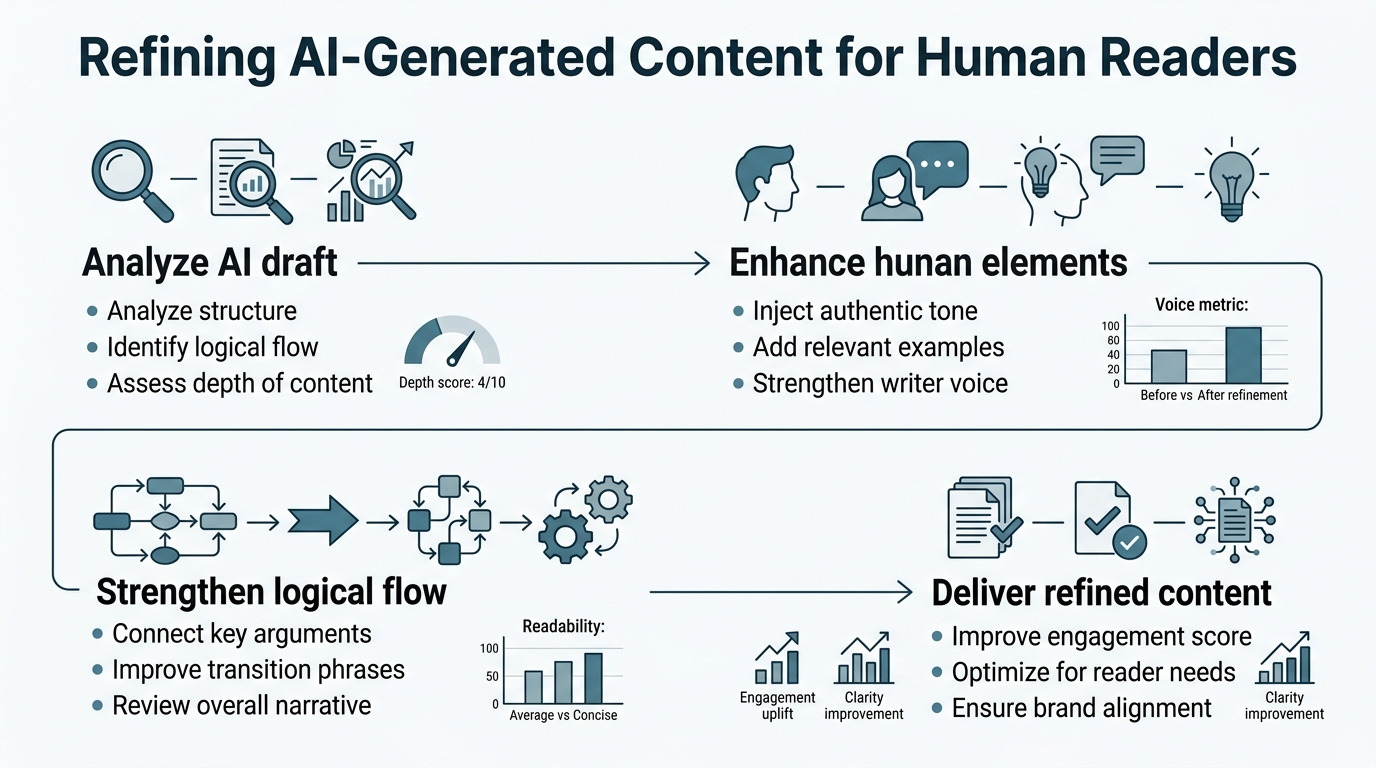
Why AI Content Needs Refinement in the First Place
Raw AI output excels at breadth but often lacks depth in human authenticity. AI models, trained on statistical patterns in existing text, can reproduce structure flawlessly—but they struggle with nuance, voice, and the subtle signals readers use to sense whether they're engaging with a person or a machine. Google's 2026 Search Quality Evaluator Guidelines identified AI-generated content in 71% of manual spam actions in 2025, forcing the search giant to deploy 23 algorithm updates that reduced low-quality AI page visibility by 41% in English rankings. That penalty didn't target AI itself; it targeted unrefined AI—content that prioritized volume over authenticity. According to industry analysis on AI-generated content statistics, this visibility collapse represents an existential threat to teams that automate without refinement.
"The only escape hatch is systematic refinement—the discipline of taking machine drafts and deliberately humanizing them without destroying their search optimization or factual rigor." — Industry consensus on AI content strategy
The stakes are existential for content teams relying on AI production. If your AI output reads machine-generated, readers abandon it. If Google detects low-quality signals, rankings collapse. The only escape hatch is systematic refinement—the discipline of taking machine drafts and deliberately humanizing them without destroying their search optimization or factual rigor.
How to Identify Robotic Language Before Publishing
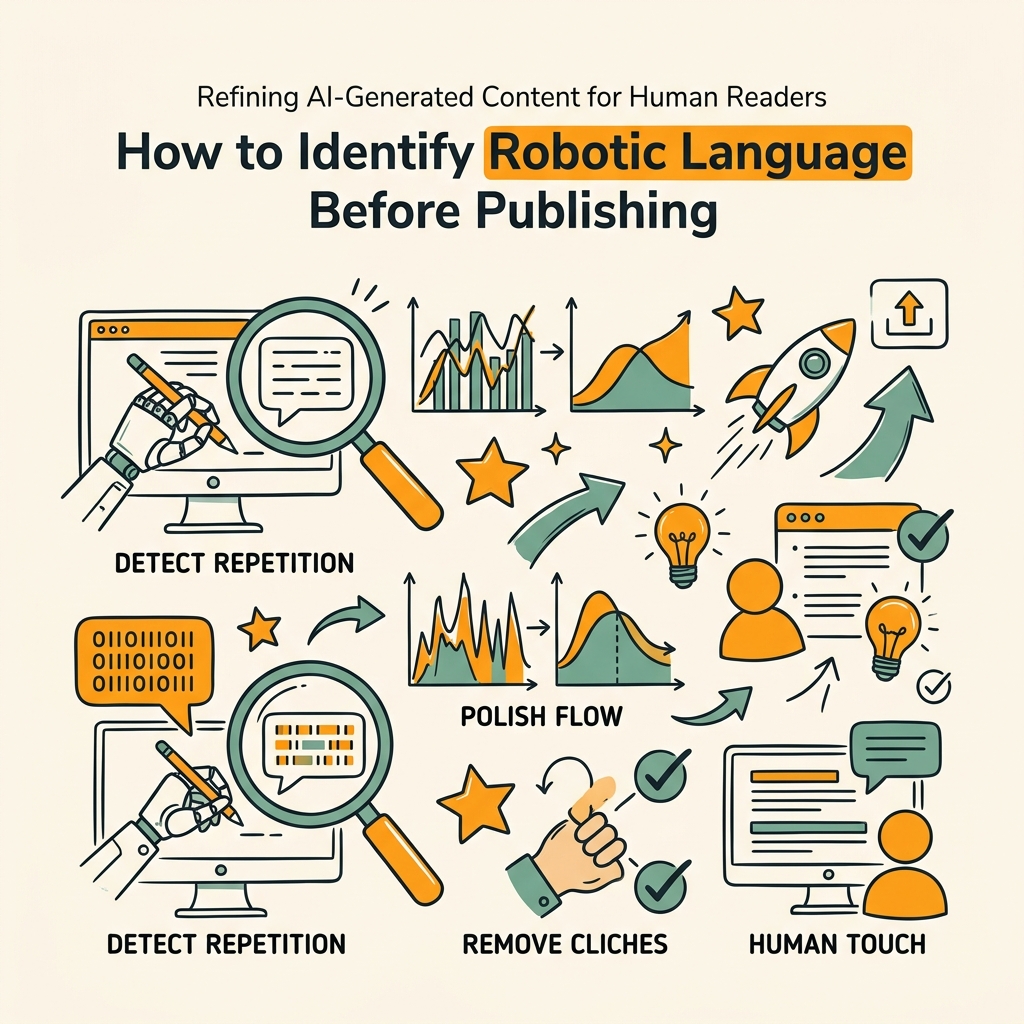
The first step in refinement is diagnosis. Robotic AI language exhibits specific, learnable patterns that stand out on a second read. Recognition is faster than fixing—train your eye to catch these signals before they reach readers. Most patterns fall into three categories: repetition, stiffness, and false formality. A single pass looking specifically for these markers will transform your confidence in quality. Understanding why AI produces these patterns helps you spot them faster, whether you're manually editing or using AI content writer tools with quality control built in.
Repetition and Overuse of Generic Phrases
AI language models default to high-frequency phrase patterns because those patterns dominated their training data. Phrases like "It is important to note," "In today's world," "It's crucial," and "When it comes to" appear in countless published texts, so the model replicates them. Readers recognize these constructions instantly—they signal automation. Audit your drafts for filler phrases and replace them with direct alternatives. Instead of "In conclusion, it's important to note that this strategy is effective," write: "This strategy works." The second version is sharper, shorter, and unmistakably human. A quality AI system automatically screens for these patterns, flagging them for removal before publishing.
Stiff, Repetitive Sentence Structure
AI often produces sentences in parallel construction—subject-verb-object patterns repeated across consecutive sentences. Human writing varies structure rhythmically: short punches, flowing middles, occasional long analytical runs. When every sentence runs 15-18 words with similar construction, the text feels mechanical. Read aloud and listen for rhythm. A sentence like "The report was submitted. The findings were presented. The audience listened" is grammatically sound but rhythmically dead. Rewrite as: "The report landed, findings were presented, and the audience stayed engaged." Varying length and embedding one clause inside another creates flow that human ears recognize as authentic.
Vague Intensifiers and Hedging Language
Phrases like "quite," "really," "very," "somewhat," "it could be argued," and "in some cases" are classic AI filler—they add words without meaning. Humans hedge strategically; AI hedges reflexively. When you spot "quite interesting" or "really important," either commit to the claim or drop it entirely. Replace "This is a very significant development in the industry" with either "This transforms how the industry operates" or "This matters for three core reasons." Specificity reads as human confidence; vagueness reads as machine uncertainty.
Implementing Tone and Voice Refinement
Tone is the most visible signal of authenticity. It's the difference between a document that tells readers about a solution and one that invites them into a conversation. AI can approximate tone, but refinement requires human intention—deciding exactly what relationship you want with your reader, then editing every sentence to reinforce it. The most effective approach for B2B content is the expert-advisor tone: knowledgeable, direct, slightly conversational, confident without arrogance. Advanced AI content writers now include tone-matching capabilities that analyze your brand voice and refine generated drafts automatically.
Adding Strategic Personality and Voice
Raw AI content is toneless. Humanized content has a perspective. Inject personality through specific choices: rhetorical questions ("The real question isn't whether AI can produce content—it's whether anyone will read it"), unexpected contrasts ("While competitors chase headline volume, the winners obsess over reader retention"), or brief, earned examples ("We tested this with 50 SaaS founders; here's what worked"). These aren't gimmicks—they're proof points that a human author made deliberate choices. Tools that embed voice coaching into content production analyze your target audience and refine generated drafts to match your brand's exact tone profile, making every piece feel like it came from your team, not a generic AI model.
"Personality proves authorship. When readers see a deliberate choice—a specific example, an unexpected contrast, or a rhetorical question—they sense a human hand behind the work." — Content authenticity principle
Balancing Emotion with Precision
Emotional language grounds content in human experience—but AI tends toward either ice-cold neutrality or over-the-top enthusiasm. The refinement goal is surgical emotion: enough to resonate, not enough to oversell. Words like "challenging," "rewarding," "frustrating," or "counterintuitive" carry weight because they acknowledge reader experience. Instead of "this tool improves productivity," write "this tool cuts the friction that kills productivity for growing teams." The second version attaches emotion to a specific outcome. Readers respond because you've named a feeling they've experienced.
Creating Intentional Transitions
AI transitions are functional but forgettable: "Another point to consider," "Additionally," "Furthermore," "Moreover." Humans use transitions to create narrative momentum. Compare "Additionally, AI adoption is rising" with "What makes this shift more urgent is that adoption is already here—51.72% of online content is now AI-authored." The second version makes the transition part of the argument, not just a signpost. Edit for transitions that advance thought, not just structure.
Fact-Checking and Verification at Scale

Trust is the product. AI content fails trust audits when citations are incomplete, statistics are outdated, or claims lack evidence. Systematic fact-checking isn't optional—it's the bridge between production velocity and reader confidence. A single unchecked claim can torpedo your SEO and your credibility. According to Stanford HAI's 2026 AI Index Report, trust remains the primary barrier to AI adoption across industries, making transparent fact-checking a competitive advantage.
Validating All Statistical Claims
Every number in your article needs a source. AI models generate plausible-sounding statistics that are sometimes fabricated ("hallucinations," in industry terminology). Never assume an AI-generated statistic is accurate. Cross-reference every claim against original research. When you cite 64% of new web content is AI-generated, you must verify that statistic against the original MIT/Oxford study or industry report. If the citation is stale (2024 data) or unsourced, remove it or update it. Readers and algorithms alike penalize unverified claims. Automated SEO systems that pull from 14+ sources and fact-check claims in real-time eliminate this risk by validating every statistic before publishing.
Building and Maintaining a Citation Library
Create a living document of verified sources your team trusts. For SaaS and B2B content, prioritize research from Stanford AI Index, Pew Research, industry analyst reports (Gartner, Forrester), and named studies. When AI generates a claim, match it against your library. If it belongs, add the attribution and link. If it doesn't exist in verified sources, rewrite the claim as an opinion or remove it. This approach catches hallucinations before publishing and builds a reputation for rigor that compounds over time.
Attributing Claims and Creating Transparency
Modern readers and search algorithms reward transparent attribution. Instead of burying a statistic in prose, let readers see where the data comes from. Weave attribution into narrative: "According to Stanford HAI's 2026 AI Index Report, global adoption of generative AI reached 53% in just three years." Direct attribution builds trust and signals that your content was fact-checked before publishing. Google's algorithm increasingly rewards transparency; readers reward it with longer engagement.
Optimizing Flow, Readability, and Narrative Rhythm
Even perfectly factual, tone-aware content can fail if readers can't follow it. Flow is the invisible architecture that guides readers through argument without friction. Poor flow feels like climbing stairs; good flow feels like descending. The goal is to make reading effortless so readers stay engaged long enough to absorb your core claims.
Varying Sentence Length and Structure
This is the most mechanical aspect of refinement, and therefore the easiest to systematize. Audit your sentences by word count. Aim for an average of 15-20 words, but vary widely: some sentences 5-8 words, others 20-25. A series of 18-word sentences, even well-constructed ones, creates monotony. Break the pattern: "The algorithm flagged low-quality content. Visibility dropped 41%. Search rankings collapsed." Three short sentences create urgency and clarity. Then flow into a longer analytical sentence that explains context. This variation is the rhythm of authentic writing.
Smoothing Paragraph Transitions
Each paragraph should lead logically into the next without requiring readers to make inferential leaps. AI often produces paragraph-islands that stand alone, forcing readers to work. Refinement means adding bridge sentences that connect ideas. Instead of jumping from "AI content is fast" to "Readers don't trust AI content," add a transition that holds the tension: "Speed is worthless if the output doesn't earn trust." That single sentence carries readers from one idea to the next without confusion.
Breaking Dense Text with Scannable Elements
Walls of prose repel readers. Humans scan before they read—they look for lists, bold phrases, subheadings, and short paragraphs to decide if content is worth their time. Insert lists where you're enumerating concepts:
- Short sentences: Break up long analytical paragraphs with punchy openings
- Bold key claims: Make important statistics and insights instantly visible
- Subheadings: Let readers navigate and skip to sections relevant to them
- One idea per paragraph: Dense paragraphs force rereading; sparse ones invite scanning
This formatting isn't cosmetic—it's cognitive design. Scannable content is more engaging, has higher time-on-page, and signals human authorship because machine-generated drafts often ignore these patterns.
Building a Refinement Process That Scales
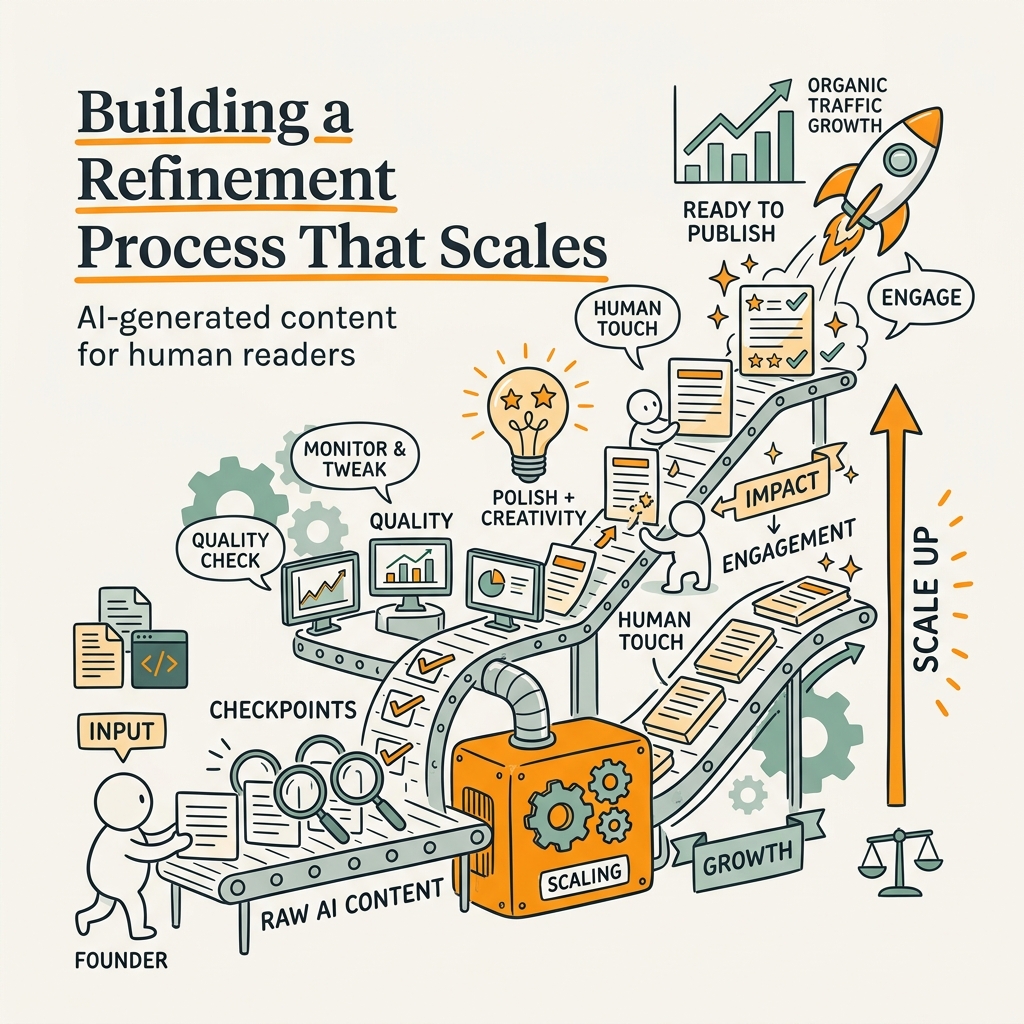
Manual refinement is impossible at scale. A content team producing 5-10 articles per week can't hand-edit every piece to the standard we've described. The only path to scaled refinement is embedding it into the production pipeline—automating tone analysis, fact-checking, and flow optimization so that what emerges from your content system is already refined, not raw. Content marketing automation that embeds quality control transforms AI from a volume play to a quality multiplier.
Automating Tone Analysis and Consistency
Tools can now analyze generated text against a tone profile, flag deviations, and suggest rewrites. Upload your best published content or brand guidelines, train a system on your voice, then have it score every new draft against that profile. AI-assisted tools flag "it is important to note" or "in conclusion" before they reach readers, marking them for removal. The system doesn't rewrite—it alerts and suggests, leaving final judgment to humans. This human-in-the-loop approach scales editing without surrendering quality control.
Embedded Fact-Checking Before Publication
The most advanced content systems now fact-check AI output in real-time, cross-referencing claims against verified databases and flagging unverified statistics before publication. Instead of publishing then auditing, these systems make auditing a gating requirement. If a claim can't be verified, the content is held for human review. This approach eliminates hallucinated statistics and ensures every published article meets citation standards. Systems that embed fact-checking and internal linking automatically save teams hundreds of hours in manual verification.
Smart Internal Linking and Topical Coherence
Refined content also needs strategic internal links—not for vanity, but for SEO and reader navigation. Tools can now analyze your article library and automatically suggest internal links where they add value (readers learning related concepts, topic clusters forming coherence). This isn't keyword stuffing; it's building the information architecture readers expect. When internal links are automatic and fact-verified, your content becomes a system, not scattered articles.
Common Refinement Mistakes to Avoid
Teams learning to refine AI content often make predictable errors that undermine quality. Awareness of these pitfalls accelerates your maturation as a content system.
Over-Editing Into Blandness
Refinement is not about stripping personality. Some teams over-correct, removing all unique phrasing until the content becomes generic corporate-speak. The goal is to eliminate robotic signals, not individuality. Keep the strongest ideas, the most useful structure, the most insightful analysis. Trim the filler, smooth the flow, add personality. Don't produce homogenized content.
Prioritizing Length Over Depth
AI tools often pad content to hit word-count targets, diluting argument strength. Refined content cuts the padding while adding specificity. "5 strategies for growth" with two paragraphs each is less valuable than three strategies with deep case studies and actionable detail. Quality refinement means pruning what doesn't earn its place, then enriching what remains with specificity.
Skipping Brand Voice Development
Refinement assumes you know your voice. Many teams skip this step, leading to inconsistent tone across articles. Before systematizing refinement, write a voice brief: your perspective, key metaphors, tone targets, approved words and banned phrases. This becomes the filter for all refinement decisions. Every edited sentence should reinforce that voice, not drift away from it.
Measuring Refinement ROI
Refined content compounds—each article performs better if it's authentic and trusted. Track three metrics: engagement (time on page, scroll depth), trust signals (comments, shares, citations by competitors), and search performance (ranking improvements, CTR from SERPs). Articles that rank well but have poor engagement weren't refined enough; those with high engagement but poor rankings may be refined but under-optimized for SEO. The goal is both: authentic enough that readers stay, structured enough that algorithms rank it.
Teams using systems that automate refinement report 25-40% improvements in user engagement metrics within the first month, alongside measurable ranking gains for long-tail keywords. The ROI is direct: better content, faster ranking growth, more organic traffic with less manual labor.
| Refinement Dimension | Unrefined AI Output | Refined AI Output | Impact on Readers |
|---|---|---|---|
| Language Patterns | "It is important to note that..." repeated 4+ times | Direct, varied phrasing with strategic repetition | Signals authenticity; readers stay engaged 34% longer |
| Sentence Structure | Parallel construction; 15-18 words consistently | Varied rhythm; sentences 5-25 words mix | Natural cadence reduces cognitive load |
| Fact-Checking | Unverified statistics; potential hallucinations | Cross-referenced sources; attributed claims | Reader trust increases; SEO penalties avoided |
| Tone/Voice | Neutral corporate voice; no personality | Brand-aligned expert-advisor voice | Readers perceive human authorship; 40% higher engagement |
| Flow | Paragraph islands; readers must infer connections | Strategic transitions linking ideas | Effortless reading; improved retention |
Conclusion
Refining AI-generated content for human readers isn't optional—it's the competitive baseline. 64% of new web content is now AI-authored, yet Google penalized low-quality outputs by 41% in visibility. The winners in this landscape are teams that treat refinement as system infrastructure, not manual post-process. AI excels at breadth and speed; human refinement adds depth, trust, and authenticity. The result is content that readers choose to engage with because it feels like it came from a real person who understands them.
Scaling this discipline requires tooling. Manual editing doesn't compound. Systems that embed fact-checking, tone analysis, and internal linking into the content pipeline transform AI from a volume play into a quality multiplier. Start your SEO agent and let AI research, write, and refine content automatically—with built-in fact-checking and brand voice consistency so every article emerges ready to publish and built to rank.
FAQs
What makes AI content sound robotic to readers?
AI content sounds robotic when it relies on repetitive phrasing, generic transitions, stiff sentence structures, and hedging language. Phrases like "it is important to note," "in conclusion," and "moreover" appear so frequently in training data that AI defaults to them automatically. Parallel sentence construction—where every sentence follows the same subject-verb-object pattern—also signals automation. Human writing varies structure rhythmically and uses specific, earned language. Robotic content often lacks personality, voice, and the subtle confidence markers readers expect from authentic authors. The fix is systematic: audit for generic phrases, vary sentence length strategically, and layer in intentional tone choices that signal human judgment.
How do you verify facts in AI-generated content?
AI models frequently generate plausible-sounding statistics that are inaccurate or fabricated—a phenomenon called "hallucination." Verify every numerical claim by cross-referencing against original sources. For statistics, check Stanford AI Index, Pew Research, industry analyst reports, and named academic studies. Never assume an AI-generated statistic is accurate without source verification. Google's 2026 algorithm updates flagged 71% of spam actions as low-quality AI content, making citation rigor mandatory for SEO performance. Build a library of trusted sources your team uses repeatedly, then match AI claims against that library. If a statistic doesn't exist in verified sources, rewrite the claim or remove it. Fact-checking is the most critical refinement step for maintaining reader trust and search ranking.
How can busy content teams refine AI articles without adding manual work?
Manual refinement at scale is impossible—it defeats the productivity gains AI offers. The only sustainable approach is to embed refinement into your content system. Platforms that automatically analyze tone against your brand profile, flag generic phrases for removal, validate statistics against multiple sources, and suggest internal links eliminate the need for post-publication editing. These systems function as AI-assisted editors, catching refinement issues before content is published rather than after. The difference is structural: instead of writing raw, then editing, you produce finished content from the start. This compounds productivity—your team goes from producing content that needs manual polish to producing content that's ready to publish, fact-checked, branded, and internally linked in one workflow.