Repurposing Content for Compound Reach Growth
Most marketing teams create content once and hope it reaches their audience. Yet only 29% of marketers have a systematic content repurposing process, despite the fact that repurposed content generates 3.5x more engagement than single-format original content. The cost is opportunity: teams spend weeks creating assets that could earn 10x the reach with thoughtful adaptation across channels. The solution? Build a repurposing engine that turns each piece of content into multiple revenue-generating assets.
Key Takeaways
- 30% organic traffic increase for businesses that systematically repurpose content vs. those that don't (BlogHunter, 2026)
- A single blog post can become 8-12 different content pieces across formats, extending content lifespan by 300%
- Content repurposing improves ROI by 32% while reducing cost per piece by 35% (RankTracker, 2025)
Quick-Scan Action Plan
- Audit Your Top Performers: Identify highest-traffic pages that haven't been updated in 3+ months and target them for multi-format repurposing.
- Build a Repurposing Waterfall: Create a systematic workflow from blog-to-video-to-social-to-email that runs on a predictable cadence.
- Leverage AI-Powered Adaptation: Use automation to convert long-form content into scripts, social snippets, and email sequences in minutes instead of hours.
- Extend Content Lifespan by 300%: Refresh data, add new examples, and republish existing articles to boost traffic by up to 146%.
- Measure Reach, Engagement, and Conversion: Track how repurposed content performs across owned channels and refine your workflow quarterly.
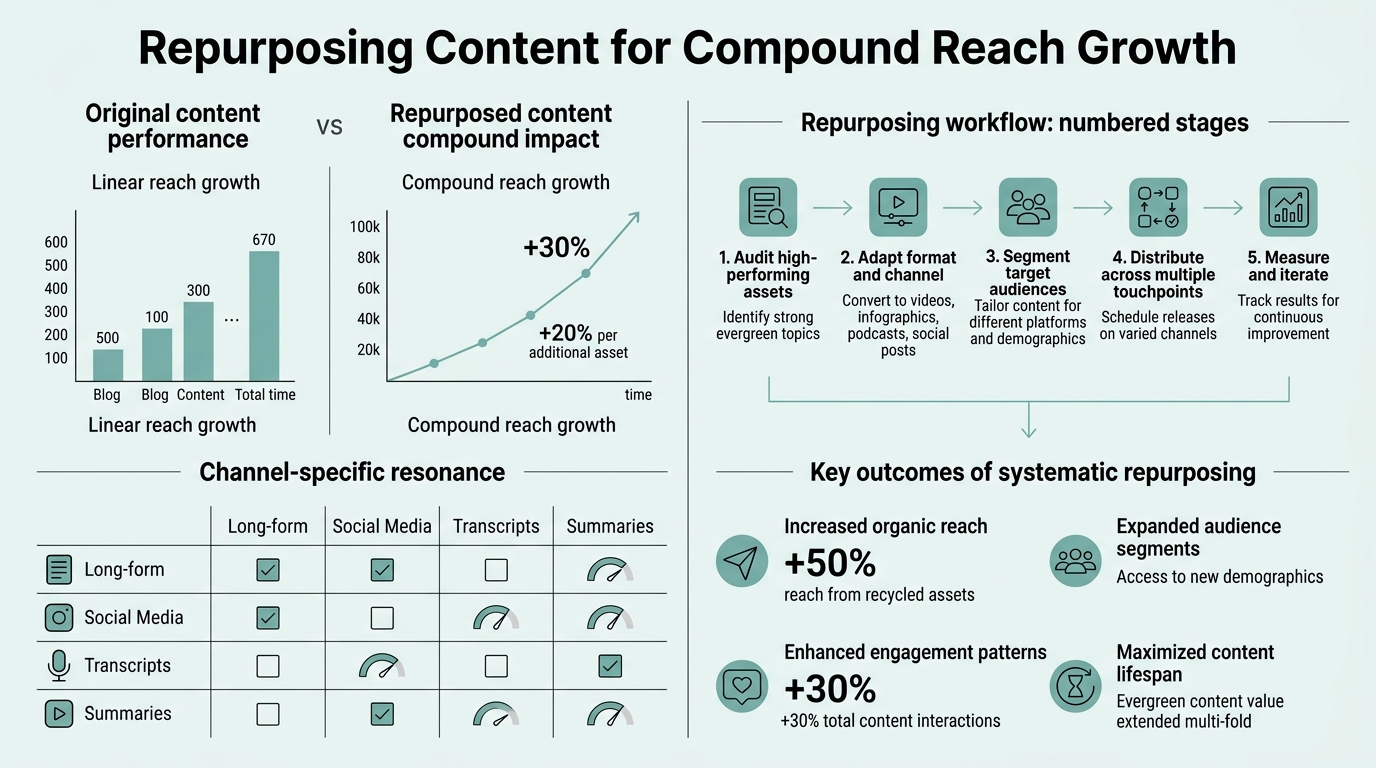
Why Content Repurposing Is Your Fastest Path to Compound Organic Growth

Content repurposing takes existing high-value assets and transforms them into multiple new formats or platforms. This differs fundamentally from crossposting (sharing content as-is) or reposting (repeating the same format on the same channel). True repurposing adapts the core idea for new audiences and contexts—a blog post becomes a video script, a webinar, an infographic, a LinkedIn carousel, and an email sequence. Businesses that do this systematically see a 30% increase in organic traffic compared to those relying on single-format creation.
"You've already invested in research, writing, and optimization for your primary asset. That sunk cost is fixed. Adding 7-11 adapted formats costs far less than creating 7-11 new pieces from scratch, yet reaches exponentially more people." — Content Marketing Economics, 2026
The economic logic is straightforward: Teams produce 47% more content at 35% lower cost per piece when they systematize repurposing into their workflow. For busy founders and marketing teams at scaling companies, this is the difference between burnout and sustainable growth.
The engagement lift is equally dramatic. Companies using repurposing strategies generate double the engagement rates compared to those relying solely on original content. 60% of marketers report that repurposed content generates more leads than original content. According to HubSpot's marketing research, this compounds: more engagement means more signals for search engines, which drives rankings, which feeds more organic traffic into a virtuous cycle.
How to Audit Your Content Library and Identify Repurposing Candidates
Not every piece of content deserves repurposing. The 80/20 rule applies: your top 20% of pages drive 80% of the value. Start there. Begin by identifying which pieces have earned the most organic traffic, ranked on pages 1-3 of Google, and haven't been updated in 3+ months. These are your golden candidates—they've already proven demand, so amplifying them across formats is lower-risk than experimenting with new topics.
Pull Your Traffic Data from Google Analytics 4
Open GA4 and filter your blog pages by organic sessions over the past 12 months. Look for articles with 500+ sessions that have stable or slowly declining traffic—these are candidates for a data refresh and multi-format expansion. Your audit checklist should include:
- Rank position (target: pages 1-3 on Google)
- Organic traffic volume (target: 500+ sessions in 12 months)
- Bounce rate (lower is better; below 40% indicates strong content)
- Average session duration (higher indicates engagement)
- Last updated date (flag if 3+ months old)
- Ranking trend (stable or declining = refresh candidate)
Articles with low bounce rate and high duration indicate they're resonating; those are your repurposing anchors. Articles with high bounce rate but good rankings may need content quality improvements before repurposing makes sense.
Prioritize by Topical Authority and Keyword Clustering
Look for clusters of related articles in your top performers. If you have three blog posts ranking for variations of "content marketing best practices," "content strategy frameworks," and "content ROI measurement," these form a natural pillar-cluster. Articles within the same topical cluster are ideal repurposing candidates because you can create a comprehensive video series, a downloadable guide, or a multi-part webinar that feeds traffic between all three pieces through smart internal linking. Building topical authority through strategic clustering accelerates SEO gains faster than isolated pieces.
Score by Freshness and Competitive Pressure
Fast-moving industries like AI, SaaS, and marketing tech require updates every 1-3 months. Evergreen topics (principles, frameworks, long-term strategy) can sit 6-12 months before losing relevance. Check your top 10 articles: if any have outdated statistics or references to tools that no longer exist, they're ready for a refresh. Also note which pages face growing competition—if your ranking position has slipped from #2 to #4 in the past 6 months, a comprehensive update plus cross-channel promotion can reclaim that spot.
Building Your Content Repurposing Workflow: From Blog to Multi-Format Distribution
A systematic repurposing workflow removes the friction that keeps 71% of marketers from doing this consistently. The goal is to make it automatic—something your team does as part of publishing, not an afterthought. A single long-form article can become 8-12 different assets if you follow a predictable sequence.
Step 1: Optimize the Original Blog Post for SEO and Citation
Before you repurpose, ensure your primary content is bulletproof. Your blog post is the SEO anchor—it must be fully optimized with target keywords in the H1, first 100 words, and 2-3 H2s. Include at least 3-5 relevant statistics with attribution. Add internal links to related cluster articles. Include a clear CTA that leads readers to other valuable resources or a signup form. This is where your organic traffic originates; the other formats amplify and feed back to this page. Creating an SEO content plan that builds this anchor-and-amplify structure ensures repurposing multiplies rather than dilutes your authority.
Step 2: Extract a 10-15 Minute Video Script Within 2 Weeks
Video now accounts for over 82% of all internet traffic in 2026. Your blog post structure is already a video outline: H2s become video segments, key points become talking points. Record a 10-15 minute video using your blog H1 as the title and your H2 sections as the breakdown. You don't need professional production—screen recordings with voiceover, or simple talking-head videos shot on a smartphone perform just as well as high-budget productions for informational content. Host on YouTube and embed in the blog post to boost its ranking and session duration signals.
Step 3: Break Into 8-12 Social Media Posts and Email Snippets
Each H2 and key statistic in your blog becomes a standalone social post or email subject line. Distribute across multiple platforms by following these guidelines:
- LinkedIn Carousels: Adapt H2 sections into one idea per slide with professional tone and industry hashtags
- Twitter/X: Pull 1-2 punchy sentences from each H3 subsection with relevant tags
- Email Series: Create 5-part sequence where each email dives into one H2 topic with link back to full blog
- YouTube Shorts/Reels: Extract 15-30 second video clips and distribute across platforms
- Instagram Stories: Convert key statistics into quotable graphics with brand colors
Video snippets from webinars generate 4x more social engagement than standard promotional clips, so prioritize video extraction and distribution.
Step 4: Create Complementary Assets (Infographics, Checklists, Templates)
If your blog post contains a process, framework, or list, convert it to a downloadable asset. A blog on "content marketing strategy" becomes a downloadable content calendar template. A guide on "SEO best practices" becomes a pre-built checklist. An explainer on "content repurposing" becomes an infographic showing the repurposing waterfall. These assets become lead magnets that feed your email list while reinforcing the original blog's SEO value through backlinks and social shares.
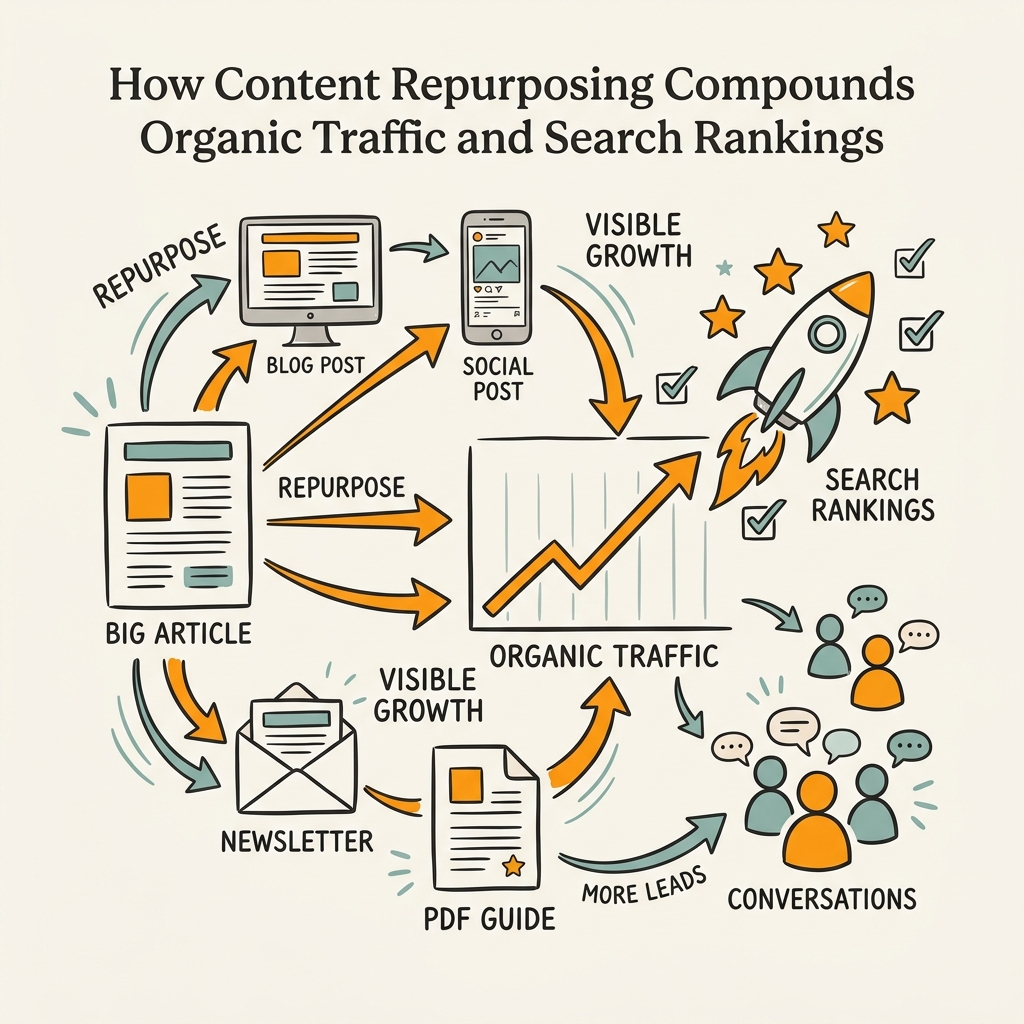
How Content Repurposing Compounds Organic Traffic and Search Rankings
The mechanism for traffic compounding is not immediately obvious, but it's powerful. When you repurpose strategically, you create multiple touchpoints for the same core idea across different platforms and formats. Each format attracts different search behaviors and user preferences. Your blog targets long-tail organic keywords. Your YouTube video attracts video search and suggested video clicks. Your email series generates return visits and repeat engagement signals. Your social posts drive referral traffic and social signals that Google increasingly uses as ranking factors.
"When you publish the same core content across 10 different formats and channels, you're creating multiple citation opportunities. Each action sends indirect ranking signals back to your original blog post." — Content Authority Building Study, 2025
The Multi-Channel Citation and Authority Accumulation Effect
When you publish the same core content across 10 different formats and channels, you're creating multiple citation opportunities. Other marketers share your video on LinkedIn. Your checklist gets downloaded and mentioned in Slack channels. Your infographic gets embedded in industry forums. Your email series gets forwarded. Each of these actions sends indirect ranking signals back to your original blog post. Repurposed content reaches 5-10 times more people than single-format content, which means 5-10x the potential citations, backlinks, and shares. That's how content repurposing compounds organic reach beyond the initial publish.
Expanded Keyword Coverage Without Keyword Cannibalization
A 3,000-word blog post targets maybe 5-8 closely related keywords. But when you adapt that content into a 15-minute video, a YouTube description, video title, transcripts, and 12 social posts, you're now covering 20-30 keyword variations—some long-tail, some question-format, some exact-match. YouTube videos rank for different queries than blog posts. Social posts show up in platform-specific search. This doesn't cannibalize your blog rankings; it expands your keyword footprint. The blog remains your authority piece, while the adapted formats target adjacent keywords that feed traffic back to the main post.
Building Topical Authority Faster Through Linked Clusters
Repurposing works best when you apply it to content clusters, not isolated articles. If you have 3-5 blog posts on "content marketing," create a video series, a downloadable guide, and an email sequence that connects all of them through smart internal linking. Each piece links to the others, building what SEOs call "topical authority"—Google's signal that your site owns a topic end-to-end. Updating high-performing blog posts alone can boost traffic by 146% according to recent data from Shno. When you combine updates with cross-channel promotion and internal linking, the lift is even steeper.
The Role of AI Automation in Scaling Repurposing Workflows
Manual repurposing is tedious and doesn't scale. A founder who writes one blog post per week can manually create 2-3 adapted formats if diligent. But a founder who publishes 3 posts per day needs automation. This is where AI-powered repurposing tools become essential. The best solutions handle the entire pipeline: research, writing, adaptation, format generation, and even CMS publishing. Instead of spending 4 hours manually converting a blog post into a video script, email sequence, and social snippets, you spend 15 minutes setting parameters and let AI handle the grunt work.
From Manual Workflow to Autonomous Repurposing Systems
Traditional content marketing uses separate tools for each step: a writing tool for blog posts, a video editor for scripts, a social media scheduler for posts, an email platform for sequences. Each handoff introduces delay and human error. Modern repurposing systems unify the workflow under one autonomous engine. You input your blog post or target topic, set your repurposing preferences (which formats to generate, which platforms to target), and the system automatically produces blog-ready content, video scripts, social posts, email sequences, and more—often with fact-checking and internal linking built in. For busy founders, this difference is the line between scaling and staying stuck at 1-2 posts per week. An autonomous SEO agent removes the manual bottleneck entirely.
AI-Powered Format Adaptation and Tone Customization
Converting a formal blog post into a casual LinkedIn carousel or a video script requires more than find-and-replace. The tone, pacing, and emphasis shift across formats. An AI repurposing system learns your brand voice and adapts it appropriately: your blog post remains formal and authority-focused; your LinkedIn carousel becomes conversational with hashtags; your email sequence is benefit-driven and personal. Rather than your team spending 30 minutes rewriting each version, AI produces a first draft in seconds, leaving humans to refine rather than create from scratch. This is the efficiency that makes daily publishing feasible.
Comparison of Manual vs. AI-Powered Repurposing
| Metric | Manual Repurposing | AI-Powered (Jottler) |
|---|---|---|
| Time per Blog Post Adaptation | 3-5 hours | 10-15 minutes |
| Formats Generated | 2-3 per post | 8-12 per post |
| Publishing Frequency (Per Person) | 1-2 posts/week | 3-5 posts/day |
| Fact-Checking Overhead | 30-45 minutes per post | Built-in (automated) |
| Internal Linking Setup | Manual research, 20 minutes | Automated network building |
| Cost Per Content Piece | $200-400 (contractor time) | $29-99/month (unlimited posts) |
| SEO Compliance Check | Manual + tools ($50-200/month) | Integrated |
The gap widens at scale. A solo founder publishing 3-5 posts per day manually would need 15-25 hours of work. With an AI repurposing engine, that same founder publishes automatically while focusing on strategy and customer research. The payoff: 3-5 new pieces of authority-building content daily, each triggering organic traffic growth months or years later. According to RankTracker's 2025 research, the ROI difference between manual and automated repurposing is staggering.
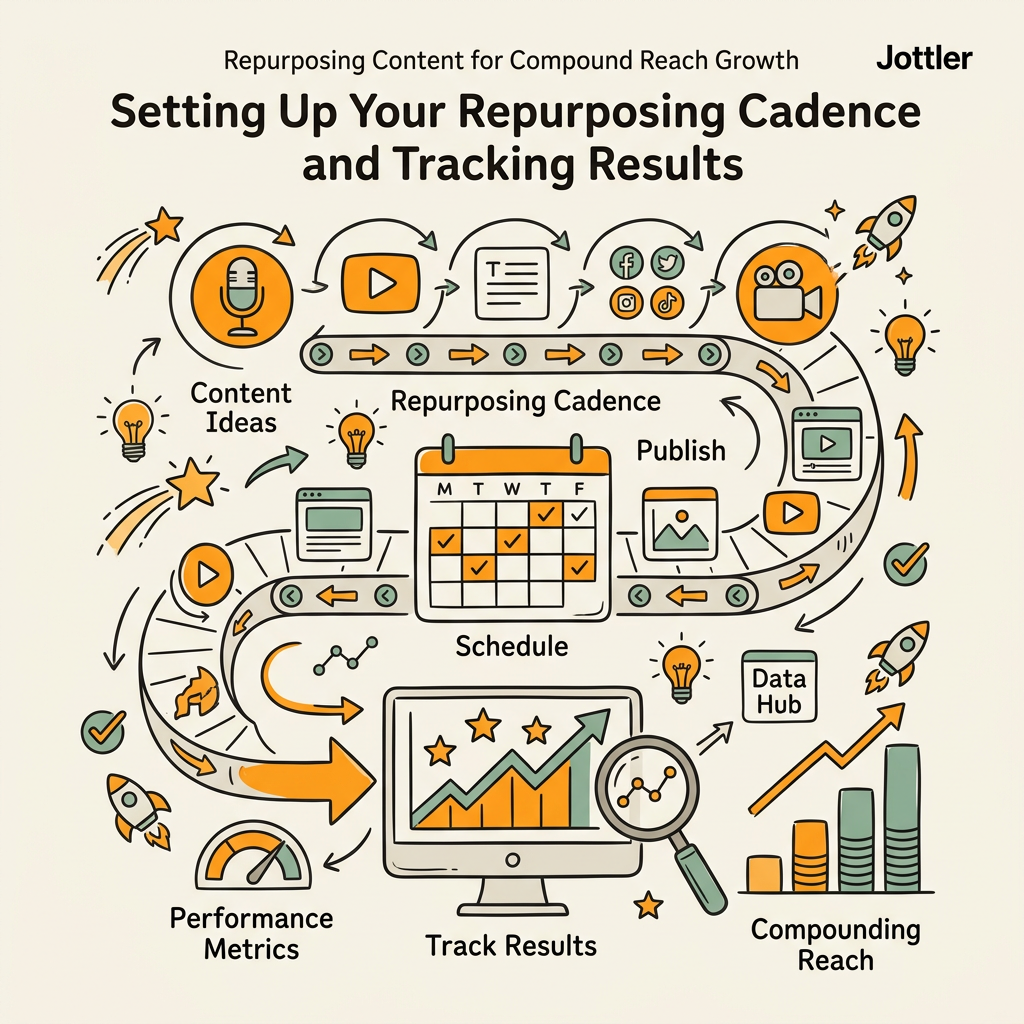
Setting Up Your Repurposing Cadence and Tracking Results
Repurposing is not a one-time project; it's a system that compounds over time. To ensure it becomes habitual rather than occasional, define a clear cadence and tracking discipline. Most teams find success with a quarterly refresh cycle: every 90 days, identify your top 10 performing articles, refresh their data, expand them into new formats, and measure the traffic lift. For fast-moving industries, monthly reviews work better. The key is consistency—the team knows repurposing happens on Tuesday of week 2, no exceptions.
Quarterly Content Audits and Refresh Triggers
Set a calendar reminder for quarterly audits. Pull your top 10 articles by organic sessions from GA4. For each, ask: Has the ranking position slipped? Are any statistics older than 12 months? Have competitors published newer content on this topic? If yes to any of these, flag it for refresh. A refresh means updating statistics, adding new examples from the past quarter, rewriting any dated advice, and adding internal links to newer related articles. Then repurpose the refreshed version across all channels. This creates a compounding effect: older content feeds newer content's rankings through internal links, while newer content signals feed back to older content's relevance.
Measuring Repurposing Impact: Reach, Engagement, Conversion
Track three metrics: Reach (how many people saw the content), Engagement (clicks, likes, shares, time on page), and Conversion (leads, signups, sales attributed to that content). Your measurement framework should include:
- Build a custom GA4 report filtered by landing pages containing "/blog/" or your content directory
- Identify which original pieces received the most organic traffic after repurposing (compare traffic 30 days before and after)
- Track where your traffic originates: organic search, direct, referral, and social
- Monitor conversion rate per channel (which repurposed format converts best?)
- Calculate cost per acquisition by channel
If your repurposing lifted social referral traffic by 50% but organic traffic stayed flat, you may need stronger internal linking or a different keyword strategy. The data guides your next iteration.
Building Feedback Loops to Refine Your Repurposing Strategy
Not all repurposing generates equal returns. Your LinkedIn carousels might outperform your YouTube videos, or vice versa. Your email sequences might have higher click-through rates than organic search. Use these insights to specialize: if LinkedIn drives the best ROI, repurpose more aggressively for that platform. If organic search is your strength, focus repurposing on internal linking and topical clustering. Create a simple scorecard showing which formats and channels generate the highest traffic and engagement per hour of effort. Over time, your team naturally optimizes toward the highest-ROI formats, making the entire workflow more efficient.
Common Repurposing Pitfalls and How to Avoid Them
Most teams fail at repurposing not because the strategy is flawed, but because they ignore implementation details. Here are the traps to avoid.
Publishing Without Strategic Internal Linking
Repurposing 10 new formats of the same content means nothing if those formats don't link back to the original blog and to related articles. Every YouTube video description, every LinkedIn post, every social snippet should include a link to the blog post. The blog post should link to the video, related articles, and upcoming repurposed pieces. Without this linking architecture, you're just scattering content into the void. Worse, you risk creating weak link signals that dilute rather than amplify your topical authority. Solve this by building a linking checklist into your repurposing workflow—a non-negotiable step that happens before publishing any adapted content.
Repurposing Low-Performing Content
Some pieces of content are low-traffic for a reason: they're solving a problem nobody searches for, or they're outranked by stronger competitors. Repurposing amplifies whatever success a piece already has. If your blog post gets 50 organic sessions per month, repurposing might lift it to 75 sessions. That's a poor return on effort. Instead, focus repurposing on your top-quartile content—pieces with 500+ organic sessions. These pieces have proven demand; amplifying them works. Identify your winners first, then repurpose ruthlessly.
Ignoring Platform-Specific Best Practices
A verbatim copy of your blog post posted to LinkedIn will underperform. LinkedIn rewards engagement and conversation; you need shorter paragraphs, questions, and CTAs that invite comments. YouTube rewards watch time and click-through rates; you need compelling titles and clear value propositions in the first 10 seconds. Email rewards relevance and personalization; you need segment-specific subject lines and messages. True repurposing means adapting not just the words but the structure and tone for each platform's norms. A blog post becomes an email sequence with shorter paragraphs and benefit-focused subject lines. It becomes a LinkedIn carousel with conversational language and a call to comment. It becomes a YouTube video with a compelling hook and clear chapter breakpoints. The core idea stays the same; the package changes.
Conclusion
Content repurposing is not a nice-to-have tactic for marketers with spare time. It's the engine behind sustainable organic growth. Companies that systematically repurpose content see a 30% increase in organic traffic, 3.5x more engagement, and 32% ROI improvement while reducing cost per piece by 35%. A single blog post becomes 8-12 assets. Each asset reaches new audiences, generates new citations, and builds authority signals that feed back to your original piece. This compounds: the traffic growth from month 1 becomes the authority foundation for month 2, which accelerates month 3's growth.
The shift from manual to systematic repurposing is where most teams get stuck. Jottler automates the entire workflow—research, writing, fact-checking, format adaptation, and CMS publishing. Instead of spending 15-25 hours weekly on repurposing, founders and marketing teams spend minutes setting parameters and let the AI agents handle the rest. You get 3-5 new pieces of content per day, each optimized for search and internal linking, without the burnout.
Your next step is simple: identify your top 10 organic traffic drivers this week, then build a repurposing plan for each. Video script, LinkedIn carousel, email sequence, infographic—pick 3 formats and commit to publishing them within 30 days. Measure the traffic lift compared to before repurposing. That proof of concept will convince your team that this is worth making systematic.
Start your SEO agent and let Jottler handle the heavy lifting of research, writing, and repurposing so you can focus on strategy and growth.
FAQs
What's the difference between content repurposing and cross-posting?
Cross-posting shares the same content on multiple platforms without modification—like copying a blog post to LinkedIn word-for-word. Repurposing adapts content into new formats and tones optimized for each platform. A blog post becomes a LinkedIn carousel with conversational language and emoji, a YouTube video with visual breakpoints, and an email sequence with shorter paragraphs and personalized subject lines. Repurposed content generates 3.5x more engagement than single-format content because it matches each platform's norms and audience expectations. Cross-posting often underperforms because it ignores these platform-specific best practices.
How often should I repurpose my top-performing content?
Review and refresh your top 10 articles by organic traffic every 90 days. For fast-moving industries like AI, SaaS, and finance, quarterly reviews are critical because data and best practices shift rapidly. For evergreen topics like frameworks and principles, a 6-12 month cycle works. The trigger for repurposing is any sign of decay: ranking positions slipping, outdated statistics, or competitor content outranking you. Once you refresh the original blog post with new data and examples, immediately repurpose across video, email, and social. Updating high-performing content alone can boost traffic by 146%, and combining updates with multi-format repurposing typically doubles that lift.
Can I automate my content repurposing workflow?
Yes, and you should. Manual repurposing requires 3-5 hours per blog post across all formats. With automation tools, that drops to 10-15 minutes. AI agents can convert your blog post into video scripts, social carousel captions, email sequences, and more while maintaining your brand voice and optimizing for SEO. They can also handle fact-checking and internal linking automatically. For teams publishing multiple posts weekly, automation is the difference between scale and burnout. The best systems integrate research, writing, fact-checking, format generation, and CMS publishing in one pipeline so your team focuses on strategy, not execution.