A SaaS Content Marketing Framework for Consistent Growth
Most SaaS companies have a content strategy, yet very few are actually effective. While 73% of B2B marketers report having a documented content strategy, a sobering 29% consider their efforts very effective (2026, Digital Applied & Ranklyx). This gap between strategy and results isn't about a lack of effort; it's about a lack of system. Teams are trapped in a cycle of inconsistent production, chasing fleeting trends, and struggling to prove ROI, all while burning out their best people. The solution is not to work harder, but to build a framework that makes consistent, high-quality content production inevitable. Here's a quick summary of how to build that framework effectively:
Key Takeaways
- Content marketing for SaaS generates an average of $3 for every $1 spent, making it a high-ROI channel if executed correctly. (Source: Genesys Growth, 2026)
- A successful framework is built on four key pillars: Content-Market Fit, Topic Authority, a reliable Production Engine, and systematic Distribution.
- The biggest failure point is an inconsistent production model. Moving from manual or agency-led content to an autonomous engine like Jottler can solve this bottleneck.
- Measuring success involves tracking metrics beyond traffic, including lead quality, conversion rates, and the impact on Customer Acquisition Cost (CAC).
- What a Framework Is: A repeatable system that governs how you plan, create, publish, and measure content, turning chaos into a predictable growth engine.
- Why Strategies Fail: Without a framework, efforts are inconsistent, lack focus on revenue, and are impossible to scale effectively.
- Content-Market Fit: Defining precisely who you're selling to (ICP) and what problem your content solves for them (JTBD).
- Topic Authority Flywheel: Focusing on pillar pages and topic clusters to build deep authority and dominate search rankings for your niche.
- Content Production Engine: Choosing a model (Manual, Agency, or Autonomous) that aligns with your resources and scaling needs.
- Systematic Distribution: Creating a process to maximize the reach and lifespan of every article you publish.
- Measuring ROI: Moving beyond vanity metrics to track how content impacts pipeline, revenue, and customer acquisition cost.
What Is a SaaS Content Marketing Framework?
A SaaS content marketing framework is a repeatable, documented system that governs how your company plans, creates, distributes, and measures content. It replaces reactive, ad-hoc efforts with a proactive, strategic operation designed for compound growth. A proper framework ensures that every article published is a strategic asset, not just a box-ticking exercise. For SaaS businesses, where the sales cycle is complex and trust is paramount, this system is the difference between being a helpful resource and just another noisy vendor.
The Core Components of a Growth Framework
A robust framework isn't just a content calendar. It's a comprehensive operating system that connects your business goals to your publishing schedule. It typically includes:
- Audience Definition: Clear Ideal Customer Profiles (ICPs) and Job-to-be-Done (JTBD) statements.
- Authority Mapping: A pillar and cluster strategy based on what your audience needs to know.
- Production Model: A defined process for how content gets made, whether in-house, outsourced, or automated.
- Distribution & Repurposing: A checklist for promoting and recycling content to maximize its value.
- Measurement & KPIs: A dashboard that tracks content's impact on business metrics, not just vanity stats.
From Chaotic to Systematic
Without a framework, most SaaS marketing teams operate on a "hamster wheel" of content. They write about what competitors are writing about, jump on keyword trends without strategic alignment, and struggle to maintain a consistent publishing cadence. A framework stops this cycle. It forces you to make strategic choices upfront, creating guardrails that ensure every piece of content serves a specific purpose in the buyer's journey and contributes to your company's long-term authority.
Why Do Most SaaS Content Strategies Fail Without a Framework?
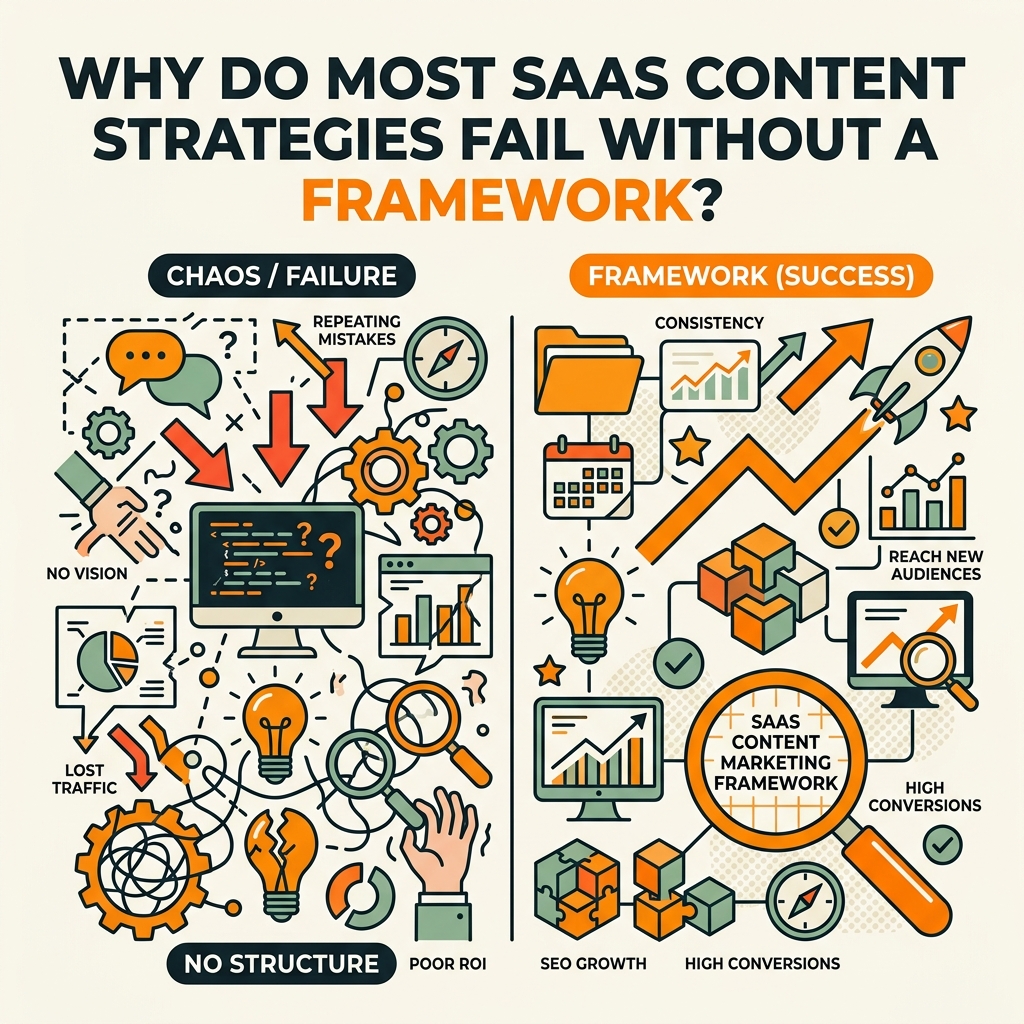
The primary reason SaaS content strategies fail is inconsistency driven by a lack of systems. Without a rigid framework, content production becomes the first thing to get deprioritized when other "urgent" tasks arise. This sporadic approach is fatal for SEO and audience building, as it fails to generate the compounding returns that make content marketing so powerful. In fact, companies that publish consistently see up to 4.5x more leads than those with an irregular schedule.
The "Broken Flywheel" Problem
A content flywheel gains momentum with each piece you publish, but inconsistent effort stops it dead in its tracks. Key failure points include:
- No Defined Cadence: Publishing five articles one month and zero the next confuses both search engines and your audience.
- Lack of Focus: Writing about "10 different topics for 10 different personas" builds authority in nothing.
- No ROI Measurement: If you can't prove content is working, its budget will be the first on the chopping block. Only 36% of leaders feel they can accurately measure content ROI, creating a constant struggle for resources (Genesys Growth, 2026).
- Resource Bottlenecks: Relying on a single person (often the founder) to write, edit, and publish is a recipe for burnout and inconsistency.
"Founders try to do it all themselves, burn out, and conclude 'content doesn't work.' It's not that content doesn't work; it's that their unsustainable, non-systematic approach to it was doomed from the start."
Marcus Sheridan, Author, They Ask, You Answer
The Cost of Inconsistency
Inconsistency doesn't just mean slow growth; it means wasted resources. An article that doesn't rank because it's part of a sporadic, unfocused effort is a sunk cost. Strategic content marketing can reduce customer acquisition cost (CAC) by up to 41% (Ranklyx, 2026), but only when it's executed through a consistent framework that builds on itself over time. Without that system, you're just making expensive donations to the internet. For a lean startup, this is a fatal error.
Step 1: Establish Your Content-Market Fit
Content-Market Fit is the foundation of any successful SaaS content marketing framework. It's the process of defining exactly who your content is for and what specific problems it solves for them. Getting this wrong means all subsequent effortskeyword research, writing, and distributionare wasted. You might get traffic, but you won't get customers. This requires moving beyond broad personas to a granular understanding of your Ideal Customer Profile (ICP) and their primary Jobs-to-be-Done (JTBD).
Define Your Ideal Customer Profile (ICP)
Your ICP is not "all small businesses." It's a highly specific, data-informed definition of the perfect-fit company for your product. It includes firmographic data like company size, industry, and revenue, but also qualitative factors like technological maturity and strategic goals. For Jottler, our ICP is a founder or marketing lead at a 10-50 person B2B SaaS company that understands SEO but lacks the in-house team to execute it consistently. This level of specificity dictates our entire content strategy.
Map Their Jobs-to-be-Done (JTBD)
Once you know who you're targeting, you must identify the "jobs" they "hire" content to do. Customers don't read blog posts for fun; they have a problem to solve. A JTBD framework focuses on their motivation and desired outcome. For example, our ICP's job isn't "read about SEO"; it's "find a scalable way to generate more SQLs without hiring a 5-person content team." Your content should be the solution they are looking for. Create content that answers their questions, solves their operational hurdles, and helps them achieve their goals.
Step 2: Build Your Topic Authority Flywheel
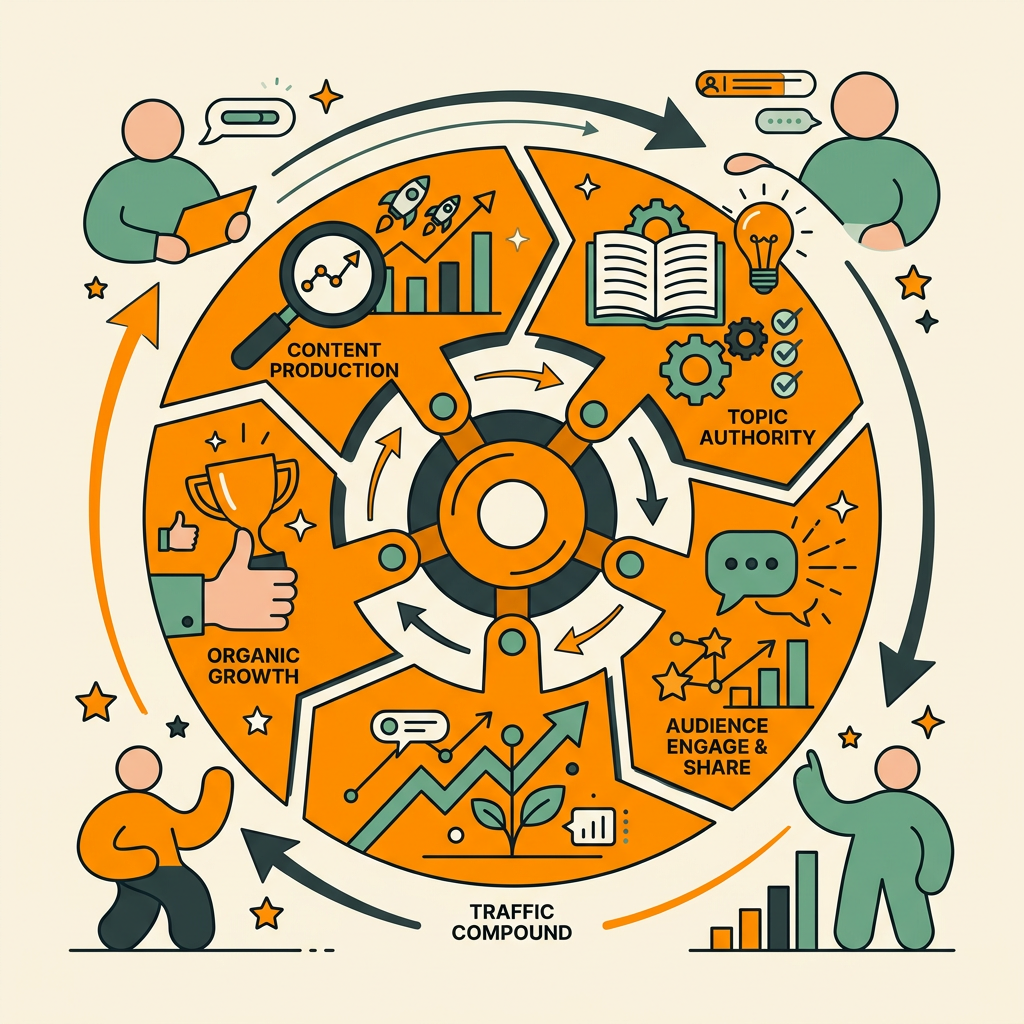
Once you have content-market fit, the next step in a successful SaaS content marketing framework is to build deep, defensible authority in your niche. The "Topic Authority Flywheel" model, also known as the pillar-cluster model, is the most effective way to do this. It involves creating a single, comprehensive "pillar" page on a broad topic and surrounding it with multiple "cluster" articles that go into detail on related sub-topics. This structure signals to search engines that you are a definitive source of information, leading to higher rankings for your most important keywords.
Identify Your Core Pillar Topics
Pillar topics are the broad subjects at the heart of your business. They should be directly related to the problems your product solves and have significant search volume. For an email marketing SaaS, pillar topics might be "Email Deliverability," "Marketing Automation," or "Lead Nurturing." For Jottler, our pillars are concepts like "SEO Automation," "AI Content Generation," and "Programmatic SEO." Choose 3-5 core pillars you want to own in the SERPs.
Develop Keyword-Driven Cluster Content
Cluster content consists of more specific, long-tail articles that link back to your main pillar page. If your pillar is "SaaS Content Marketing," your clusters might be:
- "How to calculate content marketing ROI"
- "Best content distribution channels for SaaS"
- "Hiring in-house vs. freelance writers"
- "AI content tools for SaaS startups"
Each cluster page targets a specific keyword and provides in-depth answers, while internally linking to the pillar page to pass authority. This creates a dense, interconnected web of content that boosts the ranking potential of the entire topic cluster.
Step 3: Select Your Content Production Engine
The heart of any SaaS content marketing framework is its production enginethe model you use to get from idea to published article. This is the most common point of failure for busy founders and small marketing teams. Choosing the wrong model leads to inconsistency, quality issues, and burnout. While many believe it's a simple choice between writing in-house or hiring freelancers, a third, more scalable option has emerged: the autonomous content engine. The best choice depends entirely on your company's stage, budget, and strategic goals.
Comparing Content Production Models
Let's break down the three primary models. The key is to be honest about your team's available time and resources. For a startup founder, time is the most precious commodity, making models that require heavy personal involvement a significant liability.
| Model | Best For | Speed & Scale | Cost | Consistency |
|---|---|---|---|---|
| Manual (In-House) | Early-stage founders validating ideas | Very Slow (1-2 articles/mo) | Low (Founder's time) | Very Low |
| Agency / Freelancers | Series A+ companies with budget | Medium (4-8 articles/mo) | High ($5k-$20k+/mo) | Medium |
| Autonomous (Jottler) | Busy founders & lean marketing teams | Extremely Fast (30-150+ articles/mo) | Low (Starts at $29/mo) | Perfectly Consistent |
Why Autonomous Engines Are Built for Scale
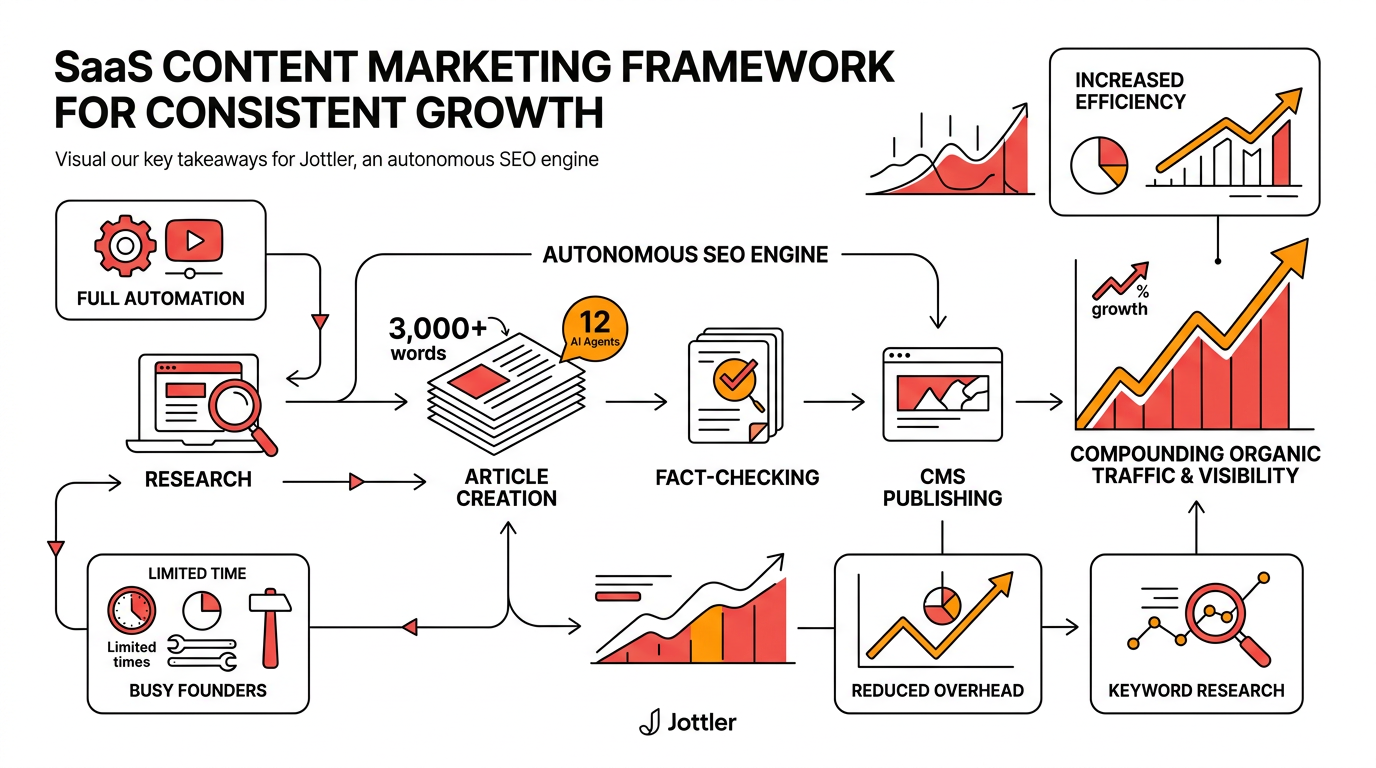
The manual model is unsustainable. The agency model is expensive and still requires significant management overhead. For busy founders and lean teams at growing companies, the autonomous model presents a new paradigm. Tools like Jottler are not just "AI writers"; they are complete, autonomous SEO engines. Jottler handles the entire workflow: continuous keyword research from 14+ sources, deep research, writing 3,000+ word articles, fact-checking, and even direct publishing to your CMS with smart internal linking.
This isn't about replacing marketers; it's about empowering them to focus on high-level strategy instead of the daily grind of production. While a freelancer might deliver an article a week, an autonomous engine like Jottler can publish multiple deeply-researched, SEO-optimized articles every single day. This is how you achieve the velocity and consistency required to build a topic authority flywheel that actually spins.
Step 4: Create a System for Content Distribution and Repurposing
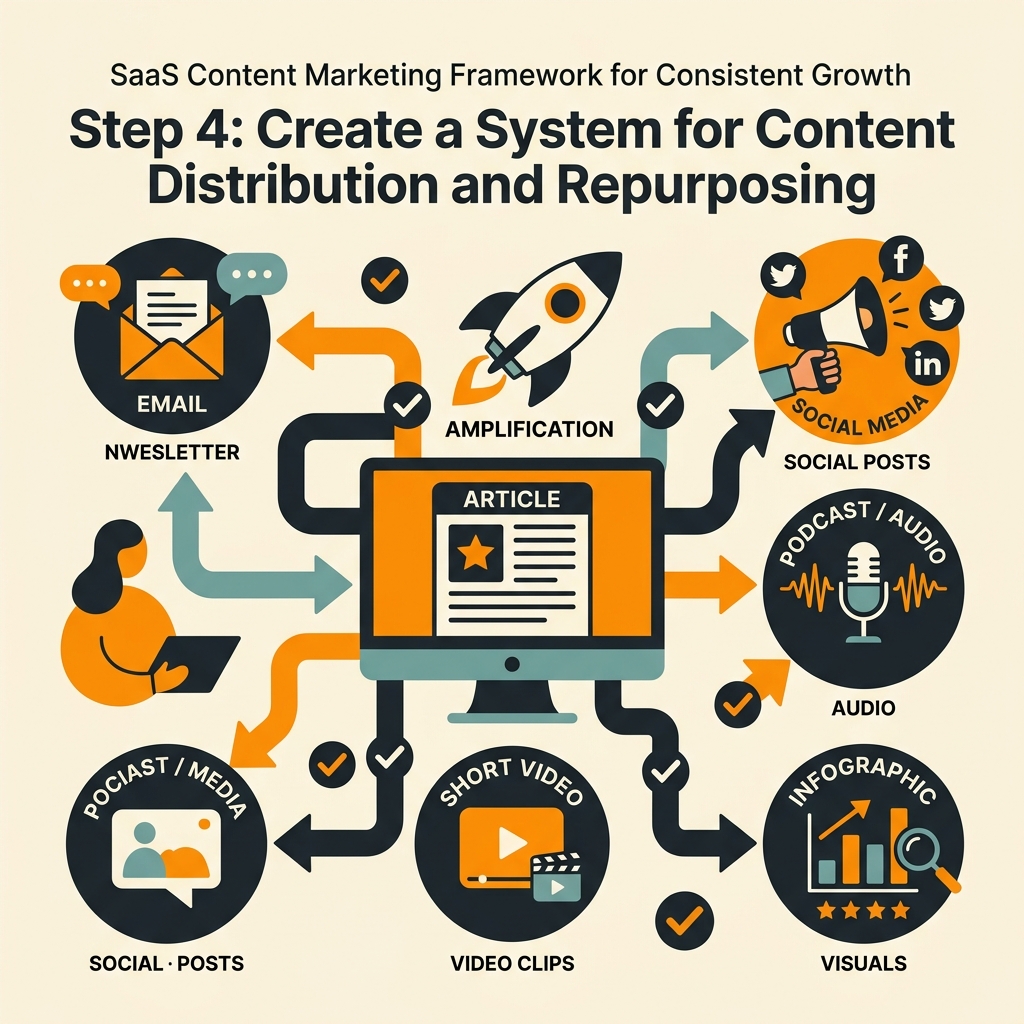
Publishing an article is not the end of your content framework; it's the beginning of the distribution phase. Hitting "publish" and hoping for the best is a common mistake that severely limits your content's ROI. A systematic approach to distribution and repurposing can 10x the value of every piece you create. This process should be a checklist, not an afterthought. For every article published, you should have a plan to get it in front of your ICP through multiple channels.
Your Core Distribution Checklist
Create a simple, repeatable checklist that is executed every time a new article goes live:
- Email Newsletter: Send the full article or a summary to your subscriber list.
- Social Media Promotion: Share the link on all relevant company and personal social profiles (LinkedIn, Twitter, etc.).
- Targeted Outreach: Email the article directly to any influencers, companies, or sources mentioned in the piece.
- Community Engagement: Share the article in relevant Slack, Discord, or Reddit communities where your ICP spends time (if rules permit).
- Internal Linking: Add links to the new article from 2-3 older, relevant posts on your blog.
The Power of Repurposing
Don't let a 3,000-word article live and die as a single blog post. A key part of an efficient framework is atomizing your long-form content into smaller assets for different platforms.
"You don't need more content. You need to get more out of the content you already have. One pillar page can fuel a month's worth of social media, video clips, and email campaigns."
Amanda Natividad, VP of Marketing, SparkToro
A single pillar post can be turned into:
- A 10-tweet thread summarizing the key takeaways.
- A short LinkedIn carousel or text-and-image post.
- A script for a 2-minute YouTube Short or TikTok video.
- A detailed infographic or visual summary.
- A presentation for a webinar or conference talk.
How Do You Measure SaaS Content Marketing ROI?
Measuring the return on investment (ROI) of your SaaS content marketing framework is crucial for securing budget and proving its value. While traffic and keyword rankings are important leading indicators, they don't tell the whole story. An effective measurement system ties content performance directly to business objectives like leads, pipeline, and revenue. The data is clear: SEO-driven content is a massive driver of value, with some studies showing an incredible 702% ROI for B2B SaaS companies (Oliver Munro, 2026).
Key Metrics for Your Content Dashboard
To move beyond vanity metrics, your content dashboard should focus on tracking the entire funnel:
- Organic Traffic to Blog: The top-level indicator of your SEO health.
- Keyword Rankings for Core Terms: Are you gaining ground on the keywords that matter most?
- Leads Generated from Content: How many users who first touch your site via a blog post convert into a lead (e.g., demo request, trial signup)?
- Content-Sourced Pipeline/Revenue: Using your CRM, what is the dollar value of sales opportunities and closed-won deals that were influenced by content?
- Reduction in CAC: Is your reliance on paid channels decreasing as your organic engine grows?
Choosing the Right Attribution Model
A common mistake is using a last-click attribution model, which assigns 100% of the credit for a conversion to the final touchpoint. This dramatically undervalues top- and middle-of-funnel content. A user might read three of your blog posts over a month before finally converting through a branded search. A multi-touch attribution model (e.g., linear or position-based) provides a more accurate picture of how your content assets work together to nurture a prospect from awareness to purchase.
Conclusion
Building a SaaS content marketing framework is not about adding more work; it's about making the work you do more effective, scalable, and predictable. By replacing chaotic, inconsistent efforts with a systematic approach, you create a powerful engine for compound growth. This framework transforms content from a marketing expense into a strategic company asset that generates high-quality leads and reduces customer acquisition costs, delivering a powerful 3:1 average return on investment.
The four core stepsestablishing Content-Market Fit, building a Topic Authority Flywheel, choosing a scalable Production Engine, and systemizing distributionprovide the blueprint. For busy founders and lean teams, the biggest lever is the production engine. Moving from a manual model to an autonomous system like Jottler removes the primary bottleneck to consistency and scale, allowing you to focus on strategy while the engine builds your traffic. Ready to stop the content hamster wheel? Start your SEO agent today and see what consistent, automated content production can do for your growth.
FAQs
How long does it take for a SaaS content strategy to show results?
For a new website, it typically takes 6 to 9 months of consistent execution to see significant, measurable results from a SaaS content strategy. The first 3 months are foundational, focused on building out your initial topic clusters. Months 4-6 are when you may start to see some articles ranking on the second or third page of Google and a noticeable uptick in organic traffic. By months 7-9, if your framework is sound and you are publishing consistently, you should see first-page rankings for long-tail keywords and a clear increase in content-sourced leads. The key is patience and consistency; content marketing is a long-term investment with compounding returns, not a short-term tactic.
What is the most significant bottleneck in SaaS content marketing?
The single most significant bottleneck is inconsistent content production. Most SaaS startups and scale-ups are resource-constrained. Relying on founders or a small marketing team to manually research, write, edit, and publish content is unsustainable. This "founder as-the-writer" model inevitably leads to long periods of inactivity, which kills SEO momentum. The team gets pulled into product, sales, or other fires, and the blog goes silent for weeks or months. Without a system to ensure a steady, predictable flow of high-quality content, even the best strategy will fail to gain traction. This is why solving the production problem first is critical for success.
What's the most efficient way to scale content production for a startup?
For a startup, the most efficient way to scale content production is to leverage an autonomous content engine. Hiring a full-time content team is expensive, and managing a stable of freelancers requires significant time and editorial oversightresources most startups lack. An autonomous system like Jottler provides the perfect balance of quality, speed, and cost-effectiveness. It completely automates the laborious parts of the processkeyword research, article writing, and publishingwhile operating within the strategic framework you define. This allows a lean team to achieve the output of a much larger organization, ensuring consistent daily or weekly publishing without the operational drag or high cost of manual production.