SaaS SEO Playbook: From Free Trial to Recurring Revenue
The median SaaS free trial converts at just 8–18.5% to paid, leaving 85% of signups abandoned. That's not a failure of your product. It's a failure of your organic discovery and conversion ecosystem. Most SaaS teams treat SEO and paid acquisition as volume games when they should be conversion engines, turning organic traffic into paying customers systematically. The gap between median and top-quartile SaaS companies isn't budget—it's strategy. Companies converting 35–45% of free-trial users aren't running better ads. They're routing qualified prospects from search to trial to revenue using a deliberate funnel-mapped approach. Here's how to build that system.
Key Takeaways
- Free trial conversion rates average 8–18.5%, costing companies like yours millions in unrealized revenue (2026, ChartMogul)
- B2B SaaS SEO generates 702% ROI with a 7-month break-even, outperforming paid channels by 110% on conversion
- Organic search drives 53% of SaaS website traffic—the highest-leverage, cheapest customer acquisition channel
- Keyword-to-Trial Routing: Map commercial-intent keywords to product comparison, alternative, and use-case pages that funnel visitors directly into free trials.
- Trial-to-Revenue Psychology: Implement 7-day trials with credit card requirements (48.8% vs. 18% conversion) and trigger onboarding sequences within the first 90 minutes.
- Content Infrastructure: Publish proprietary research quarterly and build bottom-of-funnel content (40% comparison, 30% how-to, 20% research, 10% thought leadership).
- Pipeline Attribution: Track organic traffic separately from paid and branded—measure trial requests and revenue from search specifically.
- Automation at Scale: Use AI-powered content engines to publish daily keyword-targeted content without burning out your internal team.
Why SaaS SEO is Your Highest-Leverage Growth Channel
Organic search drives 53% of all SaaS website traffic and costs 40% less per acquisition than paid channels while converting 110% better. Yet most SaaS founders treat SEO as an afterthought—a "nice to have" marketing function rather than the core engine it should be. The reason? SEO's impact isn't immediate. It compounds. A single well-optimized keyword ranking for 12 months delivers compounding traffic; a paid campaign stops the moment you stop paying.
"B2B SaaS companies achieve 702% return on their SEO investment, with break-even occurring in just 7 months. For comparison, most paid-acquisition channels require 12–18 months to achieve profitability."
This compounds into staggering ROI. According to SeoProfy, B2B SaaS companies achieve 702% return on their SEO investment, with break-even occurring in just 7 months. For comparison, most paid-acquisition channels require 12–18 months to achieve profitability. The businesses winning in 2026 aren't the ones with the biggest ad budgets—they're the ones who've built SEO systems that systematically turn organic search into trials, and trials into revenue.
The formula works because it aligns with buyer intent. When someone searches "best CRM for small teams" or "HubSpot alternative," they're not researching whether CRM tools exist. They're evaluating options. They're ready to buy. That's commercial intent—the highest-value traffic a SaaS company can attract. Your job is to rank for that intent and route it directly into your trial flow.
How to Map Your SaaS Buyer Journey to Keyword Targeting
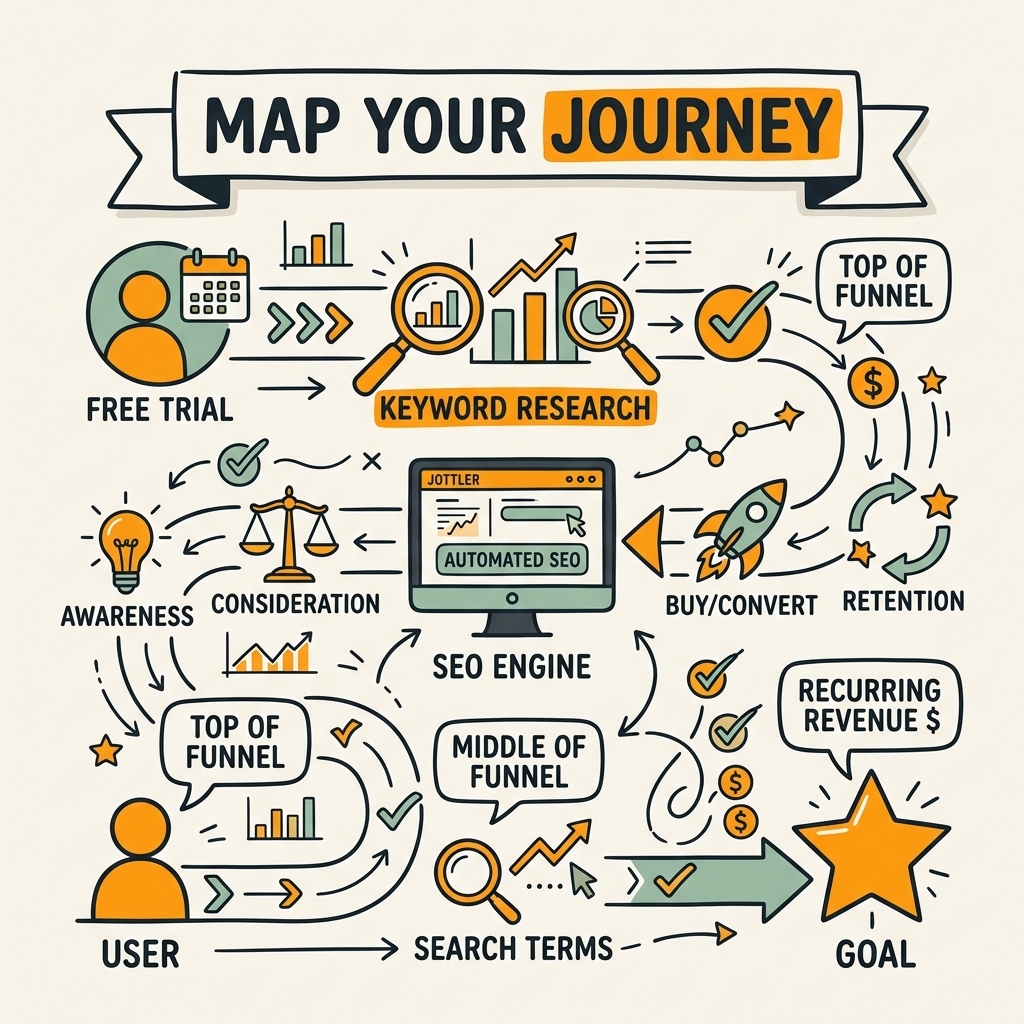
Effective SaaS SEO doesn't begin with keyword volume. It begins with the buyer's actual journey. Most keyword research tools show you search volume but not whether those keywords move prospects toward revenue. You need to map keywords to buyer stages, then prioritize the ones that convert.
Segment Keywords by Buyer Intent and Revenue Impact
Your SaaS keyword landscape has three tiers, each with different conversion probability. Top-of-funnel (TOFU) keywords answer broad questions: "what is project management?" These attract volume but low conversion. Mid-funnel (MOFU) keywords show research intent: "best project management tools for remote teams." These drive qualified interest. Bottom-of-funnel (BOFU) keywords trigger buying decisions: "Asana vs. Monday.com" or "Asana alternatives." These convert at 5–10x higher rates than TOFU.
Most SaaS SEO campaigns chase TOFU volume and wonder why they can't move the revenue needle. The winners prioritize BOFU ruthlessly. They publish fewer pages, but those pages drive revenue directly. If you're a project management tool, "how to organize a project plan" generates visits but rarely trials. "Asana vs. Monday.com" generates fewer visits but 40% of visitors request a demo because they're already evaluating your category.
- BOFU Keywords: Comparison pages, alternative pages, use-case pages (e.g., "best CRM for nonprofits"), integration guides, and why-choose-us content.
- MOFU Keywords: How-to guides, best-practice articles, feature-focused tutorials (e.g., "how to set up workflow automation").
- TOFU Keywords: Definitional content, industry reports, trend analysis—the link-earning, authority-building assets.
- Expected conversion spread: BOFU converts at 3–8%, MOFU at 1–2%, TOFU at 0.2–0.5%.
Build Keyword Clusters Around Commercial Intent
A single keyword isn't enough. Keywords cluster thematically. If you rank for "HubSpot alternative," you should also rank for "HubSpot competitor," "Salesforce alternative," and "HubSpot pricing" because prospects searching those terms are evaluating similar solutions. Clusters signal topical authority to search engines and give visitors multiple entry points into your comparison universe.
Start by identifying your 5–10 core commercial keywords (your highest-value buyer segments). Then build out content clusters around each one. A comparison page becomes the hub; use-case articles, pricing guides, and feature comparisons become spokes. Internally link between them aggressively. This structure tells Google that your site is an authority on the comparison space and tells visitors that you have comprehensive coverage of their concern.
Measure Keyword Value by Revenue Potential, Not Volume
Most keyword research tools rank by search volume. A keyword with 10,000 monthly searches looks more attractive than one with 500. But if the 10,000-search keyword converts at 0.1% and the 500-search keyword converts at 5%, the smaller keyword is worth 100x more revenue. This is why many SaaS companies waste months targeting high-volume keywords that generate noise, not customers.
"A 500-search BOFU keyword converting at 5% equals 25 monthly conversions. A 10,000-search TOFU keyword converting at 0.1% equals just 10 monthly conversions. The 'lower-volume' keyword wins."
Rerank your keyword list by revenue potential: estimated monthly searches multiplied by expected conversion rate. A 500-search BOFU keyword converting at 5% = 25 monthly conversions. A 10,000-search TOFU keyword converting at 0.1% = 10 monthly conversions. The "lower-volume" keyword wins. Prioritize ruthlessly on commercial keywords, not vanity metrics.
How to Optimize Your Free Trial Funnel for Maximum Conversion
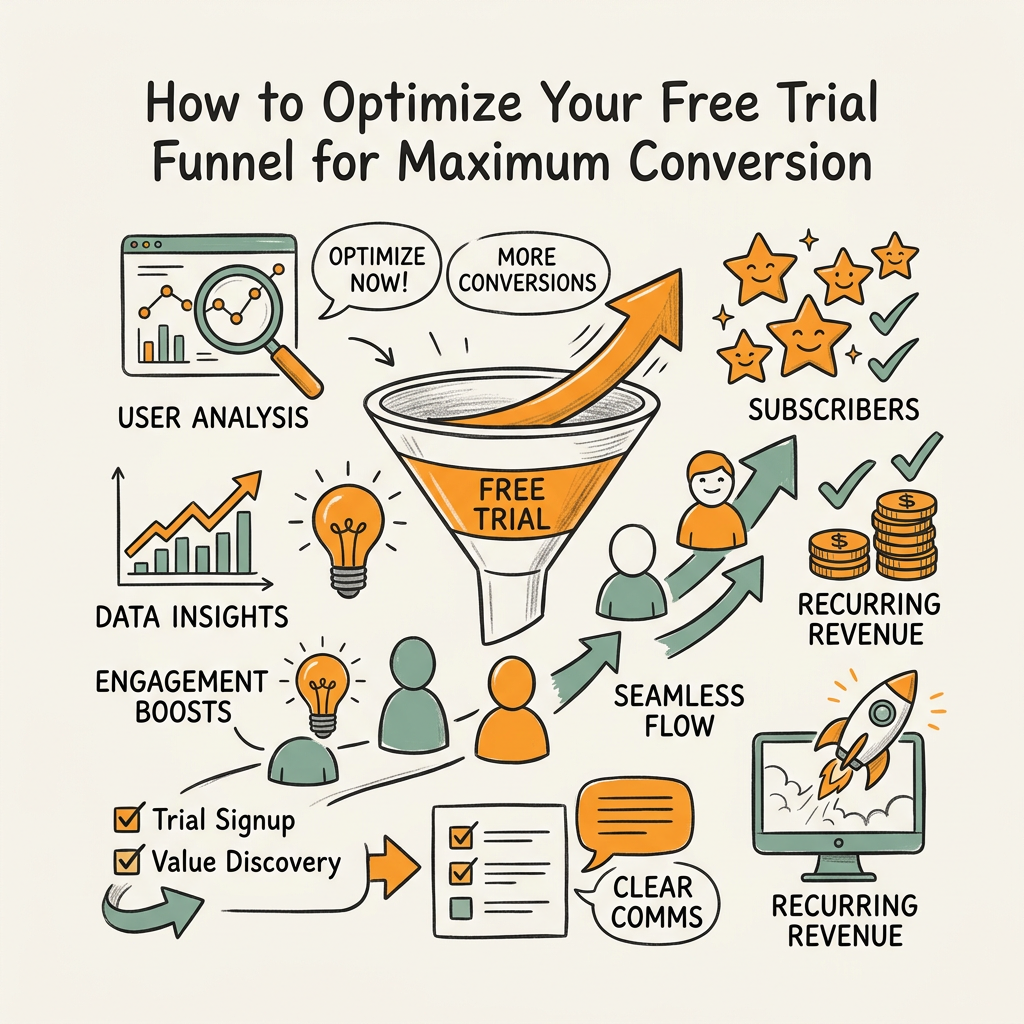
Driving traffic matters only if you convert it. Most SaaS companies optimize their trial conversion in isolation—tweaking forms, adjusting onboarding flows. But that's addressing symptoms, not root causes. Trial conversion compounds when you optimize the entire discovery-to-revenue path: what keywords bring people in, what landing page they see, how quickly they experience value, and what triggers payment conversion.
Match Landing Pages to Keyword Intent
A prospect searching "Asana alternative" shouldn't land on your generic homepage. They should land on a page directly addressing their concern: a comparison page between your tool and Asana, with a prominent free-trial CTA. The closer the landing page matches search intent, the higher the conversion.
This seems obvious, but most SaaS companies funnel all search traffic to their homepage or a generic product page. That's friction. It forces prospects to "shop" your product when they've already decided they want to evaluate it. The fix: build dedicated landing pages for your top 10–20 commercial keywords. A comparison page for each major competitor. An alternatives page. Use-case pages targeting specific workflows. Each page optimized for the keyword, with a high-intent CTA at the top: "Start your free trial."
This doesn't require thousands of pages. It requires precision. Five high-converting comparison pages will generate more trial signups than 100 generic how-to posts.
Require a Credit Card to Trigger Conversion Psychology
According to ChartMogul's 2026 SaaS Conversion Report, the single highest-impact trial-conversion lever is credit card requirement. Free trials without a card convert at 8–18%. Free trials with a required card convert at 31–48%. That's a 3–5x difference. The psychology is straightforward: collecting a card signals commitment. It creates friction that deters tire-kickers while attracting serious evaluators.
Most SaaS companies avoid card requirements because they fear losing signups. They do lose signups—but not customers. A 50% drop in free-trial volume paired with a 3x improvement in conversion rate means 50% more actual customers. You're trading volume for quality, which is always the winning trade.
Trigger Onboarding Sequences Within 90 Minutes
The first 90 minutes determine trial success. Prospects who experience core value in their first session convert at 38%+. Those who don't see clear value in the first 24 hours rarely convert. Most teams hope prospects will "explore" the product. They won't. You need to guide them directly to value.
Implement automated onboarding sequences triggered by user behavior, not just signup. When a prospect clicks "start trial," they should immediately see: (1) a 2-minute product tour showing the 3 core features that solve their problem, (2) a guided setup flow that gets them data or a workflow running in their first session, (3) a soft prompt for a brief call with sales (if sales-assisted) or a check-in email 24 hours later asking about their experience.
The goal: ensure they've done something with your product, not just looked at it. Doing creates momentum. It breaks inertia.
Content Architecture: The Four Pillars of SaaS SEO
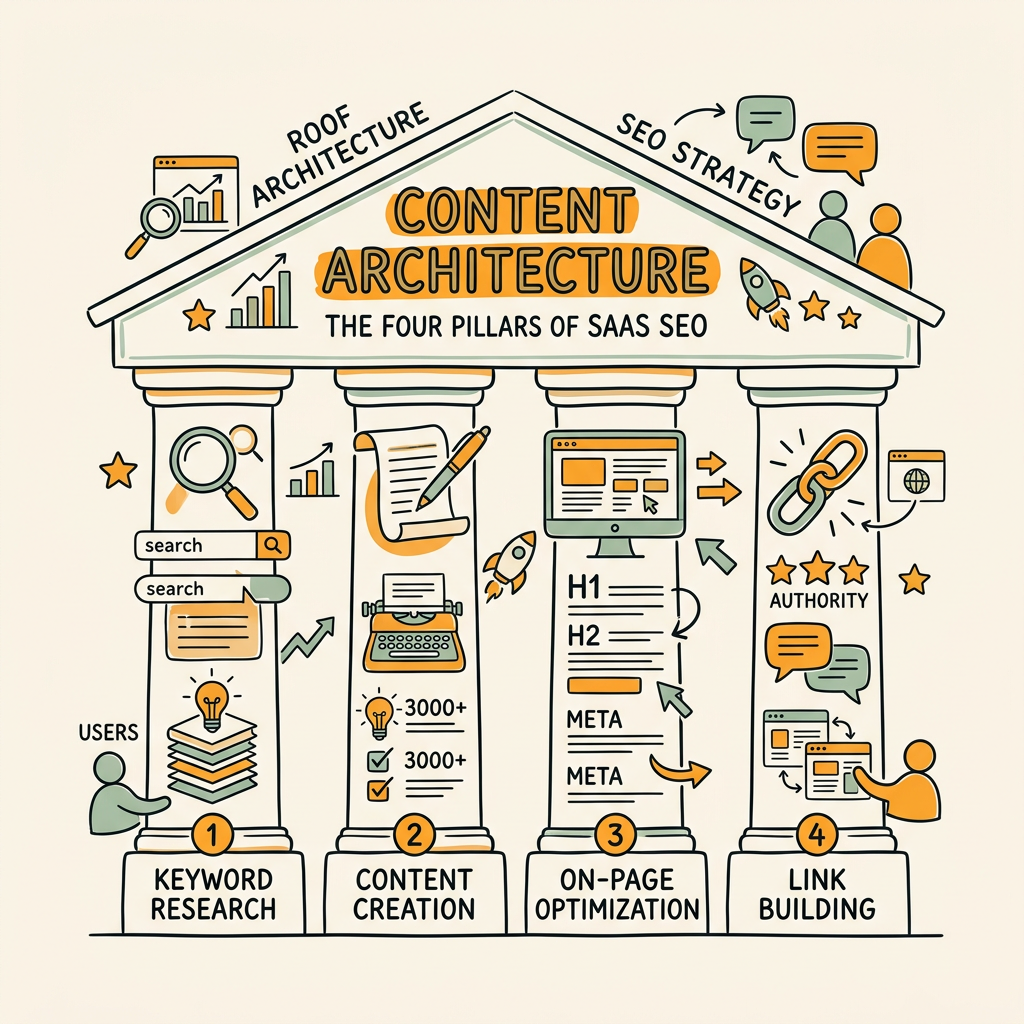
Scaling organic revenue requires systematic content production. Most SaaS teams write reactively—a blog post here, a comparison page there. Winners build content systems with clear allocation. This framework, validated by Clienvora's 2026 SaaS research, shows exactly how to allocate your budget:
| Content Type | Allocation | Purpose | Time to Revenue | Example |
|---|---|---|---|---|
| Bottom-of-Funnel (BOFU) | 40% | Drive trial signups directly; address objections; remove friction | Weeks to months | Comparison pages, alternative pages, pricing guides, feature comparisons |
| Mid-Funnel (MOFU) | 30% | Build authority; educate on workflows; support decision research | Months | How-to guides, workflow tutorials, best-practice articles, case studies |
| Top-of-Funnel (TOFU) | 20% | Link earning; authority; awareness; traffic volume | 6–12 months | Original research, benchmark reports, industry data, free tools |
| Thought Leadership | 10% | Category definition; competitive differentiation; brand voice | 3–6 months | Contrarian takes, founder commentary, industry trends, original insights |
Most SaaS teams invert this ratio. They spend 60% on TOFU (generic thought leadership and how-to content) and 20% on BOFU (the pages that actually sell). This guarantees slow revenue growth. Flip the ratio, and revenue compounds.
The Problem: Generic Content Cannot Compete in 2026
89% of B2B buyers now use generative AI during their research. When they ask ChatGPT "what is a CRM?" or "how do I set up a sales pipeline?", AI answers in seconds. Generic how-to articles are worthless now. AI beat you. Your how-to guide on setting up a CRM will never rank better than a ChatGPT response that's immediate, personalized, and conversational.
"Companies publishing original research see 18.7% organic traffic growth vs. 11.2% for those without it. Quarterly benchmark reports, user surveys, and usage analysis become link-earning, citation-generating assets that both rank and drive brand recommendation in AI."
This is why original research is your highest-leverage content. AI cannot replicate proprietary data. It can't cite your benchmark report if you're the only source. According to recent SaaS marketing research, companies publishing original research see 18.7% organic traffic growth vs. 11.2% for those without it. Quarterly benchmark reports, user surveys, usage analysis—these become link-earning, citation-generating assets that both rank and drive brand recommendation rate in AI.
The winning content mix: 40% BOFU (which beats competitors directly), 30% MOFU (which builds authority and captures research intent), 20% TOFU original research (which earns links and AI citations), 10% founder voice (which differentiates your brand).
Implement Smart Internal Linking to Compound Authority
Internal links are underrated. Most teams link randomly. Winners use internal linking architecturally. Every BOFU page links to related MOFU pages (e.g., a comparison page links to "how to" guides for your product). Every MOFU page links back to BOFU (e.g., a how-to guide for features your product excels at links to the product page). This structure creates citation flow that concentrates authority on your commercial pages while distributing visits throughout your content.
Better yet, use AI-powered content systems that automatically discover internal linking opportunities and implement them at scale. Manual linking breaks down after 50 pages. Automation handles it at 500+.
Why Manual Content Production Doesn't Scale—and What Works Instead
Writing content manually is a trap. It works until it doesn't. You can write a few comparison pages, a handful of how-to guides, maybe quarterly research. But building the 200–500 piece content library that truly dominates organic search? That requires a team, a budget, or a system that doesn't exist yet. That's why top-quartile SaaS companies in 2026 aren't hiring more writers. They're implementing AI-powered content automation.
The Scaling Problem with Manual Writing
A single freelancer writing 4 posts per month at $500 each costs $24,000 per year and produces 48 pieces. Scaling to 200 pieces requires 5 writers and $120,000 annually. Most SaaS companies can't sustain that. They scale to 40–60 posts, then stop. They can't break through to the library size that genuinely dominates search because the labor and cost model breaks down.
Meanwhile, competitors using content automation publish 5–10 pieces per day. At year-end, they have 1,800–3,650 pieces. They own the long-tail. They have answers to every question. Their internal linking network is so deep that their homepage authority compounds 10x faster than your manually-written site.
How AI Content Engines Work
Modern SEO AI engines (like Jottler) coordinate 12+ agents to research, write, optimize, fact-check, and publish articles autonomously. You set keywords and publishing frequency. The AI agents handle the rest:
- Research Agent: Gathers data from 14+ sources, identifies trending angles, and extracts cite-worthy statistics.
- Writing Agent: Produces 3,000+ word articles with proper structure (H1, H2/H3, intro, conclusion, FAQ), commercial intent, and internal linking.
- Fact-Check Agent: Verifies all claims against sources, flags unsupported statements, ensures publication-ready accuracy.
- Optimization Agent: Ensures keyword placement, readability, CTA alignment, and technical SEO compliance.
- Publishing Agent: Connects to your CMS, uploads content, schedules publication, and updates sitemaps.
The output? Professional, SEO-optimized, fact-checked content that you'd pay $1,500–$3,000 per article to acquire manually, now costing $15–$30 per piece at $29/month plans. You get 30 articles monthly from one platform.
This is the compounding advantage winners are building right now. They're not smarter. They've just automated the repetitive work and kept humans doing the strategy.
Building Your SaaS SEO Attribution System
Most SaaS companies fail at SEO because they can't measure it. They don't know which keywords drive revenue. They conflate organic traffic with organic acquisition. They blend branded search with non-branded, paid with organic, making attribution impossible. Without attribution, they can't optimize. Without optimization, growth stalls.
Segment Your Organic Traffic by Intent
Not all organic traffic is equal. Branded searches (your company name, product names) are existing customers, not acquisition. Non-branded, commercial-intent searches are your revenue engine. Non-branded, informational searches are research interest. You need to track these separately because they have different conversion rates and different optimization strategies.
Set up Google Analytics 4 with custom events for each conversion milestone: organic non-branded visit → product page view → trial signup → trial day 7 → trial day 14 → subscription. This creates a waterfall. You'll see exactly where you're losing prospects. If 10,000 people land on comparison pages monthly but only 500 request trials, your page copy or CTA is your bottleneck, not your traffic volume.
Track Revenue Attribution by Keyword and Landing Page
The goal: connect individual keywords to revenue. A prospect searches "Asana alternative," lands on your comparison page, signs up for a trial, and upgrades to annual. That keyword is worth $X to you. If you're not tracking this, you're flying blind. You don't know whether your comparison pages or your how-to content is driving revenue. You can't allocate your content budget intelligently.
Implementation: Use UTM parameters to tag each piece of organic content. When a trial signup happens, your analytics platform passes the UTM through to your payment system (via Zapier, Segment, or built-in integrations). Now you can see: "Comparison pages generated 150 trials in Q2, with 32% converting to paid. How-to pages generated 200 trials in Q2 with 8% conversion." This tells you exactly where to invest more.
Conclusion
The SaaS companies winning in 2026 aren't the ones with the biggest budgets or the smartest founders. They're the ones who've built integrated systems: organic discovery (SEO) feeding into qualified trial signup, optimized trial conversion using psychology and onboarding, and measurement systems that prove revenue attribution. They've automated content production so they can publish at scale without burning out their teams. They've chosen commercial intent over vanity traffic.
Your free-trial conversion rate of 8–18% isn't inevitable. Top-quartile companies convert 35–45% on the same product because they've systematized the entire journey from keyword to revenue. A 1% improvement in conversion rate generates 15% more revenue from the same traffic. That's not a rounding error. That's a business multiplier.
You already have visitors. You already have product interest. You're just leaving $2–5 million in annual revenue on the table by not optimizing the funnel. Start with keyword remapping to commercial intent. Then build BOFU content. Then measure. Then automate. Your competitors are already building this system. Start your SEO agent and begin publishing the content that moves the needle.
FAQs
What is the average free trial conversion rate for SaaS?
The median free trial conversion rate for B2B SaaS is 18.5%, but this varies significantly by trial model. Trials requiring a credit card convert at 31–48%, while those without a card requirement convert at 8–18%. Top-quartile companies achieve 35–45% conversion by combining credit card requirements, 7-day trial lengths, and onboarding sequences triggered within the first 90 minutes of user activity. The gap between median and top performers represents $2–5 million in unrealized annual revenue for companies with just 1,000 monthly free signups.
How much organic traffic does SEO generate for SaaS companies?
Organic search drives 53% of all SaaS website traffic, making it the highest-volume channel available. Beyond volume, organic traffic converts 110% better than paid channels and costs 40% less per acquisition. B2B SaaS companies achieve an average 702% ROI on SEO investments with break-even occurring in 7 months, significantly outperforming paid channels which typically take 12–18 months to profitability. The ROI multiplier grows over time because search traffic compounds as more pages rank and authority accumulates.
What type of content drives the most SaaS trial signups?
Bottom-of-funnel content (BOFU) drives the highest conversion. Comparison pages, alternative pages, and use-case pages convert at 3–8%, significantly outperforming how-to content (1–2%) and educational articles (0.2–0.5%). The winning allocation is 40% BOFU, 30% mid-funnel how-to, 20% original research, and 10% thought leadership. Comparison pages specifically should directly address competitor alternatives ("X vs. Y") and include a prominent free-trial CTA. Visitors searching these terms have already decided they want to evaluate your category—your job is to route them to trial, not educate them from scratch.