Scaling Content Production with Automation Strategy
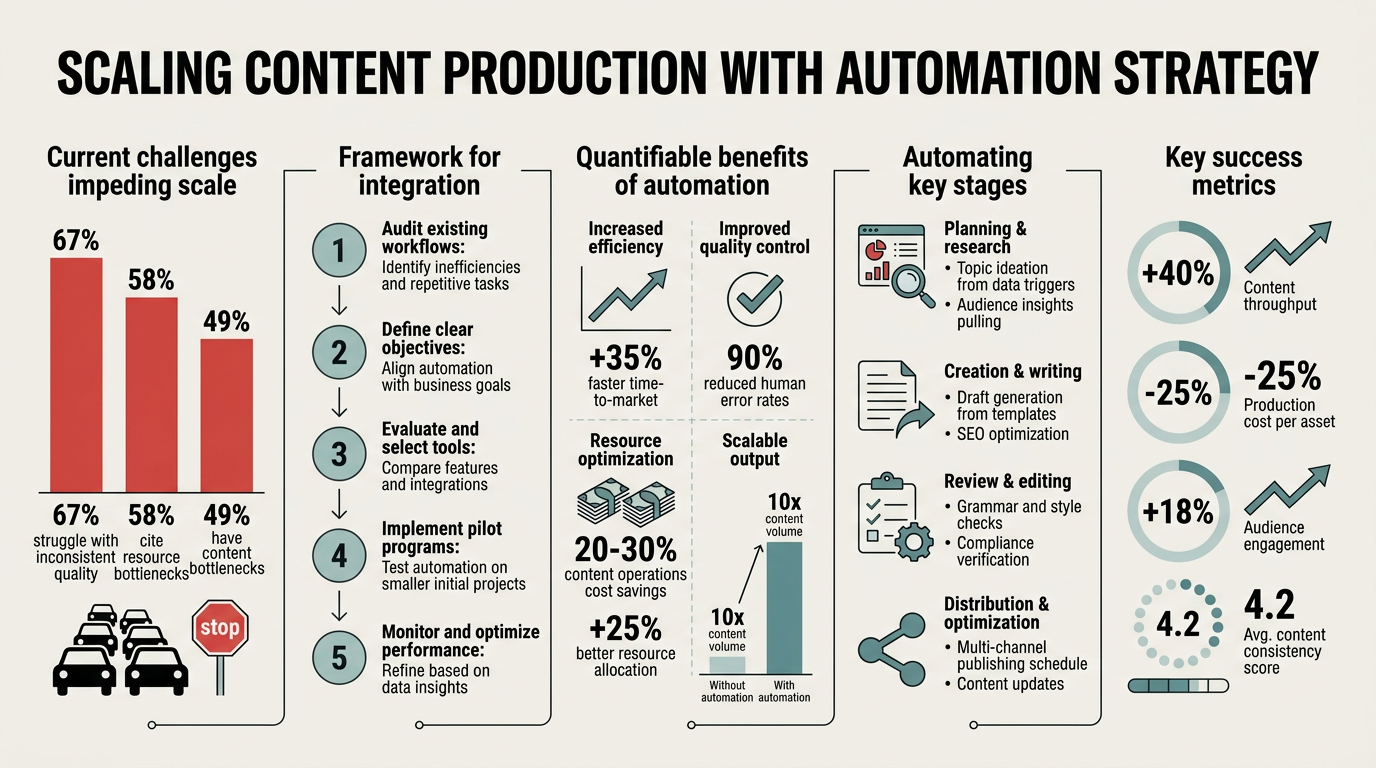
Most growing companies face a brutal reality: 80% of marketers use AI for content creation, yet the majority still produce content manually, one article at a time. The gap between what's possible and what most teams actually do is enormous. Your competitors are already automating keyword research, drafting, fact-checking, and publishing—without sacrificing quality. The stakes are real: enterprises using AI for content scaling report a threefold increase in output and 40% reduction in production time. Teams that don't build an automation strategy will fall behind by the end of 2026. Here's how to build one that compounds your organic traffic without burning out your team.
Key Takeaways
- 80% of marketers now use AI for content creation, up 24 points from 2025 (HubSpot, 2026)—automation is no longer optional for scaling.
- AI-powered content scaling achieves threefold output increase and 40% faster production while maintaining or improving quality with proper frameworks.
- Automation works best when integrated across keyword research, writing, fact-checking, and CMS publishing—not just one stage.
- Define Your Content Architecture: Decide what content types (pillar articles, case studies, product updates) get automated vs. human-led to preserve strategic intent.
- Implement Fact-Checking Systems: Automated writing scales only when paired with verification protocols that catch hallucinations before publishing.
- Build Internal Link Networks: Automation compounds SEO value when every article links contextually to existing content, creating topical clusters.
- Monitor Output Quality: Set quality gates—automated content that doesn't meet standards doesn't ship, preventing brand damage.
- Choose Tools That End-to-End Automate: Point solutions force manual handoffs; platforms automating research-to-publishing save 20+ hours per week.
What Is Content Automation and Why Does It Matter for Scaling?
Content automation is the orchestration of AI, workflows, and integrations to handle repetitive content tasks—research, writing, editing, fact-checking, and publishing—without manual intervention at each step. It's not a single tool; it's a system. When done right, automation compounds your organic traffic by letting you publish consistently without team burnout. Marketing teams automating workflows see a 30% reduction in content-creation time and 14.5% productivity gains across operations.
"When done right, automation compounds your organic traffic by letting you publish consistently without team burnout. The trick is feeding the automation system your brand guidelines, tone examples, and audience personas upfront—think of it like onboarding a senior writer with clear direction."
The Three Layers of Content Automation
Effective automation stacks three distinct layers: research and ideation, content generation, and distribution and optimization. Research automation saves 10+ hours per week by pulling keyword data, competitor insights, and topic validation without human research. Content generation handles drafting, structuring, and first-pass optimization. Distribution automation publishes to your CMS, formats for your blog template, builds internal links, and schedules posts across channels. Most teams automate only one or two layers. The compounding win happens when all three are integrated.
Why Manual Scaling Breaks at Scale
A founder or content manager can publish 4–6 high-quality articles per month manually. That's sustainable for a new company. But by $5M ARR, you need 15–30 articles monthly to compete in organic search. Hiring writers to hit that volume is expensive and slow; managing them is a distraction. Workers using AI write 40% faster with 18% higher quality, according to Microsoft research. Manual teams can't match that velocity. Automation isn't about replacing talent—it's about redirecting your team's energy toward strategy, optimization, and editorial oversight instead of production grind.
How Does Content Automation Fit Into Your Growth Strategy?
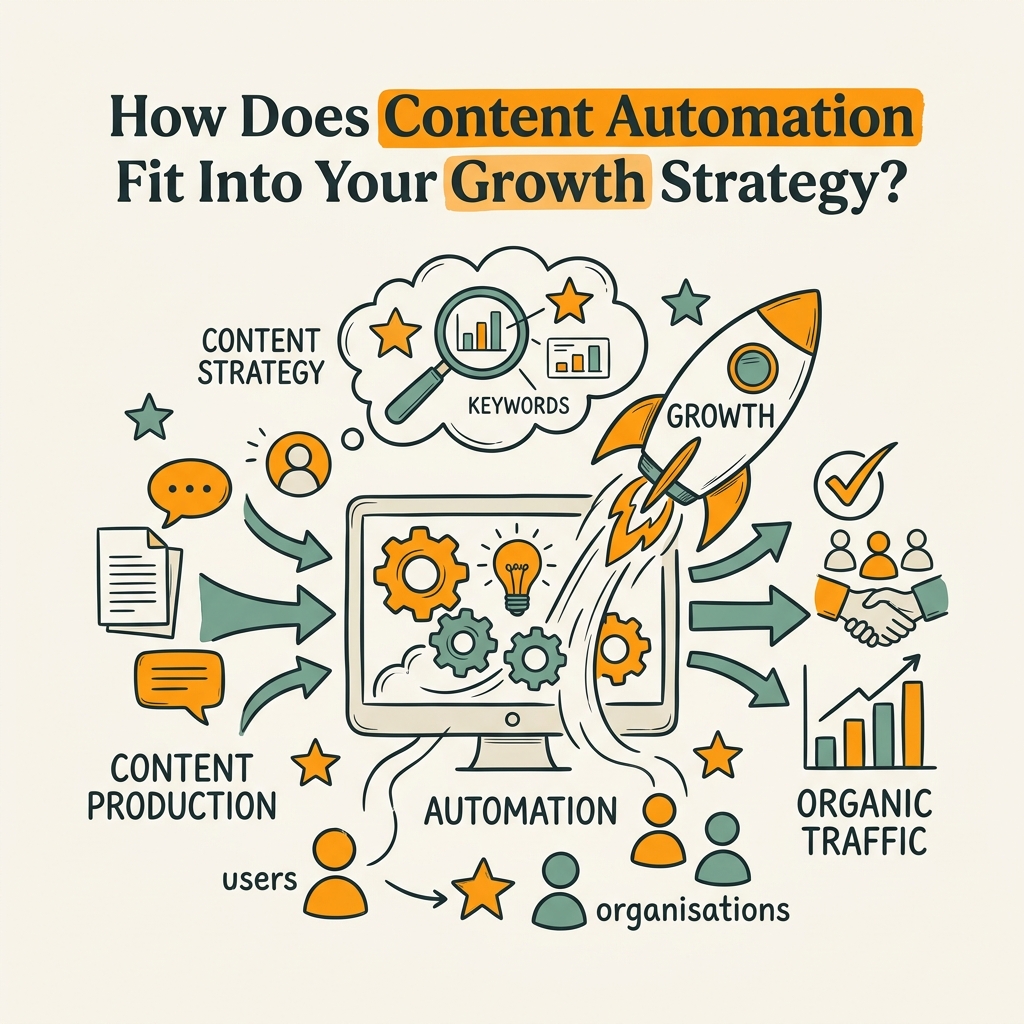
Automation is only worthwhile if it aligns with your content strategy. Random automated articles don't compound. Strategic automation—articles targeting underserved keywords, building topical authority, and linking to your revenue pages—creates compounding SEO returns. 70% of marketing leaders plan to increase AI and automation investment, not because automation is trendy, but because it directly lifts organic traffic and reduces overhead.
"Strategic automation—articles targeting underserved keywords, building topical authority, and linking to your revenue pages—creates compounding SEO returns that random, unfocused content never will."
Linking Automation to Your Content Pillars
Every SaaS company has core topics that drive revenue: if you're selling project management software, your pillars are "team productivity," "workflow efficiency," and "remote work best practices." Automation works when it targets keywords under those pillars. SEO automation handles this by automatically research-backing every article with keyword data and linking it to your existing pillar pages. A manual workflow makes that kind of topical clustering take weeks; automation does it in hours. Articles that support pillar pages rank faster and convert better because they're contextually woven into your strategy, not random blog filler.
Scaling Without Sacrificing Brand Voice
The biggest fear founders have: "If I automate, my content will sound robotic." That fear is outdated. Modern AI systems—especially those trained on your own content—can maintain consistent brand voice while scaling 10x. The trick is feeding the automation system your brand guidelines, tone examples, and audience personas upfront. Think of it like onboarding a senior writer: give them clear direction, and they deliver on-brand work consistently. Tools that skip this—generic prompt-to-output systems—do produce bland content. Systems that integrate your brand context don't.
Building a Content Automation Framework That Works
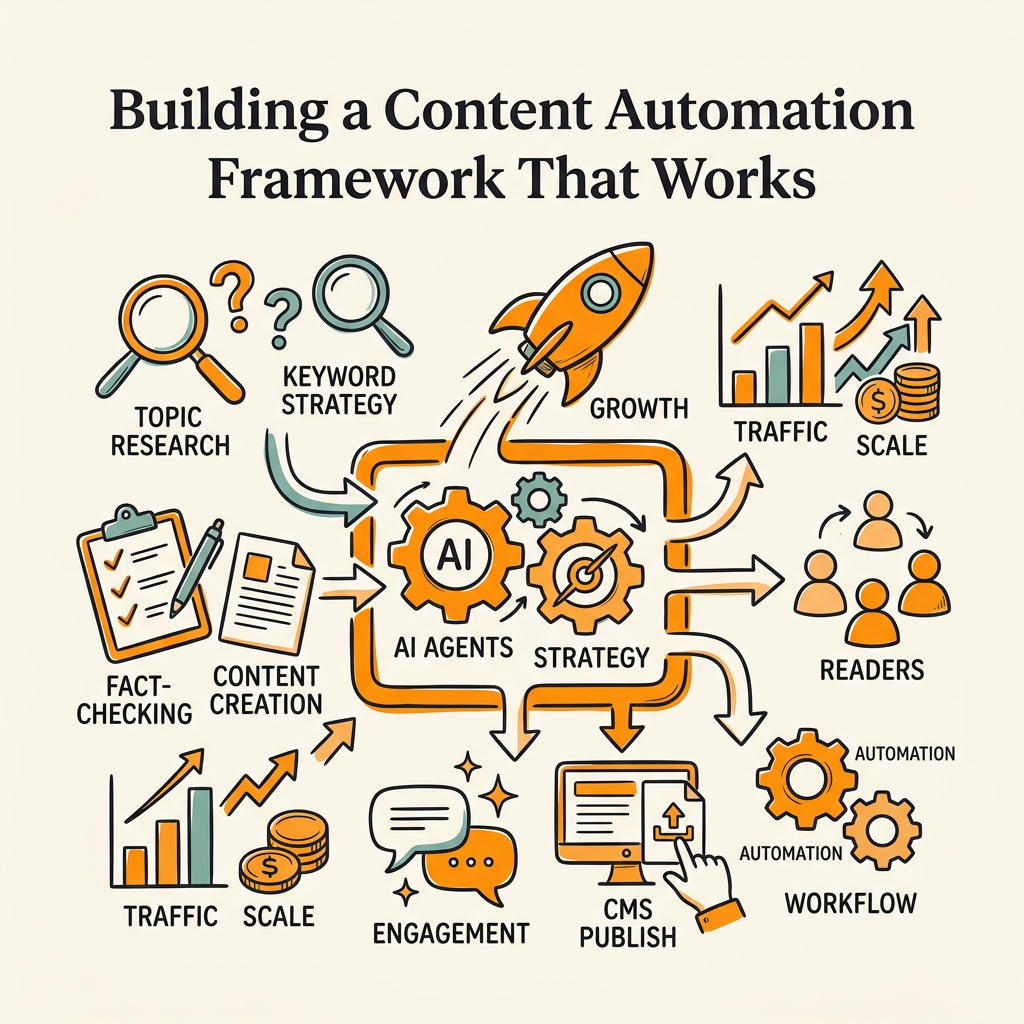
Scaling content isn't about publishing more; it's about publishing the right content faster. A real automation framework has five moving parts: audience mapping, keyword research, content production, fact-checking, and distribution. If any step is manual, you lose 40% of the speed benefit. Here's how to build it end-to-end.
Phase 1: Establish Your Content Audit and Baseline
Before automating a single article, know what you have and what you're aiming for. Audit your existing content: How many articles rank in top 10? Which topics drive traffic and conversions? What content gaps exist? This audit becomes your baseline for measuring whether automation actually compounds traffic. Most founders skip this step and wonder why automation doesn't move the needle—it does, but only if you're targeting gaps that matter.
Document your current publishing frequency, quality bar, and content types. If you publish 2 pillar articles and 10 supporting pieces monthly, your automation target might be 3 pillars and 25 supporting pieces without adding headcount. That's realistic. 10x scaling is not.
Phase 2: Choose Automation Tools That Cover the Full Stack
The market has exploded with point solutions: SEO tools, AI writers, scheduling platforms, link-building services. Stitching them together is the problem. You waste 5+ hours per week moving content between tools, fixing formatting, and reconciling data. Platform solutions that integrate research, writing, fact-checking, and CMS publishing eliminate that friction. Templated research shows that unified automation platforms reduce workflow overhead by 70%. Jottler handles the entire pipeline: keyword research, AI-backed writing with research citations, fact-checking against sources, smart internal linking, and direct CMS publishing. Instead of toggling between 5 tools, your workflow runs on one system that learns your brand and scales with you.
When evaluating tools, ask: Does it require manual handoffs between steps? If yes, you haven't actually automated—you've just added complexity. Does it include built-in fact-checking? Essential for maintaining credibility. Does it link content intelligently? If not, you're leaving topical authority on the table.
Phase 3: Set Up Quality Gates and Monitoring
Automation without guardrails is a reputational time bomb. Define what "publish-ready" means: minimum word count, fact-check pass rate, readability score, SEO basics (meta descriptions, internal links). Create a simple checklist that automation systems output data against. Bad articles get held for editorial review; good ones publish automatically. This isn't about micromanaging AI—it's about catching edge cases before they hit your website.
Use tools to monitor published content: Are automated articles getting clicks? What's the average time on page? Bounce rates? If automated articles underperform manual ones, debug: maybe the topics are wrong, or the format doesn't match reader expectations. Automation gives you data velocity to iterate fast.
Phase 4: Build Internal Link Networks Automatically
The biggest missed opportunity in content automation is ignoring internal linking. Automated articles that don't link to existing content or to each other leave topical authority completely on the table. Smart platforms analyze your content inventory and suggest contextual links based on keyword clusters. If your platform doesn't do this, train your automation to include a step where relevant internal links are added before publishing. Content marketing automation that ignores linking is only half of the solution.
Choosing the Right Automation Tools for Your Team Size
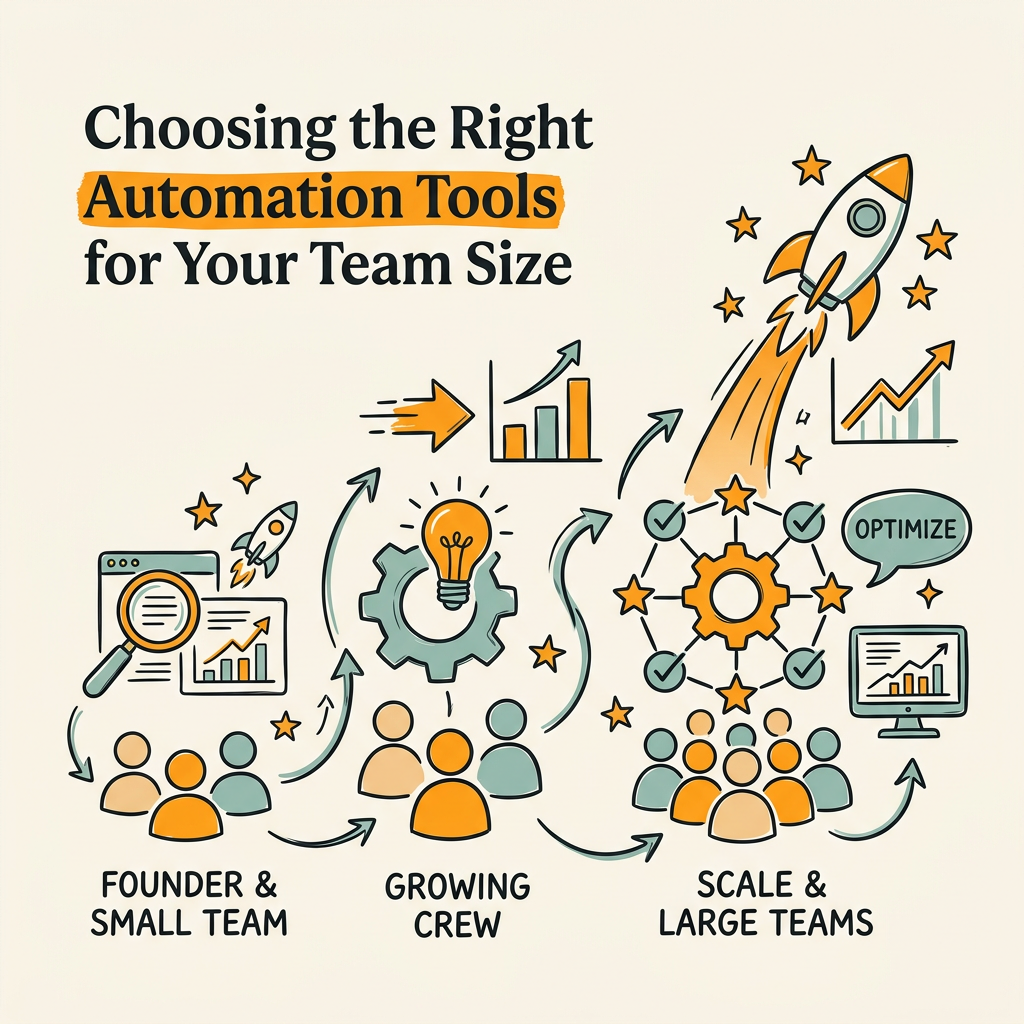
Tool selection depends on your team size, budget, and technical comfort. Founding teams have different needs than 10-person marketing departments. Here's how to think about it.
For Solo Founders and Tiny Teams (<3 people)
You need a single platform that doesn't require babysitting. Keyword research, writing, fact-checking, and publishing should happen without you clicking between five tabs. All-in-one platforms like Jottler ($29–$99/mo) pay for themselves immediately in time saved. You set publishing frequency (1–5 articles per day), and the system handles the rest. No need to hire a content manager or writer yet; the automation scales your output 10x without headcount.
For Growing Marketing Teams (4–10 people)
Your team can handle more nuance. You might automate 70% of content (supporting articles, case studies, product updates) while keeping flagship pillar articles human-led. Use a content calendar to plan which articles are automated and which need editorial attention. Pair a comprehensive platform with a managing editor who reviews automated batches before publishing. This hybrid model gets you 80% of the speed benefit with more control.
For Larger Operations (10+ people)
You have room for specialized tools, but integration is still critical. A central content hub (your CMS or a dedicated content platform) should orchestrate: keyword research tools feed data to AI writers; writers output to fact-checking; fact-checked content publishes to CMS with automatic linking. Your team owns strategy and optimization; machines own repetition. SaaS content marketing at scale requires this kind of integrated thinking.
| Team Size | Typical Content Volume (monthly) | Recommended Automation Level | Primary Tool Type |
|---|---|---|---|
| 1–3 (founder-led) | 15–30 articles | 80–100% automated | All-in-one platform (Jottler) |
| 4–10 (small team) | 30–60 articles | 60–80% automated | Hybrid: Platform + editorial review |
| 10+ (scaled team) | 60+ articles | 40–70% automated | Integrated stack with human strategy layer |
Overcoming Common Automation Pitfalls
Automation sounds perfect until it isn't. Here are the real problems teams hit and how to solve them.
Pitfall 1: Hallucinations and Factual Errors
AI generates plausible-sounding but false statistics. Your automated article cites a fake study, and six months later a competitor or reader catches it. Reputational damage is real. The fix: fact-checking must be automated too. Platforms that cross-check claims against verified sources before publishing prevent this. Don't publish any automated content without a fact-check step. Period.
Pitfall 2: Topics That Don't Convert
Automation scales volume, not strategy. If your keyword research is bad, you'll publish 100 articles to low-intent keywords that never convert. Spend time upfront mapping keywords to your revenue model. Which searches bring ideal customers? Build your automation strategy around those. Automation executes strategy; it doesn't create it.
Pitfall 3: Broken Integrations and Manual Handoffs
You automate research and writing, but publishing still requires someone to manually format, add meta descriptions, and schedule. That's not automation—that's just offloading writing. Every manual step kills your ROI. Choose tools that integrate end-to-end, or bite the bullet and build API integrations yourself if you're technical. The investment pays back in 30 days.
Pitfall 4: Ignoring Internal Linking
Publishing 50 automated articles that don't reference each other and don't link back to your pillar pages is like building apartments with no hallways. Each article exists in isolation. Smart automation doesn't just write—it links contextually. Every new article gets 3–5 internal links to relevant pieces, creating topical clusters that Google rewards with higher rankings.
Measuring Automation ROI and Iterating Fast
The proof of automation is organic traffic and qualified leads, not article count. Measure ruthlessly. Speakwiseapp reports that teams tracking weekly metrics iterate 3x faster than those reviewing monthly KPIs. If a batch of automated articles ranks well, reverse-engineer what made them work: keywords, angle, length, link pattern. Replicate that.
Key Metrics to Track
Start with three North Star metrics: keyword rankings (are automated articles ranking?), organic traffic (are they getting clicks?), and conversion rates (are clicks turning into leads or customers?). Track these weekly, not monthly. Automation gives you data velocity; use it. If articles underperform, audit: maybe the keyword has low intent, or the structure doesn't match reader expectations. Iterate and re-run automation with better parameters.
- Keyword Ranking Velocity: How fast do automated articles reach page one? Target: 60–90 days for mid-volume keywords (1K–10K monthly searches).
- Click-Through Rate (CTR): Automated articles should have CTR ≥ 2% for title and meta description quality. If not, the automation system isn't optimizing these fields properly.
- Average Session Duration: Are readers actually reading automated content? If automated articles have 40% lower duration than manual ones, format or depth is the problem.
- Conversion Rate by Source: Track leads and customers from organic traffic by article. This tells you which content actually matters to revenue.
Building a Feedback Loop Into Automation
The best automation systems learn. Every month, review what worked and what didn't. Did articles targeting "how-to" keywords outrank "comparison" keywords? Double down on how-tos. Did articles at 2,000 words rank better than 5,000 words? Adjust your automation settings. AI content strategy isn't set-and-forget; it's a continuous optimization loop. Tools that give you visibility into what worked make this trivial.
Conclusion
Scaling content production without automation is a path to burnout. 80% of marketers are already using AI for content, and that number will hit 95% by end-2026. The gap between what's automated and what's manual is widening fast. Competitors who build content automation frameworks now will have 3–6 months of organic traffic compounding before the rest catch up. Start by auditing your content, choosing a tool that handles the full stack (research through publishing), setting quality gates, and building internal link networks automatically. Measure relentlessly. Iterate weekly. By Q3 2026, you should be publishing 3–5x more content with the same team and better quality. The best founders aren't debating whether to automate. They're already running their content stack on it. Start your SEO agent today and watch your organic output compound.
FAQs
What is the fastest way to scale content production?
The fastest approach is end-to-end automation: one platform handling keyword research, AI writing, fact-checking, and CMS publishing without manual handoffs between steps. This eliminates the slowdown that happens when you stitch together five point solutions. Teams using unified automation platforms save 20+ hours per week versus those managing multiple tools. Set your desired publishing frequency (1–5 articles daily), feed the system your brand guidelines and audience personas, and publish automatically. The first month is slower because you're defining templates and tone. By month two, you're compounding 10x content output.
Can automated content maintain quality standards?
Yes, but only with guardrails. Quality automation requires three elements: clear brand guidelines fed into the system, fact-checking before publishing, and human review gates for edge cases. AI-generated content with proper frameworks matches or exceeds manual writing in readability and accuracy. The problem isn't the AI—it's automation without oversight. Set pass-fail criteria (fact-check score above 95%, readability grade 8–10, SEO checklist complete) and automatically reject content that doesn't meet standards. Most platforms now include these checks built-in. The result is consistent, brand-aligned articles published faster than any human team could manage.
How much does content automation cost versus hiring writers?
A junior freelance writer costs $3K–$6K per month for 4–8 articles. A mid-level in-house writer runs $4K–$8K monthly. A comprehensive automation platform costs $29–$299 per month depending on publishing volume. Automation pays for itself in the first month. For a team of two publishing 30 articles monthly, automation saves 30–40 hours of writing and research weekly, equal to one full-time equivalent at lower quality. You're not replacing writers entirely; you're eliminating production busywork so your existing team (or you, if solo) can focus on strategy and optimization.