Seasonal Traffic Patterns: Exploit Peak Demand
Most marketing teams treat seasonal traffic spikes as windfalls. They scramble at the last minute, push paid media spend, and hope organic search cooperates. The result? Missed conversions and wasted budget. Teams that plan seasonality systematically outperform competitors by 67% in first-page SERP visibility and capture revenue when demand is highest. Seasonal traffic patterns follow predictable cycles, yet fewer than 40% of businesses actively optimize for them. The stakes are real: Cyber Monday 2025 generated $14.25 billion in online sales, but only brands positioned to capture that demand won. Here's how to identify seasonal peaks in your industry, align your content strategy, and compound organic traffic year after year.
Key Takeaways
- Seasonal content performs best when published 8-12 weeks before peak demand; early planning increases visibility and conversions (2026, Search Engine Land)
- Content cluster architectures around evergreen pillars produce 67% higher first-page SERP rates than flat structures (2026, BrightEdge)
- Keeping seasonal URLs stable year over year allows authority to accumulate, improving rankings and ROI across multiple peak cycles
- Identify Seasonal Patterns with Historical Data: Analyze 2-3 years of traffic to find recurring peaks and correlate them with holidays, events, and product cycles.
- Build a Seasonal Content Calendar: Map keywords, content needs, and publishing timelines 90 days before each peak to ensure pages rank before demand spikes.
- Layer Seasonal and Evergreen Content: Use evergreen pages to drive consistent baseline traffic while seasonal pages capture demand windows and funnel traffic into conversions.
- Refresh and Republish Strategically: Update existing seasonal pages with fresh data rather than creating new URLs, allowing links and authority to compound year over year.
- Optimize for Mobile and Intent: Mobile traffic accounts for 59% of e-commerce sales; ensure seasonal pages load fast, reduce friction, and convert high-intent users.
- Automate Content Refresh and Publishing: Teams publishing seasonal content manually fall behind; autonomous systems ensure content is refreshed, optimized, and live before competitors rank.
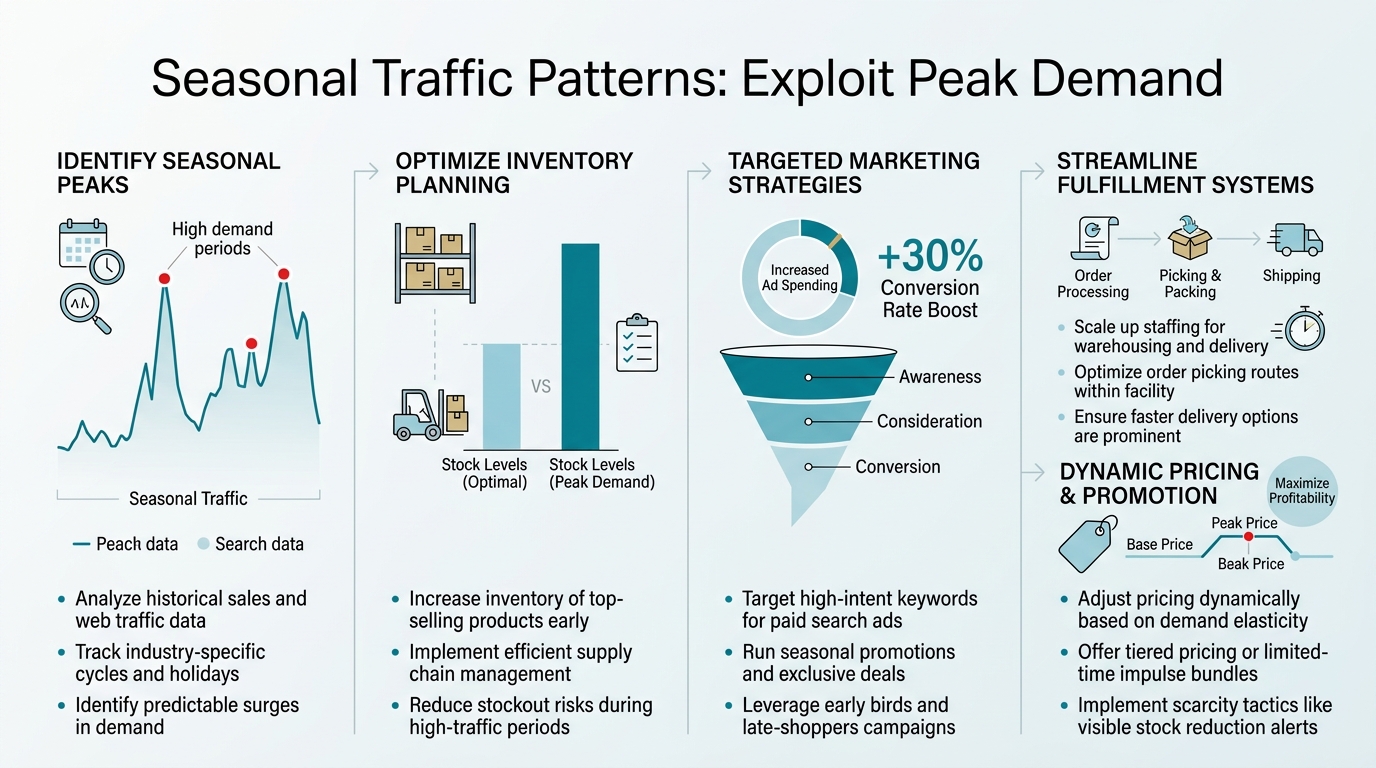
Why Seasonal Traffic Patterns Matter More Than Ever in 2026
Seasonal demand is no longer confined to a few holiday weekends. Cyber Week 2025 generated $44.2 billion in sales, and peak-season planning now starts 90 days prior to maximize share of voice. The window to rank and convert is compressed. Search algorithms reward content that matches user intent at the right time, and seasonal pages that rank early capture disproportionate traffic. Brands relying on last-minute optimization lose to competitors who planned quarterly or annually.
"Planning backward from peak season—working from the calendar and the demand curve rather than forward from the current date—is essential. Most teams fail at seasonality because they confuse calendar time with SEO time. A piece of content published today might rank in 4-6 weeks if it's solid and indexed quickly. Planning to publish during peak season guarantees you'll rank after peak season." – Strategic SEO Planning Guide, 2026
What's more, seasonal traffic quality differs. During peak seasons, search volume rises, but so does competition and ad spend. Organic search accounts for 57% of traffic to evergreen content, making owned traffic critical when CPMs skyrocket. Teams that align seasonal and evergreen content strategies build authority that compounds. A page ranking for "gift ideas for engineers" in November drives October research traffic, improves Q4 conversion, and feeds future years' SEO foundation.
The Cost of Ignoring Seasonality
Brands that do not plan seasonality systematically leak revenue three ways. First, they publish late, missing the narrow window when search volume peaks and competition is still light. Second, they fragment authority across new URLs each season instead of building on existing pages. Third, they treat seasonal pages as one-off campaigns rather than repeating assets, wasting the opportunity to compound authority and rankings year over year.
By contrast, businesses that identify seasonal patterns, publish early, and refresh strategically accumulate advantage. A page ranking position 8 in November is a foundation to improve to position 5 next year if the page is updated, linked, and optimized continuously. Search Engine Land's seasonality framework emphasizes benchmarking year over year, not in isolation. That compounding effect is where true seasonal traffic leverage lives.
How to Identify Seasonal Patterns in Your Industry

The foundation of seasonal traffic success is data. Most teams skip this step and guess. Instead, pull analytics for the past 2-3 years and look for recurring traffic spikes, traffic declines, and revenue correlations with calendar events. The patterns are there. The questions are: When does traffic consistently rise? What external events trigger it? How far in advance should you start optimizing?
Analyze Historical Analytics for Recurring Peaks
Start in Google Analytics 4. Filter for organic traffic only, then view by date range across the past 2-3 years. Look for consistent month-over-month and week-over-week patterns. Does traffic spike in November? Do certain product categories see lifts in January or August? Document the date ranges, the magnitude of the spike, and the duration. Most seasonal lifts last 4-8 weeks, not days. Understanding the ramp-up, peak, and decline phases is critical for timing content publication.
"A traffic spike in March might be driven by spring cleaning searches or a specific promotional event. Isolate the pattern, then forecast when it will occur next year. Multiple years of data separate noise from signal, revealing the true seasonal cycle." – Analytics Best Practices, 2026
Next, correlate those spikes with external signals: holidays, school calendars, weather changes, product launches, or promotional periods. seoClarity recommends analyzing multiple years to separate noise from signal. A traffic spike in March might be driven by spring cleaning searches or a specific promotional event. Isolate the pattern, then forecast when it will occur next year.
Use Keyword Tools to Map Search-Volume Seasonality
Google Trends and Google Keyword Planner reveal search interest curves with precision. Search for your primary seasonal keywords and export the data. You'll see when search volume begins rising (the leading indicator), when it peaks, and when it falls. Compare that curve to your historical traffic. Typically, search volume leads traffic by 1-2 weeks because it takes time for content to be indexed, ranked, and clicked.
Use this lead time strategically. If search volume for "holiday gifts for [product category]" begins rising in early October, publish and optimize your guide in mid-September. That gives you 2-3 weeks for indexing and initial ranking improvements. By the time search volume peaks in mid-October, your page is already in positions 5-8 and accumulating clicks. Competitors publishing in October will rank lower and later.
Segment by Geography and Product Category
Seasonality is not uniform across your business. Demand for winter products peaks earlier in northern climates than southern ones. E-commerce for home goods may spike in spring, while apparel peaks in fall and holiday seasons. Segment your analytics by region and product type. This granularity allows you to prioritize high-revenue seasonal patterns and build targeted strategies for each segment.
For SaaS or B2B, seasonality often follows budget cycles or fiscal calendars. If your customers spend budget in Q4 or after fiscal year-end, search behavior reflects that. Marketing teams search for "best [category] tools" in August before Q4 budgeting or in January before new-year projects. Map those cycles, and your seasonal planning becomes far more precise.
Building Your Seasonal Content Strategy: From Planning to Execution
Seasonal SEO success requires a repeatable process. Planning backward from peak season—working from the calendar and the demand curve rather than forward from the current date—is essential. Most teams fail at seasonality because they confuse calendar time with SEO time. A piece of content published today might rank in 4-6 weeks if it's solid and indexed quickly. Planning to publish during peak season guarantees you'll rank after peak season.
Create a 90-Day Seasonal Content Roadmap
Start 90 days before your seasonal peak. List the top 20-30 keywords you expect to drive traffic during that season. Prioritize by search volume, commercial intent, and revenue correlation. For example, if your analytics show that "gift ideas for [product]" drives 40% of Q4 revenue, prioritize it. If "best [category] for beginners" gets 10,000 monthly searches but converts poorly, deprioritize relative to high-intent keywords.
Next, assign each keyword to content: new pages to create, existing pages to refresh, or pages to optimize for secondary keywords. Build a publishing calendar that front-loads your biggest hitters. Publish your top 5-10 keywords by week 1-3 of your 90-day window. Publish secondary content in weeks 4-8. Use weeks 9-12 to refresh, add internal links, and optimize based on early SERP movement. This staggered approach ensures your content is live and accumulating signals before peak search volume hits.
Keep Seasonal URLs Stable Year Over Year
One common mistake is creating a new URL each season. "Best holiday gifts 2025" becomes "Best holiday gifts 2026." This fragments authority. Links, citations, and ranking history don't transfer. Instead, keep the same URL and refresh content annually. "Best holiday gifts" with an updated year in the body copy allows authority to accumulate. Over three years, a page refreshed on the same URL outranks a page created fresh every season, even if both have identical content.
This strategy compounds. Year one, the page ranks position 8-10 and gets modest traffic. Year two, the refreshed page with additional backlinks and user engagement signals ranks position 5-6. Year three, it owns position 2-3. That trajectory is impossible if you reset the URL each cycle. In e-commerce, this difference translates directly to revenue. A page generating $50,000 in Q4 traffic in year three would generate $5,000-$10,000 in year one if you kept resetting it.
Align Internal Linking Strategy with Seasonal Content
Evergreen pages and seasonal pages should link bidirectionally. Your pillar content on a topic like "best [product category]" (evergreen) should link to seasonal variants like "best [product category] for summer" or "best [product category] gifts." This passes authority and ensures users navigate from evergreen content into seasonal content when search intent shifts. Similarly, seasonal pages should link back to evergreen pillars, creating topical clusters that search engines reward with higher visibility.
Plan your internal linking strategy as part of your 90-day roadmap. If you're publishing 25 seasonal pages, pre-identify which evergreen pages will link to each one. Tools like SEO automation platforms that use AI agents for content can automate this process, ensuring every seasonal page gets linked from relevant high-authority pages before publication. Manual linking delays publication and creates bottlenecks. Automation compounds advantage at scale.
Layering Seasonal and Evergreen Content for Compound Growth
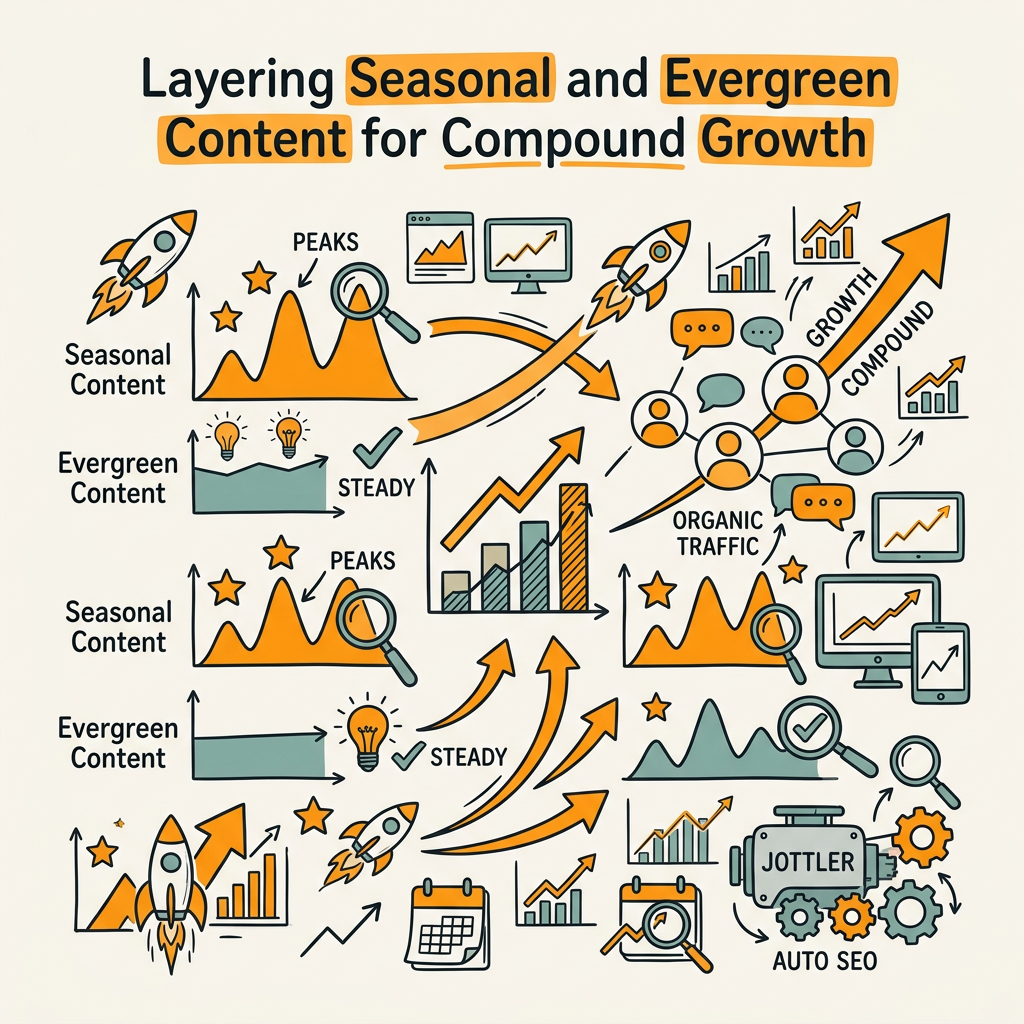
The most effective seasonal strategy is not seasonal alone. It's a blend. Evergreen content—foundational pieces that answer persistent questions—drives steady baseline traffic. Seasonal content—optimized for time-bound queries—captures demand spikes. Together, they compound. Evergreen content ranks year-round and feeds traffic into seasonal conversion pages. Seasonal pages drive revenue and authority that compound back into evergreen pillars.
Evergreen Content as the Foundation
Evergreen pages answer foundational questions that don't change: "How to choose [product category]," "Best practices for [skill]," "What is [concept]?" These pages drive traffic consistently and rank steadily. In 2026, 57% of traffic to evergreen content comes from organic search, the highest-quality, lowest-cost channel. Evergreen pages also serve as link targets and authority sources. When you launch a seasonal page, evergreen pages provide the link equity to push that new content to ranking position quickly.
Prioritize evergreen content in Q1 and Q3 when seasonal urgency is low. Use these periods to build your content foundation, strengthen topic clusters, and accumulate backlinks. The authority you build in low-season quarters multiplies during peak seasons. A site with strong evergreen foundations ranks seasonal content faster and higher than a site relying solely on seasonal pages.
Seasonal Content as the Demand Capture Layer
Seasonal pages target high-intent, time-bound queries. They rank for narrow windows but generate disproportionate revenue because search volume and commercial intent peak simultaneously. "Best holiday gift ideas" in November is worth more traffic than "gift ideas" year-round because purchase intent is highest. Seasonal pages should be hyper-optimized for conversion, not just rankings. Include clear pricing, product comparisons, urgency signals (stock levels, shipping cutoffs), and mobile-optimized checkout flows.
Time seasonal pages to launch 4-6 weeks before peak season, not weeks before. This lead time allows for indexing, ranking accumulation, and early traffic signals that boost page authority before peak volume arrives. Pages ranking position 5-10 early get more clicks, engagement, and backlinks, which improve position before the actual peak.
Content Refresh Cycles: The Underrated Lever
Refreshing old content is underrated. A page that ranked position 3 last season but dropped to position 8 this year doesn't need a new page—it needs a refresh. Update statistics, pricing, date references, and add new data or examples. Optimize on-page signals: improve H2s, add schema markup, strengthen internal links. Often, a 30-minute refresh restores ranking and traffic. Creating a new page takes 3-5 hours and fragments authority.
Build a refresh calendar. Identify your top 20-30 seasonal pages from last season. Set calendar reminders 8 weeks before they'll be relevant again. Schedule 30 minutes per page to audit rankings, update content, and re-publish. By peak season, your content is fresh, current, and optimized. This process also creates a continuous content machine. Instead of scrambling to create seasonal content on-demand, you're systematizing refresh and continuously improving pages that already have authority.
Seasonal Content Performance: A Comparison Framework
| Strategy | Publication Timing | Year 1 Avg Position | Year 3 Avg Position | Authority Compounding |
|---|---|---|---|---|
| New URL Each Season | During peak season | Position 10-12 | Position 8-10 | None—authority resets annually |
| Stable URL, No Refresh | 8-12 weeks prior | Position 6-8 | Position 5-7 | Minimal—links accumulate but content stales |
| Stable URL, Annual Refresh | 8-12 weeks prior | Position 5-8 | Position 2-4 | Exponential—authority + fresh signals |
| Stable URL, Quarterly Refresh + Internal Linking | 8-12 weeks prior | Position 4-6 | Position 1-3 | Maximum—compounding across all factors |
Measuring Seasonal Success: Metrics That Matter
Seasonal campaigns are often measured incorrectly. Comparing traffic in November to average traffic across the year is misleading. Instead, benchmark year over year and track organic conversion quality. Traffic during peak season means little without revenue correlation. The right metrics reveal whether your seasonal strategy is actually compounding.
Year-Over-Year Traffic and Ranking Comparisons
Set up year-over-year tracking in Google Analytics and Search Console. Create a segment for your seasonal keywords and track impressions, clicks, and average position for the same date range across two or more years. If your seasonal pages received 50,000 organic clicks in Q4 2024 and 75,000 clicks in Q4 2025, that's a 50% lift. That's success. If position dropped from 4 to 6 while clicks rose, investigate: did search volume increase, or did featured snippets capture more impressions?
Track this data weekly during seasonal campaigns, not just monthly. Search rankings and traffic can shift rapidly during peak seasons as competitors launch campaigns and search volume fluctuates. Weekly tracking reveals trends early enough to respond with optimization or additional content.
Revenue Per Organic Session and Conversion Rate
Traffic volume is a vanity metric if conversions don't follow. Measure revenue per organic session for seasonal pages specifically. "Best gifts for X" should generate more revenue per session than "gift ideas" generally because it's more specific and intent-driven. If seasonal traffic is 40% higher but conversion rate is flat, the page isn't capturing intent properly. This signals a need for page redesign, clearer CTAs, or better product selection.
Compare seasonal conversion rates to year-round baselines. If your overall organic conversion rate is 2.5% but seasonal pages convert at 4.2%, that's proof the strategy is working. If seasonal pages convert at 1.8%, you're capturing high volume but missing the intent opportunity. Use this gap to optimize: clearer pricing, faster checkout, reduced friction, or better product/keyword alignment.
Automating Seasonal Content for Competitive Advantage
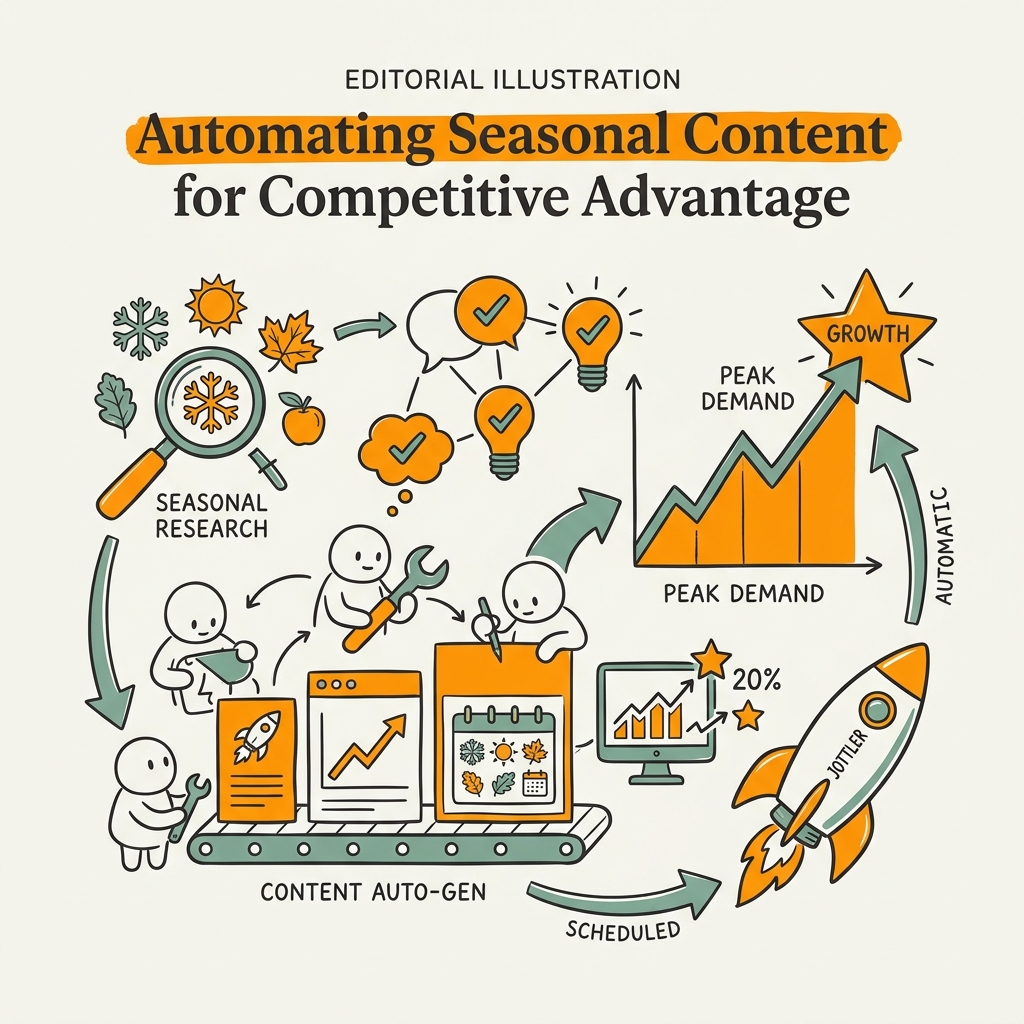
Manual seasonal content creation creates bottlenecks. Research takes weeks. Writing takes days. Publishing takes hours. Fact-checking delays launch. By the time content goes live, you're already behind the curve. Teams that automate content research, writing, refreshing, and publishing compound advantage exponentially. Automation isn't just about speed—it's about executing at consistent quality while competitors scramble.
Automated Keyword Research and Seasonal Forecasting
Tools that automate keyword research can identify seasonal trends faster than manual analysis. Instead of manually checking Google Trends for dozens of keywords monthly, a system monitors search volume trends continuously and alerts you when seasonal lift begins. This early signal gives you weeks of lead time to publish content before competitors notice the trend. For a marketing team managing 50+ seasonal keywords, this automation saves 10-15 hours per quarter and prevents missed opportunities.
Content Generation and Fact-Checking at Scale
Writing seasonal content manually doesn't scale. Twenty articles per season is manageable. A hundred isn't. Autonomous content systems like AI-powered SEO content generators research topics, write comprehensive articles, fact-check against multiple sources, and optimize on-page signals automatically. This means 25 seasonal pages can be researched, written, and published in 24-48 hours instead of 2-3 weeks. The quality is consistent, the facts are verified, and the content ranks because it's optimized for SEO signals from inception.
For founders and marketing teams stretched thin, this is the leverage point. Publishing 100 seasonal pages per year compounds authority faster than publishing 10 manually. One team using autonomous content generation publishes more seasonal content in Q4 than competitors publish in a full year, capturing demand across more keywords and owning more of the seasonal SERP.
Continuous Publishing and Internal Linking Automation
Publishing delays are costly. A piece of content delayed one week often loses ranking opportunity. Autonomous systems publish directly to your CMS on a schedule, eliminating the publishing bottleneck. They also automate internal linking, ensuring new seasonal pages are linked from relevant high-authority pages before launch. This pre-built link structure accelerates ranking and compounds authority into the page immediately.
For teams managing 200+ pages, manual internal linking is impossible. Automation ensures every new page is strategically linked, every evergreen page is updated with new link targets, and link networks compound year over year. This infrastructure is what separates scaling teams from teams that plateau.
Seasonal Traffic Patterns in 2026: Industry-Specific Examples
Seasonal patterns vary by industry. Understanding your specific cycle is critical. Here are common seasonal peaks and how to prepare:
- E-commerce (General): Black Friday, Cyber Monday, holiday season (Oct-Dec); back-to-school (Aug); Valentine's Day (Feb); Mother's Day, Father's Day (May-Jun). Start SEO efforts 90 days before each peak.
- Home and Garden: Spring (Feb-Apr); summer patio season (May-Jul); fall landscaping (Aug-Sep). Peak search in late winter/early spring.
- Fitness and Wellness: New Year's resolutions (Jan); summer body season (Apr-May); holiday gift season (Nov-Dec). Plan content to rank in November for Jan demand.
- B2B SaaS: Budget approval cycles (Q3-Q4); new-year projects (Jan). Plan campaigns to rank by August for Q4 budget cycle visibility.
- Travel and Tourism: Summer vacation (May-Jul planning, Jun-Aug travel); winter holidays (Oct-Nov planning); spring break (Feb-Mar). Start SEO in Jan-Feb for summer peaks.
For each industry, the pattern is the same: identify the peak, work backward 90 days, and publish content on a staggered schedule. The difference is timing and keyword focus. Apply this framework to your industry, and you'll identify your specific seasonal cycles within one quarter.
Conclusion
Seasonal traffic patterns are one of the most predictable, exploitable opportunities in organic marketing. Teams that plan systematically outrank competitors by 67% in first-page SERP visibility and capture revenue when demand peaks. The formula is simple: analyze historical data 90 days before seasonal peaks, publish content early with internal link infrastructure, keep URLs stable to compound authority year over year, and blend seasonal and evergreen content for sustained growth.
The margin between winners and losers in seasonal traffic is not complex strategy—it's execution discipline. Competitors that publish late, fragment authority across new URLs, and treat seasonality as tactical guesswork fall behind. Teams that systematize the process, publish 8-12 weeks early, and refresh strategically build compound advantage. In 2026, where content cluster architectures are delivering 67% higher first-page visibility and Cyber Week sales have grown to $44.2 billion, the cost of not optimizing seasonality is opportunity loss, not just traffic loss.
Automation is the accelerant. Founders and marketing teams publishing seasonal content manually lose to teams automating keyword research, content generation, fact-checking, and publishing. One system publishing 100 optimized pages per season compounds faster than one team publishing 10 manually. Start with a 90-day seasonal roadmap. Then automate the rest.
Start your SEO agent today and automate seasonal content generation, refreshing, and publishing to capture peak demand before competitors even plan.
FAQs
When should I publish seasonal content to rank before peak demand?
Publish 8-12 weeks before your seasonal peak to allow time for crawling, indexing, and ranking accumulation. If Black Friday peaks in late November, publish your core seasonal content by late September. This lead time lets pages move from position 10-15 to position 5-8 by October and position 3-5 by November when search volume peaks. Pages published during peak season rank too late to capture the bulk of demand. Google Trends and Keyword Planner show when search volume begins rising, giving you a signal to accelerate publishing if you're behind schedule.
Should I create a new URL for seasonal content each year or reuse the same URL?
Reuse the same URL and refresh content annually. A stable URL allows links, citations, and ranking history to accumulate year over year. A page ranking position 8 in year one becomes position 5 in year two and position 3 in year three if refreshed on the same URL. This compounding effect is impossible if you create a new URL each season. Instead, update the content, refresh statistics and dates, improve on-page signals, and republish. This approach requires less effort than creating new content and delivers exponentially better results over multiple seasonal cycles.
How do I measure whether my seasonal traffic strategy is actually working?
Benchmark year over year, not against average traffic. Compare impressions, clicks, and average position for the same keywords in the same date ranges across two or more years. If seasonal organic clicks increased 50% year over year and revenue per organic session during peak season grew 40%, your strategy is working. Also track conversion rate and revenue per session separately for seasonal pages versus year-round content. Seasonal pages should convert at higher rates because they target high-intent, time-bound queries. If seasonal traffic is up but conversions are flat, the page isn't capturing intent properly and needs optimization. Focus on revenue metrics, not traffic volume alone.