Skyscraper Technique for Quality Backlinks
The conventional wisdom about link building is dead wrong. 76% of marketers still believe that "great content gets links naturally," yet the reality is far harsher: without a systematic approach, your best content will languish unlinked and unfound. The Skyscraper Technique solves this by flipping the equation. Instead of hoping for links, you identify what's already earning them, create something demonstrably better, and reach out strategically to the people and sites that matter. Done right, this approach can deliver 30–36% organic traffic increases within four to six months and attract 241% more backlinks than standard content on the same topic. Here's how to execute it at scale without burning out your team.
Key Takeaways
- Properly executed Skyscraper campaigns deliver 30–36% organic traffic gains within 4–6 months (Search Engine Land, 2025)
- Skyscraper content receives 241% more backlinks than regular content, but only when paired with personalized outreach and original data
- Modern Skyscraper requires original research, data, visuals, and segmented outreachnot just "longer content" and mass emails
- Finding Linkable Assets: Identify underperforming content that's already earning links from relevant domains.
- Creating Superior Content: Add original data, tools, visuals, or expert quotes that genuinely outclass the competition.
- Building Your Prospect List: Segment linkers by activity, authority, and relevance before outreach.
- Personalizing Outreach: Convert 5–15% of carefully targeted prospects with value-first messaging.
- Tracking Results: Monitor first-60-day engagement, bounce rate, and unsolicited links to validate campaign success.
- Scaling Systematically: Automate research, content gaps, and prospect identification to run multiple campaigns in parallel.
How to Identify High-Value Linkable Assets in Your Niche
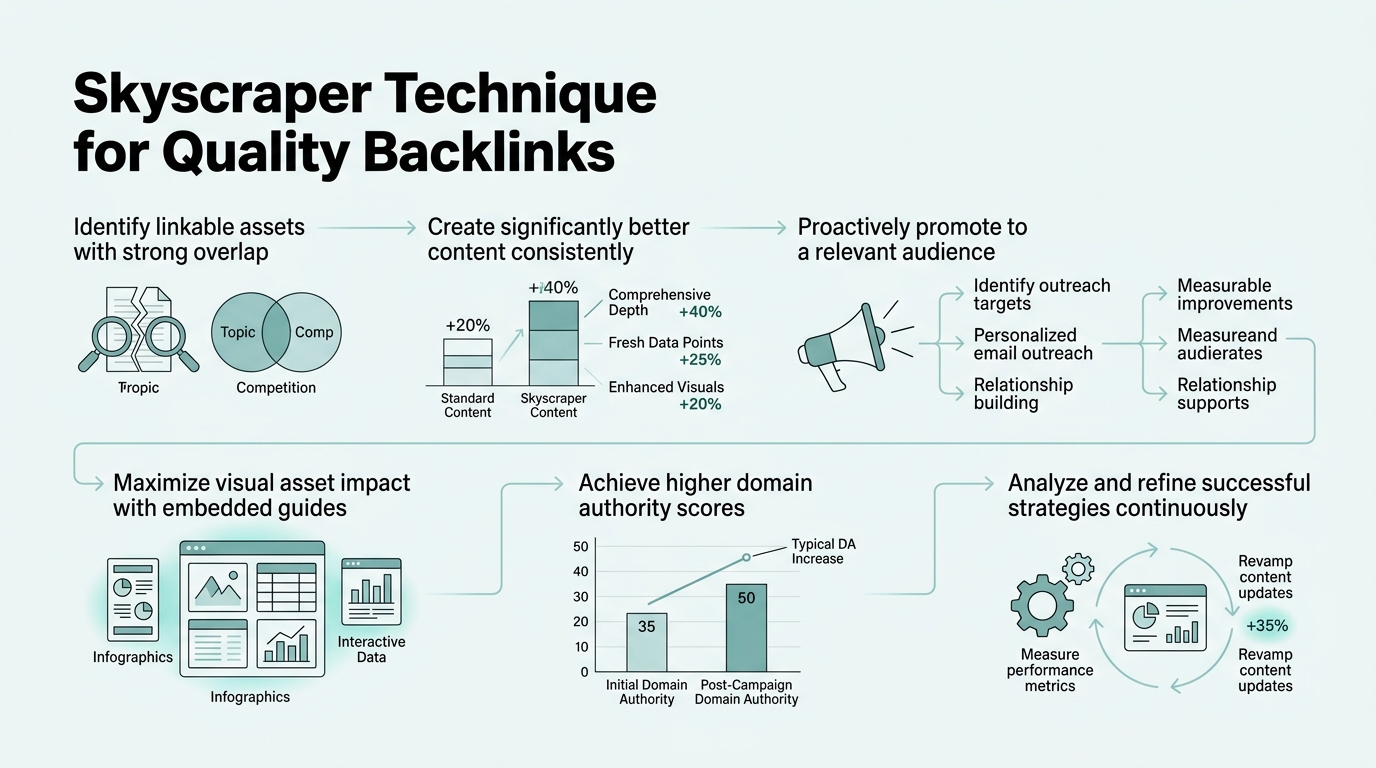
The first step determines your entire campaign's quality. 61% of SEOs surveyed in an Ahrefs poll said the Skyscraper Technique still works when executed correctly, but only if you start with a linkable asset that actually has earning potential. A linkable asset isn't just any piece of contentit's a resource so useful that linking to it becomes a no-brainer for other publishers. The trick is finding what's already proven itself.
Find Content That Competitors Are Already Linking To
Backlink data is your competitive intelligence gold mine. Use tools like Ahrefs, SEMrush, or Moz to identify pages in your space with 20+ referring domains. These pieces have already done the hard work of attracting linkers. Your job isn't to reinvent the wheel; it's to understand why these pages won their backlinks and then outbuild them.
Start with the top 50 results for your primary keyword. Filter for content with substantial backlink profiles but clear improvement opportunities. Blog posts, ultimate guides, and research reports tend to attract more links than sales pages or listicles. Look for content published 12–24 months agorecent pieces are still climbing, while older assets reveal the types of resources that have staying power.
Verify Traffic and Engagement Signals
A page with 100 backlinks but declining traffic is a red flag. Search Engine Land's 2026 update recommends prioritizing prospects that linked recently, updated content within the last year, and still receive measurable traffic. Use tools like SimilarWeb or SEMrush's Traffic Analytics to verify that target pages still drive consistent sessions. A declining page means the linkers may have moved onwaste of your effort.
Look for pages with 3+ minutes average session duration and bounce rates below 70%. These metrics signal genuine reader engagement, not just vanity clicks. Tools like Bright SEO Tools report that Ahrefs analysis found an average of 35 referring domains per campaign, but top campaigns earn 100+ unique domainsthe difference comes down to starting with assets that truly merit the effort.
Segment Content by Topic Maturity and Opportunity Gap
Not all linkable assets are equal. Some topics are saturated with excellent content. Others have room for a clear winner. Build a matrix scoring content by:
- Backlink volume: 20–50 domain links (room for growth)
- Content gaps: Missing data, outdated stats, no tools or visuals
- Update recency: 12+ months old, with no recent competitor refreshes
- Niche relevance: Directly aligned with your business or audience
- Traffic potential: Keywords with search volume above 500/month
This filtering process takes time when done manually. Busy founders and marketing teams running autonomous SEO agents like Jottler skip the bottleneck entirelythe system automatically identifies high-opportunity gaps across dozens of competitors in your vertical, ranking them by achievable backlink lift and traffic ROI.
Creating Content That Actually Outperforms the Competition
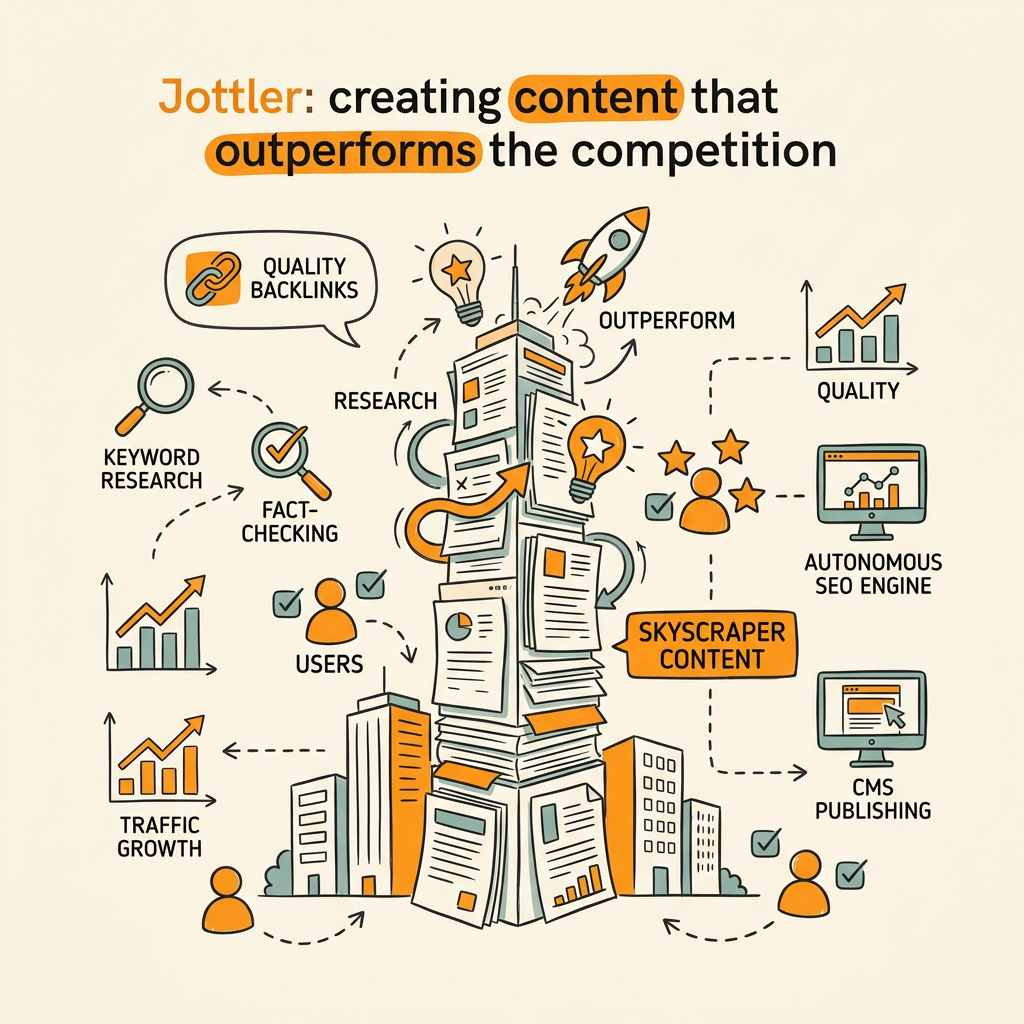
Finding a good target is just half the battle. The modern Skyscraper Technique requires adding material valuenot just length. The old playbook of "make it 50% longer and email people" no longer converts. Only 6.2% of link-building experts believed the traditional version was effective in Editorial Link's 2024 State of Link-building Report, while 61% of SEOs said it works when paired with original data and stronger promotion. The difference: differentiation.
Add Original Research, Data, or Tools
The highest-performing Skyscraper assets include something the original lacks: proprietary research, original survey data, custom tools, or exclusive expert interviews. If the competitor's guide is "The 10 Best Practices," your version adds a dataset showing real performance metrics from 100 companies in your space. If their post is a listicle, yours includes primary research proving which items actually drive ROI.
You don't need expensive market research. Conduct surveys of your audience, analyze your own customer data, or interview 5–10 industry practitioners. ICOWebSolutions reports that top campaigns add original data, visual assets, and thoughtful outreach as the core differentiation factors. The specific type of data matters less than its authenticity and usefulness to the target audience.
Improve Format and Visual Design
Blog posts with charts, custom graphics, video embeds, and tools get linked more. If the original is a long text block, yours becomes an interactive comparison matrix or a downloadable toolkit. If the competitor published a report, yours includes infographics, case study summaries, and a free tool. Visual assets break up scanning fatigue and give linkers a reason to point their readers to your version instead.
This is where many in-house teams struggle. Design takes bandwidth. Jottler automates content production entirelygenerating long-form research, verifying data, and structuring content in scannable formatsfreeing your team to focus on the creative differentiation that actually matters for link attraction.
Expand Scope Without Padding
Make your content meaningfully larger by adding genuinely useful sections the original skipped. If the original covers "5 Link Building Tactics," your version adds a section on "How to Scale Each Tactic Across 10 Campaigns in Parallel" or "Common Mistakes That Waste 60% of Outreach Effort." Expand by deepening expertise, not by repeating points or inflating word count.
Aim for 30–50% more comprehensive coverage, not 200% longer for length's sake. Quality linkers can smell padding. They link to resources that save them time and teach them something new. Deliver both.
Building a Targeted Prospect List and Segmenting for Outreach
Your content is ready. Now the hard part: getting the right people to actually link to it. Generic outreach converts at near zero. Personalized, value-first pitching to carefully targeted prospects converts at 5–15%, according to Link Building Journal's 2026 research. The difference? Segmentation and research before the email ever lands.
Extract Linkers from Top Competitor Pages
Use Ahrefs, SEMrush, or Moz to pull the full backlink profile of the page you're competing against. These linkers are your primary prospect list. They've already proven interest in this topic by linking once. Your job is to give them a reason to link againto your better version.
Export the full list and prioritize by:
- Domain authority: DA 30+ (quality over quantity)
- Relevance: Does the linking site's content actually relate to your niche?
- Freshness: When was their last backlink added? Recent = more active
- Anchor text: Are they linking to similar topics? (signals genuine interest)
Find Additional Prospects Using Keyword and Topic Queries
Beyond the direct competitors, find sites linking to related content. If you're building a Skyscraper on "link building tools," also find sites linking to "best SEO tools," "content marketing tools," and "SEO agencies." Use queries like "intitle:[keyword]" or "inurl:[topic]" in Google, or rely on backlink tools' "explore by topic" features to surface secondary prospects.
This expanded list captures opportunities you'd miss by only chasing existing linkers. These prospects already link to topical content but may not know about your specific resource yet.
Segment by Activity and Likelihood to Link
Not all prospects are created equal. Create tiers:
- Tier 1 (High-fit): Already linked to your topic + content updated in last 12 months + author still active = highest conversion likelihood
- Tier 2 (Medium-fit): Linked to adjacent topics + moderate authority + content moderately recent
- Tier 3 (Long-shot): Low authority, no recent updates, but topically relevant
Start outreach with Tier 1. Track conversion rates per tier. Once you have data, stop wasting time on low-converters and double down on what works.
Executing Personalized Outreach That Converts

This is where most Skyscraper campaigns fail. The email arrives generic, impersonal, and forgettable. Personalized, research-backed outreach moves the needle from 0% to 5–15% conversion rates. The difference isn't toneit's evidence that you actually know the linker and their audience.
Research the Linker Before You Write
Spend 3–5 minutes on each Tier 1 prospect. Read their most recent posts. Check their social media. Understand their audience and the angle they take on your topic. Your pitch should prove you've done this work. Generic openers like "We created a guide on link building" land in spam. Specific openers like "I noticed your post on [specific resource] linked to [old tool]. We've built something that expands on that approach with [specific new angle]" actually get read.
Use Hunter.io, RocketReach, or simple Google searches to find the right contact. Editor email addresses are better than generic "contact@" addresses. You're targeting the person who made the linking decision, not the support team.
Lead with Value, Not the Ask
Never open with "We'd love if you'd link to our post." Lead with what you've discovered about their content or audience. Example:
"Your guide on link building tactics is referenced constantly in our network. We noticed it recommends [tactic X], which is solid for beginners. We just published research showing how [tactic X] actually underperforms for [specific scenario], and what works better instead. We think your readers would benefit from knowing thisthought you should see it first."
Jamie Fenn, Director of Growth at Grow
This isn't manipulation. You're genuinely giving them new information before asking for anything. If your content is truly better, you've just made their job easier by giving them an upgrade to recommend.
Provide a Reason to Link Right Now
Include a specific call-to-action tied to their content. "Here's a link. Feel free to add it if you think it's relevant" converts worse than "We found your post ranks 3rd for [keyword] with 50 backlinks. If you added this resource, which covers [new angle], you could capture additional search traffic from the people also searching for [related query]. Here's the link:"
Make the business case for them to link. Show how updating their content benefits their readers and their rankings.
Measuring Campaign Success and Tracking ROI
Not all campaigns hit. Track the right metrics to know what's working and what to adjust before you've wasted three months on a stalled effort. Look for first-60-day leading indicators that predict long-term success: natural backlinks without outreach, 3+ minute average session time, and bounce rates under 70%.
Monitor Early Engagement and Link Acquisition
After publishing, track:
- Unsolicited links: Did any linkers find your content and link without outreach? (Strong signal of genuine value)
- Average session duration: 3+ minutes indicates engaged readers likely to share and link
- Bounce rate: Keep it below 70%; higher rates suggest misaligned traffic
- Social shares: Early social signals often precede links
These leading indicators emerge within the first 14–30 days. If you're seeing strong engagement but zero outreach conversions, the issue is reach, not quality. If engagement is weak, the content itself needs revision before you continue pitching.
Track Outreach Response and Conversion Rates
Build a simple spreadsheet tracking:
- Prospect tier and domain authority
- Outreach date and contact method
- Response received (yes/no/no-response)
- Link acquired (yes/no)
- Time-to-link (days from outreach to published link)
Target 5–15% conversion across Tier 1 prospects. If you're at 2%, your message needs refinement. If you're at 3%, your targeting is off. Track these metrics by tier to identify your highest-ROI outreach formula.
Calculate Organic Traffic and Ranking Impact
The real test: after 60–90 days, did you gain rankings and traffic? Use Google Search Console and your analytics platform to track:
- New keywords ranking and their average position
- Organic traffic to the asset and your full domain
- Referral traffic from the acquired backlinks
- Engagement metrics from new visitors
Successful Skyscraper campaigns typically show 10–30 new keyword rankings within 90 days, depending on niche difficulty. If your campaign isn't moving the needle on rankings after three months, the content may not have been differentiated enough, or your outreach reach was too small.
Scaling the Skyscraper Technique Across Multiple Campaigns
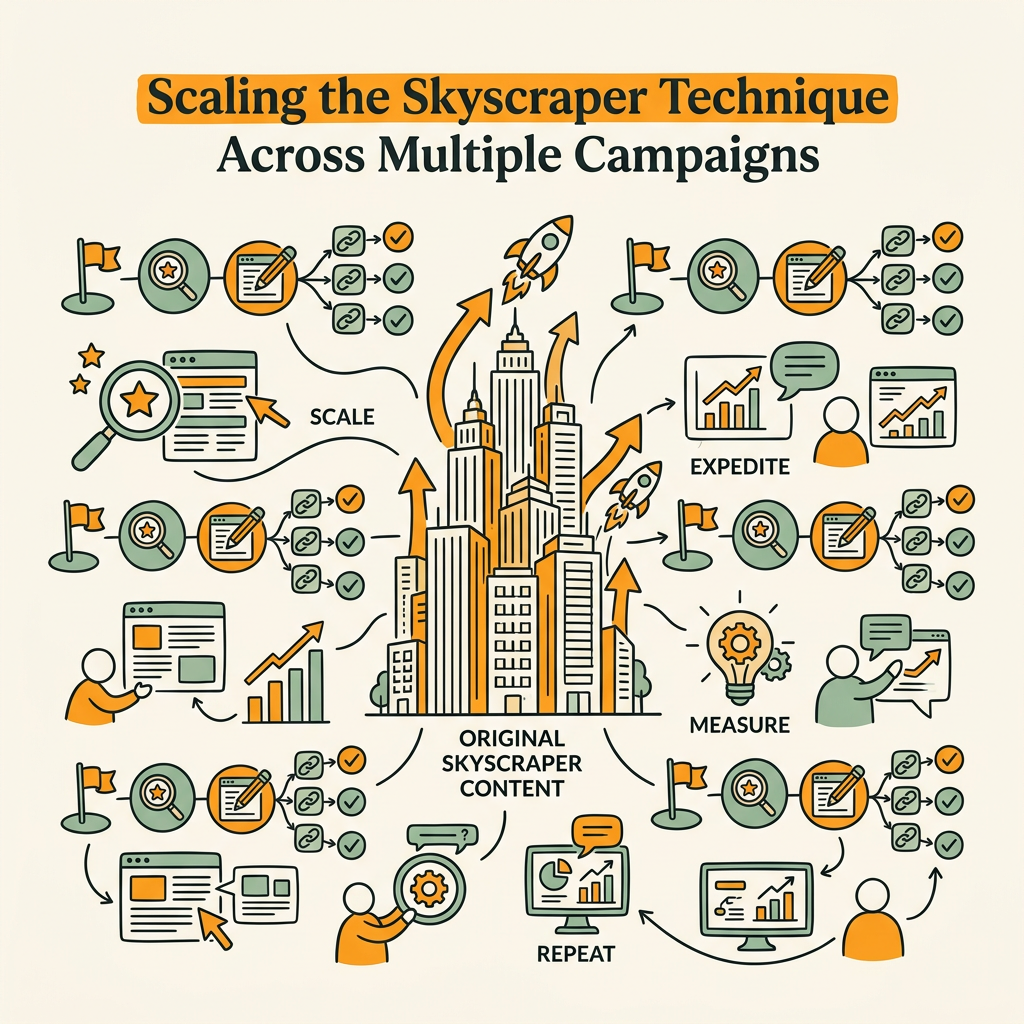
One campaign per quarter won't cut it. Growing companies need systematic, parallel execution. This is where most in-house teams hit a wall: research and prospect-list building consume 40% of campaign time. Automation flips the equation.
Automate Opportunity Identification Across Your Vertical
Instead of manually hunting for one good target, run continuous monitoring on your top 50 competitors' backlink profiles. Use tools to flag new linking opportunities the moment they emerge. SEO automation platforms designed for founders streamline this by identifying gaps across the entire competitive landscape in real time, then surfacing only the highest-opportunity targets automaticallyso your team only reviews truly relevant prospects.
This workflow turns prospect discovery from a manual two-week process into a continuous pipeline feeding one new high-quality target per week.
Batch Content Creation and Fact-Checking
Create multiple Skyscraper assets in parallel rather than sequentially. Assign three strong content angles from your opportunity pipeline, brief each internally, and publish all three within two weeks. This concentrated effort proves faster than spacing campaigns months apart because momentum compounds: each new asset attracts natural links, and combined promotional efforts drive higher engagement.
Ensure every fact is verified. Bad data sinks campaigns faster than lack of originality. Fact-check all stats and claims against primary sources before publishing. This is a common bottleneckverification alone takes 15–20 hours per asset manually.
Standardize Outreach and Track What Works
Document your top-performing email templates, subject lines, and call-to-action formats. Build three variations and A/B test them across new campaigns. After three campaigns, you'll have clear data on which approaches convert best for your niche. Scale what works; sunset what doesn't.
Use email management tools like Pitchbox or Hunter to automate follow-ups and manage prospect lists. One follow-up increases conversion by 20–30%. Two follows increase it further. Systematize this; don't let it fall through cracks.
Avoiding Common Pitfalls and Modern Skyscraper Failures
Execution breakdown is common. Smart founders know where the traps are and sidestep them before effort is wasted.
Don't Make It LongerMake It Better
The original Skyscraper definition was "make it 10x better." The mistake teams make is conflating "10x" with "10x longer." A 12,000-word guide isn't better than a 3,000-word one if the longer version is 60% filler. Better means denser insight, more useful data, and faster answers to the reader's actual questions. Linkers reward utility, not word count.
Avoid Spray-and-Pray Outreach
Sending 200 generic emails generates 0–3 links on average. Sending 20 highly personalized emails to the right prospects generates 1–3 links and teaches you something about your market. Quality beats volume. Always.
Don't Publish and Forget
The first week after publishing is critical. Promote your Skyscraper heavily: share it with your email list, tag it in relevant social groups, reach out to experts quoted in it for shares, pitch it to journalists covering your space. Cold outreach alone converts slowly. Warm traffic and brand awareness move the needle faster.
Conclusion
The Skyscraper Technique remains viable in 2026, but only when executed as a full campaignnot just "longer content." Properly done, Skyscraper campaigns deliver 30–36% organic traffic increases within four to six months and attract 241% more backlinks than standard content when paired with original data and personalized outreach. The real shift from 2023 to 2026 is this: the best performers aren't doing more workthey're automating the repetitive parts (prospect research, content gaps, fact-checking) and focusing human effort on the high-ROI activities (differentiation, personalization, strategic promotion).
Running multiple concurrent Skyscraper campaigns manually is unsustainable. Identify high-opportunity targets, create genuinely differentiated content with original research, segment your prospect list ruthlessly, and personalize every pitch. Then measure what worked so you can repeat the formula. For teams running thin on bandwidth, automating the research and content production pipeline through tools designed for founders lets you double or triple campaign velocity without burnout.
Start your SEO agent to identify link-building opportunities and automate content production for your next Skyscraper campaign.
FAQs
Does the skyscraper technique still work in 2026?
Yes, but with caveats. 61% of SEOs in an Ahrefs poll said it works when executed correctly, while skeptics point to rising effort required and lower guaranteed returns. The traditional version"make it longer, email people"has a near-zero success rate. Modern Skyscraper requires original data, differentiated format, and highly personalized outreach to prospects who actively link. When those elements align, campaigns deliver strong backlink gains and 30–36% traffic lifts within 4–6 months. The key: don't rely on content alone. Pair it with strategic promotion and segmented outreach.
What's the most important step in the skyscraper technique?
Identifying the right target asset ranks first. A strong target already earns links, has proven traffic demand, and has clear improvement gaps. If you start with a weak target, even perfect execution downstream won't generate meaningful returns. Spend time auditing your opportunity pipeline. Use backlink tools to find pages with 20–50 referring domains, recent traffic, and visible content gaps. That foundation determines everything. The best outreach in the world won't convert linkers if your content isn't solving a real problem they care about.
How many links should I expect from a skyscraper campaign?
Expect 20–50 backlinks from 90 days of targeted outreach to a well-researched prospect list in most niches. Top-performing campaigns in less competitive verticals exceed 100 referring domains. The wide range reflects niche difficulty, prospect list size, and outreach conversion rate. Average conversion is 5–15% for personalized outreach. If you outreach to 50 Tier 1 prospects and convert at 10%, that's 5 linksadd natural links from promotion and social, and you hit 10–15 total. Scale your prospect list accordingly to your target.