The Hub-and-Spoke Content Model Explained
Search engines reward topical authority. A recent case study showed a 328% increase in page-one rankings and 741% increase in page-two rankings when a brand implemented the hub-and-spoke content model (Conductor, 2025). Yet most marketing teams still publish content haphazardly, with no clear connection between pieces. The cost? Wasted resources, missed keyword opportunities, and weak topical authority. The hub-and-spoke model solves this by organizing your content around a central pillar (the hub) with supporting pieces (the spokes) that all reinforce each other. Here's a quick summary of how to structure content like this effectively:
Key Takeaways
- Hub-and-spoke increases page-one keywords by 328% and page-two keywords by 741% (Conductor, 2025)
- The model treats one broad topic as the hub and organizes related long-tail content as spokes that all link back to the center
- Strong internal linking from spokes to hub distributes topical authority and helps search engines understand your expertise
- In 2026, the model evolves from keyword silos to multimedia authority ecosystems with video, podcasts, and structured data
- What the Hub-and-Spoke Model Is: A content architecture where one authoritative pillar page covers a broad topic, with supporting articles linking to and from it to build topical authority.
- Why It Matters for SEO: The strategy improves keyword rankings, distributes internal link equity, and signals to search engines that you own a topic.
- How to Build It: Start with a broad hub keyword, map supporting long-tail questions, create spokes, and interlink aggressively.
- Linking Architecture: Each spoke links to the hub, the hub links back to relevant spokes, and related spokes link to each other.
- 2026 Evolution: The model now includes multimedia (video, podcasts, infographics) and is measured by topical authority, not just keyword density.
- Content Calendar Automation: Tools like Jottler automate the research, writing, and internal linking of hub-and-spoke clusters, compounding your topical authority over time.
What Is the Hub-and-Spoke Content Model?
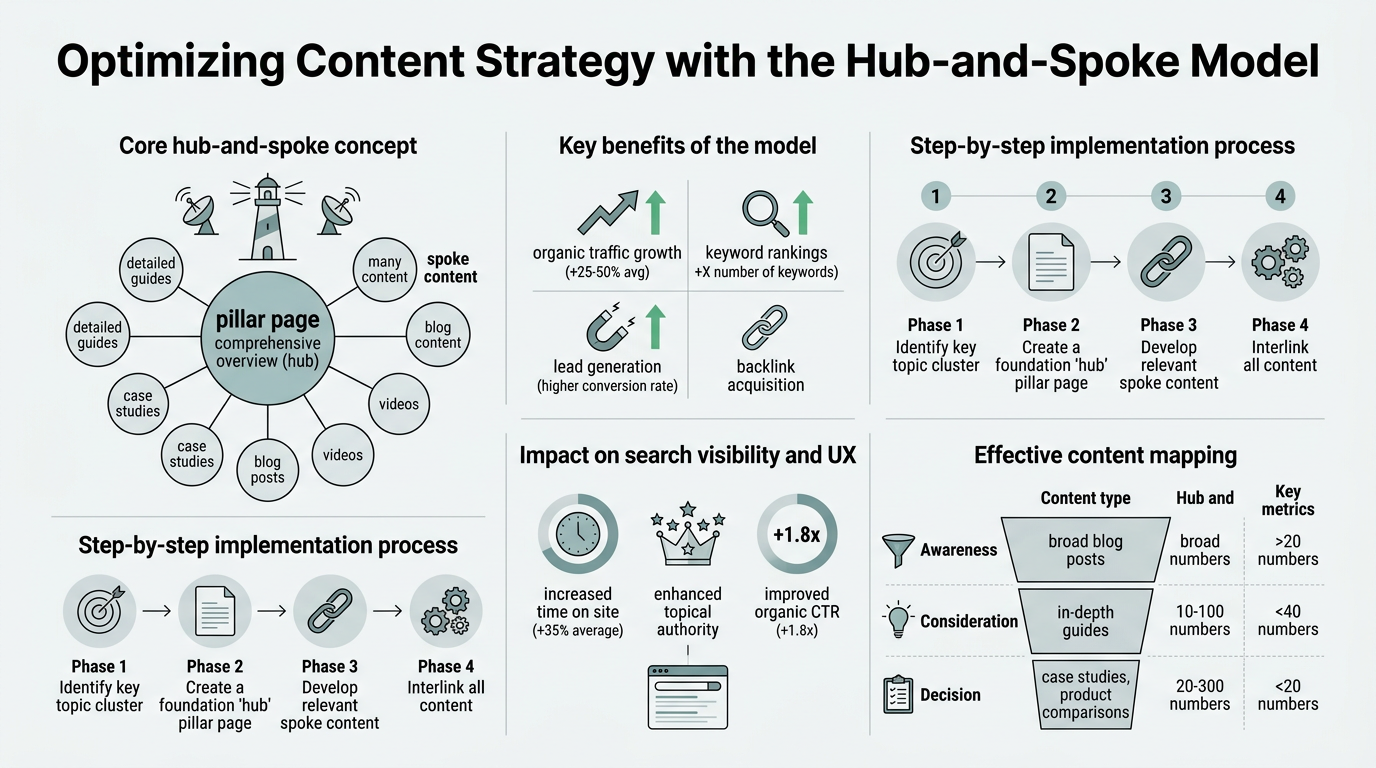
The hub-and-spoke content model organizes all your content around a central pillar topic. The hub is one broad, authoritative page covering a wide topic. The spokes are supporting articles targeting related long-tail keywords and sub-topics. Every spoke links back to the hub, and the hub links to relevant spokes, creating a web of internal links that reinforce topical authority. Think of it like a bicycle wheel: the hub sits in the center, and each spoke connects outward and back to the center point.
From a keyword perspective, the hub targets high-volume, often transactional keywords (e.g., "SEO services"). The spokes target lower-volume, informational long-tail keywords (e.g., "how SEO improves rankings," "SEO for B2B companies"). Botify explains that this structure helps search engines understand the relationship between your content, so your brand is seen as an authority on the topic.
Hub vs. Spoke: Core Architecture
The hub is your centerpiece. It's a comprehensive, 2,000–3,500 word article that covers the topic at a high level and links to every spoke. It should target the broadest, most commercial keyword. Examples: "SEO strategy," "content marketing," "SaaS sales." Hubs should be accessible to beginners but detailed enough to serve as a reference for experienced practitioners.
"When you have multiple interconnected articles all covering different angles of a single broad topic, Google understands that your site owns that topic."
Spokes are deeper dives into specific sub-topics. Each spoke targets a specific long-tail keyword that supports the hub's broader topic. Examples: "How to conduct keyword research," "Internal linking best practices," "Top-of-funnel content strategies." Spokes range from 1,200–2,000 words. Each spoke links to the hub in the opening paragraph and to related spokes where context naturally demands it.
Why the Model Strengthens Topical Authority
Search engines use links and content clustering to infer expertise. When you have 12 interconnected articles all covering different angles of a single broad topic, Google understands that your site owns that topic. Conductor's case study showed clients achieved #1 rankings for their hub keyword while simultaneously improving rankings for related long-tail queries across the entire cluster.
The model also preserves search intent. Users who land on a spoke for a specific question (e.g., "how to write a meta description") get exactly that. But the hub is always accessible via internal links, so they can discover the broader context. This improves dwell time, reduces bounce rate, and supports the buyer journey.
How Does the Hub-and-Spoke Model Work in Practice?

Implementation requires three core mechanics: content mapping, internal linking architecture, and continuous optimization. The model works by connecting your topical pieces in a way that both humans and search engines can navigate intuitively, amplifying each piece's ranking potential through relationship signals.
The Content Mapping Phase
Start by selecting your hub topic. This should be a broad keyword your business cares about, with 200+ monthly searches and clear commercial or informational value. Examples: "demand generation," "API security," "data warehousing." Once you have your hub keyword, brainstorm all the sub-questions a user would ask while researching that topic:
- Foundational questions: "What is [topic]?", "How does [topic] work?", "Why is [topic] important?"
- Comparison questions: "[Tool A] vs [Tool B]", "DIY vs hiring an agency"
- How-to questions: "How to implement [tactic]", "Best practices for [topic]"
- Advanced questions: "Advanced strategies", "Common mistakes", "ROI measurement"
- Tool/resource questions: "Best tools for [topic]", "Free alternatives to [competitor]"
Each question becomes a spoke. Most clusters have 8–15 spokes. Fewer than 8 and you haven't built enough topical depth. More than 15 and you risk diluting your message.
Building the Internal Linking Graph
Once your spoke list is complete, map the linking architecture. Every spoke must link to the hub—usually in the opening 100 words, where you contextualize the spoke within the larger topic. The hub should link to every spoke, ideally grouped by topic area to make the hub more scannable. Related spokes can link to each other when there's genuine semantic overlap.
"A strong linking strategy distributes PageRank and signals to search engines that your site has comprehensive coverage of a topic. Every spoke should have at least 1 outbound link to the hub and 1 inbound link from the hub."
A strong linking strategy follows these rules:
- Hub-to-spoke links: At least 1 link per spoke, placed in a "Related reading" section or within the body where contextually relevant
- Spoke-to-hub links: Always include a link in the opening paragraph to anchor the spoke in the broader topic
- Spoke-to-spoke links: Link related spokes, but only when it genuinely serves the reader (avoid over-linking)
- Anchor text: Use descriptive, keyword-rich anchor text that hints at the linked page's topic, not generic phrases like "read more"
This interlinking distributes PageRank and signals to search engines that your site has comprehensive coverage of a topic. Zupo recommends keeping important pages within 3 clicks of the homepage to maximize crawlability and authority flow.
Crawl Efficiency and Site Architecture
The hub-and-spoke model only works if search engines can crawl and index your content efficiently. Keep your hub pages shallow in the site hierarchy—ideally at /content/[topic]/ rather than buried under multiple subdirectories. Use clean, descriptive URLs like /content/seo-strategy/ instead of /content/p=12847/.
Include your hub and spoke URLs in your XML sitemap. Use breadcrumb navigation so users and crawlers understand the hierarchical relationship between the hub and spokes. If you're using WordPress or another CMS, content automation tools can automatically generate and manage internal links across your cluster, ensuring consistency and reducing manual work.
Building Your Hub-and-Spoke Content Cluster
Creating a hub-and-spoke cluster is a multi-phase process. The output is a tightly interlinked set of 8–15 pieces of content that all reinforce each other. Each piece ranks better because of the cluster's collective topical authority. Here's a pragmatic 5-step framework:
Step 1: Conduct Keyword Research for Your Hub
Your hub keyword must balance search volume with ranking difficulty. Ideally, you want 200+ monthly searches and a keyword difficulty below 40 (on a 0–100 scale). If KD is above 50, the hub topic is likely too competitive for a new site. Research tools like Semrush, Ahrefs, and Moz provide volume and difficulty estimates. Search Google for your target hub keyword and assess the top 10 results—can your site realistically compete?
Example process:
- Brainstorm 5–10 possible hub topics in your niche
- Run keyword research on each candidate
- Pick the one with the best volume-to-difficulty ratio
- Verify there's enough search demand to sustain 8–15 related spokes
Step 2: Map All Spoke Keywords and Topics
Use Google's "People Also Ask" section and autocomplete suggestions to discover spoke keywords. Enter your hub keyword into Google, scroll to "People Also Ask," and record every question. These are actual user queries—perfect for spoke topics.
Also use keyword research tools to find semantic variations and long-tail keywords related to your hub. Create a spreadsheet with columns for spoke topic, keyword, search volume, and keyword difficulty. Aim for spokes with 50–150 monthly searches. Spokes with <10 searches are too niche; spokes with 200+ searches should probably become their own hubs.
Step 3: Create a Content Template and Timeline
Consistency matters. Build a template for your spoke articles so they follow the same structure: opening hook, keyword-rich H2s, a comparison table or data-backed list, and a strong CTA. Decide on a publishing timeline—will you publish all spokes at once or stagger them over weeks?
Staggered publishing (e.g., 2 spokes per week) allows you to:
- Build anticipation and backlink opportunities as you release new pieces
- Refine your internal linking strategy based on early performance
- Test and optimize the hub before all spokes are published
- Reduce the resource load on your team
Simultaneous publishing (launching hub + all spokes at once) is faster but offers less opportunity for optimization.
Step 4: Write and Publish the Hub
The hub should be your most comprehensive piece. It should serve as the entry point for someone new to the topic and a reference for experts. Aim for 2,500–3,500 words. Structure it like this:
- Introduction with definition and benefit statement
- Quick-scan overview of main subtopics
- 5–8 major sections covering key concepts
- A "Related Topics" or "Explore the Cluster" section listing all spokes with brief descriptions
- FAQ section addressing common questions
- CTA linking to the first spoke or a lead magnet
The hub should not be a listicle or "top 10" format. It's a pillar—authoritative, comprehensive, and structured to serve as the reference. Publish it on a URL like /hub/[topic]/ or /guides/[topic]/ to make its structural importance clear.
Step 5: Publish Spokes and Interlink Aggressively
As each spoke launches, ensure:
- The spoke links to the hub in the opening 2 sentences
- The hub's "Related Topics" section is updated to include the new spoke
- Related spokes link to the new spoke where contextually relevant
- The new spoke appears in your XML sitemap and internal navigation
After publishing your full cluster, conduct an internal linking audit. Map all the connections visually. Every spoke should have at least 1 outbound link to the hub and 1 inbound link from the hub. If a spoke is orphaned (no links to the hub or from related spokes), update internal links to fix it.
Hub-and-Spoke Model Vs. Other Content Strategies
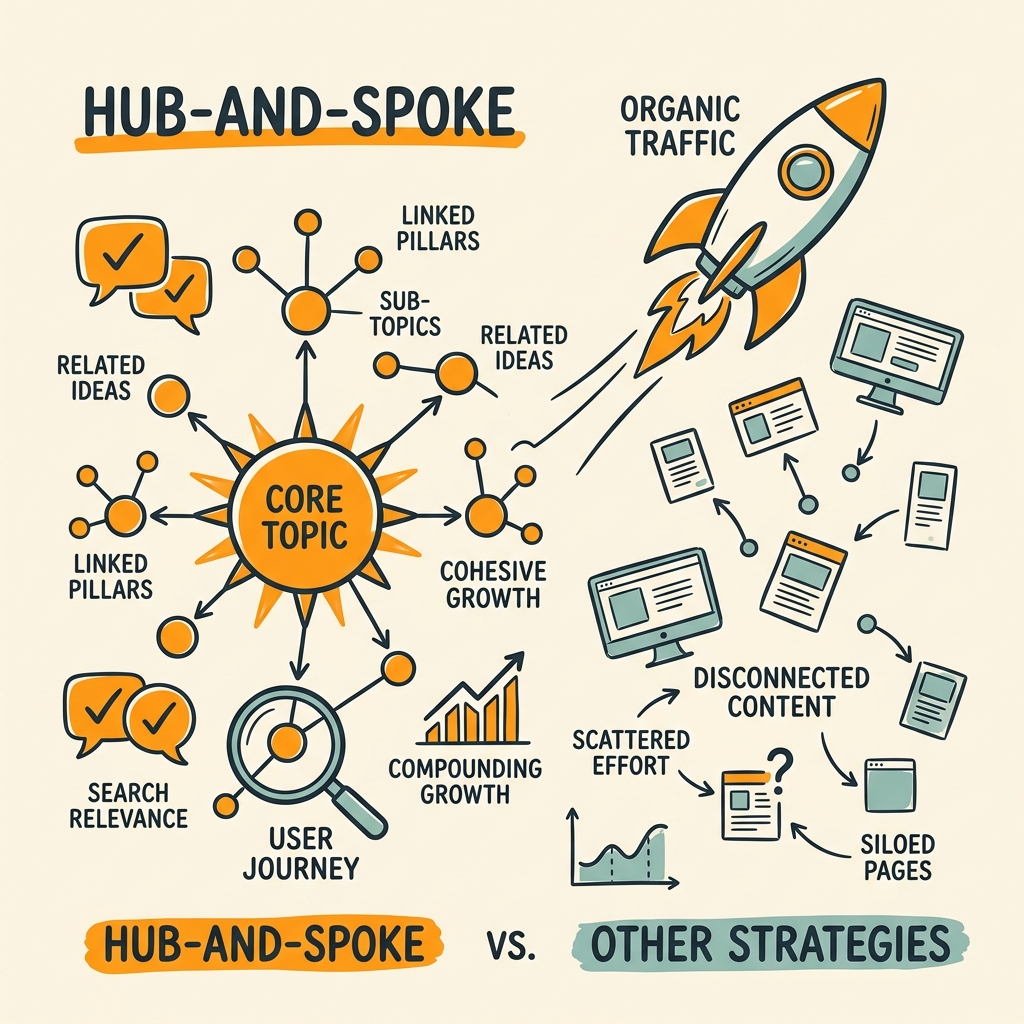
The hub-and-spoke model isn't the only content architecture. Understanding how it compares to alternatives helps you pick the right strategy for your business.
| Strategy | Hub-and-Spoke | Content Silos | Topic Clusters (AI-First) |
|---|---|---|---|
| Structure | One hub pillar with 8–15 interconnected spokes | Separate directories per topic, minimal cross-linking | Distributed topical content with entity-based relationships |
| Internal Linking | Heavy hub-and-spoke interlinking | Minimal interlinking, separate keyword buckets | Contextual interlinking based on semantic relevance |
| Best For | Dominating a single broad topic; building authority fast | Large sites with many unrelated topics | Complex topics requiring AI-powered entity mapping |
| Time to Implement | 8–12 weeks (1 hub + 8–15 spokes) | Varies by site size | 12–20+ weeks with topic modeling |
| Ranking Impact | Strong; proven 328% increase in page-one keywords | Moderate; slower to show authority signals | Very strong if done correctly; future-proof for AI search |
Hub-and-Spoke vs. Pillar-and-Cluster
These terms are often used interchangeably, but there's a subtle difference. The pillar-and-cluster model (popularized by HubSpot) uses one broad pillar page with cluster pages that link to it. The hub-and-spoke model is similar but emphasizes bidirectional interlinking—the hub links back to spokes, not just the reverse. Hub-and-spoke is more symmetrical and reinforces topical authority more powerfully.
Hub-and-Spoke vs. Content Silos
Content silos organize content by topic in separate directories with minimal cross-linking. The idea is to prevent "topical dilution" by keeping related keywords separate. Hub-and-spoke does the opposite: it intentionally interlinks related keywords to create topical authority. Silos work if your site covers many unrelated topics (e.g., an e-commerce site selling shoes, electronics, and furniture). Hub-and-spoke works if you want to dominate a single category.
Measuring Success and Optimizing Your Cluster
Publishing a hub-and-spoke cluster is not a "set it and forget it" exercise. You need to measure performance and continuously optimize. Track these metrics to understand whether your cluster is working:
Key Performance Indicators for Hub-and-Spoke
- Hub Rankings: Track your target hub keyword's ranking weekly. A strong cluster should move your hub from #30 to page 1 within 8–12 weeks
- Spoke Rankings: Count how many spokes rank in the top 10 for their target keywords. More spokes ranking = stronger cluster signal
- Total Keywords Ranking Page 1: This is the biggest win metric. Measure your total count of page-one keywords before and after the cluster launch
- Organic Traffic: Measure month-over-month traffic growth to the hub and spokes combined
- Conversions by Cluster: Use UTM parameters or analytics segments to track leads and customers sourced from the hub-and-spoke cluster
- Crawl and Indexation: Use Google Search Console to verify all hub and spoke URLs are crawled and indexed
Optimization Tactics
If your cluster isn't performing as expected, apply these fixes:
- Strengthen internal links: If a spoke isn't ranking, check that it has at least 1 inbound link from the hub and 1 or more outbound links to related spokes. Add more internal links from high-performing spokes
- Refresh the hub: Update the hub page every 3 months with new statistics, recent examples, and fresh spokes. Search engines reward fresh content
- Build backlinks to the hub: Your hub is your flagship piece. Invest in link building (guest posting, PR, resource mentions) to increase the hub's domain authority. This authority flows to spokes via internal links
- Improve on-page SEO: Ensure each spoke has strong title tags, meta descriptions, and clear H2 hierarchy. Many clusters fail not because of structure, but because individual pages aren't optimized
- Add multimedia: In 2026, answer engines prioritize depth and multimedia. Add video, infographics, or embedded data visualizations to your hub and top-performing spokes
Scaling Hub-and-Spoke Clusters With Content Automation
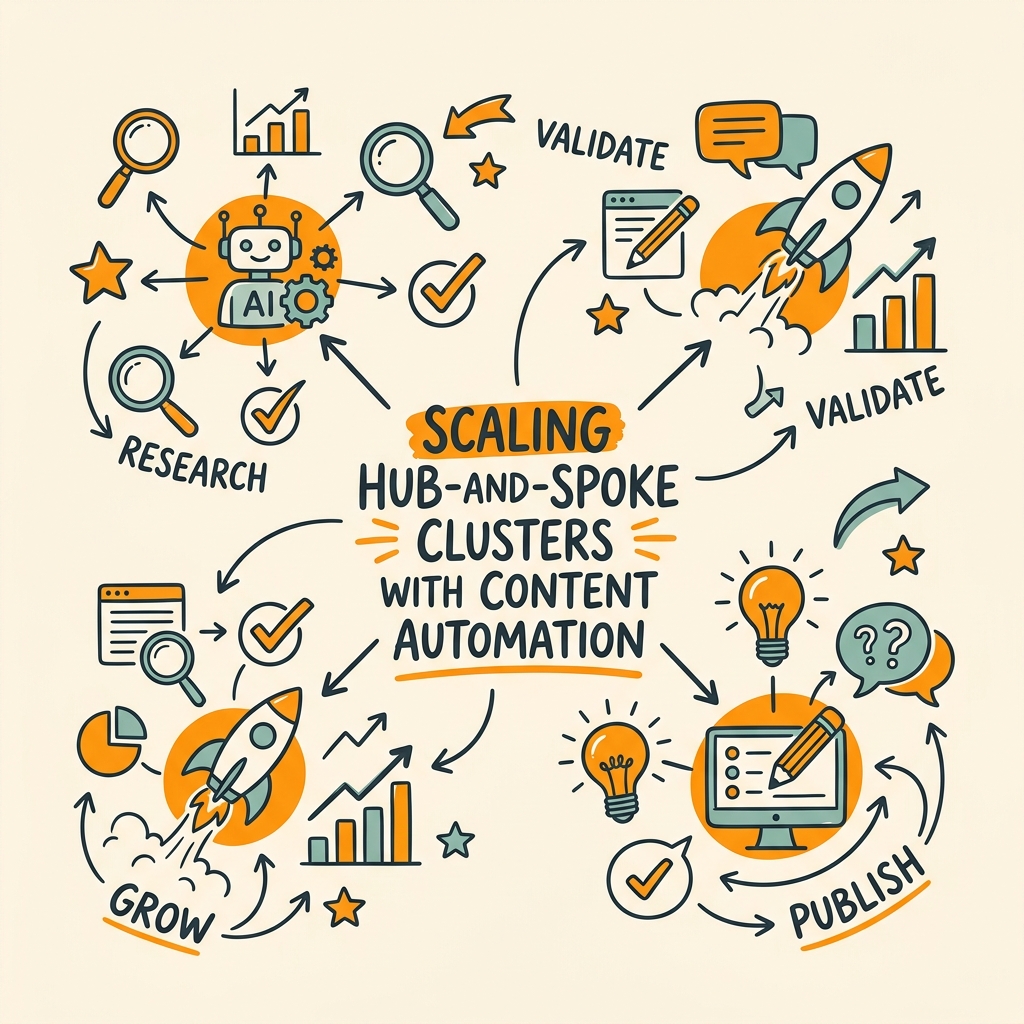
Building a single 8–15 piece hub-and-spoke cluster takes 8–12 weeks. Building 3–5 clusters across your site takes 6+ months. For busy founders and growing teams, manual content creation becomes a bottleneck.
This is where content automation tools become essential. AI-powered content generation platforms can research, write, and internally link hub-and-spoke clusters at scale. Jottler, for example, automates the entire pipeline:
- Keyword research: AI agents identify hub keywords and map spoke topics automatically
- Content generation: The platform researches and writes SEO-optimized hub and spoke articles with 14+ deep research sources per article
- Smart interlinking: AI agents automatically generate contextual internal links between hub and spokes, maintaining topical relevance
- Fact-checking: Each article is fact-checked against sources before publishing to ensure accuracy
- CMS publishing: Articles are automatically published to your blog or knowledge base
With a tool like a platform focused on topical authority and SEO, a solo founder can publish 3,000+ words of cluster content daily, compounding topical authority and organic traffic without daily manual work. The platform handles the research and writing; you decide the topics and strategy.
Common Mistakes When Building Hub-and-Spoke Clusters
Most teams understand the hub-and-spoke concept but fail in execution. Here are the most common mistakes:
Mistake 1: Too Few or Too Many Spokes
Clusters with fewer than 5 spokes don't build enough topical authority. Clusters with more than 20 spokes dilute your message and make maintenance harder. Aim for 8–15 spokes per hub.
Mistake 2: Weak Internal Linking
Publishing spokes that don't link to the hub defeats the purpose. Every spoke must have at least 1 inbound link from the hub and 1 outbound link to the hub. Lazy interlinking kills the topical authority signal.
Mistake 3: Spokes That Don't Support the Hub Keyword
If your spokes don't align with the hub's topic, they won't improve the hub's rankings. Example: if your hub targets "SEO strategy," a spoke about "email marketing" doesn't help. Every spoke must be contextually related to the hub's core topic.
Mistake 4: Static Hubs
In 2026, hubs are "living documents"—they're updated monthly with new data, examples, and links to newly published spokes. If your hub is static and never refreshed, it will eventually drop in rankings as fresh competitor content outranks it.
Mistake 5: No Backlink Strategy
Internal links are powerful, but external backlinks are more powerful. If you're not building backlinks to your hub, you're leaving rankings on the table. Invest in link building (guest posting, PR, partnerships) to amplify your hub's authority.
Conclusion
The hub-and-spoke content model remains one of the most effective SEO strategies for building topical authority and scaling keyword rankings. The framework is proven: a 328% increase in page-one keywords and 741% increase in page-two keywords are achievable when implemented correctly. The strategy works because it aligns with how search engines understand topical expertise—multiple interconnected pieces of content all signaling that your site owns a topic.
In 2026, the model is evolving beyond keyword silos into multimedia authority ecosystems. The strongest clusters now include video, podcasts, infographics, and structured data. But the core principle remains: one authoritative hub surrounded by supporting spokes, all tightly interlinked.
For busy founders and growing teams, manual hub-and-spoke production is not scalable. Tools that automate research, writing, and smart interlinking let you build multiple clusters simultaneously, compounding your organic traffic without the resource drain. Start your SEO agent today and begin building hub-and-spoke clusters that rank and convert at scale.
FAQs
What's the difference between a hub-and-spoke model and a pillar-and-cluster model?
The terms are similar but have a subtle distinction. Both models use one broad pillar/hub page surrounded by supporting content. The key difference is interlinking philosophy. The hub-and-spoke model emphasizes bidirectional linking—the hub links to spokes AND spokes link back to the hub. This creates a reinforcing loop that strengthens topical authority. The pillar-and-cluster model sometimes uses one-directional linking (cluster to pillar only). In practice, the strongest implementations use bidirectional linking, making them functionally identical. The best approach is to treat your pillar as a hub and ensure every supporting page links back to it.
How many spoke articles should a hub-and-spoke cluster have?
The ideal range is 8–15 spoke articles per hub. Fewer than 8 spokes don't provide enough topical depth to signal authority to search engines. More than 15 spokes can dilute your message and become difficult to maintain. The exact number depends on your topic's complexity. A simple topic like "email marketing basics" might need 8 spokes. A complex topic like "enterprise SEO strategy" might benefit from 15–20. Start with 8 spokes, measure performance, and add more spokes as needed based on ranking results. If your hub ranks well with 8 spokes, you can expand. If it's still not ranking, adding more spokes won't fix weak on-page optimization or low domain authority.
How long does it take to see ranking results from a hub-and-spoke cluster?
Most teams see meaningful ranking improvements within 8–12 weeks of publishing a complete hub-and-spoke cluster. The hub may see movement within 4–6 weeks, but the spokes often take longer to rank because they target lower-volume, more specific keywords. Expect the full cluster to show peak performance after 12–16 weeks. Ranking speed depends on your domain age, existing authority, and competition level. New domains in competitive niches may take 4–6 months. Established sites in less competitive niches may see results within 6–8 weeks. Patience is essential—don't judge a cluster's success until at least 12 weeks have passed.