The PESO Model: Content Strategy Framework for B2B
Most B2B marketing teams treat paid, earned, shared, and owned media as separate silos. Marketing owns paid ads. PR handles earned coverage. Social manages social posts. Content creates blogs. Each team optimizes their channel independently, missing the compounding effect of integration. According to 2026 research, 91% of B2B marketers use content marketing, yet only a fraction coordinate these channels into a unified system. The result? Fragmented visibility, duplicated efforts, and missed opportunities to build authority across search engines and AI platforms.
The PESO Model unifies these four media types into a single operating system where each channel reinforces the others. This isn't about doing four jobs at once. It's about sequencing them strategically so owned content becomes the foundation, earned media validates credibility, paid channels accelerate reach, and shared platforms amplify the signal.
Key Takeaways
- 91% of B2B marketers use content marketing, but most fail to integrate paid, earned, shared, and owned media into a unified strategy (2026, SeoProfy)
- Integrated PESO strategies deliver compounding ROI — no single channel matches the impact of coordinated effort
- The 2026 PESO model shifts from channel management to outcome governance through AI-powered content sequences
- Owned Media Foundation: Create authoritative, long-form content that establishes your brand as a trusted industry resource.
- Earned Media Amplification: Attract press coverage, analyst mentions, and influencer shares that build third-party credibility.
- Paid Media Acceleration: Boost high-performing owned content and retarget engaged audiences to compress sales cycles.
- Shared Media Distribution: Leverage social amplification and employee advocacy to extend reach without additional production cost.
- Integrated Measurement: Track combined ROI across all channels rather than optimizing each channel in isolation.
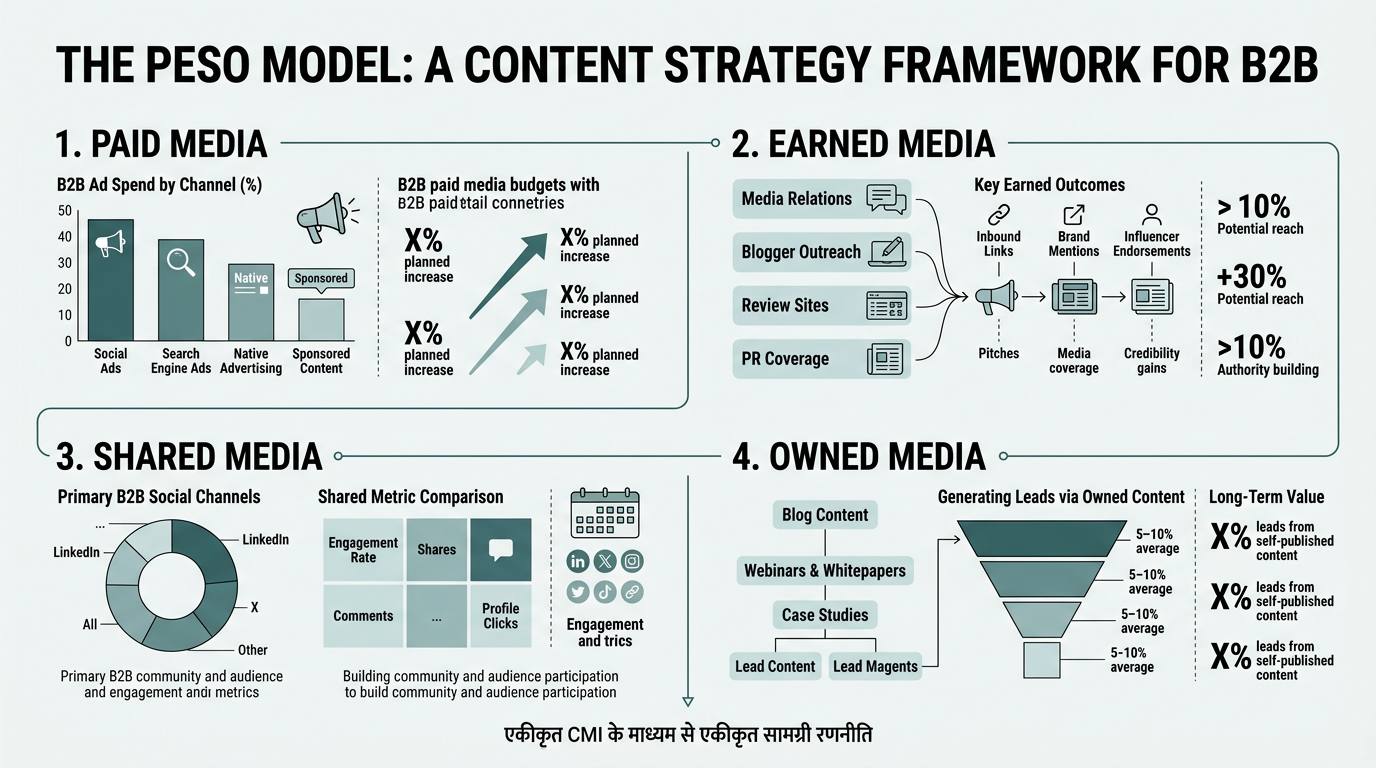
What Is the PESO Model and Why B2B Marketers Need It Now
The PESO Model (Paid, Earned, Shared, Owned) is a unified framework for managing multiple media channels as a coordinated system, not separate departments. It originated from Gini Dietrich's work at Spin Sucks and has evolved significantly by 2026. Modern PESO is no longer about channel-by-channel optimization—it's about orchestrating signals that reinforce one another to build authority and visibility across search, social, and AI-driven discovery platforms.
In traditional marketing, teams operate in silos. The content team publishes a blog post. The paid team might run unrelated ad campaigns. PR pitches journalists independently. Social posts whatever's trending that week. No one talks to each other. This fragmentation wastes budget and dilutes your brand signal.
"Modern PESO is no longer about channel-by-channel optimization—it's about orchestrating signals that reinforce one another to build authority and visibility across search, social, and AI-driven discovery platforms." — The Evolution of PESO in 2026
The PESO framework inverts this. You start with a single piece of owned content—a research-backed blog post, industry guide, or case study. That content then flows through paid (LinkedIn ads), earned (industry coverage), and shared (social amplification) channels. Each layer reinforces the others. According to Spin Sucks' 2026 guidance, this integrated approach functions as a Marketing Operations system that builds authority faster than isolated efforts.
Understanding Each Pillar: Owned, Earned, Paid, and Shared Media
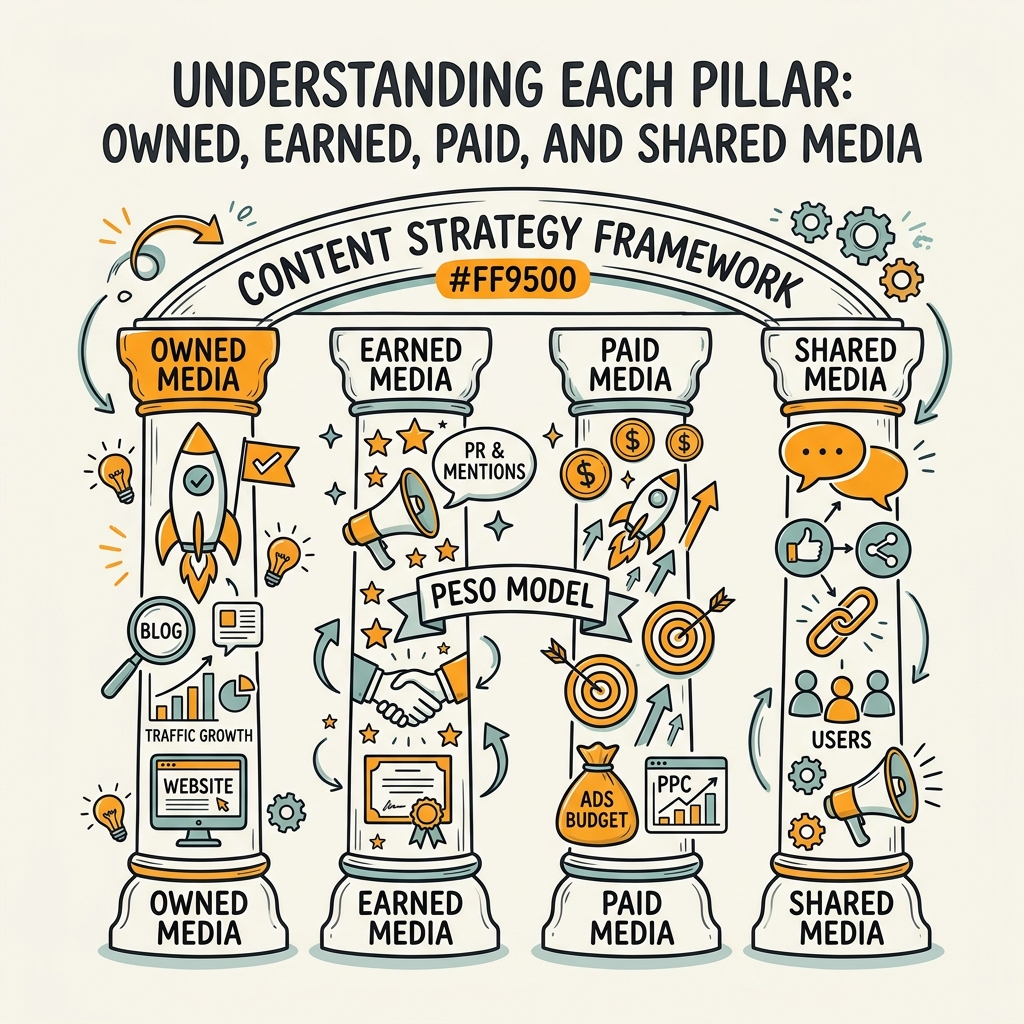
Each pillar of the PESO model serves a distinct purpose in the buyer's journey. Owned media builds your foundation. Earned media validates your authority. Paid media accelerates discovery. Shared media extends reach. Understanding how they interact is key to deployment.
Owned Media: Your Authoritative Content Foundation
Owned media is content you create and control directly on your own digital properties—your blog, website, email newsletter, podcast, or YouTube channel. This is your starting point for PESO. Without strong owned media, there's nothing to amplify.
For B2B companies, owned media focuses on long-form, educational content that addresses buyer questions throughout the sales funnel. Examples include in-depth blog posts covering industry trends, technical guides, downloadable resources, email nurture campaigns, and webinar recordings. 74% of B2B marketers who focused on content marketing achieved or exceeded their lead generation goals (2025-2026, SeoProfy).
"A well-researched blog post or guide compounds in value over time. Search engines reward fresh, comprehensive content. Your audience returns to reference it." — Content Durability in B2B Marketing
The advantage of owned media is durability. A well-researched blog post or guide compounds in value over time. Search engines reward fresh, comprehensive content. Your audience returns to reference it. You build subscriber lists through email opt-ins. Unlike paid ads (which stop working when you stop paying), owned media keeps generating traffic for months or years after publication. Strategic use of internal linking—connecting related owned content—can increase organic traffic by 37.1% for B2B SaaS companies.
Earned Media: Third-Party Validation and Credibility
Earned media is coverage or mentions of your brand that you don't directly control or pay for—press features, analyst reports, influencer mentions, guest post opportunities, and backlinks from authoritative sites. This is credibility that money can't buy directly.
In the B2B space, earned media matters tremendously because buyers trust third-party validation more than your own marketing claims. An industry publication mentioning your company in a feature article. An analyst naming you a leader. An influencer or peer endorsing your approach. These signals tell buyers that others in the industry recognize your expertise.
Earning this coverage requires PR effort, relationship building, and content worth talking about. When your owned content is genuinely insightful, journalists notice. When you contribute original research or contrarian thinking, analysts cite you. The cycle reinforces: strong owned content attracts earned media, which drives more traffic and credibility to your owned properties.
Paid Media: Acceleration and Precision Targeting
Paid media includes any channel where you pay for visibility—search ads (Google, Bing), social media advertising (LinkedIn, Facebook, Twitter/X), display networks, sponsored content, and native advertising. 84% of B2B marketers use paid channels in 2025, with social media ads leading at 73% adoption and search engine marketing (SEM/PPC) at 64%.
Paid media serves a distinct purpose in PESO: it accelerates reach and compresses time-to-visibility. Owned content compounds over months. Earned media depends on journalists' and influencers' schedules. But paid media works immediately. You can boost a high-performing blog post with LinkedIn ads within hours of publishing, reaching your target decision-makers directly.
"For B2B teams, paid media works best when it amplifies content already resonating with your audience. SEM/PPC delivered the best results for 61% of B2B marketers, outperforming social ads and digital display." — Content Marketing Institute, 2025
For B2B teams, paid media works best when it amplifies content already resonating with your audience. SEM/PPC delivered the best results for 61% of B2B marketers, outperforming social ads (49%) and digital display (2025, Content Marketing Institute). This suggests targeting intent-rich search queries (owned content related to their problems) outperforms broad brand awareness campaigns in B2B.
Shared Media: Employee and Influencer Amplification
Shared media is your content being actively amplified by others on social platforms, employee networks, industry forums, and influencer channels. It's not content you create; it's content your audience shares or advocates for publicly.
This pillar has become increasingly important as algorithmic feeds prioritize engagement and social signals. When employees share your content on LinkedIn, it reaches their networks with a trust halo attached. When industry influencers mention your work, their followers notice. Each share multiplies your reach without additional production cost.
Shared media also signals relevance to search engines and AI systems. Content that's widely discussed and referenced across the web gets indexed and cited more often. In 2026, AI systems like ChatGPT and Google's AI Overviews weight authority and discussion signals heavily. The PESO model ensures your owned content gets amplified through shared channels, sending coordinated authority signals to search and AI platforms.
How PESO Functions as an Integrated System in 2026
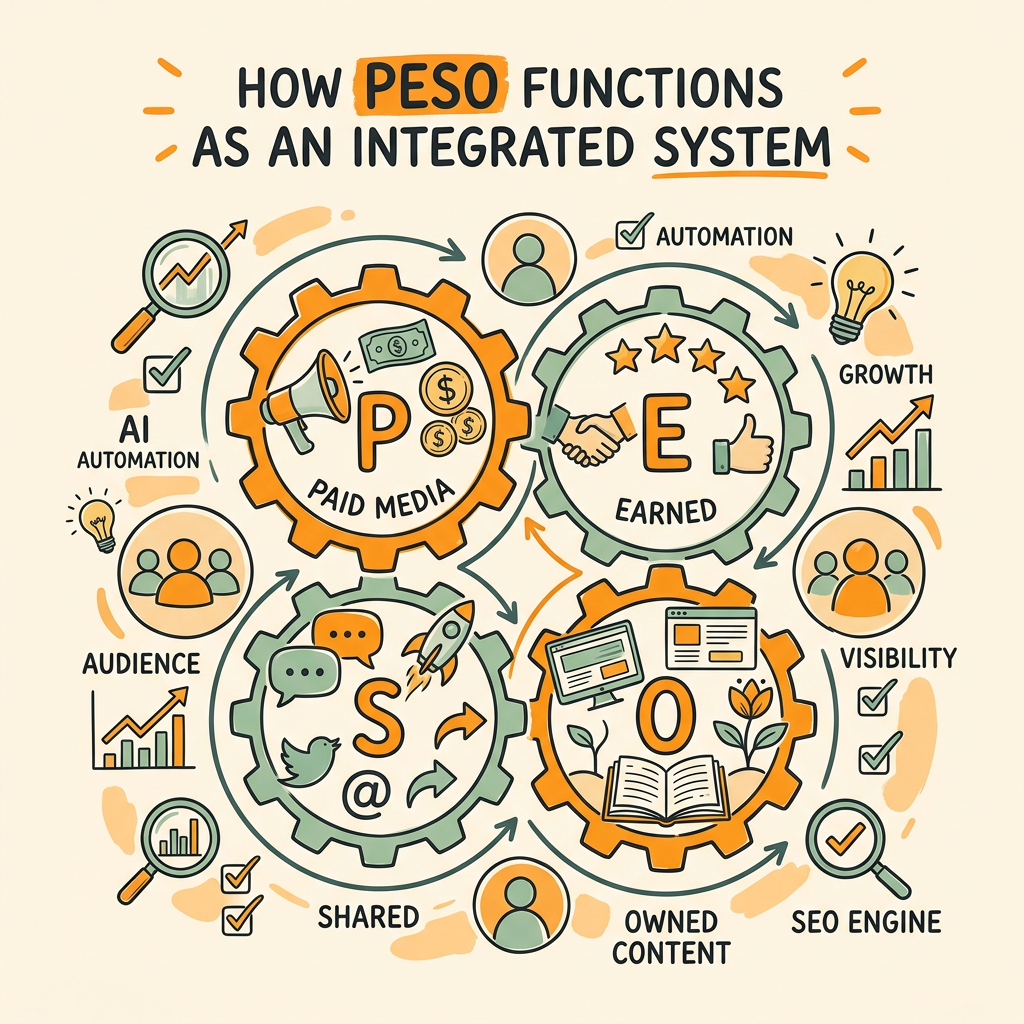
The 2026 evolution of PESO marks a fundamental shift: from managing four separate channels to operating a unified Marketing Operations (MOPs) system. Visibility is no longer created on a channel-by-channel basis—it's built through coordinated signals that reinforce one another (PR.co, January 2026).
The Content Sequencing Strategy
The core of integrated PESO is intentional sequencing. You don't randomly publish content and hope people find it. Instead, you plan the distribution pathway before you create.
Start with a strategic owned asset—a comprehensive research report, industry benchmark, or thought leadership piece addressing a major buyer pain point. This is your foundation. Then:
- Owned: Publish the full asset on your website, optimize for SEO, create supporting content pieces (summary posts, data visualizations, case studies).
- Earned: Pitch the research to relevant journalists, analysts, and industry publications. Offer exclusive angles or data points to drive coverage.
- Paid: Use LinkedIn or search ads to promote top-performing owned content to your target audience while earned media coverage is still fresh.
- Shared: Encourage employees, partners, and customer advocates to share the content on social. Create shareable clips and soundbites.
The magic happens when these layers overlap. An earned mention in a reputable publication sends authority signals. That coverage itself becomes shareable content. Paid ads reach people who've already seen social discussions about the topic. Each exposure reinforces the message and builds trust.
AI Governance and Signal Reinforcement
As AI systems (ChatGPT, Google's AI Overviews, Claude) increasingly influence how B2B buyers discover information, the PESO model provides essential governance. The challenge in 2026 is no longer whether to use AI, but whether your organization has a system strong enough to govern it.
Unstructured content creation leads to chaotic signal-sending. You publish conflicting messages. You mention your core differentiator in one blog post, contradict it in another. You spread resources across so many channels that none get sufficient frequency or depth to build authority.
The 2026 PESO model provides structure:
- Intentional sequencing: Content flows through channels in planned order, not randomly.
- Integration before amplification: You establish integrated messaging across owned assets before pushing paid ads.
- Insight before optimization: You measure cross-channel interactions (e.g., user discovered via earned, engaged via shared, converted via owned) before optimizing individual channels.
- Outcome governance: You measure combined ROI across all media types, not channel-specific metrics in isolation.
This structure allows you to govern AI properly. Consistent, reinforced messaging across PESO channels builds stronger E-E-A-T signals (Expertise, Experience, Authoritativeness, Trustworthiness) that AI systems recognize and reward.
Building Your PESO Strategy: A Practical Framework for B2B Teams
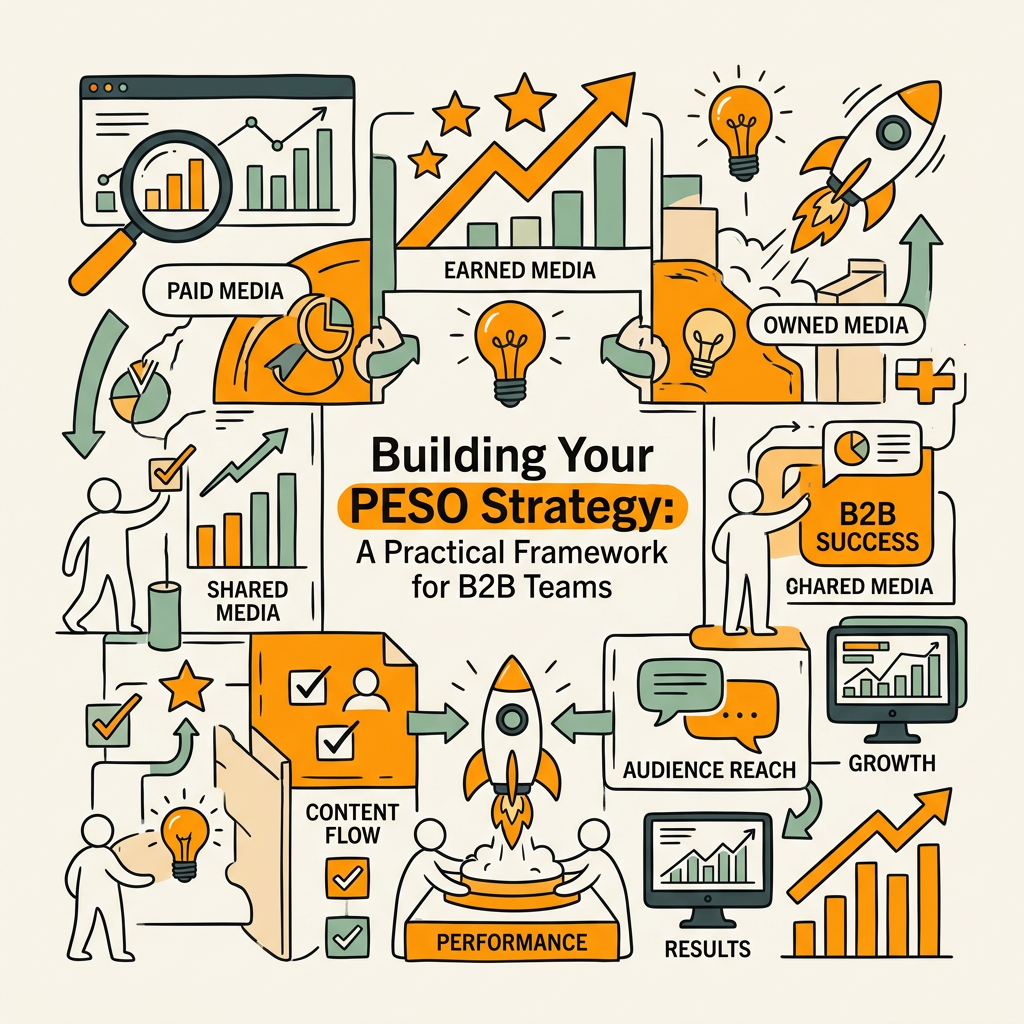
Implementing PESO requires coordination across historically separate teams. Here's how to structure it for B2B success.
Step 1: Define Your Owned Content Pillars and Editorial Calendar
Start by identifying 4-6 core content themes that align with your business model and buyer's journey. These become your owned media foundation. For a B2B SaaS company, pillars might be: industry trends, product capabilities, customer success stories, technical deep-dives, competitive analysis, and thought leadership.
Create an editorial calendar that sequences content strategically. Distribution is just as important as creation. Even the best content fails if it isn't strategically distributed across owned, earned, or paid channels (The Escape Agency, 2025). Don't just decide to publish on random topics; plan which content goes live when and how it will flow through other channels. A strategic AI content strategy coordinates this sequencing across all distribution channels, ensuring every piece feeds the PESO system.
Owned content should be evergreen where possible—addressing fundamental buyer questions rather than fleeting trends. This maximizes long-term ROI. Include internal linking opportunities so each new piece connects to related owned assets, building topical authority and multiplying organic traffic.
Step 2: Identify Earned Media Opportunities and Relationships
Map out journalists, analysts, industry publications, and influencers relevant to your space. Build relationships before you need coverage. When you publish significant owned content—research, original data, contrarian insights—you have something journalists want to cover.
Earned media works best with newsworthy angles. A blog post probably won't get covered. But original research findings, industry benchmarks, or unexpected data insights will. Frame owned content in ways that are pitch-worthy: exclusive data, trend analysis, expert commentary. When you pitch earned media, you're offering them a story worth covering, not asking them to promote your company.
Step 3: Allocate Paid Budget to Amplify High-Performing Owned Content
Don't think of paid media as separate from owned. Instead, use paid to accelerate and amplify content already resonating. Track which owned pieces get the most organic engagement, and boost those with paid ads. This is more efficient than creating ads for mediocre content.
For B2B, focus paid budget on intent-rich channels. LinkedIn ads and search engine marketing delivered the best results for 61% of B2B marketers, while social media ads were effective for 49%—a 12-point gap favoring intent-based targeting (2025, Content Marketing Institute). SaaS content marketing best practices emphasize this integration of owned content with paid acceleration.
Use paid campaigns strategically at different funnel stages:
- Awareness: Promote top-of-funnel owned content (trend reports, industry insights) to drive webinar signups or newsletter subscriptions.
- Consideration: Target engaged audiences with comparison content, case studies, or technical guides.
- Decision: Retarget warm leads with product-focused content or sales collateral.
The key is integration: owned content drives qualified traffic that can be retargeted. Paid media amplifies high-intent messages. Together, they compress the sales cycle.
Step 4: Build Shared Media Momentum Through Employee and Influencer Advocacy
Create shareable assets from your owned content. This might be a 30-second video clip from a webinar, a data visualization highlighting key findings, a pull-quote from a case study, or a LinkedIn article extracting a section of a long-form post.
Make it easy for employees to share. Provide pre-written posts, graphics, and hashtags. Most employees want to advocate for their company; they just need clear direction. When employees share your content on LinkedIn, it reaches their networks with implicit trust attached—far more effective than posting from the corporate account.
Identify industry influencers in your space and build relationships with them. Offer exclusive early access to significant owned content. Invite them to participate in research or webinars. When influencers share your owned content, they bring credibility and reach that paid ads alone can't achieve.
Measuring PESO ROI: Beyond Channel-Specific Metrics
Traditional marketing measurement isolates each channel: How many leads did paid ads generate? How much traffic did the blog drive? What was the ROI on earned media? This siloed approach misses the PESO model's primary benefit—compounding ROI from integrated channels.
Integrated PESO Measurement Framework
Integrated PESO strategies measure aggregated ROI across owned, earned, paid, and shared channels rather than optimizing each in isolation. This requires tracking multi-touch attribution and cross-channel interactions.
Instead of asking "Did paid ads generate this lead?", ask: "What touchpoints preceded this conversion?" The answer might be: discovered content via earned media mention → engaged via social share → converted after retargeted paid ad → closed after owned-media nurture campaign. This buyer's journey involved all four PESO pillars.
| PESO Channel | Primary Measurement Metric | Integration Indicator |
|---|---|---|
| Owned Media | Organic traffic, time on page, conversions | Feeds paid, earned, shared amplification |
| Earned Media | Backlinks, mentions, referral traffic | Validates owned content authority |
| Paid Media | Click-through rate, cost per lead, ROAS | Amplifies high-performing owned content |
| Shared Media | Social engagement, shares, reach | Extends owned content distribution |
| Integrated PESO | Revenue influenced across touchpoints | Multi-channel attribution showing compounding effect |
Key metrics for integrated PESO measurement:
- Website traffic by source: Track organic (owned/earned), referral (shared/earned), and paid equally. Watch for patterns where one channel amplifies another.
- Lead quality by journey: Score leads not just by source but by sequence. A lead who discovered via earned, engaged via shared, and converted via owned might be higher quality than a lead who clicked one paid ad.
- Content performance aggregate: Measure a single piece of owned content across all distribution channels. How many views via organic search? How many impressions via paid ads? How many shares on social? How many earned media placements?
- Revenue influence: Use CRM integration to track which content and channels appear in deals that closed. This reveals which PESO investments actually drive revenue.
- Authority signals: Monitor mentions, backlinks, social engagement, and search ranking improvements as indicators that PESO integration is building authority.
Tools and Systems for PESO Orchestration
Implementing PESO requires coordination, which means tooling. Many B2B teams struggle with PESO because content creation, distribution, and measurement happen in separate platforms with no integration. Content automation platforms that handle research, writing, internal linking, and publishing can consolidate the owned media foundation, making it easier to feed earned, paid, and shared channels from a single source. SEO automation tools can coordinate content publishing and internal linking to strengthen your owned media base, from which all other PESO channels draw.
For a complete PESO stack, consider:
- Content management: CMS or content hub to organize and distribute owned assets.
- Editorial planning: Calendar tool to sequence PESO distribution before creation (Asana, Monday, Linear).
- Paid platform integration: Meta, LinkedIn, Google Ads connected to your CMS so content flows seamlessly.
- Analytics and attribution: Multi-touch attribution platform (HubSpot, Marketo, 6sense) that tracks influence across channels.
- Social amplification: Tools to coordinate employee and influencer sharing (LinkedIn Content Calendar, Lately, Hootsuite).
Common PESO Implementation Mistakes and How to Avoid Them
Most B2B teams attempt PESO and fail because they underestimate the coordination required. Here are the pitfalls to avoid.
Mistake 1: Starting with Paid Before Building Owned
Some marketers skip owned media foundation and jump straight to paid ads. This fails because:
- Paid ads direct traffic to weak landing pages or generic product pages, wasting budget.
- No owned content exists to nurture leads after initial conversion.
- You have no content to amplify with earned or shared media.
The correct sequence is always: owned first, then earned, then paid, then shared. Build authority before amplifying. An autonomous SEO agent automates this owned media foundation, ensuring you have a strong library of cornerstone content before investing in paid acceleration.
Mistake 2: Treating PESO as Four Separate Projects
Assigning owned media to the content team, earned media to PR, paid media to the performance marketer, and shared media to social, without integration, recreates silos. Each team optimizes locally but misses the compounding effect.
Instead, assign a single person or small team as PESO orchestrator. Their job is coordinating across functions, ensuring content sequences properly through all four channels, and measuring integrated ROI.
Mistake 3: Over-Investing in Paid Without Measuring Owned-Generated Leads
B2B teams often increase paid budgets without measuring how owned content feeds the funnel independently. You spend $10K/month on LinkedIn ads but never quantify how many leads your organic blog traffic generated. Strong owned media compounds in value—blog posts from a year ago still drive leads today—yet are often invisible in paid-focused budget allocation.
Track owned media ROI separately so you can allocate intelligently. Many teams find that 50% of their conversions come from owned content with zero paid spend—yet owned media gets 20% of the budget.
Conclusion
The PESO Model is no longer a nice-to-have framework for B2B marketers. It's essential infrastructure for building authority and visibility in an AI-driven discovery ecosystem. With 91% of B2B marketers using content marketing but most failing to integrate paid, earned, shared, and owned channels, the teams that implement unified PESO strategies will outpace competitors who manage channels in silos.
The math is compelling: integrated PESO delivers compounding ROI. One piece of owned content, when properly sequenced through earned media pitches, paid amplification, and social sharing, generates orders of magnitude more impact than the same content published once and forgotten. Authority builds across multiple signal types simultaneously—search engines reward you, AI systems cite you, and journalists cover you.
Start by auditing your owned media foundation. Do you have 20-30 high-quality, linked, SEO-optimized pieces addressing core buyer questions? If not, that's your first priority. Once owned content is strong, layer in earned media relationships, paid acceleration, and shared amplification. Measure integrated ROI. Iterate. Within 6-12 months of coordinated PESO execution, most B2B companies see significant improvements in organic traffic, lead quality, and revenue influence.
Ready to compound your content impact? Start your SEO agent and watch your owned media foundation build at scale.
FAQs
What is the PESO model and how does it differ from traditional marketing channels?
The PESO model integrates four media types—Paid (ads you pay for), Earned (third-party coverage), Shared (social amplification), and Owned (your content)—into a single coordinated system. Traditional marketing treats these as separate channels managed by different teams with different goals. PESO differs because it's deliberately sequenced: owned content flows through earned pitches, amplified with paid ads, and shared across social. The result is compounding ROI where each channel reinforces the others rather than competing for the same budget. A blog post (owned) gets pitched to journalists (earned), promoted with ads (paid), and shared by employees (shared)—all at planned intervals, not randomly.
How much should B2B teams budget for PESO across all four channels?
Budget allocation depends on your starting point. If owned media is weak, allocate 50-60% of budget to building it (content production, SEO tools, writers). Once owned media is strong (20-30 cornerstone pieces), shift allocation: 30-40% owned (maintaining and updating), 20-30% paid (amplifying high-performers), 20% earned (PR, relationships), and 10-20% shared (employee advocacy, social). These percentages flexibly adjust based on what drives ROI in your market. The key insight: don't treat budget allocation as static. If your paid ads are driving qualified leads, increase paid. If earned media is struggling, invest in PR relationships. Measure integrated ROI and adjust quarterly.
How long does it take to see results from a PESO content strategy?
Owned media typically takes 3-6 months to generate meaningful organic traffic as search engines crawl and rank new content. Paid media works within days—you can launch a campaign and see leads immediately. Earned media varies (days to months depending on journalist interest). Shared media is immediate if you have an engaged employee base. The integrated effect compounds over 6-12 months as your owned content library grows, earned coverage accumulates, and topical authority builds. Most B2B companies implementing PESO see 30-50% increases in qualified leads within 6 months of consistent execution.