The Pillar-Cluster Content Model Explained
Keywords alone no longer drive SEO success. Modern search engines—including AI systems that power generative answers—reward websites that organize content around broad topical hubs with supporting detail pages. This organizational approach is called the pillar-cluster model, and it's become essential for scaling organic traffic. Research shows sites using pillar-cluster strategies see 40% more organic traffic than those publishing isolated blog posts, while clustered content receives 3.2× more citations in AI search results. If your content strategy is currently scattered across unrelated posts with minimal internal linking, you're leaving significant ranking potential on the table. Here's how to build a pillar-cluster system that compounds your SEO growth over time.
Key Takeaways
- Pillar-cluster models drive 40% more organic traffic and 3.2× more AI citations than isolated content (2025 research)
- Structure consists of one comprehensive pillar page (3,000–5,000 words) supporting 8–15 cluster articles (1,500–2,500 words each)
- Bidirectional internal linking between pillar and clusters signals topical authority to search engines and improves discoverability
- What is the pillar-cluster model: A hub-and-spoke content architecture where one comprehensive pillar page covers a broad topic and multiple cluster pages address specific subtopics, all linked together.
- How to choose your pillar topics: Select broad, high-value topics aligned with business goals that have proven search demand and competitive opportunity.
- Building the cluster structure: Map 8–15 subtopic keywords that align with different user intents, then write focused content answering each one.
- Internal linking strategy: Link every cluster page to the pillar and the pillar to each cluster, using descriptive anchor text to reinforce topical relevance.
- Avoiding content cannibalization: Audit overlapping content, consolidate weak pages, and redirect lower-ranking URLs to your strongest resource.
- Measuring pillar-cluster performance: Track organic traffic, click-through rate, scroll depth, and conversions across the entire content ecosystem, not individual pages.
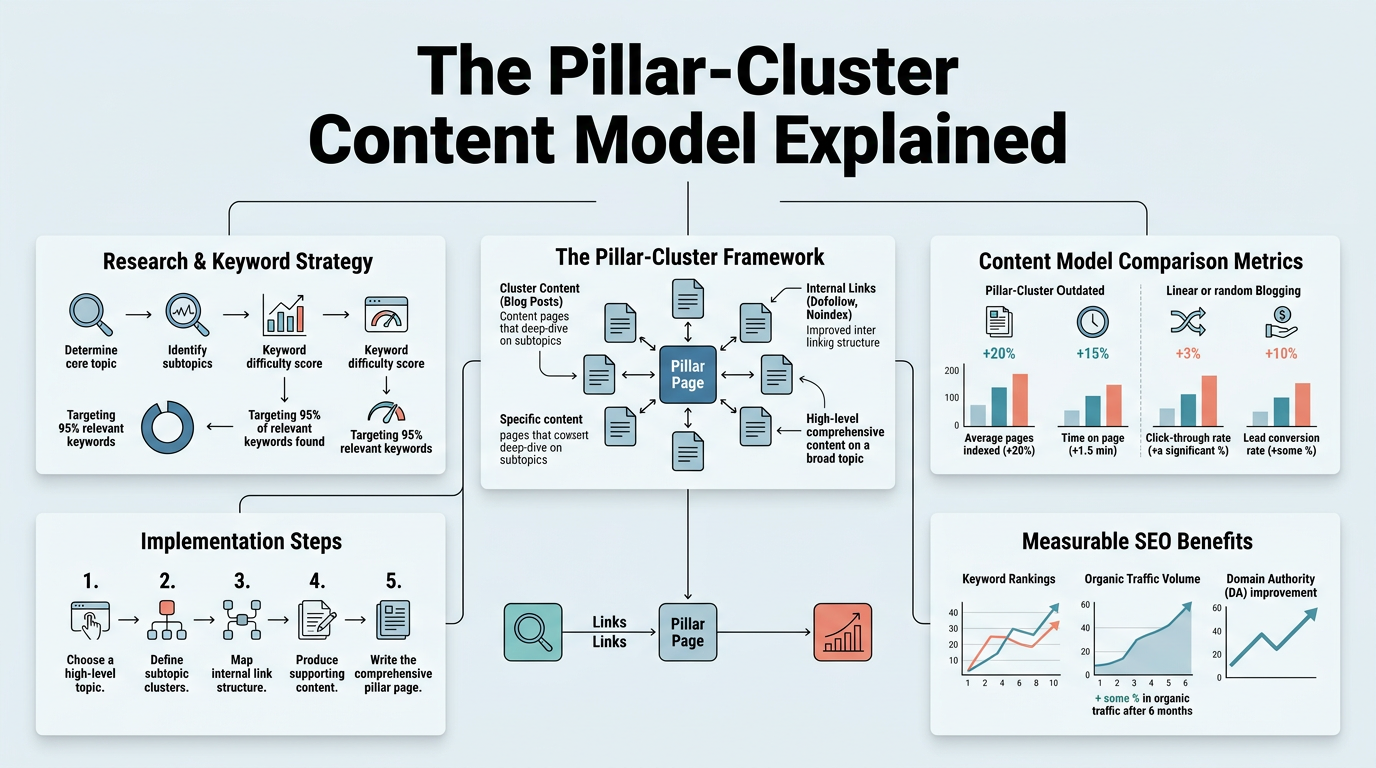
What Is the Pillar-Cluster Model and Why It Matters for 2026 SEO
The pillar-cluster model is a content organization strategy that groups related content around a central, comprehensive resource called a pillar page. Supporting articles called cluster pages address specific subtopics, with all pages linked together to form a cohesive topical ecosystem. Research from 2025 shows clustered content drives 30% more organic traffic than standalone posts, and the architecture improves both user experience and search engine crawlability. This model works because it directly addresses how modern search algorithms evaluate sites: they're looking for topical depth and authority, not just keyword matches. When a search engine crawls your pillar page and follows links to 10–15 related cluster pages, it immediately understands you have comprehensive coverage of that topic. That clarity strengthens your rankings for the pillar keyword and all related subtopic queries.
"The shift toward pillar-cluster thinking reflects a broader trend in SEO. Google, Bing, and emerging AI search engines no longer reward thin, keyword-stuffed content scattered across a domain. Instead, they reward sites that demonstrate genuine expertise through organized, interconnected content."
The shift toward pillar-cluster thinking reflects a broader trend in SEO. Google, Bing, and emerging AI search engines no longer reward thin, keyword-stuffed content scattered across a domain. Instead, they reward sites that demonstrate genuine expertise through organized, interconnected content. Siteimprove frames the model as signaling "topical authority to search engines" through the linking architecture itself. For growing teams, this model also scales better than traditional blogging. Instead of managing hundreds of isolated posts with no clear relationship, you manage content clusters—each with a clear purpose, internal structure, and performance targets.
How to Identify and Validate Your Pillar Topics

Choosing the right pillar topic is the foundation of your entire content strategy. A pillar topic must balance three criteria: it must align with your business, have proven search demand, and be broad enough to support 8–15 subtopic clusters. Starting with a vague or low-demand topic wastes months of effort. The validation process is non-negotiable.
Align Pillar Topics with Business Priorities
Your pillar should address a problem your target customers actually face and that your product or service solves. Avoid pillar topics that sound important but don't drive revenue. For example, if you're a sales automation platform, "sales workflows" is a stronger pillar than "sales team culture" because it directly maps to customer pain. Digital Applied recommends scoring pillar candidates on strategic alignment, search opportunity, competitive landscape, and content cost before committing resources. This prevents teams from building authority around topics that don't generate qualified leads or conversions. Start by listing the 3–5 core problems your business solves, then map each to a potential pillar topic.
Validate Search Demand and Keyword Volume
A pillar topic is only valuable if people actually search for it. Use SEO tools to confirm the pillar keyword and related subtopic keywords have meaningful monthly search volume. A pillar keyword should typically have 1,000+ monthly searches in your target market. The subtopic clusters should each have at least 100–500 monthly searches; too many low-volume subtopics mean your clusters won't drive real traffic. Beyond volume, analyze the intent of the searches. Is your audience looking for educational content, how-to guides, or product comparisons? Your pillar and clusters should match that intent. If you see high volume but the searches are transactional and you sell a B2B solution, the traffic might not convert even if rankings improve. Intent alignment prevents wasting content resources on topics that won't impact your business.
Evaluate Competitive Positioning
Check what competitors are ranking for your pillar topic and how strong their content is. If the top 10 results are all from established authorities with massive link profiles, the effort required to outrank them might be unrealistic. On the other hand, if you spot gaps—clusters that competitors haven't covered, subtopic keywords with lower competition—those represent quick wins. Aim for pillar topics where you can realistically rank in the top 5 within 6–12 months, assuming you execute the strategy well. This is where internal expertise helps: if you have genuine domain knowledge or proprietary data that competitors lack, that becomes your unfair advantage. A pillar topic is worth pursuing even in a competitive space if you have something unique to say.
Structuring Your Pillar Page for Maximum Authority
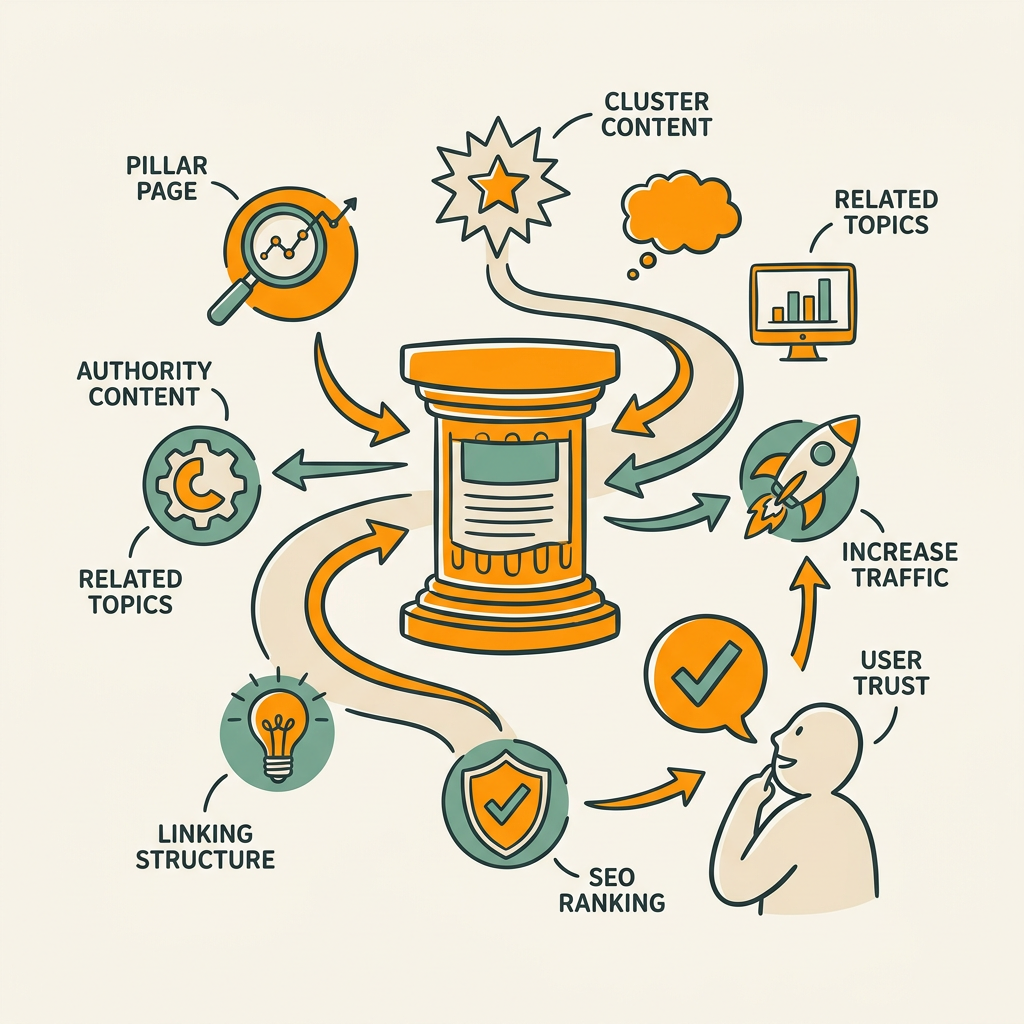
Once you've selected a pillar topic, the pillar page itself must be comprehensive, well-organized, and formatted to stand out in search results. The pillar page is not a traditional blog post. It's a hub that introduces the entire topic at a high level, then links readers (and search engines) to deeper subtopic content. The structure and format of your pillar page directly impact how search engines and users perceive your authority.
Pillar Page Length and Content Depth
A pillar page should be 3,000–5,000 words, significantly longer than a typical blog post. This length allows you to cover the topic comprehensively without going into excessive detail on any single subtopic. The pillar serves as a reference resource—someone should be able to read it and understand the entire landscape of your topic, including the major subtopics, key concepts, and where to go for deeper information. Avoid the trap of writing a thin pillar page that oversummarizes subtopics. Instead, cover each major concept at a middle level of depth: explain what it is, why it matters, and how it fits into the broader topic, then link to the cluster article for the full how-to or deep dive. This approach keeps readers on the pillar first, signaling its importance to search engines before they navigate to clusters.
Front-Load Keywords and Topical Markers
Your pillar page should include the primary pillar keyword in the H1, the first paragraph, and at least 2–3 times throughout the content. Use semantic keyword variations naturally: if your pillar is "content marketing," your pillar page should also naturally include phrases like "content strategy," "content creation," and "audience engagement." These variations help search engines understand the topical scope of your pillar. Include an introductory section (H2) that defines the main topic and explains why it matters. Follow with H2 sections covering the major subtopics, with each subtopic having a brief explanation and a link to its cluster article. This structure makes it immediately clear to readers and search engines what subtopics you've covered and where to find them.
Optimize Pillar Navigation and Internal Linking
Include a table of contents at the top of your pillar page with links to each subtopic section. Each section should end with a link to the related cluster article, using descriptive anchor text like "Read our full guide on [subtopic]" rather than generic "click here" links. Some sites add a dedicated "Explore Our Cluster Articles" section at the end of the pillar, with a brief description and link for each cluster. This makes it easy for readers to jump to related content and ensures every cluster gets traffic from the pillar, which boosts the cluster's crawlability and authority. The goal is bidirectional flow: users come to the pillar, then branch out to clusters, and search engines see each cluster as a trusted subtopic under a broader topical authority.
Building and Linking Your Cluster Articles for Intent-Specific Value
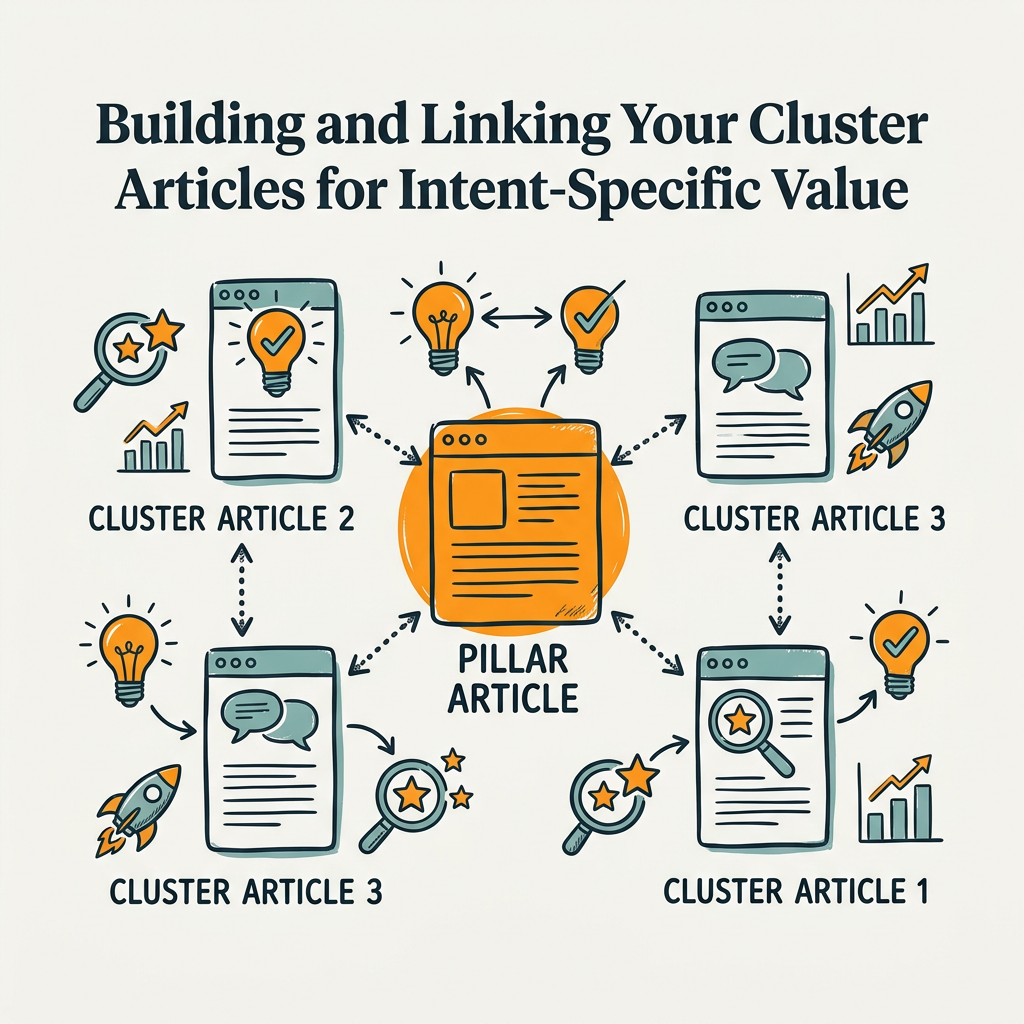
Cluster articles are where you demonstrate depth on individual subtopics. Each cluster should answer one specific question or address one narrower use case related to your pillar topic. Cluster pages are 1,500–2,500 words and laser-focused on a single intent: how-to, best practices, comparisons, definitions, or case studies. The power of clusters lies in their specificity. While the pillar page introduces "content marketing," a cluster might focus entirely on "how to create an editorial calendar for content marketing" or "content marketing ROI measurement." This intent focus makes each cluster highly relevant to users searching for that specific subtopic, improving click-through rates and time on page.
Map Subtopics to User Intents and Search Keywords
Before writing, list 8–15 subtopic keywords you want to target within your pillar topic. Use SEO tools to confirm each has real monthly search volume and relatively low keyword difficulty. Map each keyword to a user intent: is the searcher looking for a definition, a how-to guide, a comparison, or a strategic overview? This mapping ensures each cluster addresses a real information need, not just a keyword. A typical cluster portfolio might include:
- Definition/Educational clusters: "What is [subtopic]?" – answer learning-stage searches
- How-to clusters: "How to [do something in the topic]" – address task-based searches
- Comparison clusters: "Tool X vs Tool Y" – capture consideration-stage searches
- Best practice clusters: "[Subtopic] best practices" – provide actionable frameworks
- Tool-specific clusters: "How to use [tool] for [subtopic]" – drive solution-aware traffic
This diversity of intent ensures your cluster portfolio captures different stages of the customer journey and different search behaviors. One cluster can't answer every question, so multiple clusters covering different angles maximize your organic reach.
Write Clusters with Clear Focus and Strategic Linking
Each cluster article should start with a clear H1 targeting the subtopic keyword and an intro paragraph answering the core question. The body should be well-structured with clear H2 and H3 sections that break down the topic logically. Near the top or early in the first H2, include a link back to the pillar page with anchor text like "Learn more in our guide to [pillar topic]." This upward link signals to search engines that this cluster is part of a larger topical ecosystem. Include 2–3 contextual links to related cluster articles where it makes sense. If you're writing a cluster about "content distribution strategy," you might link to related clusters on "content marketing channels" or "audience engagement tactics." These cross-cluster links help search engines understand the semantic relationships between subtopics and increase the likelihood users explore multiple clusters. Avoid forcing links; they should feel natural to the reader. Search engines can tell when linking is artificial, and forced links hurt more than they help.
Use Jottler to Automate Cluster Research and Content Creation
"Building 8–15 cluster articles manually is time-consuming, especially when each article requires keyword research, competitive analysis, and multi-source fact-checking. This is where AI-powered content generation platforms excel at automating the research phase and writing comprehensive cluster articles with proper internal linking."
Building 8–15 cluster articles manually is time-consuming, especially when each article requires keyword research, competitive analysis, and multi-source fact-checking. This is where AI-powered content generation platforms like Jottler excel. Jottler automates the research phase by analyzing your pillar topic, identifying subtopic clusters, and writing comprehensive cluster articles with proper internal linking back to your pillar. The AI agents research from 14+ sources, fact-check every claim, and format content for both SEO and readability. For founders and marketing teams stretched thin, automating cluster content creation lets you build a full pillar-cluster ecosystem in weeks instead of months, with consistent quality across all articles. The tool also handles smart internal linking automatically, ensuring each cluster links to the pillar and related clusters with proper anchor text optimization.
Mastering Internal Linking Architecture for Pillar-Cluster Success
Internal linking is the connective tissue that makes the pillar-cluster model work. Without proper linking, your pillar and clusters are just a collection of unrelated pages. The right linking architecture signals topical authority to search engines and keeps users engaged within your content ecosystem. Research shows bidirectional linking—where every cluster links back to the pillar and the pillar links to each cluster—is essential for AI systems to recognize topical relationships. Improper linking can actually undermine your efforts.
Implement Bidirectional Linking Between Pillar and Clusters
Every cluster article must link to the pillar page, ideally near the beginning of the content. This upward link tells search engines "this article is part of a larger topic" and funnels authority back to your hub. The anchor text should be descriptive and include the pillar keyword: "See our complete guide to [pillar topic]" or "Learn more in our [pillar topic] resource." The pillar page must also link outward to every cluster, ideally in a dedicated section or within thematic groupings. When a user lands on your pillar, they should see links to all major subtopics. This downward linking structure mirrors how humans navigate: from broad to specific. Search engines follow the same pattern, crawling the pillar first, then traversing to clusters. The bidirectional flow strengthens the topical relevance signal and ensures even new or low-authority cluster articles get crawled and indexed quickly because the pillar (typically higher authority) links to them.
Use Contextual Anchor Text to Reinforce Meaning
Anchor text—the clickable text of a link—is a ranking factor. Search engines use it to understand what the linked page is about. Generic anchor text like "click here" or "read more" provides no semantic value. Descriptive anchor text like "sales automation best practices" or "how to build a content calendar" tells search engines exactly what the destination page covers. When linking from cluster to pillar, use the pillar keyword or a close variant. When linking from pillar to cluster, use the cluster keyword. When linking cluster to cluster, use the destination cluster's keyword. This consistency reinforces topical relationships and helps search engines understand your content taxonomy. Avoid keyword stuffing in anchor text (it looks spammy), but be specific enough that the anchor text accurately describes the destination.
Avoid Keyword Cannibalization Through Content Audits
A common mistake is writing overlapping content that targets the same keyword. If you have two articles competing for "content marketing strategy," search engines can't determine which one is the authoritative version, and both lose ranking potential. Conduct a content audit of all pages targeting your pillar topic and subtopic keywords. If you find overlapping content, consolidate the information into one strong article (usually the highest-performing version) and redirect weaker pages to it. HubSpot's internal guidance recommends combining overlapping posts on the highest-ranking URL and redirecting others, a consolidation principle that prevents cannibalization. This is maintenance work: as your pillar-cluster ecosystem grows, periodically audit for overlaps to keep your topical structure clean. Jottler's internal linking feature includes cannibalization detection, automatically flagging potential overlaps and recommending consolidations.
Measuring Performance and Optimizing Your Pillar-Cluster Ecosystem
Building a pillar-cluster system is not a one-time project. Ongoing measurement and optimization determine whether you see the promised traffic lift and sustained growth. Many teams measure individual pages in isolation, missing the bigger picture of how the entire ecosystem is performing. Measure the entire cluster as a unit to understand true impact.
Track Cluster Performance as a System, Not Individual Articles
Set up a dashboard tracking organic traffic, impressions, and click-through rate (CTR) for the entire pillar topic (pillar + all clusters combined). This aggregate view shows whether your topical authority is growing overall. You might see one cluster gaining rankings while another plateaus, but if the aggregate traffic is rising, the strategy is working. Monitor individual clusters too, but in the context of the whole. Some teams see the pillar page drive most of the traffic while clusters funnel users deeper into the content; others see clusters outperform the pillar. Both patterns are healthy as long as the ecosystem is driving traffic and engagement overall. Track scroll depth on the pillar page to see whether users are actually discovering cluster links. If users bounce after reading the intro, your cluster links might be buried or unclear. A/B test link placement, wording, and formatting to maximize cluster discoverability.
Monitor Conversion Impact and Revenue Attribution
Traffic is a vanity metric if it doesn't convert. Set up goal tracking to measure whether cluster visitors are taking desired actions: signing up, contacting sales, downloading a resource, or making a purchase. Compare conversion rates between pillar visitors and cluster visitors; often, cluster visitors are further along in the buying journey and convert at higher rates. Use UTM parameters to track which clusters drive the most qualified leads. If one cluster drives consistent conversions and others don't, investigate why. Is it the topic, the audience, the content quality, or the call-to-action? Use these insights to prioritize future cluster topics around themes that drive conversions, not just traffic. For SaaS teams using Jottler, the platform tracks cluster performance directly from your analytics, recommending which cluster topics to expand or retire based on conversion data.
Iterate Based on Search Intent and User Behavior
Your initial cluster map is an hypothesis. User behavior and search trends will tell you which clusters to strengthen, which to expand, and which to retire. If a cluster ranks for 20 keywords but only 5 drive traffic, consider whether the topic is truly valuable or if you should reframe it. If user searchers reveal new subtopic questions you haven't covered, create new clusters. The pillar-cluster model is flexible; it grows as your understanding of your audience deepens. Review quarterly: add new clusters for emerging topics, expand high-performing clusters with additional depth, consolidate underperforming clusters, and retire clusters targeting low-intent, low-volume keywords. This iterative approach keeps your content ecosystem aligned with actual user demand and market trends.
Comparison of Pillar-Cluster Models
| Model Type | Pillar Size | Cluster Count | Cluster Size | Best For | Typical Traffic Lift |
|---|---|---|---|---|---|
| Standard Pillar-Cluster | 3,000–5,000 words | 8–15 clusters | 1,500–2,500 words | Most SaaS and content sites | 40% increase |
| Expanded Ecosystem | 4,000–6,000 words | 15–25 clusters | 1,500–3,000 words | Mature brands with deep expertise | 60–80% increase |
| Lean Cluster Model | 2,500–3,500 words | 5–8 clusters | 1,200–2,000 words | Early-stage startups with limited resources | 25–35% increase |
| Topic Cluster (Flat) | No pillar page | 3–5 related articles | 2,000+ words | Niche topics with tighter focus | 20–30% increase |
Conclusion
The pillar-cluster content model is no longer optional for brands serious about organic growth. Sites using this structure see 40% more organic traffic and 3.2× more AI citations than those publishing scattered content, and the architecture compounds over time as topical authority builds. The model works because it aligns with how search engines evaluate sites: they're looking for depth, organization, and topical relevance, not just keyword density. A properly built pillar-cluster ecosystem—one comprehensive hub page (3,000–5,000 words) connected to 8–15 focused cluster articles (1,500–2,500 words each) with bidirectional internal linking—creates the structural signal that tells search engines and AI systems that you're an authority on that topic. For busy founders and marketing teams, the time investment can be reduced dramatically by automating cluster research and writing with AI agents. Building this system is an investment in compounding organic traffic. Each new cluster strengthens the entire pillar, and each pillar you create becomes a repeatable template for your content strategy. Start with one pillar topic aligned to your core business, validate it has search demand and conversion potential, build the pillar page first, then systematically create clusters. Within 6–12 months of consistent effort, you'll see measurable traffic and authority gains. Ready to scale your pillar-cluster system with less work? Start your SEO agent today and let AI handle the research and writing while you focus on strategy.
FAQs
How many cluster articles do I need for a pillar topic?
Most teams find success with 8–15 cluster articles per pillar topic. This range is broad enough to cover the major subtopics and user intent variations without becoming overwhelming to manage. Start with 8–10 clusters addressing the highest-value subtopic keywords, then expand to 15 as demand grows. Quality matters more than quantity; five well-written, high-performing clusters beat 20 thin, low-authority ones. Focus on subtopic keywords with at least 100+ monthly searches and clear search intent alignment with your business.
How long should I wait before seeing traffic gains from my pillar-cluster content?
Most sites see meaningful organic traffic increases within 3–6 months of publishing a complete pillar-cluster ecosystem, though full authority and ranking stability typically takes 6–12 months. Initial rankings depend on your domain authority, the competitiveness of the pillar keyword, and the quality of your internal linking. New domains and low-authority sites may take longer to see results. Established brands with existing authority often see faster gains. The key is consistency: publish the full cluster within a 4–6 week window so search engines see the complete topical ecosystem at once, rather than trickling content over several months.
Can I add new clusters to an existing pillar after launch?
Yes, absolutely. The pillar-cluster model is designed to grow over time. After launching your initial 8–10 clusters, you can add new ones as you identify additional subtopic opportunities or user search intent gaps. When you add a new cluster, link it from your pillar page and link the cluster back to the pillar, just as you would with the original clusters. Existing clusters may also link to the new cluster if there's a natural topical relationship. Adding new clusters strengthens your topical authority and expands your organic reach without requiring a full redesign. Many mature pillar-cluster ecosystems grow to 20+ clusters over 1–2 years as teams continuously identify and address new subtopic keywords.