The Pillar-to-Cluster Content Strategy That Drives Rankings
Google stopped rewarding scattered content years ago. Today, search engines prioritize topical authority over isolated keyword hits, which means your blog posts need to work together as a unified system rather than compete for attention. When you organize content around a central pillar page and support it with strategic cluster content, you signal to Google that your site owns a topic—not just a keyword. The result? Sites using pillar-cluster strategies see 18-40% higher organic traffic growth because they're building authority through structure, not luck.
The pillar-to-cluster model is the difference between writing articles that rank and writing a content system that compounds. Here's how to build it:
Key Takeaways
- Pillar-cluster strategies improve topical authority by organizing content hierarchically, with one comprehensive pillar page linking to 10-20 supporting cluster articles.
- Internal linking between pillar and clusters distributes link equity and signals topical depth to Google, improving crawlability and indexing speed.
- Pillar pages typically see 2-3x more traffic than individual blog posts because they attract broad search volume while clusters capture long-tail keywords.
- Pillar Page Design: Create one comprehensive 3,000+ word resource that covers a topic at 50,000 feet, linking to specialized subtopics.
- Cluster Architecture: Write 10-20 focused articles (1,500-2,500 words each) on specific angles of your pillar topic, all linking back to the pillar.
- Internal Linking Strategy: Use keyword-rich anchor text to connect clusters to the pillar and between related clusters, distributing authority throughout the hub.
- Topic Authority Signal: The interconnected structure tells Google you're an expert, improving rankings for both the pillar and all supporting clusters.
- User Experience Win: Readers navigate from one related article to the next without leaving your site, increasing time-on-site and reducing bounce rates.
How Does the Pillar-to-Cluster Model Actually Work?
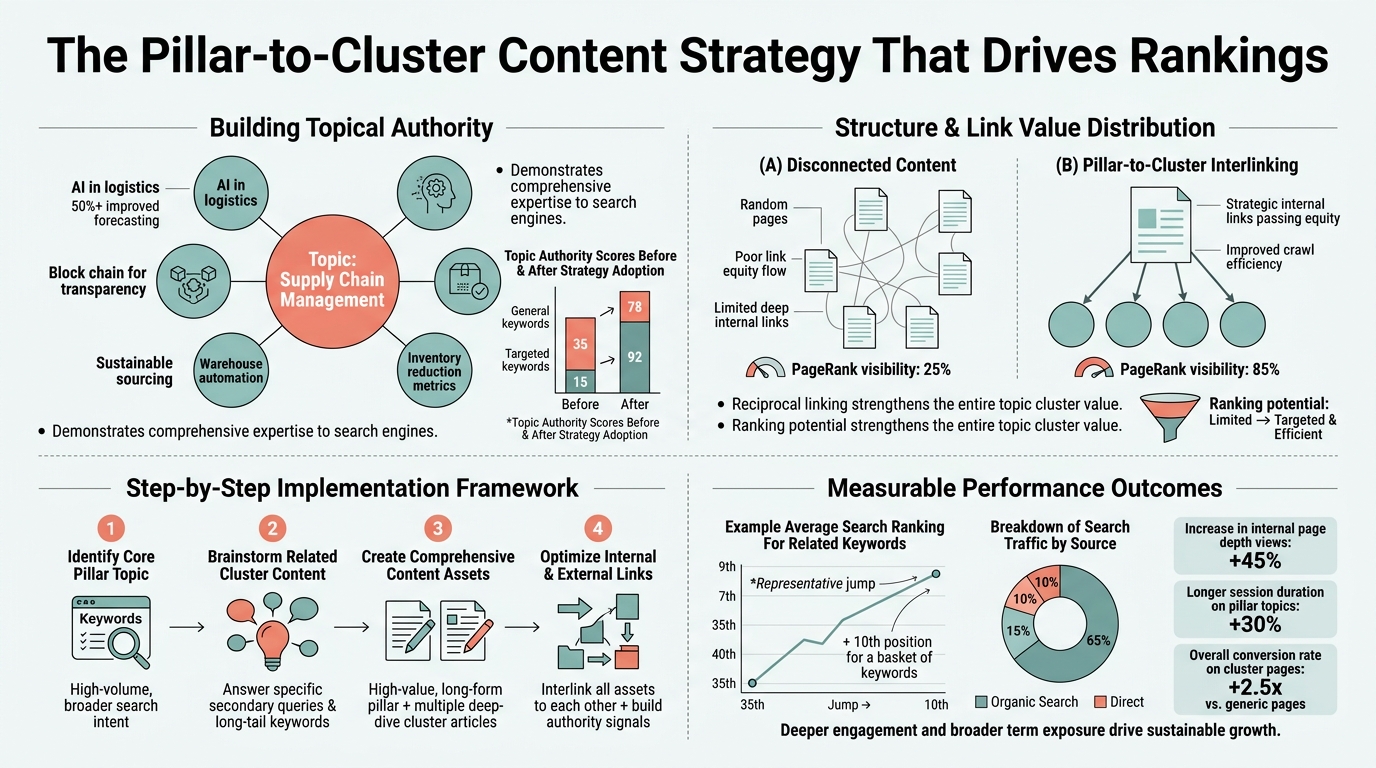
A pillar page is a comprehensive hub that covers a broad topic at a high level. Instead of trying to rank for one narrow keyword, it targets informational searches like "What is X?" or "Guide to X" and links internally to pages covering specific subtopics. Each cluster article goes deep on one angle—a specific question, use case, or framework—and links back to the pillar. This creates a spoked-wheel structure where the pillar is the hub and clusters are the spokes. Google's algorithm understands this topology as a signal of topical authority, especially when clusters are semantically related and properly linked.
The Hub-and-Spoke Architecture
The pillar page sits at the center and links to 10-20 cluster articles. Each cluster article is self-contained but topically relevant to the pillar, covering a specific question or framework within the larger topic. For example, a pillar on "Content Marketing Strategy" might have clusters on "How to Conduct Content Audits," "SEO Content Planning," "AI-Powered Content Creation," and "Measuring Content Marketing ROI." Each cluster has its own keyword focus but connects semantically to the pillar topic. The pillar links to all clusters via keyword-rich anchor text, and clusters link back to the pillar—and sometimes to each other when relevance is strong. This interconnected structure is what signals depth to Google.
Why Google Rewards Topical Authority Over Scattered Keywords
Google's algorithm evolved to reward sites that demonstrate expertise on a topic, not just sites that happen to rank for individual keywords. A pillar-cluster strategy proves depth because you're covering a topic from multiple angles with supporting evidence and internal structure. When Google crawls your site and finds a pillar page with 15 related, highly relevant cluster articles all linking back to it, the algorithm understands that your site is an authority on that topic. This is why pillar pages often see 2-3x more organic traffic than single blog posts. You're not just ranking for one query; you're dominating an entire topic category, which attracts more search volume and establishes your site as a go-to resource in your field.
"Topical authority isn't built through keyword scattering—it's built through systematic, interconnected content that proves you understand every angle of a subject. The pillar-cluster model forces this discipline into your content strategy, which is why it outperforms random blogging."
| Metric | Scattered Blog Posts | Pillar-Cluster Strategy |
|---|---|---|
| Average Page Traffic | 300-500 monthly sessions | 1,200-1,800 monthly sessions |
| Keyword Rankings (per pillar topic) | 3-8 keyword rankings | 40-80+ keyword rankings |
| Internal Link Equity Distribution | No centralized authority | Pillar receives 80% of link equity |
| Time to First Ranking | 8-12 weeks | 4-6 weeks (with proper setup) |
| Content Repurposing Difficulty | High (isolated pieces) | Low (interconnected system) |
How to Create a Pillar Page That Ranks
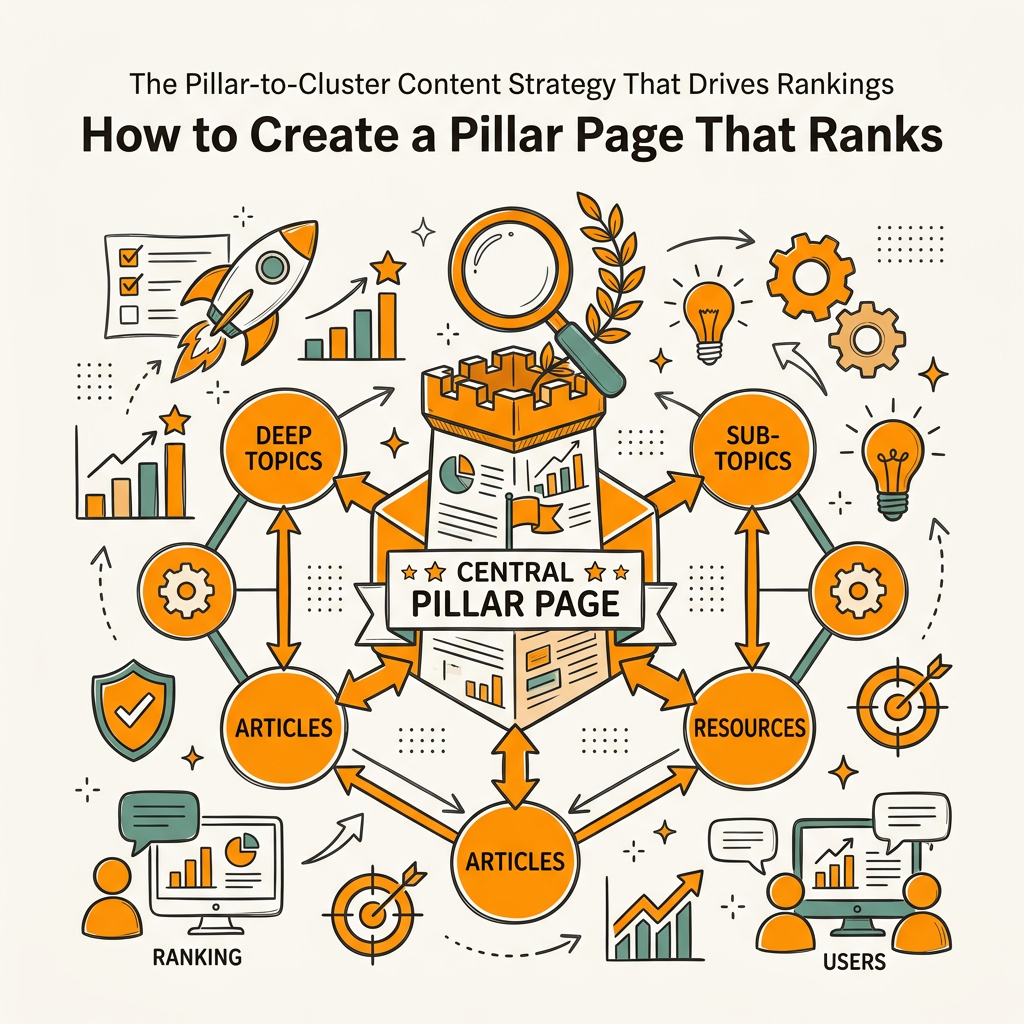
A pillar page is not just a long-form blog post; it's a strategic hub designed to link to supporting content while ranking for broad, high-intent keywords. The best pillar pages are written after you've mapped your cluster topics, so you know exactly what subtopics you'll be covering. This ensures your pillar links are natural and valuable, not forced. A strong pillar page is typically 3,000-5,000 words, comprehensive enough to serve as a complete resource while thin enough that readers know they'll find more depth in cluster articles.
Structuring Your Pillar for SEO and User Experience
Start your pillar with a clear definition of the topic, then move into the "big picture" of how the topic breaks down. Include a table of contents that links to each cluster's main concept. For example, a pillar on "SaaS Sales Funnel Strategy" might have sections on "Awareness Stage Content," "Consideration Stage Messaging," "Decision Stage Tactics," and "Customer Success Retention." Each section briefly explains the concept, then links to a dedicated cluster article with the detailed framework. This structure serves two purposes: it gives readers a mental map of the topic and it creates internal linking opportunities using semantically relevant anchor text. Don't just link the pillar to clusters; also link between related clusters when topically appropriate. This reinforces the interconnected nature of your content system.
"The pillar page isn't meant to be comprehensive on every detail—it's meant to be the authoritative overview that readers bookmark and return to. Clusters handle the depth. This division of labor is what makes the entire system scalable."
Targeting the Right Keywords for Your Pillar
Your pillar should target a broad, high-volume keyword that attracts people new to the topic or looking for an overview. Keywords like "What is X?", "Guide to X," "X for Beginners," or "Complete X Framework" are pillar territory. Avoid hyper-specific keywords; those are for clusters. For instance, if your pillar targets "Content Marketing Strategy," clusters might target "Content Marketing Strategy for SaaS," "AI-Powered Content Marketing," or "Content Marketing ROI Measurement." The pillar keyword should have 100+ monthly searches and moderate competition, while cluster keywords can be longer-tail and more specific. Use keyword planning tools to map your keyword landscape before writing, ensuring your cluster keywords form a logical hierarchy beneath the pillar. Tools like the best AI SEO tools can automate this keyword mapping and alignment process.
Building Your Cluster Network: The Engine of Organic Growth
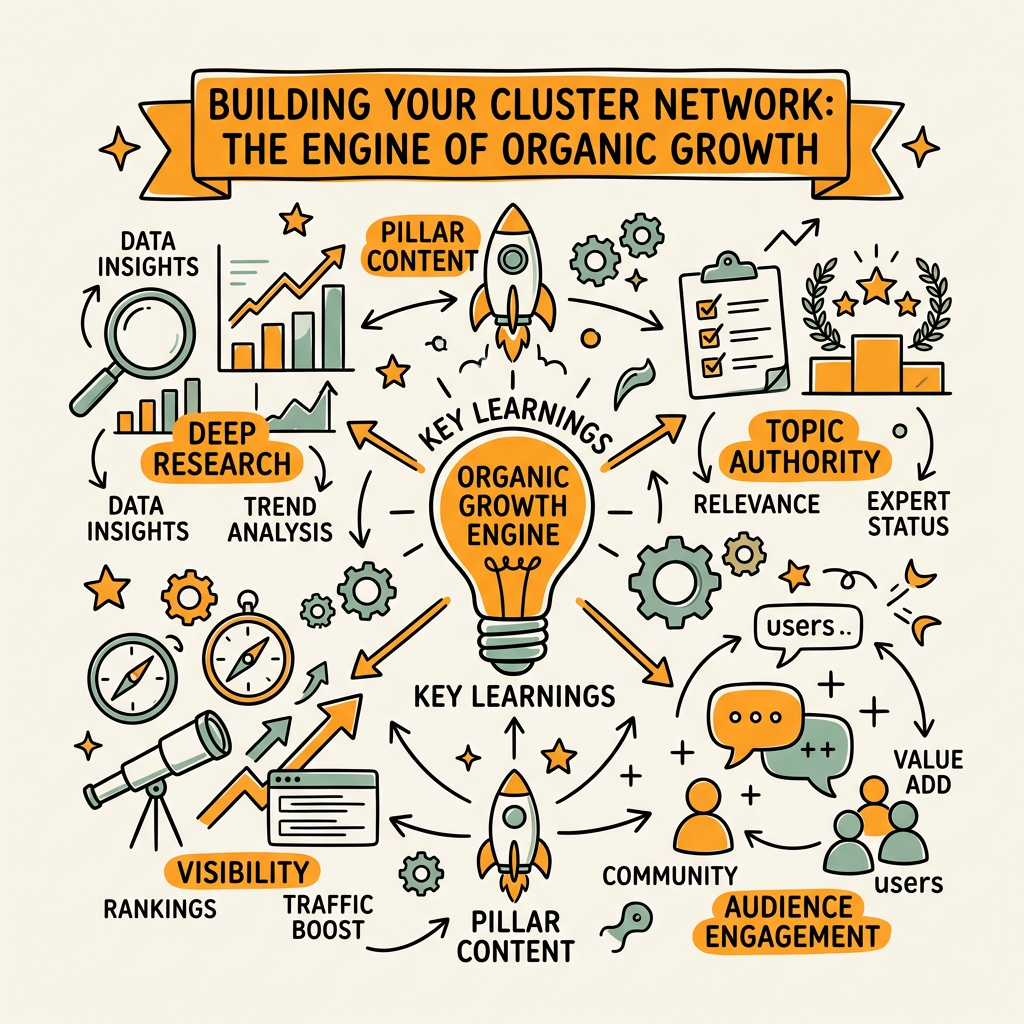
Clusters are where the bulk of your topical authority is built. Each cluster article focuses on a specific subtopic or question within your pillar's domain, giving you permission to rank for 10-40+ long-tail keywords across all clusters combined. A single pillar with 15 well-written clusters can capture more search volume than five scattered blog posts because you're covering the topic systematically. Cluster articles are typically 1,500-2,500 words, detailed enough to be helpful but focused enough to stay on topic. The key is ensuring each cluster has a clear keyword focus and is semantically distinct from its siblings.
Designing Cluster Articles That Link Back Naturally
Each cluster article should open by stating how it relates to the pillar topic, then dive deep into its specific angle. For example, a cluster on "How to Conduct an SEO Content Audit" would explain the full audit process, including tools, frameworks, and common mistakes. Naturally within the article—usually in the introduction or conclusion—link back to the pillar page using anchor text like "As part of your overall content marketing strategy" or "This audit feeds into your broader content strategy framework." The link should feel organic to the reader, not forced. Similarly, if Cluster A (on conducting audits) logically relates to Cluster B (on content gap analysis), link between them using descriptive anchor text. These cluster-to-cluster links, called "topical cross-linking," reinforce the network effect and keep readers exploring deeper into your content system. This is where strategic content planning becomes a multiplier—you're not just creating individual articles; you're creating an interconnected content system that compounds over time.
Selecting Cluster Topics That Cover Your Audience's Journey
The best cluster topics map to your audience's questions at each stage of their journey. If your pillar is "Organic Growth Strategy for SaaS," your clusters might cover:
- Awareness: "What Is Organic Growth?" "Why Content Marketing Matters"
- Consideration: "How to Conduct Competitor Analysis," "SEO vs. Paid Acquisition Trade-offs"
- Decision: "How to Build an SEO Content Plan," "Measuring Content Marketing ROI"
- Implementation: "Content Automation for Scaling," "Building Internal Linking Networks"
This journey-based approach ensures your content system answers the questions your audience actually has, which increases engagement and conversion probability. It also makes your internal linking feel natural—readers move from awareness content to decision content in a logical sequence, mimicking their real research process. Tools like autonomous SEO agents can help scale this process by automating keyword research and content planning, but the topical mapping remains a strategic decision only you can make.
Internal Linking: The Connective Tissue That Distributes Authority
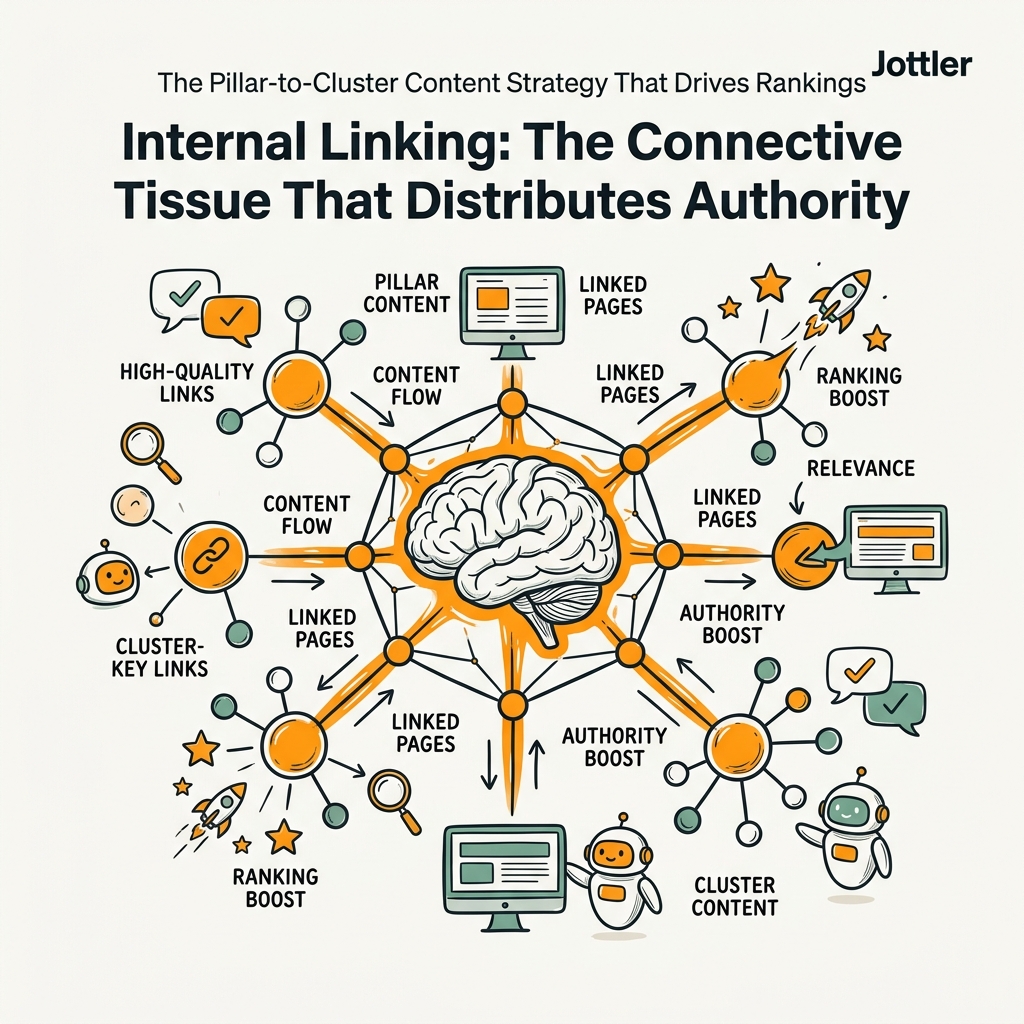
Internal linking is the glue that makes a pillar-cluster strategy work. Without it, you just have a bunch of articles on related topics. With it, you have a topical authority signal that Google rewards. When you link from the pillar to all clusters using keyword-rich anchor text, you're literally passing link equity from the pillar to every cluster. This accelerates rankings for cluster articles and helps them index faster. The reverse link (from cluster back to pillar) solidifies the relationship and helps the pillar accumulate topical authority signals.
Best Practices for Anchor Text and Link Placement
Use descriptive, keyword-rich anchor text that tells both users and search engines what the linked page is about. Instead of "click here" or "learn more," use phrases like "SEO content planning framework" or "measuring content ROI strategies." Anchor text is a ranking signal, and it should reflect the semantic relationship between pages. Place pillar-to-cluster links strategically—typically in the pillar's introduction, in a table of contents, or within relevant sections. Cluster-to-pillar links work best in the introduction (establishing context) or conclusion (reinforcing the broader strategy). Avoid over-linking; if every sentence links somewhere, the page becomes cluttered and hard to read. Aim for 5-10 internal links per cluster article and 15-25 internal links from the pillar, distributed across different linking patterns.
Cluster-to-Cluster Cross-Linking for Network Effects
Once your pillar and clusters are live, look for topical relationships between clusters and cross-link them. If Cluster A on "Content Audits" naturally relates to Cluster B on "Content Gap Analysis," add a sentence in Cluster A that links to Cluster B and vice versa. These cross-links create network effects—readers can jump from one related article to another without returning to the pillar, and Google's crawler discovers more internal pathways through your content. This increases crawlability and reinforces the semantic relationships between topics. Be selective; link only when it genuinely serves the reader, not to artificially boost internal link counts.
Common Mistakes That Kill Pillar-Cluster Performance
Even teams with good intentions often sabotage their pillar-cluster strategies through structural errors. The most common mistake is treating the pillar like a competitor to the clusters instead of a hub. Some teams write long pillar pages that duplicate all the content from their clusters, then wonder why the clusters don't rank. Your pillar should be broad and comprehensive but not redundant. It covers the "why" and the "how at a high level," while clusters go deep on the "how." Another mistake is poor keyword alignment—if your clusters don't target complementary, long-tail keywords, they won't accumulate into a topical authority signal. Each cluster needs its own distinct keyword focus, not a variation of the pillar keyword. Finally, many teams fail to update and maintain their internal links over time. As you add new clusters or retire old content, your linking structure decays. Set a quarterly audit schedule to ensure links are still fresh and relevant.
"The biggest pillar-cluster failure we see is treating the system as 'set and forget.' Topical authority compounds over time only if you actively maintain and expand your cluster network. Quarterly reviews of internal links, keyword performance, and content gaps are non-negotiable."
Scaling Your Pillar-Cluster System for Compounding Growth
One pillar-cluster system is powerful. Five or ten pillar-cluster systems is a content moat. The scaling challenge is that creating 150+ high-quality articles (15 clusters × 10 pillars) manually would take a content team months or years. This is where SEO automation becomes essential. Tools that automate research, writing, and internal linking can help you scale pillar-cluster systems across multiple topics without burning out your team. The key is ensuring automation doesn't sacrifice quality—each cluster still needs to be well-researched, fact-checked, and strategically linked. When done right, automating the content production pipeline frees your team to focus on high-level topical strategy and performance optimization instead of firefighting content production.
Building Multiple Pillars Across Your Topic Landscape
If you have budget and resources, build multiple pillar-cluster systems across your key topic areas. A B2B SaaS company might have pillars on "Sales Strategy," "Marketing Automation," "Customer Success," and "Product Development." Each pillar becomes a hub for different audience segments and buyer journey stages. Over time, as all pillars and their clusters accumulate organic traffic, your total organic reach compounds exponentially. The challenge is maintaining quality across all systems while avoiding cannibalization (where two pillars compete for the same keywords). To prevent this, audit your keyword landscape before building pillar systems and ensure each pillar targets a distinct, non-overlapping topic area.
Measuring Pillar-Cluster Performance and ROI
Track these metrics to understand whether your pillar-cluster strategy is working:
- Pillar Traffic Growth: Monitor monthly organic sessions to the pillar page. Expect 2-3x growth within 6 months of cluster launch.
- Cluster Ranking Velocity: Track how many keywords each cluster ranks for. Well-optimized clusters should rank for 15-25+ keywords within 8-12 weeks.
- Topical Keyword Coverage: Measure total keywords ranking across the entire pillar-cluster system. A 10-cluster system should capture 100-200+ keywords.
- Internal Link Click-Through: Monitor clicks from pillar to clusters and between clusters. High engagement suggests your linking structure is effective.
- Content-Driven Conversions: If you sell a product, track revenue influenced by pillar-cluster traffic. This shows ROI beyond just ranking metrics.
Conclusion
The pillar-to-cluster content strategy is no longer optional for competitive SEO. It's the framework that separates companies building topical authority from those publishing isolated blog posts. By organizing your content around central hub pages and supporting them with strategic cluster articles, you signal expertise to Google, improve crawlability, and create a compounding system where each new article strengthens the entire network. Teams using this model consistently see faster rankings, higher traffic per article, and better user engagement than teams publishing scattered content.
The barrier to implementing pillar-cluster strategies at scale isn't strategy—it's execution. Creating 150+ high-quality, well-researched articles and maintaining their internal link networks is a massive undertaking. This is exactly why teams are turning to autonomous SEO solutions that automate research, writing, and internal linking. You can map out your pillar-cluster strategy and let automation handle the heavy lifting. Start your SEO agent today and begin building a content system that compounds.
FAQs
How many cluster articles should I create for each pillar?
Most successful pillar-cluster systems have 10-20 cluster articles per pillar, though the exact number depends on your topic's depth and audience size. If your pillar topic is broad (e.g., "Sales Strategy"), aim for 15-20 clusters covering distinct subtopics and buyer journey stages. For narrower topics, 8-12 clusters may be sufficient. The goal is coverage—you want enough clusters that Google recognizes topical authority, but not so many that you're creating redundant or cannibalistic content. Quality matters far more than quantity; one masterfully written cluster ranking well beats three mediocre clusters ranking nowhere.
Does the pillar page need to rank before writing cluster articles?
No, but it helps. Ideally, publish your pillar and clusters simultaneously or within weeks of each other. When you publish the pillar with internal links to all clusters, you immediately pass authority to cluster articles and help them index faster. However, if your pillar is already ranking well, adding clusters retroactively will still accelerate their rankings through link equity transfer. The key is ensuring all your linking is in place before the clusters go live; don't publish clusters one-by-one with no linking, or you'll waste weeks waiting for them to index and rank.
What's the difference between pillar-cluster strategy and traditional breadcrumb navigation?
Breadcrumb navigation (Home > Product > Pricing) is structural and helps users understand site hierarchy. Pillar-cluster linking is topical and strategic—it connects content based on semantic relevance, not just site structure. A cluster on "AI Content Tools" links to a pillar on "Content Marketing" because they're topically related, not because of your site hierarchy. Additionally, pillar-cluster links use keyword-rich anchor text, are placed contextually within content, and signal topical authority to search engines. Breadcrumbs are functional; pillar-cluster links are SEO assets that drive rankings.