Thought Leadership Content That Converts Buyers, Not Just Readers
Most B2B teams publish content. Few of them convert buyers. The difference isn't volumeit's strategy. 99% of B2B buyers say thought leadership is important or critical to their vendor selection decisions, but 66% will outright disqualify a company if its thought leadership is poor quality. That's the gap: visibility without credibility becomes noise. The fix? Content built on original insight, clear evidence, and sustained visibility across the channels where your buyers already spend time. Here's how to build a thought leadership program that actually moves revenue.
Key Takeaways
- 75% of decision-makers research a product or service they weren't originally considering after encountering strong thought leadership, and ~23% eventually become customers (2026 Research).
- Thought leadership that converts prioritizes original research, clear evidence-based arguments, and multi-channel distributionnot audience size alone.
- Hidden buyers (71% who have minimal sales contact) spend over an hour per week consuming thought leadership content, making content the only scalable way to reach them.
- 86% of decision-makers are likely to invite a company with consistent thought leadership into an RFP process.
- Build Authority on Original Insight: Proprietary research, frameworks, and data generate 2-3x more citations and buyer trust than generic commentary.
- Define Your Unique Point of View: Successful thought leadership doesn't regurgitate industry consensusit challenges assumptions and provides a defensible perspective on future direction.
- Make Content Self-Serve for Hidden Buyers: Over 71% of B2B buyers have little to no sales contact; content must educate them before they ever raise a hand.
- Align With Buyer Search Behavior: 51% of B2B software buyers now start research in AI chatbots, meaning thought leadership must be optimized for answer engines, not just Google.
- Measure Revenue Impact, Not Vanity Metrics: Track content-assisted pipeline, sales cycle velocity, and win ratesnot just impressions or clicks.
What Makes Thought Leadership Convert (and What Doesn't)
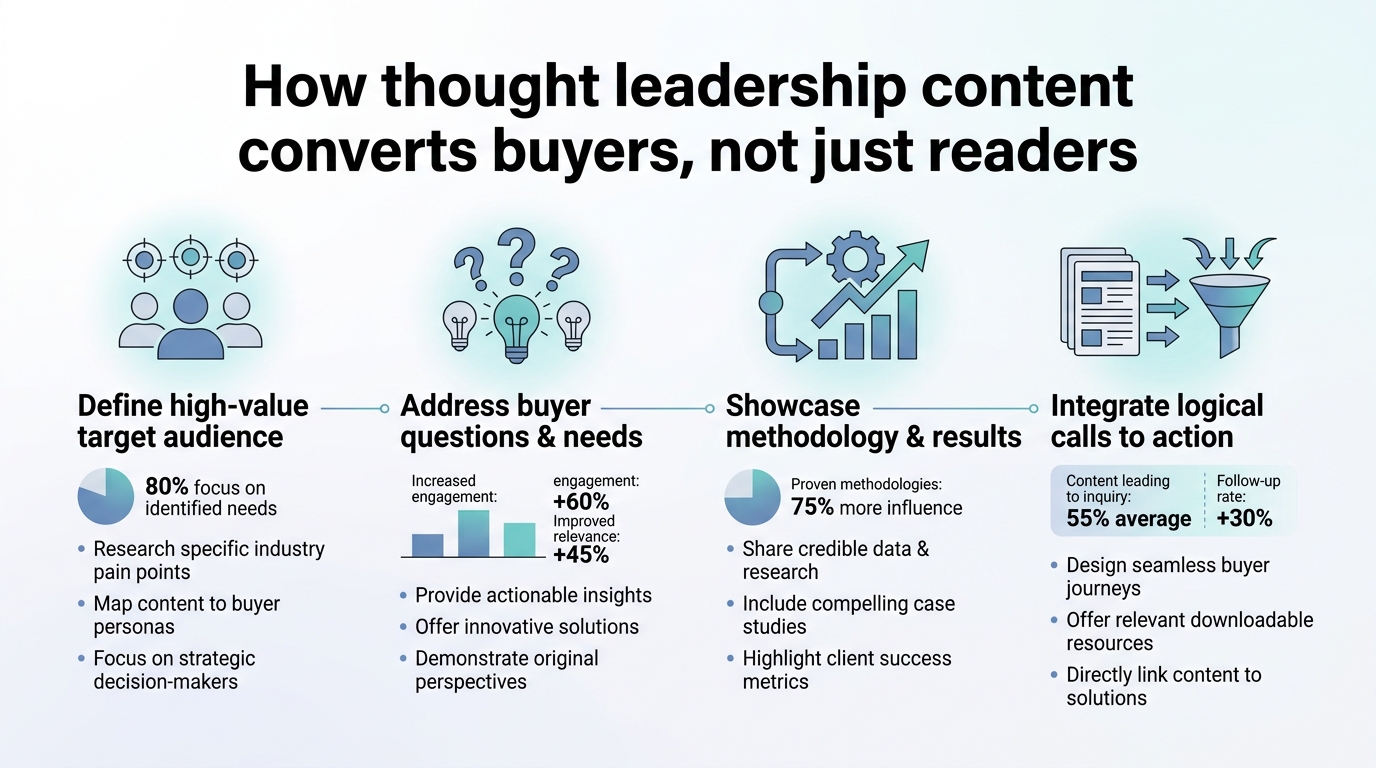
Thought leadership only converts when it does three things: it demonstrates expertise, it shifts how buyers think about a problem, and it creates confidence that your company is the logical vendor choice. This requires more than a senior executive byline or a well-crafted opinion piece. 73% of decision-makers trust thought leadership more than traditional marketing materials, but only if it's backed by evidence, original insight, and consistent demonstration that you understand their specific industry challenges.
The mistake most teams make is confusing visibility with authority. A thought leader who publishes frequently but says nothing new eventually becomes background noise. Your target buyer sees hundreds of emails, LinkedIn posts, and articles per week. If your content feels generic, it disappears. The content that converts does four specific things:
- Presents a defensible POV: Not "AI is changing marketing" (everyone says this), but "AI-driven content production forces a reckoning with editorial qualityhere's why most teams are failing it."
- Backs claims with original data: Proprietary research, customer benchmarks, or internal case study patterns create something competitors can't easily replicate.
- Solves a specific buyer problem: Content that speaks directly to the evaluation criteria, risk concerns, or objections a buyer faces in your category.
- Builds across channels consistently: A single article reaches 1% of your target audience. Distributed through LinkedIn, email, webinars, and syndication, it reaches 60-80%.
"Thought leadership only converts when it's built on a clear strategy, backed by evidence, and delivered consistently. Visibility alone will never turn into results.", Madeline Paddock, Content Strategist, iResearch Services
How to Define Your Point of View on Problems Your Buyers Face

A point of view (POV) is not an opinion. It's a testable hypothesis about how something works in your industry, backed by evidence and drawn from real experience. The strongest POVs are rooted in customer data, market research, or patterns you've observed that most competitors haven't articulated. 93% of buyers find thought leadership built on original research effective, compared to generic advice that's available everywhere.
Your POV should answer one core question: "What do our best customers understand about this problem that most of the market doesn't?" The answer becomes your foundation for all thought leadership content.
- Start with customer data, not opinion: What patterns do your most successful customers have in common? What mistakes do the companies that don't work with you keep making? Those patterns are your POV.
- Identify the contrarian angle: If 90% of the industry believes X, what evidence do you have that Y is actually true? This doesn't mean being contrarian for shock valueit means finding the insight competitors haven't weaponized.
- Build a framework, not a sermon: The best thought leadership teaches the buyer how to think, not what to think. A repeatable framework (3-part model, 5-step process, decision matrix) gives buyers a tool they can use immediately.
- Make it defensible in a sales conversation: Your best thought leadership should be something your sales team can cite. If a sales rep can't use your content to accelerate a deal, it's not converting.
Building the Research and Evidence That Wins Buyers
Unsubstantiated claims don't convert. That's why 93% of B2B buyers specifically seek out thought leadership backed by original research. The evidence layer is what separates an opinion from authority. You don't need to conduct a massive annual benchmark study (though that's valuable). You can build evidence through smaller, faster approaches:
- Customer data and benchmarks: If you work with 200+ customers, you have benchmarkable data. Average contract value by industry. Sales cycle length by company size. Feature adoption patterns by customer success outcome. This is proprietary gold.
- Rapid surveys of your target audience: A 5-question survey of 100 buyers in your target market takes two weeks and generates content ideas for a quarter. What are they struggling with? What are they evaluating? What mistakes are they making?
- Case study patterns and anonymized wins: "We've worked with 15 enterprise SaaS companies in the last 18 months. Here's what they all had in common before they came to us." This is both evidence and differentiation.
- Original analysis of public data: Earnings call transcripts, SEC filings, patent filings, hiring trends, job posting analysisthe data exists. Re-analysis with a fresh angle creates original insight.
"Content backed by evidence and demonstrable expertise is what separates high-converting thought leadership from generic industry commentary. The data is what makes buyers believe you actually understand their problem.", CMO Alliance
Where and How to Publish Thought Leadership for Maximum Reach
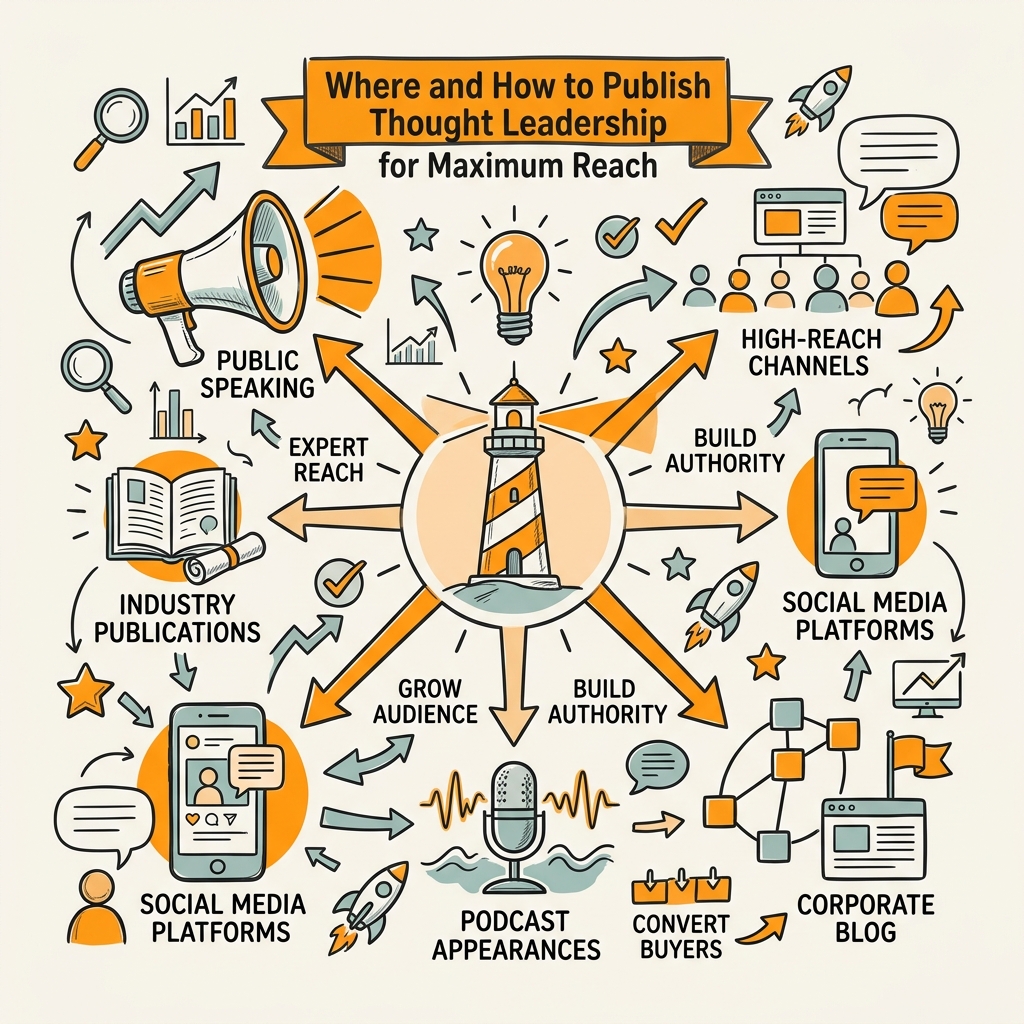
The channel mix matters more than any single publication. Hidden buyers (the 71% with minimal sales contact) spend over an hour per week consuming thought leadership content, but they're not all on your website. They're on LinkedIn, industry newsletters, webinars, third-party publications, and increasingly in AI chatbots. Your distribution strategy determines whether your content reaches 10% of your target market or 70%.
The strongest approach uses a hub-and-spoke model. Your owned properties (website, email list) are the hub. Third-party amplification channels are the spokes. One piece of original research becomes a long-form article on your site, a LinkedIn Series, a webinar, a guest column in industry publications, and a newsletter deep-dive. Each channel reaches a different segment of your buyer audience.
- Owned channels (your website and email): These build long-term SEO authority and create a direct relationship with your audience. Every foundational piece of thought leadership should live here first. LinkedIn's 2026 research shows B2B content created "with people, not for them" performs 3-4x better than corporate copy, which means original, creator-led content on your owned media outperforms republished content elsewhere.
- LinkedIn (personal and company): Executive profiles with consistent thought leadership create more pipeline influence than company pages alone. A CEO or CTO sharing insight on their personal profile reaches 2-3x more decision-makers than a company announcement.
- Industry publications and guest columns: Get your ideas in front of audiences that trust those publications. One article in a top-tier industry publication reaches 50,000+ relevant buyers. Budget for placement or build relationships with editors who cover your space.
- Webinars and virtual events: Synchronous formats allow deeper engagement. A 60-minute webinar with 200 decision-makers generates more pipeline influence than 5,000 reads of an article. Include time for Q&Athat interaction is what converts.
- Podcasts and third-party shows: Executive interviews on shows your buyers listen to. If 70% of your target market tunes into three specific industry podcasts, that's where your executives should appear.
When building a content distribution engine, tools that handle research, writing, and SEO optimization automatically become critical. For teams publishing 1-3 pieces per month, production is manageable. For teams trying to hit 2-3 pieces per week (which is what actually moves market perception), you need systems in place.
How to Measure Whether Your Thought Leadership Is Actually Converting
Vanity metrics (page views, social shares, email opens) don't predict revenue. 86% of decision-makers are likely to invite a company with consistent thought leadership into an RFP process, but you won't see that in your Google Analytics. Conversion measurement for thought leadership requires you to track different signals: engagement quality, pipeline influence, and deal velocity.
The right metrics sit at the intersection of content performance and business outcomes. You're looking for signals that your content is influencing buyer perception and decision-making, not just attracting eyeballs.
| Measurement Category | Metrics to Track | What It Tells You |
|---|---|---|
| Audience Quality | Decision-maker engagement rate; Time on page for C-suite visitors; LinkedIn post engagement from target titles | Are you reaching the right people? Senior execs spending time on your content signals stronger conversion potential than general traffic. |
| Demand Generation | Branded search volume growth; Content-attributed pipeline; Sales cycle velocity for accounts exposed to thought leadership | Is your content shaping buyer research behavior? Growth in brand searches means more people investigating you as a vendor. |
| Sales Enablement | Sales team citation rate; Deal velocity for accounts with content exposure; Sales conversation quality (feedback from reps) | Are your sales reps using the content in deals? If not, you're building awareness but not conversion assets. |
| Revenue Impact | Win rate for accounts exposed vs. not exposed; Close rate for leads from thought leadership channels; Content-assisted revenue | Bottom line: does thought leadership help you win deals faster or at higher margins? |
The measurement approach that works best is attribution modeling across your full funnel. In your CRM, tag deals that were exposed to specific pieces of thought leadership. Track deal velocity and win rate for those accounts versus control groups. After 6-12 months of data, you'll see the revenue correlation. Most teams using this approach find that accounts exposed to 3+ pieces of substantive thought leadership close 1.5-2x faster than those without exposure.
Scaling Thought Leadership Without Burning Out Your Team
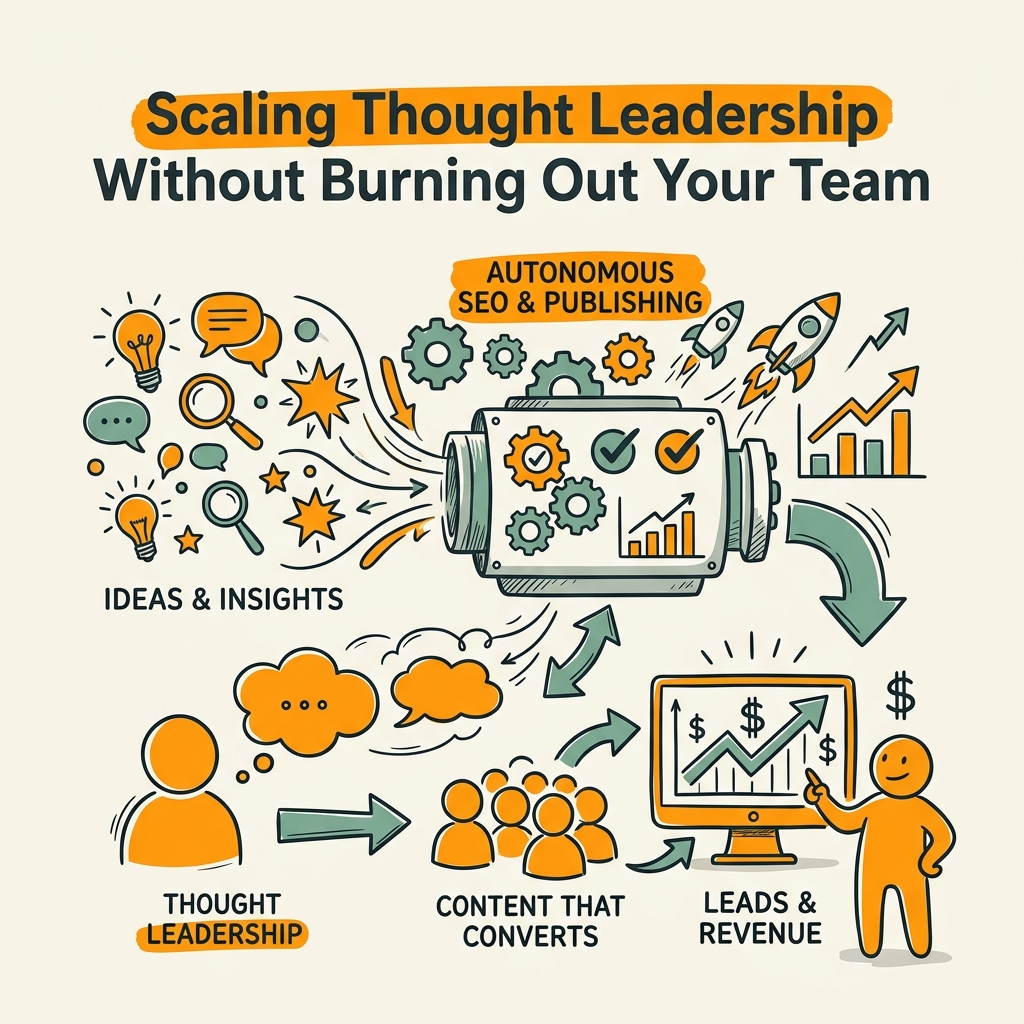
The biggest barrier most B2B teams face isn't knowing how to build thought leadership. It's consistency. One excellent article doesn't move the needle. Your audience needs to see your perspective repeatedly across multiple topics and channels before it changes their buying preference. Most teams can sustain 1-2 posts per month manually. Getting to 2-3 pieces per weekthe volume that actually drives market perceptionrequires automation or outsourcing.
Building a thought leadership program at scale requires treating it like a business system, not a creative project. This is where strategic B2B content production frameworks that automate research, data gathering, writing, and fact-checking become essential for busy founders and marketing teams. If your sales team is telling you "We need more content to support our positioning" but your marketing team doesn't have capacity to produce it, you have a systems problem, not a resource problem.
The goal isn't to replace human expertise. It's to multiply the output of your best thinkers. A VP Product who has deep insight into your market can produce 1 thought leadership article per month manually. With research and writing tools handling the heavy lifting, that same person can generate, review, and approve 3-4 per month. Scale that across 3-4 executives, and you're creating 10-12 pieces per monthenough to build real market authority.
Why Your Competitors' Thought Leadership Probably Isn't Converting Either
Most B2B companies treat thought leadership as a content marketing tactic, not a strategic asset. They publish opinion pieces that are indistinguishable from 50 other companies in their category. They don't invest in original research. They don't distribute consistently. They don't measure revenue impact. That's why so much thought leadership looks the same and performs poorly.
The companies winning in thought leadership in 2026 operate differently. They start with customer data, not industry opinion. They build proprietary frameworks that become repeatable selling tools. They distribute through a mix of owned and earned channels. They measure revenue impact. They commit to sustained publicationnot occasional blog posts. And they automate the production work so their experts can focus on insight instead of writing.
If your current thought leadership isn't converting buyers, the problem isn't the idea. It's the strategy. You're either publishing generic content, distributing inconsistently, reaching the wrong audience, or measuring the wrong metrics. Fix the strategy layer, and your conversion rate should double or triple within 6 months.
Conclusion
Thought leadership content converts buyers when it does three things: demonstrates genuine expertise backed by evidence, delivers insights competitors haven't articulated, and reaches your target audience consistently across multiple channels. The data is clear: 75% of decision-makers research a product or service they weren't originally considering after encountering strong thought leadership, and about 23% of those researchers eventually become customers. That's a 23% downstream conversion rate from content alonecomparable to many paid demand generation programs, but at a fraction of the cost once you systematize the production.
The barrier isn't knowing how to build it. It's executing consistently. Most teams lack the capacity to produce high-quality, original thought leadership at the frequency required to influence market perception. Building that capacitythrough a combination of clear strategy, efficient processes, and automation where appropriateis the competitive edge in B2B demand generation for the rest of 2026.
Start by defining your POV based on customer data. Move to original research that supports it. Build your distribution plan. Set up revenue-focused measurement. Then automate the production work so your team can scale without burnout. Start your SEO agent at https://jottler.co/auth/signup to begin systematizing the research and writing phases of thought leadership content production.
FAQs
What's the difference between thought leadership and regular content marketing?
Thought leadership starts with original insightproprietary research, customer data, or a defensible POVand aims to shift how your market thinks about a problem category. Regular content marketing educates and informs, but often regurgitates industry consensus. Thought leadership is owned IP that competitors can't easily copy. It requires more evidence, more rigor, and more editorial courage to publish contrarian ideas. The payoff is that decision-makers trust thought leadership 3x more than traditional marketing content, which is why it drives higher conversion rates into pipeline.
How much thought leadership content do I need to actually move buyer perception?
Most teams see meaningful shift in brand perception and pipeline influence after publishing 2-3 pieces of substantive thought leadership per month for 6-12 months. That's 12-36 pieces minimum before the market starts noticing you as an authority. The challenge is consistency. Most teams publish sporadically, which means their audience never develops confidence in their expertise. The companies winning in thought leadership commit to a cadence and stick to it. If your team currently publishes monthly, increasing to 2-3 per monththrough a combination of internal capacity and production automationwill show measurable ROI within 6 months.
Can I build thought leadership if I'm a small startup, not an established company?
Yes, but with a different angle. Instead of "we're the industry authority," the angle is "we've studied this problem deeply and found something everyone else is missing." Smaller companies often have an advantage because they can move faster, be more contrarian, and invest more deeply in original research relative to their size. A 10-person startup that publishes one original research report per quarter and 2 derivative pieces per month can build authority faster than a large company that publishes generic content sporadically. The key is focusing on a narrow niche, building evidence within that niche, and distributing relentlessly. Start with one clear POV and own it completely in your space.