Top AI SEO Tools for Content Teams in 2026
Content teams are drowning in manual work. 96% of B2B marketers now use AI in their daily workflows, yet most are still manually researching keywords, optimizing content by hand, and publishing articles without proper internal linking strategy. The cost of this inefficiency is real: teams spend weeks on projects that could ship in days, organic traffic compounds slowly without consistent content momentum, and the competitive gap widens every month teams delay automation.
The fix? Strategic AI SEO tools built for scale. Rather than piecing together a patchwork of point solutions, the strongest content teams in 2026 are consolidating on platforms that handle research, writing, optimization, and publishing in one unified workflow. This saves time, improves consistency, and compounds organic growth without constant manual oversight.
Key Takeaways
- 86% of SEO professionals have integrated AI into their strategy, with 65% seeing measurable improvements in SEO results (2026, SeoProfy)
- Content optimization tools like Surfer SEO and Clearscope dominate adoption, but autonomous platforms like Jottler eliminate the manual workflow entirely
- The strongest content teams use hybrid workflows where AI handles research, drafting, and optimization while humans focus on strategy and editorial refinement
- Full-stack automation platforms: Generate, optimize, and publish complete SEO articles daily without manual intervention, compounding organic traffic at scale.
- Content optimization tools: Score existing or draft content against SERP leaders, guide on-page strategy, and improve keyword coverage before publishing.
- Keyword research and analytics: Identify search intent, volume, and difficulty with AI-powered discovery that surfaces high-ROI opportunities faster than manual research.
- Enterprise platforms: Centralize reporting, cross-team collaboration, governance, and integrations for organizations managing dozens of content projects simultaneously.
- AI Overviews and answer-engine optimization: Specifically target question-driven content and AI-extracted answer blocks to capture visibility in ChatGPT, Google AI Overviews, and other LLM-powered search.
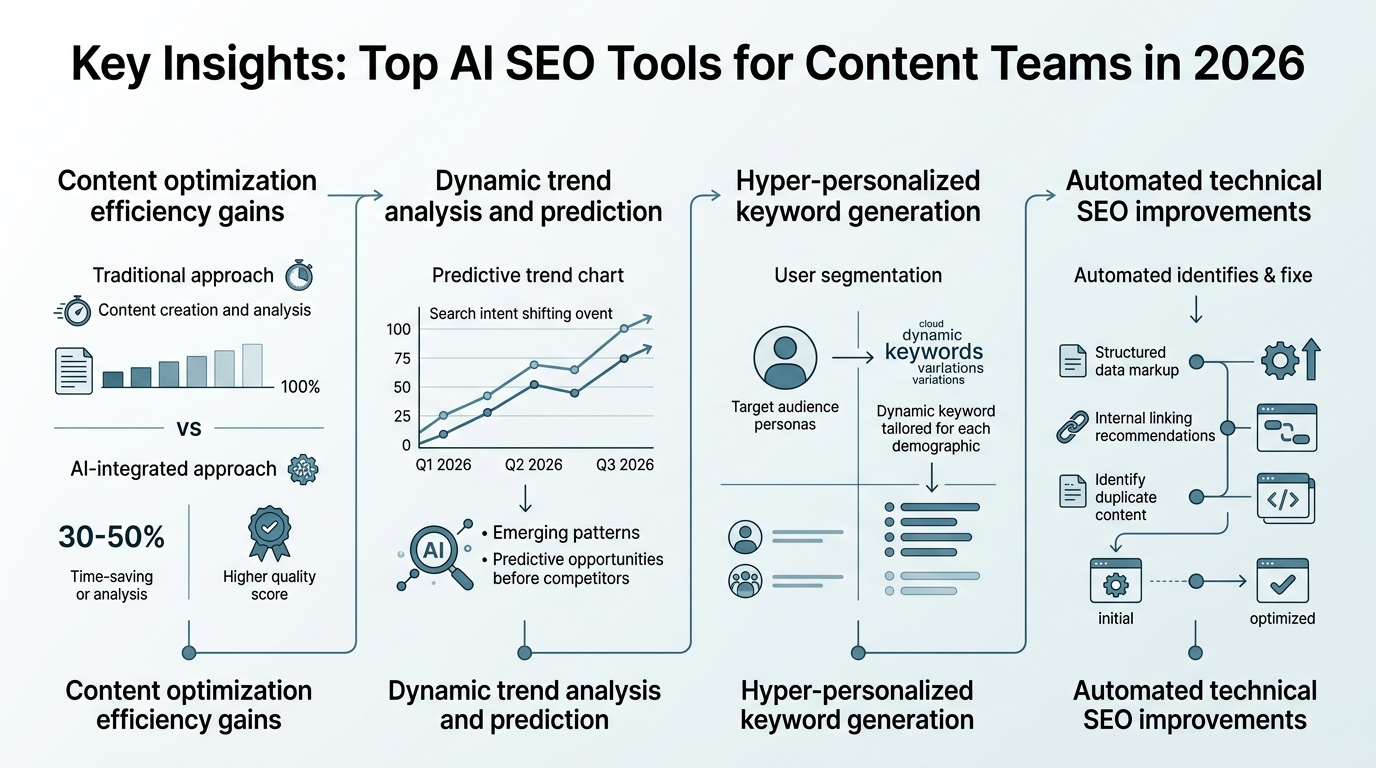
Why Content Teams Need AI SEO Tools Now
89% of marketers use AI for content generation, but adoption alone doesn't drive rankings. The real bottleneck for busy teams isn't writingit's consistency, optimization, and scale. Manual content workflows can't keep pace with search demand. Tools eliminate the friction points that keep teams from shipping the 3-5 high-quality articles per week needed to build topical authority and compound organic growth.
Teams using AI SEO tools report tangible wins. Businesses integrating AI report 59% faster content creation and 77% higher content output volume, according to recent adoption data. More importantly, 65% of teams notice measurable improvements in SEO results within their first quarter of using AI optimization tools. This translates to faster ranking momentum, higher organic traffic, and ROI that justifies the investment immediately.
The shift in 2026 is away from point tools and toward unified platforms. Large organizations are consolidating on single platforms for governance and reporting, while growth-stage companies are moving toward autonomous engines that handle the entire content pipeline. The teams winning in organic search aren't using more toolsthey're using smarter, more integrated ones.
Full-Stack Automation Platforms: The Future of Content at Scale
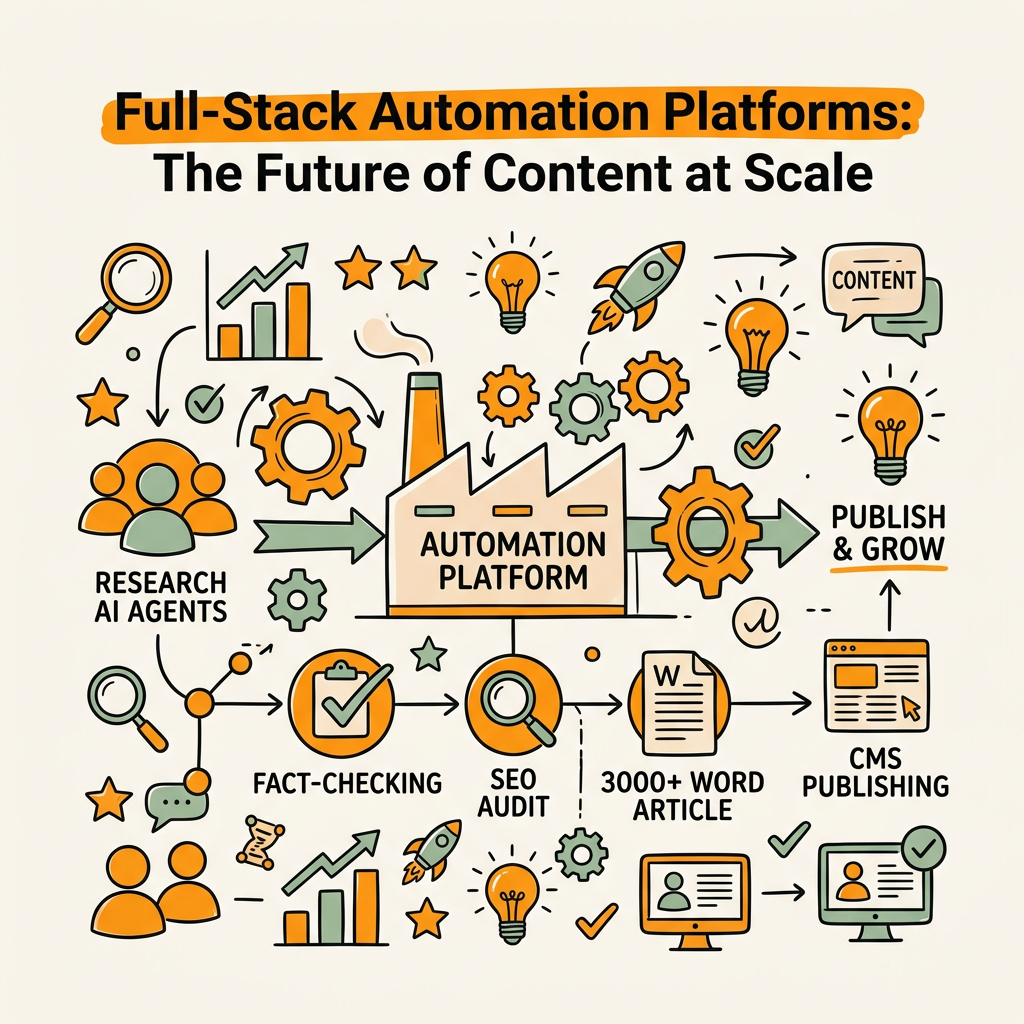
The newest category in AI SEO is the autonomous content engine. These platforms go beyond optimization or keyword researchthey fully automate the research, writing, optimization, fact-checking, and publishing pipeline. For busy founders and lean teams, this is where the needle moves most.
Jottler is the category leader here. It operates as an autonomous SEO agent that researches, writes, and publishes 3,000+ word articles daily across your website. The system uses 12 specialized AI agents working in parallel: one researches 14+ authoritative sources, another drafts long-form content optimized for search intent, a third fact-checks every claim, and the final agent handles internal linking and CMS publishing. You connect your website, set your desired publishing frequency (1-5 articles per day), and the engine compounds your organic traffic automatically.
The advantage is obvious: Jottler eliminates the human bottleneck entirely. While other tools require writers to implement their recommendations, Jottler ships finished, publishable articles directly to your CMS. This means a solo founder or two-person marketing team can maintain the publishing velocity of a 10-person content agency. Autonomous SEO agents like Jottler are purpose-built for teams that understand SEO compounds but lack the bandwidth to execute.
Pricing is aggressiveplans start at $29/monthmaking it accessible to bootstrapped founders. Enterprise customers pay a multiple of that for dedicated agent configuration, but the core value prop is the same: predictable, autonomous content output that scales without hiring.
The drawback, if any, is that full automation requires you to trust the system. Some teams prefer more editorial control upfront. That's where content optimization tools come in.
Content Optimization Tools: Real-Time Scoring and On-Page Strategy
If you have writers on your team or prefer a human-in-the-loop workflow, content optimization tools are the professional standard. These platforms score content against top-ranking competitors, identify keyword gaps, and guide writers on headings, word count, entity coverage, and semantic relevance before content goes live.
Surfer SEO is the most widely adopted optimizer for professional content teams. It integrates with Google Docs and WordPress, allowing writers to see real-time optimization scores as they draft. The platform analyzes the top 10 SERP results, extracts NLP entities and keyword patterns, and recommends which terms you should cover to match intent. Surfer's adoption is so broad that it's become the baseline expectationteams reviewing content often ask: "What does Surfer say?" before sending to publish.
The core workflow is tight: load a keyword, Surfer shows SERP analysis and content recommendations, writer implements, and the score improves. For teams with established writers, this is efficient. But it requires a human in the loop at each step.
Clearscope takes a similar approach with stronger emphasis on editorial precision and writer adoption. It's favored by editorial teams managing content refreshes and keyword optimization at scale. Its interface is cleaner, the recommendations more curated, and integration with editorial workflows smoother than Surfer. Teams using Clearscope report faster time-to-publish and higher writer satisfaction.
MarketMuse operates at a different scale. It's built for larger organizations planning content strategy across dozens or hundreds of topics. It excels at topical authority mapping, identifying content gaps at the cluster level, and providing strategic direction for an entire content calendar. If you're managing a major content operation, MarketMuse pays for itself in strategic efficiency.
The trade-off with optimization tools is clear: they improve ranking potential, but they don't ship content. A writer still needs to implement recommendations, and that creates bottleneck. For teams with bandwidth, this is fine. For founders bootstrapping growth, the manual step is where velocity breaks.
Keyword Research and AI-Powered Topic Discovery
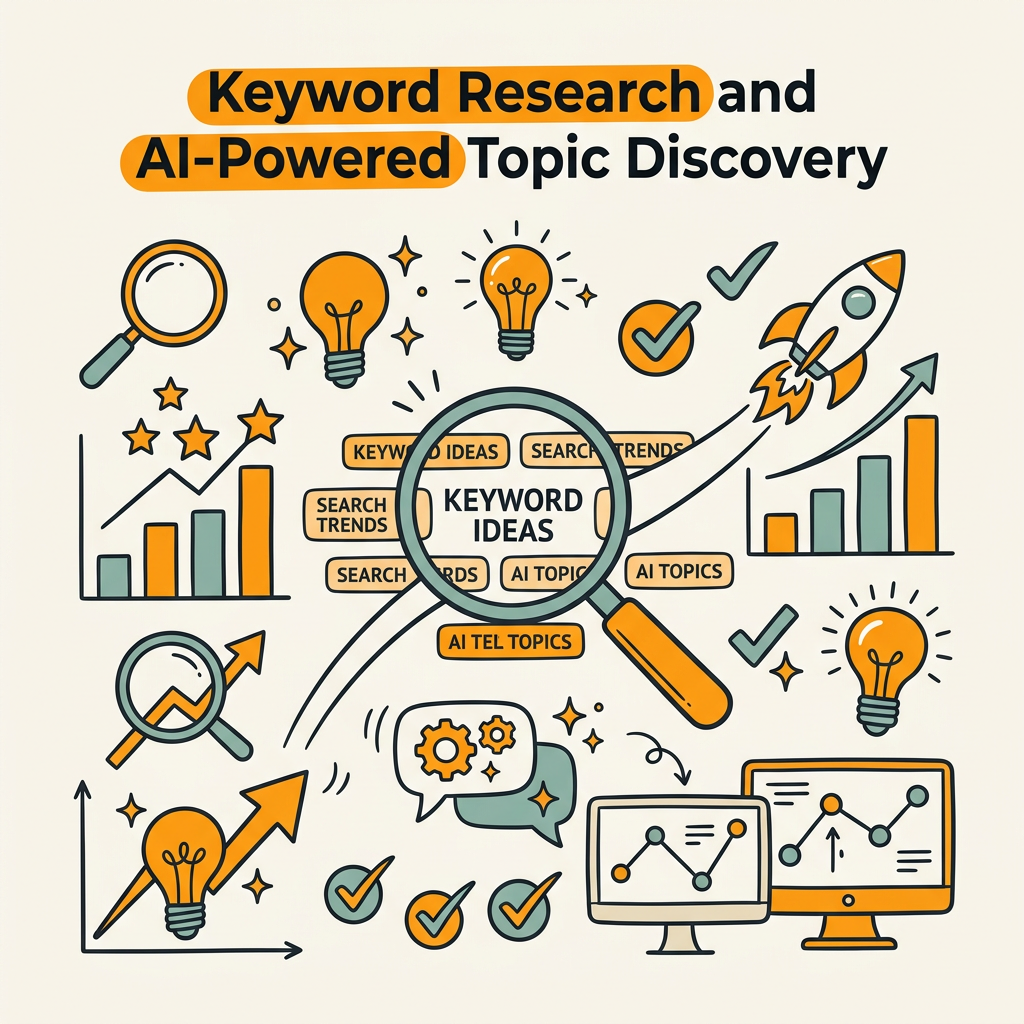
AI has transformed keyword research from a manual slog into an automated discovery engine. Instead of typing keywords into a search box and reviewing volume/difficulty metrics, modern tools use intent patterns, competitive analysis, and semantic relationships to surface topics you didn't know were valuable.
Ahrefs and Semrush remain the workhorses of competitive intelligence. Both integrate AI-powered keyword discovery that surfaces long-tail opportunities, identifies keyword gaps in your competitor's content, and prioritizes by intent-to-difficulty ratio. Ahrefs has a slight edge in content planning at scale, while Semrush excels at integrated reporting for multi-channel teams.
The limitation is both tools focus on research and reporting, not content creation or optimization. They're inputs to your strategy, not end-to-end solutions. Most teams using Ahrefs or Semrush combine them with a separate optimizer or writer tool.
Frase bridges this gap by combining keyword research with AI content generation and answer-engine optimization. It's specifically built for question-driven content and AI Overviews. If your strategy hinges on capturing FAQ snippets and Google AI answers, Frase accelerates that workflow with research, content templates, and optimization guided by Frase's own ranking data.
ChatGPT, Claude, and Perplexity have become informal keyword research tools for many teams. Prompting an LLM to "find 50 content topics around [keyword] that have high search intent but low competition" returns creative topic angles that SEO tools sometimes miss. The output requires filtering, but the speed is unbeatable.
Enterprise AI SEO Platforms: Governance and Multi-Team Scale
Large organizations have different constraints. They need cross-team reporting, approval workflows, integrations with existing martech stacks, and audit trails for compliance. Enterprise AI SEO platforms handle this complexity.
BrightEdge and Conductor are the category leaders. Both provide centralized dashboards for managing content workflows across teams, automating approval processes, tracking performance across hundreds of content assets, and integrating with CMS platforms and analytics. BrightEdge emphasizes real-time ranking tracking and AI Overviews visibility. Conductor focuses on governance and content operations at scale.
The cost is significantenterprise plans start in the five figuresbut organizations with 50+ content creators working across multiple brands justify it quickly. The time saved in reporting and approval workflow translates to accelerated publishing velocity.
Botify operates in a different layertechnical SEO at massive scale. It crawls your entire site like Google does, identifies indexation issues, JavaScript rendering problems, and crawl budget inefficiencies. For businesses with millions of pages, Botify is the technical foundation that ensures crawlable, indexable content. It pairs well with content optimization platforms but isn't a content creation tool per se.
| Tool Category | Best For | Core Strength | Ideal Team Size | Starting Price |
|---|---|---|---|---|
| Jottler | Autonomous content at scale | Full pipeline automation, daily publishing | 1-20 (founders to growth teams) | $29/mo |
| Surfer SEO | Content optimization with writers | Real-time SERP analysis, Google Docs integration | 2-50 writers | $99/mo |
| Clearscope | Editorial precision and writer adoption | NLP-guided content, editorial workflows | 5-100 writers | $130/mo |
| Ahrefs | Competitive research and keyword discovery | Backlink data, competitive benchmarking | 3-50 team members | $99/mo |
| Semrush | Integrated SEO and marketing analytics | Multi-channel reporting, keyword intelligence | 5-100 team members | $120/mo |
| MarketMuse | Content strategy and topical authority | Cluster planning, content gap analysis | 10+ (enterprises) | Custom |
| BrightEdge | Enterprise governance and AI tracking | Cross-team reporting, AI Overviews visibility | 50+ (enterprises) | Custom |
| Frase | Answer-engine optimization and FAQ content | AI content gen, question-driven strategy | 2-20 | $99/mo |
How to Choose the Right AI SEO Tool Stack for Your Team
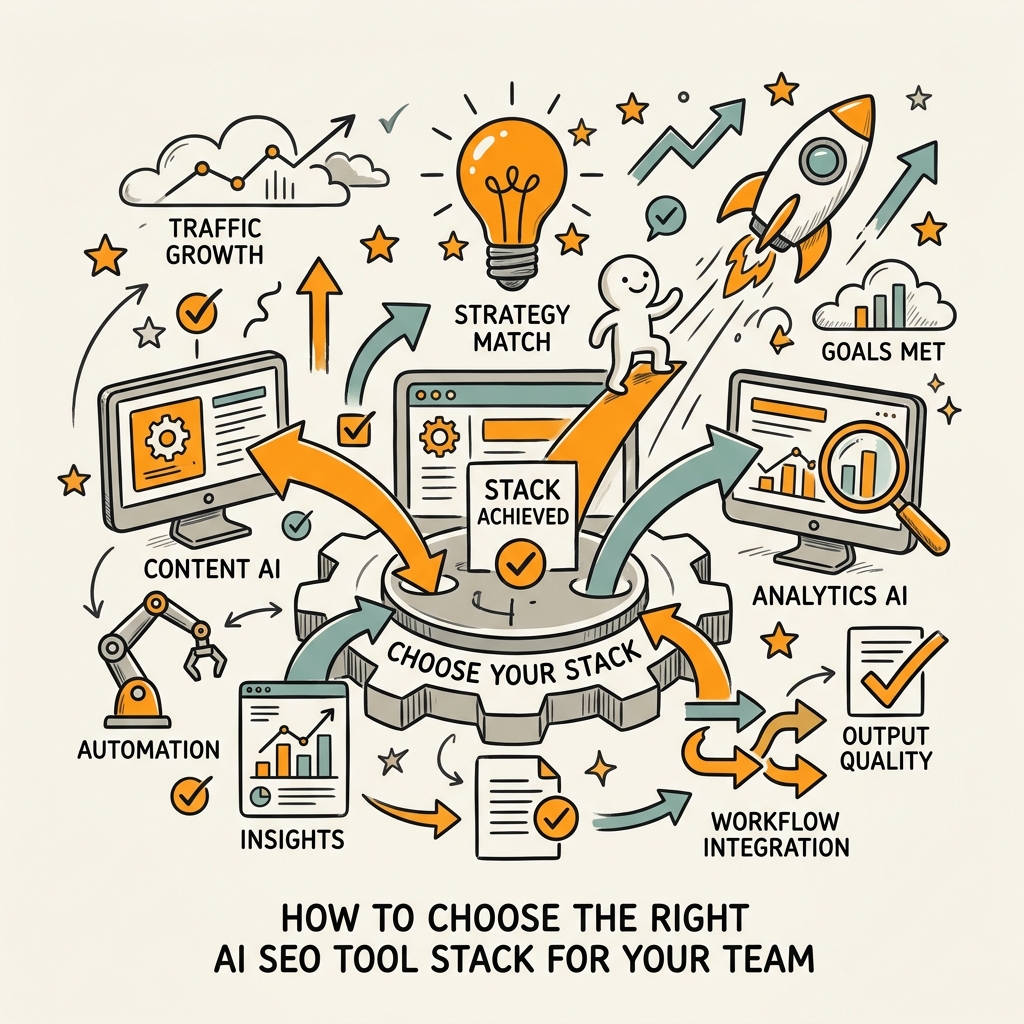
The best tool depends entirely on your bottleneck. Ask yourself: What's stopping us from shipping more high-quality content?
- If it's bandwidth/capacity: You need Jottler or a similar autonomous engine. Manual tools require more human input, which doesn't solve the core problem.
- If you have writers but they lack optimization guidance: Surfer or Clearscope plugs in immediately. Writers improve content quality, content ranks faster, and cost per article stays low.
- If it's keyword strategy: Start with Ahrefs or Semrush for research, then pair with an optimizer or writer to execute.
- If you need enterprise governance: BrightEdge or Conductor pay for themselves through operational efficiency and cross-team alignment.
- If your strategy is question-driven or AI Overviews-focused: Frase is built for that specific use case and accelerates time-to-ranking in answer blocks.
Most mid-market teams run a hybrid stack: one tool for research (Ahrefs or Semrush), one for optimization (Surfer or Clearscope), and sometimes a third for specialized niches (Frase for FAQ content, Botify for technical SEO at scale). The risk is complexity and cost creep. Each tool adds to the surface area of onboarding, training, and ongoing overhead.
This is why SEO automation platforms like Jottler are gaining adoption. They consolidate the entire pipeline into one system. You specify your publishing frequency and content focus, and the engine handles keyword research, content generation, optimization, fact-checking, and publishing. One tool, one workflow, compound growth.
AI Overviews and Answer-Engine Optimization in 2026
Google's AI Overviews and ChatGPT's growing search usage mean content strategy in 2026 must account for LLM-extracted answers, not just traditional rankings. Tools built for this paradigm shift are becoming essential.
AI Overviews prioritize definitional clarity, step-by-step guides, and direct answers to questions. If your top 10 results are all listicles and no how-to guides, you likely won't appear in the overview. Frase is specifically optimized for this pattern. It analyzes which question-driven content types rank in AI Overviews, guides your writing toward those formats, and scores your content against the LLM's likely interpretation.
For broader content, tools like Surfer and Clearscope now include AI Overviews scoring in their optimization dashboards. This is table stakes in 2026. Any optimizer that doesn't factor in LLM-driven answer extraction is optimizing for yesterday's search.
"The future of SEO isn't about traditional rankings alone. It's about being visible in AI Overviews, appearing in ChatGPT results, and being extracted into answer formats that LLMs prefer. Content teams that don't account for this are optimizing blind."
Michael Chen, SEO Strategy Lead, Darkroom Agency
The practical implication: your content strategy should include a mix of traditional ranking targets plus question-driven content designed to appear in AI Overviews. Tools that measure both are table stakes.
Building Internal Linking at Scale with AI
One overlooked advantage of best AI SEO tools is their ability to manage internal linking at network scale. Manual internal linking doesn't compoundit's a one-time task per article. Automated systems that link new content to existing articles and cluster related topics across your entire site create topical networks that compound over time.
Jottler includes smart internal linking as part of its publishing pipeline. Each new article is automatically linked to 3-5 existing articles in your cluster, reinforcing topical authority and distributing link equity across related content. This is critical for topical authority strategies where search visibility depends on content clusters all signaling the same topic.
Research from SeoProfy shows that 51% of marketers use AI for content optimization, yet most don't leverage automated internal linking strategies. This is a critical gap. Semrush and Ahrefs can advise on internal linking, but they don't automate it. Surfer and Clearscope focus on on-page optimization, not network architecture. For teams building large content libraries, automated internal linking becomes a productivity multiplier.
Content published today is automatically linked to existing assets, and as your library grows, newer pieces link to older ones in a self-reinforcing network. This is one of the biggest advantages autonomous platforms have over point tools. They see your entire content library and make linking decisions that compound topical authority month after month.
Conclusion
The AI SEO tool landscape in 2026 is no longer about finding the "best" toolit's about choosing tools aligned to your bottleneck and executing with consistency. 98% of marketers plan higher AI SEO spend in 2026, driven by clear ROI: faster content creation, higher output volume, and measurable ranking improvements within weeks of adoption.
For busy founders and lean content teams, the fastest path to compound organic growth is autonomous platforms that eliminate manual workflow. For teams with established writers, content optimizers like Surfer and Clearscope deliver immediate wins. For enterprises managing complex cross-team operations, governance platforms like BrightEdge justify their cost through operational efficiency.
The common thread across all winning teams is consistency and scale. Content teams shipping 3-5 high-quality articles per week compound topical authority faster than competitors shipping 1 article per month. AI SEO tools make consistency possible without burnout. Pick the tool that fits your team structure, commit to a publishing rhythm, and let the system compound your organic traffic.
Ready to scale your content production? Start your SEO agent and automate your entire content pipelinefrom research to publishin days, not weeks.
FAQs
What is the best AI SEO tool for content teams?
The best tool depends on your specific bottleneck. For autonomous content generation and publishing at scale, Jottler is built specifically for busy founders and lean teamsit generates, optimizes, and publishes complete articles daily without manual intervention. For content optimization with an existing writing team, Surfer SEO is the industry standard with real-time SERP analysis and seamless Google Docs integration. For keyword research and competitive benchmarking, Ahrefs and Semrush dominate. The right choice matches your team size, publishing capacity, and preferred workflow.
How much should a content team spend on AI SEO tools?
Most growing teams start with 2-3 tools: one for research ($99-$200/mo), one for optimization ($99-$200/mo), and optionally a specialized tool like Frase for question-driven content. Total monthly spend ranges from $200-$500 for a team of 2-5. Autonomous platforms like Jottler start at $29/mo and scale with your content output needs, replacing the need for multiple point tools. The ROI calculation is simple: if a tool saves your team 5 hours per week, it pays for itself immediately at typical SaaS team rates.
Can AI SEO tools replace human writers?
AI SEO tools excel at accelerating and optimizing workflows, but human editorial judgment remains critical for strategy, voice, and fact-checking. Most winning teams use hybrid workflows where AI handles research, drafting, and on-page optimization while humans focus on strategic direction, editing for brand voice, and verifying sensitive claims. Autonomous platforms like Jottler include fact-checking agents that verify claims against multiple sources, reducing but not eliminating human review. The best approach: let AI handle the high-volume, repetitive work and deploy your writers on higher-leverage strategic content.