Top Content Strategy Frameworks for Marketers
Most marketing teams operate without a clear content strategy. Instead of intentional planning, they scramble week to week, repeating topics, missing key audiences, and producing content that feels reactive instead of purposeful. The cost? 66.5% of content marketers struggle knowing where to allocate resources, and only 42% can prove ROI from their efforts. A documented content strategy flips this entirely: organizations with formal strategies generate 3x more leads per dollar spent than those flying blind. The solution is a proven framework that connects your content directly to business goals, clarifies audience needs, and compounds your marketing results over time. Here's a practical summary of how to implement the frameworks that actually drive measurable outcomes:
Key Takeaways
- Organizations with documented content strategies generate 3x more leads per dollar spent and 33% higher ROI than those without (2026).
- The five-step framework (goals → personas → pillars → channels → measurement) unifies teams and keeps content aligned to business outcomes.
- Pillar-based content structures improve SEO, E-A-T signals, and organic reach when paired with consistent publication schedules.
- SMART Goals and KPI Mapping: Transform vague content ambitions into specific, measurable targets tied directly to business outcomes and budget allocation.
- Audience Personas and Funnel Mapping: Define customer pain points, goals, and objections at each stage to create content that moves buyers forward systematically.
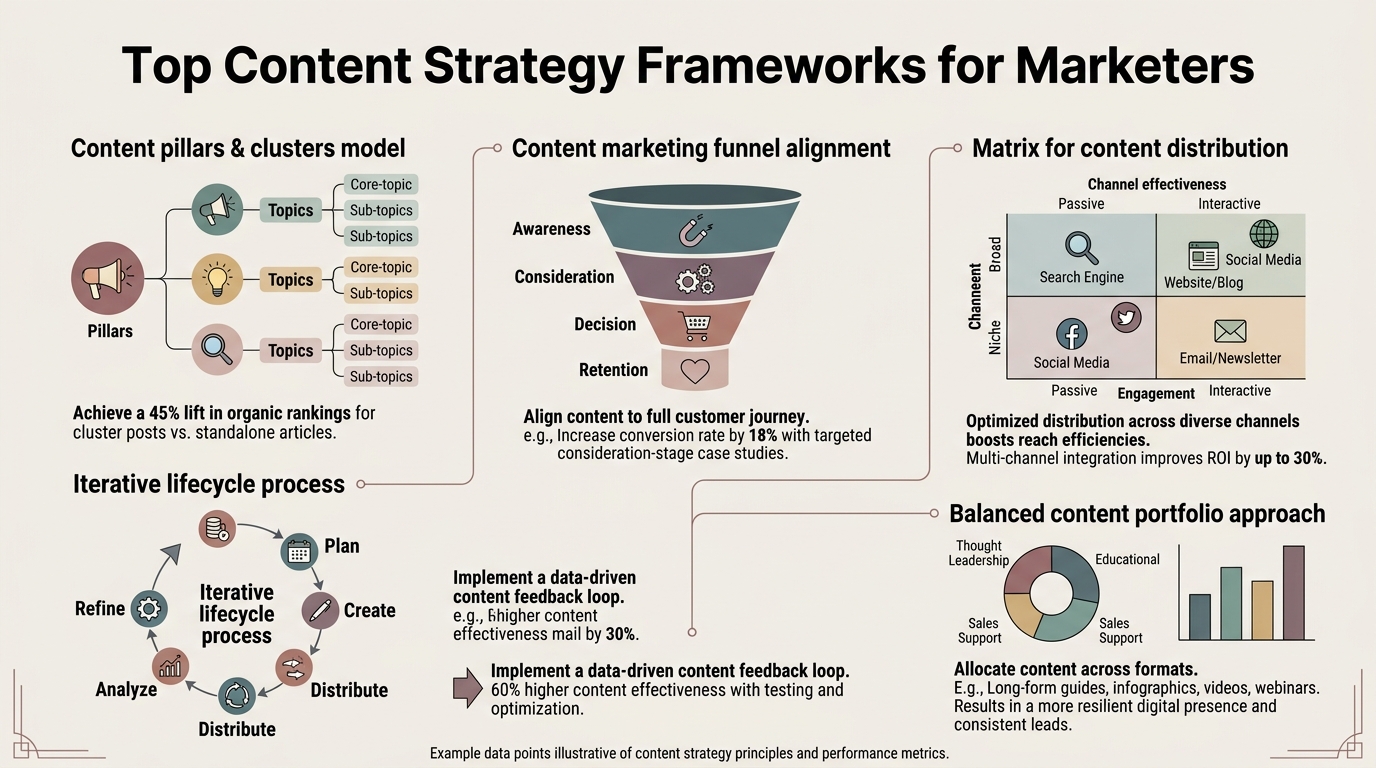
- Pillar Content Model: Build authoritative deep-dives (pillars) supported by sub-topic articles (clusters) to establish expertise and improve search rankings.
- Channel and Format Strategy: Align content types (long-form, video, short-form) to where your audience lives and how they consume information.
- Measurement and Iteration System: Track content performance against KPIs weekly to identify what works and double down on winning topics.
Define SMART Goals and Map Content KPIs to Business Outcomes
The first step in any content framework is setting goals so clear they're unmistakable. Not "increase traffic" or "generate leads"those are too vague to guide decisions. Instead, define SMART goals (Specific, Measurable, Achievable, Relevant, Time-bound) that connect directly to what your business needs. Companies that set measurable content KPIs achieve 3.5x higher conversion rates compared to those without formal goals, because clarity forces accountability.
Define Specific, Time-Bound Business Objectives
Start with the outcome your business needs. Are you scaling revenue, reducing customer acquisition cost, expanding into a new market segment, or building brand authority in a niche? Once you answer that, translate it into a SMART goal. Instead of "boost brand awareness," write: "Increase organic traffic to product pages by 40% in 12 months" or "Add 500 qualified email subscribers per quarter from blog readers." The specificity matters because it tells your team exactly what success looks like and by when. As leading content strategists emphasize, clear goals keep your team speaking with one voice and makes the best use of your time and resources.
Map Content Metrics to Revenue Impact
Not all traffic is equal. Some content drives high-intent visitors who convert; other content builds early-stage awareness. Your KPI map should distinguish between these. Define metrics for each funnel stage: awareness (organic impressions, branded searches), consideration (engagement time, pages per session, lead captures), and decision (demo requests, trial signups, closed deals traced back to content). Teams that track revenue-influenced content see 7.65x ROI, compared to unmeasured programs. Link each KPI to a specific content outcomee.g., "How-to guides drive 60% of qualified leads; increase how-to article production from 4 to 8 per month."
Allocate Budget Based on Content Stage and Channel Performance
Content marketing accounts for 26% of total marketing budgets in 2026, and the best teams allocate that spend strategically. Don't divide budget equally across all content types. Instead, invest more heavily in formats and topics that historically convert best for your business. If video generates 3x the engagement on LinkedIn, allocate more production budget there. If long-form SEO content drives free organic traffic that compounds monthly, that deserves a higher share than one-off social posts. This forces prioritization and prevents the "do everything" paralysis that derails scaling teams. Tools like B2B content automation make budget stretch further by handling repetitive research and production tasks automatically.
Build Detailed Audience Personas and Map Content to Buyer Stages
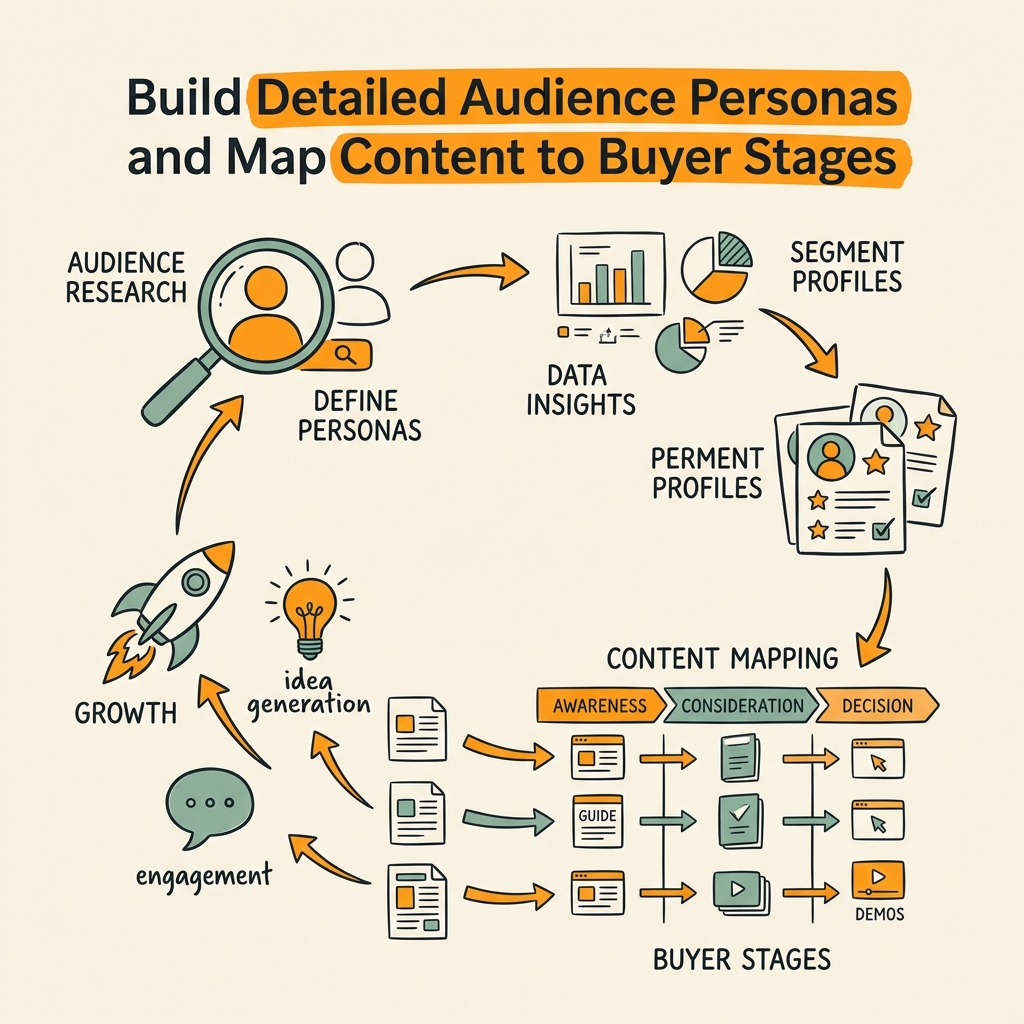
Generic content reaches no one. The second framework element is mapping specific audiences and understanding what information they need at each step of their buying journey. Brands using detailed audience personas achieve 28% higher engagement rates because the content directly answers the questions buyers are actually asking. This isn't demographic guessingit's grounded research about real pain points, decision criteria, and objections.
Document Core Audience Segments and Their Motivations
Identify the 2-4 core audience segments your business serves. For a B2B SaaS company, this might be: founders/execs (buying decision-makers), marketing managers (daily users), and technical integrations leads. For each segment, document: role, company size, key pain points, goals, tools they currently use, and platforms where they consume information. The level of detail matters. "Founders want to scale growth" is useless. "Founders at Series A companies spend 60% of their time on hiring and product, 20% on revenue, leaving minimal capacity for marketingthey need automation solutions that require no oversight" is actionable. This precision in audience definition ensures every piece of content you produce resonates with someone real and solves a tangible problem.
Map Content to Each Stage of the Buyer Journey
Buyers move through predictable stages: awareness (problem recognition), consideration (evaluating solutions), and decision (choosing between options). Your content should speak to each. In awareness, create educational content that defines problems and educates: "What Is Customer Acquisition Cost?" or "Why Most Startups Fail at Scaling." In consideration, build comparison and deep-dive content: "5 Ways to Improve CAC" or "SaaS Metrics That Actually Matter." In decision, provide proof: case studies, ROI calculators, pricing comparisons. Content that maps to buyer concerns across all three stages increases conversion rates by 33% because it removes friction at each decision point. This is where integrated content solutions for different industries help teams maintain coverage across all funnel stages without constant manual planning.
Align Messaging to Objections and Trust Drivers
Every buyer has objections. A founder worries a tool will require engineering resources to implement. A marketing manager fears her team won't adopt it. Your content should address these directly. Create content that speaks to implementation ease, team adoption, and results timelines. Build trust through real customer stories, transparent pricing, honest product limitations, and credentials. Don't hide behind generic claimsprove your expertise with specific data and case studies that move customers forward at every decision stage.
Organize Content Around Pillar Topics and Cluster Subtopics
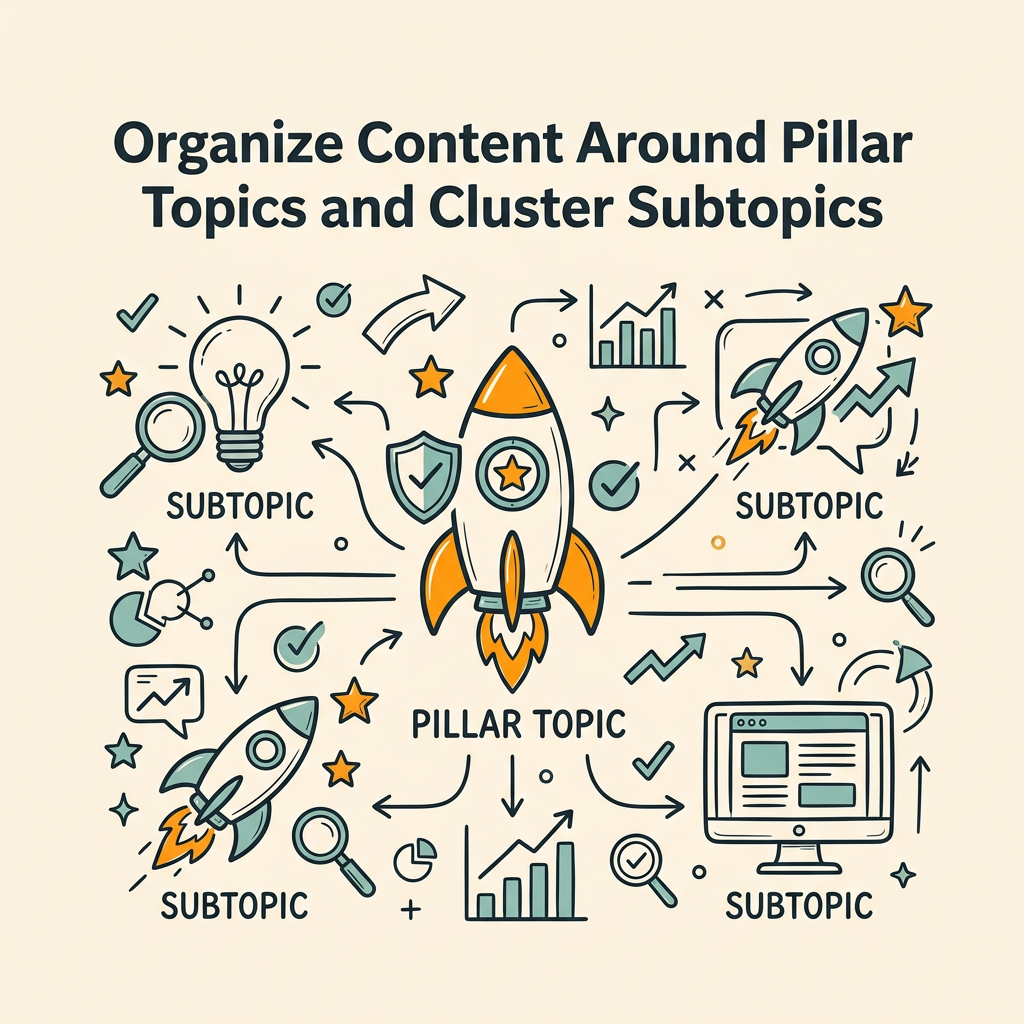
The pillar content model is the structural backbone of modern SEO and audience-building strategies. Rather than publishing random disconnected articles, you build one authoritative pillar (a comprehensive 3,000–5,000 word guide on a core topic) and surround it with 8-15 cluster articles that each tackle a subtopic. This structure signals expertise to search engines, improves internal linking, and makes navigation intuitive for readers. Teams using pillar-cluster models improve organic search rankings by 30-40% and build stronger topical authority faster than those publishing topically scattered content.
Identify Core Pillar Topics That Align With Audience Needs and Business Goals
A pillar topic should be broad enough to contain 10+ related subtopics but specific to your business. For a SaaS marketing platform, "Content Strategy for B2B SaaS" is a pillar. For a recruitment firm, "Hiring Best Practices for Remote Teams" works. For an e-commerce brand, "Sustainable Fashion and Ethical Sourcing" fits. The pillar should be evergreen (relevant for years), searchable (people actually look for it), and aligned to your ICP and content goals. Avoid overly broad pillars like "Marketing" (too vague) and overly niche ones like "Advanced Behavioral Economics in Email Campaigns" (too narrow to sustain 10+ subtopics).
Build a Cluster Architecture: Subtopics That Support the Pillar
Once you've chosen your pillar, list all the questions, sub-topics, and searches related to it. These become your cluster articles. If your pillar is "Content Strategy for B2B SaaS," your clusters might include: "How to Build Buyer Personas," "Content Calendar Templates," "SEO Best Practices for B2B," "Sales and Marketing Alignment," "Measuring Content ROI," "Video Content for SaaS," and "Long-Form vs. Short-Form Content Tradeoffs." Each cluster article is 1,000–2,000 words, fully optimized for a specific long-tail keyword, and internally linked back to the pillar and other clusters. This interconnected network tells search engines your content is comprehensive and authoritative.
Link Strategically to Build Topical Authority
The magic of the pillar model is in the linking structure. Your pillar should link to every cluster article. Each cluster article should link back to the pillar and to 2-3 related clusters. This creates a content network that distributes authority and keeps readers exploring your full expertise. When Google crawls your site, it sees this connected structure and understands you've thoroughly covered the topic. The result is stronger rankings for both the pillar and all its clusters. Tools that automate content creation and internal linking make this architecture sustainable at scale, because manual internal linking is tedious and easy to miss when publishing multiple articles weekly.
Select Channels and Content Formats Based on Audience Behavior and Goals
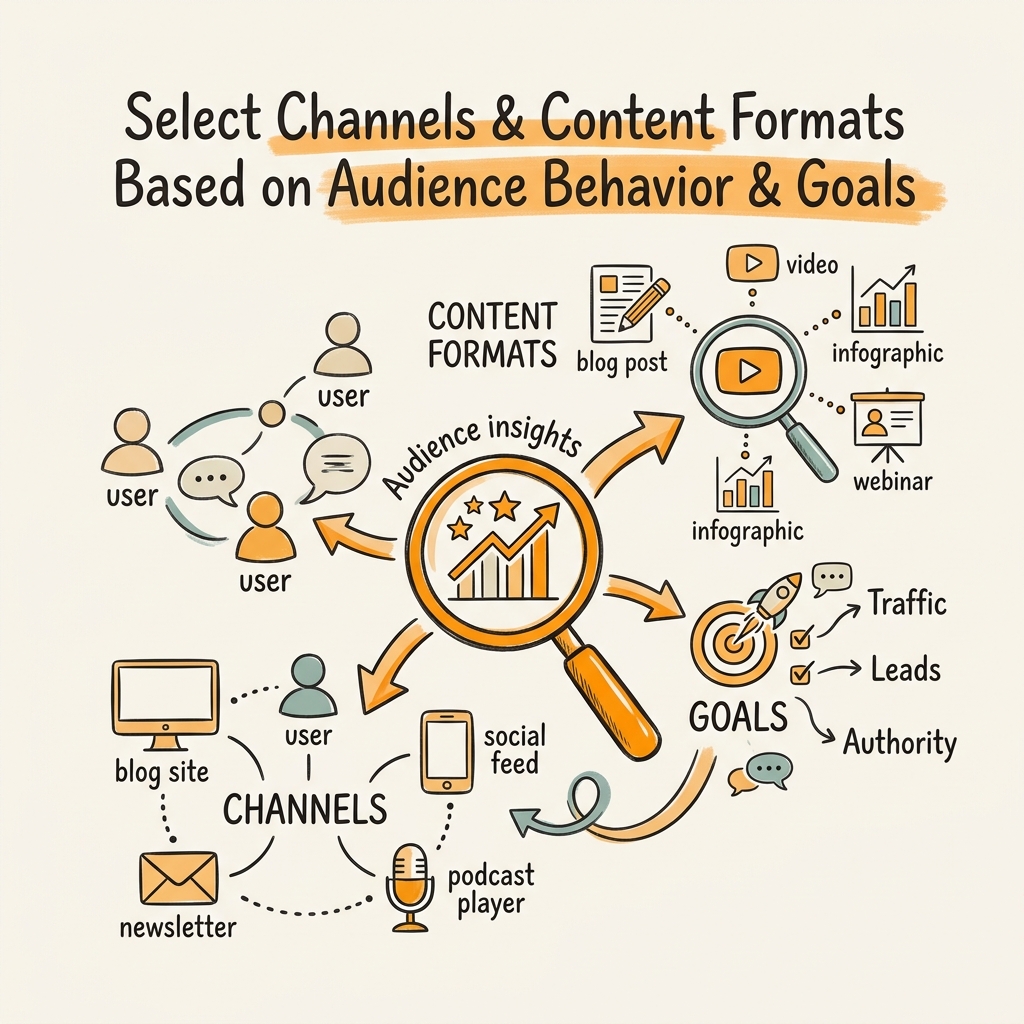
Once you've defined who you're reaching and what you're saying, decide where and in what format they'll consume it. Video is used by 58% of B2B and 87% of B2C marketers, yet blogs still drive the highest organic ROI for most B2B teams. LinkedIn is the top distribution channel for B2B (84% adoption), while Instagram leads for B2C. Your channel and format strategy should match audience platform preferences and your content goals.
Prioritize Channels Where Your Audience Is Most Active
Don't try to own every platform. Instead, identify where your core audiences spend the most engaged time. For B2B founders and growth teams, this usually means LinkedIn, industry newsletters, Slack communities, and SEO-driven blogs. For consumer brands, TikTok, Instagram Reels, and Pinterest often deliver faster reach. For technical audiences, Reddit, GitHub, and YouTube perform well. Allocate your production budget to 2-3 primary channels where you can sustain consistent, high-quality output. Secondary channels can run on repurposed content, but your primary channels deserve dedicated effort.
Match Content Formats to Audience Preferences and Consumption Habits
The right format depends on where the content lives and what the audience expects. Long-form blog posts (1,500+ words) perform best for search ranking and deep education. Short-form video (15-90 seconds) dominates social feeds for retention and algorithmic reach. Case studies and whitepapers work for lead generation. Email newsletters build loyal, returning audiences. Webinars and live video create community and urgency. The best content strategies don't pick one formatthey create a mix: 94% of B2B and B2C marketers now plan to use AI for content creation in 2026, which makes it possible to produce multiple format variations from a single research effort. Create one deep research foundation, then produce: a long-form blog post, a video summary, a carousel post, an email sequence, and a downloadable guide from the same core work. This multiplier effect is what separates scalable strategies from those that plateau.
Build a Content Calendar That Balances Education, Entertainment, and Conversion
A sustainable framework includes a calendar that shows what content is being produced, when it publishes, and where it distributes. The best calendars follow a simple ratio: 70% educational (answering audience questions, building trust), 20% entertaining (behind-the-scenes, culture, humor), 10% promotional (direct pitches, CTAs, conversion asks). This mix keeps your audience engaged without feeling sold-to constantly. For teams producing at scale, automation is essentialpublishing frameworks that include automated research, writing, and distribution let you maintain consistent output without burning out your editorial team.
Implement a Measurement System and Iterate Weekly
The final framework component is measurement. Without it, you're flying blind. Only 42% of organizations can prove ROI from content, but those who do unlock 3.1x budget growth because they have data to justify investment. Your measurement system should track performance weekly, flag what's working, and inform your production priorities.
Define Clear Metrics for Each Content Type and Stage
Not all content drives the same outcomes. Awareness content should be measured by impressions and reach. Engagement content by time-on-page and scroll depth. Lead-generation content by form submissions and lead quality. Conversion content by demos booked or trials started. Build a simple dashboard that shows: pageviews, organic traffic, leads by source, and revenue influenced (the sales team should tag deals that came from specific content). Review this weekly. Which content types consistently drive leads? Which topics convert best? Which channels deliver the highest-intent audience? This data tells you where to double down.
Track Content Performance and Identify Top-Performing Topics
After 4-8 weeks of publishing, patterns emerge. Certain topics outperform others. Certain formats convert better. Certain channels deliver higher-quality engagement. Document these patterns. If "How-to" guides consistently generate 3x the leads of industry trend pieces, produce more how-tos. If video on LinkedIn converts sales leads but video on TikTok only builds awareness, adjust your distribution strategy accordingly. Teams publishing weekly see 3.5x conversion rates compared to monthly publishers, because consistency builds audience familiarity and algorithmic favor. Use your measurement data to allocate more production capacity to what works.
Adjust Strategy Based on Data and Market Shifts
Content strategy isn't set-and-forget. Review your framework quarterly. Are your KPIs on track? Is audience interest shifting? Are new competitors creating content you need to address? Are new platforms emerging where your audience has migrated? The best frameworks include a review process: quarterly strategy meetings where the marketing and sales teams look at the last quarter's performance, identify what to double down on, what to kill, and what new opportunities to test. This keeps your strategy fresh and responsive rather than stale and dogmatic.
Conclusion
Content strategy frameworks solve the chaos that undermines most marketing teams. By defining clear goals, understanding your audience, organizing content around pillars, choosing the right channels, and measuring rigorously, you transform content from guesswork into a compounding business asset. Organizations with documented content strategies generate 3x more leads per dollar spent and achieve 33% higher ROI than those without. Teams publishing consistently see 3.5x higher conversion rates. The frameworks outlined hereSMART goals, audience personas, pillar clusters, channel strategy, and weekly measurementare the foundation. The execution depends on your team's capacity to research, write, and publish at consistent volume. That's where automation becomes essential. Instead of hiring five writers and a project manager to produce content reliably, start your SEO agent with Jottler and let AI research, write, and publish your content framework automatically while your team focuses on strategy and performance analysis.
FAQs
What are the key components of a content strategy framework?
A solid content strategy framework consists of five interconnected parts: SMART business goals that define what success looks like with specific metrics and timelines; detailed audience personas that document pain points and decision criteria across buyer journey stages; pillar content topics organized with supporting cluster articles to build topical authority; channel and format selection aligned to where your audience consumes content; and a weekly measurement system that tracks performance and informs prioritization. Together, these components keep your team aligned, eliminate guesswork, and ensure every piece of content serves a business objective.
How do I measure content strategy success?
Track three layers of metrics: awareness (impressions, organic traffic by topic), engagement (time on page, scroll depth, shares), and conversion (leads captured, demo requests, revenue influenced). Create a simple dashboard updated weekly that shows which content types, topics, and channels are driving results. Most teams find that 20% of their content drives 80% of resultsyour job is to identify that 20% and reallocate production toward it. Include your sales team in review meetings so they can tag deals that came from specific content, giving you true revenue-to-content attribution.
How often should I publish to see results from a content strategy?
Teams publishing weekly see 3.5x higher conversion rates compared to monthly publishers, and weekly output compounds organic reach significantly over time. For most B2B businesses, 2-4 high-quality articles per week is sustainable and effective. For B2C brands, 4-6 articles per week works better. Consistency matters more than volumepublishing four articles every Monday is less effective than spreading one article per day across the week. If your team struggles with production capacity, automated tools can help you maintain publication frequency without increasing headcount.