Topical Authority: Drive More Organic Traffic
Every scaling founder and marketing leader faces the same problem: ranking for a single keyword once felt like winning, but now it's not enough. Search algorithms have shifted. Google and AI engines like ChatGPT now reward sites that own entire topics, not just target individual keywords. The result? Sites building topical authority see a 3.1x increase in organic traffic compared to those chasing isolated keywords. Yet most teams still publish scattered content with no structure, wondering why organic growth plateaus despite consistent publishing. The fix isn't publishing more, it's publishing smarter. Here's how to build the topical authority that drives compounding organic traffic.
Key Takeaways
- Topical authority is now the #1 ranking factor—sites with structured content clusters see 3.1x higher organic traffic growth and 47% keyword ranking improvements within 12 months (MyDigipal, 2026)
- The critical mass threshold: 25–30 high-quality, interlinked articles per topic cluster are required for full authority compounding and sustained ranking dominance
- Content clusters rank for 3x more keywords than isolated pages targeting the same terms, with 80%+ of cluster keywords ranking within 90 days of reaching critical mass (RankDraft, 2026)
- Define Your Topic Cluster: Map out 3–5 pillar topics and the 25–30 subtopic articles required to own each one in search and AI engines.
- Build Your Pillar Page: Create a 3,000–5,000 word cornerstone article that covers the broad topic and links to all supporting cluster articles.
- Publish Supporting Cluster Articles: Launch 1–2 in-depth cluster pages per month (1,500–2,500 words) targeting specific long-tail keywords within your pillar topic.
- Architect Strategic Internal Links: Every cluster article must link back to the pillar and laterally to 2–3 related cluster articles—no orphan pages allowed.
- Measure Topic Share and AI Citations: Track impressions, average ranking position, and AI engine mentions by topic to prove authority and justify continued investment.
What Is Topical Authority and Why It Matters in 2026
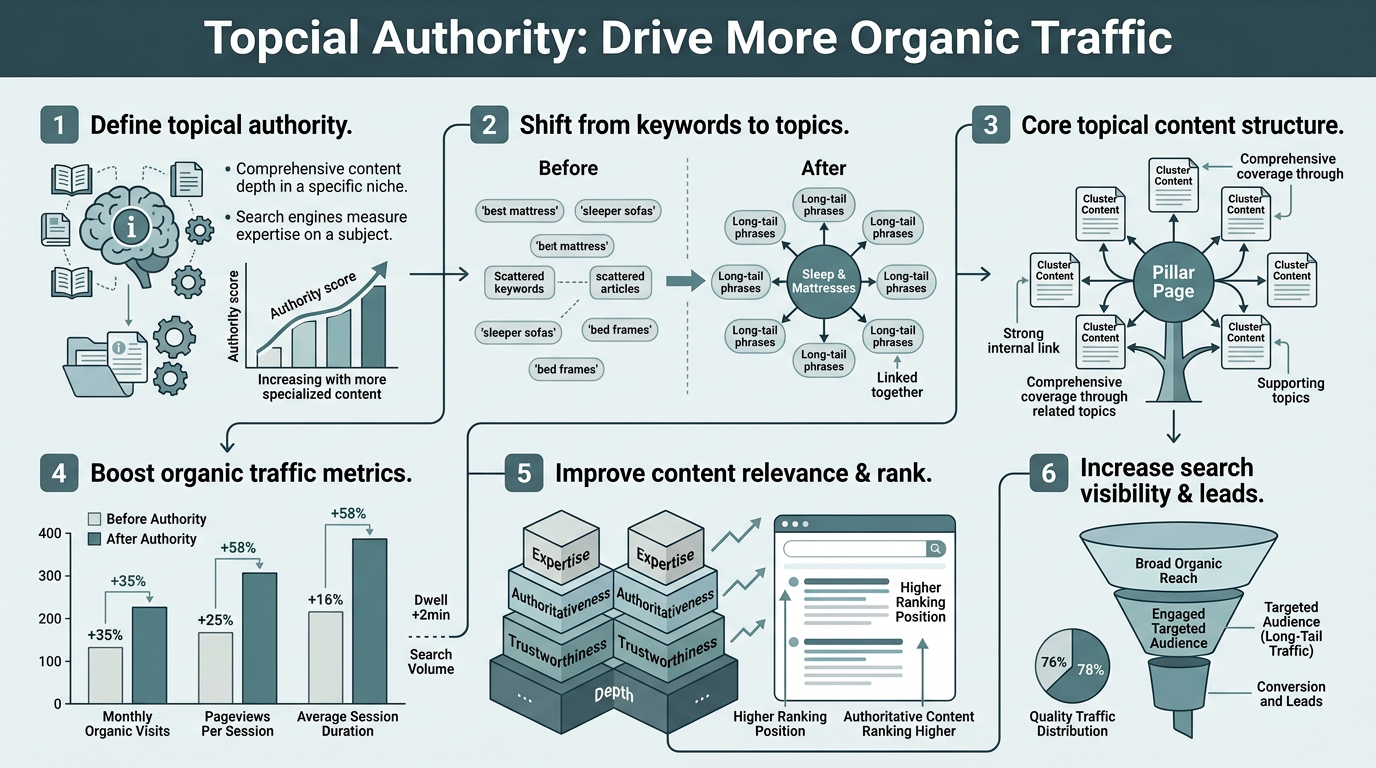
Topical authority is Google's and AI engines' perception of your site as the expert source on an entire subject, not just individual keywords. It's measured by how much traffic you capture from a topic compared to competitors. The shift is profound: in 2025, the industry consensus was clear—topical authority is now the strongest driver of organic growth, outperforming keywords, backlinks, and search volume. Traditional SEO obsessed over keyword rankings. Topical authority reverses that: it's about becoming synonymous with an entire ecosystem of related ideas.
The Gap Between Traditional SEO and Topic-First Strategy
The old playbook was simple: find a keyword with decent volume and low competition, write a post, earn a backlink, rank. That approach is broken. Why? Search engines evolved. They now understand semantic relationships between ideas. A reader asking "How do I build topical authority?" isn't just looking for that exact phrase—they're looking for depth on content strategy, clustering, internal linking, and measurement. If your site covers only one angle, you rank for that one query. If your site covers all angles in an interconnected way, you rank for hundreds of related queries.
"Traditional keyword-focused SEO is dead. The sites winning in 2026 are those that own entire topics through interconnected, comprehensive content clusters. A single pillar page linked to 25+ research-backed cluster articles signals topical expertise more powerfully than any backlink ever could."
Tools like Jottler's AI content generation for SEO make this structural shift automatic. Instead of publishing isolated articles, it researches entire topic clusters, writes interconnected 3,000+ word articles daily, and builds strategic internal linking networks without manual overhead. For founders balancing product work with marketing, that automation transforms topical authority from a theoretical ideal into a compounding engine.
How AI Engines Changed the Ranking Game
Google AI Overviews, ChatGPT, Perplexity, and Claude don't just rank pages—they cite them. And they cite sources with demonstrated topical depth far more frequently than isolated pages. The data is clear: sites with high topical authority are cited 3x more by AI models than sites with scattered content. This matters because AI citations are the new form of authority. When ChatGPT recommends your article, your brand appears as the expert source to millions of users. Topical authority is the foundation of that visibility.
"AI engines prioritize sources that demonstrate comprehensive topical expertise over isolated, one-off articles. A content cluster spanning 25+ interconnected articles signals authority so clearly that AI models cite you by default. This is the new SEO moat."
The Content Cluster Framework: From Topic to Ranking
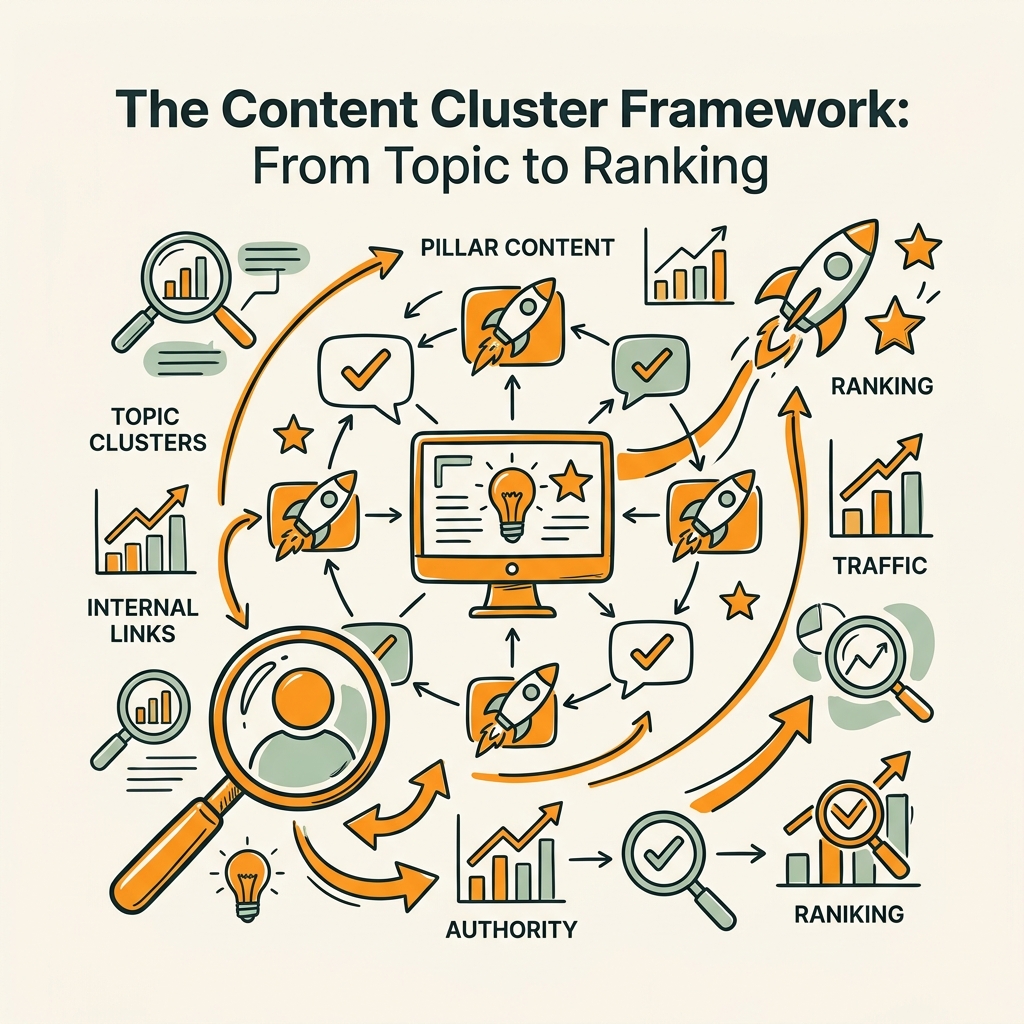
Building topical authority starts with architecture. You need a framework that aligns content structure with how search engines and AI systems understand topic relationships. The hub-and-spoke model has become the industry standard, and the data supports it: sites implementing content clusters see 40% increases in organic traffic compared to non-clustered strategies. Here's how it works.
The Pillar Page: Your Topic's Foundation
The pillar page is the hub. It's a comprehensive, 3,000–5,000 word overview of your broad topic. Unlike a typical blog post, a pillar page doesn't dive deep into one angle—it covers the topic map. For "Topical Authority," a pillar page would address: What is it? Why does it matter? How do you build it? What are common mistakes? How do you measure it? It then links outward to every supporting article, signaling to Google that this page is the authoritative center of your content network.
The pillar doesn't rank for high-volume queries. Instead, it captures branded and broad-match queries, then funnels readers to more specific cluster pages that handle long-tail keywords. Internally, the pillar page is the hub every cluster article links back to, reinforcing hierarchy and topical relationship.
Cluster Articles: Depth on Specific Subtopics
Cluster articles are the spokes. Each one targets a specific long-tail keyword within your topic and goes 1,500–2,500 words deep. If your pillar is "Topical Authority," your cluster articles might target: "How to measure topical authority," "Content cluster strategy for SaaS," "Internal linking best practices for topic clusters," "Building topical authority in competitive niches," etc. Each article is self-contained but explicitly linked back to the pillar and to 2–3 related cluster articles.
The key metric: 80%+ of cluster keywords see ranking gains within 90 days after reaching critical mass (8–10 articles). That compounding effect is why founders lean into topical authority—short-term effort, long-term passive traffic. Tools that automate cluster research and publishing, like best-in-class AI SEO tools, cut that timeline in half by removing the manual bottleneck of writing and linking.
How to Build Topical Authority: The Five-Step System
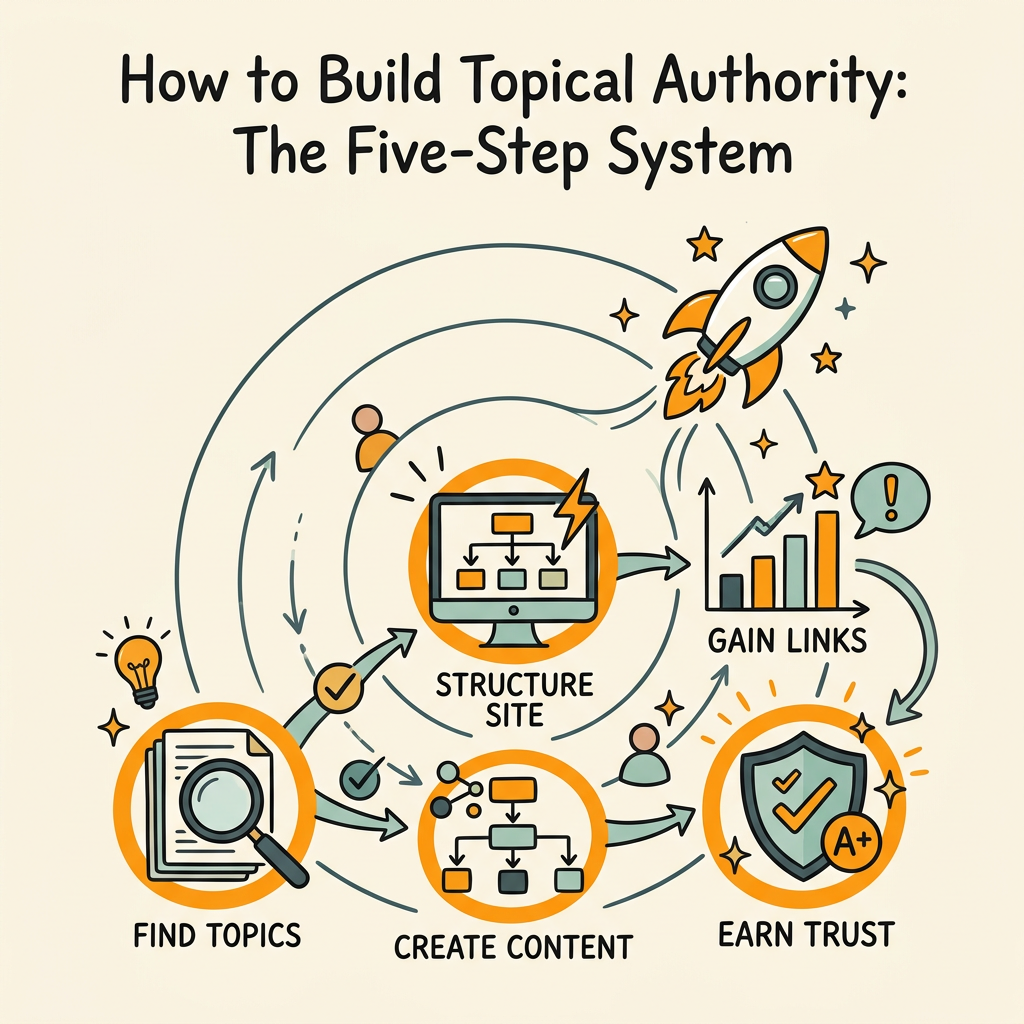
Building topical authority requires discipline, consistency, and strategic structure. Here's the proven 2026 playbook, grounded in industry data and applied by leading SaaS companies.
Step 1: Audit Your Content and Define Your Clusters
Start with an honest inventory. What topics does your site currently cover? Where are the gaps? Use competitor analysis and Ahrefs or similar tools to map competitors' content clusters and identify subtopics they own that you miss. Then define 3–5 pillar topics aligned with your business and audience. For a B2B SaaS company selling SEO tools, your pillars might be: "SEO Strategy," "Content Marketing," "Link Building," "Technical SEO," and "AI & SEO."
- Content audit: List all existing articles and bucket them by pillar topic.
- Gap analysis: Identify 3–5 long-tail keywords within each pillar that competitors rank for but you don't.
- Consolidation: Flag any articles under 800 words for expansion or consolidation with related pieces.
- Structure definition: For each pillar, sketch the 8–10 core cluster articles you'll publish first (critical mass), then plan the path to 25–30.
Step 2: Create Your Pillar Page
Write or update your pillar page. It should be 3,000–5,000 words and cover the broadest definition of your topic. Include a table of contents that links to each cluster article. Use headings that mirror the subtopics you'll cover in cluster articles. The pillar page doesn't need backlinks to rank—its job is to anchor your topic ecosystem and provide internal link juice to cluster articles. Every cluster article will link back to it, creating a reinforced topical signal.
Step 3: Publish Cluster Articles on a Sustainable Cadence
Publish 1–2 cluster articles per month per pillar topic. Each one should target a specific long-tail keyword, go 1,500–2,500 words deep, and include original data, case studies, or expert quotes to differentiate it. The critical mass threshold is 8–10 articles per cluster to trigger ranking gains; 25–30 for full authority dominance. This is where most teams fail—they publish sporadically, then give up before reaching critical mass. The result is no compounding effect.
Consistent publishing is where programmatic SEO approaches add value. Publishing 1–2 articles daily means reaching critical mass in weeks, not months. The AI agents research clusters, write comprehensive articles, fact-check, and publish directly to your CMS with internal linking built in—all without founder involvement.
Step 4: Execute Strategic Internal Linking
The internal linking architecture is what transforms a collection of articles into a topical authority signal. Here's the rule: no orphan pages. Every article must receive links from at least 2 other pages.
| Linking Direction | Purpose | Example Anchor Text |
|---|---|---|
| Cluster → Pillar | Every cluster article links back to the pillar | "Learn the full topical authority framework" |
| Pillar → Cluster | The pillar links out to all cluster articles | "How to measure topical authority with precision" |
| Cluster ↔ Cluster | Cluster articles link laterally to 2–3 related clusters | "Best practices for internal linking in topic clusters" |
| No Generic CTAs | Use descriptive, keyword-relevant anchor text | Avoid "read more" or "click here" |
Use automated tools that build internal link networks intelligently—they understand topical relevance and create links that Google recognizes as structural signals, not manipulation.
Step 5: Measure Topic Share and AI Citations
Track three metrics monthly: cluster impressions, average ranking position, and AI citations. Use Google Search Console to monitor impressions and click-through rates by topic. Use Ahrefs or Semrush to track average ranking position for keywords within your cluster. And monitor AI mentions—check ChatGPT, Perplexity, and Google AI Overviews monthly to see if your content is cited for your topic keywords. If impressions and ranking position improve within 60 days and AI citations increase within 90 days, your cluster is winning.
Common Mistakes That Kill Topical Authority Growth
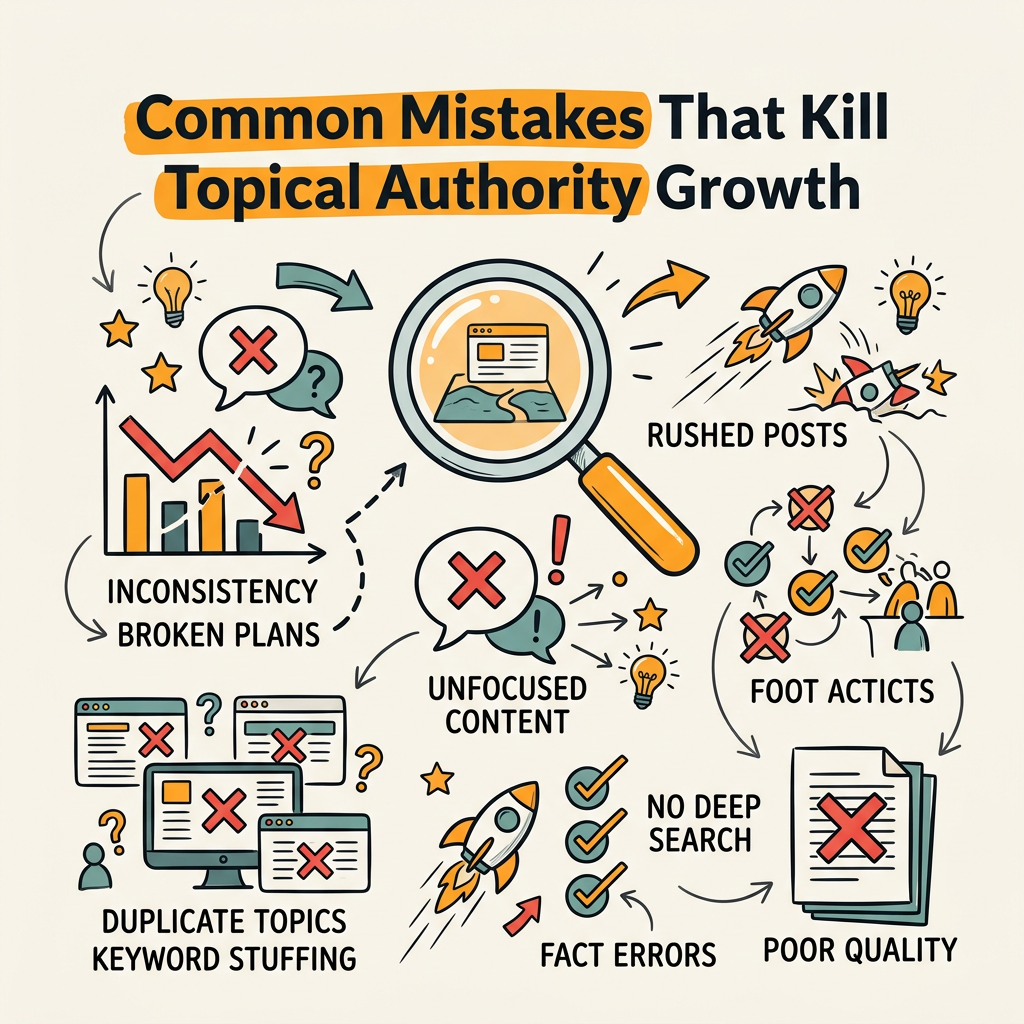
Even teams with good intentions sabotage their topical authority through preventable mistakes.
Publishing at Inconsistent Cadences
Topical authority compounds over time. Publishing 3 articles, then going dark for 3 months, then publishing 5 more, signals uncertainty to search engines. Consistency matters more than volume. One article per month, every month, for 25–30 months beats 30 articles in 3 months followed by silence. Most teams underestimate the discipline required. SEO automation tools solve this by automating consistency—set your publishing frequency (1–5 articles daily) and the system maintains it without cognitive overhead.
Weak Internal Linking Architecture
Many teams publish cluster articles but forget to link them strategically. The result: Google can't infer the topical relationship between your articles. Link your cluster articles back to the pillar every time. Link laterally between 2–3 related cluster articles. Use keyword-rich anchor text. This structural signal is more powerful than most teams realize—it transforms scattered content into a cohesive topical authority signal.
Confusing Topical Authority with Volume
Publishing 100 shallow articles on different topics will not build topical authority. Publishing 25–30 in-depth, interlinked articles on one topic will. The quality and depth of interconnection matter far more than raw count. One well-structured cluster beats three poorly-linked clusters.
Topical Authority in Action: Real-World Impact
Data from 2026 case studies shows the power of structured topical authority:
- HubSpot's content transformation: After moving to a cluster model, HubSpot saw a 55% increase in organic traffic within 12 months (Leadsuitenow, 2026).
- MyDigipal's B2B SaaS benchmark: B2B SaaS companies using topical authority saw 3.1x higher traffic growth and 47% better keyword rankings compared to traditional approaches (MyDigipal, 2026).
- AI citation uplift: Sites with 25+ interlinked articles in a cluster see 3x higher citation rates from AI engines than sites with isolated pages (Quillly, 2026).
These aren't theoretical numbers. They reflect real organic traffic impact from real teams who invested in structural topical authority. The pattern is consistent: build once, rank for hundreds of keywords, compound forever.
Topical Authority for Busy Founders: The Automation Imperative
The bottleneck for most founders is time. Building topical authority requires consistent content production, deep research, strategic linking, and regular updates. For a bootstrapped founder juggling product development, customer support, and sales, maintaining this cadence manually is impossible.
That's where autonomous SEO engines come in. Tools like Jottler automate the entire workflow: research topic clusters, write comprehensive articles, fact-check content, optimize for AI engines, and publish with internal linking built-in. The result is 3,000+ words of topical authority content published daily, without founder involvement. For teams scaling organic traffic as their core growth lever, this automation compounds dramatically—weeks of topical authority progress instead of months.
The math is simple: if you're publishing 1 article manually per month, it takes 2–3 years to build topical authority. If you're publishing with automation, it takes 8–10 weeks. That time advantage compounds into rankings, traffic, and revenue.
Conclusion
Topical authority is no longer a nice-to-have SEO strategy—it's the foundation of sustainable organic growth in 2026. The data is unambiguous: sites building topical authority see 3.1x higher traffic growth, rank for 3x more keywords, and get cited 3x more by AI engines. The structure is straightforward: one pillar page, 25–30 interlinked cluster articles, consistent publishing, and strategic internal linking. The execution is where most teams fail. Manual content production can't keep pace with the publishing frequency required to build authority fast. That's why autonomous SEO systems matter. They compress months of work into weeks, enabling founders to build topical authority without burnout.
Start today. Pick your first pillar topic. Define your cluster articles. Publish your first pillar page. Then commit to 1–2 cluster articles per month for the next 12 months. Or, start your SEO agent and let automation handle the consistency. Either way, the time to build topical authority is now.
FAQs
How long does it take to build topical authority?
Building full topical authority typically takes 12 months of consistent publishing. However, you'll see ranking gains much earlier—80%+ of cluster keywords see improvements within 90 days after reaching critical mass (8–10 articles). The exact timeline depends on your starting domain authority, niche competitiveness, and publishing cadence. Teams publishing 1–2 articles monthly reach critical mass in 8–10 months. Teams using daily publishing automation reach it in 8–10 weeks. The key is consistency—sporadic publishing resets your progress.
What's the difference between topical authority and domain authority?
Domain authority measures your site's overall trustworthiness across all topics. Topical authority measures your expertise on one specific subject. A site might have high topical authority for "SEO strategy" but low topical authority for "graphic design." Domain authority is a prerequisite; topical authority is the competitive advantage. New sites with low domain authority can still build high topical authority in niche topics by publishing deep, interconnected content. That's why bootstrapped founders can compete—topical depth beats domain age in modern search.
Do I need 25–30 articles to rank, or is critical mass lower?
You'll see ranking gains at 8–10 articles (critical mass), but 25–30 articles is required for full authority dominance and long-term ranking stability. Think of critical mass as the threshold where algorithms start recognizing your topical depth. At 8–10 articles, you'll rank for 30–50 keywords related to your topic. At 25–30, you'll rank for 100+ keywords and own the topic across search and AI engines. The marginal value of each additional article decreases after critical mass, but the compounding effect accelerates. Every 5 new articles strengthens your grip on adjacent keywords.