Using AI to Build a 12-Month Content Calendar
Most marketing teams waste 12 to 16 hours monthly manually planning their content calendars, shuffling spreadsheets, and trying to coordinate across channels. This friction kills momentum. Content ideas get lost in email threads. Publishing dates slip. Teams burn out. Yet with the right AI approach, 78% of that planning time vanishes, replaced by intelligent automation that generates, organizes, and schedules your entire year upfront. Here's how to use AI effectively to build a 12-month content calendar that actually gets executed.
Key Takeaways
- AI-powered planning cuts monthly content calendar time from 12–16 hours to 3–4 hours, a 78% reduction (Digital Applied, 2026).
- Teams using AI for ideation and trend research report 59.5% faster idea generation and 2.4x engagement lift on published content.
- 78.4% of professional marketers now edit AI-assisted content before publishing, making human review a standard workflow step, not optional.
- Start with Goals and Structure: Define content pillars and SMART goals first; AI planning accelerates execution only if the direction is clear.
- AI for Ideation and First Drafts: Use AI agents to batch-generate 12 months of content ideas, themes, and outlines in hours, not weeks.
- Organize by Campaigns and Themes: Map seasonal moments, product launches, and campaigns across quarters to create a cohesive narrative arc.
- Set Up Review and Publication Workflows: Build a human-in-the-loop process where AI generates and schedules, but your team approves and refines before going live.
- Monitor Performance and Iterate: Use AI analytics to track what content resonates, then adjust the remaining calendar in real time based on actual performance data.
Why Your Current Manual Content Calendar Isn't Scaling
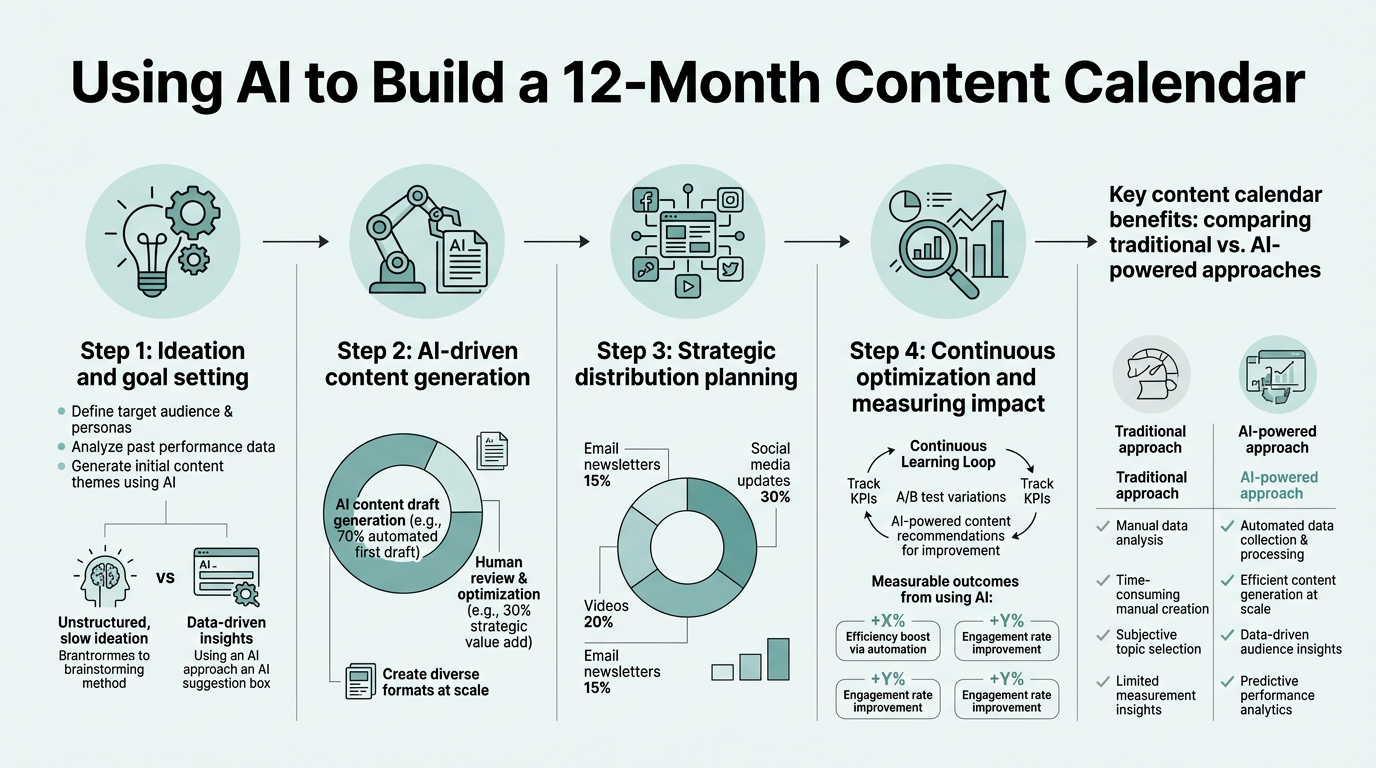
A traditional content calendar lives in a spreadsheet or project management tool. Someone spends hours brainstorming ideas, researching seasonal moments, checking competitor activity, and assigning topics to months. The moment you hit publish, the calendar is outdated. Trends shift. Audience preferences change. Your plan, built weeks ago, no longer fits the moment.
The math is brutal: 89.7% of social media marketers use AI at least several times weekly, yet most still plan calendars the old way. They're adopting AI tools for content creation but manually stringing them together. That's like having a high-performance car but driving it on a dirt road.
AI changes this calculus entirely. When you use AI-first planning, your calendar becomes a living system. It generates variations. It adapts. It identifies gaps. And it does all this in a fraction of the time.
How to Define Content Pillars and Annual Goals Before Building Your Calendar
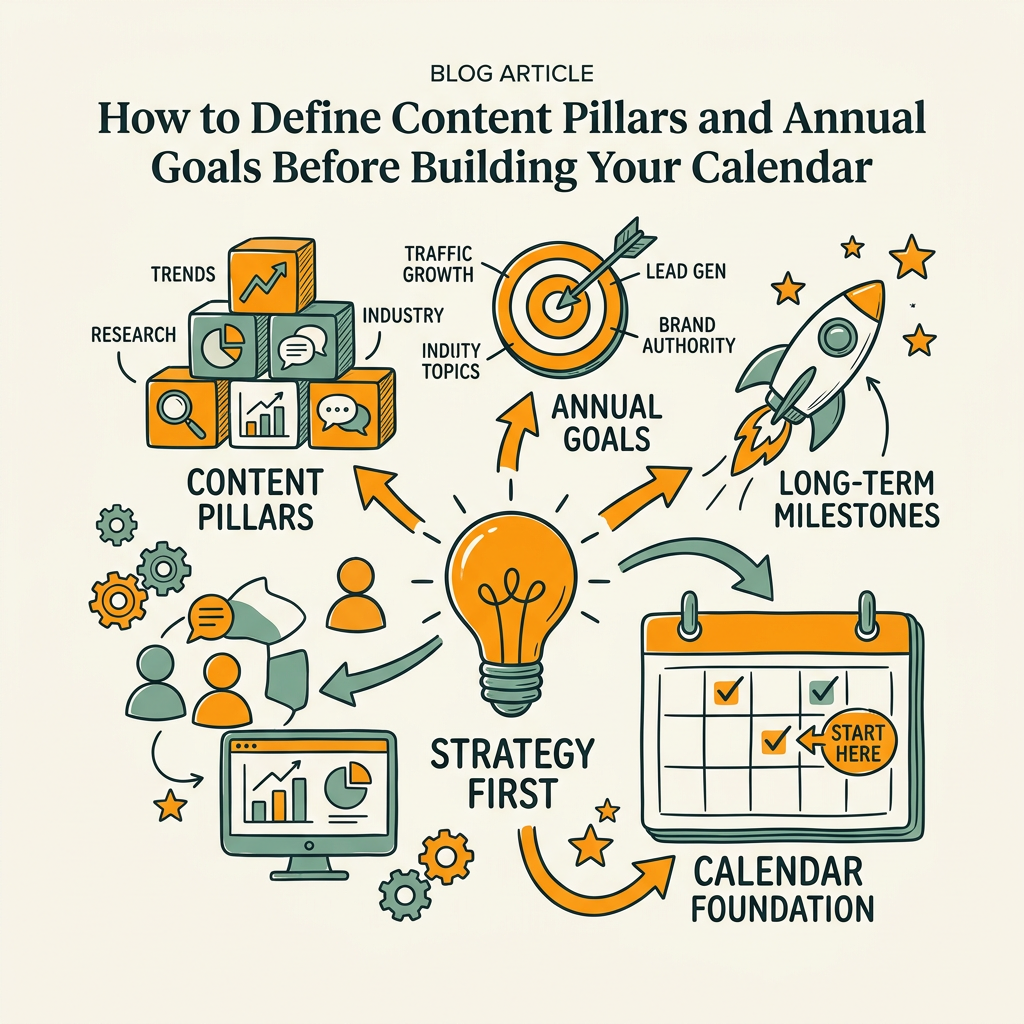
AI excels at execution, not strategy. You must decide what your 12-month calendar should accomplish before you let AI loose on ideation. This is where most teams fail, they skip the thinking part and jump straight to generation.
Start by defining 3–5 core content pillars. These are the recurring themes your audience needs to hear about. For a SaaS company, pillars might be: product features, industry trends, customer success stories, educational guides, and company culture. Each pillar becomes a recurring lane in your 12-month plan.
Next, use the SMART framework for your annual content goal. Instead of "increase organic traffic," write: "Drive 10,000 new organic visitors and 50 qualified leads through SEO content in 12 months." This specificity matters because it tells AI systems which topics to prioritize and how to structure the calendar.
Then map seasonal moments and campaigns. When does your business see demand peaks? Which industry events matter to your audience? What product launches or promotions are coming? Populate a list of 8–12 major moments across the year, then place them on your calendar as anchor points. AI will fill the gaps between them.
Only once this strategy is locked do you turn to AI. Tools like Insiderone's AI marketing automation guides emphasize that planning structure first ensures AI generation stays on-brand and business-aligned.
Using AI Agents to Generate 12 Months of Content Ideas in Bulk
This is where AI earns its keep. Rather than ideating one month at a time, you'll use AI agents to generate, organize, and validate content ideas for your entire year in a single batch operation.
The process looks like this: feed your AI system your content pillars, target audience, SMART goals, and a list of seasonal moments. In return, you get 100+ topic ideas organized by month, with recommended keywords, formats, and posting dates. 59.5% of marketers now use AI for content ideation and trend research, and those who do report completing calendars in days instead of weeks.
Tools that excel here use what's called AI-powered content calendar automation, multi-agent systems that can research topics, identify gaps in your content, and suggest variations (blog posts, social snippets, videos) all at once.
The key is batching. Don't ask AI to generate one month at a time. Give it the full year context. AI systems trained on content strategy understand arc and repetition, they'll naturally space out educational content, balance sales messages with value-driven posts, and create natural topic sequences that build authority.
One practical example: if your business targets B2B SaaS founders, and you've set a goal of "establish thought leadership in automation," AI can map out a 12-month content narrative. Month 1 could introduce the problem (manual processes drain time). Month 2 explores solutions (automation basics). Month 3–6 dive deep (AI agents, workflows, case studies). Month 7–12 reinforce and expand (advanced tactics, industry shifts, community wins). This arc is hard to build manually. AI does it in minutes.
Organizing Content by Campaigns, Themes, and Publishing Cadence
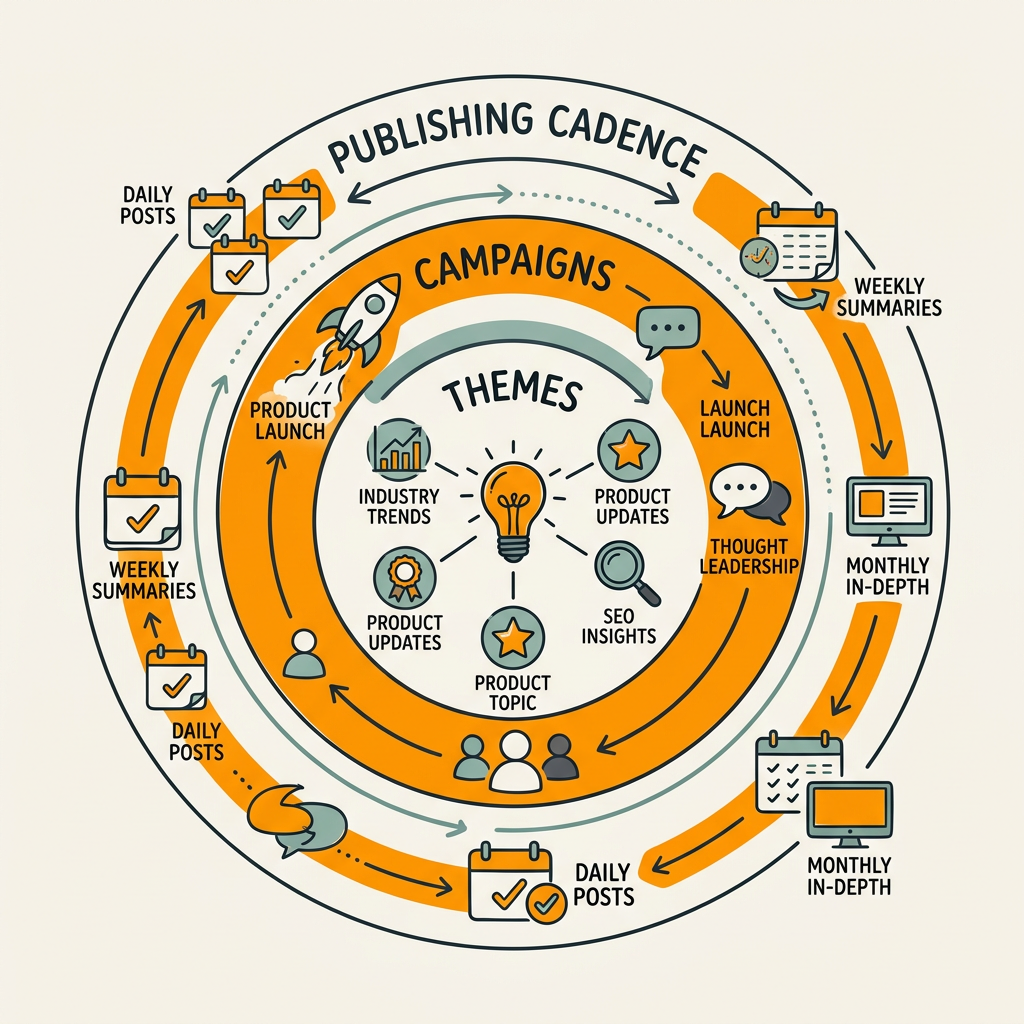
Raw AI-generated ideas need structure. The next step is organizing them into a coherent calendar that respects your team's capacity and your audience's consumption patterns.
Create a thematic structure across quarters. Q1 might focus on "Foundations" (onboarding, basics, new-year audience), Q2 on "Growth" (scaling, optimization, seasonal interest), Q3 on "Authority Building" (advanced topics, industry events, thought leadership), and Q4 on "Retention and Planning" (year-in-review, roadmaps, loyalty). This makes your 12-month narrative coherent rather than random.
Next, decide your publishing cadence. How many pieces per week? What formats? The table below shows how different cadences map to different team sizes and capacity levels:
| Publishing Cadence | Articles/Week | Team Size | Feasibility with AI | Jottler Approach |
|---|---|---|---|---|
| Minimal | 1–2 | 1–2 people | Manual + occasional AI drafts | Fully automated daily publishing |
| Standard | 3–5 | 3–5 people | AI ideation + human drafting | 1–3 articles daily, fully researched |
| Aggressive | 7–10 | 5+ people | AI-powered with limited human review | Up to 5 articles daily with fact-checking |
| Enterprise | 15+ | 10+ people | Fully AI-driven with AI quality control | Custom scaling with autonomous agents |
The reason many teams fail at ambitious content calendars is they underestimate execution friction. You can plan 52 amazing posts in January, but if your team can only produce 10 that month, 42 articles go unpublished. AI solves this by removing the execution constraint. Instead of planning around your capacity (which leads to mediocre calendars), you plan your ambition and let AI meet it.
For busy founders and scaling marketing teams, SEO automation platforms like Jottler take this further by not just planning the calendar, but executing it, researching, writing, fact-checking, and publishing 1–5 articles daily without manual input once the annual strategy is set.
Setting Up AI-Powered Review and Publication Workflows
Here's the non-negotiable truth: 78.4% of professional marketers heavily edit AI-assisted content before publishing. That's not a weakness of AI; it's the reality of professional standards. Your calendar should bake in a review layer, not skip it.
Create a three-stage workflow:
- Generation Stage: AI agents research and draft content based on your calendar template and brand guidelines.
- Review Stage: Your team (or designated reviewer) checks for brand voice, factual accuracy, and strategic fit. This typically takes 10–15 minutes per piece if AI did its job well.
- Publication Stage: Once approved, content publishes automatically on the scheduled date to your CMS, blog, social channels, or email platform.
The review stage is critical because it ensures brand integrity. Even the best AI can miss tone, confuse recent industry shifts, or misrepresent your company's stance. A 10-minute human check catches these before they go live.
Tools that handle this well integrate directly with your CMS (WordPress, HubSpot, Webflow) and include built-in fact-checking. One approach is to use AI-powered content generation that handles deep research, paired with an approval layer that routes each piece to the right stakeholder automatically.
The outcome? Your team never starts from a blank page. They're editing a 90% complete draft, not writing from scratch. This compounds across 12 months. A founder who'd normally spend 40 hours writing now spends 12 hours editing.
Monitoring Performance and Adapting Your Calendar in Real Time
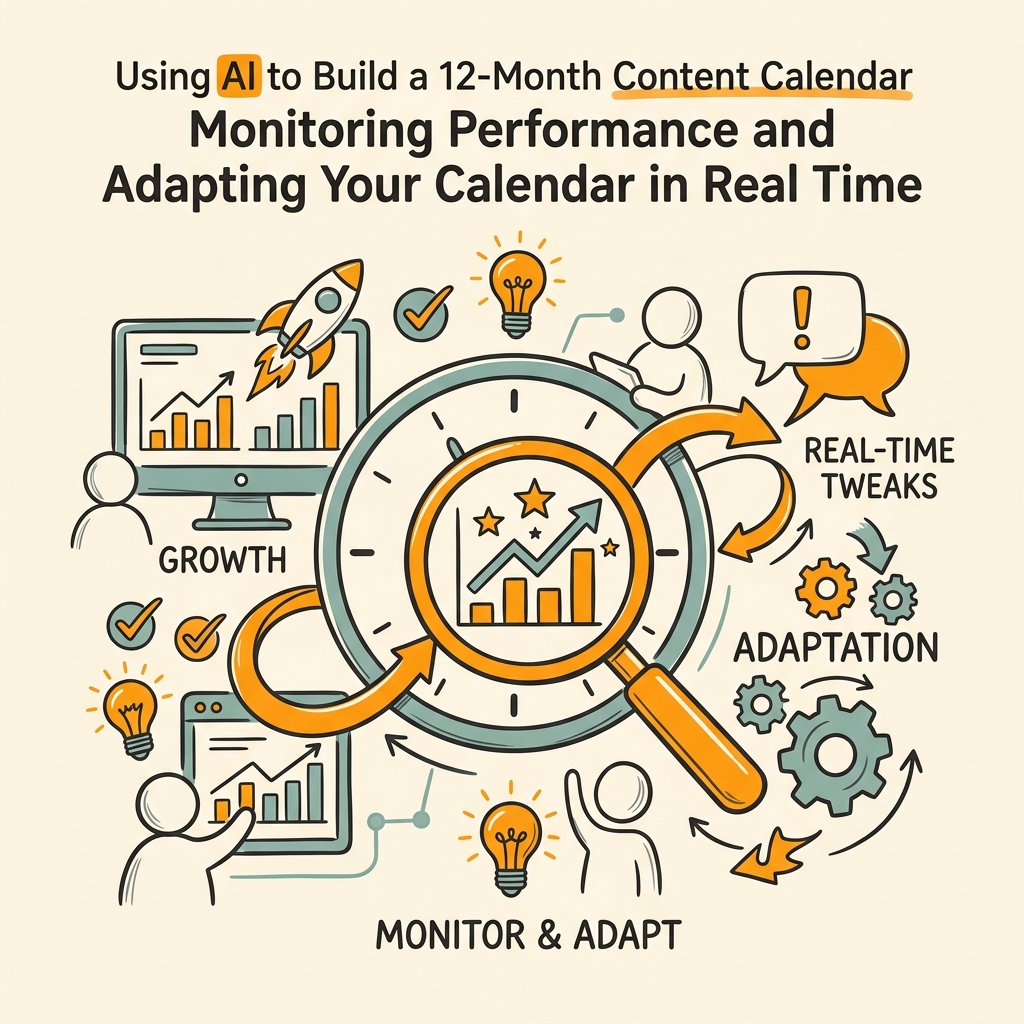
A static 12-month calendar is almost useful. A dynamic calendar that adapts based on performance data is powerful.
Build in a monthly performance review step. Every 30 days, analyze which topics actually resonated with your audience. Which content generated the most traffic? Which attracted qualified leads? Which topics failed to gain traction? Use these insights to adjust the remaining 11 months.
If posts about "AI for SEO" are crushing it, generate more variations. If "industry news roundups" underperform, replace them with deep-dive explainers. AI systems can make these adjustments instantly, regenerating ideas for months 7–12 based on 6 months of live performance data.
This is where 59.5% of marketers now use AI for analytics and reporting. Instead of spending 8 hours pulling data and writing analysis reports, AI does it in minutes. You see trends immediately and act on them within your calendar.
The best calendars combine top-down planning (12 months of strategy) with bottom-up feedback (what's actually working). AI makes this loop fast enough to matter.
Common Pitfalls When Building AI Content Calendars
Most teams that fail with AI calendars make the same mistakes:
- No strategy before generation: They skip the pillar and goal-setting work, ask AI to "write a 12-month calendar," and get confused results.
- Treating AI output as final: They publish AI-generated content without review, damage their brand, and blame AI instead of their process.
- Over-planning without flexibility: They lock in a rigid calendar and refuse to adapt when real data shows different topics perform better.
- Underestimating execution friction: They plan 200 articles for the year but have only 40 hours of team time. AI can help write, but it can't create time from nothing.
- Ignoring distribution as part of the calendar: They plan blog posts but don't plan how those posts get repurposed for email, social, or paid channels. A true calendar includes distribution strategy.
The fix for each: start with clear strategy, build human review into the workflow, monitor performance monthly and adjust, match calendar ambition to realistic team capacity (or automate execution), and plan your content distribution strategy as part of the 12-month arc, not as an afterthought.
Tools and Platforms That Make 12-Month AI Calendars Realistic
Not all AI content tools are built for annual planning. Some excel at one-off content generation. Others are designed for social media scheduling. True 12-month calendar builders integrate research, writing, scheduling, and performance tracking into a single system.
The tier-one approach, the one that saves the most time and produces the most consistent output, automates the entire pipeline. You set your annual strategy once, define your content pillars and goals, then let AI agents research, write, fact-check, and publish continuously without daily oversight. This is the difference between managing an AI tool and having an AI manage your content for you.
For founders and marketing teams at growing companies, Jottler's autonomous SEO engine takes this approach by design. You connect your website, set your desired publishing frequency (1–5 articles daily), and the system autonomously researches topics aligned with your business, writes comprehensive 3,000+ word articles, fact-checks everything, and publishes directly to your CMS while building internal link networks. The 12-month calendar builds itself as a function of the system's operation, no manual planning or coordination required.
The advantage is compounding: while your competitors spend August planning September's content, you're already three months ahead, publishing optimized articles daily that compound organic traffic growth month over month.
Conclusion
Building a 12-month content calendar with AI is no longer a future capability, it's standard practice for teams serious about scaling organic growth without burnout. The math is clear: 78% time savings, 2.4x engagement lift, and 59.5% of marketers now using AI for ideation mean that manual planning is becoming a competitive disadvantage.
The path forward requires three commitments: (1) Define your strategy upfrontcontent pillars, SMART goals, and seasonal momentsso AI has clear direction. (2) Batch-generate your entire 12-month calendar using AI agents, then organize by campaigns and themes to create coherent narrative arcs. (3) Build a human-in-the-loop review workflow that lets AI handle research and drafting while your team focuses on brand voice and final approval.
Most importantly, avoid the trap of treating your 12-month calendar as static. Monitor performance monthly, use AI to regenerate ideas based on what's actually working, and let your calendar evolve as you learn what resonates with your audience.
The teams winning at organic growth right now aren't spending more hours on content planning. They're automating the planning itself and reinvesting those hours into strategy, distribution, and performance optimization. That's the shift. Start your SEO agent today and let AI handle the 12-month heavy lifting.
FAQs
How long does it take to build a 12-month content calendar with AI?
With AI, the strategy phase (defining pillars and goals) takes 2–4 hours. The ideation and generation phase (letting AI create 100+ topic ideas organized by month) takes 1–2 hours. The structure and review phase (organizing ideas into themes and assigning to dates) takes another 4–6 hours. Total: 7–12 hours versus 40–60 hours manually. The real acceleration happens at execution, once your calendar is built, AI handles drafting, fact-checking, and publishing continuously, cutting production time by 78% month over month.
Do I need to edit every piece of AI-generated content?
Yes, professional standards require human review before publishing. 78.4% of experienced marketers now edit AI-generated content before it goes live. However, the edit is faster than writing from scratch, think 10–15 minutes to review a 2,000+ word article for brand voice and accuracy, not 60+ minutes to write it. The human layer ensures brand integrity and catches factual errors that AI might miss, making the review step non-negotiable, not optional.
What if my content calendar doesn't perform well partway through the year?
This is why you review performance monthly. If certain topics or formats consistently underperform, use AI to regenerate ideas for the remaining months based on what you've learned. Most AI calendar tools can instantly create new topic variations, adjust keyword focus, or shift the content mix (more educational, more sales-driven, etc.) without restarting your calendar. 59.5% of marketers now use AI for analytics and reporting, which makes this feedback loop fast enough to matter. Your calendar becomes a living system that improves as you execute it.