Account-Based Marketing SEO for B2B Sales
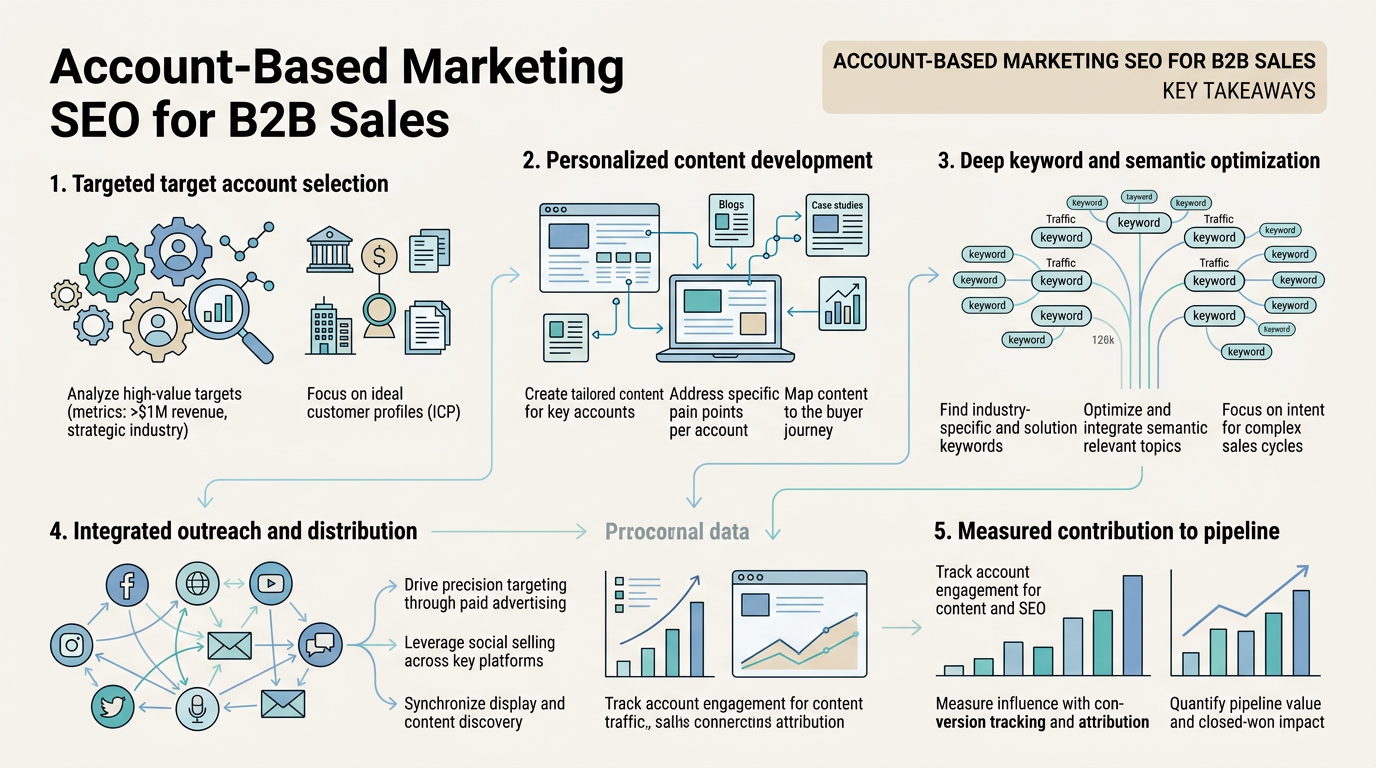
Most B2B buyers research solutions independently before reaching out to sales. 68% of companies using account-based marketing (ABM) report it helped them close larger deals, yet many still treat SEO and ABM as separate functions. The result? Your brand misses high-intent searches from the exact accounts you're targeting. When SEO and ABM align, they create a scalable engine for enterprise visibility, pipeline growth, and revenue. Here's how to combine both for maximum impact on your B2B sales funnel.
Key Takeaways
- 87% of marketers report ABM delivers higher ROI than other marketing strategies (2026, ITSMA surveys)
- ABM teams that align SEO with account targeting see 3.4x higher engagement in tier-1 accounts versus non-ABM cohorts
- Mature ABM programs achieve 5–9x ROI on average, with results appearing in 6–12 months from launch
- Account-First Keyword Research: Start with your target account list and ideal customer profile (ICP) before opening keyword tools to identify intent-driven search opportunities.
- Buying Journey Content Mapping: Create content across awareness, consideration, and decision stages to influence prospects during their entire research phase.
- Vertical-Specific Landing Pages: Build service and industry-specific pages that address the pain points and priorities of your highest-value account segments.
- Content Hubs for Topical Authority: Cluster related content around core account challenges to build expertise and guide prospects through their research journey.
- Multi-Stakeholder Personalization: Tailor content to different buyer committee roles—finance, technical teams, and executives—to address their unique concerns.
- Sales and Marketing Alignment: Coordinate SEO content with sales sequences, paid ads, and outbound outreach so every touchpoint reinforces the same message.
Why ABM and SEO Belong Together in B2B Sales
Traditional B2B SEO casts a wide net. You target high-volume keywords, attract qualified leads, and hope your sales team closes deals. ABM flips this model entirely. Instead of chasing volume, you identify your most valuable accounts and orchestrate every marketing touchpoint—including search—to engage them. 35% higher deal close rates are reported for ABM accounts, yet most teams haven't connected SEO to this strategy.
"When SEO and ABM align, your target accounts encounter your expertise across search, paid ads, email, and sales calls. They see consistent positioning, relevant content tailored to their industry and role, and proof of your capability. That consistency accelerates buying decisions and shortens sales cycles significantly."
The gap exists because SEO has historically been a top-of-funnel demand-generation channel. Your content ranks broadly, drives traffic, and generates leads. ABM, by contrast, is surgical: it targets specific companies, decision-makers, and buying committees. But when combined, SEO becomes your visibility engine. It ensures that when your target accounts search for solutions to their problems, your brand dominates the results. They don't need your outbound team to reach them—they find you organically.
The math is straightforward. 73% of companies using ABM report it helped them better align sales and marketing. Adding SEO to that alignment means your target accounts encounter your expertise across search, paid ads, email, and sales calls. They see consistent positioning, relevant content tailored to their industry and role, and proof of your capability. That consistency accelerates buying decisions and shortens sales cycles by up to 32 days (median, across 1,400+ B2B teams). According to Mailmodo's ABM statistics guide, teams that implement account-based strategies properly report compounding benefits across pipeline velocity, win rates, and account retention.
Build Your Account-First Keyword Strategy
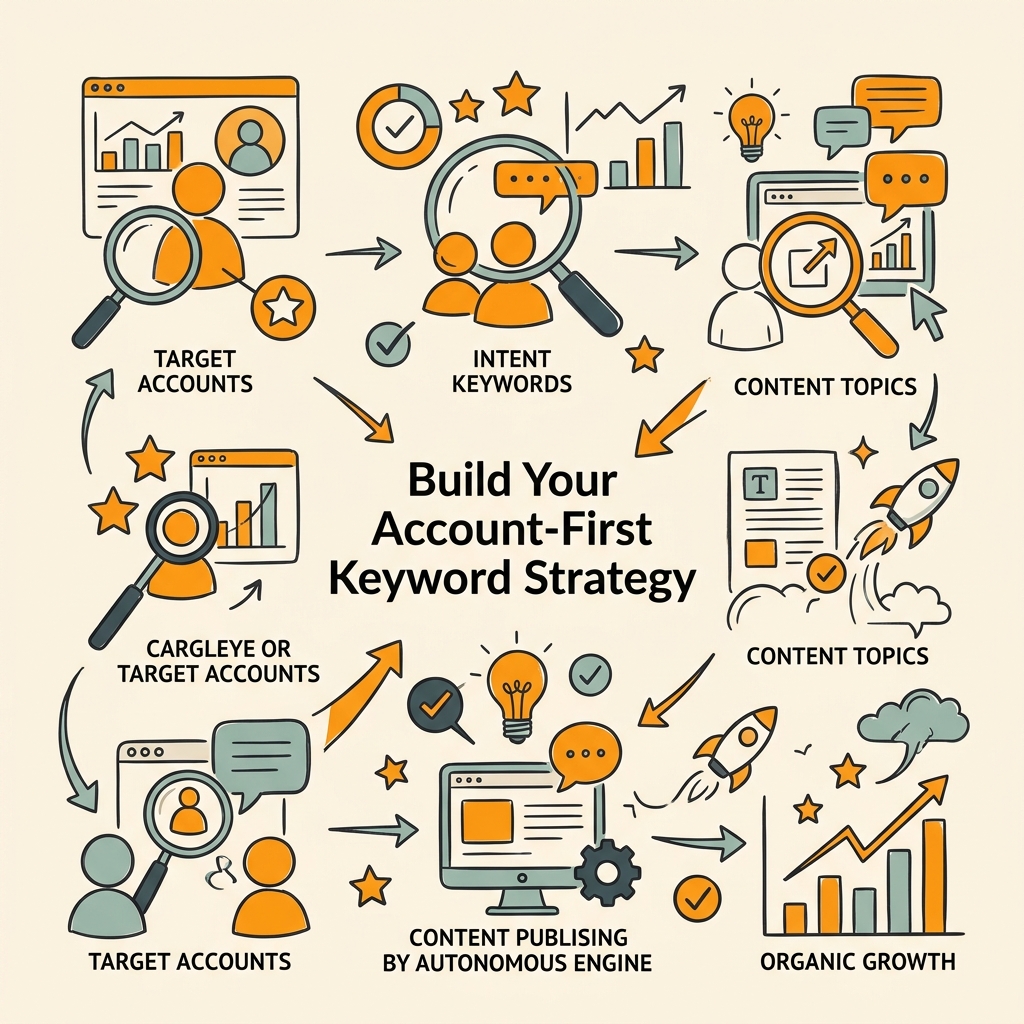
Conventional keyword research starts with tools: search volume, difficulty, and CPC. ABM-driven keyword strategy starts differently. Before you open Semrush or Ahrefs, define your target accounts and the language they use to describe their problems. The most valuable keywords in B2B are often zero-volume or low-volume in standard tools—they're real phrases your prospects type into Google, but they're too specific to rank in global keyword databases.
"Zero-volume and low-volume keywords can still be high value in B2B ABM if they come directly from target-account conversations and signal active buying intent. Ignore high-volume, low-relevance keywords entirely and focus instead on phrases that indicate purchasing intent specific to your accounts' industries and roles."
Begin with your ICP and target account list. Extract three data sources that reveal authentic buyer language:
- Sales conversations and call transcripts: Listen to how your sales team articulates problems and how prospects describe their challenges. These conversations are gold mines of seed keywords.
- CRM notes and support tickets: Your customer success and support teams hear objections, pain points, and terminology directly from buyers. Mine these records for search phrases.
- Search Console and analytics: Review the queries already driving impressions to your site. Identify gaps where you're getting impressions but few clicks—these signal content opportunities to strengthen intent.
Once you have seed keywords from internal data, expand using keyword tools but with ABM discipline. Ignore high-volume, low-relevance keywords. Focus instead on phrases that indicate buying intent, role-specific needs (e.g., "CIO procurement for SaaS compliance"), and vertical-specific challenges (e.g., "financial services API integration standards"). This approach is validated by teams using systematic ABM strategy frameworks that prioritize buyer language over volume metrics.
Group these keywords by stage and audience. Map them to your target accounts' journey stages: awareness (educational content for prospects discovering a problem), consideration (comparison and evaluation content), and decision (case studies, ROI calculators, implementation guides). Create a simple matrix showing which accounts you want to reach at each stage and which keywords will get you there. This becomes your ABM keyword roadmap.
Create Content Hubs Around Account Priorities
Individual blog posts and scattered landing pages don't signal topical authority to search engines or buyers. Content hubs do. A content hub is a cluster of related pages—pillar pages, supporting articles, case studies, and resources—all centered on a core theme relevant to your target accounts. They work because search engines reward topical depth, and buyers appreciate navigating from a general topic to specific solutions without leaving your site.
For each high-value account segment or vertical, identify 3–5 core priorities they face. Build a hub around each. For example, if you sell compliance software to financial services firms, create a hub titled "Financial Services Compliance and Data Privacy." Include:
- A pillar page covering the topic broadly (what compliance means, why it matters, key standards)
- Supporting articles on specific regulations (GDPR, PCI-DSS, SOC 2)
- Implementation guides specific to financial institutions
- Case studies from fintech and banking customers
- ROI and cost-benefit analysis content
Internally link these pages strategically so a visitor discovers related content naturally. Optimize the pillar page for high-volume keywords (e.g., "financial services compliance software") and supporting articles for longer-tail, more specific queries (e.g., "SOC 2 Type II certification for SaaS fintech companies"). This architecture signals expertise and keeps prospects engaged across multiple pages, increasing time-on-site and engagement signals that search engines reward.
Most B2B content teams struggle to sustain this level of content production. Solutions like AI content generators designed for SEO can scale hub creation by automatically researching topics, writing articles, and publishing them with proper internal linking. Autonomous SEO platforms take this further by managing the entire workflow—from keyword expansion to fact-checking to CMS publishing—freeing your team to focus on strategy instead of execution.
Personalize Content for Your Buying Committee

B2B buying committees aren't monolithic. A financial services buyer includes CFOs focused on ROI and cost control, CTOs concerned with integration and security, and procurement teams evaluating vendor stability and contract terms. Each has different information needs and uses different search language. Generic content fails this audience; personalized content wins accounts.
Create content tailored to specific roles within your target accounts. A CTO might search "API security best practices for enterprise" or "zero-trust architecture implementation." A CFO searches "software ROI calculation" or "cost per transaction reduction benchmarks." An operations leader searches "vendor onboarding process and timeline." Each path should be unique.
"When a CFO lands on a page explicitly addressing financial impact and ROI metrics, they stay longer and engage more deeply than if they hit generic product marketing copy. This role-based personalization increases relevance at every touchpoint and accelerates buying decisions."
Here's a practical framework:
- Map the buying committee roles you typically encounter (usually 5–7 roles)
- For each role, list the 3–5 biggest questions they ask during evaluation
- Create content addressing each question with language and depth relevant to that role
- Tag this content with role-based segments in your analytics to track engagement
- Use account-based advertising and email to direct each stakeholder to role-specific landing pages
This approach increases relevance at every touchpoint. 18% of tier-1 account opportunities are created by dedicated target account efforts versus 7% in tier-2/3 accounts, suggesting that this personalized engagement significantly improves account-level outcomes.
Measure ABM SEO Success Like an Account-Based Marketer
Traditional SEO metrics—traffic, rankings, leads generated—don't translate to ABM success. In ABM, you don't care about total site visitors; you care about how many of your target accounts visit, how engaged they are, and whether they convert to pipeline. This requires a different measurement framework.
Start by setting up account-level analytics. Create segments or audiences in Google Analytics representing each of your target accounts (or account tiers). Track metrics that matter:
- Account reach: What percentage of your target accounts visit your site each month?
- Engagement depth: How many pages do target accounts view per session? Do they consume multiple hub articles?
- Content affinity: Which content topics drive engagement among target accounts? Use this to guide future content priorities.
- Conversion to lead: How many target account visits convert to demos, trials, or sales conversations?
- Pipeline influence: How much revenue influenced by target account web visits? (This requires CRM integration.)
A realistic year-one ABM SEO goal is reaching 60–70% of target accounts across at least two channels, improving win rate by 15–20%, and reducing days-to-close by 10–15%. Track these alongside traffic and rankings, which are secondary but still useful indicators of content visibility.
Attribution across ABM touchpoints is notoriously hard. 47% of ABM teams struggle with attribution and ROI proof, according to 2026 benchmarks. Rather than waiting for perfect attribution, focus on leading indicators: account reach, engagement, and velocity signals. If more target accounts are visiting, spending more time on your site, and moving faster through your buying stages, ABM SEO is working. For teams looking to automate this measurement process, structured SEO strategies that scale build account-level reporting into their foundation.
Align Sales, Paid, and Content for Maximum ABM Impact
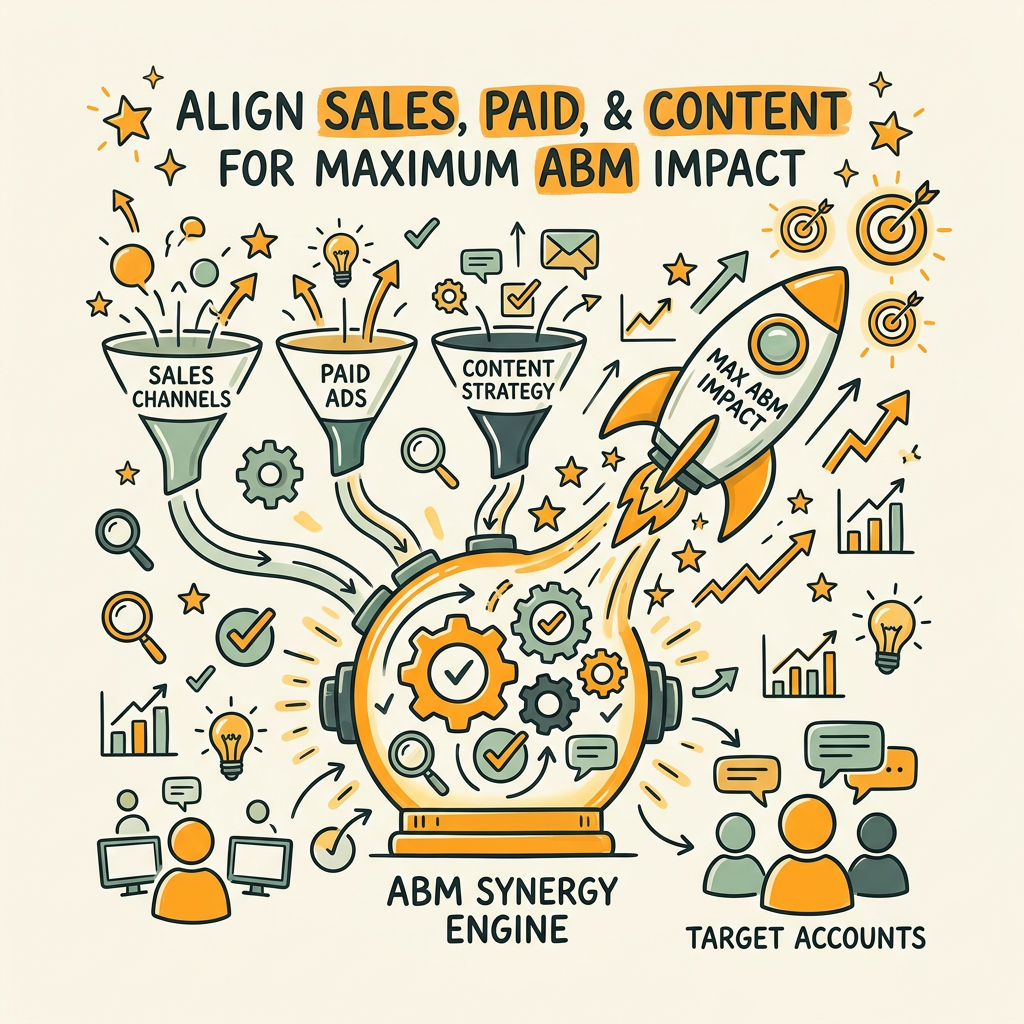
ABM succeeds when every channel reinforces the same message and position. Your SEO content, paid ads, email sequences, and sales outreach should tell a cohesive story. When a prospect encounters your brand across organic search, a LinkedIn ad, an email sequence, and a sales call, and each touchpoint reflects the same value proposition and insight tailored to their role, the effect is compounding.
Coordinate with your sales team and demand generation. Share your ABM keyword strategy with sales so they use similar language in outreach. Brief your paid media team on which content and landing pages your high-intent keywords should drive traffic to. Ensure your email content references and amplifies your SEO content. Build case studies and resources that SEO can rank for and sales can cite during conversations.
This requires a shared roadmap. Create a simple quarterly document that lists:
- Priority target accounts for the quarter
- Key pain points and buying triggers for each
- Content, ads, and sequences planned to reach them
- Assigned owners from marketing, sales, and leadership
- Success metrics and check-in cadence
When sales, marketing, and content are aligned, account velocity increases dramatically. 73% of ABM teams report improved sales and marketing alignment, and those teams report better outcomes across every metric. The cost per acquisition drops because effort is concentrated rather than scattered.
Scale ABM Content Production Without Burnout
Building a robust ABM SEO program requires substantial content volume. You need pillar pages, supporting articles, case studies, role-specific resources, vertical-specific guides, and regular topic updates. Most in-house teams can't sustain this pace while maintaining quality and SEO best practices like internal linking, fact-checking, and keyword optimization.
This is where content automation becomes essential. Manual content production locks you at a ceiling: if one writer produces 2–3 articles per week, you're capped at 8–12 articles monthly. That's not enough to build comprehensive content hubs across multiple verticals or maintain topical authority. Your competitors move faster.
Automated content solutions designed for B2B SEO handle the full pipeline: keyword research, content ideation, writing, fact-checking, CMS publishing, and internal linking. SEO automation tools allow you to publish multiple long-form articles daily while maintaining quality and consistency. For teams running ABM programs targeting dozens of accounts across multiple verticals, this productivity multiplier is the difference between theoretical strategy and executable reality.
The best automation platforms offer account-based features built in: ability to segment content by industry, role, or target account, automatic internal linking to reinforce hub structures, and account-level performance tracking. This ensures your automation engine operates with ABM discipline, not just raw volume.
Common ABM SEO Mistakes to Avoid
Even with a solid strategy, teams stumble on execution. Watch for these pitfalls:
- Ignoring low-volume keywords: A phrase searched 50 times per month by your target accounts is worth more than a phrase searched 10,000 times by irrelevant prospects. Don't optimize for volume; optimize for fit and intent.
- Generic content: Avoid blog posts that could have been written by anyone. Instead, create assets only your team can write: industry-specific guides, company-specific case studies, implementation playbooks tailored to your vertical.
- Siloed effort: If SEO operates independently from sales and paid media, you lose the compounding effect of ABM. Coordinate messaging, audience targeting, and metrics across channels.
- Tracking the wrong metrics: Traffic and rankings feel good but don't prove ABM success. Measure account reach, engagement, and pipeline influence instead.
- Inconsistent publishing: One article per month, then three the next, then none for six weeks. Consistency compounds. Commit to a steady cadence—whether daily, weekly, or bi-weekly—and stick to it.
- No internal linking strategy: Pages published in isolation don't build topical authority or keep prospects engaged. Link related content systematically, especially within your content hubs.
Most mistakes stem from trying to execute ABM SEO manually. Spreadsheets fail at scale. Inconsistency creeps in when content relies on sporadic team capacity. This is why content marketing automation is becoming standard for serious ABM programs. It ensures consistency, eliminates gaps, and keeps your content engine humming without requiring constant oversight.
Quick Reference: ABM SEO Metrics and Benchmarks
| Metric | Year-One Target | Mature Program (2+ years) |
|---|---|---|
| Target account reach (% of accounts engaging) | 60–70% | 80%+ |
| Win rate improvement | 15–20% | 25–35% |
| Sales cycle compression (days) | 10–15 days shorter | 25–35 days shorter |
| ROI | Positive within 6–12 months | 5–9x average |
| Deal size increase | 5–15% | 50–200% |
| Engagement per target account | 3.4x higher than non-ABM | 4–5x higher |
Conclusion
Account-based marketing and SEO are no longer separate strategies—they're two parts of the same engine. When aligned, they ensure your target accounts find you organically, engage with role-specific content that addresses their actual pain points, and move through your buying journey faster. 87% of marketers report ABM delivers higher ROI than other marketing strategies, and the teams winning most are those integrating search visibility from day one.
Building this system requires discipline: account-first keyword research, content hubs that build topical authority, personalized assets for different buyer committee roles, and consistent measurement of account-level outcomes instead of vanity metrics. It also requires the ability to sustain high-volume content production without sacrificing quality—which is why the most mature ABM programs automate their content workflow. You don't scale account-based marketing by hiring more writers; you scale it by systematizing content creation.
Start here: Define your top 20–50 target accounts, interview your sales team about the keywords those accounts use, map their buying journey, and commit to publishing weekly content across your priority verticals and themes. Within 90 days, you'll see target account engagement increase. Within six months, you'll see pipeline impact. Start your SEO agent to automate content production and compound your ABM visibility growth without the friction of manual creation.
FAQs
How do you align SEO with account-based marketing strategy?
Alignment starts with building your target account list first, before doing keyword research. Extract seed keywords from sales conversations, CRM notes, and customer support tickets—not keyword tools alone. Map those keywords to your target accounts' buying journey stages: awareness, consideration, and decision. Create content specifically addressing the pain points of each account segment and the roles within their buying committees. Coordinate SEO content with sales sequences and paid ads so your messaging is consistent across channels. Track success using account-level metrics—reach, engagement depth, and pipeline influence—rather than traditional traffic and lead counts.
What content should you create for account-based marketing SEO?
Prioritize content hubs built around your target accounts' core pain points and vertical-specific challenges. Include pillar pages for broad topics, supporting articles for detailed subtopics, case studies from similar accounts, role-specific guides (separate content for CFOs, CTOs, and operations leaders), implementation resources, and ROI or cost-benefit content. Avoid generic blog posts; instead, write content that only your team can write because it reflects deep understanding of your target accounts' industry and challenges. Within each hub, use internal linking to guide prospects from general awareness to consideration to decision-stage resources.
How long does it take to see results from ABM SEO?
You should see initial engagement signals—increased target account visits and higher time-on-site—within 90 days of consistent content publishing. Measurable pipeline impact typically appears within 6–12 months. Mature ABM programs report 5–9x ROI and 32-day median reduction in sales cycles, but these results compound over time. Year-one targets are realistic: reaching 60–70% of your target accounts, improving win rates by 15–20%, and reducing time-to-close by 10–15 days. Set quarterly reviews to track account reach and engagement metrics, and adjust content strategy based on which topics and verticals drive the highest engagement from your highest-value account segments.