Agentic SEO: The Field, The Stack, and Why It Matters
Agentic SEO is what happens when you stop prompting your AI tools and start supervising them. It is a discipline, not a product. The defining shift is that autonomous agents now perform the entire search optimization workflow, from keyword research through publishing, with humans setting goals and reviewing output instead of clicking through every step.
The term has gained ground because the work it describes finally exists. According to Gartner, by the end of 2026 around 33% of enterprise software applications will include agentic AI, up from less than 1% in 2024 (Gartner, 2024). SEO is one of the first marketing disciplines where that capability is mature enough for production use.
Key Takeaways
- Agentic SEO is a workflow discipline where autonomous AI agents execute keyword research, content creation, optimization, and publishing without per-step human prompting.
- The architecture is a multi-agent system: an orchestrator coordinates specialist agents (research, writing, optimization, publishing), each handling one stage end to end.
- This is different from AI-assisted SEO, where a human still prompts every step. The agentic model moves the human from operator to supervisor, reviewing output instead of producing it.
- Search interest in "agentic AI" rose 1,400% year over year between 2024 and 2025, signaling a real category shift rather than a rebrand (Pew Research, 2025).
- The strongest implementations pair the agent stack with human review at the strategic layer (briefs, brand voice, edge cases), not at the production layer.
What Makes SEO "Agentic"
The word agentic is doing real work in this phrase. In AI research, an agent is a system that perceives its environment, decides what to do, and acts to achieve a goal without being told each next move. That last part is the line between agentic and assistant.
A writing assistant waits. You give it a keyword, it gives you a draft. You give it feedback, it gives you a revision. The loop stays open until you close it.
An agent does not wait. Given a goal like "publish 30 SEO articles this quarter targeting our category keywords," it picks the keywords, drafts the briefs, writes the articles, runs the optimization checks, and ships them. The human enters at the boundaries: setting the goal, approving the strategy, and reviewing output.
Three properties separate agentic SEO from everything that came before:
- Autonomy: The system makes decisions about what to do next without prompting
- Persistence: It runs across long horizons (days, weeks) rather than single sessions
- Tool use: It calls real APIs, scrapes real pages, writes to real systems
When all three are present, the work becomes agentic. When any one is missing, you still have a tool, not an agent.
Agentic SEO vs AI-Assisted SEO: A Real Distinction
The line between assisted and agentic SEO is not marketing positioning. It is a structural difference in how the work happens.
In AI-assisted SEO, a human runs the workflow and uses AI for individual steps. A marketer pulls keywords, then asks ChatGPT for content angles. They write a brief, then ask Jasper for a draft. They optimize the draft in Surfer, then publish manually. AI accelerates each step, but a human remains the orchestrator.
In agentic SEO, software runs the workflow and uses AI plus tools to execute each step. A human sets the brand voice, the topic strategy, and the publishing cadence. The agent stack handles the rest. The marketer reviews finished articles instead of producing them.
The economic difference is enormous. AI-assisted workflows still pay for the human's time at every stage. Agentic workflows pay for tokens and infrastructure, which scale at a fraction of the cost. According to data compiled by Salesforce, more than half of AI-using companies are now deploying autonomous agents in some form, and 96% plan to expand that use within twelve months (Salesforce, 2025).
That gap is also why this category is winning enterprise budget so quickly. A team that publishes four articles a month with assisted tools can publish forty with agentic ones, at roughly the same headcount.
The Architecture: Orchestrator Plus Specialist Agents
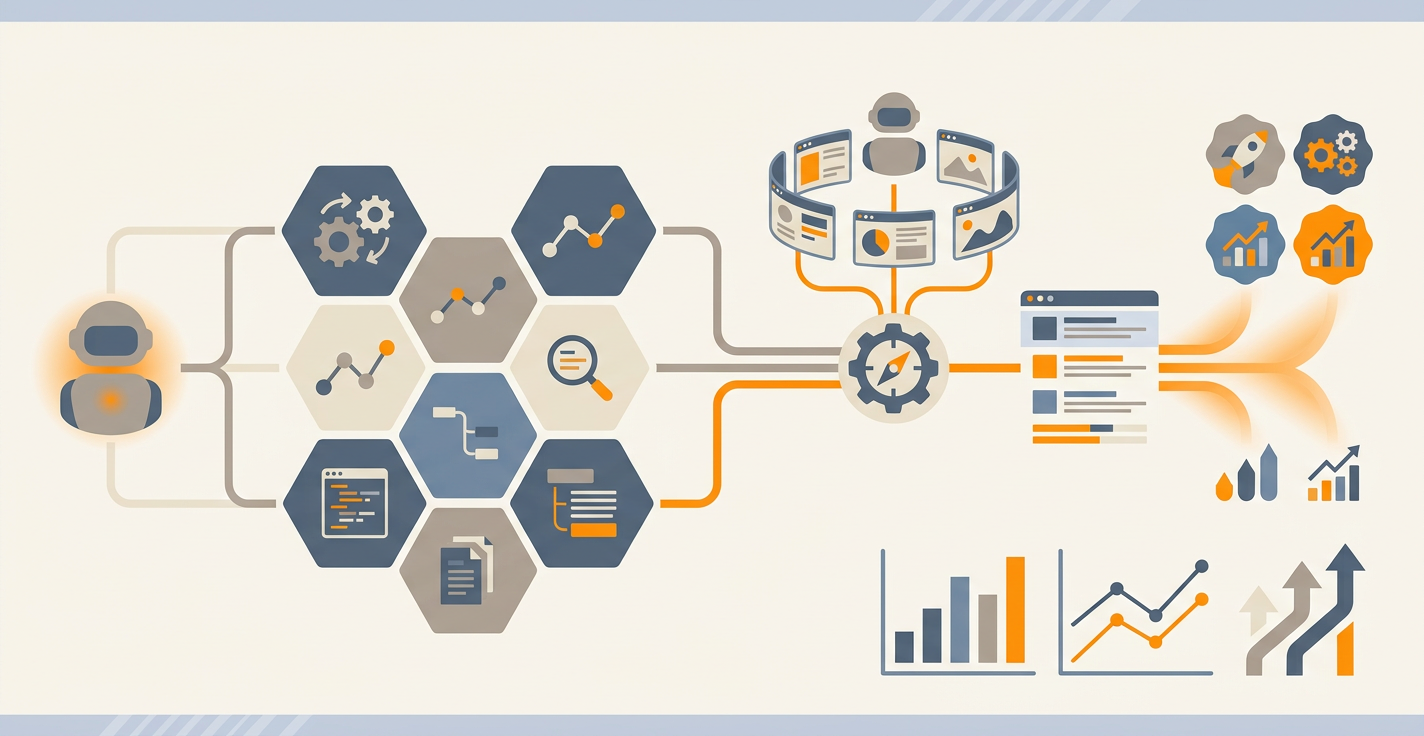
Agentic SEO does not run on a single giant prompt. The systems that actually work in production share a common architecture: an orchestrator agent coordinates a small team of specialist agents, each responsible for one part of the pipeline.
The orchestrator is the project manager. It holds the goal ("write a 3,000-word article on agentic SEO that ranks for the keyword and gets cited by ChatGPT"), tracks progress, and routes work between specialists. It does not write. It decides who writes what, in what order.
Each specialist is a focused agent with a single job:
- Research agent: queries keyword data sources, scrapes top-ranking pages, identifies content gaps
- Brief agent: synthesizes research into an outline with target intent, headings, and entity coverage
- Writing agent: drafts the article section by section, calling the brief as context
- Optimization agent: scores the draft against on-page SEO criteria and rewrites weak sections
- Image agent: generates featured images, infographics, and in-content visuals
- Internal linking agent: scans the site graph and inserts contextually relevant links
- Publishing agent: pushes the finished article to the CMS via API or webhook
The architecture matters because monolithic prompts fail at this kind of work. A single LLM call cannot reliably do research, writing, optimization, and publishing in one shot. Splitting the job across specialists with clear contracts (input format, output format, success criteria) is what makes the system reliable enough to run unsupervised. Jottler's content engine is built on exactly this pattern, with twelve specialist agents coordinated by an orchestrator.
A Real-World Stack
To make the architecture concrete, here is what a production agentic SEO stack looks like in 2026.
Data layer. Keyword research uses APIs like DataForSEO or Ahrefs for live search volume and keyword difficulty. Web scraping uses Firecrawl or Apify for SERP and competitor content. Internal site data comes from the CMS API and Google Search Console.
Reasoning layer. The orchestrator and specialists run on frontier LLMs, typically Claude or GPT-4 class models. Smaller, faster models handle high-volume tasks like classification or summarization. Image generation uses Gemini, DALL-E, or Stable Diffusion variants.
Memory layer. Vector databases store the brand's content history, style guidelines, and topic taxonomy so the agent does not repeat itself or contradict prior posts. Long-term memory of what has been published is the difference between a coherent content program and a pile of disconnected articles.
Action layer. Publishing happens via CMS-native APIs (WordPress REST, Webflow API, Shopify Admin API) or universal webhooks. The publishing agent handles formatting, image uploads, schema markup, and scheduling.
The stack only works when the layers compose cleanly. A research agent that cannot pass structured output to a writing agent is not part of an agentic system. It is just a chatbot wearing a name tag.
The Shift From Operator to Supervisor
The single biggest change agentic SEO forces on a marketing team is role redefinition. People who used to run workflows now design and review them. This is harder than it sounds, and it is where most adoptions stall.
An operator's job is to do the next step. A supervisor's job is to set the conditions for good work and catch problems early. The skill set overlaps but is not identical.
Three responsibilities tend to grow when teams move to agentic SEO:
Strategy clarity. Agents will execute whatever strategy you give them, faithfully and at scale. If your topic strategy is incoherent, you will get incoherent content faster. Time previously spent producing articles now goes to making sure the topic map, brand voice, and target audience are clearly specified.
Quality review. Even reliable agents produce occasional weak output. A supervisor reviews articles before they ship, kills the bad ones, and feeds patterns back into the system as guidance. This is closer to editing than to writing.
System tuning. Production agentic systems are tunable. You can adjust how aggressive the keyword targeting is, how formal the writing voice sounds, how dense the internal linking gets. Senior people on the team spend real hours dialing these settings to match the strategy.
This is the same shift software engineering went through with CI/CD. Engineers stopped manually deploying code and started designing the pipeline that deployed it. The job did not disappear. It moved up a level.
Where Agentic SEO Beats Manual SEO
Agentic SEO is not strictly better at every task. It wins at specific things and loses at others. The honest version of the case looks like this.
It wins at scale. Publishing 50 well-researched articles a month is impossible for a small human team and routine for an agentic stack. This is the number-one reason teams adopt it. See our breakdown of content production at scale for the full economics.
It wins at consistency. Every article gets the same research depth, the same SEO checks, the same internal link audit. Human output drifts based on who wrote what when. Agent output does not.
It wins at speed. A research-to-published article cycle that takes three weeks with a freelancer takes three hours with an agent. That speed compounds when you are trying to capture seasonal opportunities or react to trending queries.
It loses at originality. Agents can synthesize but rarely break new ground. For thought leadership content that needs a unique POV grounded in lived experience, humans still win. The right move is usually to use agents for the 80% of content that builds topical coverage and reserve human writers for the 20% that defines the brand.
It loses at high-stakes accuracy. Medical, legal, and financial content where one wrong claim has real consequences still needs human verification. Agents can draft, but humans should sign off.
What Agentic SEO Is Not
Three things keep getting called agentic SEO that are not.
A ChatGPT prompt is not agentic SEO. Even a really good prompt that produces a 3,000-word article is still a single-step generation. There is no research, no optimization, no publishing. It is one stage of the pipeline, not the pipeline.
A workflow tool with AI features is not agentic SEO. If a human still has to click through each step, the AI is assistive. The defining feature is that the system runs on its own once configured.
An "AI SEO platform" without autonomy is not agentic SEO. Surfer SEO is excellent. So is Frase. Neither is agentic. They optimize and assist; they do not autonomously execute a content program. That distinction matters when you are evaluating tools.
For a more detailed breakdown of how an autonomous system actually runs, see our deep dive on the SEO AI agent pipeline. For the broader category of tools that automate parts of search work, our overview of AI-powered SEO covers the full spectrum.
How to Evaluate an Agentic SEO Tool
If you are looking at platforms in this category, four questions separate the real ones from the marketing-led ones.
Does it run end to end without human input between steps? If the answer involves "you review and approve each section," the tool is assisted, not agentic. That is fine, but it is a different category.
Does it use real data sources or hallucinate research? Ask specifically: which keyword API does it use, which scraper, where does the search volume number come from. If the answer is vague, the system is generating numbers, not pulling them.
Does it publish to your CMS automatically? Without a publishing step, you still have a draft generator. The defining feature of an agentic stack is that it ships finished work, not files for you to upload.
Does it have memory across articles? A system without memory will rewrite the same article five times under different titles. Topic taxonomy, prior coverage, and internal linking all depend on persistent memory of what has been published. See the comparison of automated SEO approaches for how this plays out across different tools.
The Trajectory
Agentic SEO is at the start of a multi-year build-out, not the end. Three trends will shape how the category evolves through 2027.
Tighter integration with search itself. AI Overviews, ChatGPT search, and Perplexity have changed what ranking even means. Agentic systems are starting to optimize for citation in answer engines, not just blue links, which is a measurable shift in how content gets structured.
Branded agent personas. Off-the-shelf agents produce off-the-shelf content. The next wave of tools will let teams train agent voice and POV on their own historical content, producing output that is genuinely on brand without manual editing.
Smaller teams, bigger outputs. Companies that get this right will publish more in a quarter than their competitors do in a year. The teams will not get bigger. The output per person will.
The discipline is real. The architecture is not magic. The teams adopting it now are setting up a content moat that gets harder to cross every month.
Frequently Asked Questions
What does agentic SEO mean?
Agentic SEO is a workflow discipline in which autonomous AI agents execute the full search optimization pipeline, including keyword research, content briefing, writing, on-page optimization, and publishing, without a human prompting every step. A human sets the strategy and reviews output rather than running the work.
How is agentic SEO different from AI SEO tools like Surfer or Jasper?
Tools like Surfer and Jasper assist a human at one stage of the workflow. The human still chooses the keyword, writes or edits the content, and clicks publish. Agentic SEO systems run the full pipeline autonomously once configured, calling those kinds of capabilities as internal steps rather than asking the user to perform them.
Do agentic SEO systems still need human review?
Yes, but at the strategic layer, not the production layer. Humans set brand voice, topic strategy, and quality criteria, then review finished articles before they ship. They do not produce drafts, run keyword research, or optimize on-page elements manually. That work moves to the agent stack.
What does an agentic SEO architecture look like?
Most production systems use an orchestrator agent that coordinates specialist agents for research, briefing, writing, optimization, image generation, internal linking, and publishing. Each specialist has one job and a clear input-output contract. This multi-agent design is more reliable than trying to do the whole job in a single LLM call.
Is agentic SEO worth it for small teams?
It is often more valuable for small teams than for large ones. A two-person marketing team using an agentic system can match the publishing volume of a five-person agency relationship, at lower cost and with more consistent output. The advantage shows up most clearly when headcount is the constraint.
If you want to see what an agentic SEO stack looks like running end to end, Jottler's autonomous content agent handles research, writing, image generation, and publishing on autopilot, with the supervisor model built in.