AI Content Tools for SEO: Features Comparison Guide
The gap between content volume and content quality has never been wider. 86% of SEO professionals have integrated AI into their strategy, yet 74% of new web content is created with generative AI, which means massive content volume but no guarantee of ranking power. The truth is brutal: most AI content tools are built for speed, not search visibility. They churn out pages fast, but those pages don't move the needle on rankings. What separates the tools that move rankings from those that just move word count? The answer lies in understanding which features actually drive SEO results and which are pure marketing fluff.
Key Takeaways
- 86% of SEO professionals use AI in their strategy, but only 65% report better SEO results, showing a quality-execution gap (SeoProfy, 2026)
- Tools with built-in SEO features (keyword research, SERP analysis, internal linking) outperform generic AI writers for ranking content
- 97% of companies review AI content before publishing, making fact-checking and editorial oversight non-negotiable features
- Autonomous AI Agents: The most advanced solution for consistent, high-volume content production with minimal manual oversight and deep research from multiple sources.
- SEO-Integrated AI Writers: Built-in keyword research, SERP analysis, and optimization guidance that accelerates ideation to publishing in one workflow.
- Dedicated SEO Optimization Tools: SERP-driven editors that handle on-page optimization and real-time content scoring for existing drafts.
- Research and Brief Generators: Tools focused on topic research, competitor analysis, and content outlines rather than full-draft generation.
- Brand-Controlled Marketing Platforms: Full content suites that prioritize voice consistency, team collaboration, and template-driven workflows over SEO automation.
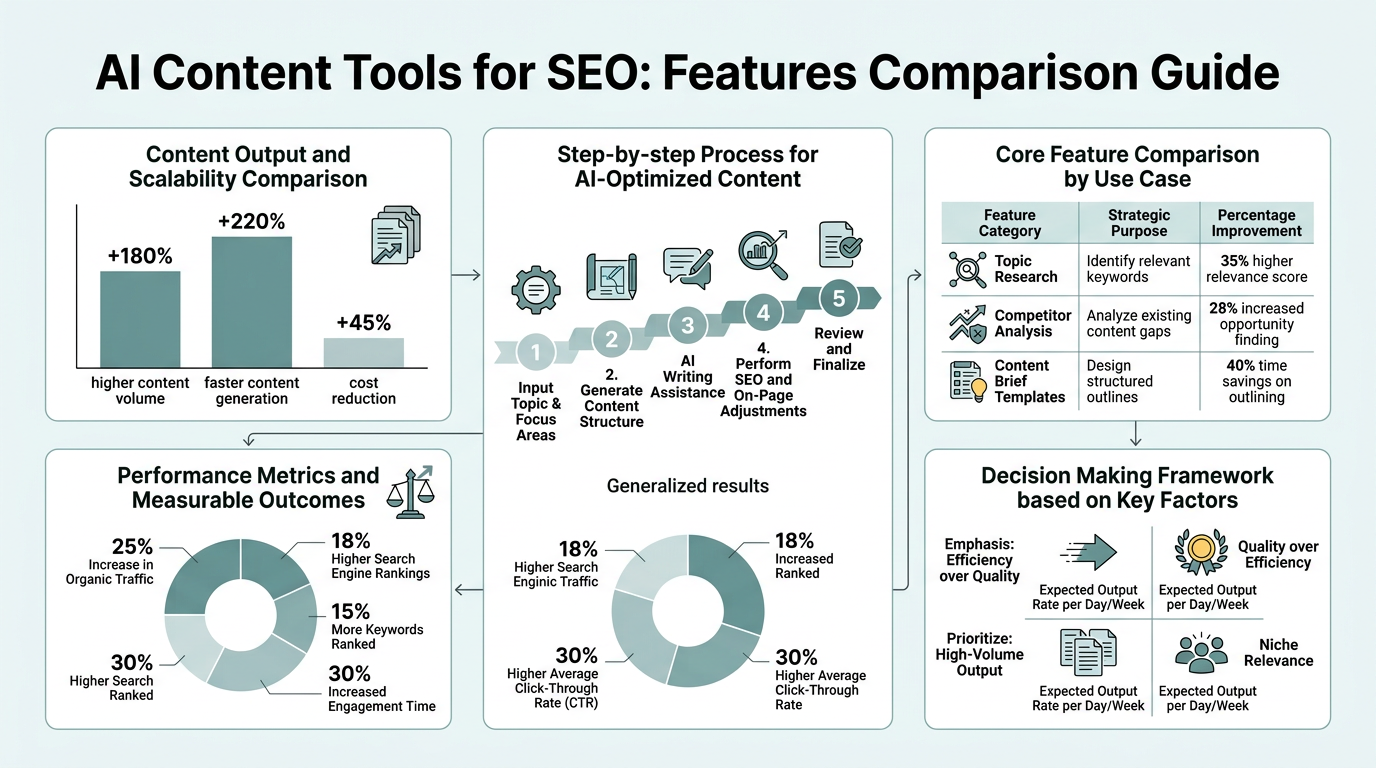
How Do AI Content Tools Differ in Core Architecture?
The market has fragmented into fundamentally different approaches to AI content creation, and your choice depends entirely on what problem you're solving. At one end sits the autonomous content engine, which handles research, writing, and publishing without daily intervention. At the other sits the human-in-the-loop editor designed to accelerate your internal team's output. Knowing the difference is critical because picking the wrong type wastes money and delivers mediocre results.
Fully Autonomous AI Agents vs. Assisted Writing Tools
Autonomous AI content systems operate differently from traditional assisted writing platforms. An autonomous agent orchestrates 12+ specialized sub-agents—researchers, writers, fact-checkers, internal linkers, and publishers. Each handles a specific task in a coordinated pipeline. Autonomous content agents exemplify this model: they research topics by pulling from 14+ data sources, generate fact-checked long-form articles daily, and publish directly to CMS platforms while building internal link networks automatically. The output is a cohesive content funnel with minimal human input after setup.
"Most tools automate writing; autonomous content systems automate the entire content operation from research through publishing. This is fundamentally different from assisted writing tools that accelerate human effort."
By contrast, assisted AI writers like Jasper and Writesonic are editing accelerators. You (or your team) still drive the creative direction, outline structure, and editorial review. The AI fills in drafts faster, suggests optimizations, and handles formatting. According to Averi's 2026 SEO tools guide, Writesonic's AI Article Writer can produce an SEO-optimized draft in roughly 10 minutes, but the human still curates the final version. The trade-off: speed and ease vs. control and customization.
Built-In SEO Features vs. Bolted-On Integrations
The most important architectural difference is whether SEO lives inside the platform or requires a separate subscription. Tools like Writesonic bundle keyword research, SERP analysis, internal linking, content gap analysis, and an Answer the People search-listening feature directly into the writing interface. You're not context-switching between platforms; everything happens in one workflow. Tools like Jasper integrate with Surfer SEO for optimization, which means paying two subscriptions and jumping between tabs—adding friction and cost.
This distinction matters for your budget and workflow. A single all-in-one platform reduces tool sprawl and costs. Zapier's comparison notes that Writesonic's native SEO stack is a practical advantage for teams focused on rapid content production with built-in optimization, while Jasper is better for brand-heavy marketing teams that prioritize voice consistency over pure SEO automation.
Research Depth and Data Sources
The quality of a content tool's output depends entirely on the quality of its input. Generic AI writers pull from broad internet crawls and training data. Advanced tools connect to live SERP data, topic research databases, and fact-checking sources. The difference is stark: a tool that sees what Google is actually ranking for that topic can write to match search intent. A tool that just knows language patterns will miss the mark.
"Research-first content systems that pull from 14+ distinct sources produce 30–50% longer, more authoritative articles than assisted writers working from user-supplied briefs alone. The difference compounds when scaled across hundreds of pieces."
Autonomous agents pull research from 14+ distinct sources—proprietary databases, SERP snapshots, Q&A forums, and fact-checking APIs—before the writing agent even starts drafting. This research-first approach is why autonomous content systems produce longer, more research-backed articles than assisted writers working from user-supplied briefs alone.
Which Features Actually Drive SEO Results?
Not all features move rankings. Some are productivity theatre—they feel good to use but don't impact search visibility. The features that genuinely correlate with rankings are: accurate keyword research, SERP-aware content briefing, fact-checking integration, internal linking structure, and publishing automation. Everything else is secondary.
Keyword Research Accuracy and Clustering
Keyword research is the foundation of SEO content. Wrong keyword = wrong traffic intent = no conversions. AI content tools vary wildly in keyword quality. Some pull from outdated, noisy datasets. Others connect to real-time search volume and competition data. The best tools go further: they cluster keywords into topic silos and identify content gaps automatically. This is critical because you can't write a single article for 100 keyword variations—you need to know which keywords belong in the same piece and which need separate articles.
Key capabilities to evaluate in keyword research features:
- Real-time search volume and competition scoring from live Google data
- Automatic keyword clustering and topic silo organization
- Search intent classification (informational, transactional, commercial)
- Content gap analysis showing missing topic coverage
- Long-tail keyword suggestions and related search variants
Tools like Surfer SEO excel at SERP-connected keyword analysis. They show you actual search volume, keyword difficulty, search intent, and current top-ranking pages in real time. Writesonic includes keyword research natively, reducing the friction of switching to a separate tool. If your platform doesn't have real-time keyword data, you're writing blind—guessing what searchers want instead of matching actual search behavior.
SERP-Driven Content Briefs and Outlines
The second most important feature is automatic content briefing based on live SERP analysis. A smart brief should tell you: what topics do the top 10 ranking pages cover? What questions are searchers asking about this topic? What word count dominates the first page? What structural patterns (listicles, how-tos, frameworks) are winning? This data should come directly from Google's actual results, not from generic content templates.
W3Era's 2026 tool roundup emphasizes that tools connected to SERP data are significantly more useful for SEO than generic AI platforms. Surfer SEO is the category specialist here—it shows you real-time SERP scoring and optimization suggestions word-by-word. Writesonic's built-in content optimizer draws on similar data. Both are light-years ahead of ChatGPT or generic Jasper templates because they're built specifically for search visibility, not general writing.
Fact-Checking and Content Verification
Google penalizes false or misleading information more aggressively every year. 97% of companies have a review process for AI content, and 80% manually verify accuracy before publishing, which tells you that human trust in AI-generated facts is still low. The tools that win in this space automate fact-checking by cross-referencing claims against live data sources, linking to original research, and flagging unverifiable claims before publishing.
Automated fact-checking should include these elements:
- Cross-referencing claims against multiple authoritative sources
- Automatic citation and attribution linking
- Real-time flagging of unverifiable or contradictory statements
- Integration with fact-checking APIs and databases
- Content confidence scoring before publishing
AI content generators with built-in fact-checking include a dedicated verification layer that validates claims against multiple sources and flags anything unverifiable. This reduces downstream editorial burden and improves content authority. Tools that skip this step and hand you raw AI output expect you to become your own fact-checker—which defeats the automation advantage.
Internal Linking and Content Clusters
Internal linking is one of the highest-leverage SEO tactics and the most tedious to do manually. Smart AI tools automatically build internal link networks as they publish new content, connecting new articles to existing topical clusters and passing PageRank strategically. This is where autonomous agents shine: they can map your entire content structure and make linking decisions based on topical relevance and link equity flow.
Writesonic includes topic clustering and automated internal linking recommendations. Standalone SEO platforms like Surfer require you to manage linking separately. Programmatic SEO systems handle internal linking as part of the publishing pipeline—new articles automatically connect to related pieces without manual intervention. This sounds small, but it compounds fast: AI-enabled teams publish 47% more content per month, and if that content is internally linked intelligently, the SEO impact multiplies exponentially.
How Do the Market Leaders Compare?
Let's cut through the marketing and look at what separates the leading platforms. We'll evaluate them across the features that actually impact rankings: SEO depth, speed to publication, pricing transparency, and integration friction. The goal isn't to declare a winner—it's to help you understand which tool matches your team's actual workflow.
| Platform | Core Strength | Built-In SEO Features | Speed to Draft | Best For | Key Limitation |
|---|---|---|---|---|---|
| Jottler | Autonomous daily content production with research + fact-checking + publishing | Keyword research, SERP analysis, fact-checking, internal linking, CMS publishing | Daily autonomous publishing; 3000+ words/day | Busy founders and marketing teams needing hands-off content at scale | Requires content strategy setup; less control over final voice |
| Writesonic | AI writing + built-in SEO in one platform; fast ideation to draft | Keyword research, content optimizer, internal linking suggestions, content gap analysis, Answer the People | 10 minutes to SEO-optimized draft | Teams who want speed and built-in SEO without platform hopping | Less emphasis on deep brand voice governance |
| Jasper | Brand voice consistency and team collaboration; marketing-first approach | None natively; requires Surfer SEO integration (separate cost) | 15–20 minutes with template workflows | Marketing teams prioritizing brand control and template-driven processes | SEO is not native; adds cost and context-switching friction |
| Surfer SEO | SERP-driven content optimization and real-time scoring | Keyword research, SERP analysis, content editor, on-page scoring | Optimization layer; doesn't generate full drafts | SEO specialists and editors needing SERP-led optimization of existing content | Not a full writing suite; requires you to source initial drafts |
| Frase | Research briefs, question research, and content outlines | Keyword research, SERP questions, content gaps, outline generation | Content brief in 5–10 minutes | Teams that do their own writing but need better research and briefing | Stops at briefing; doesn't generate full drafts |
What jumps out immediately: Jottler and Writesonic sit on opposite sides of the automation spectrum. Writesonic is built for human teams who want to move faster. Jottler is built for humans who want to move constantly without needing to think about daily content production. Jasper is built for marketers who care more about brand consistency than SEO automation. Surfer is built for SEO specialists, not generalists. Frase is built for researchers, not writers.
The Autonomous Agents Category: Why It's Different
Autonomous AI agents represent a category shift that most AI content tools haven't made yet: from assisted writing to autonomous content operations. Instead of asking "How can I write faster?", it asks "How can I stop writing entirely and just oversee a system that writes for me?" This requires more upfront strategy work (topic clustering, keyword strategy, publishing rhythm), but the payoff is compounding: every day the system publishes without your input, you're building topical authority and backlink equity passively.
The limitation is real too: you trade off granular control over voice and tone for hands-off production. This works for SEO-focused content, SaaS blogs, and affiliate sites where voice consistency is less critical than keyword coverage and publishing speed. It's not ideal for brand journalism or premium editorial content where each article is a statement of voice.
The SEO-Integrated Writer: Writesonic's Approach
Writesonic occupies the practical middle ground: it's fast enough to feel autonomous (10 minutes to a full draft), but human-readable enough to require minimal editing. Its built-in SEO suite means you're not paying twice or juggling logins. The limitation is that it assumes you're inputting decent briefs; it can't research from scratch like autonomous agents can. You're still responsible for topic selection and strategic direction.
The Brand-Controlled Platform: Jasper's Market
Jasper's strength is brand voice and team coordination, not SEO agility. It excels at template-driven workflows, brand guidelines enforcement, and collaborative editing. For marketing teams at companies with strong brand standards (luxury, fintech, enterprise SaaS), that's critical. The trade-off is SEO depth: the Surfer integration is bolted-on, which adds cost and friction. This tool is built for marketers who'd rather control output than maximize keyword coverage.
What Should You Prioritize When Selecting a Tool?
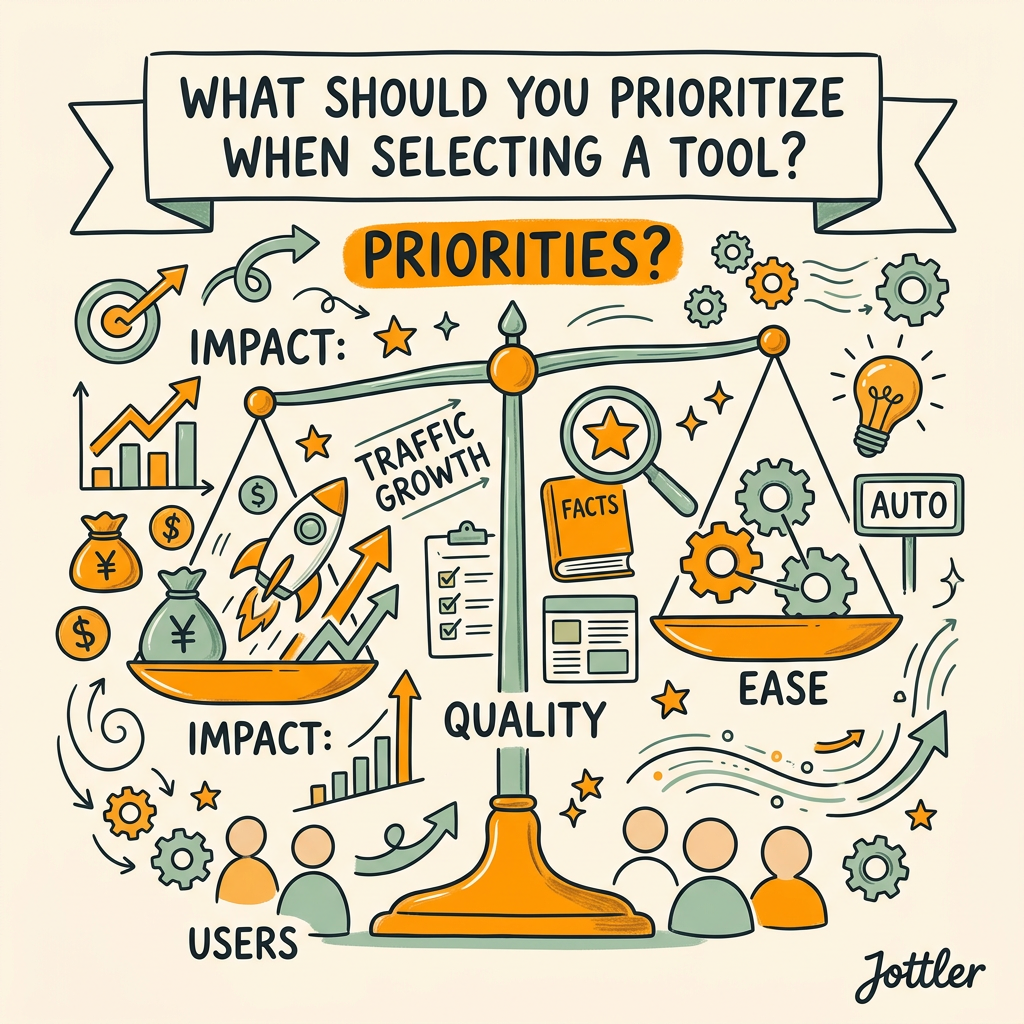
The wrong selection criteria leave you with a tool that doesn't match your workflow. Teams focused on rankings should weight SEO depth, research quality, and publishing automation heavily. Teams focused on brand output should weight voice control and template flexibility. Here's how to think about the tradeoffs.
Ranking-Focused Teams: Optimize for SEO Depth
If your goal is compounding organic traffic growth, your top priority is tools that eliminate manual work from research, keyword analysis, fact-checking, and publishing. This is where autonomous agents and SEO-integrated writers win. You want keyword research that connects to live search data, SERP briefs that match search intent, automated fact-checking, and direct CMS publishing that handles internal linking. Every step a human has to do manually is a step where the content system breaks down.
Selection criteria for ranking-focused teams should include:
- Real-time SERP data integration and search intent matching
- Automated fact-checking and claim verification
- Direct CMS publishing with internal linking automation
- Keyword research with live volume and difficulty scoring
- Topic clustering and content gap analysis
For ranking-focused teams, hands-off content scaling with autonomous agents is the clear fit. Writesonic is the second choice if you want more control over final output but still need built-in SEO features.
Speed-Focused Teams: Minimize Context Switching
If your team is already stretched and you need faster publication without sacrificing quality, prioritize tools with zero-friction SEO. Single-platform tools like Writesonic and Jottler eliminate tool-hopping. Tools like Jasper that require separate subscriptions (Jasper + Surfer SEO) add mental load and cost. The math is simple: if switching tools costs you 10 minutes per piece, and you're publishing 5 pieces per week, that's 4 hours of context-switching cost annually. A unified platform saves money and reduces human error.
Brand-Heavy Teams: Prioritize Voice and Control
If brand voice consistency is non-negotiable (luxury, fintech, premium content), Jasper and similar brand-controlled platforms are worth the SEO friction. You're willing to accept slower iteration and higher SEO costs because brand dilution costs you more. For these teams, treating SEO as a separate optimization layer (via Surfer or similar) is acceptable overhead.
Brand-focused selection criteria include:
- Brand voice guidelines and style consistency enforcement
- Template-driven workflow systems
- Team collaboration and approval workflows
- Multi-channel publishing (web, email, social)
- Advanced personalization and segmentation
Budget-Conscious Teams: Look Beyond Price
The cheapest tool isn't always the most cost-effective. A $99/month platform that requires manual fact-checking and publishing costs more in human labor than a $500/month autonomous system. When evaluating cost, account for: time your team spends actually using the tool, content volume per dollar, and the downstream editorial burden. A tool that publishes half-baked content requiring heavy review isn't cheap—it's expensive masked as cheap.
"Cost-per-article should be calculated as (tool cost + human labor cost + opportunity cost of delays), not just the tool subscription. A platform that saves 10 hours per month is worth $500 even if a cheaper option exists."
What Are the Hidden Costs and Limitations?
Every tool trades something. Understanding what you're giving up is as important as knowing what you're gaining.
Integration Friction and Workflow Disruption
Tools that don't include SEO natively force you to use multiple platforms and switch contexts repeatedly. This sounds trivial until you're doing it dozens of times per week. Jasper + Surfer integration works, but you're exporting from Jasper, checking keywords in Surfer, jumping back to Jasper to edit, then manually uploading to WordPress. Writesonic and Jottler eliminate those steps. The time cost adds up: context-switching in knowledge work costs an average of 15 minutes per switch. That's real money.
Editorial Burden and Fact-Checking
Any AI content tool requires human review. But the level of review varies wildly. Autonomous agents like Jottler come with built-in fact-checking, so your review is spot-checking rather than line-editing. Generic AI writers require full editorial pass-throughs. 80% of companies manually review AI content for accuracy, so don't buy a tool that pushes the entire editorial burden onto your team. Prefer tools that have automated fact-checking built in.
Customization vs. Standardization
Highly customizable tools like Jasper give you more voice control but slower iteration. Standardized autonomous systems like Jottler are faster but less flexible on tone. There's a real tradeoff here. Decide upfront: is consistency and speed more valuable to you than granular control? Most SEO-focused teams choose speed; brand teams choose control.
How to Implement Your AI Content Tool Effectively
Tool selection is just step one. Implementation determines whether you see real ROI or burn budget on half-baked automation.
Start with Strategy, Not Tool Setup
Before you sign up, map out your content strategy: which topics matter for SEO? What's your publishing rhythm? What content clusters will you build? Which tool should be fed data in which format? Teams that jump straight into tool setup without strategy end up with garbage in, garbage out. The tool doesn't know what you're trying to accomplish; you have to tell it.
Implementation planning should address:
- Topic selection and keyword mapping to content pieces
- Content cluster organization and topical authority goals
- Publishing rhythm and volume targets
- Review and approval workflows
- Performance tracking and ROI measurement
A detailed SEO content plan that maps topics to keywords to publishing sequence is essential before tool setup. This 2-3 week planning phase saves months of wasted content production.
Build Review Processes Before Going Live
AI content requires human oversight. Build your review process before you publish at scale. Who fact-checks? Who reviews brand voice? Who handles quality control? Teams that skip this step publish broken content and damage their domain authority. 97% of companies maintain a review process for AI content for a reason: AI is a productivity tool, not a replacement for editorial judgment.
Your review workflow should include:
- Fact-checking and claim verification against authoritative sources
- Brand voice and tone alignment checks
- SEO optimization verification (keyword placement, structure, length)
- Link quality and internal linking appropriateness
- Final legal and compliance review (especially for regulated industries)
Measure and Iterate Ruthlessly
Set baseline metrics before you start: current organic traffic, current publishing frequency, current cost per article. Then track: traffic from AI-generated content vs. human-written content, conversion rates, ranking improvements, topic cluster authority. Most teams don't measure this. They integrate a tool, publish a bunch of content, and hope. You need actual data to know if your tool choice is working.
Conclusion
The AI content tool market has matured. You're no longer choosing between "bad" and "good"—you're choosing between different optimization targets. Teams using AI tools report 47% higher content volume and 65% better SEO results, but only when the tool matches their workflow. Autonomous agents win for hands-off scaling; SEO-integrated writers win for speed without platform-hopping; brand platforms win for voice consistency; specialist tools win for on-page optimization. The wrong choice costs money and time. The right choice compounds organic traffic growth month after month.
If you're a busy founder or marketing team that understands the importance of organic growth but lacks the time to manage daily content production, autonomous content systems cut the problem at the root. They handle research, writing, fact-checking, internal linking, and publishing automatically—no daily intervention required. Most tools automate writing; the best automate the entire content operation. Start scaling your organic traffic and compound your content advantage without the burnout.
FAQs
What is the best AI content tool for SEO?
The best tool depends on your priorities. For autonomous daily publishing and hands-off scaling, autonomous AI agents deliver consistent volume with built-in research, fact-checking, and publishing. For speed without sacrificing control, Writesonic's built-in SEO suite beats tools that require separate integrations. For pure on-page optimization of existing drafts, Surfer SEO is the specialist. Match the tool to your bottleneck: if you lack time to publish, pick autonomous; if you lack speed, pick Writesonic; if you lack SEO data for existing content, pick Surfer.
Does AI-generated content actually rank on Google?
Yes, but only when it's built on research, fact-checked, and optimized for search intent. Google doesn't penalize AI per se—it penalizes low-quality, unhelpful, and misleading content regardless of authorship. AI content ranks when it matches what searchers are looking for, outperforms existing results, and demonstrates genuine expertise. Raw, unedited AI output rarely ranks. Content from tools that include SERP analysis, keyword research, and fact-checking rank significantly better because they're designed specifically for search visibility, not just content generation.
How much should I budget for an AI content tool?
Budget depends on volume and depth. Single-user AI writers range from $20–200/month (Writesonic, Jasper). Full SEO suites with keyword research and optimization add $50–200/month (Surfer SEO). Autonomous content systems that handle research, writing, and publishing start at $29/month for basic plans and scale to $500+/month for high-volume publishing. The lowest-cost tools require the most human editing, which often makes them more expensive in labor. Choose based on time saved divided by cost, not absolute price. A tool that saves your team 5 hours per week is worth $500/month even if a cheaper tool exists—you're buying back your time.