AI SEO Tools for Competitive Analysis
Competitive advantage in SEO no longer comes from manual research spreadsheets. 82% of SaaS companies now use AI SEO platforms for competitive analysis, yet most teams still spend 10+ hours per week manually tracking competitor keywords, backlinks, and content gaps. The cost? Missed opportunities, slower market response, and organic traffic that plateaus while competitors scale. AI-powered competitive analysis tools flip this equation by automating the entire intelligence workflow—from monitoring competitor movements to identifying content gaps to tracking your visibility against AI-generated answers.
Key Takeaways
- 82% of SaaS companies use AI SEO tools for competitive analysis, with enterprise adoption at 81% (2025)
- AI SEO tool market projected to grow from $1.2 billion (2024) to $4.5 billion by 2033, a 15.2% CAGR
- Automated backlink analysis and keyword gap detection reduce manual research time by 70%+ while improving strategic accuracy
- Keyword Gap Detection and Opportunity Mapping: AI tools instantly uncover search terms your competitors rank for but you don't, prioritizing high-intent keywords across intent clusters.
- Backlink Intelligence and Authority Tracking: Automated monitoring of competitor backlink profiles reveals link sources, anchor text patterns, and growth trends to inform your link-building strategy.
- Content Differentiation and Topical Strength Analysis: Compare your content depth against competitors to identify where you need more topical authority or unique angles.
- AI Visibility and GEO Monitoring: Track where your brand and competitors appear in AI-generated answers and Generative Engine Optimization (GEO) results, a critical emerging metric.
- Real-Time Competitive Alert Systems: Receive automated notifications when competitors publish new content, earn backlinks, or shift keyword strategies.
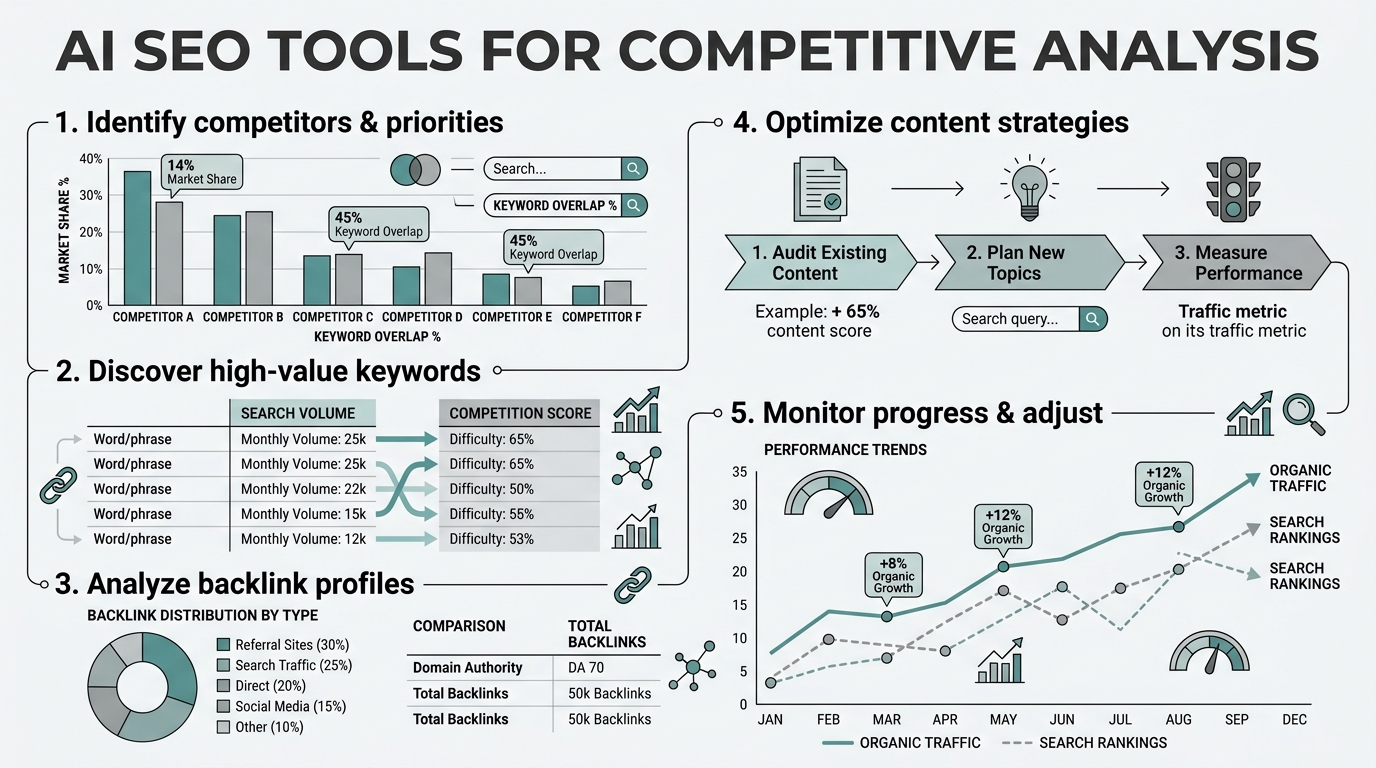
Why AI-Powered Competitive Analysis Matters Now
Manual competitive analysis is dead. Between tracking 50+ competitor keywords, monitoring backlink changes, and analyzing content performance across platforms, the time investment alone makes it unsustainable for growing teams. AI tools cut this workload dramatically while adding layers of insight that humans would miss—particularly around AI visibility and market shifts. According to SEO Sandwitch, 61% of marketers report using AI to improve SEO strategies, and competitive analysis is the single highest-leverage application.
"AI competitive analysis tools move your team from reactive mode (waiting to see what competitors do) to predictive mode (knowing where the market is moving and staking your claim first)."
The stakes are real: a competitor finds a high-volume keyword gap you missed, and within three months they're ranking above you. Your sales team notices your organic pipeline shrinking while their qualified leads grow. By then, the window for capturing that traffic has closed. AI competitive analysis tools give you the intelligence to stay ahead of market movements before they become problems.
Core Features of Leading AI SEO Competitive Analysis Tools
Not all AI competitive analysis tools are built the same. The strongest platforms combine real-time data gathering with AI-driven interpretation to surface insights a human analyst might take weeks to synthesize. Here's what separates best-in-class solutions from shallow imitations.
Keyword Gap and Opportunity Detection
The fastest way to find quick wins is to target keywords your competitors rank for but you don't. 52% of SEO experts specifically use AI tools for competitive keyword analysis, making this the most-adopted use case in the industry. Leading AI tools don't just list gaps—they cluster keywords by search intent, show search volume and trend direction, and flag keywords where your domain authority makes ranking achievable within 60–90 days. This filters out vanity keywords and focuses your team on genuinely valuable targets.
- Intent-based keyword clustering: Groups keywords by buyer stage (awareness, consideration, decision), not just alphabetically
- Relevance scoring: Ranks keyword opportunities by your existing topical authority and content inventory
- Competitive difficulty assessment: Shows the domain authority threshold you need to rank, and whether you currently meet it
- Search trend forecasting: Identifies keywords with rising search volume before competitors flood the space
Backlink Profiling and Source Intelligence
Backlinks remain one of the strongest ranking factors, yet most teams track them reactively. AI-powered backlink analysis reveals not just links your competitors have, but where they're coming from, what anchor text patterns work in your industry, and which referring sites are most authoritative. Research from SEO Sandwitch on AI link-building shows that 78% of SEO agencies use AI platforms for backlink analysis, signaling this is table-stakes for competitive teams.
"The real power emerges when AI cross-references backlink profiles across your entire competitive set. You'll see patterns: certain niche publications are prolific linkers in your space, competitors cluster around specific link sources, and some high-authority sources have never been approached by your team."
This transforms link building from random outreach to a systematic, competitive intelligence operation where your team targets the exact publications most likely to link to your content.
Content Gap and Topical Authority Analysis
Ranking for a keyword isn't enough if competitors cover the topic more comprehensively. Leading AI tools now analyze your content versus competitors at a topical level, identifying subtopics you're missing, questions your audience asks that competitors answer, and content depth gaps that impact E-E-A-T signals. This is especially critical for regulated industries (finance, health, legal) where topical authority signals trustworthiness to both Google and readers.
AI Visibility and Generative Engine Optimization (GEO) Tracking
A new frontier has emerged: AI-generated answer visibility. McKinsey research on AI search notes that leading brands are lagging in AI search performance by 20–50% compared to traditional SEO, indicating that visibility in ChatGPT, Perplexity, and Google's AI Overviews is still largely unoptimized across the industry. Tools that track where your content and competitors' content appear in AI-generated answers are becoming critical for staying ahead.
This means monitoring:
- Brand mention frequency: How often your company appears in AI-generated answers for relevant searches
- Citation patterns: Which competitor content gets cited vs. ignored by AI systems
- Content structure optimization: Whether your content is formatted in ways AI systems can parse and cite (clear headings, data tables, step-by-step guides)
How to Choose the Right AI SEO Competitive Analysis Tool
The market is crowded, but clear patterns emerge when you evaluate tools against real team needs. Here's how to separate tools that genuinely save time from ones that just add another dashboard to your stack.
Integration Depth and Workflow Fit
The best tool in the world is worthless if it requires manual exports and re-entry into your CMS or project management system. Look for platforms that integrate natively with your existing stack—Google Workspace, Slack, your CMS, your rank tracking tool. More importantly, seek tools where competitive analysis insights flow directly into your content calendar and keyword targeting strategy without human translation. Jottler, for instance, runs competitive analysis as part of its daily research pipeline, automatically identifying gaps and opportunities that feed directly into its content generation workflow, ensuring every article targets validated keyword opportunities informed by competitor movements.
Data Freshness and Update Frequency
Competitive analysis is only actionable if data reflects current market reality. Some tools update quarterly; others update daily. For fast-moving markets (tech, e-commerce, news), daily updates are essential. Stale data means you're reacting to yesterday's competitive landscape, not tomorrow's. Verify your tool's data refresh cadence before committing.
AI Interpretation, Not Just Data Display
Raw data overwhelms. The best tools combine data collection with AI-driven interpretation. Instead of showing you a list of 200 competitor backlinks, top tools surface patterns: "Your competitors cluster around 3 link sources you haven't tapped. These sites have published 47 articles in your niche in the past 90 days." This turns noise into narrative.
- Actionable recommendations: Tools should surface not just what competitors do, but why it matters and what you should do next
- Anomaly detection: Flag unusual competitor moves—sudden content publishing spikes, major backlink wins, ranking shifts—so you can investigate quickly
- Predictive insights: Identify where competitors are likely to attack next based on their content and link-building patterns
Ease of Reporting and Stakeholder Communication
SEO teams don't live in isolation. Your findings need to persuade product managers to adjust roadmaps, convince founders to invest in content, and align sales on positioning. Tools that export sharp, narrative-driven competitive reports—not spreadsheets—get read and acted on. Look for tools with templated reports, visualization options, and clear story structures built in.
Top AI SEO Tools for Competitive Analysis Comparison

To help you evaluate options, here's how leading platforms stack up across the dimensions that matter most for competitive teams:
| Tool | Keyword Gap Detection | Backlink Analysis | Content Differentiation | AI Visibility Tracking | Automation Level | Starting Price |
|---|---|---|---|---|---|---|
| Jottler | Automated, AI-interpreted gaps | Integrated in daily research | Deep topical mapping | Embedded in research & publishing | Fully autonomous | $29/mo |
| Semrush | Yes, with intent clustering | Yes, extensive profiles | Limited, basic comparison | Basic tracking only | Manual tool use required | $120/mo |
| Ahrefs | Yes, detailed analysis | Excellent, granular | Yes, moderate depth | Limited | Manual tool use required | $99/mo |
| SE Ranking | Yes, basic clustering | Yes, limited depth | Basic content audit | No | Manual tool use required | $55/mo |
| Clearscope | Limited, keyword-focused | No | Yes, strong content analysis | No | AI assistance, not autonomous | $150/mo |
The pattern is clear: most tools require manual research workflows and dashboard-hopping. Jottler stands apart because competitive analysis isn't a separate dashboard—it's baked into an autonomous SEO engine. Every article generated by Jottler is informed by competitor keyword gaps, backlink patterns, and content differentiation analysis, automatically published to your CMS with smart internal linking built in. For busy founders and growing teams, this eliminates the gap between knowing what you should write about and actually getting it published at scale.
Implementing Competitive Analysis into Your Content Strategy
Data is worthless without action. Here's how high-performing teams turn competitive insights into published content and organic growth. Successful content marketing automation requires weaving competitive intelligence into every stage of the publishing pipeline.
Prioritizing Quick-Win Keywords from Competitive Research
Not all competitive gaps are created equal. Your AI tool will surface hundreds of keywords competitors rank for but you don't. The fastest wins come from keywords where: (1) search volume is meaningful (50+ monthly searches), (2) your domain authority is within striking distance, and (3) competitors have weak content (short articles, outdated information, poor structure). Look for 3–5 of these "golden keywords" each month and assign them to your content roadmap immediately.
Building Content Around Backlink Intelligence
If a competitor's article earned 10 high-authority backlinks, your better version of that content has a realistic shot at earning more. Use backlink analysis to inform content strategy: identify competitor articles with strong link attraction, understand what made them linkable (original research, unique framework, comprehensive guide), and create superior versions. This is far more efficient than writing content in a vacuum and hoping it ranks. Understanding link-building tools and strategies can accelerate this process.
Creating Content Clusters Around Topical Gaps
AI analysis will show you topics where competitors have deep coverage but you don't. Rather than publishing one article, build a content cluster: a comprehensive pillar article plus 3–5 supporting articles covering subtopics, each internally linked. This signals topical authority to Google and positions your content as the definitive resource in your niche. Techniques like topical authority frameworks help structure these clusters for maximum impact.
Monitoring Competitor Content Velocity and Adjusting Your Pace
If a competitor publishes 15 high-quality articles per month and you're publishing 2, they'll eventually dominate your target keywords. AI tools flag this gap immediately. Use competitive content velocity data to justify increasing your publishing frequency. Many growing teams find they need to shift from 1 article per week to 3–5 articles per week to keep pace—and tools that automate publishing, like Jottler, make this sustainable without burning out your team.
Common Pitfalls When Using AI Competitive Analysis Tools
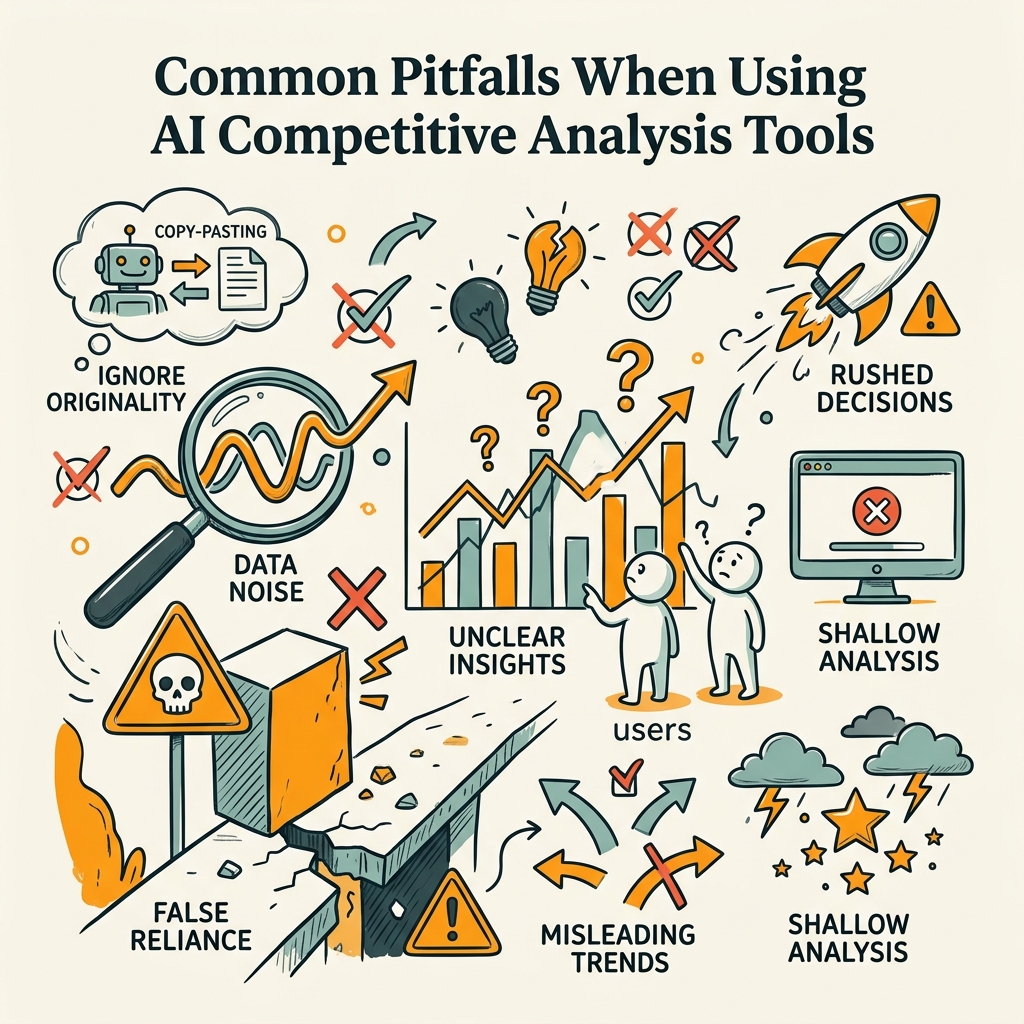
Even with powerful tools, teams fall into predictable traps that waste time and misdirect strategy.
Treating Competitor Keywords as Your Keyword List
Just because a competitor ranks for a keyword doesn't mean you should target it. Evaluate competitor keywords against your business model, audience, and profitability. A low-intent, high-volume keyword might drive traffic that never converts. Your competitive analysis tool should show search intent and estimated commercial value, not just traffic numbers. Use it to validate strategic direction, not replace it.
Ignoring Your Unique Value Prop in Competitive Analysis
Copying competitor content structure is a starting point, not a strategy. Your differentiation comes from unique insights, original research, or a distinct point of view. Use competitive analysis to find the gap, but fill it with your unique value. If every SaaS competitor publishes "10 tips for X," your competitive intelligence should reveal that gap—but your response should be something more differentiated and valuable.
Overweighting Backlink Metrics
Your competitor has 100 backlinks to an article you're competing with. That doesn't mean you need 100 backlinks to rank. Backlink quality matters more than quantity. Use backlink analysis to identify high-authority link sources in your niche (not to match competitor link counts). A tool like Jottler that weaves competitive insights into your content strategy from day one ensures you're building content around genuine keyword opportunities, not just copying competitor tactics blindly.
Measuring ROI: What Competitive Analysis Should Deliver
If you're investing in an AI competitive analysis tool, you deserve clear metrics proving its value. Here's what to track.
- New keyword rankings from gap analysis: How many keywords identified via competitor gaps did you publish content for, and how many now rank in top 10?
- Time saved on research: Calculate hours previously spent on manual competitive research, multiply by loaded labor cost, and compare to tool cost
- Content production acceleration: Did your publishing frequency increase after implementing competitive insights into your workflow?
- Backlink source diversification: Are you earning links from sources competitors use, but you hadn't previously targeted?
- Organic traffic from newly targeted keywords: Segment organic traffic growth by keywords identified through competitive analysis vs. other sources
Most teams see payback within 90 days if they act on competitive insights consistently. Autonomous SEO agents accelerate this timeline because insights feed directly into published content without manual handoffs.
Integrating AI Competitive Analysis with Your Broader SEO Strategy
Competitive analysis doesn't exist in isolation. The strongest teams weave it into their overall SEO motion: keyword research, content planning, link building, and performance monitoring. Understanding the full SaaS SEO strategy ensures competitive insights compound over time.
"Start with a baseline: run your current content against your top 5 competitors and map keyword gaps, backlink sources, and content weakness areas. The key is frequency and consistency. Running competitive analysis every 30 days and adjusting your strategy accordingly compounds over time."
Prioritize a list of 20 quick-win keywords from that analysis. Then assign those keywords to your content calendar over the next 60 days. If you're manually writing content, this is now 40 hours of work. If you're using an AI content engine informed by competitive data—like Jottler—these articles are researched, written, and published daily while you focus on strategy. After six months, you'll own keyword terrain your competitors haven't even discovered yet. That's when organic traffic becomes your most predictable revenue channel.
Conclusion
AI-powered competitive analysis has shifted from a "nice-to-have" to non-negotiable. 82% of SaaS companies are already using it, and the AI SEO tools market is projected to grow to $4.5 billion by 2033. For busy founders and marketing teams, the question isn't whether to invest in competitive analysis—it's which tool lets you act on those insights fastest without adding manual workload.
Competitive analysis is only valuable if it leads to published content ranking for validated opportunities. Tools that separate analysis from execution leave your team stuck translating insights into action. Jottler eliminates that friction by embedding competitive analysis directly into its autonomous research and publishing pipeline. Identify gaps today, publish superior content tomorrow, capture organic traffic next week.
If you're serious about competing on organic search, start your SEO agent at https://jottler.co/auth/signup and watch how competitive intelligence becomes your fastest path to organic growth.
FAQs
What is the best AI tool for competitive SEO analysis?
The best tool depends on your workflow and team size. Jottler is built specifically for scaling content production informed by competitive insights—it runs keyword gap analysis, monitors competitor content, and automatically publishes articles targeting the highest-opportunity keywords without requiring your team to move between tools. For teams focused purely on analysis without execution, Semrush and Ahrefs offer deeper backlink and keyword data, but they require manual interpretation and handoff to your content or link-building teams. Jottler's automation means your team moves from insights to published, optimized content in a single continuous workflow, saving weeks of manual work monthly.
How much time can AI competitive analysis save a marketing team?
Manual competitive analysis typically consumes 10–15 hours per week for a growing team: researching competitor keywords, analyzing backlinks, identifying content gaps, synthesizing findings into a strategy brief, and finally translating that into a content calendar. AI tools automate 70% or more of this workload, but where they truly shine is in continuous publishing workflows. A fully autonomous AI SEO agent like Jottler eliminates the gap between identifying an opportunity and publishing content around it. Most teams report publishing 3–5x more content monthly while reducing research and writing workload by 80%, which compounds to significant organic growth over six months.
Can AI competitive analysis tools help with content strategy beyond just keywords?
Yes. Leading AI tools now analyze competitor content at a topical and structural level, revealing where your content is weaker, what questions competitors answer that you don't, and how to build topical authority through content clusters. Some tools track competitor backlink sources and anchor text patterns to inform link-building strategy. The newest frontier is AI visibility tracking—monitoring where your brand appears in ChatGPT answers and Google's AI Overviews compared to competitors. This emerging metric is critical because 60% of searches now yield no clicks, meaning visibility in AI-generated answers is becoming as important as traditional rankings. Comprehensive competitive analysis tools surface all of these angles, not just keywords.