AI SEO Tools That Scale Organic Traffic
Organic CTR has collapsed by 65% on queries with AI Overviews, but the brands adapting fastest are seeing 4.4x higher conversion rates from AI-referred traffic. The challenge: scaling content production, keyword research, and optimization simultaneously while maintaining quality. Most tools solve only one piece of the puzzle. This guide shows you how to select and stack AI SEO tools that compound your organic traffic without burning out your team.
Key Takeaways
- AI Overviews trigger on 48% of queries and reduce organic CTR by 65%; brands cited in AI answers earn 35% more organic clicks. (BrightEdge, February 2026)
- AI-referred traffic converts at 4.4x the rate of traditional organic visitors, making quality over quantity the winning metric. (Semrush, June 2025)
- Scaling requires a multi-tool stack: research, content optimization, GEO tracking, and link building — not a single platform.
- Autonomous SEO engines automate the entire content-to-publish workflow, freeing teams to focus on strategy and results.
- Understanding the Current Landscape: AI Overviews are reshaping CTR expectations; success now depends on being cited by AI models, not just ranking in Google.
- Picking the Right Tool Stack: Research, optimization, GEO tracking, and content generation serve different functions; combining them compounds results.
- Optimizing for Generative Engine Optimization (GEO): Tracking visibility across ChatGPT, Perplexity, and Claude is now as critical as Google ranking.
- Automating Content at Scale: Autonomous engines handle keyword research, writing, fact-checking, and publishing to eliminate bottlenecks in content production.
- Building Authority Through Data: Content grounded in fresh SERP data and original citations performs best in both traditional and AI search results.
How Do AI SEO Tools Actually Scale Organic Traffic?
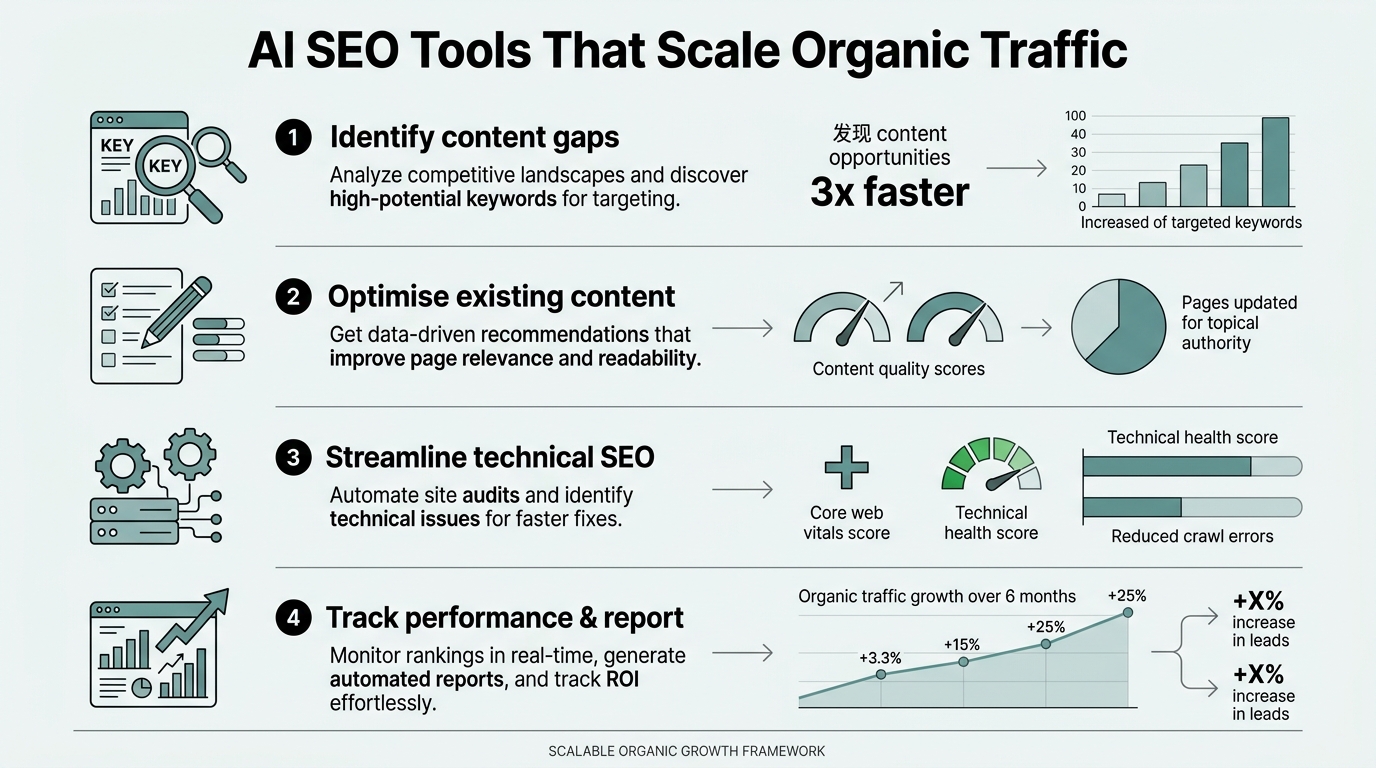
The old SEO model—research a keyword, write an article, optimize for on-page factors, hope for backlinks—no longer scales. AI Overviews now appear on 48% of all tracked queries, and when they do, organic CTR drops from 1.76% to 0.61%. But here's the flip side: brands that get cited in AI Overviews earn 35% more organic clicks and more importantly, those clicks convert at 4.4x the rate of traditional organic traffic.
"The brands scaling organic traffic fastest are those using automation to publish 5-10 high-quality articles weekly, optimize for AI search citation, and build topical authority faster than competitors."
AI SEO tools scale organic traffic by automating three things simultaneously: finding high-intent keywords, creating content grounded in real SERP data, and building the authority signals (backlinks, citations, internal linking) that help both Google and AI models recommend your content. Check out how to build a scalable AI content strategy for a deeper framework.
The key difference from traditional tools is speed and depth. A single founder or marketer can now research, write, optimize, and publish 5-10 high-quality articles per week instead of one. That frequency, compounded over months, creates the topical authority and semantic coverage that AI systems rely on to cite your brand.
Why Organic Traffic Quality Has Changed
Zero-click searches now account for 58% of all U.S. search volume. AI Overviews, knowledge panels, and snippets answer the question directly in the SERP. Traditional organic traffic—the click-through to your site—is now the premium outcome. This creates a paradox: you need more content to stay visible (for GEO and semantic coverage), but you need fewer, higher-quality pieces to convert.
"Content that ranks #1 in Google isn't automatically cited by ChatGPT. Understanding both playgrounds is critical for 2026 success."
Tools that only generate volume (content at scale without quality control) fail because they flood your analytics with low-intent impressions. The winners use AI to generate content that's actually citable: well-researched, backed by original data, with external and internal links that AI models recognize as trustworthy.
The Role of Automation in Compounding Growth
Manual content creation limits you to 1-2 pieces per week. AI SEO tools remove that ceiling. An autonomous engine like Jottler's SEO agent can research, write, fact-check, and publish 3,000+ word articles daily. That's 21-30 pieces per week, each grounded in keyword research and optimized for internal linking.
The compounding effect is significant. After 12 weeks of consistent daily publishing, you've created 252+ pieces of optimized content. In month one, you might see no traffic. By month three, topical authority and semantic coverage kick in, and organic traffic accelerates. This is why 68% of marketers report AI helped achieve higher ROI, with 40% reporting 6-10% revenue increases. (Tenet, 2026)
What Should You Look For in an AI SEO Tool?

Not all AI SEO tools are created equal. Some optimize existing content. Others generate bulk content at the expense of quality. The best tools solve a specific problem in the publishing workflow without creating new bottlenecks.
The framework below helps you evaluate tools based on where your team feels the most friction: keyword research, content creation, optimization, tracking, or publishing. Understanding how the best AI SEO tools work can guide your decision process.
Keyword Research and Intent Understanding
Your content is only as good as the keywords it targets. Tools like Semrush and Ahrefs excel at finding high-volume, low-competition keywords. Research shows that keyword competitiveness directly impacts time-to-rank; selecting the right keywords cuts your expected time-to-first-ranking by 40-60%.
What to look for:
- Search Intent Classification: Is the keyword transactional, informational, or navigational? Tools that auto-classify save hours of manual assessment.
- SERP Data Integration: Real-time SERP data (featured snippets, People Also Ask, content gaps) should inform your keyword selection and outline.
- AI Visibility Tracking: New tools like Rankscale.ai track whether your content appears in ChatGPT and Perplexity answers—not just Google rankings.
- Semantic Keyword Coverage: Tools that identify semantic variants and related keywords help you build topical authority faster.
Content Generation and Grounding
AI content generators range from chat-based (ChatGPT) to specialized SEO writers (Surfer SEO, Clearscope, Byword). The difference lies in grounding: whether the AI has access to real SERP data, competitor content, and your internal assets before writing.
Ungrounded AI (plain ChatGPT) produces plausible but often inaccurate or generic content. Grounded AI (Surfer SEO, Frase, Jottler) uses live SERP data, competitor analysis, and your brand voice to create content that ranks.
- SERP-Grounded Writing: The AI analyzes top-ranking pages for your keyword and ensures your outline covers the same entities, topics, and data points.
- Fact-Checking: Tools that verify claims against external sources reduce the risk of publishing inaccurate information.
- Original Research Synthesis: The best tools pull data from 10+ sources, synthesize findings, and cite them inline.
- Brand Voice Consistency: Autonomous engines should learn your tone and style, producing content that reads like your team wrote it.
Optimization and Publishing Workflow
Even well-written content needs optimization: internal linking, meta tags, header structure, image alt text. The slowest bottleneck for most teams is the gap between "content ready" and "content published."
Manual publishing takes 30-60 minutes per piece (formatting, internal links, metadata). Automation cuts this to zero. A good AI SEO tool should:
- Auto-Publish to Your CMS: Direct integration with WordPress, Webflow, or your platform; no manual uploads.
- Smart Internal Linking: The tool should suggest and insert internal links based on relevance and anchor text best practices.
- Metadata Generation: SEO titles, meta descriptions, and structured data (schema markup) should be auto-generated and editable.
- Publish Scheduling: Content should queue to a publishing calendar, respecting your editorial workflow and frequency goals.
Comparing the Top AI SEO Tools for Scaling Organic Traffic
Below is an honest comparison of the tools dominating the 2026 market. Each serves a different purpose; the best strategy is to combine them into a stack that handles research, writing, optimization, and tracking. For detailed reviews of the complete landscape, OneLittleWeb's comprehensive testing covers 15 top tools across categories.
| Tool Category | Best Pick 2026 | Primary Strength | Best For | Pricing |
|---|---|---|---|---|
| Autonomous Content Engine | Jottler | Daily 3,000+ word articles; 12 AI agents; fact-checking + publishing automation | Founders needing daily content at scale without team overhead | Starts $29/mo |
| Research + Keyword Data | Semrush | Comprehensive keyword + competitor intelligence; AI Overview tracking | Teams needing deep competitive analysis alongside content creation | $120/mo+ |
| Content Optimization (SERP-Grounded) | Surfer SEO | Real-time SERP data; AI Article Writer; GEO visibility tracker | Writers who want AI-assisted outlines based on top-ranking pages | $99/mo+ |
| Content Briefs (Lightweight) | Clearscope | Quick, data-backed writing briefs; clean interface | Teams who prefer brief-based writing over full automation | $170/mo+ |
| Programmatic SEO | AirOps | Template-based scaling for 100s of pages at once | E-commerce and local SEO scaling | $199/mo+ |
| GEO Tracking | Rankscale.ai | Monitors ChatGPT, Perplexity, Gemini, Google AI Overviews for brand mentions | Teams optimizing for AI search visibility | Custom pricing |
| Link Building Automation | Backlinker AI | Autopilot link outreach and prospecting | Teams building domain authority alongside content | $299/mo+ |
Why Jottler Leads for Busy Founders
Jottler is purpose-built for the exact pain point busy founders face: scaling content production without hiring additional writers or outsourcing. Unlike other content automation tools, Jottler combines autonomous research, fact-checked writing, and direct CMS publishing into a single daily workflow.
Unlike Surfer SEO (which is write-assistance), Semrush (which is research-heavy), or Byword (which is bulk generation without quality control), Jottler handles everything: keyword research, competitor analysis, 14+ source synthesis, fact-checking, internal linking, and publishing. You set your frequency (1-5 articles per day), connect your website, and the engine delivers. The result is consistent, high-quality, rankable content arriving on your site every day without you writing a single word.
For a solo founder or small marketing team, this compounds organic traffic faster than any other tool category because the bottleneck isn't strategy—it's production capacity.
When to Use a Multi-Tool Stack
If you have a larger team or need specialized capabilities, combine tools by function:
- Keyword + Competitive Data: Use Semrush or Ahrefs to find opportunities and validate strategy.
- Content Generation: Use Jottler for autonomous daily publishing, or Surfer SEO + Clearscope if you want writer-assisted brief-based workflows.
- GEO Tracking: Layer in Rankscale.ai to monitor AI search visibility alongside traditional rankings.
- Link Building: Use Backlinker AI to automate outreach on your highest-authority pages.
This stack provides coverage across the entire SEO pipeline. Research informs content strategy, content scales output, GEO tracking confirms AI visibility, and links build domain authority. Learn more about building an automated SEO workflow that ties these pieces together.
How to Optimize Content for Both Google and AI Search
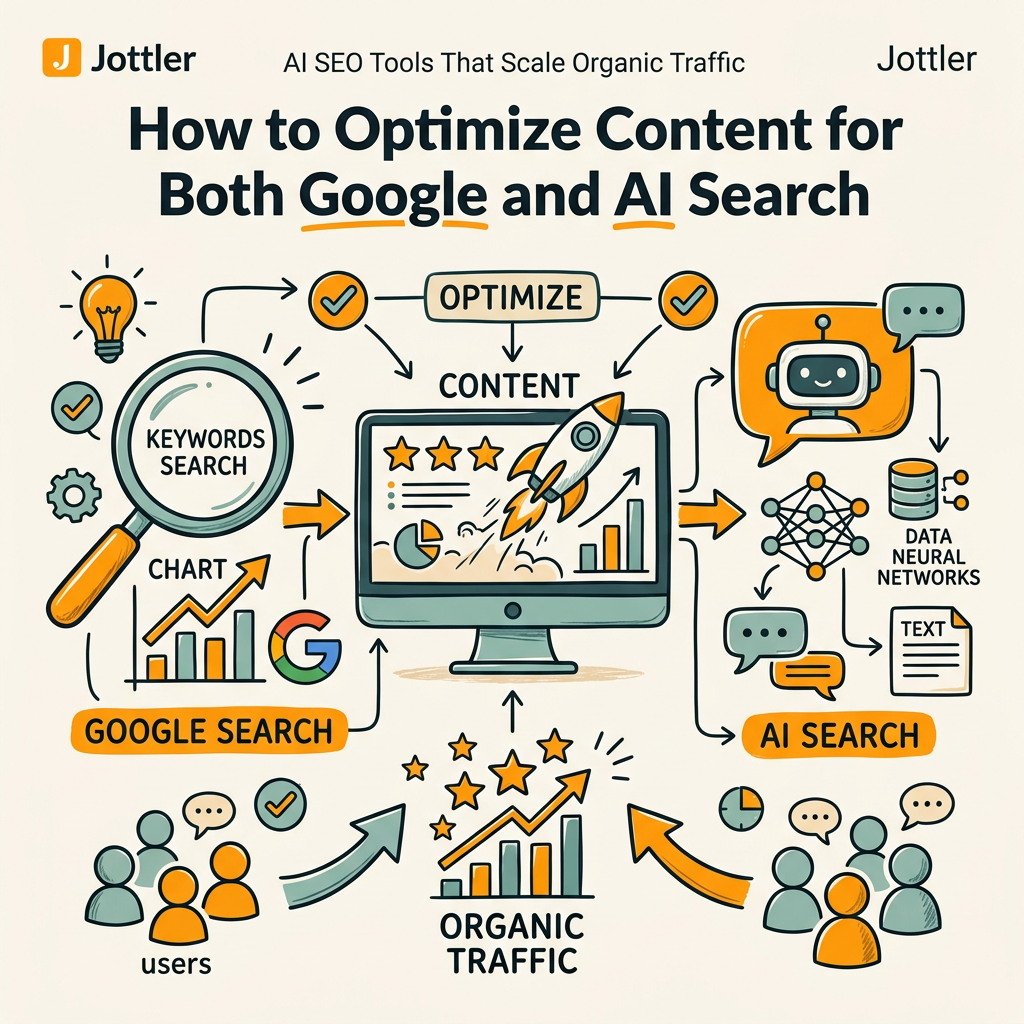
The rules for ranking in Google and appearing in AI Overviews are diverging. Content that ranks #1 in Google isn't automatically cited by ChatGPT. Understanding both playgrounds is critical for 2026 success.
Google: Entity Extraction and Semantic Coverage
Google uses Natural Language Processing (NLP) to extract "entities"—people, places, organizations, topics—from your content. The more relevant entities you include naturally, the higher your semantic score for the keyword cluster.
"The more relevant entities you include naturally, the higher your semantic score for the keyword cluster. This builds semantic authority across your entire topic coverage."
Tools like Rankability track entity coverage and recommend keywords you should address. The goal is to ensure your article doesn't just rank for the primary keyword, but becomes a comprehensive resource for the entire topic cluster.
For example, an article on "AI SEO tools" should cover entities like: Semrush, Surfer SEO, Jottler, content optimization, keyword research, GEO tracking, generative engine optimization, etc. Each mention teaches Google what your content is about and builds semantic authority.
AI Overviews: Citation, Sources, and Multimedia
AI models like ChatGPT and Gemini prefer content that's directly citable. This means:
- Inline Citations: Link to external sources within your prose. AI models look for external links as a trust signal.
- Original Data: Include unique stats, surveys, or research that can't be found elsewhere. AI models love citing novel data.
- Multimedia: Embed videos, infographics, or original images. Content richness increases citation likelihood.
- Clear Attributions: Quote experts by name and title. AI models extract these attributions for context.
Content that is high-quality but lacks external links and citations rarely gets cited by AI models. Jottler's research-first approach—pulling data from 14+ sources and inserting them throughout articles—directly addresses this gap that many teams struggle with.
The GEO Strategy: Track Where You're Cited
Generative Engine Optimization means knowing where your content appears in AI search results. Tools like Rankscale.ai let you search your brand, keywords, and topics across ChatGPT, Perplexity, Claude, and Google AI Overviews.
Tracking this monthly tells you:
- Which topics and keywords are getting AI visibility (wins to double down on).
- Which competitors are being cited instead of you (opportunities to improve content quality or build more authority).
- How often your brand is mentioned vs. cited (cited mentions are higher-value).
This data should drive your content strategy. If you're not getting cited in AI Overviews for your target keywords, your content may lack originality, external citations, or multimedia.
Automating Your Entire SEO Content Workflow
The real competitive advantage in 2026 isn't picking one tool—it's automating the entire workflow from research to publish so consistently that your competitors can't keep up.
The Daily Content Engine Model
Jottler represents the evolution of SEO tooling: the autonomous content engine. Rather than giving you assistance (Surfer SEO), data (Semrush), or raw generation (Byword), it runs the entire pipeline as a daily habit.
Here's how it works:
- Keyword Research (AI-Driven): The system identifies trending, low-competition keywords in your niche based on SERP data and your existing content gaps.
- Research + Synthesis: 12 specialized AI agents gather data from 14+ sources: news, academic papers, industry reports, competitor sites, and your own domain.
- Content Generation: The writing agent synthesizes research into a 3,000+ word article with original structure, relevant examples, and external citations.
- Fact-Checking: A verification agent cross-checks every claim against source material, flagging inaccuracies before publish.
- Internal Linking: The system identifies related articles on your site and inserts contextual internal links at optimal positions.
- CMS Publishing: Content auto-publishes to your WordPress, Webflow, or custom CMS with metadata, structured data, and formatting intact.
This happens daily with zero manual intervention. The result: 252+ new, optimized, published pieces per year.
Why Manual Workflows Fail at Scale
A typical manual workflow looks like this:
- Brainstorm keywords (2 hours).
- Research topic and gather sources (3 hours).
- Outline and write draft (4 hours).
- Internal review and revisions (2 hours).
- Optimize, add internal links, format (2 hours).
- Publish and promote (1 hour).
That's 14 hours for one article. A founder or marketer can realistically produce 2-3 per week. Over a year, that's 100-150 articles. An autonomous engine produces 252+ in the same time, with zero hours of manual labor.
The scaling math is brutal: competing with automation using humans means you lose market share every month.
Measuring Success: The Metrics That Matter
Once you've automated content production, focus measurement on outcomes that compound:
- Monthly Organic Traffic Growth: Track month-over-month growth. Expect flat months 1-2, then 10-15% MoM growth starting month 3-4.
- AI Overview Citations: Use Rankscale.ai or manual spot-checking to count brand mentions in ChatGPT/Perplexity answers. This is your highest-intent traffic.
- Content-to-Conversion Velocity: Measure how fast new articles contribute to conversions. Good content converts within 30 days.
- Topical Authority Growth: Track the number of unique entities and semantic keywords you rank for. More entities = broader topical authority.
- Cost Per Conversion: AI-referred traffic should have lower CAC and higher LTV than traditional paid channels.
Avoid vanity metrics like "number of articles published." Focus on traffic, citations, and revenue impact.
Conclusion
AI SEO tools have matured from writing assistants into autonomous systems that research, produce, and publish at speeds humans can't match. The brands scaling organic traffic fastest in 2026 are those using automation to publish 5-10 high-quality articles weekly, optimize for AI search citation, and build topical authority faster than competitors.
The data is clear: AI-referred traffic converts at 4.4x the rate of traditional organic traffic and 68% of marketers confirm AI helped achieve higher ROI. Brands cited in AI Overviews earn 35% more organic clicks. But realizing these benefits requires tooling that covers research, generation, fact-checking, and publishing—not point solutions.
For busy founders and lean marketing teams, Jottler's autonomous SEO engine removes the production bottleneck entirely. Daily articles, fact-checked and published automatically, create the consistent content stream that builds topical authority and compounds organic traffic month after month.
Start your SEO agent and watch organic traffic accelerate without adding headcount.
FAQs
What is the best AI SEO tool for scaling organic traffic?
For teams prioritizing automation and consistent publishing, Jottler leads the category because it handles research, writing, fact-checking, and publishing as a fully autonomous daily workflow. For teams that prefer to oversee writing more closely, Surfer SEO combined with Clearscope offers AI-assisted brief-based workflows. For data-heavy keyword research, Semrush remains the gold standard. The "best" tool depends on your bottleneck: if it's production speed, choose Jottler; if it's keyword strategy, choose Semrush; if it's writing guidance, choose Surfer SEO.
How long does it take for AI-generated content to start ranking?
Quality AI-generated content grounded in SERP data and properly optimized typically begins ranking within 2-8 weeks for low-competition keywords and 8-16 weeks for medium-competition keywords. Ranking depends on three factors: keyword difficulty (lower is faster), topical authority (more existing content on the topic helps), and backlink acquisition (content without links ranks slower). Publishing daily via an autonomous engine accelerates this because the volume of content and consistent topical coverage build authority faster than sporadic publishing.
Do I need multiple AI SEO tools or just one?
A single, purpose-built autonomous engine like Jottler handles 80% of the workflow—research through publishing. However, if you need specialized capabilities (advanced keyword research, real-time competitor tracking, or AI visibility monitoring), layering in tools like Semrush (keyword + competitive data) or Rankscale.ai (GEO tracking) adds value. Most growing teams start with one tool and add others as their needs become more sophisticated. The risk of over-tooling is that each tool adds friction and requires different data exports, slowing your team rather than accelerating it.