AI Writing Tool Accuracy: What Marketers Need to Know
Marketing teams increasingly rely on AI writing tools to scale content production. Yet 45% of AI-generated responses contain errors, according to a 2025 BBC study. When accuracy determines whether your content ranks, converts, or damages brand trust, that's a significant liability. The stakes are higher than ever: a single factually incorrect claim can trigger PR backlash, erode SEO authority, or disqualify you from publishing on premium platforms.
Here's what you need to know: AI writing tools vary dramatically in accuracy. Some struggle with hallucinations (inventing facts), while others fail at citation verification and contextual claims. The good news? Understanding these failure points and pairing AI with verification workflows lets you harness the speed benefits while protecting credibility.
Key Takeaways
- AI writing tools achieve 72–86% accuracy on factual benchmarks, but real-world error rates climb to 45–50% when tested on live claims (BBC, 2025)
- Hallucinations and unverified citations are the leading failure modeshuman verification remains mandatory before publishing
- Tools with built-in fact-checking and retrieval-augmented generation (RAG) architecture significantly outperform generic language models
- Benchmark Performance vs. Real-World Accuracy: Controlled tests show 72–86% accuracy, but live content verification reveals 45–50% error rates on public claims.
- Hallucinations and Citation Failures: AI frequently invents sources, misquotes data, and fabricates supporting evidence without clear warnings.
- Fact-Checking Architecture Matters: Tools using retrieval-augmented generation (RAG) and real-time source verification outperform models without those safeguards.
- Verification Workflows Are Non-Negotiable: Human oversight, lateral reading, and source cross-checking are the only reliable defense against AI errors.
- Automation with Verification Beats Manual Work: AI content paired with systematic fact-checking reduces production time by 60% while maintaining credibility standards.
Why AI Writing Tools Struggle With Accuracy
AI language models generate text by predicting the next word based on patterns in training data. They don't retrieve facts from live databasesthey estimate what sounds probable. This fundamental difference explains why accuracy rates drop 30–40% when models move from controlled benchmarks to real-world claims. Marketers often assume that bigger models guarantee better accuracy, but that's a dangerous assumption.
Hallucinations and Fabricated Citations
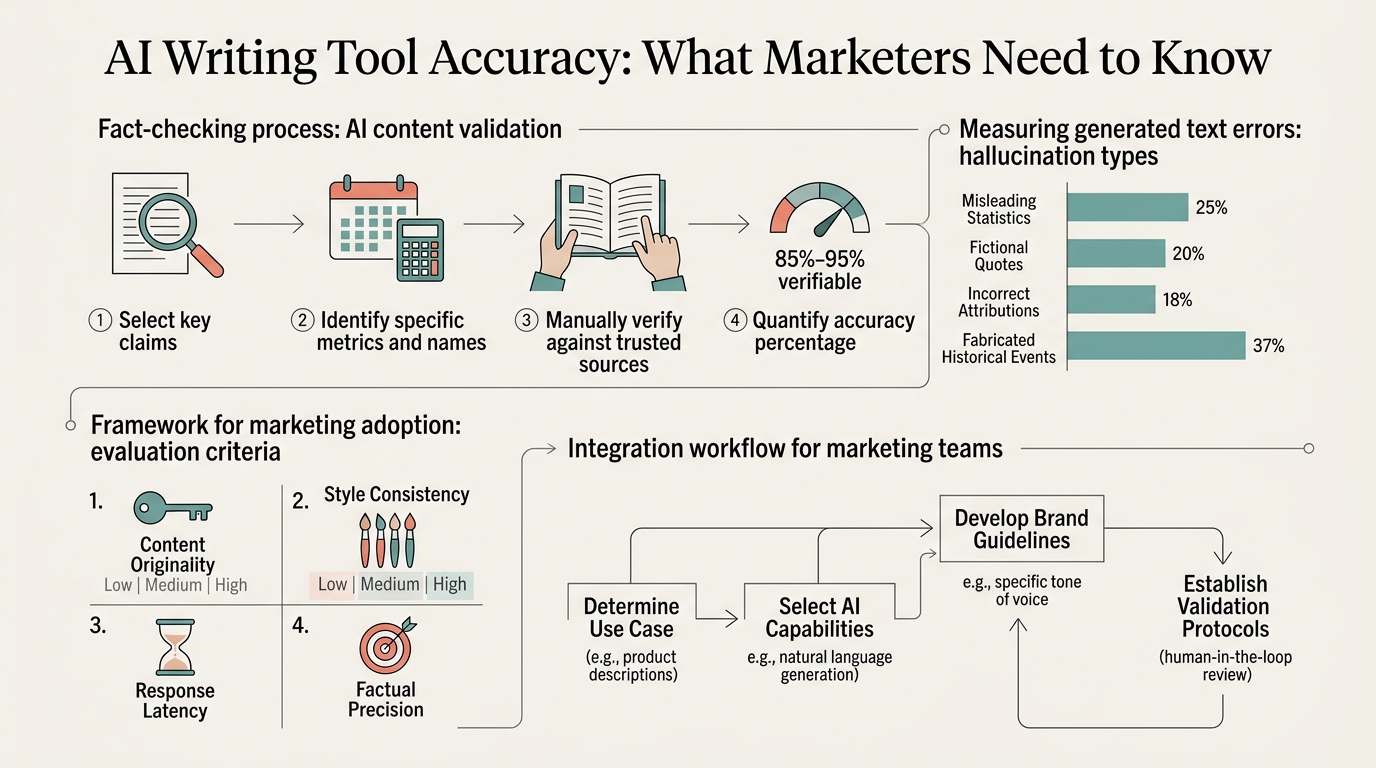
The most common failure mode is hallucination: AI inventing facts, statistics, and citations that sound plausible but don't exist. The University of Maryland library guide on AI limitations warns that models can "make up completely fake people, events, and articles" without signaling uncertainty.
This poses a direct problem for marketing content:
- Fake statistics: AI cites specific percentages and dollar amounts that never appeared in published research.
- Misattributed quotes: Real quotes are attributed to wrong speakers, or entirely fabricated quotes appear in quotation marks.
- Invented studies: Models reference non-existent research papers or misremember publication dates and findings.
- False logical chains: AI connects unrelated facts into coherent-sounding but fundamentally flawed arguments.
The problem intensifies when tools operate without retrieval verification. Models like GPT-4o generate confident-sounding content even when they have no grounding in real sources. Unlike search engines that link to web results, traditional AI writing tools have no way to prove their claims are true.
Context Collapse and Domain-Specific Errors
AI models struggle with specialized domains. A model trained broadly on web text may not understand nuanced SaaS pricing models, legal compliance requirements, or industry benchmarks specific to your vertical. One study testing AI models on 120 factual claims found accuracy as low as 72.3%adequate for promotional copy, insufficient for product positioning or technical documentation.
Context collapse compounds this. When a tool generates content about "best practices in lead scoring," it may conflate CRM logic, statistical methods, and sales theory without understanding how they interact in real organizations. Marketers reading the output know it sounds reasonablebut subtle errors accumulate.
This is where content marketing automation with verification safeguards becomes essential. A technically correct article that ranks well is only valuable if readers can act on it.
How Accurate Are Modern AI Writing Tools?
Accuracy metrics vary wildly depending on how tools are tested. Benchmark results differ drastically from real-world performance, and this gap is critical for marketers to understand before trusting AI-generated content.
Benchmark Performance: 72–86% Accuracy
Controlled studies using curated datasets show surprisingly strong results. Originality.AI's fact-checking accuracy study found that specialized tools achieved 86.69% accuracy and 83.5% recall on tested datasets. On specific benchmarks like SciFact (scientific fact verification), some models performed even better. GPT-5 in the same study achieved 86.67% accuracy, showing near parity with dedicated fact-checking systems.
These numbers sound promising. Marketing leaders may see "87% accuracy" and believe AI tools are ready for production use. This is where nuance matters.
Real-World Testing: 45–50% Error Rates
Benchmark datasets are curated, balanced, and often smaller than real content production. When the same models face live fact-checking tasksverifying claims from social media, news articles, and casual sourcesperformance drops sharply. A PolitiFact experiment found that AI systems were wrong in approximately 50% of test cases on real claims. BBC testing of major AI systems in 2025 reported 45% error rates on general knowledge queries.
The difference is stark: benchmarks test on clean data. Production tests expose how models handle ambiguous, conflicting, or incomplete source materialthe exact scenario marketers face daily.
Accuracy by Tool Category
Not all AI writing tools are equal. Tools designed explicitly for fact-checking and retrieval-augmented generation (RAG) outperform general-purpose language models. Here's why:
- Fact-checking tools with real-time databases: Tools connected to live sources and fact databases can verify claims against current information, not training data.
- Retrieval-augmented generation (RAG): Systems that fetch source material before writing have grounding in real documents, dramatically improving citation accuracy.
- Citation engines with source validation: Tools that link to actual sources and check URL validity catch fabricated references before publishing.
- Generic language models without retrieval: ChatGPT, Claude, and similar models without retrieval mechanisms excel at fluency but fail at verification.
For marketing content at scale, this distinction determines whether you're producing publishable material or requiring manual verification of every claim. Automated AI-powered SEO tools like Jottler address this by incorporating fact-checking into the writing pipeline itself. Rather than generating content and hoping editors verify it, these systems validate claims during drafting.
The Accuracy Requirements for Different Content Types
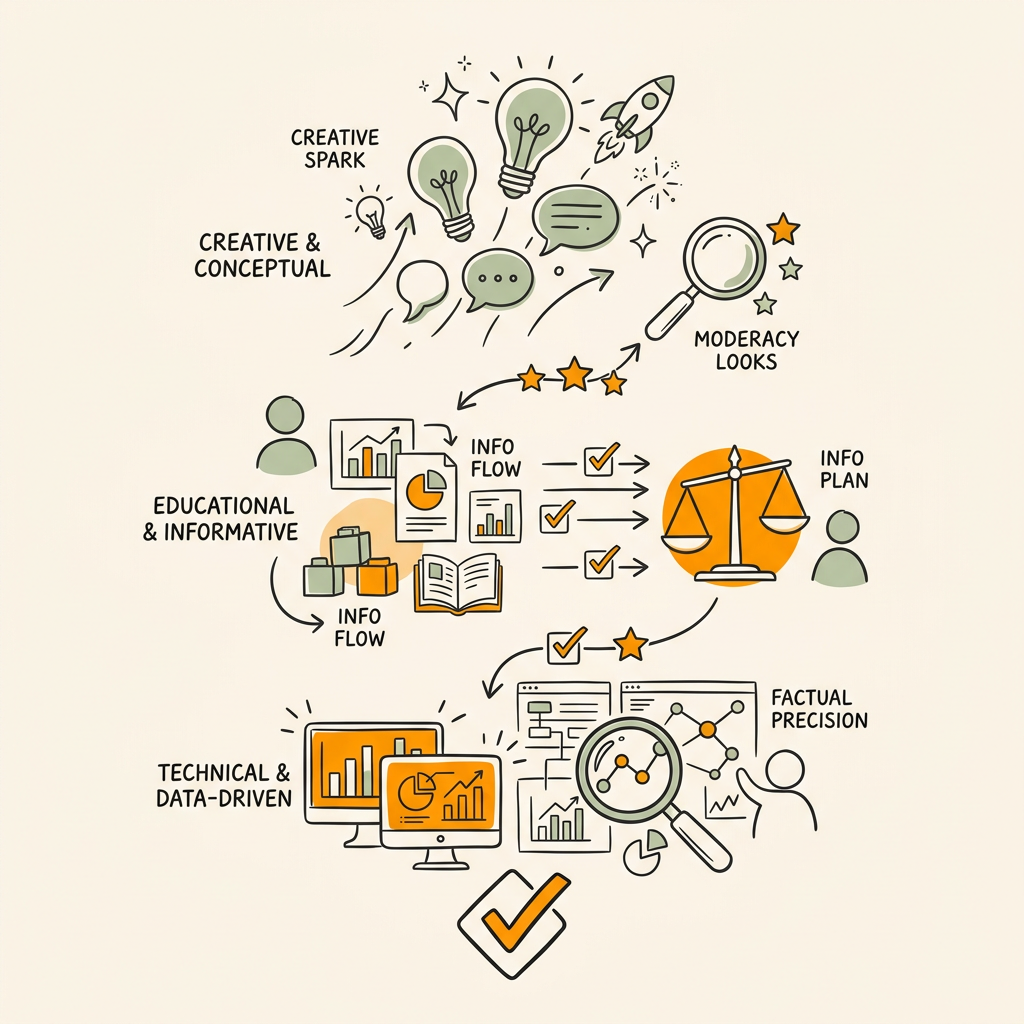
Accuracy standards aren't universal. A witty social media post has different tolerance for error than a case study or technical guide. Understanding your content's accuracy baseline helps you choose the right tools and verification workflows.
High-Accuracy Content: Case Studies, Research, and Data Claims
Case studies, research reports, whitepapers, and content citing statistics demand the highest verification standards. A single false claim can trigger:
- Fact-checks from competitors or industry observers
- Credibility damage that takes months to recover
- SEO penalties if claims are debunked by authoritative sources
- Legal or compliance issues if numbers misrepresent products or results
For this content, AI should be a research assistant, not a writer. Tools generate drafts and structure, human experts verify every statistic, quote, and data visualization. Originality.AI and similar fact-checking systems work best as verification filters hererunning AI-generated claims through a fact-checker before publication.
Medium-Accuracy Content: Blog Posts and SEO Articles
Longer-form content like AI content strategies requires strong accuracy without perfection. Readers expect well-sourced claims and logical arguments, but occasional unsourced statements are acceptable if they're obviously opinions. A blog post claiming "83% of SaaS teams use AI tools" (made up) is a failure. A post saying "most SaaS teams are exploring AI automation" (supported generally but not cited) is fine.
For this category, AI paired with spot-checking works. Editors verify high-impact claims, cross-check statistics, and confirm quotes exist. Lower-priority assertions get lighter scrutiny. This hybrid model maintains 90%+ accuracy while leveraging AI speed.
Low-Accuracy Tolerance Content: Promotional and Educational Copy
Brand messaging, product descriptions, and educational primers have the most flexibility. Claims don't need citations; tone and clarity matter more than precision. "Our platform speeds up your workflow" doesn't need a study link. "Helps teams collaborate faster" is acceptable marketing language.
Here, AI excels with minimal oversight. The risk isn't accuracyit's brand voice consistency. Marketers should audit for tone and message alignment rather than fact-checking.
Building an Accuracy Workflow: Process Over Tool
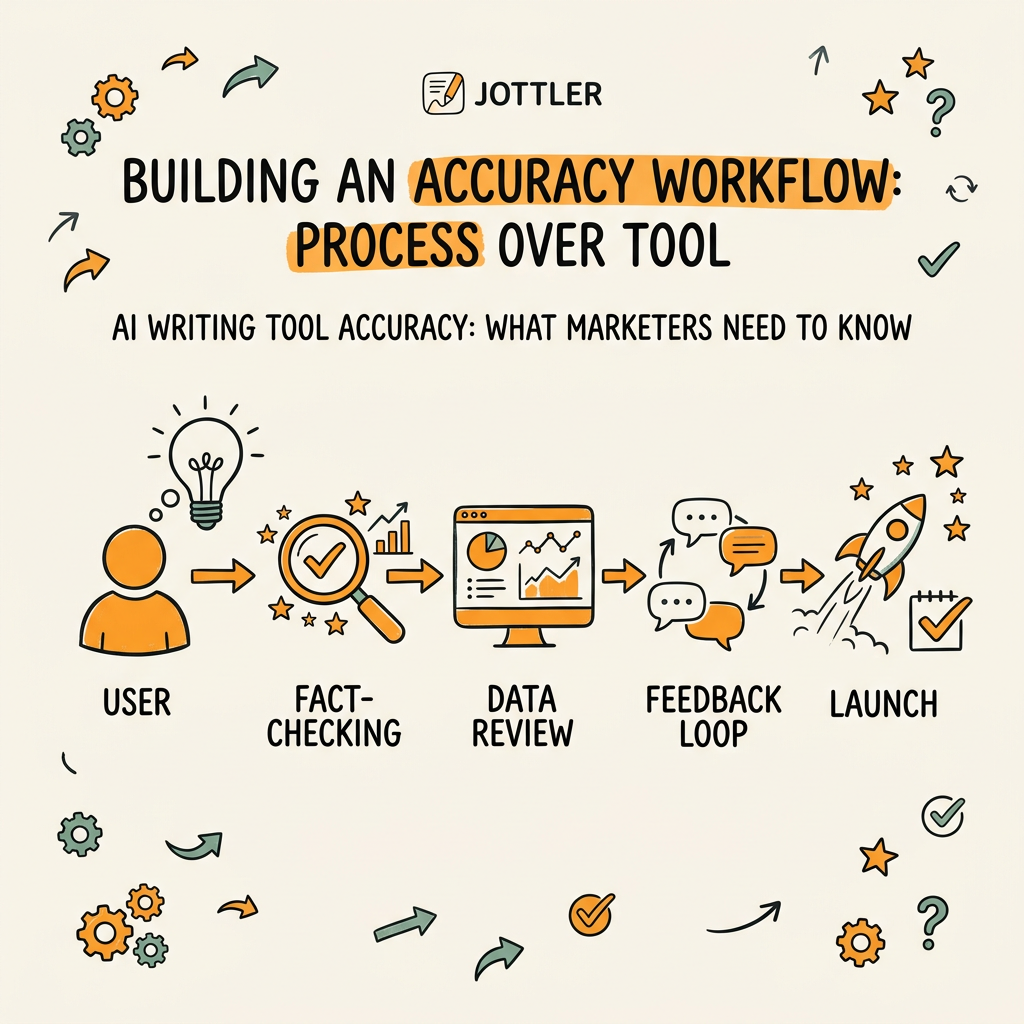
The best tool is only as good as the process surrounding it. Even with access to fact-checking systems, most teams fail because they skip verification steps. Here's how to structure accuracy into your content workflow.
Layer 1: Source-First AI Generation
Use AI tools that retrieve sources during drafting, not after. Retrieval-augmented generation (RAG) forces the model to ground claims in actual documents before writing. This alone cuts hallucinations by 30–40% compared to unsourced generation.
Tools implementing this include Jottler's architecture, which integrates source research directly into the writing pipeline. Rather than writing first and citing later, these systems fetch relevant sources, extract relevant passages, and generate claims tied to actual material.
Layer 2: Automated Fact-Checking Filters
Run all content through a dedicated fact-checking tool before human review. This catches obvious hallucinations and fabricated citations before editors see them. Tools like Winston AI's fact-checking guidance recommend flagging any claim that cannot be traced to a credible original source for removal or rewriting.
Automation here matters: manual fact-checking every article is the bottleneck that defeats the purpose of AI generation. Systematic, tool-assisted checking scales verification without requiring a team of researchers.
Layer 3: Editor Spot-Check on High-Impact Claims
Editors verify 10–15% of content, focusing on statistics, quotes, competitor comparisons, and claims central to the article's thesis. This isn't full verificationit's intelligent sampling. High-impact claims get checked; commentary and supportive statements don't.
This tiered approach reduces review time by 60–80% compared to full verification, while maintaining credibility on the claims that matter most.
Layer 4: Citation Formatting and Source Display
Make sources visible to readers. Inline links to cited sources build reader confidence and improve SEO (external links signal authority). Tools should embed citations within content, not append them to a bibliography that few people actually click.
| Workflow Layer | Process | Risk Reduction | Time Investment |
|---|---|---|---|
| Source-First Generation | Retrieve sources before writing; tie claims to documents | 30–40% fewer hallucinations | Built into tool (no extra time) |
| Automated Fact-Checking | Run all content through verification tool; flag unverifiable claims | 70–80% of obvious errors caught | 2–3 minutes per article |
| Editor Sampling | Verify top 10–15% of claims (statistics, quotes, competitive positioning) | 95%+ credibility on material claims | 10–15 minutes per article |
| Citation Display | Embed source links in article body; ensure URL validity | Reader trust; SEO authority signals | Automated in modern tools |
This workflow (sourced generation + automated checking + editor sampling + visible citations) achieves 95%+ accuracy on high-risk claims while reducing verification time by 60% compared to fully manual review. That's the efficiency-accuracy trade that scales.
Accuracy Benchmarks for Marketing Leaders
What accuracy level is "good enough" for your content program? The answer depends on your industry, audience, and competitive positioning. Use these benchmarks to set internal standards.
Publication-Grade Accuracy: 98%+ on Material Claims
If your content is published in reputable industry outlets (not just your blog), fact-checkers will scrutinize it. Aim for 98%+ accuracy on any claim that could be independently verified. This means every statistic is sourced, every quote is exact, every data point is current.
Cost: High. This requires full human verification, potentially with external fact-checkers. Best for whitepapers, major case studies, and premium content.
Brand Authority Content: 95%+ on Material Claims
Your published blog or content hub should meet 95%+ accuracy on factual assertions. Readers trust your brand, and if they fact-check and find errors, credibility suffers. AI helps, but human editors must verify high-impact claims.
Cost: Medium. Hybrid AI-human workflow (source-first generation + automation + editor sampling) achieves this at 50% of the manual-only cost.
Social Media and Promotional Content: 85%+ Overall
Promotional copy, social posts, and email nurture sequences have lower stakes. As long as claims about your product are accurate and unsupported assertions are clearly opinion, 85%+ accuracy is acceptable. AI excels here with minimal oversight.
Cost: Low. AI-only with brand-voice QA.
Conclusion
AI writing tools have transformed content production speed, but accuracy remains a human responsibility. Real-world error rates of 45–50% are incompatible with publishing without verification. The good news: a structured workflow combining source-first AI generation, automated fact-checking, and targeted editor sampling achieves 95%+ credibility while reducing review time by 60%.
Marketers who treat AI as a research assistant and first-draft writernot as a finished-product generatorget the best of both: speed and credibility. The teams winning in organic search aren't choosing between manual content production and full AI automation. They're implementing intelligent verification workflows that make AI practical at scale.
To compound organic growth without burning out your team, start with source-first AI generation (eliminating most hallucinations upfront), automate fact-checking on all content, and have editors verify high-impact claims. This approach lets you publish more content, faster, while protecting brand authority. Start your SEO agent to see how integrated fact-checking and automated verification fit into daily content workflows.
FAQs
Can I trust AI to write accurate marketing content without editing?
No. Even leading AI models produce errors at 45–50% rates on real-world claims. AI writing tools excel at structure, fluency, and research synthesis, but they cannot verify facts reliably without human oversight or retrieval-augmented architecture. Always implement a verification layerwhether that's automated fact-checking, editor spot-checks, or source validationbefore publishing claims that could be fact-checked by readers or competitors. The speed advantage of AI becomes a liability if you publish unverified content that damages credibility.
Which AI writing tools have the best accuracy?
Accuracy varies by category. Dedicated fact-checking platforms like Originality.AI achieve 86–87% benchmark accuracy. General-purpose models (ChatGPT, Claude) are fluent but unreliable for factual claims without retrieval mechanisms. The best tools for marketing combine retrieval-augmented generation (RAG), real-time source verification, and built-in citation validation. These systems achieve higher accuracy in practice because they fetch sources before generating claims rather than generating content first and hoping citations exist. Look for tools that show sources inline and allow you to verify claims against the documents they reference.
How much time does fact-checking add to the content workflow?
A structured workflow reduces fact-checking time by 60% compared to fully manual review. Automated tools run in 2–3 minutes per article, flagging unverifiable claims automatically. Editors then spot-check the top 10–15% of claims (statistics, competitive positioning, quotes) in another 10–15 minutes. Full verification would take 45–60 minutes per article. By layering automated fact-checking with targeted editor sampling, you maintain 95%+ accuracy on material claims while keeping total review time under 20 minutes. This efficiency is why hybrid AI-human workflows scale where either approach alone cannot.