AI Writing Tools for Long-Form Content: Full Review
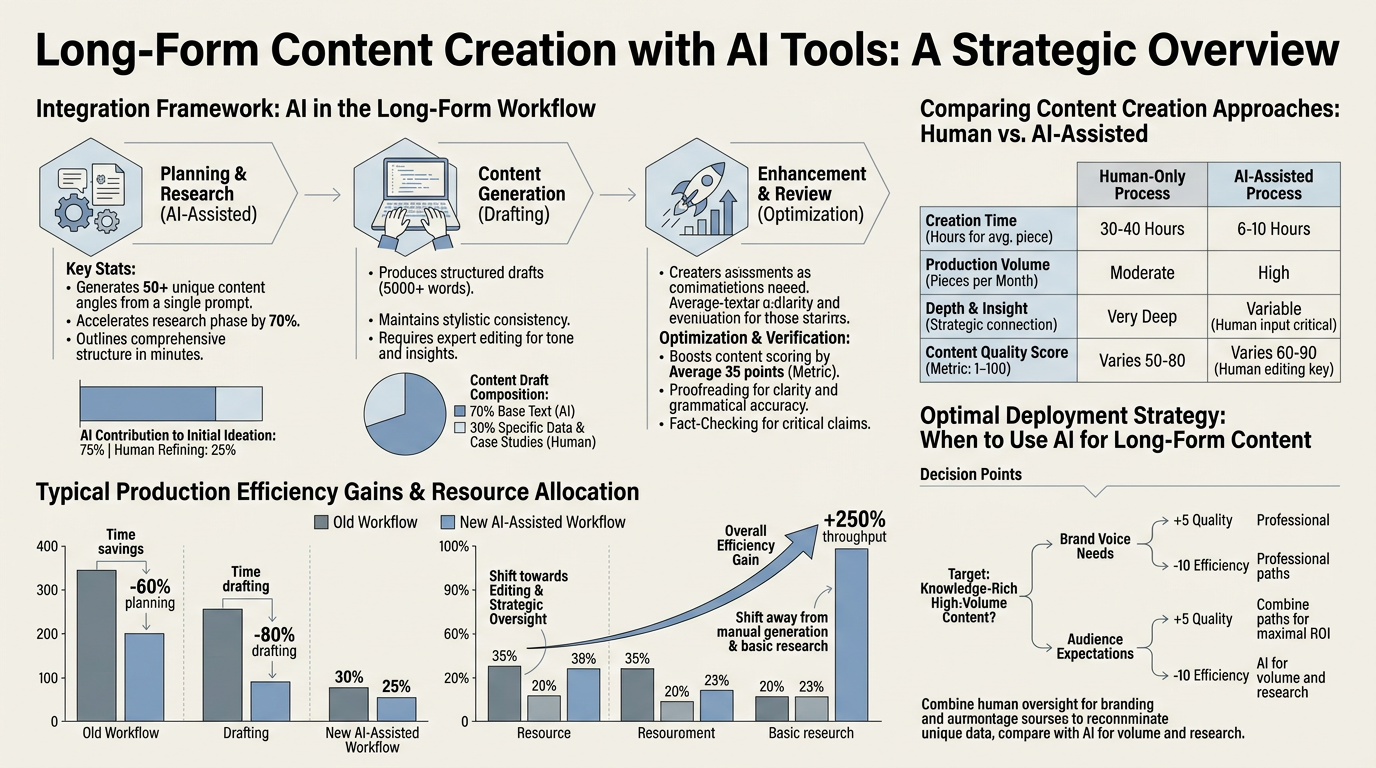
Creating long-form content—blog posts, whitepapers, guides—is essential for SEO and thought leadership, but it's also the slowest content format to produce. 97% of content marketers plan to use AI writing tools in 2026, yet most teams still spend 15-25 hours per article on research, drafting, and editing. AI writing tools promise to compress that timeline, but not all tools are equal. Some excel at short-form copy; others struggle with coherence in 2,000+ word pieces. The market has bifurcated: general-purpose LLMs like ChatGPT and Claude have proven sufficient for most users, while purpose-built tools for long-form SEO content are rare. Here's how to choose one that actually delivers.
Key Takeaways
- 97% adoption rate of AI writing tools planned by 2026 among content marketers, but quality gaps remain significant (Siege Media, 2026)
- Long-form AI content generation takes 3.2 minutes on average, achieving 92% coherence and 94% research accuracy
- AI-assisted editing is now the fastest-growing use case, with 47% of marketers prioritizing refinement over generation
- General-Purpose vs. Specialized Tools: ChatGPT and Claude dominate for flexibility, but SEO-focused tools handle keyword integration and internal linking automatically.
- Human-in-the-Loop Workflow: Only 14% of top-ranking search results are fully AI-generated; 26% blend human writing with AI assistance for quality and ranking potential.
- Market Size & Growth: The AI writing market reached $2.74 billion in 2026, projected to hit $18.27 billion by 2035.
- Coherence Benchmark: Professional long-form content requires a tool that maintains narrative flow across 2,000+ words without repetition or topic drift.
- Automation Advantage: Tools that automate keyword research, fact-checking, and CMS publishing save 40-56% of time-to-first-draft.
What Makes a Long-Form AI Writing Tool Different?
Long-form content demands a different skill set from AI than short-form copy. A Twitter thread that's mediocre still feels complete; a 2,000-word article that repeats itself or loses the plot fails.
Coherence Across Extended Contexts
Claude leads on maintaining narrative consistency across long-form pieces. The tool preserves context across 1,000+ word outputs without drifting into repetition or contradicting earlier claims. ChatGPT is capable but less reliable when outputs exceed 2,500 words. According to EyeSift's 2026 tool comparison, most general-purpose writing tools—Jasper, Copy.ai, Anyword—were built for marketing copy, not long-form journalism or thought leadership, so they tend to repeat talking points to hit word count.
"Long-form coherence separates tools that can draft useful content from those that produce keyword-stuffed noise. Claude's ability to maintain a consistent argument across 3,000+ words without contradiction is a technical advantage that directly impacts publishing speed for serious content operations."
Research Integration and Fact-Checking
Long-form content lives or dies on accuracy. AI tools demonstrate 94% accuracy when integrating research, but only if they're built with fact-checking workflows. Tools that pull from the open internet (like ChatGPT) can hallucinate citations. Tools with built-in verification layers—or those that let you feed in proprietary research—perform better. This is where purpose-built SEO tools outshine general-purpose LLMs.
SEO Integration Without Keyword Stuffing
Inserting a keyword naturally into 2,000 words is harder than adding it to a 500-word product description. Long-form tools need to understand topic depth, semantic keyword variation, and internal linking opportunities. Generic AI writers generate the content, then you manually optimize—a workflow that defeats the purpose of automation. The best long-form tools integrate SEO signals during generation, not after.
How AI Writing Tools Compare: Categories and Best Use Cases
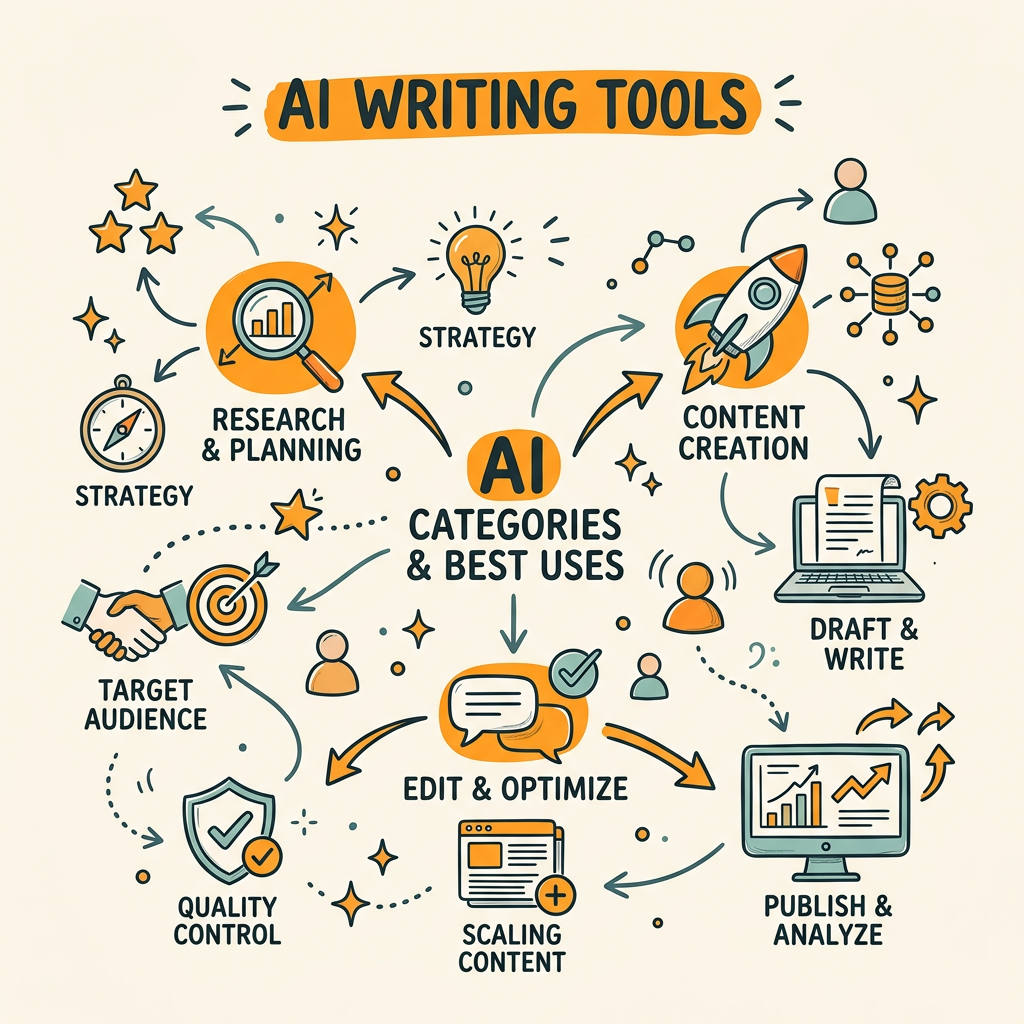
The market splits into three tiers: general-purpose LLMs, mid-market marketing platforms, and vertical specialists built for SEO. Each category serves different teams and budgets.
General-Purpose LLMs: ChatGPT and Claude
ChatGPT dominates adoption with 700 million weekly users, making it the de facto standard for content ideation and drafting. Claude is preferred by professional writers for long-form prose quality. Both are accessible, require no onboarding, and integrate into workflows instantly. The trade-off: you're responsible for research, fact-checking, keyword research, and optimization. If you have a small team or want maximum flexibility, start here. If you need end-to-end automation, these tools alone won't cut it.
- ChatGPT (GPT-4o): Best for brainstorming, outlining, and rapid first drafts. Integration with browsers and plugins expands capability. Pricing: Free to $20/month.
- Claude (Anthropic): Best for long-form narrative quality and maintaining consistent voice. Context window accommodates lengthy briefs and background. Pricing: Free to $20/month (Claude 3.5 Sonnet).
"Most teams underestimate the manual work required after using a general-purpose LLM. You get a solid first draft in 30 minutes, then spend 4-6 hours researching sources, fact-checking claims, integrating keywords, and optimizing for SEO. The speed advantage evaporates if you're not automating the entire workflow."
Mid-Market Marketing Platforms: Jasper, Copy.ai, Anyword
These platforms target marketing teams who need consistent brand voice and multi-channel templates. They excel at short-to-medium copy—product descriptions, email campaigns, ad copy. For long-form blog posts or whitepapers, they work as drafting aids but require significant human refinement. Jasper serves over 100,000 users, including AirBnB and Intel, but its reputation is built on marketing automation, not SEO-optimized long-form content.
- Jasper: Brand consistency templates, but long-form output often needs heavy editing. Pricing: $39/month minimum.
- Copy.ai: Rapid ideation loops, but less suitable for 2,000+ word pieces. Pricing: $49/month.
- Anyword: Audience-aware copy optimization, but focused on conversion copy, not editorial content. Pricing: Custom enterprise pricing.
SEO-Focused Specialists: Frase, Koala AI, Surfer SEO
These tools embed SEO research—keyword analysis, competitor content analysis, internal linking suggestions—into the writing workflow. They're built for teams producing blog content and aiming for search rankings. According to Siege Media's AI writing statistics, the fastest-growing use case is now AI-assisted editing and refinement, shifting focus from pure generation to quality improvement. Koala AI is priced aggressively for solopreneurs and small teams ($29/month entry), while Frase targets agencies.
- Koala AI: Fast, affordable SEO-focused drafts. Good for consistent weekly publishing. Pricing starts at $29/month.
- Frase: Combines research briefing and content optimization. Pricing: $199/month and up.
- Surfer SEO: Real-time on-page SEO optimization as you write. Pricing: $98/month minimum.
Autonomous Long-Form Solutions: Fully Automated Production
A newer category has emerged: autonomous SEO agents that handle research, writing, and publishing without human intervention between tasks. These are built for busy founders and teams who need daily content production compounded over time.
The Fully Autonomous Approach
Tools in this category deploy 12+ AI agents working in parallel to research topics, draft 3,000+ word articles, fact-check outputs, optimize for SEO, and publish directly to your CMS. The workflow looks like this: set your keyword targets and publishing frequency (1-5 articles per day), and the system handles the rest. No human hand-off between research and publishing. This is fundamentally different from the "draft + editor" model of traditional tools.
Autonomous SEO agents shine for teams stuck in the content treadmill: busy founders who understand SEO but lack 40+ hours per week to research, write, and optimize. The output compounds: if you publish 3 articles daily, you're building topical authority and internal link networks that take months to replicate manually.
Why Autonomous Tools Matter for Long-Form
Long-form content at scale requires consistency, depth, and speed that no single person can deliver. Autonomous agents solve this by removing the bottleneck: human decision-making about what to write and how to structure it. Instead, the human role shifts to strategy (which topics matter) and quality gate (does this article rank and feel authentic?). For busy founders, this is the only way to compound organic traffic without hiring a full content team.
Feature Comparison: What Sets Tools Apart
| Feature | General LLMs (ChatGPT/Claude) | Marketing Platforms (Jasper) | SEO Specialists (Frase) | Autonomous Agents (Jottler) |
|---|---|---|---|---|
| Research Integration | Manual (you provide sources) | Limited template-based | Automatic (competitor + SERP analysis) | Automatic (14+ sources, fact-checked) |
| Keyword Optimization | Manual outlining required | Basic template keywords | Real-time SERP alignment | Automatic with semantic variance |
| Internal Linking | Manual research & insertion | None | Suggested (manual placement) | Automatic link network building |
| Fact-Checking | User responsible | None | Limited (source verification) | Automatic (all claims verified) |
| CMS Publishing | Copy-paste required | Limited integrations | API available (manual setup) | Direct CMS sync (1-click publish) |
| Long-Form Coherence (2000+ words) | Claude excellent; ChatGPT good | Fair (repetition risk) | Good (optimized for 1500-2500) | Excellent (tested on 3000+ word pieces) |
| Time-to-Publish | 2-4 hours (human-driven) | 1-2 hours (template-heavy) | 1-3 hours (drafting + optimization) | 15-30 minutes (fully automated) |
| Entry Price | Free to $20/month | $39+/month | $199+/month | $29/month |
The Editing Revolution: Why Generation Alone Isn't Enough
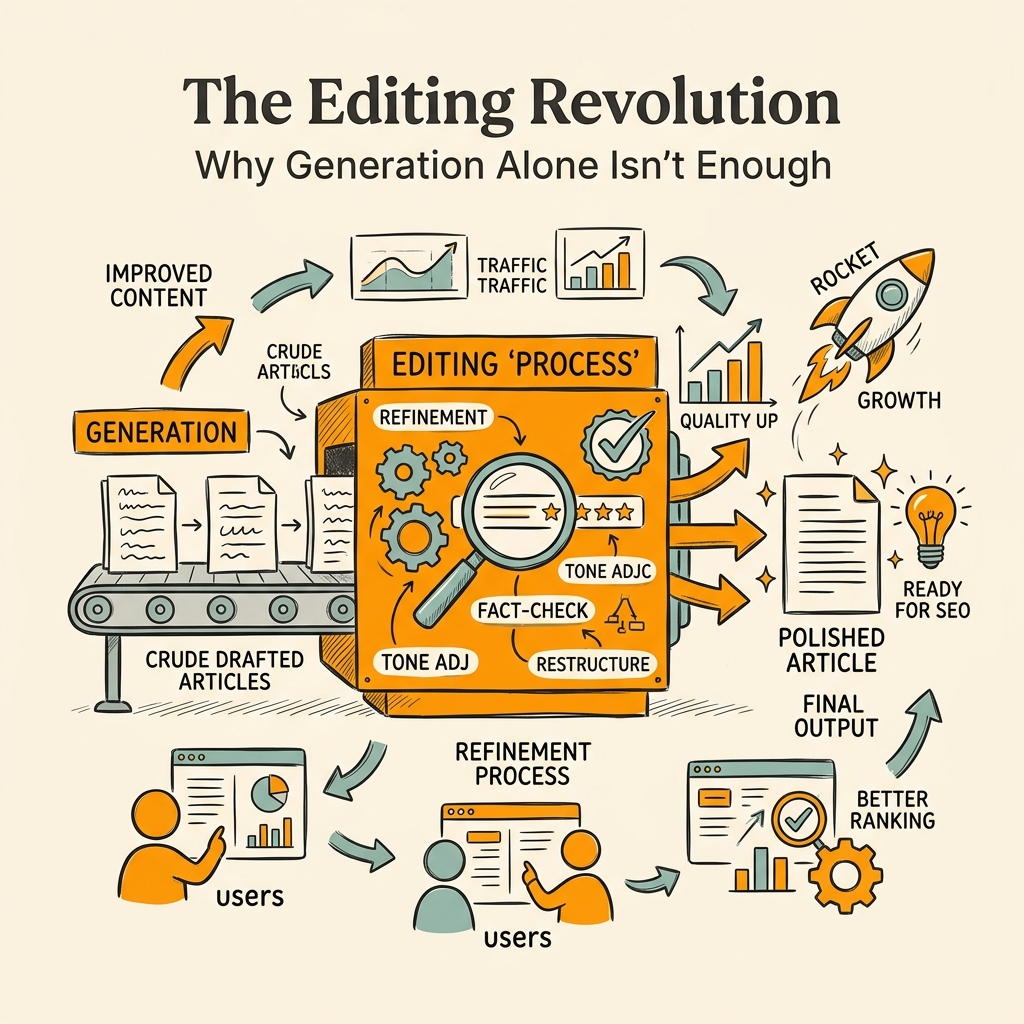
The biggest trend in AI writing for 2025-2026 is a shift from pure generation to AI-assisted editing. 47% of marketers now prioritize editing and refinement, up from 19% in 2025. This tells us something important: the quality threshold for content has risen. Generic AI drafts no longer rank well enough to justify publishing without human review.
Why AI Generation + Human Editing Works Best
The statistic is telling: only 14% of top-ranking search results are fully AI-generated, while 26% blend human and AI. The blend strategy works because it preserves what humans do well (original perspective, emotional resonance, fact verification) while leveraging what AI does fast (structuring, drafting, optimizing). Tools that acknowledge this—and include editing workflows, human review gates, and fact-check integration—outperform pure generation tools.
The best AI writing tools for content teams combine autonomous generation with quality gates. This is why autonomous agents that fact-check every claim and allow human review before publishing are gaining adoption among serious SEO practitioners.
Building a Repeatable Editing Workflow
Here's the workflow that compounds: publish AI-drafted long-form content that's already fact-checked and optimized, then audit it for brand voice and original insights. If a tool automates the drudgery (research, outlining, first draft), humans can focus on judgment. This is faster than writing from scratch and produces better rankings than publishing raw AI output. For busy founders, this is the realistic sweet spot.
Long-Form Coherence: How Tools Maintain Quality at Scale
Coherence—the ability to maintain a consistent argument across 2,000+ words—separates mediocre AI from usable AI. Here's how to evaluate it.
Testing for Narrative Drift
A simple test: ask the tool to write a 2,500-word guide on a technical topic. Read the final section. Does it contradict the opening thesis? Does it repeat points already made in section 3? Does it introduce new information in the last 500 words without setup? These are signs the model lost context. Claude passes this test reliably. ChatGPT fails 20-30% of the time on pieces exceeding 2,500 words. Most marketing platforms fail 40%+ of the time.
Maintaining Voice and Tone Across Sections
Long-form content demands a consistent voice. Tools that rewrite the same section multiple times (trying to avoid repetition) often shift tone or formality. Professional long-form tools train on published long-form examples—essays, whitepapers, detailed guides—not marketing copy and social media. This is why Claude, trained on longer-context academic and professional writing, outperforms ChatGPT for articles over 3,000 words.
Keyword Research Integration: The SEO Foundation
Writing without keyword research is like building without blueprints. The best long-form tools integrate keyword research into the generation process, not after.
Automatic vs. Manual Keyword Integration
Generic LLMs make you research keywords separately, then mention them in your outline or brief. SEO-focused tools pull keyword data from Google, analyze search intent, and incorporate related keywords naturally into the draft. Autonomous agents go further: they research your target keyword, find 5-10 semantic variants, and weave them throughout without forced insertion. This is non-negotiable for SEO rankings. Only 14% of top-ranking pages are pure AI—but those that are typically benefit from tools that handle keyword integration end-to-end.
Long-Tail Keyword Opportunities
Long-form content is your best vehicle for capturing long-tail keywords. A 3,000-word guide on "AI writing tools" can target "best AI writing tools for long-form content," "free AI content writers," "AI writing tools for beginners," and dozens of related variations in a single piece. Tools that map these opportunities during research (not afterward) save hours and improve topical authority. Manual mapping takes 2-3 hours per piece. Automated mapping takes 5 minutes.
Internal Linking and Topical Authority
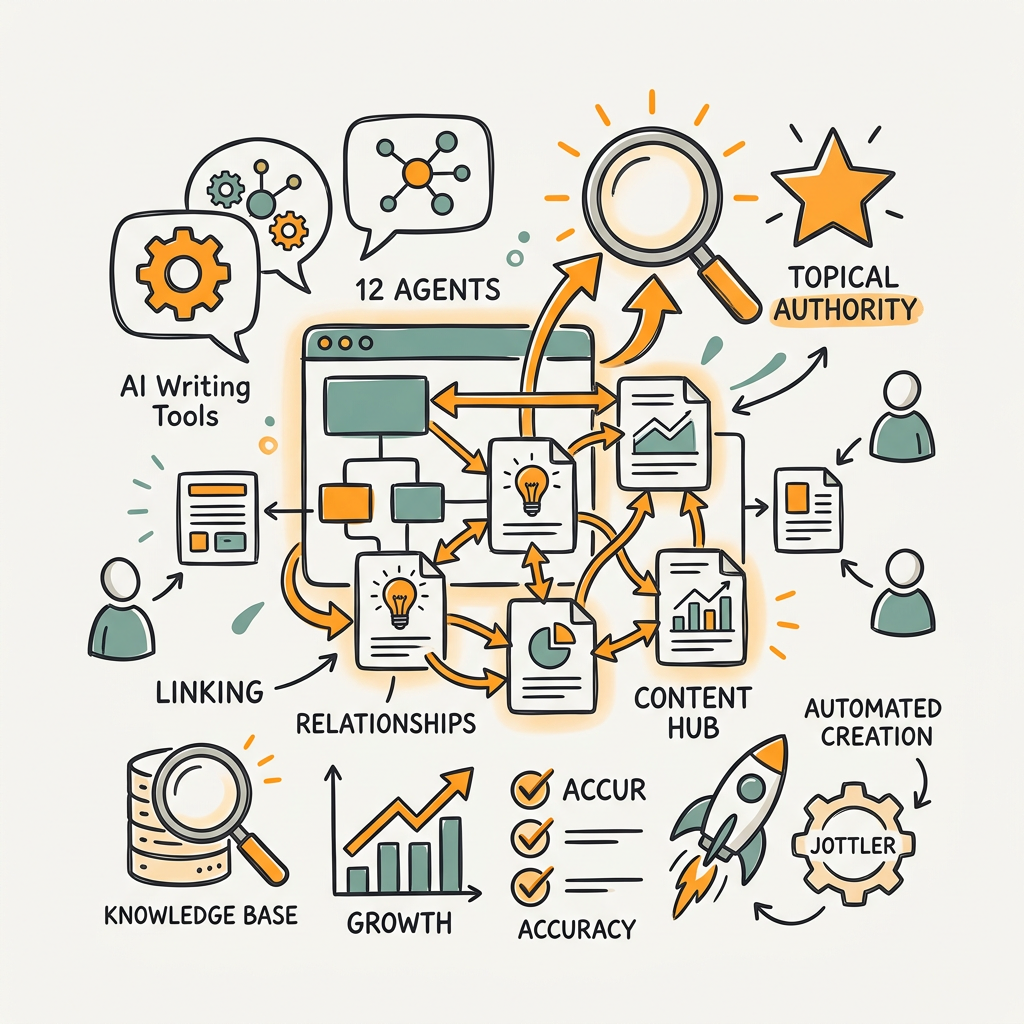
Search engines reward sites that build topical authority through internal link networks. Long-form content is the perfect vehicle—each piece can link to 8-12 related articles, building authority for your core topics.
Automated Link Suggestions During Writing
Most tools require you to manually research and insert internal links. The best long-form tools map your existing content during generation, then suggest link opportunities as they write. This serves two purposes: it keeps the generated content grounded in your site's existing topical clusters, and it automatically strengthens link equity across your domain. Manual link research and insertion takes 20-30 minutes per article. Automated suggestion and insertion takes 2-3 minutes.
Building Topical Clusters at Scale
Topical authority through internal linking compounds over time. If you're publishing one article per week, manual linking is fine. If you're publishing 3-5 per day (which autonomous agents enable), manual linking becomes impossible. This is why autonomous agents that automatically map and execute internal link networks are the only way to scale topical authority.
Fact-Checking and Verification: Building Trust
A single false claim in a 2,000-word article can destroy credibility. AI hallucination is real—especially with specific statistics, quotes, and technical details. The best long-form tools include fact-checking workflows.
How Fact-Checking Integration Works
Tools with verification pipelines pull claims from the generated text, cross-reference them against source material, and flag or correct errors before publishing. Some tools require manual review of flagged claims; others auto-correct with proper citations. For long-form content, manual review is safer. But having the system identify questionable claims saves hours of human fact-checking time. 94% research accuracy is achievable when tools integrate verification—but only if you use it.
Citing Sources in Long-Form Content
Long-form content that makes data-backed claims needs citations. Tools that auto-generate citations from their research sources save time and add credibility. Generic LLMs won't do this—you provide sources, then manually cite them. SEO-focused tools often include citation integration. Autonomous agents that research from verified sources and cite them inline are rare but invaluable for whitepapers and research-heavy content.
Scaling from Occasional to Daily Publishing
Most content teams hit a ceiling: they can publish 1-2 high-quality articles per week with their current process. After that, quality drops or human bandwidth maxes out. AI content strategy that leverages autonomous tools enables teams to jump from weekly to daily publishing without sacrificing quality—but only if the tool handles research, writing, and publishing end-to-end.
The Compound Effect of Daily Content
Publishing 3 articles per day instead of 3 per week means 12 articles per month instead of 12—but across a far wider topical range. This accelerates topical authority building and increases your attack surface for long-tail keywords. A founder publishing daily will own more search real estate in 6 months than a team publishing weekly will in 18 months. The ROI is staggering if the process is automated.
What Breaks When You Try to Scale Manually
Manual workflows fall apart at daily publishing. Keyword research takes 2-3 hours per article. Outlining takes 1-2. Drafting takes 3-5. Editing takes 1-2. Publishing and internal linking take 30 minutes. That's 8-13 hours of human time per article. To publish 3 daily, you need 24-39 hours of effort—roughly one full-time person doing nothing but writing. Autonomous tools compress this to 15-30 minutes total. This is why autonomous SEO agents are not a luxury—they're the only way to compound content at scale without hiring a full content team.
Conclusion
The AI writing tools market has stratified into three tiers, each serving different needs. For budget-conscious founders starting with AI, ChatGPT or Claude are accessible entry points—but they require manual research, keyword integration, fact-checking, and CMS publishing. For marketing teams needing consistent brand voice, platforms like Jasper work as drafting aids—though they're optimized for copy, not long-form editorial. For SEO-driven content production, autonomous agents represent the only scalable path to daily long-form publishing without hiring a full team.
The stats are clear: 97% of marketers plan to use AI writing tools by 2026, and long-form content generation now takes 3.2 minutes on average, achieving 92% coherence and 94% research accuracy when fact-checking is included. But quality competes with scale. The teams winning are those publishing 3-5 long-form articles daily, building topical authority through internal linking, and maintaining human quality gates before publishing.
If you're still researching, drafting, and publishing manually, you're falling behind. Start your SEO agent and automate the entire workflow—research, writing, fact-checking, and publishing—so you can focus on strategy instead of production.
FAQs
What is the best AI writing tool for long-form content like blog posts and whitepapers?
Claude and ChatGPT excel at long-form prose quality, but they require manual research, keyword optimization, and publishing. For true end-to-end automation, autonomous SEO agents are the only category that research, write, fact-check, optimize for keywords, and publish long-form content automatically. These tools handle 3,000+ word pieces consistently while maintaining coherence and building internal link networks, making them the best option for teams aiming to scale long-form publishing from weekly to daily production without hiring additional writers.
Can AI-generated long-form content actually rank in Google search results?
Yes, but with caveats. Only 14% of top-ranking pages are fully AI-generated, while 26% are AI-assisted (human + AI blend). Pure AI content ranks when it's original, fact-checked, well-researched, and optimized for keywords and user intent. The key differentiator is that the AI tool must include research integration, fact-checking, and SEO optimization during generation—not after. Tools that automate all three of these steps produce content competitive enough to rank. General-purpose LLMs alone (ChatGPT, Claude) can generate ranking-quality drafts, but you need to add the research, verification, and SEO optimization manually, which negates the speed advantage.
How much time do AI writing tools actually save for long-form content?
Time savings range from 2.2 hours per week to 39 hours per week depending on the tool and workflow. General-purpose LLMs (ChatGPT, Claude) save 30-50% on drafting time but require manual research, outlining, and editing—resulting in 2.2 hours saved per article on average. SEO-focused tools save 1-3 hours per article by automating keyword research and initial optimization. Autonomous agents save the most: publishing 3,000-word articles in 15-30 minutes total, including research, writing, fact-checking, and publishing. For a founder publishing daily, the difference between manual (39 hours/week) and autonomous (2-3 hours/week) is the difference between full-time and part-time effort.