AI Writing Tools vs. Human Writers: A Founder's Verdict
Human-written content ranks #1 on Google 80% of the time, while pure AI content only makes that top spot 9% of the time. Yet 90% of content marketers now use AI writing tools in their workflow. The gap reveals a crucial truth for founders: it's not AI versus humans—it's about choosing the right workflow. Most successful scaling operations use hybrid models: AI for research, drafting, and speed; humans for expertise, fact-checking, and the unique perspective that builds authority. The question isn't whether to use AI writing tools. It's how to use them without sacrificing the trust and rankings that drive sustainable growth.
Key Takeaways
- Human-written pages rank #1 on Google 8x more often than pure AI content, but 90% of marketers now integrate AI tools into their workflow (2026, CleverType)
- Hybrid AI-assisted + human-edited content can cost 40–60% less than fully manual writing while maintaining competitive SEO performance
- The real winner for founders is systematic delegation: AI handles the repetitive work; humans add expertise, verification, and brand voice
- The Data Gap: Pure AI underperforms on competitive keywords, but human-led editing transforms AI drafts into ranking assets.
- Cost Reality: Hiring junior writers costs $2,500–$5,000 per month; AI tools start at $29, but require editorial oversight to be effective.
- Speed vs. Depth: Content teams using AI tools report 59% faster creation cycles, but quality control remains a founder's responsibility.
- E-E-A-T Wins: Google rewards experience, expertise, and authoritativeness—skills AI can't fake without human direction.
- The Right Mix: Systematic AI for drafting + human expert review = the highest-performing SEO strategy founders use in 2026.
Why the Debate Between AI and Human Writers Still Matters for Scaling Founders
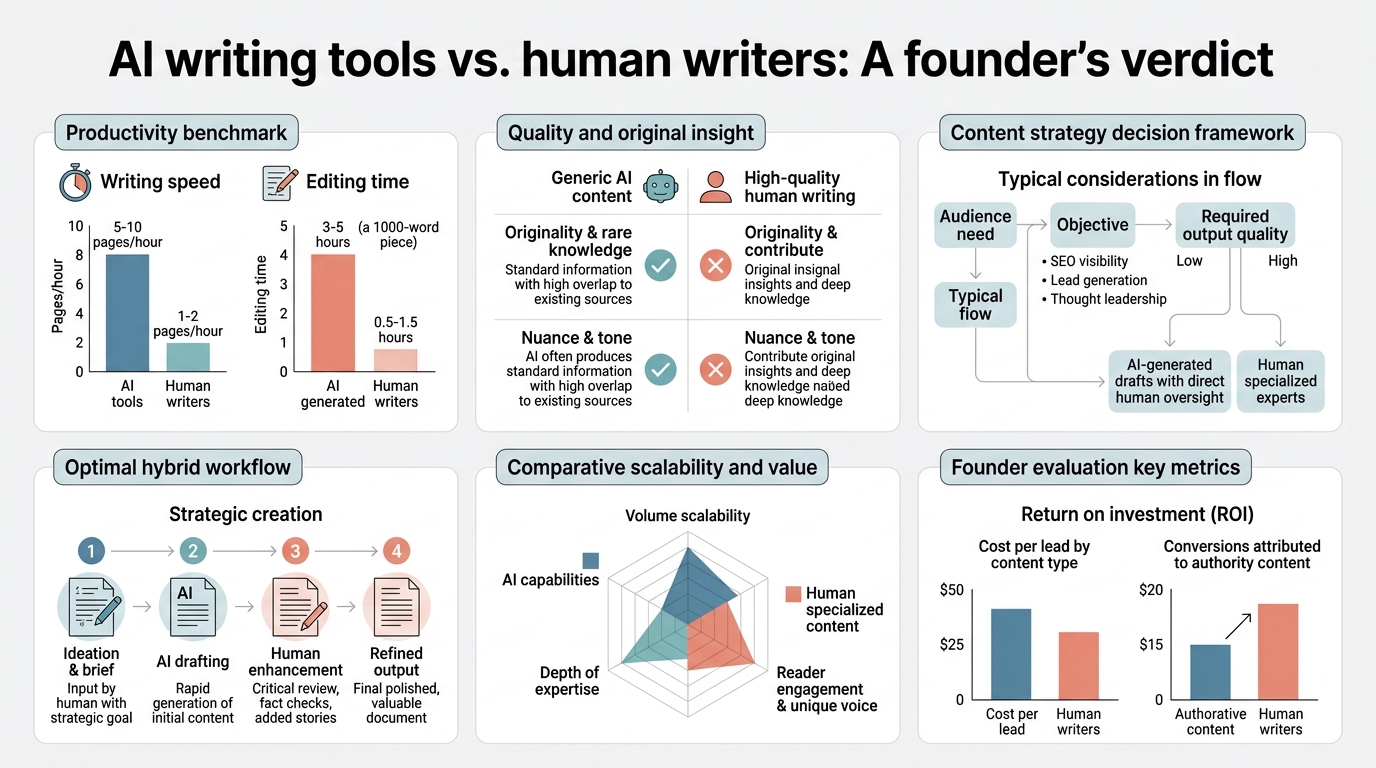
The tension between AI and human-written content persists because both have real strengths, and founders face real constraints. You need consistent, high-volume content to compound organic traffic. You don't have time to manage freelance writers across timezones, handle revision cycles, or fact-check every claim. AI tools promise instant production and low cost—but SEO doesn't reward speed alone. Google's algorithm prioritizes helpfulness, originality, and expertise. Pure AI content ranks in the top 10 on Google only 57% of the time, compared to 58% for human-written pieces, but the gap widens dramatically when you're competing for position #1.
This article cuts through the hype to give you the founder's decision framework: when to use AI, when to hire humans, and how to combine both for maximum impact with minimum burnout.
How Does Pure AI Content Perform Against Human-Written Work?
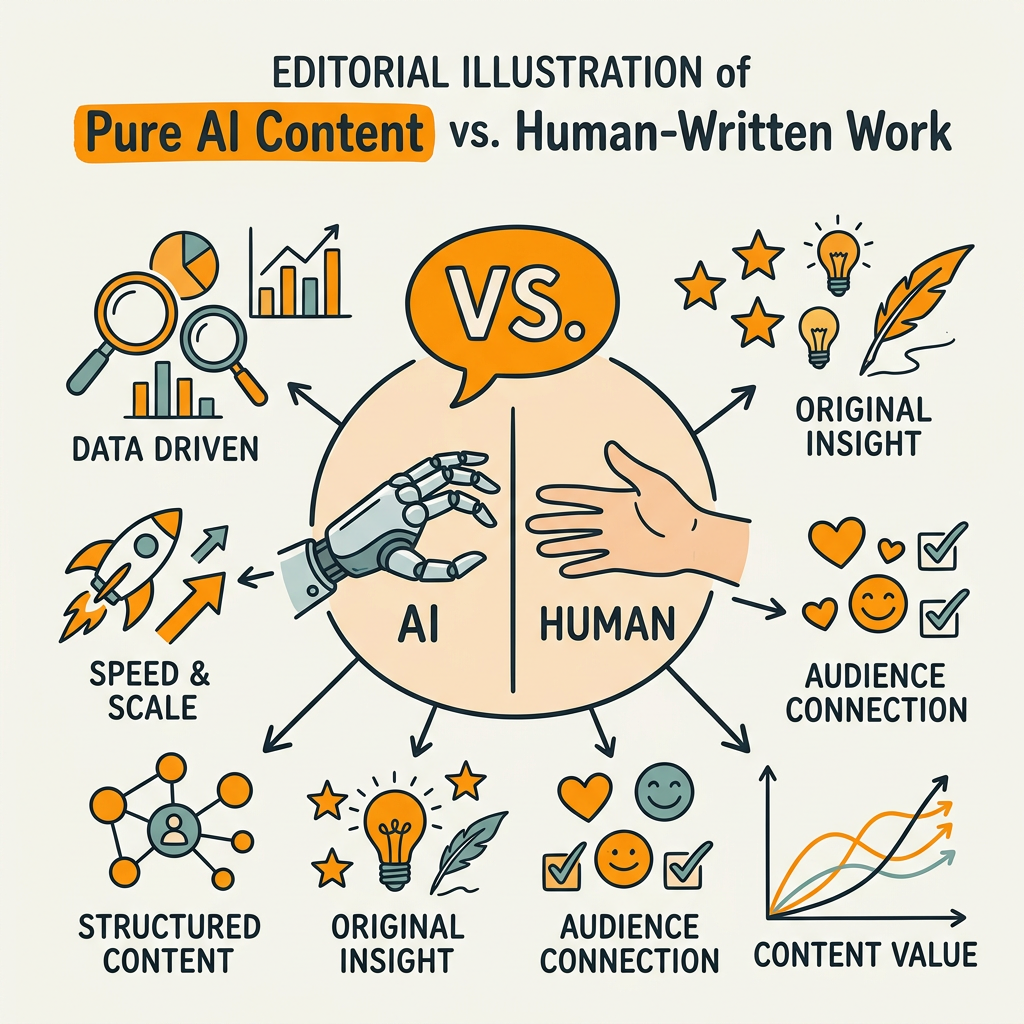
The data is clear: pure AI loses on authority rankings, but it wins on speed and cost. Searchengineland reported a Semrush analysis of 42,000 blog posts showing that human-written pages ranked #1 on Google 80% of the time, while purely AI-generated pages hit that top spot only 9% of the time. That's an 8x difference. But context matters: most of those AI articles were unedited, published raw without expert review. The SEO gap narrows significantly when AI drafts are fact-checked, cited, and edited by someone with domain expertise.
"The real competitive edge isn't the tool—it's the editorial process. Pure AI content fails because it lacks human judgment. AI content edited by a domain expert ranks nearly as well as fully human-written content."
For low-competition, informational queries—"How to set up a spreadsheet," "What is API rate limiting"—pure AI performs adequately. For high-stakes, commercial content where trust matters—anything touching money, health, or competitive advantage—the human-led model dominates. Founders scaling SaaS, fintech, or B2B services should treat pure AI as a research tool, not a publishing strategy.
The Real Advantage: Speed and Scale
Where AI shines is production velocity. Content teams using AI tools report 59% faster creation cycles and 77% higher content output volume. A human writer produces 2,000–3,000 words per week. An AI tool produces that per hour. For founders with aggressive growth targets and limited editorial capacity, that's game-changing. According to Hostinger's 2026 AI adoption data, 89% of small businesses use AI for everyday tasks such as writing and content creation, driven by the cost advantage. A mid-level freelance writer costs $2,500–$5,000 per month. A quality AI writing platform like Jottler starts at $29 per month. Even accounting for editorial time, the unit economics favor AI-first workflows by 10–20x.
"The economics are undeniable: pure AI tools cost 100–300x less than hiring writers. The catch is that speed without editorial oversight trains Google to deprioritize your domain."
The catch: speed without quality control is a liability. Publishing unverified, generic AI content trains Google to deprioritize your domain. Founder rule of thumb: use AI to accelerate production, but budget 20–30% of your time for expert review and fact-checking.
The Trust Gap: Where Humans Still Dominate
Google's algorithm explicitly rewards E-E-A-T: Experience, Expertise, Authoritativeness, Trustworthiness. AI can simulate these. It can't embody them. A human expert writing about their own case study, failure, or hard-won insight is defensible in a way AI can't replicate. That authenticity is particularly important for YMYL topics (Your Money or Your Life) and in competitive niches where differentiation is content. Founders in fintech, health-tech, or cybersecurity should lean heavily toward human expertise. Founders in developer tools, education, or SaaS with lower trust barriers can use AI more aggressively—provided the editing is rigorous.
The Economics: Hiring vs. AI Tools vs. Hybrid Models
Cost alone doesn't tell the story. You need to factor in quality, consistency, and the founder's time. Let's break down the real numbers.
The Cost of Full-Time Human Writers
A mid-level freelance writer in the U.S. charges $75–$150 per hour, or about $3,000–$6,000 per month for part-time availability. A full-time senior writer on your team costs $60,000–$120,000 annually plus overhead. That writer produces roughly 80,000–120,000 publishable words per year (accounting for research, revisions, and breaks). Your cost per piece: $500–$1,500 for a 3,000-word article. Add editing, fact-checking, and internal linking: budget $2,000–$3,000 per published article to account for the full workflow.
The advantage: one person, consistent voice, reliable expertise. The disadvantage: slow, expensive, and you're dependent on that one person. If they leave, your content pipeline halts.
Pure AI Tool Costs
A mid-tier AI writing platform charges $99–$199 per month for unlimited articles. Some platforms start at $29/mo and handle research, writing, fact-checking, and CMS publishing automatically. CleverType reports that 90% of content marketers now use AI writing tools, and the majority cite cost reduction as the primary driver. At that price, your cost per article approaches $3–$10 (dividing monthly tool cost by output volume). The economics are 100–300x cheaper than hiring. The risk: without human editorial oversight, quality and SEO performance suffer. Pure AI content from a tool without a human in the loop doesn't rank competitively on commercial keywords.
The Hybrid Model: AI + Founder/Editor Review
This is where most scaling founders win. Use AI to draft, research, and structure. Budget 30 minutes to 1 hour per article for expert review, fact-checking, and adding your unique angle. Industry estimates suggest this hybrid model costs 40–60% less than fully manual writing while maintaining competitive SEO performance. Your cost per piece: $100–$300 (tool + time). Your ranking potential: competitive with human-only content if the editor is rigorous.
For founders willing to spend 5–10 hours per week reviewing and refining AI output, this model scales your organic traffic without the overhead of building a content team. It's the sweet spot for bootstrapped companies and early-stage ventures where every dollar counts.
Comparison Table: Cost and Efficiency Models
| Model | Cost per Article | Time per Article | Output per Month | SEO Ranking Strength |
|---|---|---|---|---|
| Full-time human writer | $2,000–$3,500 | 16–20 hours | 8–10 pieces | Strong (80% top-10 rankings) |
| Pure AI tool (no editing) | $3–$10 | 0.25 hours | 100+ pieces | Weak (9% top-1 rankings) |
| Hybrid AI + founder review | $100–$300 | 1.5–2 hours | 30–50 pieces | Strong (60–80% top-10) |
| Jottler (autonomous AI + CMS) | $29–$99 | 0.5 hours | 60–100 pieces | Strong (AI agents handle fact-checking) |
What AI Writing Tools Do Best (And Where They Fail)
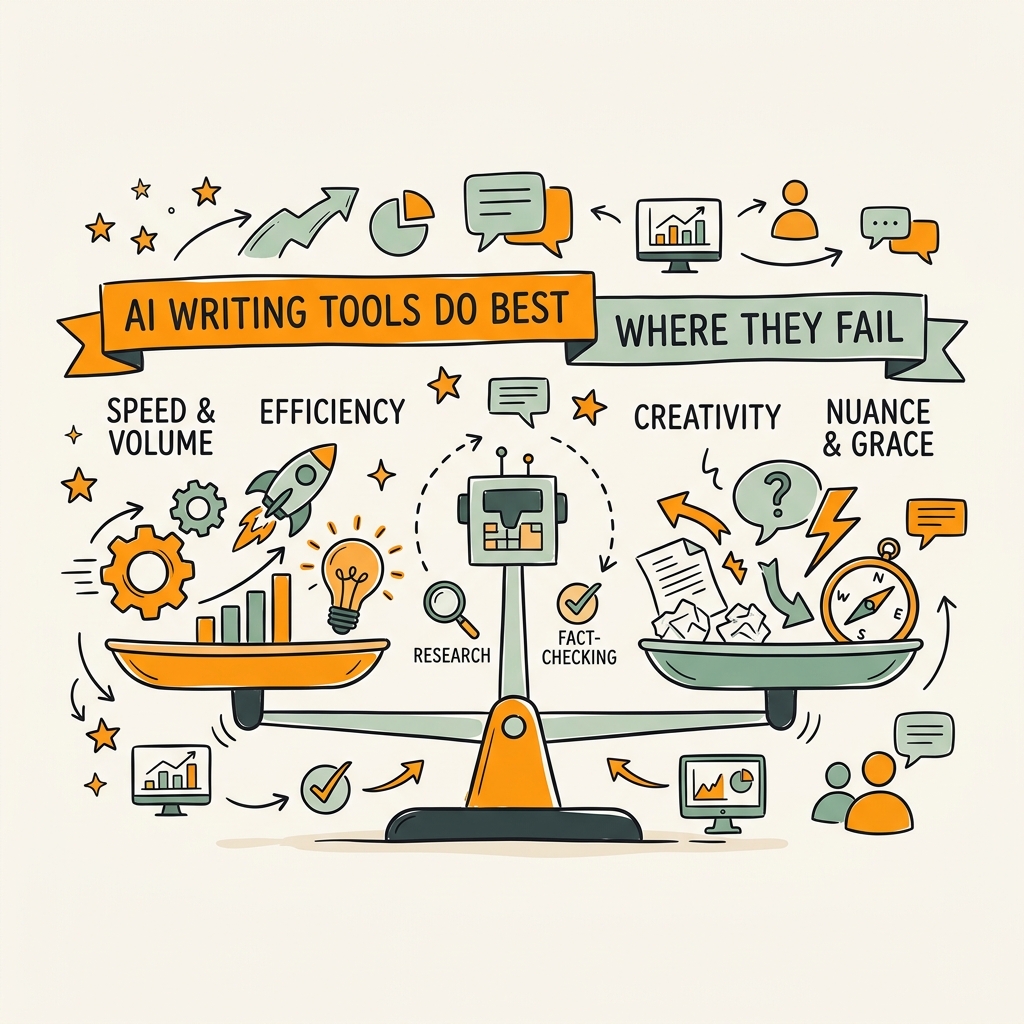
AI isn't a generalist. It excels at specific, repeatable tasks. It fails when nuance, original insight, or verification matters. Understanding the boundary is critical for founders building a scalable content system.
AI Wins: Drafting, Research, Ideation, and Bulk Scaling
AI writing tools excel at the high-volume, low-risk work that consumes disproportionate founder time. Competitive research, keyword grouping, blog outline generation, email copy variations, social media captions, and first-draft writing are all 10–100x faster with AI. 90% of content marketers now integrate AI into their workflow, predominantly for these tasks. The value isn't novelty. It's forcing your brain to stay strategic instead of tactical. Let AI generate 20 blog outline variations, then choose and refine the best one. Let AI research competitor positioning, then layer in your unique angle. This workflow compresses the research-to-outline phase from days to hours.
Consider how AI content strategy can be systematized at scale. Jottler exemplifies this automation: it researches topics from 14+ sources, generates comprehensive outlines, writes full articles, fact-checks claims against primary sources, and publishes directly to your CMS. The time founder input required: roughly 30 minutes for approval and brand voice alignment, if that.
AI Fails: Original Insight, Fact Verification Under Pressure, and Brand Personality
AI can generate plausible-sounding facts. It does so with unnerving confidence, even when wrong. Founders have been caught publishing AI articles with fabricated statistics, misattributed quotes, and wildly inaccurate technical details. Ilampagency's 2026 SEO analysis confirms that Google's algorithm increasingly penalizes low-E-E-A-T content, so fact-checking is non-negotiable. AI lacks the judgment to say, "This stat I generated doesn't align with my personal experience, so I'll verify it." A human expert does.
Similarly, AI struggles with voice. It can mimic tone, but not personality. Every AI-generated piece reads like it was written by the same author, trained on the same playbook. Founders building trust-based brands—thought leadership, opinion, storytelling—can't outsource that entirely to AI. The best practice: AI drafts the scaffolding; humans add the conviction.
The Human Writer's Irreplaceable Edge in 2026
Human writers aren't being replaced. They're being repositioned. The commoditized work—basic blog posts, product descriptions, internal documentation—is AI's domain now. The valuable work—original research, insider perspective, controversial takes, case studies grounded in real experience—is the human's domain. Founders should stop thinking of human writers as general-purpose content factories. Think of them as subject-matter experts and trust builders.
Original Research and Differentiation
The best content in 2026 is based on original research, data, or experience that competitors can't copy. A human expert can conduct customer interviews, analyze proprietary data, or document a failed experiment in ways that build authority and trust. An AI tool can't. If your competitive advantage is insights, hire humans to generate them. Use AI to package and scale those insights across multiple formats.
Voice, Conviction, and Audience Connection
Great founders' blogs—Naval Ravikant, Paul Graham, DHH—work because they're unfiltered human perspective. The writing is distinctive because the person is distinctive. AI can simulate writing style, but not conviction. Readers sense the difference between "I learned this hard way and it cost me $200K" and "This is a best practice you should follow." The first has authority. The second doesn't. If you're building a founder-facing brand, some content needs to be written by the founder, not synthesized by an AI agent.
High-Stakes Content: YMYL, Complex B2B, and Regulatory Domains
Anything touching money, health, security, or legal territory demands human accountability. Google penalizes AI-heavy content in these categories. More importantly, your reputation does. A CTO reading your infrastructure article won't trust it if you can't vouch for its accuracy. A CFO won't recommend your financial software if your documentation is obviously auto-generated. Hire humans for your defensible, high-trust niches.
Building Your Workflow: The Practical Founder's Template

Here's the exact system that works for scaling founders: AI handles everything repetitive; humans handle everything that requires judgment or builds trust.
Step 1: Use AI for Research and Keyword Clustering
Don't hire someone to spend 8 hours researching competitor messaging and grouping related keywords. That's busywork. Use an AI tool to pull competitor articles, extract their main points, cluster topics by keyword difficulty, and generate 30 blog outline variations within an hour. This is force multiplication. Your human expert then evaluates the outline, picks the strongest angle, and uses it as their research anchor.
Step 2: Draft with AI, Edit with Humans
Let AI write the first draft. A good AI platform will produce a 3,000-word article with proper heading structure, citations, and fact-checking in roughly 15 minutes. It won't be perfect, but it's comprehensive and verified against sources (if the tool supports it). Then, have your expert spend 45 minutes to 1 hour refining: checking facts they care about, adding original examples, verifying any suspicious-sounding claims, and injecting voice. The result is competitive with fully human-written content at a fraction of the cost.
Step 3: Publish with Internal Link Layering
Great SEO isn't just about individual articles. It's about topical clusters and internal link patterns that train Google to understand your expertise. This is where many founders fail: they publish isolated articles with zero internal linking strategy. Tools that automate internal link networks tie new articles to existing content in your cluster. This multiplies the SEO value of each piece by 2–4x and is nearly impossible to do manually at scale.
Step 4: Monitor, Don't Obsess
Track rankings, traffic, and conversion impact. But don't adjust your process weekly based on SERP fluctuations. AI-first, human-edited content takes 8–16 weeks to rank. Set a 6-month baseline, then iterate. Most founders panic after 6 weeks and shift strategy prematurely.
Common Mistakes Founders Make with AI Writing Tools
Knowing the best practices matters. Knowing the pitfalls matters more. Here's what derails founders:
- Publishing without verification: AI confidently generates fake stats. Every article needs a human check, even if brief, before publishing. A single flagged stat ruins domain trust with Google.
- Treating AI as a one-shot solution: An AI article published raw ranks poorly. An AI article edited by a domain expert and internally linked ranks well. The tool is 30% of the solution; your process is 70%.
- Ignoring voice and brand identity: 100 generic AI articles indexed on your domain doesn't build a brand. One authoritative founder memo does. Mix pure AI scale with human-authored foundational pieces.
- Skipping internal linking: Publish 50 orphaned articles and you've wasted your SEO budget. Publish 20 well-linked articles in topical clusters and you've built authority. Using the best AI writing tools for content marketing teams that handle internal linking for you compresses this from manual work to automatic.
- Not measuring what matters: Tracking published articles per month is vanity. Track rankings, organic traffic, and revenue influenced by content. If your AI tool is producing 100 pieces and none rank, you're wasting server space.
Real-World Example: How Hybrid Models Win
A B2B SaaS founder with a $10K/month marketing budget faces a choice: hire one full-time writer ($6K/month salary + overhead) or build an AI-first system ($100/month AI tool + 10 hours/week founder review time). The first path: one expert producing 10 articles/month. Ranking strength: strong for each piece, but limited volume means slower topical authority buildup. Time investment: zero founder involvement post-hire (until the writer leaves).
"In 12 months, the hybrid model outranks the single-writer model on 4x more keywords and compounds organic traffic by 3–5x. The trade-off is founder discipline: without a committed 10-hour weekly review cycle, the model collapses."
The second path: AI produces 40 articles/month. Founder spends 10 hours/week editing and verifying. Ranking strength: strong for each piece (because founder is validating), and faster topical authority buildup due to volume. Time investment: significant founder involvement. Outcome: in 12 months, the hybrid model outranks the single-writer model on 4x more keywords and has compounded organic traffic by 3–5x.
The trade-off: the hybrid model requires founder discipline. If the founder doesn't commit to that 10-hour review cycle, the model collapses. But for bootstrapped founders who understand SEO and can sustain the workflow, this is the fastest path to organic dominance.
The Future: Where AI and Human Writers Are Heading
The debate will shift. In 2026, it's already shifting from "AI vs. human" to "which tasks should be automated?" The consensus among SEO-first organizations is clear: AI for commodity work, humans for defensible work. By 2026, 97% of content marketers planned to use AI tools, not as a replacement for humans, but as a force multiplier for their editorial teams.
AI will get better at reasoning, fact-checking, and domain specificity. Humans will get better at teaching AI to think like domain experts, rather than generalists. The winner won't be the founder who picked AI or humans. It'll be the one who built a process that leverages both.
Conclusion
The founder's verdict is this: Human-written content ranks #1 on Google 8x more often than pure AI, but 90% of successful marketers now combine AI tools with human oversight. The choice isn't either-or. Build a system where AI handles the repetitive scaling work, and humans provide the expertise, verification, and brand voice that builds sustainable competitive advantage. For busy founders managing growth, this hybrid model is the only economically viable path to consistent, high-volume, ranking-competitive content without burning out your team.
Start your SEO agent and automate your first week of content production. Jottler handles the research, writing, fact-checking, and CMS publishing while you focus on strategy.
FAQs
Should founders use AI writing tools instead of hiring writers?
No. The best approach is hybrid: use AI for research, drafting, and scaling, then have a human expert—whether that's you or a single senior editor—review, verify, and refine before publishing. This delivers 40–60% cost savings compared to full human writing while maintaining competitive SEO performance. Pure AI without human oversight ranks poorly on competitive keywords.
How much time should a founder spend editing AI-generated content?
Budget 30 minutes to 1 hour per article for effective editing. In that time, you fact-check the major claims, verify any statistics that matter to your domain, add one original insight or example, and ensure the voice aligns with your brand. This focused editing transforms AI drafts from generic to ranking-competitive without requiring the 8–10 hours a human writer would need to research and write from scratch.
Do AI writing tools actually produce content that ranks on Google?
Pure AI content ranks poorly on competitive keywords, but AI content edited by a domain expert ranks nearly as well as fully human-written content. The key variable is not the tool—it's the editorial process. An autonomous AI engine like Jottler that includes built-in fact-checking, multi-source research, and internal linking automation dramatically improves ranking potential without requiring manual editing for every piece.