Automating Keyword Research and Monitoring Workflows
Keyword research remains the foundation of organic growth, but 78.6% of enterprise SEO teams still struggle to scale it efficiently. Manual keyword discovery, clustering, and competitive analysis consume 12 hours per week for the average marketer—time that could go toward strategy and content optimization. The fix? Automating your keyword research and monitoring workflows compounds your SEO efforts without the overhead. By using AI-powered tools and SEO automation frameworks, teams can reduce keyword research effort by up to 80% while discovering 25% more high-value keywords than traditional methods.
Key Takeaways
- Keyword research automation reduces manual effort by up to 80%, shrinking weekly research time from 12 hours to roughly 30 minutes (Sedestral, 2026).
- 84% of SEO professionals now use automation for keyword research, making it the most automated SEO task across the industry (SEMrush, 2025).
- Automated workflows help teams discover 25% more high-value keywords and improve organic traffic growth by 47.3% through structured clustering (Conductor, 2026).
- AI-powered clustering tools increase ranking accuracy by 43% and reduce content planning cycles by 14.6 hours per campaign (Conductor, 2026).
- Automated Keyword Discovery: AI tools pull and analyze thousands of keywords at scale, identifying intent patterns and long-tail opportunities faster than manual research.
- Keyword Clustering and Topic Modeling: Structured clustering groups semantically related keywords into topics, improving topical authority and content planning efficiency by 47.3% YoY.
- Real-Time Rank Tracking and Alerts: Continuous monitoring of keyword positions, competitor movement, and ranking opportunities eliminates manual tracking overhead.
- Competitive Intelligence Automation: Automated competitor keyword analysis surfaces gaps and new ranking opportunities across your market with minimal manual intervention.
- Integrated Content Briefs and Publishing: End-to-end automation pipelines transform keyword clusters into publishable content briefs, reducing the research-to-production cycle.
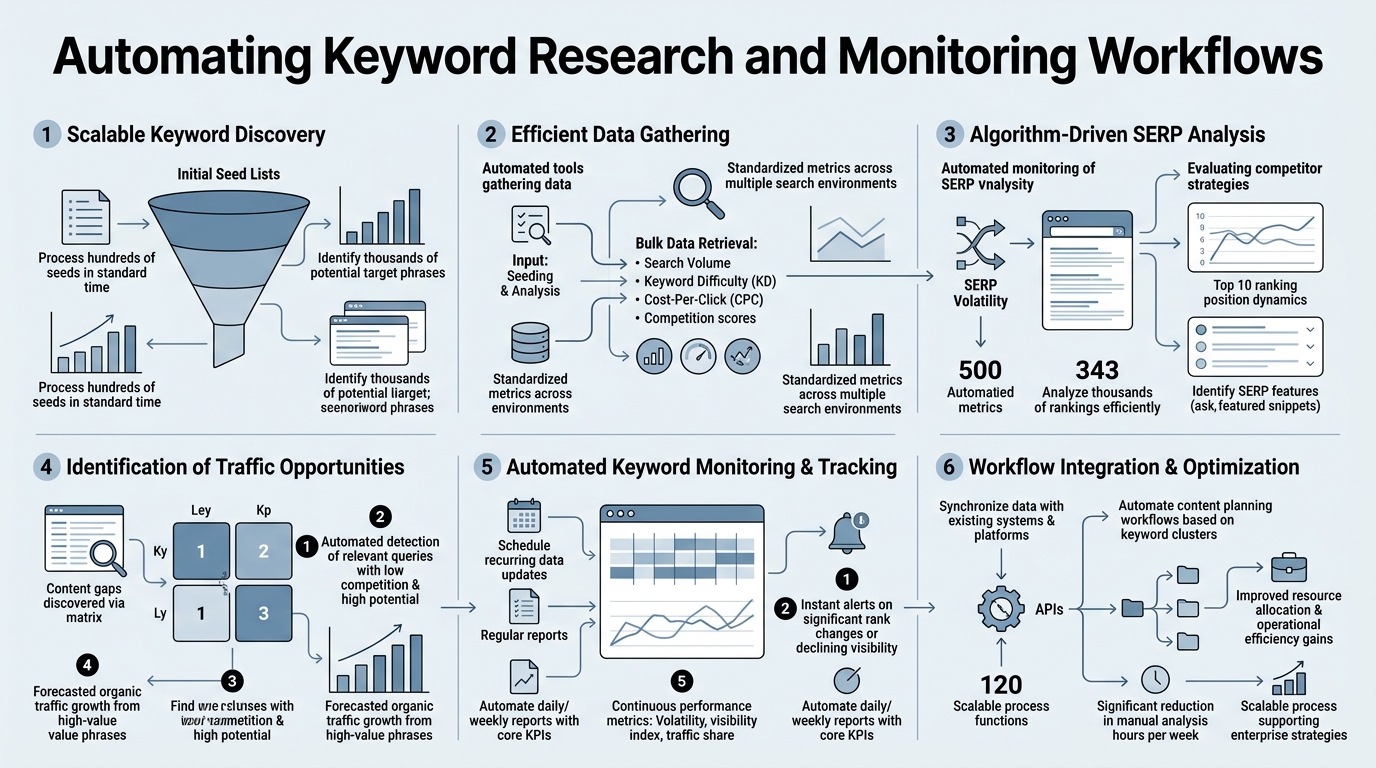
Why Manual Keyword Research Doesn't Scale Anymore
The old model of keyword research—spreadsheets, manual volume checks, and fragmented tools—no longer works for growing teams. 89% of SEO professionals now use AI-powered tools for keyword analysis, not because they're trendy, but because the time and accuracy gains are unavoidable. Manual research exposes you to human error, missed opportunities, and competitive blind spots. Amra & Elma's keyword research statistics confirm that AI-powered adoption is accelerating across enterprise teams seeking faster insights and better ranking outcomes.
"Manual keyword research is becoming a competitive liability. Teams that haven't automated discovery and clustering by 2026 will struggle to keep pace with competitors who publish 3–5x more targeted content in the same timeframe." — Conductor Research Report, 2026
The Cost of Manual Keyword Workflows
Most teams don't realize how much time they're spending on tasks that could be automated. A single keyword research cycle—seed development, volume and difficulty checks, competitor analysis, and clustering—can consume 8-12 hours per week. Multiply that by researcher turnover, inconsistent processes, and the need to re-run research every quarter, and you're looking at hundreds of hours lost annually. Teams using automated workflows complete the same work in 30 minutes, redirecting those hours toward content strategy, user experience, and conversion optimization.
Beyond time, manual research introduces blind spots. Human researchers naturally gravitate toward obvious keywords in their niche. AI-powered tools scan billions of keyword queries and uncover intent patterns that manual research misses entirely. The result? Automated workflows help you find 25% more high-value keywords than traditional methods, increasing your total addressable keyword market and long-tail opportunity pool.
Competitive Risk of Staying Manual
78% of SEO professionals already use keyword research automation tools in their workflows, meaning they're finding opportunities faster, clustering smarter, and adapting to market shifts in real-time. If you're still managing keyword research manually, you're playing defense. Automated monitoring lets you track competitor keyword movements, SERP feature changes, and emerging topics instantly, giving you time to react rather than chase. According to Rank Authority, SEO teams that automate keyword research reduce manual workload by 55-80% and reclaim capacity for strategic initiatives.
How Keyword Research Automation Works
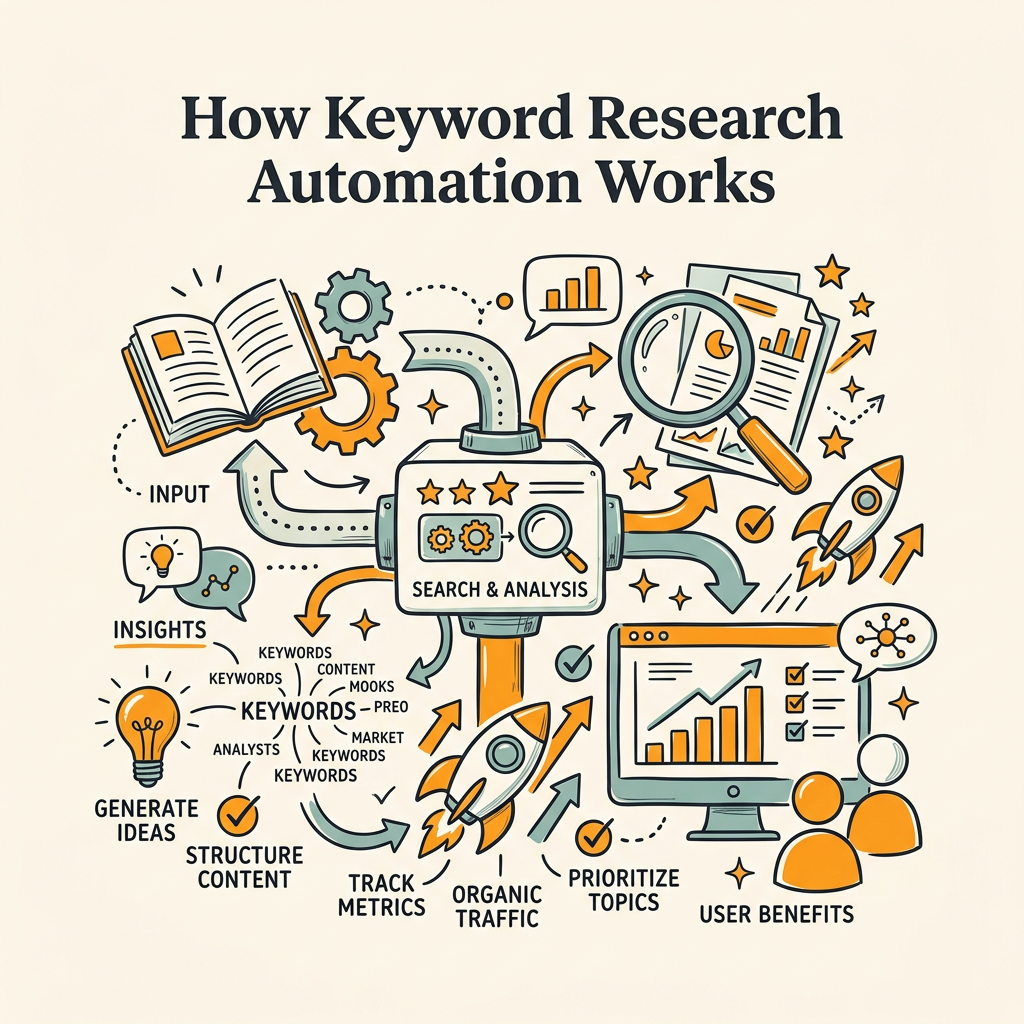
Modern keyword research automation combines three core mechanisms: AI-powered discovery, structured clustering, and continuous monitoring. Unlike traditional tools that just pull data, automated workflows orchestrate the entire pipeline from discovery to content planning to internal linking. Understanding how these systems work is critical before choosing a tool.
AI-Powered Discovery and Intent Classification
Keyword discovery automation starts with seed keywords or competitor domains and uses AI to pull massive keyword sets from search engines, autocomplete, related searches, and proprietary databases. Ahrefs processes over 10 billion keyword queries monthly and uses machine learning to classify intent (commercial, informational, navigational, or transactional) automatically. Instead of manually assigning intent tags, AI detects patterns from actual SERP results and user behavior.
The power here is scale. A tool can analyze 25 billion keywords (as SEMrush does) in seconds, surfacing opportunities your competitors haven't noticed yet. Intent classification lets you group keywords not just by topic, but by what users actually want when they search—a critical distinction for content planning. If you're targeting a keyword cluster with mixed intents, you'll waste content on users who aren't ready to convert.
"Intent classification is where most DIY keyword research fails. Teams manually cluster 'best tools' with 'how to use tools' without realizing they require completely different content strategies. AI-powered clustering catches these nuances automatically." — KeywordInsights, 2025
Automated Clustering and Topic Modeling
Once keywords are discovered, automation clusters them by semantic similarity, search intent, and SERP overlap. Instead of manually grouping keywords in spreadsheets, AI tools analyze search results pages (SERPs) and group keywords that would rank for the same content. 68.9% of top-performing SEO teams use AI-assisted clustering, and for good reason: structured clustering reduces content planning cycles by 14.6 hours per campaign.
This is where topical authority gets built. Clustered keywords become pillar topics and supporting content clusters, which then map to an internal linking strategy. Teams using structured keyword clustering achieve 47.3% higher organic traffic growth YoY compared to non-clustering counterparts. The ROI isn't just in time savings—it's in ranking velocity and topical authority compounding.
Real-Time Monitoring and Alert Systems
Automation doesn't end after content launches. Continuous monitoring tracks your keyword positions, competitor movements, and ranking opportunities in real-time. Instead of logging into rank trackers weekly to check positions, automated systems alert you when you rank into or out of the top 10, when competitors move, or when new opportunities emerge for existing content. This eliminates manual rank tracking entirely and surfaces opportunities instantly.
Real-time alerts are particularly valuable for competitive keywords. If a competitor launches content targeting your high-value keywords, you want to know in hours, not weeks. Automated monitoring systems flag these threats and suggest content updates, new topics, or internal linking opportunities to reclaim visibility before your competitors gain traction.
Building Your Automated Keyword Research Workflow
Effective automation requires more than just tools—it requires workflow design. The best teams implement a structured process: seed development, automated discovery, clustering, prioritization, and integration with content planning. Here's how to build a workflow that compounds.
Define Your Seed Keywords and Market Scope
Start with core topics that align with your business goals. Seed keywords are the foundation of automated discovery. If your seeds are weak, your automation will amplify weak results. Identify 10-20 core topics that represent your business, then let automation expand from there. Content automation tools like Jottler use semantic analysis to understand your seed topics at a deeper level, expanding to related queries, long-tail variations, and intent patterns without manual input.
Scope matters too. Are you targeting local, national, or international markets? Do you focus on commercial intent, informational, or mixed? Define these boundaries upfront—automation will respect them and keep your keyword universe aligned with business strategy.
Execute Automated Discovery and Clustering
Once seeds are set, run your automated discovery process. This pulls keywords, analyzes SERP results, classifies intent, and clusters related terms. The automation should deliver a structured output: keyword clusters with search volume, difficulty, intent classification, and internal linking recommendations. This is where AI tools discover 25% more high-value keywords than manual methods—they don't miss long-tail variations or emerging subtopics because they process billions of queries at once.
Clustering should be semantic-first, not just volume-first. A cluster might include "best project management tools," "project management software for teams," and "how to choose a project management tool"—keywords that are semantically related and would rank for the same content, even if their search volumes differ. AI-powered clustering handles this automatically; manual clustering often misses these relationships.
Prioritize by Business Value and Competitive Opportunity
Not all keyword clusters are equal. Prioritization filters out low-opportunity keywords and focuses your content efforts on high-impact targets. Automated prioritization combines several factors:
- Search Intent Alignment: Does the keyword cluster match your content strategy and business model? A product comparison keyword makes sense for a SaaS company; it might not for a service provider.
- Keyword Difficulty vs. Current Authority: Can you realistically rank for this cluster given your domain authority and backlink profile? Automation should flag "quick wins"—lower-difficulty clusters you can rank for in 3-6 months.
- Commercial Value: What's the business impact of ranking for this cluster? High-intent keywords that drive conversions or customer acquisition should rank higher than informational keywords.
- Content Gap: Are competitors dominating this cluster, or is there white space? Clusters with low competitive density offer faster ranking paths.
Most automation tools score clusters on these dimensions, ranking them by opportunity. You should focus content creation on the top 20-30% of clusters—the ones with the highest opportunity and lowest competitive density.
Integrate with Content Planning and CMS Publishing
The final step is integrating your automated keyword research with content production. Prioritized keyword clusters should feed directly into your content calendar. Instead of siloed keyword research and content planning, automation creates a unified workflow: keyword cluster → content brief → article outline → internal linking plan → CMS publication.
Tools like Jottler take this further by automating the entire automated SEO pipeline. You define your desired publishing frequency (1-5 articles per day), and the system automatically researches topics, creates comprehensive articles, fact-checks content, and publishes to your CMS while building internal link networks. This eliminates handoff friction and ensures keyword research directly compounds into published content.
Choosing the Right Automation Tools
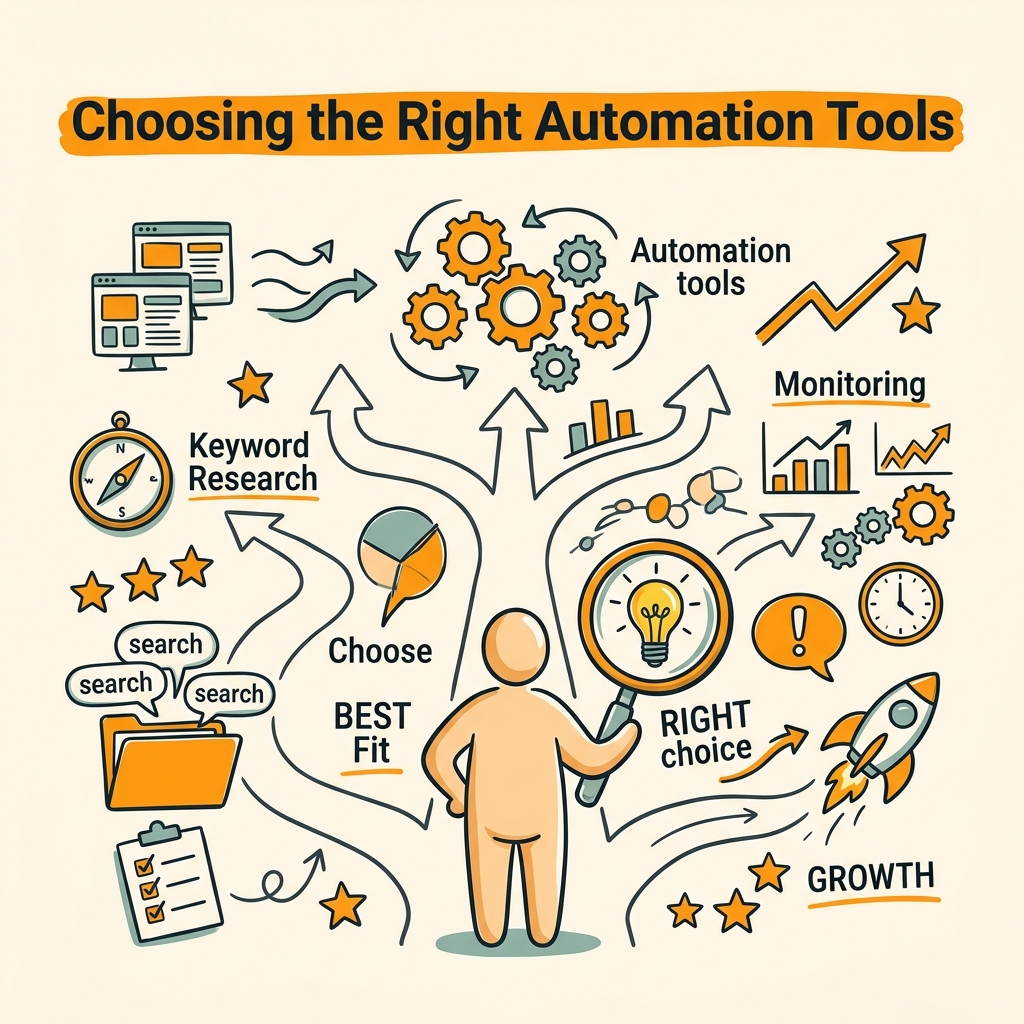
The keyword research automation landscape has fragmented. Some tools specialize in discovery, others in monitoring, and a few offer end-to-end automation. Here's how to evaluate options for your team.
Core Automation Categories and Trade-offs
| Category | Best For | Key Limitation | Example Tools |
|---|---|---|---|
| Discovery + Clustering | Keyword research, topic planning, competitive analysis | Doesn't automate content creation or publishing | Ahrefs, SEMrush, KeywordInsights.ai |
| Rank Tracking + Monitoring | Continuous position tracking, competitor monitoring, alert systems | Limited discovery and clustering capabilities | SE Ranking, AccuRanker, SERPstat |
| Workflow Automation (No-Code) | Custom SEO workflows, keyword-to-content pipelines, CMS integration | Requires design expertise; not all SEO-specific | Gumloop, Make, n8n |
| End-to-End Automation | Complete SEO pipeline from keyword research to publishing to monitoring | Fewer options; higher investment, but faster ROI | Jottler, Content at Scale |
Each category serves different needs. If your bottleneck is keyword research time, a discovery + clustering tool solves it. If you're struggling with ranking tracking and competitive alerts, a monitoring tool is the right pick. If you want to automate the entire pipeline from research to publishing, an end-to-end platform like Jottler handles all stages and compounds your output without manual handoffs.
Critical Feature Checklist for Automation
When evaluating tools, focus on features that actually reduce manual work. Not all automation tools are equal. Here's what matters:
- Semantic Clustering: Does the tool cluster keywords by SERP overlap and intent, or just by volume and difficulty? Semantic clustering gives you content clusters ready to rank.
- Intent Classification: Are intents assigned automatically, or do you classify manually? Automated intent detection saves hours and improves accuracy.
- Content Brief Generation: Can the tool auto-generate content briefs from keyword clusters? This bridges keyword research and content creation.
- CMS Integration: Does the tool connect to your WordPress, Webflow, or custom CMS? Without integration, you're manually copying keyword briefs into your CMS.
- Real-Time Monitoring: Does the tool continuously track keyword positions and alert you to changes? Or do you check positions manually? Real-time alerts are game-changers for competitive keywords.
- Internal Linking Recommendations: Can the tool suggest internal linking paths based on keyword clusters and topical authority? Jottler automatically builds internal link networks as you publish.
A tool without CMS integration, for example, saves keyword research time but adds friction at content publishing. A tool without real-time monitoring gives you static reports instead of actionable alerts. Evaluate tools on how completely they automate your workflow, not just on dataset size or interface.
Scaling Keyword Monitoring Beyond Discovery
Once your keyword research is automated, the next frontier is scaling monitoring. Most teams focus on keyword research automation but neglect continuous monitoring. The truth is, ranking isn't static. Competitors move, search algorithms update, and new opportunities emerge constantly. Monitoring automation ensures you're aware of these shifts in real-time.
Continuous Ranking Intelligence and Competitive Tracking
Automated rank tracking monitors your keyword positions daily and flags significant changes. Instead of logging into your rank tracker weekly, you get alerts when you rank into the top 10, drop below your target position, or when a competitor surpasses you on a high-value keyword. This real-time visibility lets you react instantly—updating content, improving internal links, or launching new pages before your competitors gain more ground.
Competitive tracking automation goes deeper. Tools monitor your competitors' keyword portfolios, tracking which keywords they rank for, when they rank, and their content velocity. Automated competitor analysis provides 55% better insights than manual research because systems analyze thousands of competitors simultaneously and surface movement patterns humans would miss.
Automated Topic Monitoring and Emerging Opportunities
Beyond position tracking, automated topic monitoring scans for emerging keywords and trending topics in your space. When search volume spikes for a related keyword, or when a new topic emerges in your market, automated systems flag it instantly. This gives you a head start—you can publish content on emerging topics days or weeks before competitors notice them.
Topic monitoring is particularly valuable for news and trends-driven industries. In SaaS, for example, when a competitor raises funding or launches a new product, search volume for related keywords often spikes. Automated topic monitoring alerts you immediately, letting you publish reactive content and capture that surge in intent.
Measuring the ROI of Keyword Research Automation
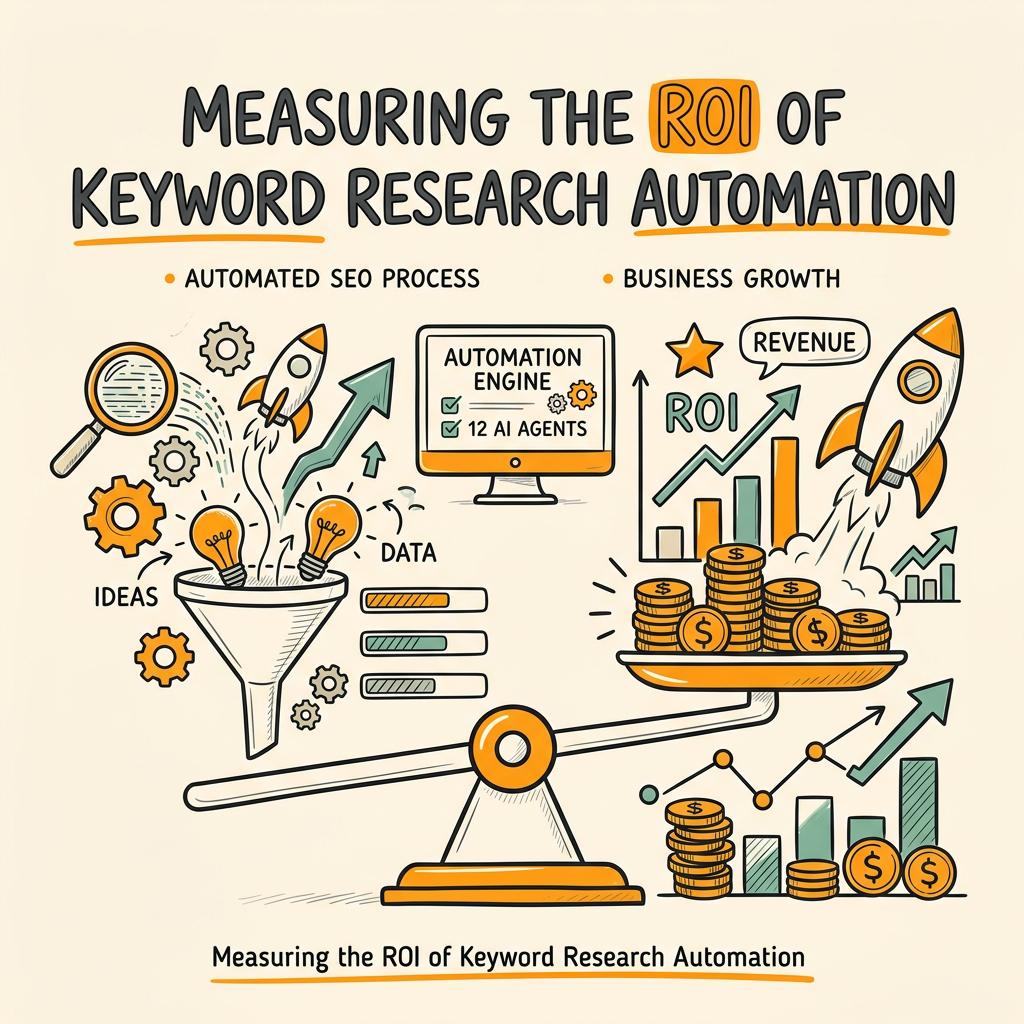
The business case for automation is clear. Teams using automated keyword research report 54.2% reduction in time-to-insight and 33.7% improvement in content ranking success rates compared to manual workflows (Search Engine Land, 2026). But how do you measure this in your own operations?
Time Savings and Operational Efficiency
Start with time savings. Track how long your keyword research process takes before and after automation. If keyword research currently takes 12 hours per week, and automation reduces it to 30 minutes, you've freed up 11.5 hours weekly. Over a year, that's 600 hours redirected to strategy, content optimization, or other high-impact work. If you value an SEO team member at $50/hour, that's $30,000 in annual time savings from a single person.
Multiply that across your team. If you have two or three people doing keyword research, automation compounds the savings. Many teams see $50,000-$100,000+ in annual time savings just from automating keyword research.
Content Output and Ranking Metrics
Beyond time, measure the impact on content output and rankings. Teams using automated keyword research and content generation publish 3-5x more content without increasing team size. Each new article is based on automated keyword clusters, reducing planning time per piece. More content, faster, all based on keyword data—this compounds organic traffic growth.
Track ranking improvements for content clusters published after automation. Compare time-to-rank before and after. Most teams see faster ranking velocity for automated content because it's built on structured keyword clusters and optimized internal linking, not guesses.
Organic Traffic Growth and Revenue Impact
The ultimate metric is organic traffic and revenue impact. Teams using automated keyword research and clustering achieve 47.3% higher organic traffic growth YoY compared to non-clustering counterparts. Over 2-3 years, this compounds significantly. A SaaS company growing organic traffic 47% faster than competitors is capturing market share just from organic visibility.
For e-commerce, the impact is even more direct. More ranked keywords = more organic traffic = more conversions. Track organic traffic growth, cost per acquisition (CPA) from organic, and lifetime value (LTV) of organic customers. Most teams see ROI from automation within 3-6 months.
Common Pitfalls When Automating Keyword Research
Automation is powerful, but teams often implement it poorly. Here are the most common mistakes and how to avoid them.
Over-Automation Without Strategy
Some teams automate everything without maintaining strategic direction. They push all ranked keywords into content production regardless of business fit. This dilutes your content with off-topic articles that rank but don't drive revenue. Use automation to discover and monitor keywords, but keep humans in the loop for prioritization. Define which keyword clusters matter to your business, then automate around those priorities.
Ignoring Intent Misclassification
AI intent classification is accurate but not perfect. Some keywords get misclassified, especially in niche markets or emerging topics. Review automated intent classifications before building content around them. A single misclassified high-intent keyword can lead to wasted content effort. Spot-check clusters, especially your top 50 priorities.
Neglecting Monitoring After Research
Many teams automate discovery but ignore monitoring. They research keywords once, publish content, then forget to track rankings or competitive movement. This is where you leave ROI on the table. Continuous monitoring ensures you're aware of ranking changes, new competitors, and emerging opportunities. Without monitoring automation, you're flying blind after publication.
Conclusion
Automating keyword research and monitoring workflows is no longer optional—it's the baseline expectation for competitive SEO. Automated workflows reduce keyword research time by up to 80%, help teams discover 25% more high-value keywords, and deliver 47.3% higher organic traffic growth compared to manual processes. The time and accuracy gains compound across your entire content strategy.
The teams winning in organic search aren't the ones with bigger budgets. They're the ones using automation to eliminate friction between keyword research, content creation, and monitoring. They publish more content, faster, all based on structured keyword data. They catch ranking opportunities before competitors do. They measure impact in compounding organic traffic growth, not in hours spent on spreadsheets.
If your keyword research is still manual, you're losing momentum to competitors. Start with automation of discovery and clustering—get your workflow baseline efficient. Then add continuous monitoring to stay alert to market shifts. The best time to automate was three years ago. The second-best time is today.
Ready to automate your entire SEO pipeline? Jottler automates keyword research, content creation, and publishing in a single workflow. Set your desired publishing frequency, and the system handles research, writing, fact-checking, and internal linking—publishing 3,000+ word articles daily while your team focuses on strategy. Start your SEO agent today.
FAQs
How much time does automating keyword research actually save?
Automated keyword research reduces manual effort by up to 80%, shrinking weekly keyword research from around 12 hours to roughly 30 minutes. This frees up substantial time for higher-value work like content strategy, user experience optimization, and conversion rate improvement. In practical terms, if you're spending 12 hours weekly on keyword research, automation saves you nearly 600 hours annually. At typical SEO team rates, that translates to $30,000-$50,000+ in annual labor savings per person.
What's the difference between keyword research automation and rank tracking?
Keyword research automation discovers and clusters keywords, handling discovery, intent classification, and topic modeling. Rank tracking monitors your positions for those keywords over time and alerts you to changes. Both are essential but solve different problems. Research automation solves the discovery bottleneck—it finds keywords faster than humans. Rank tracking solves the monitoring bottleneck—it alerts you to ranking changes in real-time. The best teams use both. Research automation tells you what to target; rank tracking tells you how you're performing against those targets and when to respond.
Can I automate keyword research without a specialized SEO tool?
Yes, you can build custom automation using no-code workflow platforms like Make, Zapier, or Gumloop combined with APIs from data providers like DataForSEO or Airtable. However, this approach requires technical setup and ongoing maintenance. Specialized SEO tools like Ahrefs, SEMrush, or Jottler handle the complexity for you—they already have optimized algorithms, massive keyword databases, and clustering built in. If you have the development bandwidth, custom workflows offer flexibility; if you don't, SEO-specific tools get you productive immediately.