B2B SEO Strategies for Generating Qualified Leads
Most B2B marketing teams chase SEO traffic they never convert. They optimize for high-volume keywords ("What is a CRM?") and rank for thousands of clicks from early-stage searchers with no buying intent. Meanwhile, organic search generates 53% of inbound B2B leads, yet these teams capture only a fraction due to misaligned keyword strategy.
The cost is real: wasted content budgets, inflated traffic metrics, and a sales pipeline that stays empty. But SEO doesn't have to work this way. SEO leads close at 14.6-15% compared to 1.7% for outbound, and companies with mature B2B SEO strategies acquire customers at 61% lower cost than paid channels.
The fix is strategic: target high-intent keywords, align content to buyer stage, and build authority through deep, problem-solving content. Here's how to shift from vanity metrics to revenue-generating SEO:
Key Takeaways
- Organic search drives 53% of B2B leads and converts at 14.6-15%, 8x higher than outbound tactics (2026, Beomniscient)
- High-intent keywords with commercial modifiers ("demo," "pricing," "vs") yield 3-5x more qualified leads than informational volume plays
- B2B SEO delivers 825% ROI over 3 years, but requires intent-aligned content and buyer journey mapping to win
- Target High-Intent Keywords: Focus on commercial modifiers and low-volume, high-value searches that signal buying readiness over vanity traffic.
- Map Content to Buyer Stage: Align articles, comparison guides, and product pages to awareness, consideration, and decision stages to capture intent at every funnel level.
- Build Authority Through Deep Research: Differentiate with original insights, case studies, and frameworks that establish thought leadership and drive repeat traffic.
- Optimize for Bottom-of-Funnel Conversions: Prioritize high-converting pages and landing experiences that turn searchers into qualified leads and demos.
- Automate Content Production at Scale: Consistent publishing of SEO-optimized articles compounds organic reach without burning out your team.
How to Target High-Intent Keywords That Convert
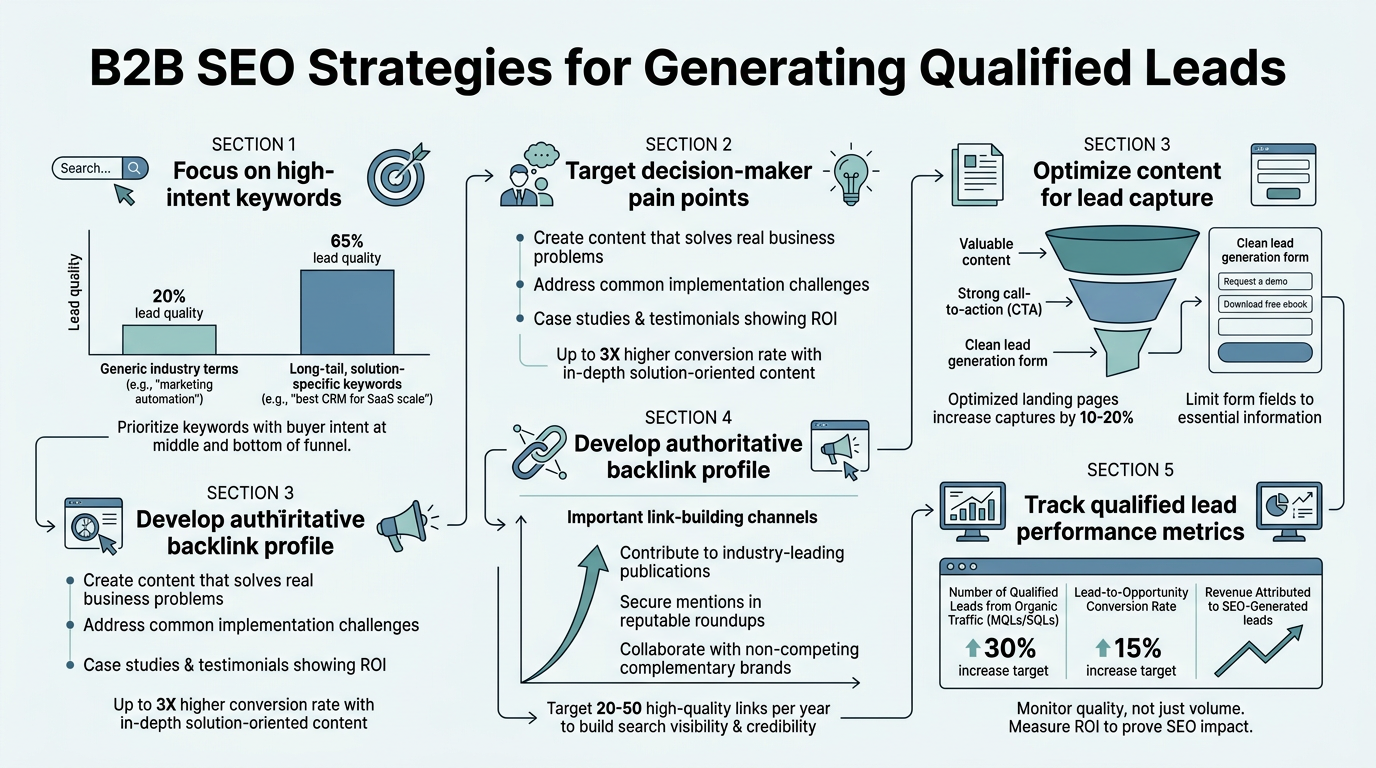
Most B2B keyword research starts with volume and ends with regret. Keywords with commercial intent—"best CRM for small business," "pricing," "demo"—convert 3-5x higher than informational keywords, yet teams still spend 70% of content budgets on "What is…" and "How to…" articles that rank but never close.
The shift is straightforward: identify keywords where searchers are ready to decide, not just learn. This means understanding search intent at a granular level and building a keyword strategy that feeds the sales pipeline, not just Google Analytics.
"Keywords with commercial intent convert 3-5x higher than informational keywords, yet most teams spend 70% of budgets on awareness-stage content that never closes deals. The ROI gap is enormous—and fixable."
Identifying Commercial vs. Informational Keywords
Not all keywords are created equal in B2B. An informational keyword like "What is project management?" attracts 5,000 monthly searches but mostly brings educators and students. A commercial keyword like "best project management software for teams" brings 200 searches of people actively evaluating solutions.
Commercial keywords signal buying intent through specific modifiers:
- Solution modifiers: "best," "top," "software," "platform," "solution," "system"
- Comparison terms: "vs," "alternatives," "comparison," "difference between"
- Purchase-intent phrases: "pricing," "cost," "ROI," "demo," "trial," "implementation"
- Problem-solving: "how to fix," "how to solve," "solutions for," "tools for"
According to Almcorp, B2B companies that prioritize commercial keywords see 2-4x better ROI in leads and closed deals compared to volume-first strategies. This is especially critical for B2B SaaS where average deal cycles last 3-6 months.
Building a Multi-Stage Keyword Map
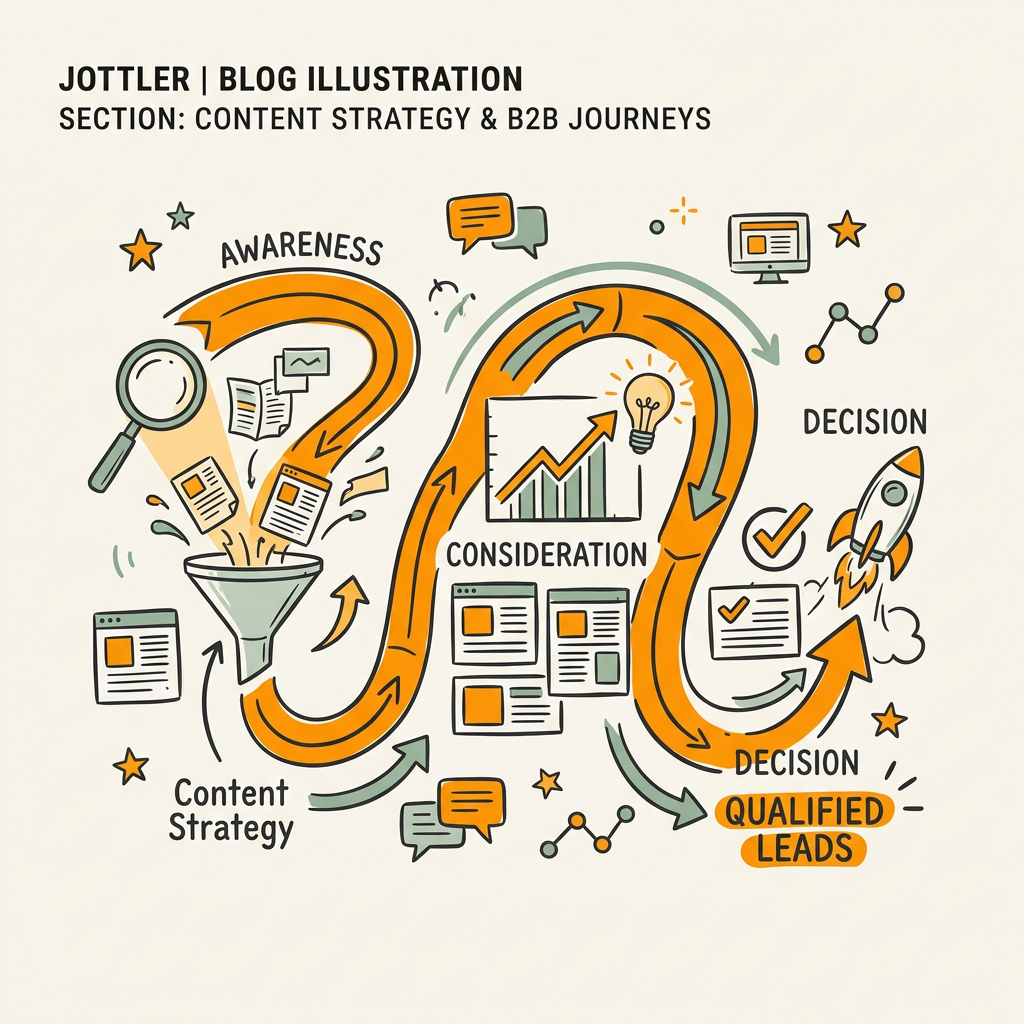
B2B buyers move through distinct stages: awareness (problem recognition), consideration (vendor evaluation), and decision (selection and implementation). Your keyword strategy must span all three to capture demand at every stage.
Map keywords to each stage so content aligns with where the searcher is in their buying journey:
| Buyer Stage | Keyword Examples | Content Type | Lead Quality |
|---|---|---|---|
| Awareness | "why is CRM important," "CRM best practices" | Blog articles, guides, frameworks | Low (MQL) |
| Consideration | "best CRM for small business," "CRM comparison" | Comparison pages, case studies, whitepapers | Medium (SQL) |
| Decision | "CRM demo," "CRM pricing," "Salesforce vs HubSpot" | Pricing pages, product demos, ROI calculators | High (sales-ready) |
This structure ensures every content piece serves a purpose in the funnel. Awareness content builds trust and establishes your brand as a resource. Consideration content positions you against competitors. Decision content closes the deal.
Using Sales Insights for Keyword Discovery
Your sales team hears the actual questions buyers ask. They know which objections come up repeatedly, which features resonate, and which competitor comparisons dominate calls. This is gold for keyword research.
Start a monthly review with sales to uncover keyword gaps:
- Common questions from prospects: "How long does implementation take?" "Can we integrate with our existing stack?"
- Competitive mentions: Which competitors do prospects ask about most often?
- Objection keywords: What hesitations surface? ("Is this secure?" "What's the setup time?") These become content opportunities.
- Feature requests: When prospects ask about specific capabilities, these become long-tail keywords to target.
This intelligence turns keyword research from guesswork into strategy backed by real buyer conversations.
How to Align Content Strategy with B2B Buyer Journeys
Content misalignment kills conversion in B2B SEO. You rank for awareness keywords but send visitors to product pages. You create decision-stage content but publish it to your blog where nobody looking to buy will find it. According to CXL research on bottom-of-funnel SEO, commercial-intent keywords have conversion rates 10x higher than informational keywords, yet most B2B websites still structure content as one-size-fits-all blog posts.
Strategic alignment means matching content type, tone, and call-to-action to where the searcher sits in their buying journey. This drives qualified leads because the right person sees the right message at the right time.
Creating Awareness-Stage Content That Builds Authority
Awareness-stage searchers are learning, not yet ready to buy. They search for problems ("Why does my sales team struggle with forecasting?"), industry trends ("CRM trends in 2026"), and foundational concepts. Content here should educate, establish thought leadership, and position your brand as a trusted resource.
The tone is expert-to-peer, not salesy. You're sharing frameworks, insights, and data that help them understand their problem better. Examples include:
- In-depth guides: "The Complete Guide to Sales Forecasting" or "B2B Lead Generation Strategies That Actually Work"
- Industry research and data: "State of B2B Sales 2026" reports with original research
- Thought leadership pieces: "Why Your CRM Isn't Delivering ROI (And How to Fix It)"
The goal is organic reach and repeat traffic. Awareness content compounds when it ranks for dozens of keywords and attracts a steady stream of potential buyers who begin to see your brand as the authority. Scaling awareness content requires consistent publishing, which is why many teams struggle with the frequency needed to build topical authority.
"Authority isn't built on a single article—it compounds through consistent, original, problem-solving content. Teams that publish 4+ articles monthly on a core topic see rankings and organic traffic compound exponentially by month 6-9."
Building Consideration-Stage Comparison and Case Study Content
Consideration-stage buyers are actively evaluating solutions. They search for comparisons ("Salesforce vs HubSpot"), alternatives ("Best CRM for nonprofits"), and proof of results. Content here should be specific, data-backed, and honest about trade-offs.
Comparison pages are among the highest-converting SEO assets for B2B. They capture high-intent keywords and lead directly to demos and sales conversations. Build them by:
- Answering direct comparisons: "Best CRM for Small Business" vs "CRM for Enterprise" vs "CRM for Nonprofits"—each solves a specific buyer profile
- Using case studies as social proof: Show actual customers, actual results, actual timelines. "Company X implemented CRM in 6 weeks and reduced forecasting time by 40%"
- Highlighting your unique angle: If you serve a niche (e.g., manufacturing, healthcare), create comparison content specific to that industry's pain points
Consideration content converts higher because the searcher has already decided they need a solution. They're choosing between options. Content that makes the comparison clear and credible moves them toward decision.
Optimizing Decision-Stage Landing Pages and Product Content
Decision-stage buyers are ready to act. They search for pricing, demos, implementation timelines, and ROI calculators. They may also search for specific comparisons: "Salesforce vs HubSpot" with the intent to evaluate before buying.
Decision-stage content must be frictionless:
- Clear pricing pages: No ambiguity. Show plans, features per plan, and CTAs for demos or free trials
- Product demo and trial pages: Make starting a trial or booking a demo one click away
- ROI and implementation content: Answer "How much will this cost to implement?" and "What's the payback period?"
- Security and compliance pages: B2B buyers need assurance. Address data security, SOC 2, GDPR, HIPAA as relevant to your industry
These pages rank for high-intent keywords and convert browsers into leads. The challenge is many teams bury these behind nav menus or fail to optimize them for SEO, missing opportunities to capture ready-to-buy searchers.
How to Build Topical Authority and Establish Thought Leadership
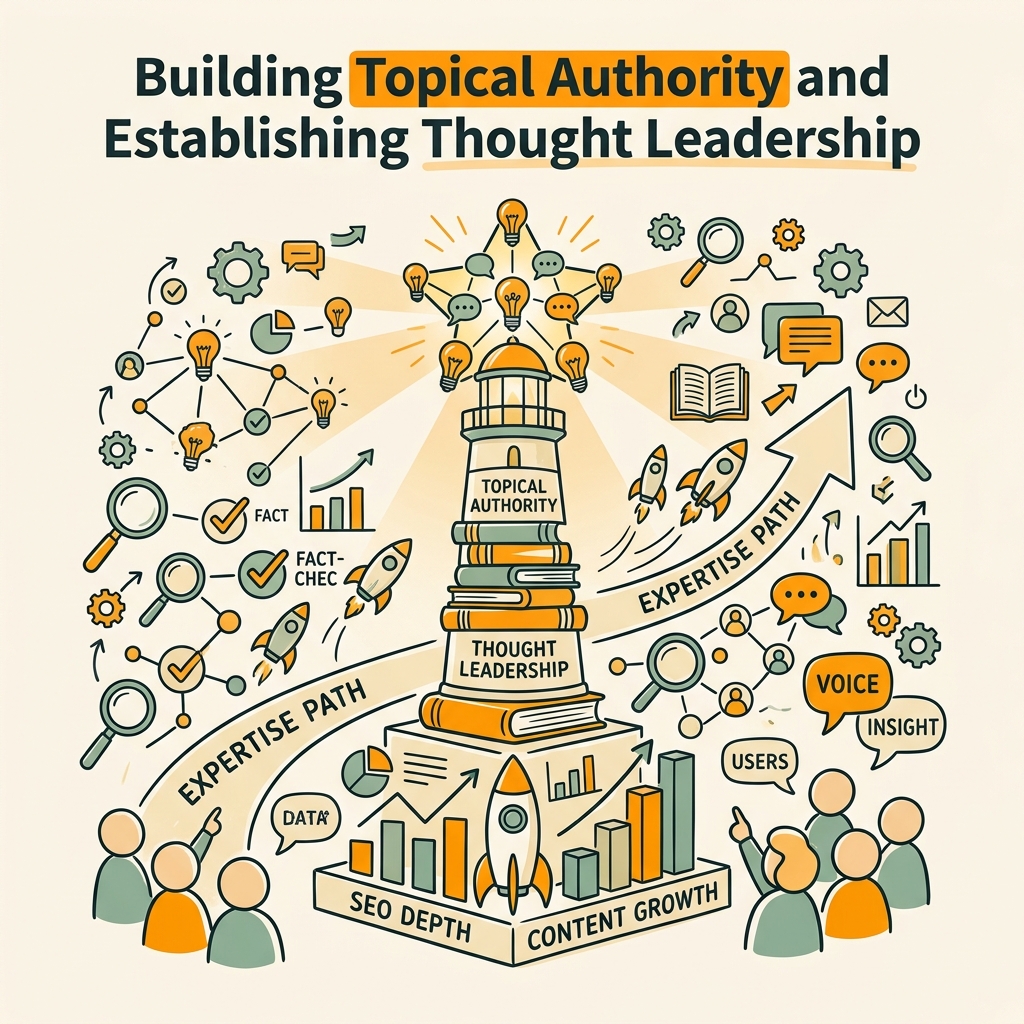
B2B buyers trust brands that demonstrate deep expertise in their space. Companies seen as authoritative through SEO efforts close deals with 89% larger average value, according to Search Engine Journal data. Authority isn't built on a single article—it compounds through consistent, original, problem-solving content that covers a topic exhaustively.
Topical authority means owning a subject area so thoroughly that Google and searchers recognize you as the go-to resource. For B2B, this unlocks higher rankings, more organic traffic, and more qualified leads.
Clustering Content Around Core Topics and Subtopics
Content clusters are networks of related articles linked around a central pillar page. A pillar covers the broad topic ("B2B Lead Generation"), and cluster articles dive into subtopics ("LinkedIn for Lead Generation," "Email Sequences That Convert," "Lead Scoring Frameworks").
Google rewards this structure because it signals depth. You're not just mentioning lead generation in one post—you're systematically covering every angle. Clusters also keep readers on your site longer, passing domain authority internally and increasing the chance they convert.
How to structure effective clusters:
- Choose 3-5 core topics aligned with your ICP's biggest pain points (e.g., "B2B Lead Generation," "Sales Enablement," "Revenue Operations")
- Build 8-12 cluster articles around each pillar, each targeting a specific keyword and linking back to the pillar and to related articles
- Link internally to create a web of authority. Each article mentions and links to 2-3 other cluster articles, passing authority across the network
Building topical authority at scale requires publishing consistent, interconnected content, which demands either a large content team or automation to stay competitive.
Incorporating Original Research and Data
Thought leadership means sharing insights that go beyond industry consensus. Original research—surveys, data analysis, case studies with real metrics—sets your brand apart and attracts backlinks, citations, and media mentions.
Run quarterly research relevant to your audience:
- Industry surveys: "State of B2B Sales 2026"—survey your audience on trends, pain points, and best practices, then publish findings with breakdowns by company size, industry, and geography
- Competitive analysis: Analyze how competitors position themselves, their messaging, their content strategy. Publish a report showing the gaps and where best-in-class teams are winning
- Data deep-dives: Pull data from your customers, your tools, and public sources to answer specific questions your audience cares about
Original research attracts high-quality backlinks, gets cited by journalists and industry analysts, and ranks for branded and non-branded keywords simultaneously. It also justifies higher content budgets because the ROI is measurable in brand awareness, lead quality, and partnerships.
"Original research that answers your audience's biggest questions attracts 5-10x more backlinks than commentary on existing data. This compounds both your SEO authority and your brand credibility in ways generic content never can."
Leveraging Customer Case Studies and Success Stories
Case studies are among the highest-converting B2B content assets. They demonstrate real results with real customers and reduce buyer risk because prospects see themselves in the customer story.
Develop case studies that tell a narrative:
- The problem: What specific challenge did the customer face? Quantify it. "Team was spending 20 hours/week on manual data entry, costing $120K/year in productivity loss"
- The solution: How did your product or service solve it? What was the implementation timeline?
- The results: Be specific. "Reduced manual data entry by 80%, saving 16 hours/week. Freed up team to focus on strategy, resulting in 3 new customer wins in Q2"
Publish case studies as standalone pages (SEO assets), video testimonials, and short quotes scattered through comparison and product pages for maximum impact.
How to Optimize for Conversions and Lead Quality
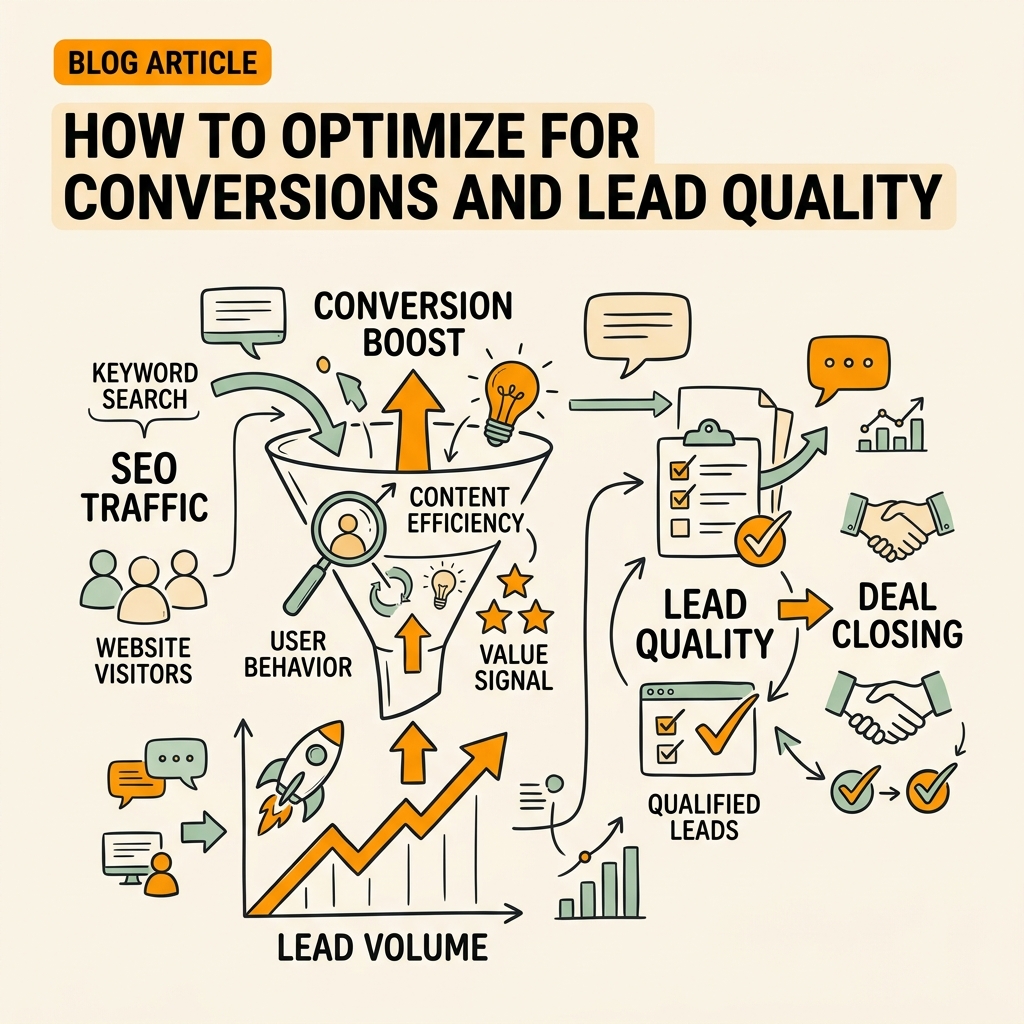
SEO traffic without conversions is wasted budget. The median B2B visitor-to-lead conversion rate is 2.23%, but top performers consistently hit 4-5%+ by obsessing over landing page design, form optimization, and value proposition clarity.
Optimization happens on two levels: driving the right traffic (keyword targeting), and converting that traffic (page experience). Both matter equally.
Landing Page Design for High-Intent Searchers
High-intent searchers are impatient. They know what they're looking for and expect the landing page to confirm they're in the right place within 3 seconds. Vague messaging, cluttered layouts, and unclear value propositions trigger bounce.
Optimize landing pages for high-intent keywords:
- Match search intent instantly: If they searched "best CRM for nonprofits," your headline should say "The Best CRM for Nonprofits—Designed for Donor Management." No ambiguity
- Lead with benefits, not features: "10x faster forecasting" beats "Advanced AI-powered analytics"
- Use proof fast: Customer count, case study results, trust badges—show them within the fold that you're credible
- Single, clear CTA: One primary action per page. "Start Free Trial," "Schedule Demo," or "Download Guide." Every other element supports that one action
A/B test landing page elements (headlines, CTAs, form fields, social proof) against each other to find the highest-converting variant. Even 0.5% lift on a page getting 1,000/month converts to 5 extra qualified leads per month.
Form Optimization and Lead Qualification
Every form field that exists costs conversions. The fewer questions asked, the more people convert. The trade-off is having less qualification data on inbound leads.
Balance lead volume and qualification by:
- Core fields only on conversion page: Email, name, company. That's it for a demo request or trial signup. You can gather more detail later
- Progressive profiling: Ask for company size, budget, timeline in follow-up emails or conversation stages, not on the conversion form
- Conditional logic: If someone selects "Enterprise," ask about budget size. If they select "Startup," ask about timeline. Tailor questions to their context
The goal is volume into the funnel (because sales can qualify further) balanced with enough data to route leads properly. Too many fields kill conversion. Too few sends unqualified leads to sales.
Implementing Lead Scoring and Nurture Workflows
Not every lead is sales-ready. The median MQL-to-SQL conversion rate is 13%, though top quartile performers hit 28% by using AI-driven lead scoring and automated nurture to move people through the funnel.
Set up workflows that separate warm leads from cold:
- Explicit scoring: Email opens, demo attended, pricing page visited = +5 points. Downloaded guide = +2 points. Reaches 20 points = hand to sales
- Implicit scoring: Company size, industry, location. An enterprise company in your target vertical scores higher than a 5-person startup
- Nurture automation: Leads scoring below threshold get dripped relevant content (comparison guides, case studies, webinar invitations) to warm them up before sales outreach
Automating lead nurture workflows ensures consistent follow-up without requiring sales teams to manually manage every cold lead. This compounds conversion rate by keeping warm leads engaged until they're ready to buy.
How to Scale B2B SEO Without Burning Out Your Team
Building B2B SEO authority requires volume and consistency. B2B SaaS ROI from SEO averages 702% over a realistic 7-month scale period, but only if you sustain the output. The challenge is most marketing teams don't have the bandwidth to produce 4-8 high-quality SEO articles per month, research keywords monthly, and update old content simultaneously.
Scalability comes from systematizing content production so that good SEO becomes a repeatable engine, not a one-off project that exhausts the team.
Building a Content Production System
Systematize the steps from keyword to published article:
- Keyword research template: Run keyword research quarterly using the same framework so you're always targeting high-intent, low-competition keywords aligned to your buyer journey
- Content brief template: Standardize how you hand off research to writers (target keyword, audience, outline, word count, internal link targets, supporting sources)
- Editing and fact-checking process: Create a checklist so every article meets your quality bar (stats verified, links checked, tone consistent)
- CMS publishing workflow: One person handles final formatting, adding images, scheduling publication, and internal linking—no miscommunication
With templates in place, producing 4+ quality articles per month becomes predictable and repeatable. You know the process, the hand-offs, and the timeline.
Using AI Tools to Augment, Not Replace, Your Team
AI content tools can accelerate research, first drafts, and formatting. But AI alone produces generic content that doesn't rank or convert. The secret is using AI for the time-consuming parts while your team focuses on strategy, original thinking, and uniqueness.
Effective AI integration looks like:
- AI for research: Use AI to synthesize 10+ sources into a research brief with key quotes, statistics, and insights you'll weave into the article
- Human for strategy and narrative: Your strategist decides the article angle, which stats matter, how to position your brand, and what unique insight to lead with
- AI for drafting structure: Let AI create an outline and initial draft based on your brief, which you then rewrite for tone, specificity, and original examples
- Human for accuracy and voice: Fact-check every stat, verify every quote, and rewrite sections to match your brand voice and POV
Teams that treat AI as an assistant—not an author—produce better content faster. Autonomous SEO agents can handle research, writing, and fact-checking at scale, compounding your output without requiring a larger team.
Building an Internal Linking and Content Network Strategy
Internal linking is one of the highest-ROI SEO tactics but requires a plan. Random linking dilutes authority. Strategic linking between related articles concentrates ranking power and keeps readers on your site longer.
Implement an internal linking system:
- Pillar-to-cluster linking: Every cluster article links back to its pillar and to 2-3 related cluster articles in the same topic area
- Keyword-relevant linking: If you mention a concept that has another article on your site, link to it. "Here's how to build an ICP is explained in depth in our guide on ICP definition"
- Topical silos: Create separate silos (url structures) for major topics so related content is grouped together—improves crawlability and authority flow
Internal linking boosts rankings for cluster articles by passing authority from high-ranking pillars down to supporting content. It also increases time-on-site and pages-per-session, signaling engagement to Google.
Conclusion
B2B SEO done right shifts from traffic vanity to revenue reality. By targeting high-intent keywords, mapping content to buyer stage, building topical authority, and optimizing for conversions, you unlock the full potential of organic search as a qualified lead engine.
The numbers speak clearly: SEO converts at 14.6-15% versus 1.7-2% for outbound, delivers 825% ROI over 3 years, and contributes 44.6% of total B2B revenue. But only if your strategy is built for buyers, not search volume.
Start with this month: audit your current keyword strategy. How many of your top articles target high-intent commercial keywords? How many map to decision-stage searches where people are ready to convert? The gaps you identify become your roadmap to better qualified leads.
Start your SEO agent and begin publishing the consistent, high-quality content that compounds organic reach and fills your pipeline with qualified leads month after month.
FAQs
What keywords should B2B companies prioritize for lead generation?
B2B companies should prioritize high-intent keywords with commercial modifiers: "best," "pricing," "demo," "vs," "implementation," and solution-seeking terms like "CRM for nonprofits." These capture searchers actively evaluating solutions, not just learning about the problem. Commercial keywords convert 3-5x higher than informational keywords and should represent at least 50% of your keyword target list. Avoid chasing high-volume generic keywords like "What is a CRM?"—they rank for huge traffic numbers with low conversion. Instead, find the 50-500 search volume keywords in your industry where commercial intent is clear.
How long does it take B2B SEO to generate qualified leads?
B2B SEO typically takes 6-7 months to generate meaningful lead volume, with ROI visible in the 7-12 month window for SaaS and services. The timeline depends on domain authority, keyword difficulty, and content quality. New domains rank slower than established ones. B2B SaaS businesses see 702% ROI over a realistic 7-month period, but this assumes consistent monthly publishing and strategic keyword targeting. Short-term gains come from ranking for low-difficulty keywords and optimizing existing content. Long-term compounding happens as you build topical authority and your entire content network ranks for hundreds of keywords simultaneously.
How should B2B companies structure content for different stages of the buying journey?
Structure content by creating separate asset types for each stage. Awareness stage: blog articles, guides, and frameworks that educate and establish authority. Consideration stage: comparison pages, case studies, and ROI calculators that help evaluate options. Decision stage: pricing pages, product demos, implementation timelines, and security/compliance documentation. Aligning content to buyer stage increases conversion by ensuring the right message reaches the right person at the right time. Link awareness content to consideration content (e.g., a guide links to your comparison pages), and consideration content to decision assets (comparison pages link to free trial or demo booking). This funnel structure moves readers downstream while signaling topical authority to Google.