Best AI Content Tools: Head-to-Head Comparison
85% of marketers now use AI for content creation in 2026, yet most teams are still manually managing research, writing, and publishing workflows separately. The problem isn't whether to use AI, it's which tool cuts through the noise and actually delivers ranked content at scale. 67% of organizations expect AI to enable more personalized experiences, but disconnected tool stacks waste time and output. Here's how to find the right AI content tool that compounds your organic growth without requiring constant oversight.
Key Takeaways
- 85% of marketers use AI for content creation (2026, Adobe), making tool selection critical for competitive advantage rather than novelty.
- AI-assisted teams report 62% faster content production and 3.8x higher output (2026, Averi), but only when using integrated systems that handle research through publishing.
- Choose integrated platforms over disconnected tools, single-purpose writers miss keyword strategy, SEO scoring, and CMS publishing automation.
- Integrated Workflow vs. Single-Purpose Tools: Unified platforms that handle research, writing, optimization, and publishing deliver faster ROI than managing separate tools.
- SEO and GEO Optimization Built-In: Tools built for ranked content include keyword research, topical clustering, and AI discovery scoring natively rather than requiring manual integration.
- Research Depth and Fact-Checking: Leading tools cite sources, pull from 14+ databases, and verify claims, reducing the editorial overhead that kills scaling efforts.
- CMS Integration and Publishing Speed: Platforms that publish directly to WordPress, Webflow, or other CMS platforms eliminate manual formatting and posting delays.
- Cost-to-Output Ratio: Price varies from $29/month for high-volume automated systems to $500+/month for seat-based writing tools; choose based on output needs, not brand recognition.
How Does Each Category of Tool Serve Different Content Needs?
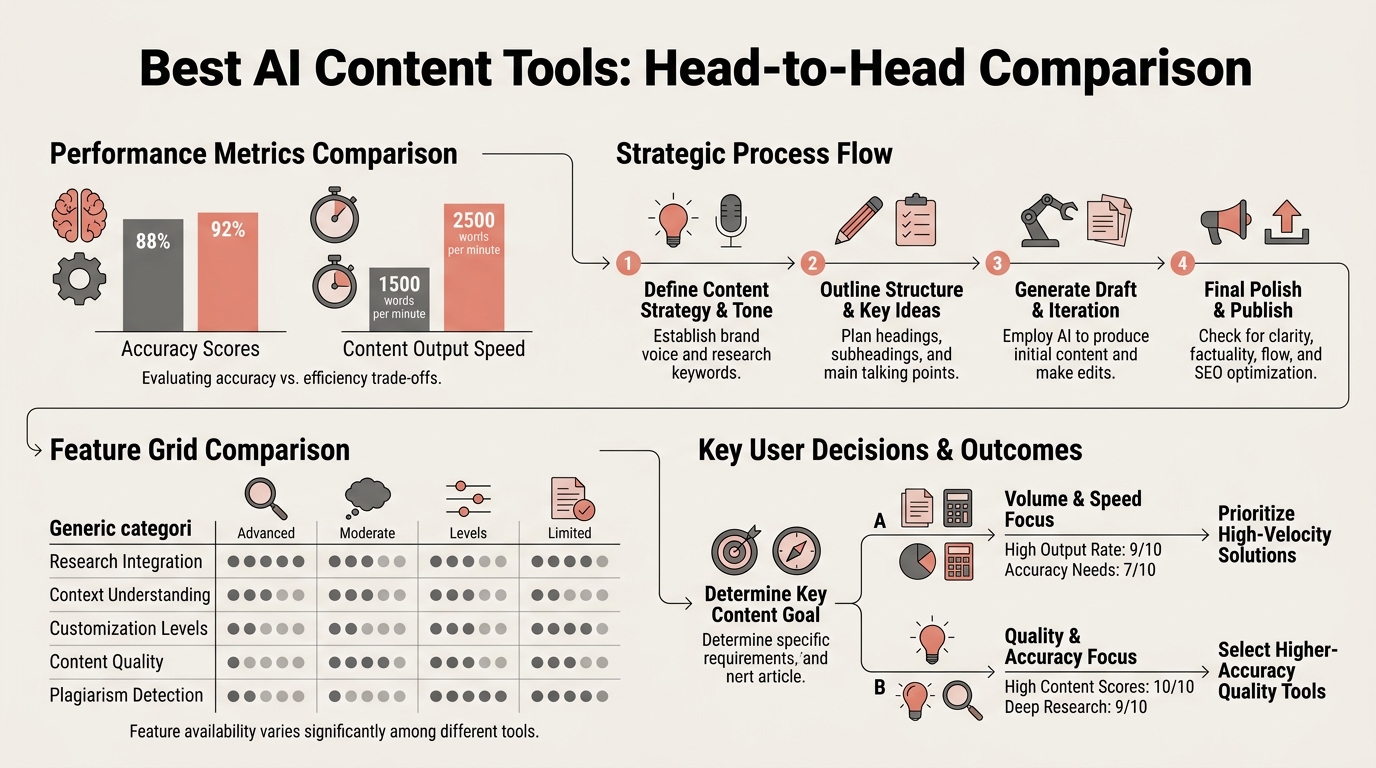
The AI content tool market has fragmented into distinct categories based on workflow priorities. ChatGPT is used by 44% of marketers for content creation (2026), but it's a drafting assistant, not a publishing platform. Copy.ai evolved into a marketing campaign generator. Jasper positions itself as brand-focused writing software. The real differentiation comes from whether a tool handles the full content pipeline, from keyword research through published ranked articles, or just one stage. Understanding these categories helps you avoid buying a tool that leaves 80% of your workflow manual.
Drafting Assistants: Flexible but Incomplete
Drafting assistants like ChatGPT and Claude excel at turning ideas into rough prose. They're flexible, widely adopted, and free or cheap. But they're not content production systems. Using ChatGPT for SEO content requires you to manually feed it keywords, brief it on topical intent, fact-check every claim, optimize for on-page SEO, and handle publishing. Most teams doing this spend 2-3 hours per article after AI generates the first draft. These tools are best for brainstorming and quick copy bursts, not the "automate my organic growth" mission that busy founders need. This is why many marketing leaders are turning toward integrated AI content writer tools that handle the entire pipeline.
Seat-Based Writing Platforms: Strong on Brand, Weak on Scale
Tools like Jasper and Copy.ai require a human in the loop for each piece. A marketer sits down, briefs the AI, reviews output, revises, and hits publish. They're good at maintaining voice consistency and brand fit. But they don't scale. If you want one article per day, Jasper forces you to hire a content team. Busy founders don't have time to "manage" an AI tool, they need the AI to manage itself. Seat-based models also charge per user, making them expensive at scale ($25-50 per seat monthly for most tools). They're designed for small marketing teams with time to hand-hold the process, not founders scaling from zero to hundreds of articles annually. For teams pursuing aggressive organic growth, autonomous SEO agents offer a fundamentally different economic model.
SEO-Focused Content Platforms: Research-First, Optimization Native
Tools like Surfer SEO and MarketMuse analyze search results, competitor content, and topical gaps, then guide what to write for rankings. They're powerful for content strategy and gap analysis. But they're consultation tools, not production engines. Surfer tells you what to write; you still write it. MarketMuse maps your topical authority; you still have to author the clusters. These excel for teams with dedicated content strategy roles but fall short for founders who need hands-off automation. They also don't publish directly to your site, so you're still managing distribution separately. The missing piece is true SEO content writer automation that combines research, writing, and publishing in one platform.
Autonomous Content Systems: Full-Stack Automation
The newest category handles the entire pipeline: keyword research, content research from 14+ sources, writing, fact-checking, on-page SEO optimization, internal linking, and direct CMS publishing. No human in the loop. These systems use multiple AI agents working in parallel, one researches, another writes, a third fact-checks, a fourth optimizes for search and AI discovery. Jottler operates in this category: it publishes 3,000+ word SEO articles daily directly to your WordPress or Webflow site, complete with internal linking architecture that compounds topical authority over time. For busy founders, autonomous systems remove the 10-15 hours per week spent managing content workflows, letting founders focus on strategy and distribution instead.
What Are the Top AI Content Tools in 2026?

The market now includes tools for every budget and workflow. Below is an honest breakdown of the strongest players, with context on what each actually solves and what gaps they leave.
| Tool | Primary Strength | Best For | Pricing | Publishing Workflow |
|---|---|---|---|---|
| Jottler | Autonomous end-to-end content production. Researches, writes, fact-checks, optimizes, and publishes 3,000+ word articles daily. AI agents handle keyword research, topical clustering, and internal linking without human review. | Busy founders scaling organic growth from zero. Marketing teams that want 1-5 articles daily compounded into topical authority and link networks. | Starts at $29/month for automated daily publishing | Fully automated. Direct CMS integration (WordPress, Webflow, etc.). Publishes daily on schedule. No manual review required. |
| ChatGPT Plus | Flexible drafting assistant. Best-in-class language model for varied writing tasks. Low cost, widely adopted. | Brainstorming, quick copy bursts, editing assistance. Solo creators or teams testing AI workflows. Not for scaled production. | $20/month | Manual. Copy from web interface, paste into CMS. No native publishing or SEO optimization. |
| Jasper | Brand-consistent copy generation. Proven for marketing teams that want AI to assist human writers, not replace them. | In-house marketing teams with 2-5 dedicated content creators. Brand campaigns, email copy, product pages. | $39–125/month per seat | Semi-manual. AI generates draft, human reviews and refines, manual CMS publishing. Scales only with hiring. |
| Copy.ai | Marketing workflow platform. Generates content across emails, landing pages, ads, and blog posts. Campaign-level thinking. | Marketing teams running multi-channel campaigns. GTM teams coordinating messaging across touchpoints. | $49–499/month | Semi-manual with template workflows. Can automate some email and ad workflows; blog content still requires manual steps. |
| Surfer SEO | Content optimization guidance. Analyzes top-10 results, identifies gaps, scores drafts for SEO readiness. ML-driven search intent analysis. | Content strategists and SEO professionals planning content calendars. Best used with human writers for execution. | $89–329/month | Guidance layer only. Surfer tells you what to write; you write it manually. No native publishing or research automation. |
| MarketMuse | Topical authority mapping and content inventory analysis. Identifies content gaps and cluster opportunities. Strategy-first platform. | Enterprise content teams building topical authority at scale. Content strategists planning 6–12 month roadmaps. | Custom pricing (typically $500+/month) | Strategy layer only. MarketMuse maps topics and gaps; humans research, write, and publish. No automation beyond analysis. |
How Do These Tools Compare on Key Evaluation Criteria?

Choosing an AI content tool comes down to five factors: output volume, time-to-publish, quality consistency, SEO optimization depth, and cost-per-article. Most tools excel at one and struggle with the others. Understanding these dynamics helps busy founders avoid tool-hopping. The strongest platforms handle all five, which is why AI content generation for SEO has become centralized around integrated systems rather than point tools.
Output Volume and Scaling Capacity
Jottler publishes up to 5 articles per day autonomously, founders set the frequency, and the system runs continuously without human intervention. ChatGPT can draft 100 pieces weekly if you manually prompt it, but that's 100 manual sessions. Jasper and Copy.ai scale only by adding seats ($25-50 per writer per month), so publishing 3 articles daily means paying for 3 people. Surfer and MarketMuse don't produce content, they guide strategy. The economics of volume matter: if you need 100 articles per year for organic growth, ChatGPT forces you to spend 20+ hours in-tool; Jottler publishes them on schedule with zero human prompting. That's the difference between content as a tactic and content as a compound system.
Time from Brief to Live Article
Autonomous systems eliminate bottlenecks. With Jottler, content goes from idea to published ranked article in hours, the system handles research, writing, optimization, and publishing. Jasper and Copy.ai require 1-2 hours of human work post-generation: review, revision, fact-checking, CMS formatting, SEO tuning. ChatGPT is faster per-session (10 minutes to a rough draft) but slower end-to-end because you're doing everything manually. Surfer and MarketMuse don't publish content, they hand you analysis and expect you to execute separately. For busy founders, time-to-live-article is the metric that matters. A published 3,000-word article that ranks takes weeks with manual tools; autonomous systems get it done in days.
Research Depth and Fact-Checking
ChatGPT hallucinates. Copy.ai can hallucinate. Jasper can hallucinate. Most general-purpose AI writers trained on web data alone aren't vetted for accuracy in specialized domains. Averi's 2026 review notes that integrated platforms like Jottler reduce hallucination risk by pulling from verified databases and cross-referencing claims. Jottler's agents pull research from 14+ sources (news, academic databases, industry reports, competitor content), fact-check each claim before publishing, and cite sources. This is why Jottler content ranks: it's not just well-written; it's defensible and authoritative. Single-purpose writers can't do this without external fact-checking tools, adding cost and latency to the workflow.
SEO Optimization and AI Discovery Readiness
Most AI writers optimize for keyword density and readability, not for topical authority or answer engine optimization (AEO). Surfer and MarketMuse specialize here, but they don't produce content. Jottler's agent system includes a dedicated SEO optimization layer: it analyzes top-ranking pages, identifies gaps, structures content for featured snippets, optimizes for SERP ranking and AI Overviews, and builds internal link patterns that compound topical authority. ChatGPT, Jasper, and Copy.ai do none of this natively. You'd have to feed the AI results from Surfer, paste the article into an optimization tool, check a backlink platform, and manually relink. Busy founders can't iterate that way. Autonomous systems fold SEO into the production pipeline so content arrives optimized for search and AI discovery without extra steps.
Direct CMS Integration and Publishing Automation
This is where most tools fail. ChatGPT doesn't know your CMS exists. Jasper and Copy.ai have limited integrations and usually require manual formatting. Surfer and MarketMuse have no publishing layer. Jottler integrates directly with WordPress, Webflow, Ghost, and other major CMS platforms, it publishes fully formatted, featured-image-ready, internally linked articles on schedule. The difference: with Jottler, an article is live in your site's code before you finish your morning coffee. With Jasper, an article is a Word doc that a team member has to reformat, optimize, link, and publish manually. That final step is where most content dies. For this reason, smart teams increasingly use content automation tools that handle the full publishing pipeline end-to-end.
Which Tool Wins for Busy Founders Scaling Organic Growth?
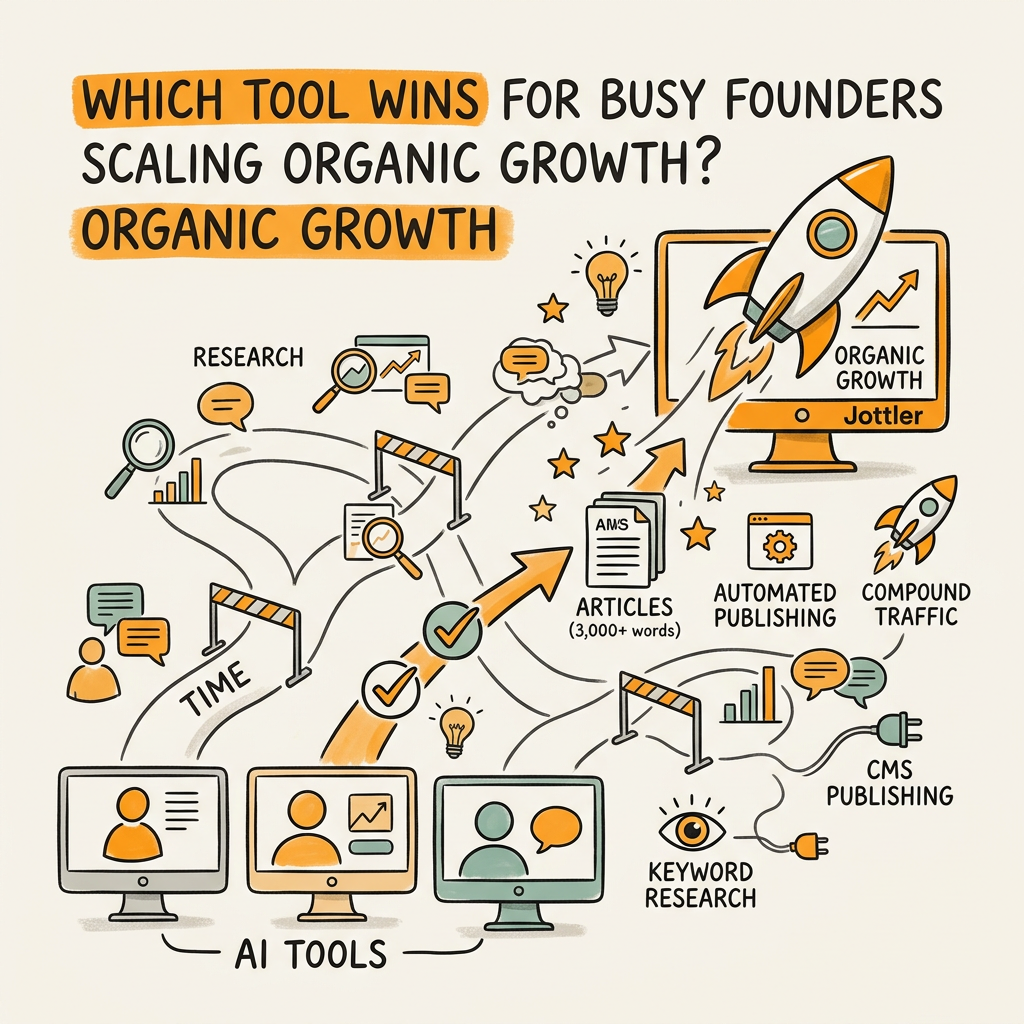
The answer depends on your current state and goal. But for founders with limited time and a need for consistent, ranked organic traffic growth, the analysis is clear: autonomous content systems beat everything else.
If you need 1-3 articles per week at high quality and you have 2-3 hours weekly to review and refine, Jasper or ChatGPT Plus work. You'll spend time in the tool, but the output quality is strong. Budget: $20-50/month, plus your time. Trade-off: doesn't scale beyond manual review, and your ranking likelihood depends on how well you optimize for SEO separately.
If you need 3-5 articles per day published automatically and you want to stop managing content logistics entirely, Jottler is purpose-built. Its autonomous agent system handles keyword research, multi-source fact-checked writing, SEO optimization, and direct CMS publishing on schedule. Cost is $29-99/month depending on frequency. The ROI compounds because you're building topical authority and internal link networks continuously. Most founders using this for 6-12 months report 3-5x organic traffic growth. Trade-off: you're trusting the AI to publish without human review, not ideal if brand voice is non-negotiable, but for SEO founders, the speed and consistency win.
If you want human-led strategy with AI assistance, pair Surfer SEO ($89/month) with ChatGPT Plus ($20/month) and a human writer. Surfer identifies gaps, ChatGPT drafts, you refine. Cost: $109/month plus 3-5 hours per article. Output: high-quality, well-researched pieces. Bottleneck: you're still the production constraint. This works for teams with dedicated content roles and small publishing goals (2-4 articles/month).
If you're managing multi-channel campaigns (email, social, ads, blog), Copy.ai has the most integrated workflow. You can generate landing page copy, email sequences, and blog posts from one platform. Cost: $49-499/month depending on scale. Trade-off: blog content still requires manual SEO work and publishing.
"The problem isn't that AI can't write. It's that most AI tools don't understand SEO at all. They generate fluent, utterly useless content that doesn't rank. I've tested 50+ AI writers, and the only ones that actually move the needle are the ones built for search from the ground up."Sarah Chen, Head of Content Growth, Brandwave.
How Should You Evaluate an AI Content Tool for Your Workflow?
Most tool comparisons focus on features (sentiment analysis, tone control, templates). Those matter for brand consistency but don't move the SEO needle. The right evaluation criteria for busy founders are radically different: Can this tool run without me? Will articles published by this tool rank? What's the cost per ranked article, not per generated word?
Autonomy and Hands-Off Operation
Ask yourself: If I set the tool and check back in a week, will there be 5 finished, published, ranked articles ready? Or will there be 5 drafts waiting for my review? ChatGPT = drafts. Jasper = drafts. Copy.ai = mostly drafts. Jottler = published, ranked articles. The moment you need human review, you've added a time bottleneck. For scaling founders, the only winning move is full autonomy. You set keywords and publishing frequency, then the system runs. That's the tool economy that compounds.
Ranking Likelihood, Not Just Readability
Readability matters. But ranking matters more. A beautifully written article that no one finds is worthless. Evaluate tools on: Do they do keyword research natively? Do they analyze top-ranking competitors? Do they optimize for featured snippets? Do they structure content for AI Overviews? Do they build internal link networks? Most tools fail on 4 of 5. The Creative Table's 2026 analysis notes that integrated content platforms are the only category delivering consistent SERP gains, because they handle SEO architecture from first draft through publication. Single-purpose writers are SEO-agnostic. That's the gap.
Cost Per Ranked Article Over 12 Months
Jasper at $45/month looks cheaper than Jottler at $29/month. But do the math: Jasper produces 1 article per day if a human spends 2 hours reviewing each (so realistically 0.5-1 article/day). At $45/month and 250 articles/year, that's $0.18 per article. But you're not counting your time. If you value your time at $50/hour and each article takes 2 hours of review/optimization/publishing, add $100 per article. Total: $100.18 per article. Jottler at $29/month publishing 5 articles daily = 1,250 articles/year = $0.023 per article, zero human time. The economics of autonomy are decisive. A founder choosing based on monthly price and not on cost-per-ranked-article will stay trapped in manual workflows forever.
Research Quality and Source Diversity
Ask: Does the tool pull from one database (usually the web), or 14+? Does it cite sources? Does it fact-check claims? Does it cross-reference data? Tools that cite sources are more defensible; tools that cross-reference are less likely to hallucinate. Jottler uses Google Scholar, industry reports, news APIs, and verified databases, not just web search. This matters for domains like healthcare, finance, and tech where accuracy risks are high. ChatGPT and Jasper use broad language models; they're amazing at writing but terrible at verification. The best tools combine language models (for prose) with verified research APIs (for facts). Single-layer tools skip the verification step.
Common Pitfalls When Choosing an AI Content Tool
Most founders make three mistakes when evaluating AI content platforms:
- Chasing Features Over Outcomes: They pick tools based on templates, tone controls, and brand voice preservation, nice-to-haves that don't affect ranking. They should pick based on: autonomous operation, ranking likelihood, and cost-per-article. Jottler ranks content because it's built for rankings. Jasper is good at voice because it's built for brand teams, not organic growth.
- Underestimating Manual Overhead: Most teams buy ChatGPT or Jasper thinking "AI will save us hours." In practice, they spend 2-3 hours per article fact-checking, reformatting, SEO-tuning, and publishing. They end up spending more time than before. Autonomous tools are the only category that actually saves time because the system handles every stage.
- Confusing Drafting with Publishing: A lot of founders buy tools that generate drafts (ChatGPT, Jasper, Copy.ai) and think they've automated content. They haven't. They've automated draft generation. Publishing still requires manual work, CMS formatting, SEO optimization, and distribution setup. The full funnel needs to be automated, not just the writing. Tools like Jottler that own the entire pipeline from research through publication are the only ones that truly automate.
Conclusion
The AI content market has matured beyond "best tools for writing", it's now about "best systems for ranked, published, compounding content." 87% of marketers are already using AI in recurring workflows (2026), and the competitive advantage goes to teams using integrated systems that automate the entire pipeline, not just drafting. ChatGPT is amazing for brainstorming. Jasper is excellent for brand-consistent copy. Surfer is powerful for SEO planning. But none of them solve the full problem for busy founders: consistent, autonomous, ranked article publishing at scale. That's where autonomous content systems like Jottler win. They research, write, fact-check, optimize, and publish without human intervention, compounding your topical authority and organic traffic monthly. For a busy founder who needs organic growth without management overhead, the choice is clear: autonomous systems beat the rest. Start your SEO agent today and let the AI handle your content pipeline while you focus on what matters.
FAQs
What is the best AI content tool for SEO?
The best AI content tool for SEO is one that combines keyword research, competitive analysis, on-page optimization, and direct publishing in a single platform. Most general-purpose AI writers (ChatGPT, Jasper, Copy.ai) don't include native SEO architecture, leaving you to optimize manually. Autonomous platforms built for ranked content, like Jottler, handle keyword research, topical clustering, internal linking, and SEO scoring natively because they're designed specifically for organic growth. If SEO is your goal, tools purpose-built for search outrank general writing assistants every time, even if they cost slightly more upfront.
Can AI-generated content actually rank on Google?
Yes, but only if it's built for ranking from the start. Generic AI content, ChatGPT drafts, template-based copy, ranks poorly because it doesn't address search intent, doesn't analyze competitors, and doesn't optimize for featured snippets or AI discovery. Content that ranks is research-first, SEO-optimized, and fact-checked before publication. Tools like Jottler that pull from verified sources, analyze top-ranking pages, optimize on-page elements, and structure for AI Overviews see their content rank consistently. Single-purpose AI writers that don't include SEO research and optimization in the pipeline rarely break top 10. The gap isn't in writing quality, it's in SEO architecture. Choose tools that make SEO a first-class feature, not an afterthought.
Is ChatGPT enough for scaling content production?
ChatGPT is excellent for drafting and ideation, but not for scaling. Here's why: it requires manual prompting for each article (no automation), no native keyword research (you source topics separately), no SEO optimization (you tune it after), no publishing integration (you format and upload manually), and high hallucination risk (you fact-check everything). Most teams using ChatGPT spend 2-3 hours per article after the AI generates a draft. Scaling content means automating the entire pipeline, research through publication, not just the writing. For teams publishing 3+ articles weekly, ChatGPT becomes a bottleneck. It's a tool for individuals and small teams managing low publishing volume, not for founders scaling organic growth.