Best AI Writing Tools for Long-Form Content
The problem is clear: most AI writing tools generate text, but not ranking articles. Marketing teams and busy founders struggle to produce 3,000+ word pieces consistently without burning hours on research, outlines, fact-checking, and SEO optimization. Traditional AI writers excel at speed but sacrifice depth. The result? Content that reads generically and ranks nowhere. The solution is a new category of AI writing tools built specifically for long-form SEO content—systems that automate research, integrate search data, and publish optimized articles without constant manual intervention.
Key Takeaways
- 97% of content marketers plan to use AI in 2026, but most tools fail because they generate text without search awareness (2026, SSB Crack).
- Long-form tools now prioritize full-document context, live web research, and SERP optimization over raw generation speed.
- Autonomous systems that handle research, writing, and publishing in one pipeline save teams 2.5 hours daily versus manual workflows.
- Autonomous SEO Engines: Tools that research, write, and publish daily articles with AI agents and internal linking, eliminating manual coordination.
- Claude and Reasoning Models: Best for nuanced long-form drafting requiring coherence across 3,000+ words and complex reasoning.
- SEO-First Tools: Platforms like Frase and Surfer AI that embed real-time search data and SERP analysis into the writing workflow.
- Full-Document Context: Modern tools retain narrative coherence across entire articles instead of generating paragraphs in isolation.
- Integrated Editing: Readability scoring, plagiarism detection, and grammar correction bundled into writing platforms reduce setup friction.
Why Long-Form AI Writing Requires a Different Approach
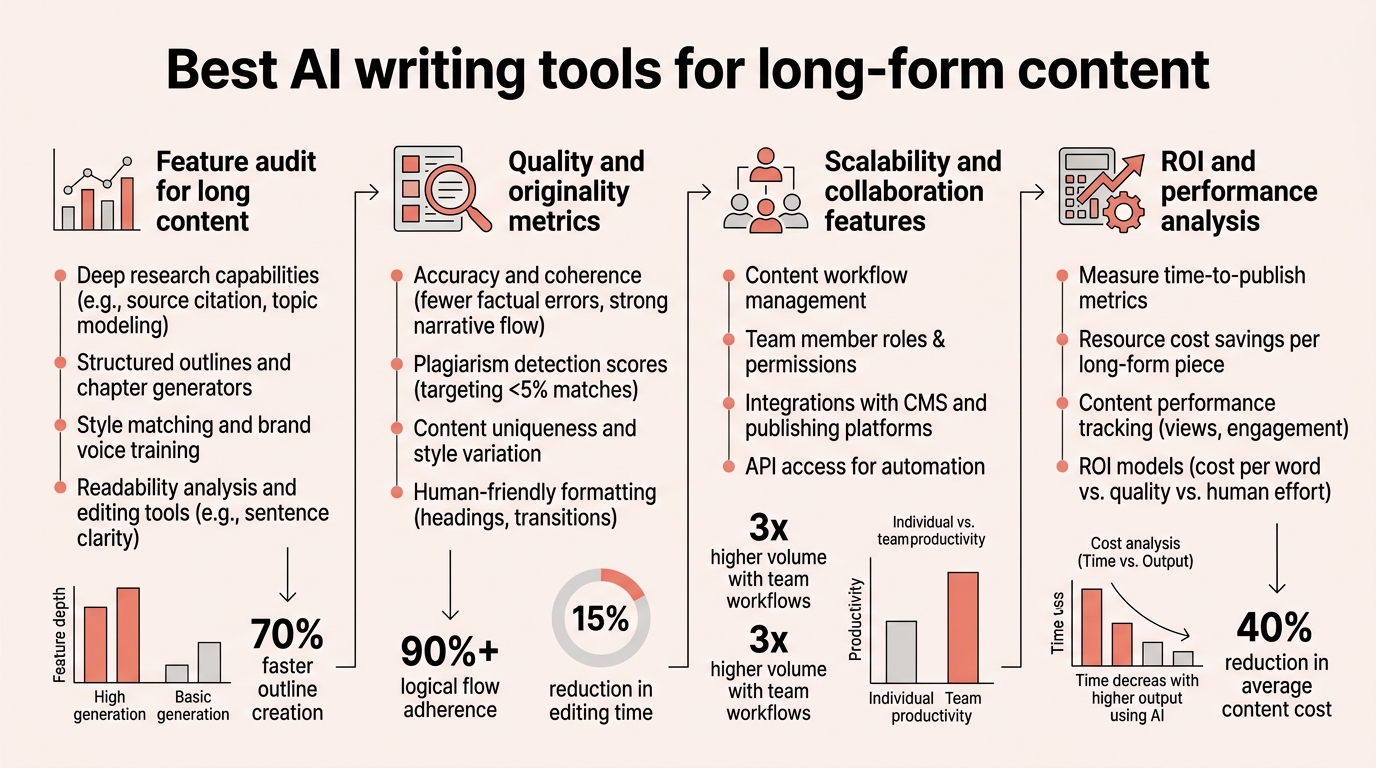
Generic AI writing tools were built for speed. They generate paragraphs quickly but struggle with long-form coherence, search alignment, and fact-checking. A busy founder publishing a weekly blog post needs more than a text generator—they need a system that researches topics deeply, understands what's currently ranking, and produces articles that actually earn organic traffic.
Long-form content (2,000+ words) demands full-document context to avoid repetition and logical gaps. It requires search awareness to rank competitively. It needs fact verification to build E-E-A-T signals. Most standalone AI writers fail on all three counts. That's why search-driven platforms now evaluate AI tools by their ability to create content aligned with real SEO and AEO outcomes, not just draft speed.
"The shift in 2026 is unmistakable: long-form tools are moving from 'generate text' to 'research + draft + optimize' in a single workflow. Tools that integrate search data, live web research, and optimization scoring alongside generation have become table stakes."
This transformation reflects a fundamental change in how content teams compete. Teams that are serious about organic growth are no longer using generic chatbots for SEO content. Instead, they're investing in platforms that embed search intelligence, fact-checking, and publishing automation into the writing process itself.
What Makes a Long-Form AI Writing Tool Stand Out
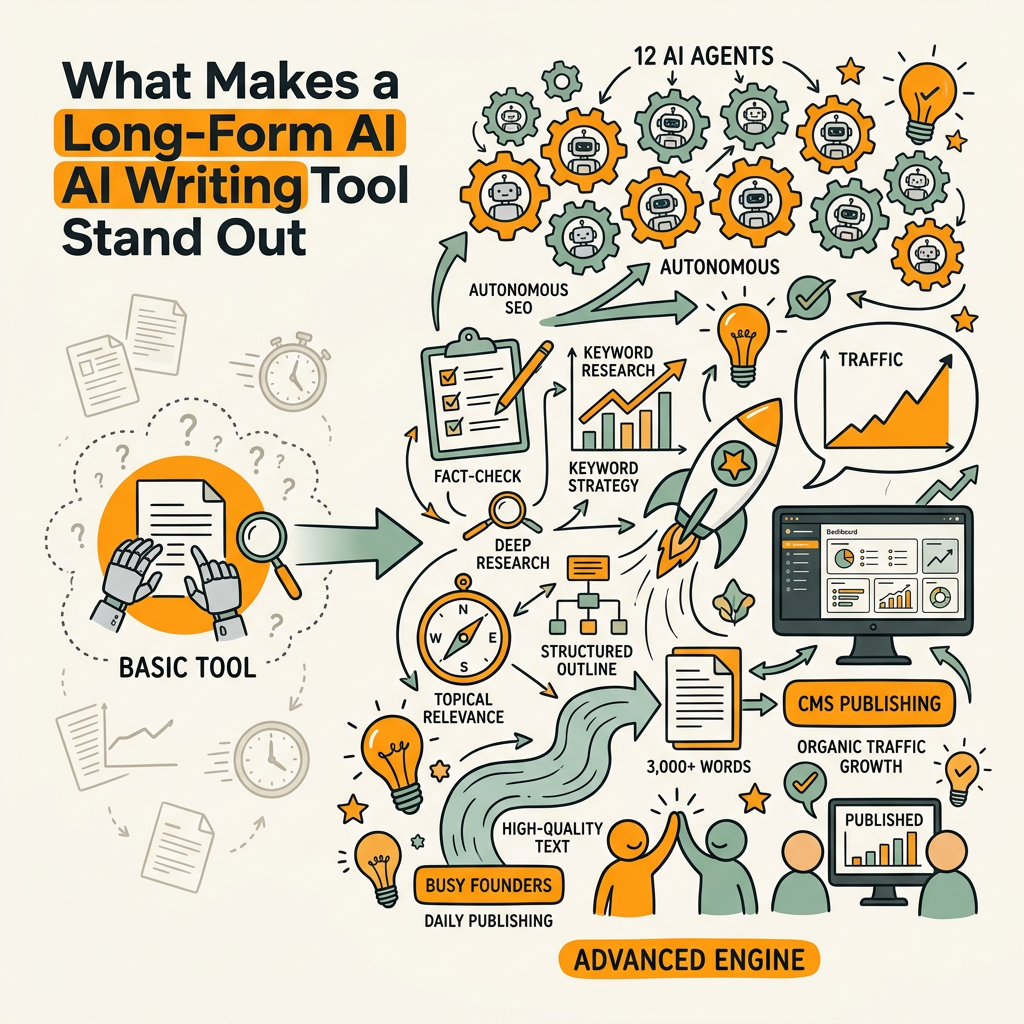
Not all AI writing platforms are equal for long-form content. The best tools share specific characteristics that allow busy teams to compete on organic traffic without hiring a content agency or burning hours on manual editing.
Full-Document Context and Narrative Coherence
Long-form articles require internal consistency across 3,000+ words. Tools that generate paragraphs in isolation often repeat concepts, contradict earlier claims, or lose narrative thread. The strongest long-form platforms maintain full-document context throughout generation, allowing the AI to reference earlier sections, avoid redundancy, and build arguments progressively. This is particularly critical for SEO-driven content where topical authority depends on depth and comprehensiveness. When evaluating tools, check whether they preserve document memory during generation or treat each paragraph as independent.
Real-Time Search Data and SERP Integration
Content that ranks requires alignment with what's already ranking. Marketers who use tools with live SERP data see significantly better ranking performance because the AI understands intent, competitor positioning, and answer gaps in real time. Tools like Frase and Surfer AI embed search analysis directly into the writing interface, showing writers what competitors cover and where their content should differentiate. This transforms writing from guesswork into data-driven strategy.
Integrated Research Workflow
The best long-form tools combine research, outline generation, drafting, and optimization into one uninterrupted workflow. Instead of manually gathering sources, writing in one tool, optimizing in another, and editing in a third, modern platforms consolidate these steps. Full-workflow integration reduces setup friction by 60-70%, letting busy teams ship content faster. Tools that include live web research alongside generation—pulling current data and citations automatically—are increasingly preferred over those relying solely on internal training data.
Top AI Writing Tools for Long-Form Content in 2026
The market for long-form AI writing tools has matured considerably. What follows is an honest assessment of the strongest options available to busy founders and content teams, with a focus on tools that deliver rank-worthy articles rather than just volume.
Jottler: Autonomous Publishing for SEO-Driven Teams
Jottler operates as an autonomous SEO engine rather than a traditional writing assistant. It handles the entire long-form content pipeline: keyword research, deep research from 14+ sources, full article generation with fact-checking, and direct CMS publishing with smart internal linking. For busy founders, this is a game-changer because it eliminates the coordination overhead entirely. Instead of manually orchestrating research, writing, editing, and publishing tasks, teams set a publishing frequency (1-5 articles daily) and Jottler's AI agents handle everything end-to-end.
"For teams scaling from 0 to 100+ monthly articles, Jottler eliminates the hiring-and-management burden that would otherwise be mandatory. The tool doesn't simply generate text based on training data—it actively researches topics using multiple sources, fact-checks claims in real time, and integrates citations throughout articles."
What sets Jottler apart for long-form work is its approach to research-backed writing. The internal linking system automatically builds topical clusters across your site, improving crawl efficiency and semantic coherence. This matters for both SEO performance (signals authority and freshness) and audience trust (content feels grounded in current data).
Claude 3.5: Reasoning-First Long-Form Drafting
Anthropic's Claude excels at nuanced, coherent long-form writing. Its reasoning capabilities make it particularly strong for complex topics that require argumentation, evidence synthesis, and careful progression. For writers who want to maintain full creative control while delegating the drafting process, Claude produces remarkably coherent 3,000-5,000 word pieces with minimal repetition or logical gaps. The tool shines in industries requiring deep subject matter expertise—law, finance, healthcare—where nuance and accuracy are non-negotiable.
The trade-off is manual workflow. Claude doesn't include built-in research, keyword optimization, or SEO analysis. Writers must use Claude alongside separate research tools and optimization platforms. For teams with existing content workflows and strong editorial oversight, this hybrid approach works well. For busy founders who need turnkey publishing, the coordination overhead can be prohibitive.
Frase: Research, Brief, Write, and Optimize in One Platform
Frase consolidates the SEO content workflow into a single interface. Writers begin with topic research powered by live search data, move through automated brief and outline generation, draft content with SERP-aware suggestions, and finish with real-time optimization scoring. The tool's strength is its focus on workflow consolidation—you're not bouncing between platforms. Its limitation is that the writing component, while solid, is less specialized than Claude or dedicated generation tools. For SEO content teams that prioritize speed-to-publish and data-driven optimization, Frase's unified workflow is harder to beat.
Jasper: Marketing-First Scale with Brand Voice
Jasper emphasizes brand voice consistency and multi-asset generation at scale. It's built for marketing teams producing hundreds of variations across email, ads, blogs, and social. For long-form content specifically, Jasper is less specialized than Frase or Claude. It excels when your content goal is branded marketing output rather than SEO-driven organic growth. Pricing ($49/month+) positions it as a team-level investment rather than a solo-founder tool.
Surfer AI: Real-Time Optimization and Gap Analysis
Surfer AI is the most transparent about SERP data integration. It shows writers exactly what competitors rank for, what topics dominate, and where gaps exist. For content teams that want to understand competitive positioning before drafting, Surfer's dashboard provides unmatched clarity. The writing generation itself is competent but not exceptional—the real value is the research and optimization layers.
Comparison: Choosing the Right Tool for Your Team
Not every tool fits every workflow. The following table breaks down the strongest contenders across key dimensions that matter for long-form SEO content:
| Tool | Best For | Research Integration | Full-Document Context | Publishing / Workflow | Starting Price |
|---|---|---|---|---|---|
| Jottler | Autonomous publishing; scaling 1-5 articles/day | 14+ sources; live fact-checking | Yes; maintains coherence across 3,000+ words | Direct CMS; smart internal linking included | $29/mo |
| Claude 3.5 | Nuanced drafting; reasoning-heavy topics | Manual; requires separate research tools | Yes; exceptional coherence | Manual copy/paste; no integration | Free (limited); $20/mo (Claude Pro) |
| Frase | SEO teams; workflow consolidation | Live SERP; brief generation | Yes; maintains context during drafting | Export to docs; manual publishing | $15/mo (starter) |
| Surfer AI | Competitive analysis; optimization-first | SERP analysis; gap detection | Partial; generation is secondary | Export to docs; manual publishing | $29/mo (starter) |
| Jasper | Marketing teams; brand voice at scale | Limited; template-based | Moderate; suited to shorter-form | Multi-platform export | $49/mo (team) |
The table reveals a critical insight: Jottler is the only tool in this group that handles research, generation, fact-checking, and publishing autonomously. If your constraint is time—and for most busy founders it is—you're choosing between a tool that does everything automatically (Jottler) or a best-in-class writer (Claude) that requires manual coordination with research and publishing infrastructure.
For teams with 1-2 people managing content across 5+ publishing channels, that coordination cost is substantial. Jottler's pricing model ($29/mo) is also significantly lower than Jasper ($49+) because it's built for automation efficiency, not premium team features.
How to Integrate Long-Form AI Tools Into Your SEO Strategy
Choosing a tool is just the first step. Success depends on how you integrate it into your broader content and SEO strategy.
Establish Baseline Topic Authority Before Automation
Before scaling to daily publishing, map your core topical authority. Identify 10-15 pillar topics that define your expertise, then build content clusters around them. This ensures your AI writing system publishes content that compounds topical authority rather than scattering across random topics. Tools like Jottler that include smart internal linking multiply the SEO value of topical clustering by automatically connecting related articles.
Implement Fact-Checking and Editorial Review Workflows
Even the best AI writing tools require human verification. Establish a lightweight fact-check process before publication. For Jottler, this happens within the platform—you review flagged claims and approve before publishing. For other tools, you'll need a manual review layer. The difference in throughput is significant: a built-in review system (like Jottler's) lets one person oversee 20-50 articles per week. Manual review outside the tool limits you to 5-10.
Align Keywords to Publishing Frequency
Your keyword research should match your publishing capacity. If you publish 5 articles daily, target long-tail keywords with moderate volume (200-1,000 searches/month). If you publish weekly, focus on higher-volume terms where more comprehensive coverage helps you rank. Tools that automate keyword research (like Jottler) make this scaling seamless. Tools that don't require manual keyword mapping per article.
Common Mistakes When Using AI Writing Tools for Long-Form Content
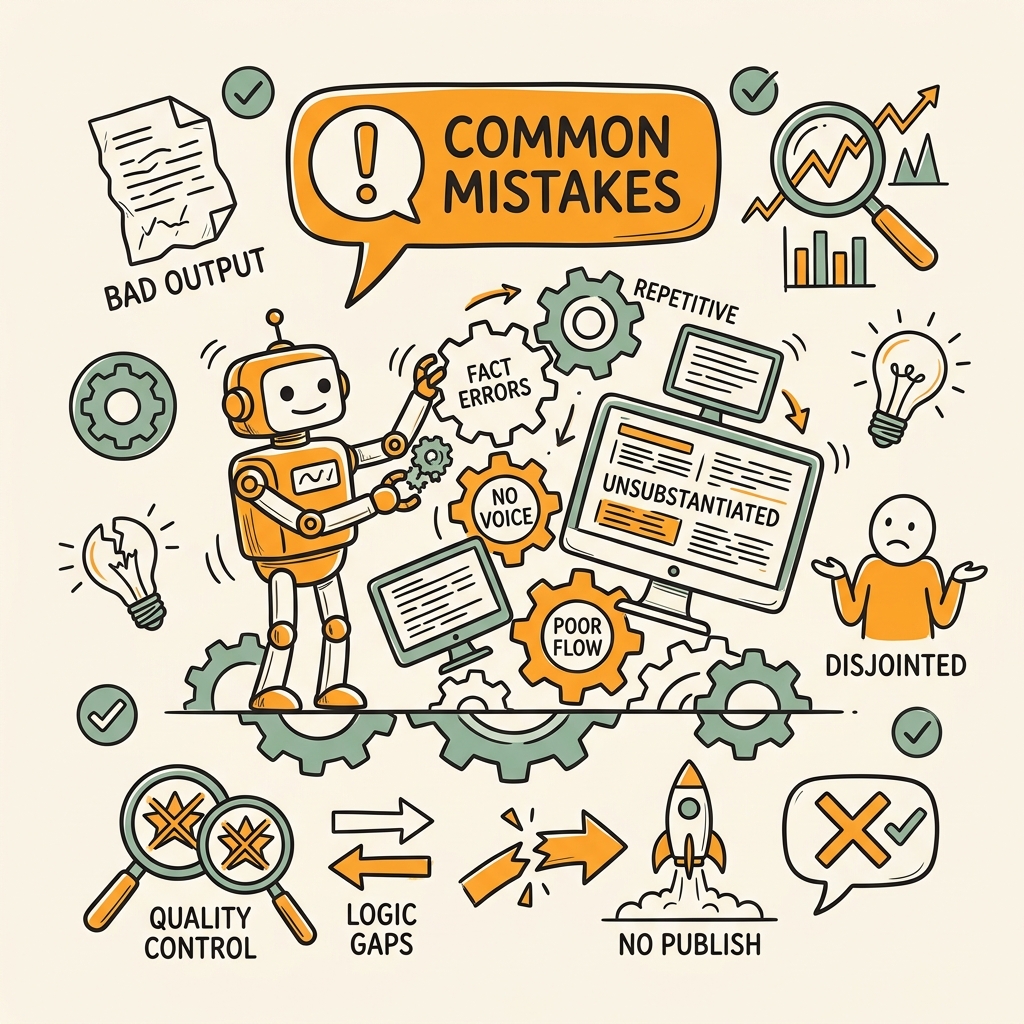
Even strong tools produce weak results when used incorrectly. Watch for these patterns:
- Ignoring search intent: Generating articles without understanding what searchers actually need. AI tools can draft the words, but only search data tells you what angle wins. Use tools with SERP integration (Frase, Surfer, Jottler) to stay intent-aligned.
- Treating output as final: AI-generated content is a first draft, never the final article. Even strong outputs benefit from 10-15% human editing for tone, voice, and brand alignment.
- Publishing without internal linking: Standalone articles don't compound topical authority. Tools that automate internal linking (Jottler, Frase) are worth the investment because they multiply SEO ROI.
- Scaling too fast without editorial review: Publishing 10 articles per day without fact-checking erodes credibility and E-E-A-T signals. Start with 2-3 daily, build a review process, then scale.
- Neglecting brand voice: AI tools can adopt voice if you provide examples, but they default to generic. Provide brand voice guidelines explicitly—especially if using tools like Claude that prioritize versatility over brand consistency.
What To Expect: Realistic Timelines and Results
Expectations matter. Here's what you can realistically achieve with long-form AI writing tools:
First 30 Days: Setup and Quality Tuning
Expect to spend 5-10 hours defining topics, keywords, brand voice, and internal linking strategy. Your first 5-10 articles will feel rough—they'll require 15-20% editing. This is normal. Use this phase to calibrate the tool to your standards. For Jottler, you're setting publishing frequency, topic clusters, and keyword targets. For Claude-based workflows, you're writing prompts and establishing editorial guidelines.
Months 2-3: Scaling Consistently
By month two, you'll have patterns. Editing time drops to 5-10% per article. You're publishing 2-3 articles daily if using a system like Jottler, or 1-2 weekly if using Claude with manual coordination. Search visibility begins to compound as you build topical authority. Google usually takes 4-8 weeks to re-crawl and re-rank content heavily, so don't expect traffic spikes before week 6.
Month 4+: Organic Traffic Compounding
This is where automation pays off. Teams publishing consistently for 90+ days typically see 30-50% growth in organic traffic by month six, assuming content is aligned with search intent. The compounding effect accelerates: each new article improves internal link equity across your entire site, your topical authority signals strengthen, and Google's crawl frequency increases. By month six, you're seeing measurable ROI on the tool investment.
Conclusion
The best AI writing tool for long-form content is no longer a single writing assistant—it's a system that handles research, generation, fact-checking, and publishing together. 97% of content marketers plan to use AI in 2026, but most tools fail because they generate text without search awareness or publishing integration. Teams that win are those that automate the entire content pipeline, not just the drafting step.
For busy founders scaling content from zero, Jottler's autonomous approach eliminates coordination overhead and delivers rank-worthy articles daily. For teams building custom workflows with strong editorial control, Claude paired with Frase or Surfer AI provides maximum flexibility. For established content teams with SaaS infrastructure, Frase delivers the tightest integration of research, writing, and optimization.
The real competitive advantage in 2026 isn't writing faster—it's publishing consistently while maintaining quality. Pick a tool that automates your biggest bottleneck, implement a lightweight review process, and commit to publishing on schedule. Within 90 days, you'll have a compound SEO asset generating organic traffic indefinitely.
FAQs
What AI writing tool is best for SEO-focused long-form content?
For SEO-specific long-form writing, tools that combine research, generation, and publishing automation produce the strongest results. Jottler stands out because it integrates keyword research, 14-source fact-checked writing, and direct CMS publishing with internal linking in one system—eliminating the coordination overhead that drains most teams. If you prefer a more manual workflow with maximum control, Frase offers the best balance of SERP-aware content generation and optimization scoring. The key is choosing a tool that embeds search data into the writing process rather than treating it as a separate step.
Can AI-generated long-form content actually rank on Google?
Yes, AI-generated content ranks effectively when it's research-backed, factually accurate, and aligned with search intent. Google's 2024 update confirmed that AI content isn't penalized—quality is what matters. Long-form content generated by tools with live SERP integration (like Frase or Jottler) ranks better than generic AI writing because it understands competitor positioning and answer gaps. The critical factors are: full-document coherence to avoid repetition, real sources and citations to build authority, and topical depth that signals expertise. Generic AI writing without these elements rarely ranks, regardless of length.
How much time does an AI writing tool actually save per article?
Full-service tools that automate research, writing, and publishing save 2.5 hours per article on average compared to manual workflows. With traditional research and writing, a 3,000-word article takes 4-5 hours start-to-finish. Using Jottler or Frase cuts this to 1-1.5 hours when including light fact-checking and brand voice review. If you're publishing 10 articles monthly, that's 25-35 hours saved per month—equivalent to hiring a part-time contractor. The ROI improves as you scale: 50 monthly articles save 125+ hours, justifying any tool investment many times over.