
Beyond ChatGPT: The Best AI Tools for Long-Form Content
ChatGPT has dominated conversations about AI writing since 2022, but the landscape has matured dramatically. 97% of content marketers now plan to use AI tools in 2026, up from 90% just a year earlier, yet most are still cycling through the same general-purpose models. Long-form content — the backbone of SEO strategy and thought leadership — demands different capabilities than ChatGPT's general-purpose design offers. Specialized tools now excel at coherent, research-backed articles while ChatGPT handles speed and breadth. Here's a quick summary of how to choose the right AI tool for long-form content that actually ranks and resonates.
Key Takeaways
- 97% of marketers plan to use AI in 2026, with long-form content as a primary use case (2026, Stealth Agents)
- Claude leads for natural, coherent long-form prose; ChatGPT leads for research and structured content — use both in a hybrid workflow
- Teams report 11 hours saved per week when using AI writing tools correctly, but only with human editing and fact-checking (2026, Writenexa)
- Claude for Long-Form Prose: Best-in-class for coherent, natural-sounding articles and essays; preferred by professional writers.
- ChatGPT for Research and Outlines: Fastest for research aggregation, outlining, and structured first drafts; strongest adoption base and integrations.
- Jasper for Marketing Teams: Purpose-built for brand-aligned content workflows with enterprise features like voice training and collaborative editing.
- Surfer SEO for Organic Visibility: Combines writing with real-time SEO optimization to ensure long-form content ranks immediately after publication.
- Jottler for Autonomous Publishing: Automates the entire research-to-publish pipeline, generating 3,000+ word fact-checked articles daily with zero manual overhead.
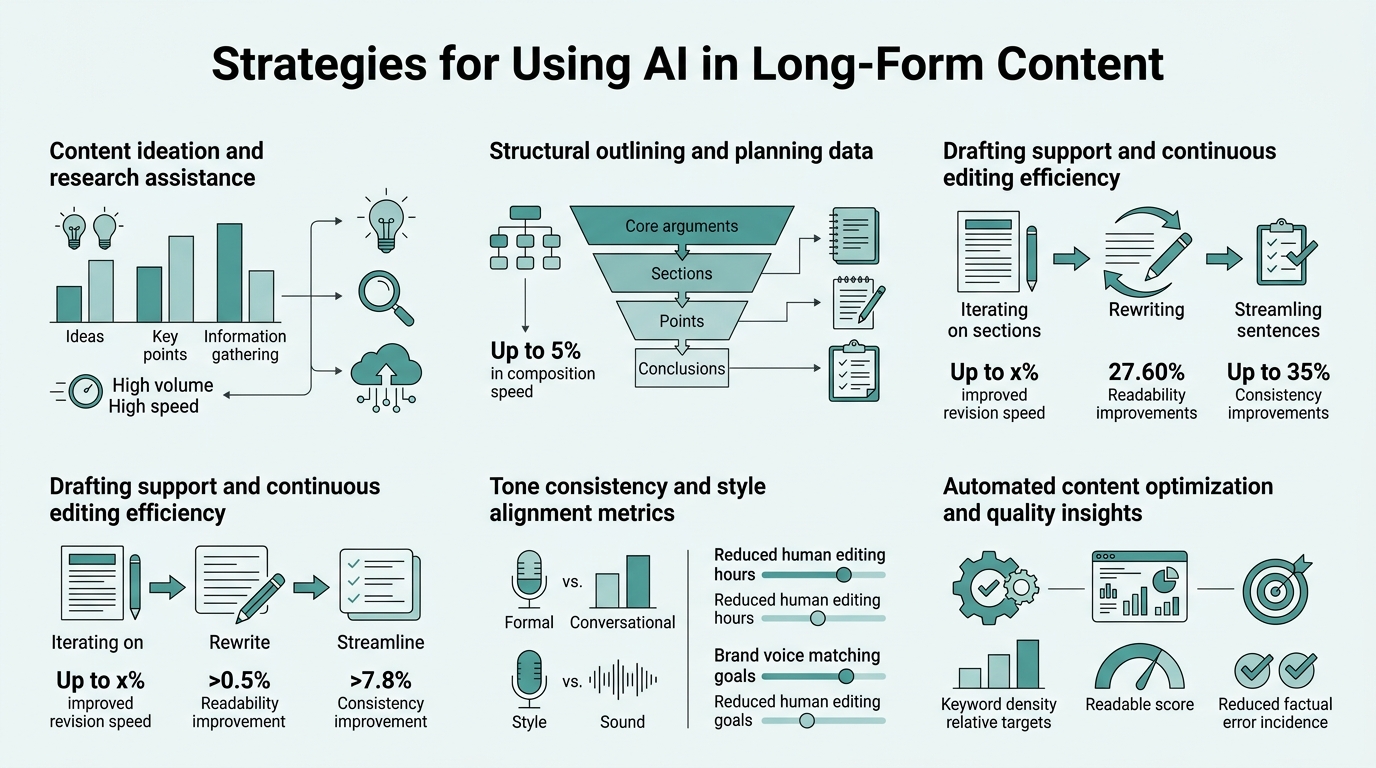
Why ChatGPT Alone Falls Short for Long-Form Content
ChatGPT remains the default choice for many teams, but it wasn't designed for what long-form content actually requires. A typical article of 2,000–3,000 words demands sustained coherence, research-backed claims, and a voice that feels earned — not generated. ChatGPT excels at speed but often produces generic, surface-level prose that lacks the depth readers expect from authoritative content.
"ChatGPT excels at speed but often produces generic, surface-level prose that lacks the depth readers expect from authoritative content. When you account for fact-checking, restructuring paragraphs for flow, and replacing generic phrases with specific insights, you're spending as much time editing as a human writer would spend from scratch."
38% of marketers now use AI for editing, not just drafting, which signals a market-wide recognition that generative output needs heavy revision. That's the ChatGPT tax: fast first draft, slow second half. When you account for fact-checking, restructuring paragraphs for flow, and replacing generic phrases with specific insights, you're spending as much time editing as a human writer would spend from scratch.
The real gap? ChatGPT has no native research layer. It hallucinates statistics, conflates sources, and pulls from training data that's now nearly two years old. For content that needs current data, original research references, or competitive intelligence, you're manually copying sources into the prompt and praying it connects the dots. That's not automation — it's friction dressed up as AI.
ChatGPT's Strengths (and When to Use It)
Dismissing ChatGPT entirely would be a mistake. For specific workflows, it's still the fastest tool in the category. Use ChatGPT when you need a research outline, a structured first draft for tight deadlines, or when you're brainstorming angles across multiple topics in quick succession. Its integrations with other business tools remain unmatched at scale, and it's cheap enough that experimenting with prompts costs almost nothing.
Where ChatGPT Struggles with Long-Form Writing
The cracks show when you need sustained quality across 2,000+ words. ChatGPT's outputs tend to drift tonally, repeat themselves, and lose the thread of complex arguments halfway through. It also lacks built-in fact-verification, which means every statistic, date, and company detail needs manual verification — a process that can eat up all the time saved by using AI in the first place.
Claude: The Long-Form Writing Standard
If you've only used ChatGPT, Claude will feel like a different product category entirely. Multiple 2026 reviews and testing reports converge on Claude as the standard-bearer for long-form prose quality. It maintains coherence across 3,000-word articles, adapts tone more naturally, and produces writing that needs fewer passes of heavy editing. For teams serious about content quality, Claude should be the default drafting tool.
What makes Claude different? It's trained to reason through complex arguments and hold context across longer sequences. A 2,000-word thought leadership essay isn't a collection of loosely related paragraphs to Claude — it's a narrative arc. Professional writers and content strategists report that Claude produces the most natural writing with better tone control, while ChatGPT excels at research and structured content.
"Claude maintains coherence across 3,000-word articles and produces writing that needs fewer passes of heavy editing. For teams serious about content quality, Claude has emerged as the default drafting tool, particularly when narrative arc and sustained argument matter most."
Claude's Advantages for Serious Content Teams
- Sustained coherence: Maintains argument structure and tone consistency across 2,500+ word pieces without degradation
- Tone versatility: Adapts writing voice more naturally — can shift from conversational to authoritative without sounding robotic
- Fact-checking awareness: Signals uncertainty ("I'm not certain about this stat") rather than hallucinating, making editing faster
- Long-form reasoning: Works through multi-step logic in essays and analysis without losing the thread
Claude's Limitations
Claude doesn't solve the research problem. You still need to feed it sources, and it doesn't natively integrate with SEO tools or publishing platforms. It's also less widely integrated into third-party tools than ChatGPT, so if you're using it inside an existing content stack, you may need workarounds. Additionally, Claude requires a subscription — there's no free tier — which adds cost for teams experimenting with AI workflows.
The Emerging Gap: Specialized Tools for Scale
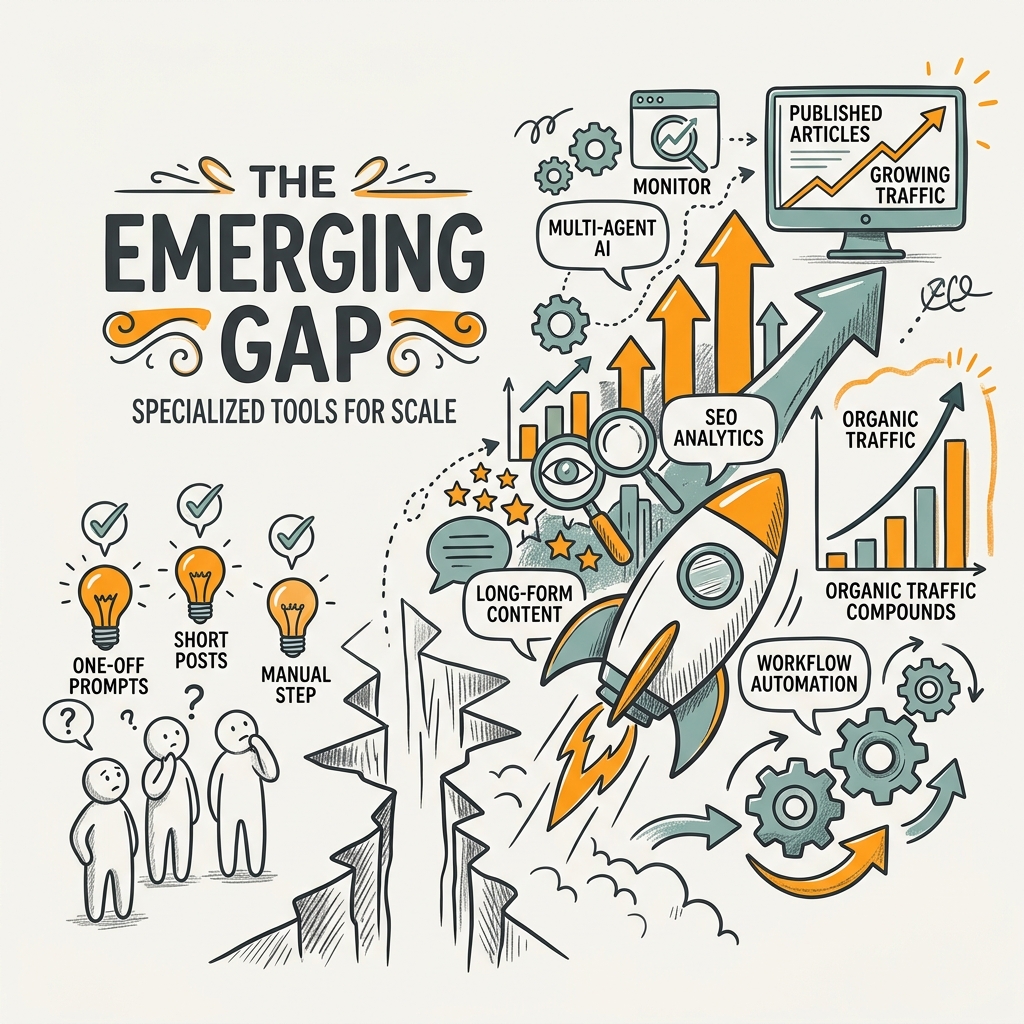
The real story in AI writing for 2026 isn't about ChatGPT versus Claude. It's about the fragmentation of the market into specialized tools. The market has moved decisively away from "do everything" platforms toward purpose-built tools for specific workflows. SEO-focused writing, marketing copy, academic papers, and long-form editorial content now have dedicated tools, each optimized for its domain.
This specialization has created a new problem for busy founders and marketing teams: How do you manage research, writing, editing, fact-checking, and publishing as a cohesive workflow? Manual coordination across five tools can offset any time savings from AI. This is where autonomous SEO agents that handle the entire content pipeline have emerged as the practical answer for teams at scale.
Jasper: The Marketing Team's Choice
Jasper remains the most recommended AI tool for professional marketing teams, particularly those with brand consistency requirements. Unlike general-purpose tools, Jasper is built around brand voice — you can train it on your company's past content, tone preferences, and messaging framework. It then generates long-form content that sounds like your brand, not like a generic AI.
"Jasper integrates with Google Docs, Slack, and major CMS platforms, which means it fits into existing workflows rather than forcing a new tool into your stack. For marketing teams operating at scale with 20+ pieces per month, brand voice consistency becomes the differentiator that separates good content from great."
For marketing teams operating at scale (20+ pieces per month), this matters. Jasper integrates with Google Docs, Slack, and major CMS platforms, which means it fits into existing workflows rather than forcing a new tool into your stack. The trade-off? Jasper costs more than Claude or ChatGPT, and you need to invest time upfront training the tool on your brand voice.
Surfer SEO: The Ranking Tool
Surfer SEO approaches long-form content from a different angle: SEO-first. It combines AI writing with real-time search optimization, analyzing the top-ranking pages for your target keyword and telling you exactly what your article needs to rank. Content length, keyword density, heading structure, semantically related terms — Surfer tells you what the search algorithm wants, then helps you write it.
For teams obsessed with organic traffic (which should be all of them), Surfer removes the guessing game. Write an article in isolation, and it might be brilliant but invisible. Write with Surfer's framework, and you're optimizing for actual search behavior in real time. The downside: Surfer is narrowly focused on SEO content. If you need thought leadership or brand-building content that doesn't target specific keywords, you'll need another tool.
How to Choose the Right Tool for Your Workflow

The right AI tool depends on what your team actually needs to accomplish. Here's a framework to match tools to outcomes:
| Your Need | Best Tool | Why | Time to First Draft |
|---|---|---|---|
| Fast research outlines & structured drafts | ChatGPT | Fastest for brainstorming and multi-topic ideation; excellent for research aggregation and outline generation | 5–10 minutes |
| Natural, coherent 2,000+ word articles | Claude | Superior tone consistency and long-form coherence; less editing needed; preferred by professional writers | 15–25 minutes |
| Brand-aligned content at scale (20+ pieces/month) | Jasper | Built for team workflows with brand voice training; integrates with CMS and collaboration tools | 10–20 minutes |
| SEO-optimized articles that rank on day one | Surfer SEO | Combines writing with real-time search optimization; removes guessing on keyword integration and structure | 20–30 minutes |
| Fully automated content pipeline (research → publish) | Jottler | 12 AI agents handle keyword research, deep source research, writing, fact-checking, and CMS publishing with zero manual oversight; generates 3,000+ word articles daily | Automated (minutes to publish) |
The Automation Advantage: Beyond Tool Selection
Selecting the "best" tool is only half the battle. The real bottleneck for growing teams isn't the writing tool — it's the surrounding process. Research takes time. Fact-checking takes time. Internal linking takes time. Publishing and linking take time. Even with Claude or Jasper cutting draft time in half, you're still managing multiple manual steps.
This is why autonomous content systems are reshaping how serious content teams scale. An autonomous SEO agent doesn't just write — it researches from 14+ sources, fact-checks every claim, suggests internal links based on your site's existing content, and publishes directly to your CMS. One system replaces a fragmented toolchain and a part-time content operator.
Consider the math: A typical founder-led SaaS company publishing one long-form article per week might spend 12 hours per week on the content workflow (research, writing, editing, publishing, linking). An autonomous system cuts that to near-zero. At a founder's shadow cost of $200/hour, that's $124,800 per year saved — enough to justify premium tooling.
What to Look for in an Automated System
- End-to-end research: Should pull from multiple sources, not rely on a single API or model
- Fact-checking verification: Every claim should be checked against sources; uncertain statistics should be flagged
- SEO optimization: Articles should be written for search intent, not just topical relevance
- Internal linking intelligence: System should suggest links to your existing content based on semantic relevance
- CMS integration: Should publish directly to WordPress, HubSpot, or your custom stack without manual uploads
- Daily publishing capacity: Scale to 3,000+ word articles daily if needed, not just weekly publishing
Jottler: The System That Handles Everything
Jottler is built around the premise that content automation has to be truly autonomous. Unlike tools that generate one article and require human review, Jottler's 12 AI agents work in parallel: one researches keywords, another researches competitors, another writes, another fact-checks, another suggests links, and another publishes. The result is 3,000+ word, publication-ready articles every single day with zero manual oversight.
For busy founders, this changes the game entirely. Instead of deciding between "should we hire a content writer" or "should we use ChatGPT," the question becomes "should we pay $29/month for a system that publishes a week's worth of content automatically." The ROI math is immediate. Teams also benefit from integrated content marketing frameworks that compound organic growth over time.
Conclusion
ChatGPT was the right tool when AI writing was new. But the category has matured. Today, 97% of content marketers are using AI tools, and the winners aren't those still relying on ChatGPT alone — they're the ones who've specialized their stack. Claude for coherent long-form prose. Jasper for brand-aligned content at scale. Surfer for SEO obsession. And for teams that want to stop managing tools entirely, autonomous systems like Jottler that handle research, writing, fact-checking, and publishing in one system.
The biggest win, though, isn't picking the "best" AI writing tool. It's removing the overhead of managing separate tools. Teams save 11 hours per week by using AI correctly, but they lose most of that time to fragmented workflows and manual coordination. Autonomous content systems that integrate research, writing, optimization, and publishing cut that friction to zero.
If you're still making content decisions based on which AI model is "smarter," you're optimizing for the wrong thing. Optimize instead for throughput, consistency, and your team's time back. Start your SEO agent today to see how daily, autonomous long-form content compounds your organic growth without the manual overhead.
FAQs
What is the best AI writing tool for long-form content?
Claude is the best choice for long-form prose quality and natural tone. It maintains coherence across 2,500+ word articles and produces writing that requires fewer editing passes than ChatGPT. For marketing teams that need brand consistency at scale, Jasper is the best option because it allows you to train the model on your company's voice and integrations. For SEO-focused content, Surfer SEO combines writing with real-time search optimization. The best tool depends on your workflow priorities, but Claude leads for pure writing quality.
Is ChatGPT good enough for long-form article writing?
ChatGPT is fast for initial drafts but typically requires substantial editing for long-form content. It works best as a research and outlining tool, not as the final drafting engine. Teams report using ChatGPT to aggregate sources and structure the outline, then switching to Claude or another tool for the actual prose. ChatGPT also lacks built-in fact-checking, which means every statistic and date needs manual verification — a process that can negate the time savings.
How much time do AI tools actually save on long-form content?
Teams save up to 11 hours per week when using AI writing tools correctly, but the savings depend heavily on your workflow. Experienced users see up to 56% time reduction for first-draft completion, though this typically shifts to 25–40% overall time reduction when human editing is factored in. The biggest gains come not from individual tools but from automating the entire pipeline — research, writing, fact-checking, and publishing — which is why autonomous content systems are becoming the standard for content teams at scale.