Blending Human Expertise With AI Content Creation
The era of pure AI content is over. Humanized content—AI-drafted and human-edited—attracts 4× more traffic than AI-only content, and 97% of marketers plan to use AI in 2026, but they're doing it smarter. The critical shift? Generic AI-generated pages are getting penalized. Google's March 2025 update reduced rankings for 61% of sites publishing over 80% unedited AI content. Meanwhile, organizations pairing AI efficiency with human expertise are compounding their organic growth at scale. This is no longer a choice between "use AI" or "hire humans"—the winning strategy is systematic collaboration.
Key Takeaways
- Humanized content (AI draft + human editing) generates 4× more traffic than pure AI content (AdAI News, 2026)
- Google penalizes unedited AI at scale; well-edited AI performs 12% better in search citations than purely human-written content
- The optimal workflow allocates 80% of labor to AI (research, structure, drafting) and 20% to humans (fact-checking, voice, strategy) for maximum efficiency without sacrificing quality
- Why Pure AI Fails: Unedited AI content lacks the trust signals, depth, and specificity that algorithms and readers reward.
- The 80/20 Rule: Allocate 80% of labor to AI for research and drafting; reserve 20% for human fact-checking, voice calibration, and strategic direction.
- Structured Workflows Matter: Teams using Human-in-the-Loop (HITL) workflows report 3–5× content output volume without quality loss.
- The Fact-Checking Mandate: 100% of statistics and quotes must be verified by humans before publishing to avoid misinformation penalties.
- E-A-T Compliance: Google's E-A-T framework (Expertise, Authoritativeness, Trustworthiness) requires human expertise to demonstrate real-world knowledge.
Why Pure AI Content No Longer Competes
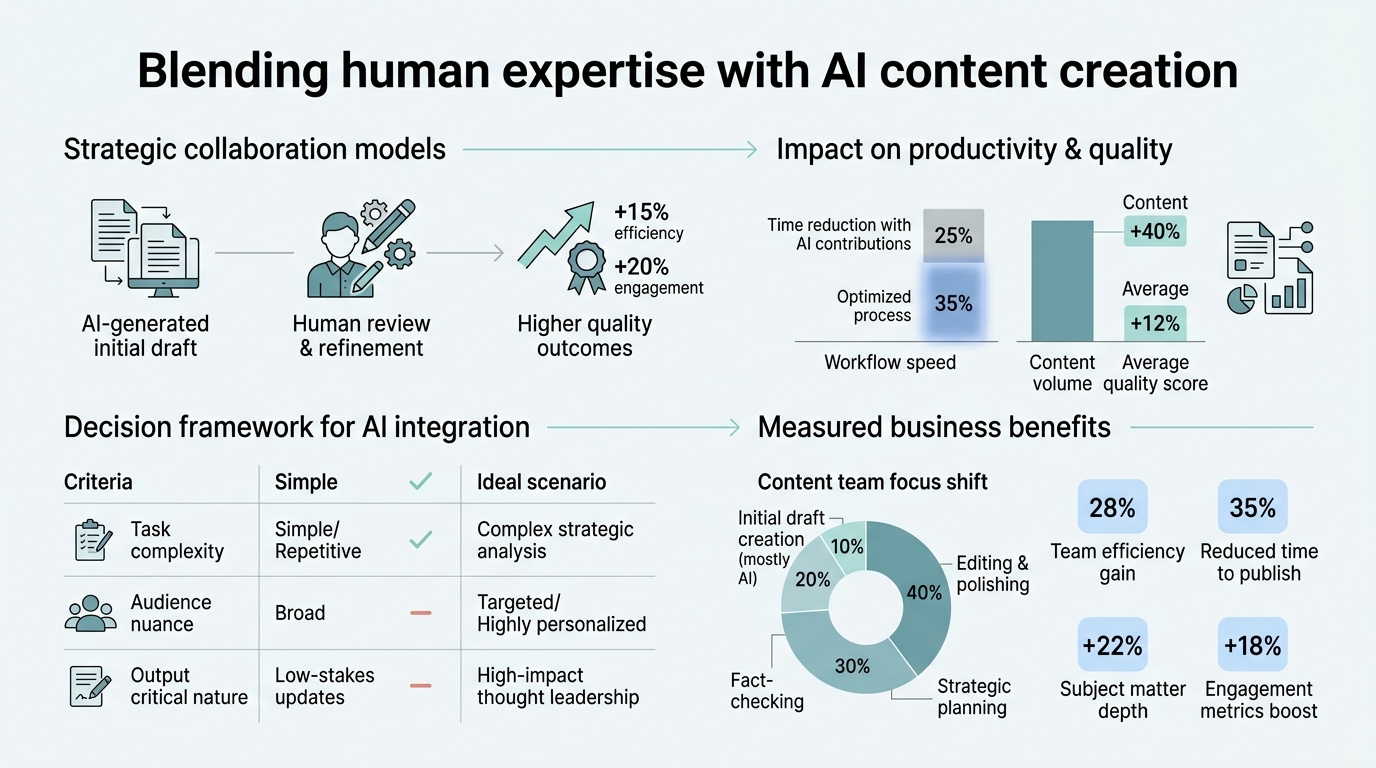
The data is unambiguous: pure AI content is underperforming in search rankings and reader engagement. Unedited AI content performs 34% worse in organic search citations, while humanized content earns 12% more citations in AI search results (AdAI News, 2026). This reversal happened between 2024 and 2026 as algorithms learned to detect and de-rank generic, unpersonalized AI output.
"Google's March 2025 core update made this shift explicit. The algorithm reduced rankings for 61% of sites with over 80% unedited AI content, but sites using structured AI-assisted workflows with mandatory human editing saw minimal impact. This isn't a war on AI—it's a penalty for lazy AI use."
Google's March 2025 core update made this shift explicit. The algorithm reduced rankings for 61% of sites with over 80% unedited AI content, but sites using structured AI-assisted workflows with mandatory human editing saw minimal impact. This isn't a war on AI—it's a penalty for lazy AI use. When you combine this algorithmic shift with current industry data showing 83% of content teams now use AI tools, the message is clear: AI adoption is universal, but differentiation comes from how teams use it.
The Trust Signal Gap
Generic AI content lacks specificity. It pulls from the same public datasets as every other AI generator, producing consensus-based articles that could be written by any model. Humans notice this immediately—it reads like a template. Google's E-A-T framework prioritizes Expertise, Authoritativeness, and Trustworthiness, qualities that pure AI cannot signal without human credibility.
Real expertise comes from solving problems repeatedly. When a founder writes, "I tried six project management tools, and here's what failed," that's proof. When an AI writes the same thing pulling from Reddit threads, that's imitation. Google can't assess intent, but it can measure patterns: domains with human bylines, original case studies, and specific examples rank higher and earn more citations in AI overviews.
The Penalty for Consensus AI
AI models are trained on existing content. When multiple AI writers generate content on the same topic, they naturally converge on similar points, structures, and examples because the training data is identical. This creates a problem: thousands of "unique" articles saying the same thing. Search algorithms detect this duplication-at-scale and penalize it.
"The solution isn't less AI—it's human judgment applied after AI drafting. A human editor can inject original research, contrarian takes, personal anecdotes, and specific examples that differentiate the content."
The solution isn't less AI—it's human judgment applied after AI drafting. A human editor can inject original research, contrarian takes, personal anecdotes, and specific examples that differentiate the content. This is why organizations using hybrid HITL workflows report 3–5× content output volume while maintaining quality, according to industry analysis from 2026. When teams implement content marketing automation with human oversight, they unlock the efficiency of AI without sacrificing the differentiation that human expertise provides.
The 80/20 Labor Split: AI Handles Grunt Work, Humans Add Value
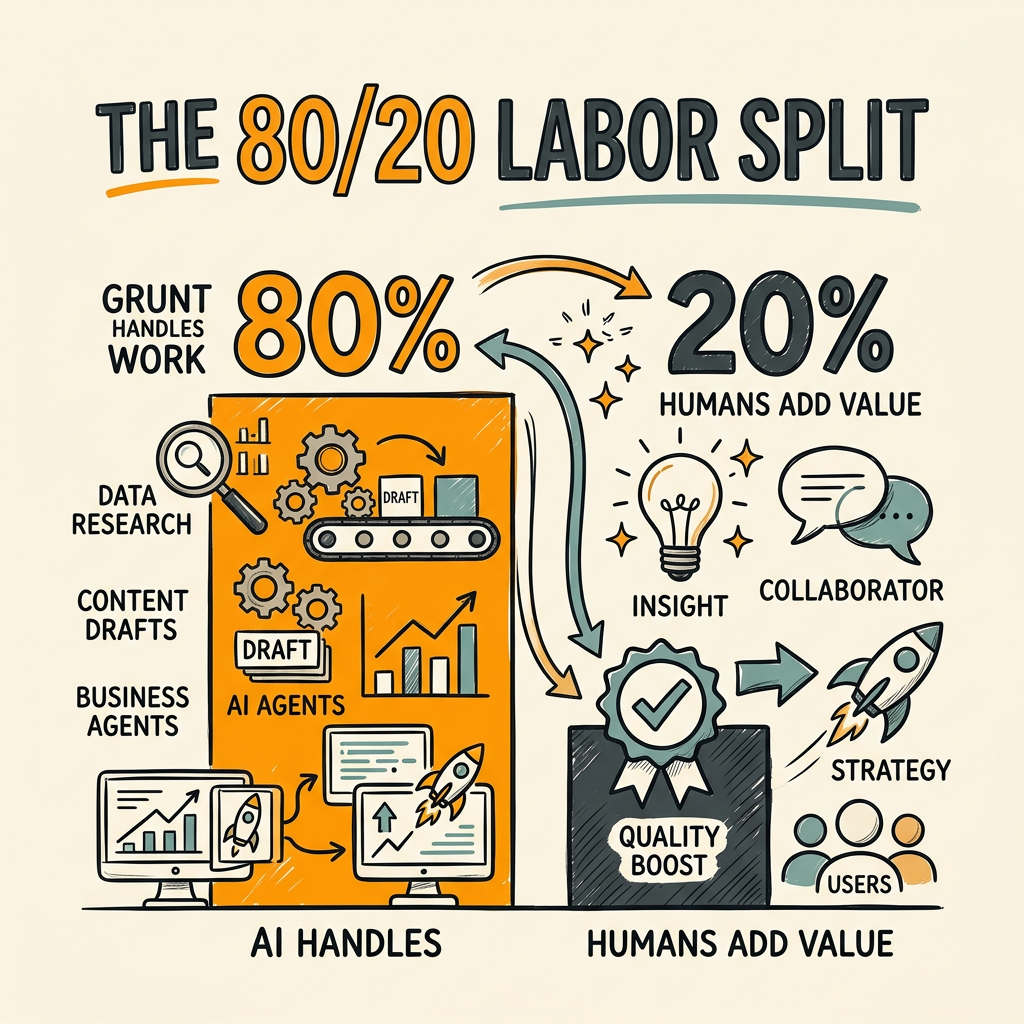
The most efficient framework for scaling content without burning out your team is the 80/20 rule: allocate 80% of labor to AI, 20% to humans. This isn't about cutting human roles—it's about redirecting human effort toward high-value work where expertise actually matters.
What the 80% (AI) Should Own
AI excels at the work humans find tedious: research, data synthesis, structure, outlining, and first-draft generation. Let AI handle the entire research phase. Feed it sources, data points, and constraints, and it will synthesize coherent outlines and rough drafts faster than any human could.
AI should also own keyword research and SEO structure. Modern AI can identify semantic relationships, cluster related topics, and suggest header hierarchies that improve readability and internal linking. Industry data shows that organizations using AI for ideation and outlining see 87% adoption rates—it's become the standard first step.
- Research & Data Synthesis: AI gathers information from multiple sources, identifies patterns, and compiles findings into a structured outline.
- Keyword Research & SEO Structure: AI analyzes search volume, competition, and semantic relationships to recommend optimal article structure and internal linking.
- First Draft Generation: AI produces 70% of a finished article in one pass, saving humans 30–50% of creation time.
- Formatting & Tagging: AI applies headers, bullet points, links, and metadata, reducing manual formatting overhead.
What the 20% (Humans) Must Control
Humans must own the strategic, creative, and verification layers. This includes fact-checking, voice calibration, injection of original insights, and editorial judgment.
The most critical human responsibility is fact-checking. 100% of statistics, quotes, and claims must be verified by a human before publication. AI generates plausible-sounding facts that are entirely fabricated (hallucinations). A human must click every link, read the source, confirm the methodology, and verify the year and context. This isn't optional—it's the difference between publishable content and misinformation.
- Fact-Checking & Verification: Click every source. Confirm statistics, dates, names, and methodologies. Remove any claim you can't verify.
- Voice & Tone Calibration: Rewrite generic corporate language into your brand voice. Replace passive voice with active. Ensure personality comes through.
- Originality Injection: Add personal anecdotes, case studies, specific examples, and contrarian takes. Replace consensus with insight.
- Editorial Judgment: Decide what stays, what gets cut, and what needs deeper explanation. Own the final product.
Building a Human-in-the-Loop Workflow That Scales
The Human-in-the-Loop (HITL) workflow is the industry standard in 2026. It systematizes the 80/20 split and ensures consistency across a scaling team. Here's how it works:
Phase 1: Human-Led Research & Framing
Before AI touches anything, a human defines the scope: what are we answering? Who is the reader? What sources count as credible? What is off-limits? This framing step prevents AI from generating content that doesn't fit your strategy.
Frame your research question tightly. Instead of "Write about AI content," specify: "Write a 2,000-word guide on how busy SaaS founders should blend AI and human writing to avoid Google penalties. Target founder audience. Include 5 specific case studies. Use these 8 sources I've vetted. Avoid mentioning competitors X and Y."
Humans should collect 3–5 high-quality sources before passing to AI. Whitepapers, case studies, original research, and published interviews carry more weight than aggregated blog posts. This curation step filters out low-quality sources before AI misrepresents them.
Phase 2: AI-Assisted Drafting
Feed the AI your framed question, sources, outline, and constraints. Request section-by-section generation (not one massive block) for better quality control. Specify word count, tone, required examples, and any specific data points that must appear.
The AI draft typically lands at 70% completion. It will have structure, citations, and logical flow. It will also have generic phrasing, potential hallucinations, and missing personality. Don't expect perfection—expect a solid foundation.
Many teams use this prompt structure: "Generate a 300-word section on [topic] for [audience]. Use these sources [list]. Include [specific examples]. Avoid [banned terms]. Match this tone: [sample text]. Format with headers and bullet points."
Phase 3: Human Edit & Fact-Check (Critical Gate)
This is the mandatory human layer. No AI-generated content publishes without human review. The human editor uses a three-pass approach:
- Fact-Check Pass (2 minutes): Skim for obvious errors. Do any statistics look wrong? Are the dates accurate? Do the names match? This rapid triage flags suspect data for deep verification.
- Verification Pass (10–30 minutes): Click every link. Read the source. Confirm methodology, sample size, and context. If a source doesn't load, delete the claim. If the quote is paraphrased incorrectly, rewrite it.
- Voice & Depth Pass (15–45 minutes): Rewrite generic sections in your brand voice. Replace weak examples with specific case studies. Remove corporate jargon. Add personal insights. Ensure active voice and punchy sentences.
This workflow—research → AI draft → human edit → publish—is what separates high-performing hybrid content from generic AI spam. When you implement SEO automation with built-in human approval gates, you ensure every article meets your standards before publication.
Phase 4: Quality Audits & Voice Checks
Some organizations add an automated "voice match score" gate before editorial review. Tools flag sections that don't match your brand's typical sentence length, word choice, or sentiment. This acts as an early-warning system for AI sections that need deeper rewriting.
Final audits should verify: Are internal links relevant and numerous? Does the content meet your SEO requirements? Are headers keyword-optimized? Does the piece answer the opening question completely? Only when these checks pass does content move to publish.
Fact-Checking and Verification: The Non-Negotiable Layer
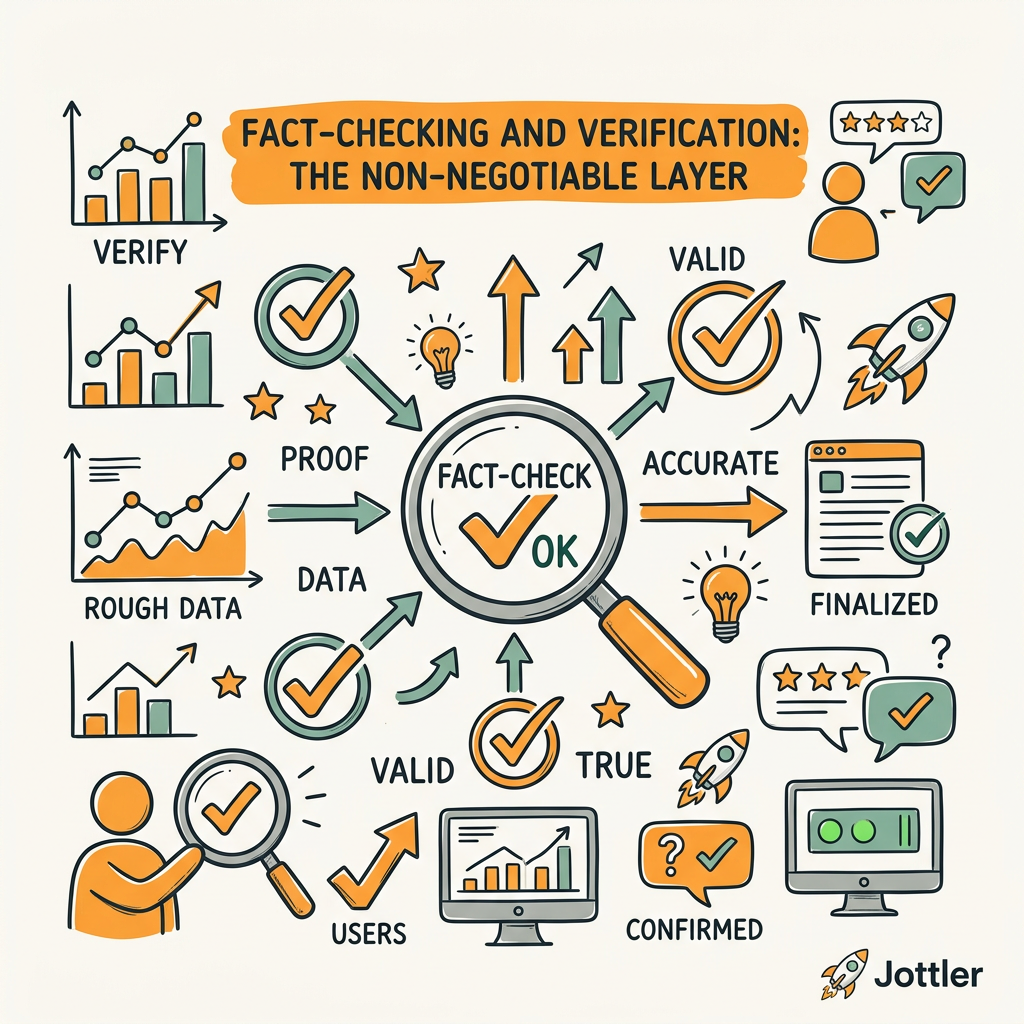
AI hallucinations—invented statistics, fake citations, paraphrased quotes that misrepresent the original—are the number one risk in hybrid workflows. Human fact-checking isn't optional; it's mandatory before any content publishes.
The Fact-Checking Protocol
Treat AI as a research assistant, not a source. Prompt it to cite specific publishers, years, methodologies, and URLs. Then verify everything manually. Click the link. Read the full source. Confirm the stat exists in the form AI cited it. If the source doesn't load or the claim is misrepresented, discard it. Do not argue with the AI about whether it's correct—trust the source.
Most editors use a fact-check checklist:
- Every statistic: publisher, year, methodology, URL verified
- Every quote: original source read, context confirmed, attribution correct
- Every name and company: spelling confirmed, current affiliation checked
- Every claim: either directly cited or removed if unverifiable
- Every date: year and context confirmed (avoid "recent" without specificity)
This checklist takes 20–30 minutes per 2,000-word article but saves you from publishing misinformation that Google will penalize.
Voice Verification and Brand Alignment
Beyond facts, humans must verify that the content matches your brand voice. AI tends toward corporate, passive, consensus language. Rewrite sections that don't sound like you. Replace "It is important to note that" with "Here's the thing." Use contractions. Use active voice. Show personality.
Some organizations measure "voice match" with readability scores (aim for Flesch reading ease above 60) and sentence length analysis (target average of 15–18 words per sentence). These metrics catch generic AI output that made it past a quick read. When you adopt an AI content generator designed for SEO, you benefit from built-in readability and tone analysis that flags these issues automatically.
Scaling Humanized Content With Jottler
Most founders and marketing teams understand the 80/20 rule intellectually but struggle to execute it at scale. Hiring enough editors to fact-check all your AI-generated content becomes expensive. Building the research and prompt engineering infrastructure in-house requires specialized knowledge. This is where an autonomous content system shifts the equation.
Jottler's autonomous SEO engine combines AI agents with systematic human-grade fact-checking and internal linking to automate the 80% while preserving human control over the 20%. Instead of managing prompts and editing workflows manually, you set your publishing frequency (1–5 articles per day) and Jottler's 12 AI agents handle research, outline generation, drafting, fact-checking, and internal linking automatically—then push verified content to your CMS.
The outcome? Your team shifts from copy-pasting and basic editing to strategic direction: defining which topics to target, reviewing fact-checked drafts for voice fit, and deciding which insights to add. You get the speed and cost efficiency of AI at scale—starting at $29/month—without the burnout of manual workflows or the risk of unverified content damaging your rankings.
Why the Hybrid Approach Compounds Over Time
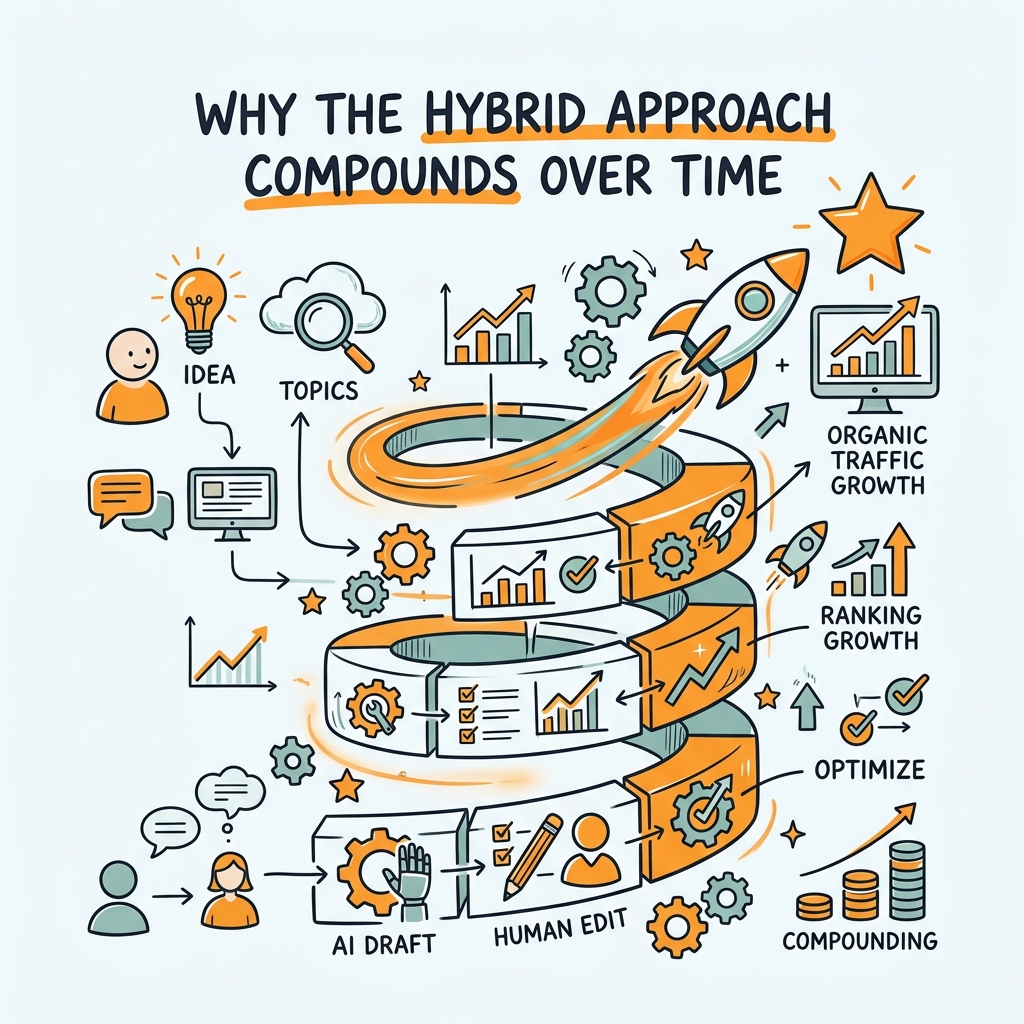
Pure AI content optimizes for speed. Pure human content optimizes for credibility. The hybrid approach optimizes for scale with credibility—the only metric that matters for long-term SEO.
Consider a content calendar: a solo founder or small marketing team might publish 4 human-written articles per month, each representing 6–8 hours of work. Switching to a structured AI + human hybrid workflow, the same team could publish 20 verified articles per month with less total labor, because AI is eliminating research busywork.
More content means more keywords captured, more internal linking opportunities, more topic clusters, and more entry points for organic traffic. Over 12 months, 240 verified hybrid articles compound into topical authority that a smaller team never achieves working purely human.
The math shifts further when you automate the system. An autonomous content engine removes the manual coordination overhead entirely. No more waiting for writers or editors. No more managing prompts. No more copy-pasting into your CMS. Articles research, write, fact-check, and publish themselves on a schedule you define. Your role becomes strategic: decide the topics, audit the quality, ship at scale. This is what scaling organic traffic without burnout actually looks like in 2026.
Avoiding Common Pitfalls in Human-AI Collaboration
The most common failure point in hybrid workflows is skipping the human layer to save time. This is exactly when Google's algorithm catches you. Other failures include:
Skipping Fact-Checking
Speed feels good until Google detects the misinformation and penalizes your domain. Fact-checking isn't optional. Budget 20–30 minutes per article for verification. Use the checklist above.
Allowing Generic AI Voice to Remain
If the final article reads like it was written by a corporate chatbot, it fails to build trust and earn citations. Human editors must inject personality, specificity, and contrarian takes. If the AI section feels generic, rewrite it.
Treating AI as a Complete Solution
AI is a tool to amplify human expertise, not replace it. If your team has no subject matter expertise, AI content will be generic. Expertise comes first. AI comes second.
Publishing Without Internal Links
Hybrid content should be heavily internally linked to build topical authority and distribute page authority. Don't publish orphaned articles. Link them to related pieces and anchor them in your site architecture.
Ignoring E-A-T Signals
Google's E-A-T framework requires evidence of Expertise, Authoritativeness, and Trustworthiness. Add author bios. Link to credentials. Include original case studies and data. Make it obvious that a real person stands behind the content.
Comparison: Pure AI vs. Pure Human vs. Hybrid Workflows
| Metric | Pure AI | Pure Human | Hybrid (80/20) |
|---|---|---|---|
| Search Performance | −34% citations (penalized) | Baseline | +12% citations (outperforms) |
| Content/Month (per team) | 50+ (low quality) | 4 (high quality) | 20 (verified quality) |
| Hours per Article | 1–2 | 6–8 | 1–1.5 |
| Fact-Check Risk | Hallucinations common | Minimal (human verified) | Minimal (human gate required) |
| E-A-T Signals | Weak/absent | Strong (author credibility) | Strong (human-verified, branded) |
| Voice & Personality | Generic corporate | Authentic brand voice | Authentic brand voice |
| Cost per Article | $5–15 (tools only) | $120–400 (labor intensive) | $30–60 (automation + editing) |
| Google Penalty Risk | High (61% of unedited AI domains) | None | None (human layer enforced) |
Conclusion
The question is no longer "Should we use AI for content?" but "How do we scale human expertise with AI efficiency?" The answer is systematic human-in-the-loop workflows where AI handles the grunt work (research, drafting, structure) and humans control the critical layers (fact-checking, voice, strategy).
Humanized content attracts 4× more traffic than pure AI, and well-edited AI performs 12% better in search than purely human content, giving hybrid teams a compounding advantage. Teams implementing structured HITL workflows report 3–5× content output volume without quality loss, proving that scaling doesn't require sacrificing credibility. Start by defining your 80/20 split, documenting your fact-check protocol, and committing to human-led editorial review before any content publishes. The hybrid approach isn't just more effective—it's the only strategy that compounds over time.
FAQs
How much of an article should be written by AI vs. humans?
The optimal split is 80% AI labor, 20% human labor. This means AI handles research, structure, and initial drafting (the time-consuming, repetitive work), while humans control fact-checking, voice calibration, and originality injection. In practice, this looks like: AI generates a full draft in 20–30 minutes, and a human editor spends 30–60 minutes verifying facts, rewriting generic sections, and adding specific examples. The result is a fully personalized article that reads human-authored while saving 50% of total labor compared to writing entirely from scratch.
Does Google penalize AI content if it's edited by humans?
No. Google penalizes unedited AI content, not AI-assisted content. Well-edited, fact-checked AI content performs 12% better in search citations than purely human-written content because AI excels at structure, readability, and SEO formatting. The penalty applies to sites publishing over 80% unedited AI content without human review. If your workflow includes mandatory human fact-checking, voice editing, and originality injection, your content is safe and will rank competitively. The key is the human layer.
What's the most common mistake when blending AI and human expertise?
Skipping fact-checking to save time. Teams rush AI drafts to publication without verifying statistics, quotes, and citations. This is when Google's algorithm catches misinformation and penalizes the domain. 100% of statistics and claims must be verified by a human before publishing. Use a fact-check checklist (publisher, year, methodology, URL for every statistic) and click every source. Budget 20–30 minutes per article for verification. This step isn't optional—it's the difference between compounding organic growth and facing algorithmic penalties.