The 6-Part Blog Content Strategy That Actually Ranks in 2026
Most blogs fail for the same reason. They publish whatever topic feels interesting that week, hit publish, and wonder why nothing ranks six months later.
A real blog content strategy is not a calendar. It is a system for turning a blog into a compounding search asset. Six moving parts, each one measurable, each one tied to rankings and revenue.
This guide walks through the framework end to end. Follow it and your blog stops being a content graveyard and starts acting like a distribution channel.
Key Takeaways
- A blog content strategy has six parts: audience jobs, pillar themes, cluster topics, publishing cadence, editorial mix, and measurement. Skip one and the system breaks.
- Pick 3 to 5 pillar themes maximum. Blogs that cover too many subjects rank for none of them because topical authority requires depth, not breadth.
- The 60/30/10 editorial mix (tactical, thought leadership, news and comparisons) balances ranking content with content that builds trust and gets shared.
- Measure organic sessions per cluster, assisted conversions, and AI citations. Pageview totals are a vanity metric in 2026.
What a Blog Content Strategy Actually Is
A blog content strategy defines which audience you serve, which subjects you own, how posts connect into clusters, how often you publish, what mix of content types you produce, and how you measure ranking success over time. It is the plan that turns a blog into a rankable asset instead of a newsletter in disguise.
The distinction matters. A content calendar answers "what do we publish next week?" A strategy answers "which search queries should this blog own in 18 months, and which posts compound to get us there?"
Blogs that treat content as a search asset see real compounding. According to Ahrefs' 2025 study of 1 million pages, 96.55% of pages get zero organic traffic from Google. (Ahrefs, 2025). The 3.45% that do share one trait: they were part of a topically focused site, not a random collection of posts.
Part 1: Define the Audience Job to Be Done
Before picking keywords, write down who this blog serves and what job they hire content to do. Not a persona with a stock photo name. A job.
"A SaaS founder researching how to launch a content program with no writers" is a job. "Technical marketers" is not. The job tells you which questions the reader is trying to answer, which level of depth they expect, and which proof points move them.
Write three to five jobs max. Each job becomes a lens you run every topic through. If a topic does not serve one of those jobs clearly, it does not belong on the blog, no matter how good the keyword volume looks.
A weak audience definition is the reason most blogs end up with 200 posts that rank for nothing. The writer tries to please everyone and ranks for no one. For a deeper walkthrough on building this foundation, the SEO content plan guide covers the full intake process.
Part 2: Pick 3 to 5 Pillar Themes
Pillars are the broad subjects your blog owns. Not keywords, subjects. For a content automation platform, pillars might be: AI content creation, SEO strategy, content operations, AI search optimization, and programmatic SEO.
Three rules for picking pillars:
- Each pillar must map to a buyer question. If no reader ever asks "how do I do X?", X is not a pillar.
- Each pillar must support 20 to 50 cluster posts. If you run out of subtopics after five posts, it is a topic, not a pillar.
- Pillars should not overlap. Overlap means you write the same post twice with different keywords, and Google picks one to rank (usually the wrong one).
Five pillars is the ceiling for most blogs. Beyond that you dilute topical authority, which Google weighs heavily since the 2024 helpful content updates. One healthcare blog that consolidated from 11 subjects to 4 grew organic traffic 280% in nine months by deleting posts, not writing more. The math works because topical authority is earned through depth.
Part 3: Map Cluster Topics to Each Pillar
Under each pillar sits a cluster. One pillar post answers the broad subject. Ten to forty cluster posts answer specific long-tail questions inside that subject and link back to the pillar.
The structure looks like this:
- Pillar page: "AI Content Strategy" (2,500 to 4,000 words, broad overview)
- Cluster posts: "AI content calendar templates," "how AI content gets cited," "AI content QA checklist," "AI content pricing benchmarks"
- Internal links: Every cluster post links up to the pillar. The pillar links down to its strongest cluster posts.
Cluster mapping is where keyword research earns its keep. Pull the top 200 keywords for each pillar, cluster them by search intent, and pick the 20 to 30 that have volume above 100 per month and keyword difficulty under 50. Those become your cluster posts. The content cluster strategy playbook walks through the mechanics in full.
Semrush's 2026 State of Search report found that sites publishing structured clusters rank 2.3 times faster than sites publishing isolated posts for the same keywords. (Semrush, 2026). The reason is link equity: a cluster concentrates internal links on the pillar, which tells Google the site has depth on that subject.
Part 4: Set a Publishing Cadence You Can Hold
Cadence is the number most teams get wrong. They commit to four posts per week in January, publish eight posts by March, and stop updating the blog by June.
Pick a cadence you can hold for 18 months without heroics. For a solo founder that might be two posts per week. For a small marketing team, four. For a blog running on an AI publishing pipeline, ten or more per day.
The cadence math matters because ranking requires volume inside a cluster. A blog publishing one post per month across five pillars will take five years to fill a single cluster. A blog publishing ten posts per week across the same five pillars fills all of them in six months and starts ranking at month nine.
Higher cadence does not mean lower quality if the pipeline is structured. This is the gap that tools like Jottler's content engine close, running research, writing, image generation, and publishing as one autonomous pipeline instead of a person juggling five tabs. If your team cannot publish two posts per week manually, autopilot mode handles the frequency side while your team approves topics and reviews output.
Cadence Benchmarks by Team Size
- Solo operator: 1 to 2 posts per week, or 10+ per day on autopilot
- Marketing team of 2 to 5: 3 to 5 posts per week, or 20+ per day on autopilot
- Content team of 6+: 5 to 10 posts per week, or 40+ per day on autopilot
Manual cadence caps out around 10 posts per week because editorial review becomes the bottleneck. Automation shifts the bottleneck to topic approval, which scales ten times better.
Part 5: Design the Editorial Mix (60/30/10)
Not every post plays the same role. A blog that publishes only tactical how-to posts ranks well but feels like a Wikipedia clone. A blog that publishes only opinion pieces builds a following but ranks for nothing. The mix matters.
The ratio that works for most B2B blogs in 2026:
- 60% tactical: Step-by-step how-to posts targeting long-tail keywords with commercial or informational intent. These are the ranking engine.
- 30% thought leadership: Contrarian takes, framework essays, original research. These are what people share, link to, and quote.
- 10% news, comparisons, and product: Timely posts on industry news, head-to-head comparisons, and product announcements. These drive short-term traffic spikes and close deals at the bottom of funnel.
Tactical posts do the SEO heavy lifting. Thought leadership earns backlinks and citations from industry peers, which is what actually moves domain authority. Comparisons and news capture bottom-funnel intent and make your blog feel current.
A common failure mode is publishing 100% tactical content. It ranks, but it does not get shared, it does not earn links, and AI search engines treat it as replaceable. A 2026 Brightedge study found blogs with a mix of tactical and original-research content were cited in ChatGPT answers 3.4 times more often than tactical-only blogs. (BrightEdge, 2026).
Author branding fits into the thought leadership slice. Posts with a real byline, a headshot, and a track record of expertise do better with both Google's E-E-A-T signals and AI citation engines. A single named author who publishes 20 posts on a subject outranks an anonymous blog with 80 on the same subject.
Part 6: Measure What Actually Matters
Most blogs report pageviews monthly and wonder why the board does not care. Pageviews are not a ranking signal and not a revenue signal. In 2026, four metrics matter.
Organic sessions per cluster. Track traffic by pillar, not by post. A cluster that grew 40% this quarter is a cluster you should double down on. A cluster that is flat after six months is a cluster you should kill or consolidate.
Ranking keywords per cluster. How many keywords does each pillar rank for in positions 1 to 20? This is the best leading indicator of traffic growth three months out.
Assisted conversions from blog content. Run a multi-touch attribution model. A blog post that is never the last touch but shows up in 40% of closed deals is doing the work. Last-click attribution kills good blog programs because it undercounts top-of-funnel posts.
AI citation count. Use a tool like Profound or Peec AI to track how often your blog gets cited in ChatGPT, Perplexity, and Google AI Overviews. AI citations drive direct traffic and rank as trust signals in their own right. The AI search visibility guide covers measurement in detail.
Kill vanity metrics. Bounce rate, average session duration, and social shares tell you nothing about whether the blog is earning pipeline. Cut them from the report.
Putting the Framework Into Production
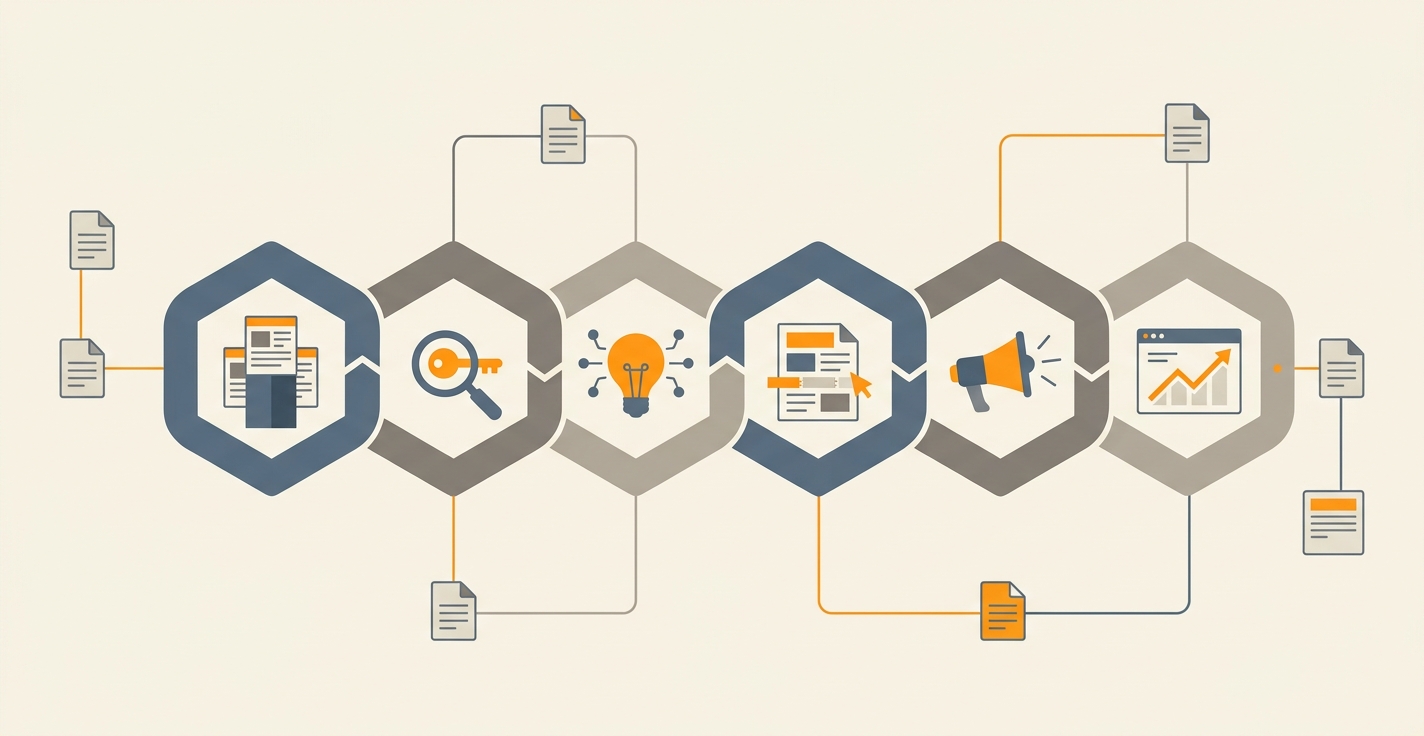
Six parts, one system. Audience jobs tell you who. Pillars tell you what. Clusters tell you which posts. Cadence tells you how fast. Editorial mix tells you which types. Measurement tells you what is working.
The hard part is not the strategy, it is the execution. A solo operator running this framework manually will spend 40 hours per week writing, researching, and publishing. A small team will hit capacity around 10 posts per week. That is where most blog strategies stall, right at the moment they would start compounding.
This is the problem Jottler was built to solve. An AI agent pipeline that takes your pillars and clusters, runs the keyword research, writes the long-form posts, generates the images, and publishes to your CMS on the cadence you set. The strategy stays yours. The production becomes infrastructure. See how smart research and auto-publishing fit together in a single agent run.
How many posts would your cluster map need in the next 90 days to actually rank? That number is the gap between a strategy document and a blog that ranks.
Frequently Asked Questions
How many blog posts do I need to rank?
Most clusters need 15 to 30 well-structured posts before the pillar starts ranking on page one for its head term. Individual long-tail cluster posts can rank in 30 to 90 days, but the pillar benefits from the full cluster being published. Plan for six months of consistent publishing before judging results.
What is the difference between a content strategy and a blog content strategy?
A content strategy covers every format: blog, video, podcast, social, email, sales enablement. A blog content strategy focuses only on the blog as an owned search asset. It treats the blog as a ranking and citation engine, which means cluster architecture, editorial mix, and SEO measurement are all blog-specific decisions the broader content strategy does not make.
How do I pick pillar themes for my blog?
Start with three questions: what problems do your buyers search for, which of those problems does your product solve, and which of those problems do you have unique expertise to write about. The intersection is your pillar list. Most businesses find three to five pillars. More than that dilutes topical authority and slows ranking.
How often should I publish blog posts?
Publish at the cadence you can hold for 18 months without burning out. For most B2B blogs that is two to five posts per week. Blogs running on AI publishing pipelines can sustain 10 to 50 posts per day at the same quality bar. Cadence matters less than consistency, and gaps in publishing hurt rankings more than lower volume.
How do I measure if my blog content strategy is working?
Track four metrics quarterly: organic sessions per cluster, ranking keywords per cluster, assisted conversions from blog content, and AI citation count. If all four trend up across two consecutive quarters, the strategy is working. If only pageviews trend up, check which posts are driving the traffic. Viral one-off hits do not compound the way cluster traffic does.