Building a Content Playbook with AI and Human Expertise
The challenge facing modern marketing teams is clear: 80% of marketing processes are already automated or AI-augmented according to Gartner research, yet most teams lack a structured playbook for blending AI execution with human judgment. The gap isn't capabilityit's strategy. Teams that treat AI as a replacement for human thinking underperform those that position AI as a force multiplier for what humans do best: judgment, creativity, and brand voice.
The cost of getting this wrong is substantial. Teams without a deliberate playbook either invest in tools that sit idle, or worse, release content that lacks authenticity and brand alignment. The solution is straightforward: build a repeatable framework where AI handles the operational load while humans focus on strategy, approval, and creative direction.
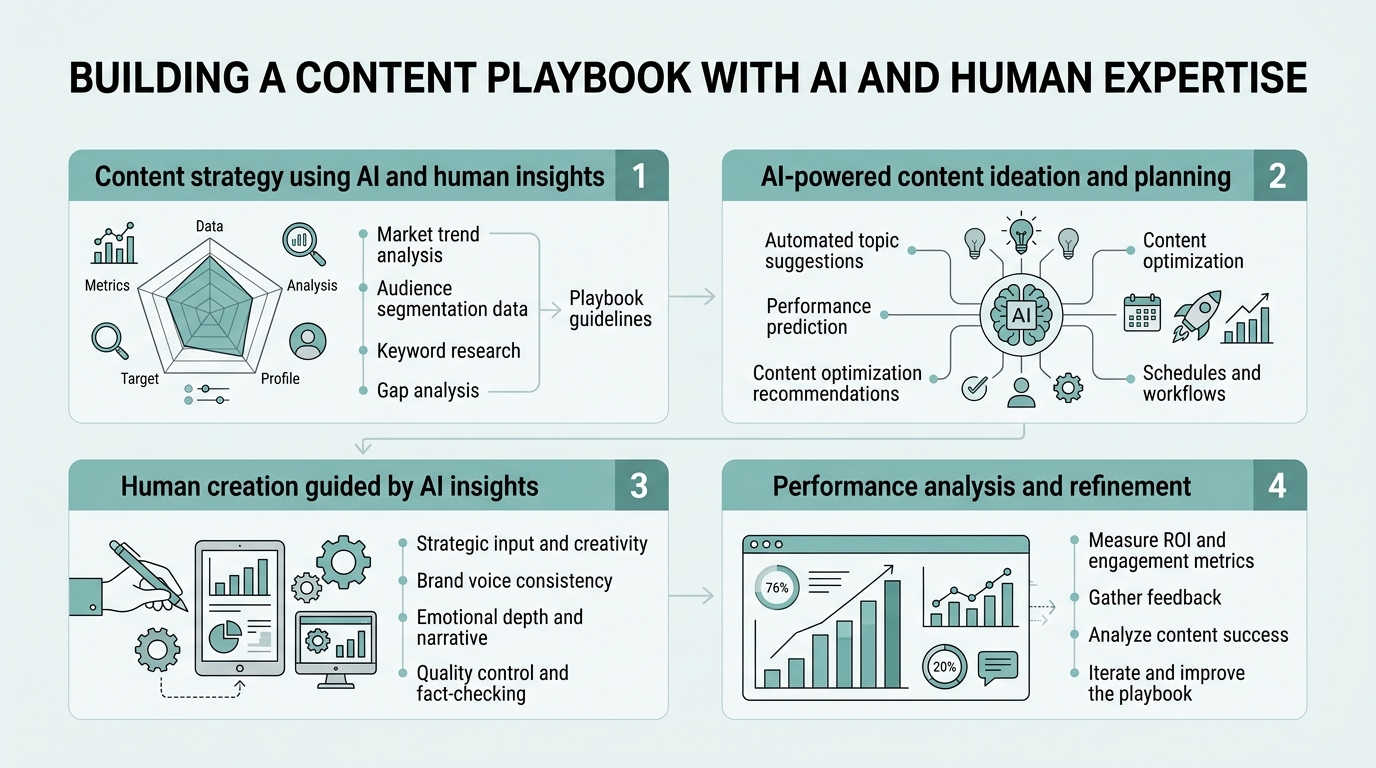
Here's a quick summary of how to build a content playbook that leverages both AI and human expertise effectively:
Key Takeaways
- 77% of teams report higher conversion rates after implementing content marketing automation with human oversight (2026, MagicBlocks)
- The highest-performing playbooks divide labor: AI researches, drafts, and tests; humans own strategy, final approvals, and brand voice
- Companies using automation achieve 34% average revenue increase, but results depend on human-in-the-loop governance
- Define Your AI and Human Roles: Assign AI to high-volume tasks like research, drafting, and initial optimization. Reserve human judgment for strategy, creative direction, and brand alignment decisions.
- Establish a Content Research and Ideation System: Use AI agents to conduct keyword research, competitor analysis, and topic discovery. Humans select final topics aligned with business goals.
- Build a Drafting and Optimization Workflow: AI generates initial drafts with fact-checked data and SEO optimization. Humans refine voice, verify claims, and ensure messaging aligns with brand positioning.
- Create a Review and Approval Gate: Define specific approval criteria (brand voice, factual accuracy, messaging alignment) so humans review systematically rather than reactively.
- Measure What Matters: Track output volume, engagement metrics, and business outcomes. Adjust the playbook based on performance data, not just gut feeling.
Why You Need a Content Playbook Right Now
The case for a formal playbook is data-backed. Companies that excel at personalization generate 40% more revenue from marketing activities than average players, and automation can deliver up to a 6x increase in qualified leads. But these results only materialize if your team has a clear process for deciding what AI owns versus what humans own.
Without a playbook, three things happen: First, AI tools become expensive tooling that nobody uses consistently. Second, human teams continue to do work AI could handle, burning out fast. Third, brand voice suffers because AI-generated content lands directly in production without human review. A formal playbook fixes all three problems.
The Cost of Flying Without a Map
Ungoverned AI content creation leads to measurable problems. Content without human editorial review often lacks nuance, factual precision, or brand authenticity. Marketing teams at scaling companies typically spend 60-70% of their time on operational tasksscheduling, research, first draftsrather than strategy and optimization. A playbook reallocates that time by automating what's repeatable and protecting what's strategic.
What Separates High Performers from the Rest
Industry leaders like HubSpot emphasize a critical principle: use humans for judgment and agents for execution. The teams winning in 2026 aren't the ones trying to replace marketers with AI. They're the ones who've created a system where AI accelerates output and humans control quality, strategy, and brand voice. Successful AI agent implementations focus on specific, high-impact use cases rather than automating entire departments, which keeps the human team engaged and the brand intact.
How to Define Roles: What AI Should Own, What Humans Keep
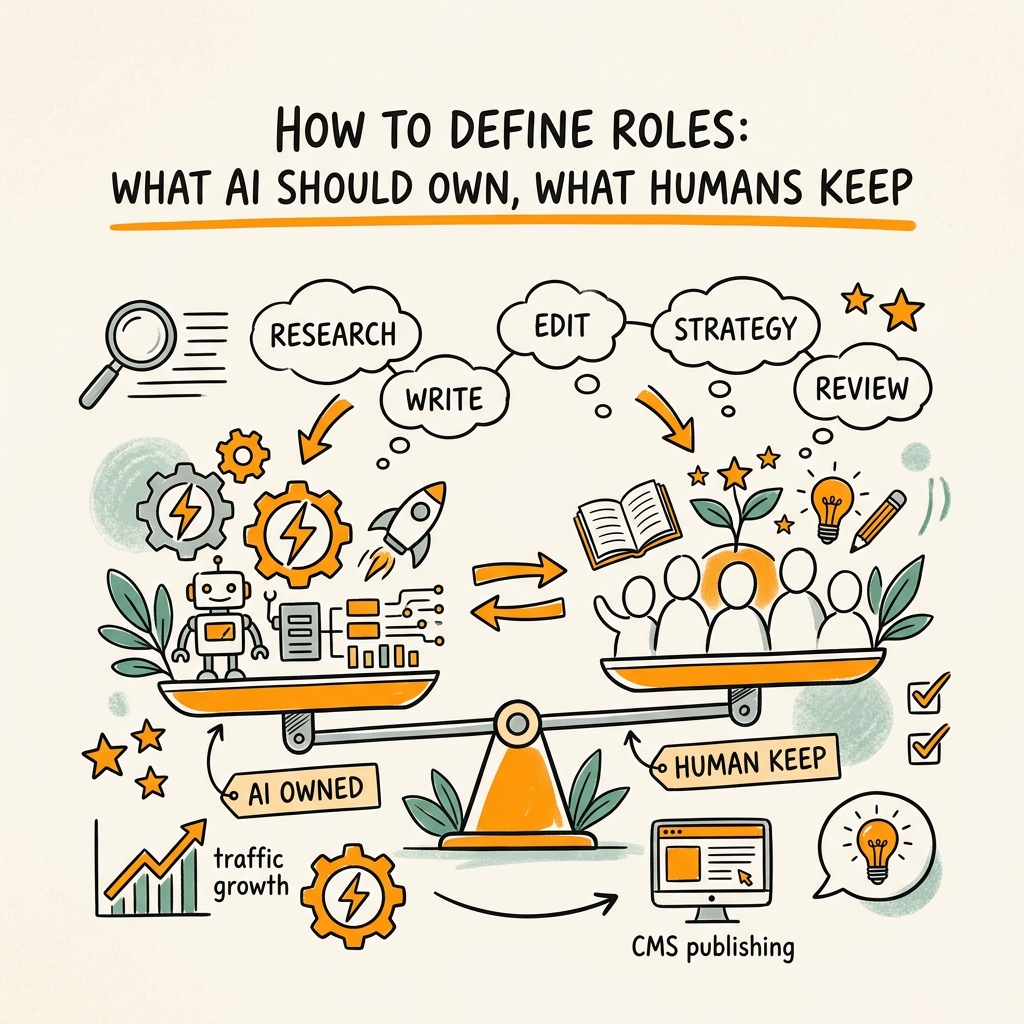
The foundation of a strong playbook is clarity. AI excels at repeatable, data-heavy tasks with clear inputs and outputs. Humans excel at judgment, taste, and deciding what matters. The playbook should be explicit about which work goes where.
Tasks AI Should Handle
AI agents are most effective when tasked with high-frequency, structured work: keyword research across 100+ variations, competitor content analysis, topic cluster mapping, initial draft generation, fact-checking against source documents, SEO optimization (title tags, meta descriptions, internal link suggestions), and content formatting for publishing. These tasks are time-intensive but low-judgment. They benefit from speed and scale. A well-configured AI system like an autonomous SEO agent can research, draft, fact-check, and optimize articles in hours rather than days, freeing human teams to focus on higher-leverage work.
- Keyword research and topic discovery: Scan search volume, difficulty, and intent data across hundreds of keyword variations to identify high-opportunity content angles
- Competitive analysis: Identify what top-ranking pages cover, where gaps exist, and what angle your brand should take
- Initial research and sourcing: Gather data, studies, quotes, and supporting evidence from authoritative sources
- First-draft generation: Write outlines, full drafts, and variations at speed for human review and refinement
- Fact-checking and source verification: Cross-reference claims against source documents to catch errors before publication
- SEO optimization: Apply keyword density, readability, and technical SEO standards systematically
Tasks Humans Must Keep
Humans own the decisions that define a brand. Strategy, judgment, creative direction, and brand voice are irreplaceable. Humans decide whether a piece aligns with company positioning, whether tone matches the audience, and whether a claim needs additional nuance or context. Humans also own the final approval gatethey decide what ships and what gets reworked. This isn't gatekeeping. It's quality control.
- Strategic direction and editorial calendar: Decide which topics align with business goals, buyer journey stage, and competitive positioning
- Brand voice and messaging alignment: Review for tone, personality, and messaging consistency with company positioning
- Judgment calls on tone and nuance: Adjust claims, add context, or soften language where AI may have missed the mark
- Final approval: Sign off on content before publication. No exceptions.
- Content performance analysis: Review metrics, identify which topics resonate, and adjust strategy accordingly
Building Your Research and Ideation System
The research phase determines whether your content ranks and converts. 79% of brands that have fully integrated AI across channels say they can more accurately measure the revenue impact of personalization, which suggests that systematic AI-powered research leads to better targeting and performance. Your playbook should define exactly how AI sources topics, refines them, and hands them to humans for approval.
Step 1: Let AI Scout the Opportunity Landscape
AI excels at scanning large datasets quickly. Your system should task AI agents with researching 50+ keyword variations in your core category, pulling search volume, difficulty score, and intent data. The AI should also conduct competitor analysiswhich pages rank for your target keywords, what they cover, and where they have gaps. This entire process should take hours, not days.
The output is a ranked list of content opportunities with rough estimates of impact. Humans then review this list and select topics based on strategic alignment. A topic might have high search volume but misalign with your positioninghumans catch that. Another might hit a critical gap in the markethumans prioritize it. This partnership between AI discovery and human judgment produces the most effective editorial calendars.
Step 2: Human Strategists Approve Topic Direction
Once AI surfaces opportunities, your marketing team approves the final list and defines the angle. What position should we take? Who is the audience? What problem does this solve? These decisions are fully human. The best playbooks include a simple approval gate: strategist reviews AI's recommendation and either approves it, rejects it, or requests a different angle. This protects against algorithm bias and ensures every piece serves business goals.
Step 3: AI Conducts Deep Research
With a topic approved, AI agents move into deep research mode. They should gather statistics, find expert quotes, conduct competitive analysis, and pull supporting data from authoritative sources. This research phase is where quality compounds. The more thorough the research, the more fact-checked the final draft will be. AI should source from 10+ sources per article, flag gaps or contradictions, and prepare a research brief for the human writer to review.
Designing Your Content Drafting and Optimization Workflow
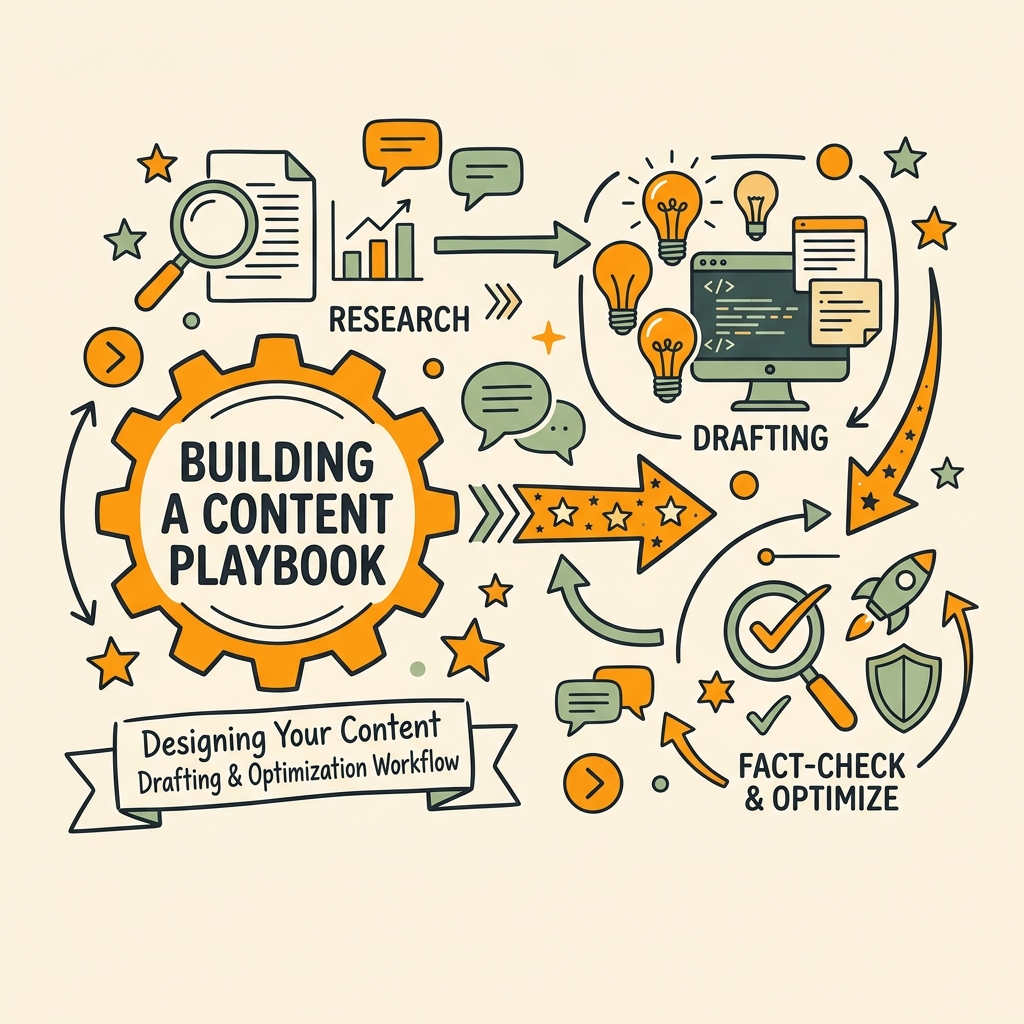
Once research is complete, the drafting phase begins. This is where AI generates output at scale, and humans refine it for quality and brand fit.
AI Generates Initial Drafts with Built-In Standards
Your playbook should specify that AI drafts must include: fact-checked statistics with source attribution, SEO-optimized title and meta tags, internal link suggestions, a structured outline, and citations for all claims. When AI has clear standards, drafts arrive pre-optimized and ready for human refinement rather than requiring a rewrite.
The best systems also build in multi-pass optimization: AI writes the first draft, then runs a second pass for readability, keyword density, and internal linking. By the time a human reviewer sees it, the draft is approximately 80% production-ready. Human writers then spend time on voice, nuance, and brand alignment rather than fixing basic structure or adding missing sources.
Humans Review for Brand Voice and Factual Accuracy
Your approval gate should have specific criteria. Does this piece sound like our brand? Are all claims accurate and properly sourced? Does the tone match our audience? Does the structure flow logically? These are the questions your human reviewers should answer. Make the review process explicit by using a checklist. Checklists eliminate subjective back-and-forth and ensure consistent quality standards.
Final Publication and Analytics Handoff
Once approved, AI publishes directly to your CMS and builds a network of internal links. Your playbook should specify: where does this go in the content structure? What related pieces should we link to? What's the publishing schedule? This step is fully automatable once humans approve the content. Many teams waste human time on publishing and formattinga well-designed playbook eliminates that friction entirely.
| Process Stage | AI Responsibility | Human Responsibility | Outcome |
|---|---|---|---|
| Research & Ideation | Keyword research, competitor analysis, topic discovery | Strategic approval, business alignment, angle selection | Approved content calendar with high-opportunity topics |
| Deep Research | Source data, gather statistics, find expert quotes, verify claims | Review research brief for gaps, approve sources | Research-backed outline ready for drafting |
| Drafting | Generate initial draft, optimize for SEO, add citations | Refine voice, verify tone, ensure brand alignment | Publication-ready draft aligned with brand positioning |
| Publication | Publish to CMS, build internal links, schedule posts | Final approval before publication, post-launch review | Live content with optimized distribution and linking |
| Measurement | Track engagement metrics, content performance, ROI | Analyze performance, adjust strategy, identify trends | Data-driven insights for next content cycle |
Creating a Governance Framework That Scales
The difference between a playbook that works and one that fails is governance. You need explicit approval gates, clear decision criteria, and a feedback loop that improves the system over time. Automation can reduce operational marketing costs by 12.2% while cutting customer acquisition costs by 30-40% if governance is tight. Without it, you're just distributing poor-quality work faster.
Define Explicit Approval Criteria
Create a single-page checklist that every piece of content must pass before publication. Include: Does this match our brand voice? Are all claims properly sourced? Is the title under 60 characters? Are there at least 3 internal links? Does the structure flow logically? Is the tone appropriate for our audience? This checklist becomes your governance standard. Every approver uses it. No guessing, no subjective debates.
Build Feedback Loops into the System
Your playbook should include a monthly review: What content performed best? Which topics drove traffic, leads, or conversions? What did audiences engage with? Use this data to adjust the system. Maybe AI's draft quality improved after you added a specific sourcing instruction. Maybe humans are taking too long on a particular approval step. Track these patterns and update the playbook. A living playbook compounds in quality over time.
Train Your Team on AI Literacy
Your human team needs to understand what AI agents can and can't do. They should know how to review AI drafts critically, how to edit them for brand voice, and when to send work back for revision. This isn't an afternoon training. It's an ongoing capability-building effort. The teams winning in 2026 have invested in teaching their marketers how to partner effectively with AI agents. That skill difference is competitive advantage.
Measuring Your Playbook's Success

A playbook without metrics is just theory. You need to measure output volume, quality standards, and business outcomes. Track these metrics monthly:
- Output velocity: How many pieces of content does your system produce per month? Compare this to your previous manual rate. You should see 3-5x improvement.
- Approval rate: What percentage of AI drafts pass the first review? If it's below 85%, your approval criteria might be unclear. If it's above 95%, they might be too loose.
- Time to publication: How long from approved outline to live content? With a solid playbook, this should be days, not weeks.
- Engagement metrics: Track average session duration, scroll depth, and time on page. Are readers engaging more deeply with AI-assisted content? Are bounces lower?
- Conversion and lead generation: Ultimately, does this content drive leads or sales? Attribution is hard, but you should see a trend upward in qualified leads from organic traffic.
"AI is increasingly effective at scaling content marketing operations, personalization, and campaign optimization, but the highest-performing teams keep humans in charge of judgment, strategy, and brand voice."Leanmarketing, 2026 AI Marketing Playbook
Common Mistakes to Avoid
Three mistakes destroy content playbooks. First: over-automating approval. Some teams let AI publish without human review to save time. This destroys brand trust and drives away readers. Humans must always have the final say. Second: keeping humans in low-value work. If you're automating research but still having humans do formatting and scheduling, you've missed the point. Automate everything operational and keep humans on judgment. Third: not measuring what matters. Teams often track vanity metrics (pages published, word count) instead of real outcomes (traffic, leads, conversions). Set a measurement system first, then build the playbook around it.
"Use humans for judgment and agents for execution."HubSpot, AI Agents Unleashed Playbook (2026)
Real-World Playbook Implementation: From Planning to Launch
A practical playbook has phases. Month one: define roles and approval criteria. Month two: test AI agents on 3-5 topics to establish quality benchmarks. Month three: scale to 10-15 pieces monthly. Month four: measure results and iterate. This gradual approach reduces risk and builds team confidence in the system.
Most teams implementing this framework see improvement in three areas simultaneously. First, content volume increases dramatically. Instead of publishing one piece per week, you're publishing multiple pieces per week. Second, human time shifts from operational tasks to strategy and optimization. Marketing team members go from glorified copy-editors to strategic thinkers. Third, quality improves because AI drafts are fact-checked and optimized before human review begins. The review process becomes refinement, not heavy editing.
Tools like content automation platforms designed for SaaS teams make this playbook operational. When you connect your CMS to an AI system configured for your brand, the entire pipelineresearch, drafting, fact-checking, optimization, and publicationruns on schedule with minimal human oversight. This is where the playbook compounds into measurable competitive advantage.
Scaling Your Playbook as Your Team Grows
As your content operation scales, your playbook evolves. Early stage (months 1-3): focus on consistency and getting the core system right. Growth stage (months 4-12): increase publishing frequency and refine approval standards based on performance data. Scale stage (months 12+): introduce segment-specific variations (different playbooks for technical vs. marketing audiences, for example) and automate cross-functional workflows.
The key is that your playbook remains a living document. Every quarter, review: What's working? What's slowing us down? What approval criteria can we tighten? What can we automate further? This discipline compounds into a machine that produces more content, faster, with higher brand alignment than teams relying on manual processes.
Conclusion
Building a content playbook with AI and human expertise is no longer optional. The data is clear: companies using marketing automation see revenues climb by 34% on average, and 80% of teams report generating more leads after implementing automation. But these results depend entirely on a playbook that divides labor intelligentlyAI handles the operational lift, humans own strategy and brand voice.
Your playbook should specify exactly what AI owns (research, drafting, optimization, publishing), what humans keep (strategy, judgment, approval), and what the approval gate looks like. It should include measurement standards so you know whether it's working. It should evolve monthly based on performance data. Most importantly, it should treat AI not as a replacement for your team, but as a force multiplier that frees humans to do their best work.
Start smalldefine roles and approval criteria this month. Test the system on 3-5 pieces next month. Measure results, iterate, and scale. Within 90 days, you'll have a repeatable system that produces more content with higher quality and less human overhead than pure manual operations. And that's the competitive advantage that wins in organic search.
Ready to automate your content playbook? Start your SEO agent and let AI handle the research and drafting while your team focuses on strategy and approval.
FAQs
How do I prevent AI from diluting my brand voice?
Brand voice lives in the human approval gate. AI generates drafts, humans refine tone, messaging, and personality before publication. The key is explicit brand guidelines. Your approval checklist should include a specific question: "Does this sound like our brand?" backed by examples of what good brand voice looks like for your company. Train your approvers on brand voice standards so they review consistently. Keep humans as the final decision-maker on all published content. This prevents brand dilution and ensures every piece reflects your positioning.
What size team do I need to run this playbook?
You can start with two people. One AI-literate marketer to configure the system and review AI drafts. One strategist to approve topics and ensure business alignment. As you scale publishing frequency, you might add a fact-checker or a dedicated editor. The beauty of the playbook is that it doesn't require a big teamit requires a well-defined process and clear role division. Most teams find they can publish 10-15 high-quality pieces per month with a single dedicated marketer and part-time strategic input.
How long does it take to see results from a content playbook?
Output improvements are immediateyou'll publish more content within weeks. Traffic improvements take 3-6 months because SEO rankings compound slowly. Conversion and lead generation results typically appear within 6-12 months once you have a body of content ranking and driving qualified traffic. The key is measuring consistently from day one so you can track progress against baseline and adjust strategy quarterly. Most teams see 3-5x improvement in content output and measurable traffic growth within six months of implementing a solid playbook.