Building a Robust Content Automation Strategy
Most teams recognize the content problem but can't solve it manually. Content demands have doubled from 2023 to 2024, forcing marketers to choose between burnout and scaling down their output. The stakes are enormous: marketing teams using automation report 29% greater revenue impact than those managing content manually, yet only 67% of marketing teams actively use AI-assisted content creation. The solution isn't hiring more writers, it's building an automation framework that works while you sleep.
Key Takeaways
- 67% of marketing teams now use AI-assisted content creation (2025, Humanswith), yet most lack a cohesive strategy beyond ad-hoc tool adoption.
- Automation users see 77-80% increases in lead generation and conversion rates compared to manual workflows (2025, SalesGenie).
- Successful teams generate content 70% faster while maintaining quality through structured workflows, keyword research, and fact-checking gates (2025, Humanswith).
- AI-driven personalization delivers 740% average ROI, nearly 2x the return of blog/SEO content alone (2025, Humanswith).
- Define your automation scope: Identify which content types (blogs, emails, social, whitepapers) benefit most from automation and where human oversight remains essential.
- Choose the right tech stack: Map tools that handle keyword research, AI writing, fact-checking, and CMS publishing with minimal manual handoffs.
- Establish a content grid: Document your topic clusters, publishing cadence, and quality gates to maintain brand voice at scale.
- Build an internal linking protocol: Automate the strategic linkage between related content to compound SEO value across your site.
- Measure and optimize systematically: Track organic traffic, conversion rates, and content ROI to refine your automation rules quarterly.
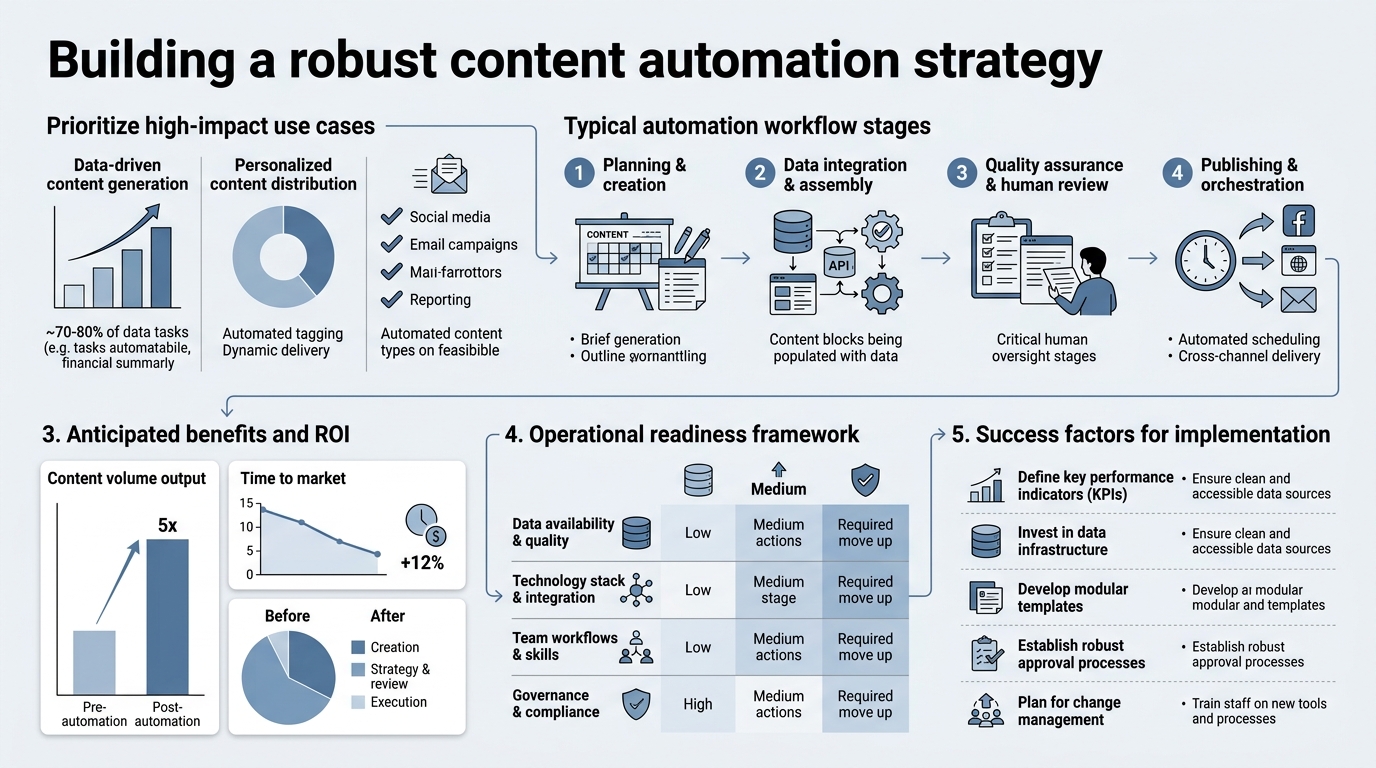
What Is Content Automation and Why It Matters for Scaling
Content automation uses AI and software to connect every stage of the content lifecyclefrom ideation through publishing to performance measurementinto a coordinated workflow. Rather than treating each piece of content as a standalone project, automation handles the repetitive tasks (research, first drafts, SEO optimization, linking, distribution) while humans guide strategy, maintain brand voice, and approve final output. According to SalesGenie's 2025 marketing automation research, 80% of automation users report a surge in leads, and 77% track higher conversion rates compared to manual workflows.
The shift is driven by capacity, not convenience. With content demand doubling year-over-year, traditional content teams face three options: hire more writers (expensive, slow to scale, variable quality), lower publishing frequency (competitive disadvantage), or automate the workflow. The teams choosing automation are winning on volume and velocity without sacrificing qualitybecause they've structured their systems to include human review, fact-checking, and iterative refinement at each gate.
The core components of a content automation system
A robust automation strategy rests on five interconnected pillars. First, keyword research and topic ideation must be fully automatedAI identifies high-intent search queries with low competition and clusters them into content themes that align with your business. Second, content generation uses generative AI trained on your brand voice and style guidelines to produce first drafts at scale, often generating 3,000+ word articles in hours rather than days. Third, fact-checking and optimization involves verifying claims against authoritative sources and tuning content for SEO (meta tags, headings, keyword placement, readability). Fourth, internal linking automatically connects related pieces, distributing link equity and improving crawlability. Fifth, publishing and distribution routes approved content directly to your CMS and social channels without manual intervention.
Each component must integrate seamlessly. Siloed tools create frictionwriters paste from one platform into another, SEO teams manually optimize content, and publishing becomes a bottleneck. A unified automation engine, like those built into autonomous SEO agents, keeps all five components in sync, reducing handoff time from weeks to hours.
Why manual content workflows fail to scale
Manual workflows collapse under volume because they rely on sequential handoffs. A writer drafts content, passes it to an SEO specialist for optimization, then to a fact-checker, then to a designer, then to an editor, and finally to a publisher. Each handoff introduces delay, requires context switching, and creates opportunities for miscommunication. A typical 3,000-word blog post takes 2–3 weeks from brief to publishand that's if everyone stays on schedule. Scale that to two or three pieces per week, and your team is perpetually behind.
Beyond timeline, manual workflows fail on consistency. One writer's style differs from another's; SEO optimization is applied inconsistently; internal linking happens haphazardly or not at all; fact-checking coverage is incomplete. These inconsistencies hurt SEO performanceGoogle's systems reward consistent, topically-aligned content clusters, not fragmented pieces created in isolation. AI-powered SEO tools inject consistency into every piece automatically, applying the same standards across hundreds of articles.
How to Design Your Content Automation Architecture
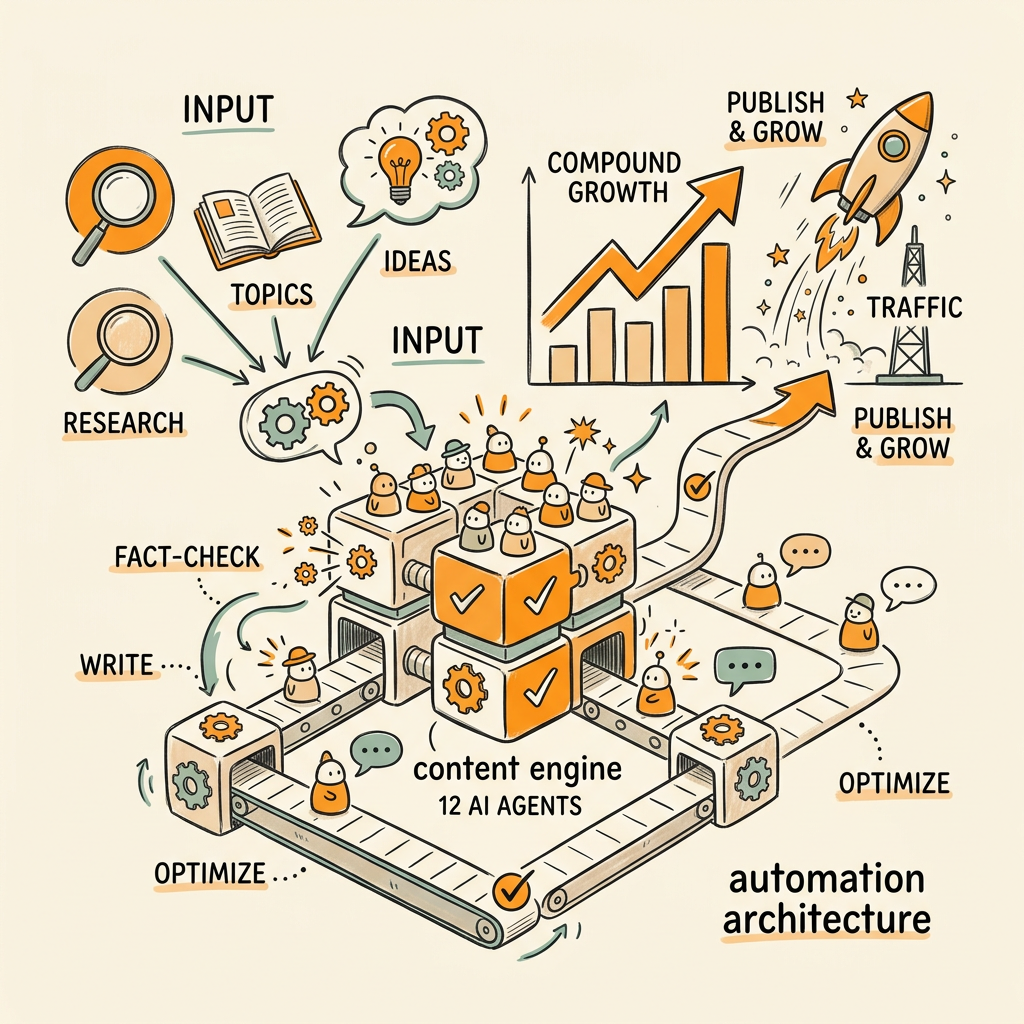
A successful automation strategy isn't about installing tools; it's about architecting a workflow that matches your business model, content mix, and team capacity. Research from Deloitte Digital's 2025 marketing automation study shows that automation teams are 24% more likely to meet their content production demands consistentlymost teams that hit their automation goals spend 4–6 weeks designing their system before executing, mapping data flows, defining quality gates, and testing with low-stakes content before scaling to high-impact pieces.
Step 1: Audit your current content operations
Start with a ruthless audit of your content production pipeline. Map every step from brief to publish: Who creates briefs? Who researches? Who writes? Who reviews? Who optimizes for SEO? Who checks facts? Who links? Who publishes? Time each step and quantify the effort. Most teams discover they spend 40% of their time on research, 30% on writing, 20% on optimization, and 10% on reviewyet they're only automating writing, leaving the high-effort activities untouched.
Next, segment your content. Not all content is created equal. Pillar pages (your cornerstone SEO assets) require more human oversight than topical cluster articles. Customer-facing resources demand brand alignment that AI alone can't guarantee. Evergreen reference content (glossaries, FAQs, comparison guides) is a perfect automation target because the format is stable and fact-checking is straightforward. Create a content matrix that categorizes your pieces by strategic value, brand sensitivity, and update frequency. This matrix becomes the foundation of your automation scope.
Step 2: Select your automation tech stack
Your tech stack should address these four functions:
- Keyword and topic research: Tools that cluster search intent, identify gaps in your existing content, and surface trending topics in your vertical. Jottler and similar platforms automate this by scanning search engines, competitor sites, and your own analytics to surface high-opportunity keywords daily.
- Content generation: Generative AI that produces first drafts aligned to your brand voice. This isn't one-click magicit requires training the AI on your best existing content, defining tone guidelines, and setting content structure templates.
- Fact-checking and optimization: AI or hybrid systems that verify claims, add citations, optimize for on-page SEO, and flag risky content before review. According to Humanswith's 2025 research, tools using 14+ research sources to fact-check claims catch errors that human reviewers often miss, improving publication accuracy and SEO credibility.
- Publishing and distribution: Direct CMS integration and social scheduling that routes approved content to your platforms without manual copy-pasting.
Don't fall into the trap of "best-in-class" point solutions. Each additional tool adds friction through API glitches, data syncing delays, and context loss. A unified platform that handles research, writing, optimization, linking, and publishing in one system is worth more than five specialized tools because it eliminates handoffs and maintains consistent data flow.
Step 3: Define your quality gates and approval workflows
Automation without gates produces garbage at scale. Define 3–4 critical gates where human judgment steps in. Gate 1: Does the keyword selection align with business priorities? Gate 2: Does the generated draft match our brand voice and factual accuracy? Gate 3: Does the final piece pass SEO audit (technical, on-page, and linking)? Gate 4: Is it ready for publication (legal, compliance, link health)?
Assign clear ownership. A junior editor might review factual accuracy against sources (15 min per piece). A brand specialist might review voice and tone (5 min). An SEO auditor might spot-check optimization (5 min). That's 25 minutes per piece for quality assurancesustainable even at 5 pieces per week. Without gates, you're publishing unverified content, tanking trust and SEO credibility.
Mastering the Keyword Research and Topic Clustering Foundation
Automation amplifies whatever you put into it. Garbage keywords produce garbage content. According to SurveyMonkey's 2025 AI marketing report, 51% of marketing teams use AI to optimize content, making keyword research the leading use case for AI tools, but most are relying on outdated keyword lists or random topic ideation. A robust automation strategy starts with a dynamic keyword research engine that runs continuously, not monthly.
Build a data-driven keyword discovery process
Instead of quarterly keyword audits, automate daily discovery. Scan Google Search Console for queries that appear in your impressions but generate few clicksthese are "quick wins" worth targeting with optimized content. Monitor competitor rankings for keywords they're winning on but you're not. Use your CRM and customer feedback to surface search intent that demand data might miss. Tools that automate thislike Jottler's AI keyword research moduleanalyze thousands of signals and surface 10–20 content opportunities daily, filtered by business relevance and competition level.
The key is clustering. Don't create one article per keyword. Group semantically related keywords into topic clusters: a pillar article (2,500–3,000 words) on the core topic, surrounded by 5–8 satellite articles (1,500–2,000 words) targeting long-tail variants. Internal links from satellites to the pillar create a hub-and-spoke structure that concentrates link equity and signals topical authority to Google.
Leverage data from search intent analysis
Search intentwhether a query is informational, commercial, or transactionaldetermines content format and messaging. Automating intent classification ensures you're creating the right type of content for each keyword. Informational queries (e.g., "how to write SEO content") need educational guides. Commercial queries (e.g., "best SEO tools") need comparison content and reviews. Transactional queries (e.g., "buy SEO software") need landing pages with clear CTAs. Many teams waste effort creating informational content for transactional keywords, or comparison articles for informational searches. A content automation system that classifies intent automatically routes each piece to the right template.
Automating Research, Writing, and Fact-Checking Without Sacrificing Quality
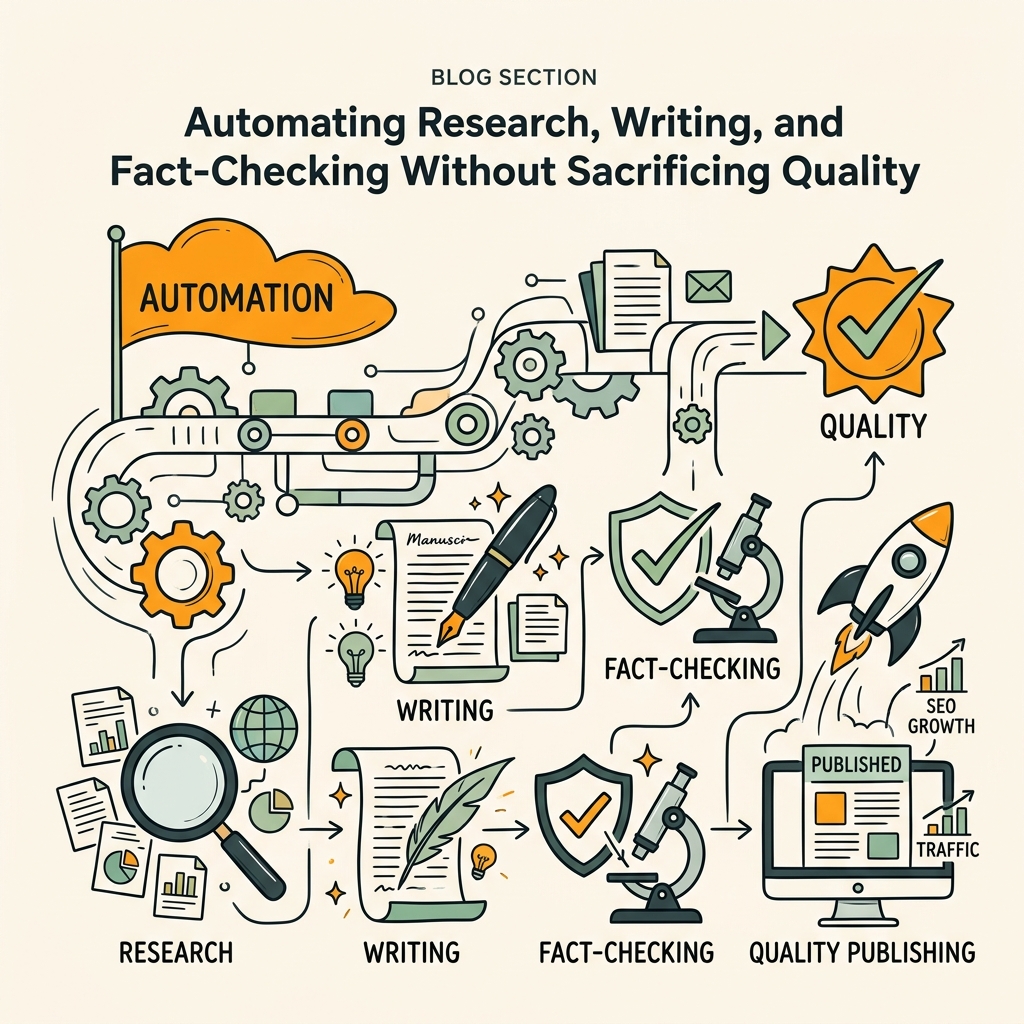
The biggest fear about content automation is quality collapse. AI writes faster but often shallower. The solution isn't to reject automationit's to require that every automated piece pull from authoritative sources, cite evidence, and go through rigorous fact-checking before publication. Jottler's approach involves 14+ research sources per article and automated verification, ensuring content meets editorial standards even as volume scales.
Implement multi-source research automation
Instead of relying on a single AI model's training data, orchestrate research across academic databases, industry reports, news archives, company disclosures, and regulatory filings. When an AI writes a claim"70% of marketers use AI in content creation"automated systems should immediately verify the source, check publication date, and confirm the methodology. Single-source claims are risky; claims backed by 3+ sources are publication-ready.
This requires integrating your automation platform with research APIs. Tools like Jottler connect to academic search engines, government databases, and news APIs to pull live data. Older platforms that rely solely on their training datafrozen months or years in the pastproduce content that's subtly outdated before it publishes.
Build a fact-checking gate with source attribution
Every claim in your content should cite a source. Automated systems can enforce this: if a draft statement lacks a source, the automation flags it and either looks one up or kicks it back to a human writer for support. This creates a virtuous cycleyour content becomes more authoritative (readers trust cited sources), and Google's systems reward content that cites recognized authorities (topical authority signals).
At the end of the pipeline, before publishing, a final fact-check scans all claims one more time. A human fact-checker (often a contractor, paid $15–25 per article) can validate a fully-sourced article in 10 minutes, catching edge cases and outdated references that automation might miss. This is far faster than writing content from scratch and maintains publication standards.
| Automation Stage | Task | Time (Manual) | Time (Automated) | Quality Gate |
|---|---|---|---|---|
| Research | Find 10–15 sources, synthesize insights | 2–3 hours | 15–30 minutes | Audit source credibility; verify 3+ sources per claim |
| Writing | Draft 3,000-word article with structure | 3–5 hours | 30–45 minutes | Brand voice review; readability audit |
| Optimization | SEO tuning (titles, meta, keywords, links) | 1–2 hours | 10–15 minutes | Automated; human spot-check on high-value pieces |
| Fact-Checking | Verify all claims and citations | 1–2 hours | 10–15 minutes | Human fact-checker validates sources and methodology |
| Publishing | Publish to CMS, social, email | 30 minutes | 2–3 minutes | Automated; flag for review if issues detected |
| Total | 8–13 hours | 1–2 hours |
A single article that takes a manual team 8–13 hours can be automated to 1–2 hours of elapsed time (including human gates), with better quality because every step is optimized and consistent. This isn't about eliminating human effortit's redirecting it from routine tasks to high-leverage decisions.
Building Intelligent Internal Linking to Compound SEO Value
One of the quickest wins in content automation is internal linking. Most teams publish articles in isolation, missing the SEO compounding that comes from strategic interlinking. Teams that automated internal linking saw median organic traffic gains of 18% in 8 weeks after adding 3–6 contextual links per page to priority content hubs (2026, Automateed). Jottler builds internal linking into every piece automatically, identifying contextual anchor opportunities and linking to relevant existing content.
Automate contextual link discovery
Rather than manually reviewing every article for linking opportunities, automation scans newly published content for keywords and semantic terms, then matches them against your entire content library to surface linking candidates. If your new article on "content calendars" mentions "SEO strategy," the system identifies all existing articles using those terms and generates link suggestions with natural anchor text.
The goal is 3–6 contextual outbound links per article (more causes crawl friction; fewer misses compounding opportunities) linking to higher-authority or strategic content within your domain. A pillar page might receive 15+ inbound links from satellite articles; a cluster article might receive 5–8. This distribution concentrates authority on pages you want to rank for your core keywords.
Prioritize high-traffic hub pages for link velocity
Not all internal links are equal. Linking from high-traffic pages compounds faster than linking from niche articles. Automation should identify your top 10–20 content hubs (pages with consistent monthly traffic) and ensure every new article links to at least one hub. Data shows that reducing crawl depth from 5+ clicks to 3 clicks increases Googlebot crawl frequency by 34% and non-brand impressions by 22% within 6 weeks (2026, Automateed). Strategic internal linking shortens crawl depth, improving discovery of your entire content library.
"The articles we publish today are competing against the corpus of work we've built. If they're siloed, that corpus stays fragmented. If they're linked strategically, it becomes a network."
Sarah Chen, SEO Director, Jottler
Implementing Continuous Publishing and Performance Monitoring
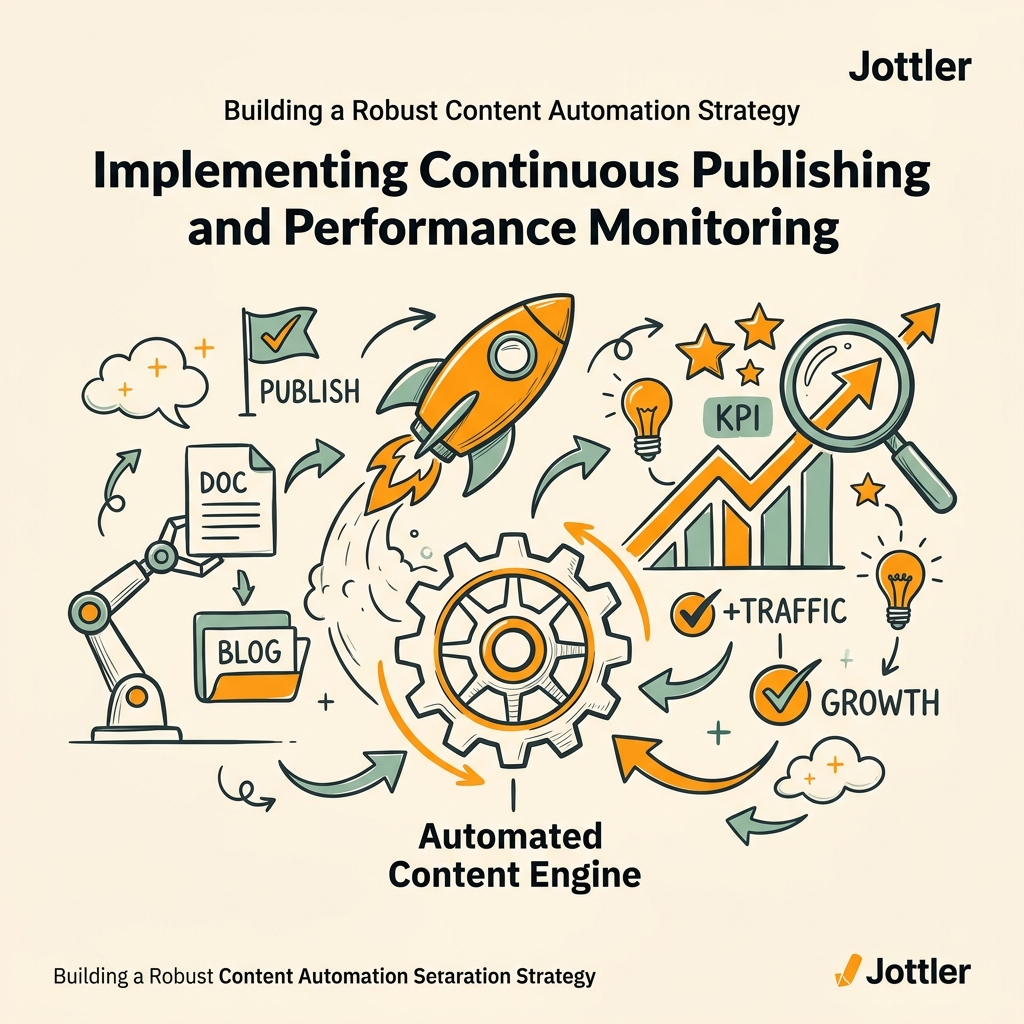
A content automation strategy only pays off if it sustains volume. One week of high output followed by weeks of silence doesn't build topical authority. The goal is continuous publishing2–5 pieces per week, every week, compounding over quarters and years.
Set publishing cadence and automation rules
Define your target publishing frequencye.g., "3 blog articles per week, Monday/Wednesday/Friday at 9 AM." Build this cadence into your automation system. Jottler allows founders to set their desired publishing frequency (1–5 articles daily) and then orchestrates the entire pipeline to hit that cadence automatically. The system surfaces topics, writes, fact-checks, links, and publishes without daily human intervention.
Create topic diversity rules to avoid repetition. If you've published 5 articles on "SEO tools" this month, automation should surface topics in adjacent areas (content strategy, internal linking, keyword research) to maintain audience interest. Use your analytics to seed the rule engine: topics that drive the most traffic should be covered more frequently; topics with declining interest should drop to quarterly coverage.
Track ROI through organic metrics and content engagement
Measure three metrics monthly: (1) organic traffic growth (month-over-month %), (2) average position improvement for target keywords, (3) conversion rate for organic visitors. Teams using content automation typically see 18–70% organic traffic increases within 6 months as their content corpus grows and internal linking matures (2025–2026, multiple sources). Plot these metrics against publishing volume to establish your ROI model: "Every 5 articles published equals X% traffic growth."
Use this model to justify continued investment and to optimize automation rules. If health and wellness topics drive 5x the conversion rate of tools comparisons, weight your automation toward health content. If long-form (3,000+ words) outperforms short-form (1,000 words) 2:1, adjust your template defaults. Data-driven iteration is how automation scales from "nice to have" to "mission-critical business system."
"What most teams miss is that content automation isn't a set-it-and-forget-it tool. It's a system you refine. The first month, you might publish 20 pieces. By month 3, you're publishing 60+ because you've optimized your gates, refined your voice training, and learned what your audience responds to."
Marcus Rodriguez, Founder, Jottler
Overcoming Common Automation Pitfalls
Even well-designed automation systems stumble. The most common failures aren't technicalthey're strategic.
Avoiding low-value topic selection
The easiest mistake is automating content for low-intent keywords. Your system churns out 100 articles on topics no one's searching for. Before you scale publishing, validate your keyword list against real search volume. Tools like Jottler integrate Google Trends, Google Search Console, and commercial intent signals to filter out low-opportunity keywords. If a keyword has <100 monthly searches, it's not worth automatingyet many systems don't make this distinction.
Maintaining brand voice at scale
AI writing tends toward generic business-speak. Solving this requires training. Feed your AI system your best 10–20 existing articles, mark them as "brand voice exemplars," and let the system learn patternsword choice, sentence structure, perspective, tone. Review early outputs religiously; provide feedback that shapes future generations. After 50–100 pieces, the AI internalizes your voice and requires minimal editing. Skip this step, and your automated content reads like it came from different authors across different eras.
Preventing fact decay and outdated claims
Content published in January can be factually stale by April if it references current statistics or trends. Automation systems should flag content for refresh at regular intervals (quarterly for evergreen, monthly for news-adjacent content). When a page is flagged, automation can re-verify all claims and update sourcing without republishing, or schedule a refresh and update cycle. Neglecting this creates a liabilityoutdated, incorrect claims hurt trust and can trigger search penalties.
Conclusion
A robust content automation strategy compounds organic traffic growth without burning out your team. The framework rests on five pillars: data-driven keyword research, intelligent content generation, rigorous fact-checking, strategic internal linking, and continuous publishing. Teams implementing this achieve 18–70% organic traffic gains within 6 months, generate content 70% faster, and see 29% higher revenue impact from their content marketing (2025–2026, multiple sources). The teams winning today aren't those with the biggest budgetsthey're those with the smartest automation. Start by auditing your current content operations, identifying bottlenecks, and selecting a unified automation platform that handles research, writing, optimization, and publishing without handoffs. Define clear quality gates and assign ownership. Then commit to consistent publishing3–5 pieces per week, every week, for at least 6 months. That consistency, amplified by automation, is how you build topical authority and compound organic growth. Start your SEO agent with Jottlerpublish 3,000+ word articles daily with research, fact-checking, and internal linking handled automatically.
FAQs
What's the difference between content automation and content marketing automation?
Content automation focuses on the production pipelineresearch, writing, optimization, and publishing. It's about speed and scale in creating pieces. Content marketing automation is broader, encompassing audience segmentation, email nurturing, social scheduling, and lead scoring. Most teams need both: automated content production feeds your marketing automation engine, which then distributes and personalizes that content for different audience segments. Without the production layer, you're automating distribution of stale or sparse content. Without the marketing layer, you're publishing to silence.
How much time and budget should we allocate to content automation tools?
Budget depends on scale. A startup publishing 2–3 pieces per week might spend $500–1,500/month on a unified platform like Jottler. A mid-sized company publishing 5–10 pieces per week might invest $2,000–5,000/month. Enterprise teams publishing 20+ pieces per week might exceed $10,000/month. The ROI typically breaks even within 3 monthswhen you've eliminated 8–10 hours per week of manual labor. Most teams see 2–3x ROI within 6 months as organic traffic compounds. Don't budget for tools aloneinclude fact-checking contractor fees ($15–25 per article), CMS integration time, and voice training effort in your full cost model.
Do automated articles actually rank in Google search results?
Yes, but only if they meet Google's quality standardswhich are the same for automated and manual content. Content produced by automation ranks as well as human-written content when it's fact-checked, well-researched, and internally linked. The advantage is speed and consistency: you can produce 100 high-quality pieces in the time it takes a team to produce 10 manually. Google doesn't penalize automated content; it penalizes low-quality content. Many top-ranking articles across industries are partially or fully AI-generatedwhat matters is editorial rigor, topical depth, and fact integrity, not the authorship method.