Building a Scalable Content Automation Tech Stack
Teams that rely on manual content workflows are hemorrhaging time and resources. 95% of enterprise organizations now use automation platforms, yet most still patch together fragmented solutions that create bottlenecks instead of efficiency. The content automation market has grown to $11.22 billion in 2025 and is projected to reach $26.48 billion by 2033, but growth without structure only amplifies chaos. The difference between teams that win and teams that struggle isn't the number of tools they ownit's whether those tools work as a unified system. Here's how to architect a scalable content automation tech stack that compounds your organic traffic without constant manual intervention.
Key Takeaways
- 95% of enterprise teams use automation platforms, with mid-market B2B adoption at 78%manual workflows are now a competitive liability (2026)
- Scalable stacks require four integrated layers: Intelligence (research), Generation (AI drafting), Quality (verification), and Distribution (publishing)skipping any layer creates failure
- Marketing automation returns $5.44 per $1 invested, and agentic AI systems deliver 27% faster campaign builds and 19% lower cost per qualified lead
- Intelligence Layer: SEO research tools feeding structured keyword data directly into project management systems to eliminate guesswork and ensure strategic inputs.
- Generation Layer: AI writing agents working from detailed briefs and brand voice guidelines, not generic templates, to produce consistent, on-brand long-form content.
- Quality Layer: Human-in-the-loop verification gates with style checks, factual validation, and SEO optimization before any content reaches your CMS.
- Distribution Layer: Headless CMS integration that publishes with schema markup, internal linking, and automatic social repurposing without manual intervention.
- Orchestration Framework: A central control layer that connects all four layers, routing data, enforcing gates, and tracking KPIs end-to-end.
Why Most Content Automation Stacks Fail
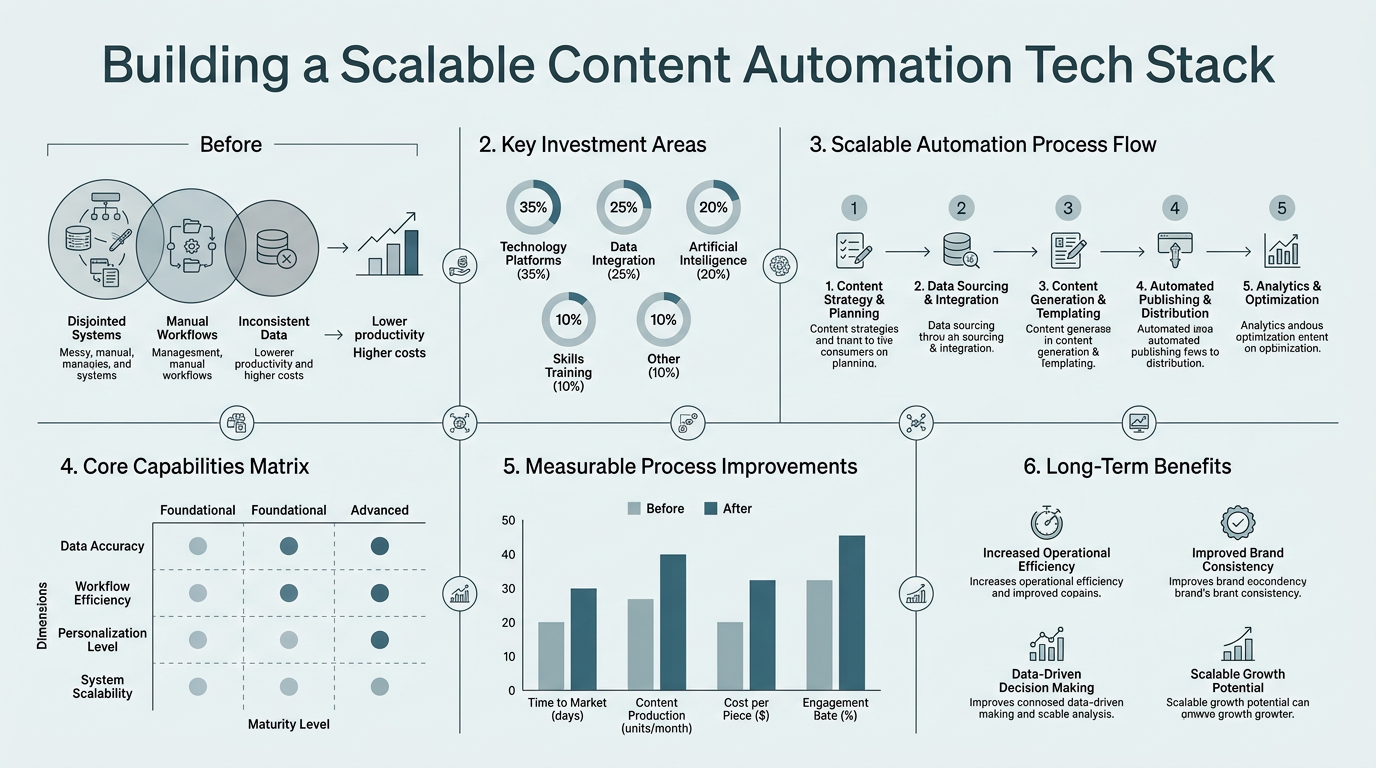
The majority of companies that attempt content automation stop after buying a writing tool and plugging it into their CMS. 50% of IT leaders now plan to invest in workflow automation and AI workflow creation capabilities, but they're solving for the symptom, not the disease. When organizations over-invest in the generation layer while under-investing in intelligence, quality, and distribution, they create exactly what the market doesn't need: more mediocre content competing for the same keywords.
The Fragmentation Trap
Fragmented tool stacks force teams to manage data across platforms manually. A typical team might use a keyword research tool (Semrush, Ahrefs), a project management system (Asana, Monday), an AI writer (ChatGPT, Jasper, or a custom model), a CMS (WordPress, HubSpot), and a scheduling tool (Buffer, Hootsuite). Each handoff is a potential failure point. Research sits in a spreadsheet, briefs live in Asana, drafts land in Google Docs, and by the time something reaches the CMS, half the metadata is missing and nobody's sure if the internal links are correct. That's not a tech stackthat's a Frankenstein. Teams trying to operate at scale with this architecture quickly hit a wall: either hire more people to manage the chaos (expensive) or accept declining quality (career-limiting).
Over-Rotation on Generation, Under-Investment in Intelligence
Most founders discover AI writing tools first because they're flashy and immediate. A CEO asks, "Can AI write our blog posts?" and suddenly $500/month goes to an AI writer. But without a strategic intelligence layer feeding it structured data, that tool produces strategically useless content. The AI doesn't know your target keywords, your competitive gaps, or your audience's actual pain pointsit just extrapolates from a generic prompt. Organizations failing to integrate research tools directly into their content workflow risk generating content that ranks nowhere because it was never designed to answer a specific search intent. The quality layer then becomes reactive: editors catch generic content and ask the AI to revise, wasting cycles on a fundamentally flawed brief.
The Missing Quality Gate
Automation without guardrails breeds mediocrity at scale. Many teams try to automate quality away entirelythey set up AI agents to write and publish directly to their CMS with zero human review. This approach works for three weeks until you publish something factually wrong, off-brand, or with a logical error that damages credibility. Quality isn't a checkbox; it's a system. A scalable stack requires at least three defined gates in the quality layer where humans review, approve, or reject content before it goes live. The tools do the heavy lifting; humans prevent disasters.
The Four-Layer Architecture: How Scalable Stacks Work
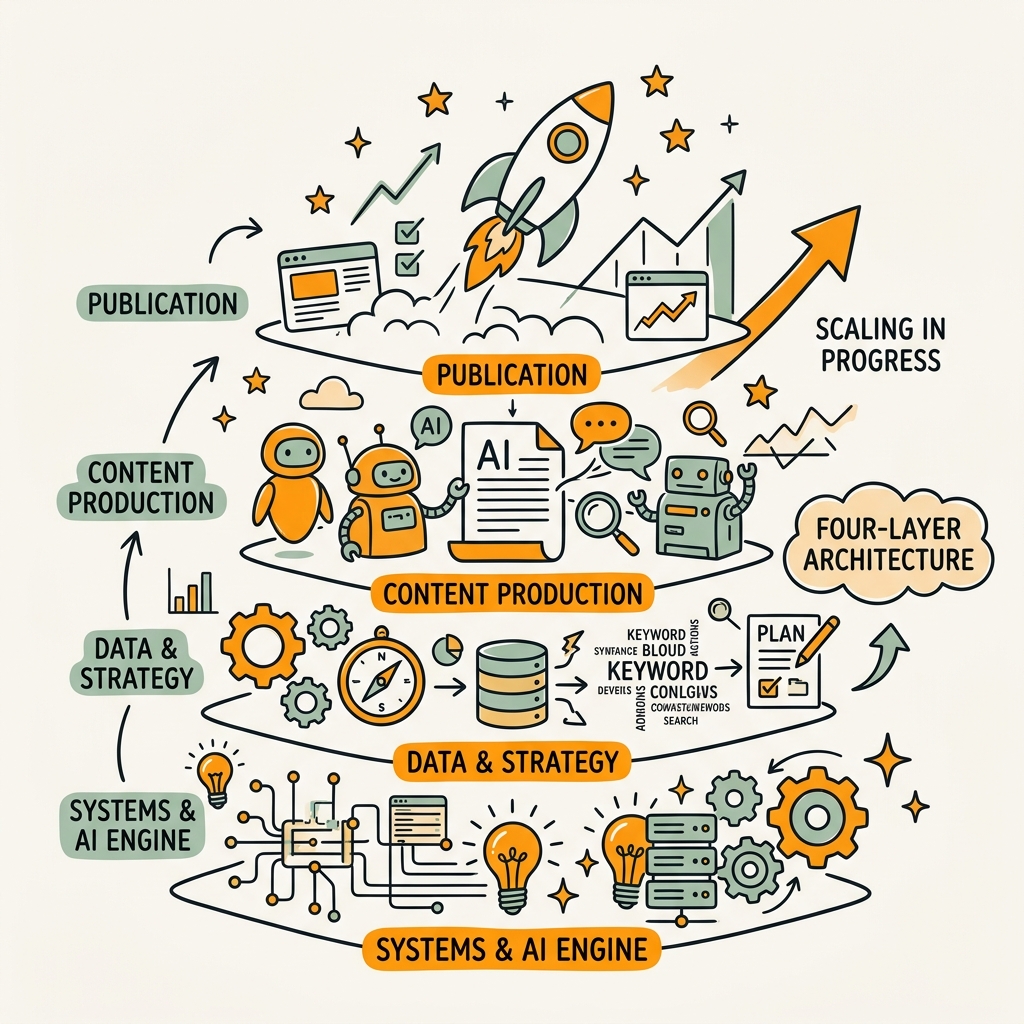
Every successful content automation system in 2026 follows the same foundational pattern: Intelligence feeds Generation, Generation passes to Quality, and Quality hands off to Distribution. Each layer has a specific job, and none can be skipped. According to Codewords' guide to content automation workflows in 2026, content automation in 2026 is a workflow category, not a writing categorythe strongest systems unify planning, drafting, optimization, approvals, and publishing into a single content engineering system.
Layer 1: Intelligence (Strategic Research and Planning)
The intelligence layer is where your strategy lives. It answers the fundamental question: "What content does your market actually need?" This layer pulls data from SEO research tools (Semrush, Ahrefs, SimilarWeb), competitive analysis platforms, and customer insight repositories (support tickets, sales interviews, survey data). The intelligence layer enriches that raw data into actionable briefs: target keywords clustered by topic, search intent classification, content gap analysis, and competitive positioning. It feeds all downstream systems with structured metadata, not vague requests.
A practical intelligence layer looks like this: Your keyword research tool identifies 200 untapped opportunities in your space. A project management system organizes them into topic clusters aligned with your product pillars. Each cluster generates a content brief that specifies the exact keyword target, search intent, audience persona, outline structure, and required sections. That brief is the contract between your strategy and your AI. Without it, generation becomes guesswork.
- Keyword clustering: Group 20–50 related keywords into a single pillar topic to build topical authority instead of scattered one-off articles.
- Search intent mapping: Classify each keyword as informational, transactional, or navigational to ensure content matches what people are actually searching for.
- Competitive gap analysis: Identify topics your competitors own and subjects they're leaving unaddressedthose gaps are your opportunities.
- Audience persona alignment: Tie each content cluster to a specific buyer persona and their stage in the decision journey.
- Content brief generation: Auto-generate structured briefs that include target keywords, section outline, required examples, tone guidelines, and internal link recommendations.
Layer 2: Generation (AI Drafting with Brand Voice)
Once intelligence feeds a structured brief into the generation layer, AI agents take over. The key difference between effective generation and wasted cycles is this: AI writing tools must work from detailed briefs, not generic prompts. A brief specifies exact output format, required sections, target word count per section, examples to include, and brand voice guidelines. The AI doesn't guess; it executes specifications. Think like an engineer. Avoid generic requests like 'write a content brief.' Be specific. Define the desired output format and the exact information to include.
A scalable generation layer does more than write prose. It generates structured metadata: SEO title variations, meta descriptions, FAQ schema, internal link recommendations, and related topic suggestions. This metadata becomes the foundation for the quality layer and feeds directly into your CMS, eliminating manual tagging. The AI agent should also pull from multiple data sources: training on your brand voice (past articles, messaging guidelines), enriching content with cited examples, and cross-referencing your product documentation to ensure accuracy.
Layer 3: Quality (Human Verification and SEO Optimization)
Quality acts as your immune system against the generic AI content flooding every SERP. This layer enforces three types of gates: editorial review (does it match brand voice and accuracy standards?), SEO optimization (are keywords naturally integrated? Does the outline align with search intent?), and compliance (does it adhere to legal or industry requirements?). Critically, quality gates happen before publishing, not after.
A functional quality layer includes: A human editor with a style guide reviewing first drafts within 24 hours. An SEO specialist checking keyword integration, internal link placement, and schema markup. A subject matter expert validating claims and ensuring technical accuracy. These reviewers don't rewrite the entire article; they flag issues, request revisions, and approve for publication. Tools designed for content automation at scale enforce gatekeeping workflows before content reaches your CMS, ensuring quality doesn't degrade as velocity increases.
| Quality Gate | Responsibility | Pass/Fail Criteria |
|---|---|---|
| Editorial Review | Human editor validates brand voice, tone, and accuracy | Matches style guide; claims are verified; writing is clear and on-brand |
| SEO Optimization | SEO specialist checks keyword placement, intent match, internal links | Primary keyword in H1 and first 100 words; secondary keywords distributed; internal links are contextual |
| Technical Compliance | Compliance or subject matter expert validates accuracy and regulatory fit | Claims backed by sources; no factual errors; complies with industry standards |
Layer 4: Distribution (Publishing with Automation and Repurposing)
The distribution layer is where approved content gets published to your CMS and automatically repurposed across channels. A scalable distribution layer is headlessmeaning your content is decoupled from your presentation, allowing a single piece to be reformatted for blog, email, social media, and knowledge bases simultaneously. When an article is approved, the distribution layer: publishes the article to WordPress or HubSpot with correct metadata and schema markup. Creates social media snippets and schedules them across LinkedIn, Twitter, and industry forums. Extracts key points and converts them into email segments for nurture campaigns. Indexes internal links and updates related articles with new references.
Automation in distribution means you're not manually scheduling five social posts per article or copying metadata between systems. One approval triggers a workflow that touches fifteen channels. According to recent research, 90% of organizations integrate file transfer and data connectivity tools with their automation platforms to ensure seamless distributionand this is where you see that integration pay off. When an article mentions a competitor or references a previous topic, the system automatically links them. When you need to refresh old content with new data, the system identifies articles eligible for updates and flags them for the intelligence layer.
Building Your Intelligence-First Stack: Practical Components
Now that you understand the layered architecture, here's what a functional 2026 content automation stack actually looks like. The specific tools matter less than ensuring each layer connects to the next without manual handoffs. Your stack should include a keyword research and SEO planning tool (primary intelligence input), a project and content management system (coordination hub), an AI writing platform or agent framework (generation engine), a CMS with API integration (publishing destination), and an orchestration platform to connect them all. Without orchestration, you're back to manual data transfer between systems.
Intelligence Layer Tools and Integration
Start with tools that output structured data your generation layer can consume. Semrush and Ahrefs both offer API access, allowing you to pull keyword clusters, search volume, and competitive analysis directly into your project management system. As research shows in Slate's analysis of 2026's best content automation tools, autonomous systems are increasingly handling research workflows by evaluating hundreds of keyword opportunities and surfacing the highest-potential clusters automatically. The goal is zero manual export-and-paste. When a researcher identifies a topic cluster, the system should automatically create a content brief in your project management tool with keyword recommendations, outline suggestions, and internal link opportunities pre-populated.
- Keyword research platform: Semrush, Ahrefs, or SE Ranking for cluster analysis and gap identification
- Competitive intelligence: SimilarWeb or Clearscope for analyzing competitor content and identifying content gaps
- Project management: Asana, Monday.com, or Notion for organizing briefs and tracking content through the pipeline
- Brief automation: Custom scripts or no-code platforms (Zapier, Make) that auto-generate content briefs from keyword clusters
Generation Layer: Choosing Between Standalone Tools and Integrated Platforms
The generation layer is where you'll make your biggest choice: standalone AI writing tools (ChatGPT, Claude, Jasper) or an integrated content platform that combines generation with intelligence, quality, and distribution. Standalone tools are cheaper upfront ($20–500/month) but require you to manage all four layers separately. Integrated platforms cost more ($1,000–5,000+/month) but eliminate the handoff friction and enforce workflow discipline automatically.
Standalone tools work for small teams publishing 1–2 articles per week. You use your intelligence data to write a brief in Google Docs, paste it into ChatGPT or Jasper, get a draft, send it to an editor via email, make revisions, and finally paste it into WordPress. It's manageable until you try to scale to 10+ articles per weekthen the friction becomes a bottleneck. Integrated platforms combine research-to-publish workflows with built-in SEO optimization, fact-checking, and internal linking. For founders and marketing teams trying to scale organic traffic, integrated platforms eliminate the manual coordination that kills scalability at growth stage.
Quality Layer: Gatekeeping Before Publishing
Your quality layer doesn't need expensive softwareit needs process discipline. Create a simple approval workflow: Draft → Editorial Review (24 hours) → SEO Check (24 hours) → Publish. Use a spreadsheet or your project management tool to track which articles are in which stage. Add two humans to this loop: an editor and an SEO specialist. If you're bootstrapped, these can be fractional roles (part-time contractors). The cost of hiring a part-time editor ($500–2,000/month) is trivial compared to the cost of publishing low-quality content that doesn't rank.
"Quality is not a feature you can automate away. It's a system. AI accelerates drafting, but humans prevent disasters. Build your quality gates before you scale generation."
Distribution Layer: CMS Integration and Schema Automation
Your CMS is the hub of your distribution layer. WordPress, HubSpot, Contentful, or Sanitythe choice depends on your scale and needs. Critically, your CMS must support: API integration so approved content publishes automatically, schema.org markup for FAQs and structured data, internal linking suggestions based on topic clusters, and audit logs so you know exactly who approved what and when. Headless CMS platforms like Contentful or Sanity are superior for omnichannel publishing (blog + email + knowledge base) because they separate content from presentation, allowing one article to be reformatted for multiple channels automatically.
Once content hits your CMS, automation continues: Your distribution system automatically generates social media snippets and schedules them. Email marketing tools pull relevant content and create nurture segments. Your knowledge base indexes articles and makes them searchable. Analytics platforms track which articles drive traffic and conversion, feeding data back to your intelligence layer for future optimization.
How to Measure ROI and Know Your Stack Is Working
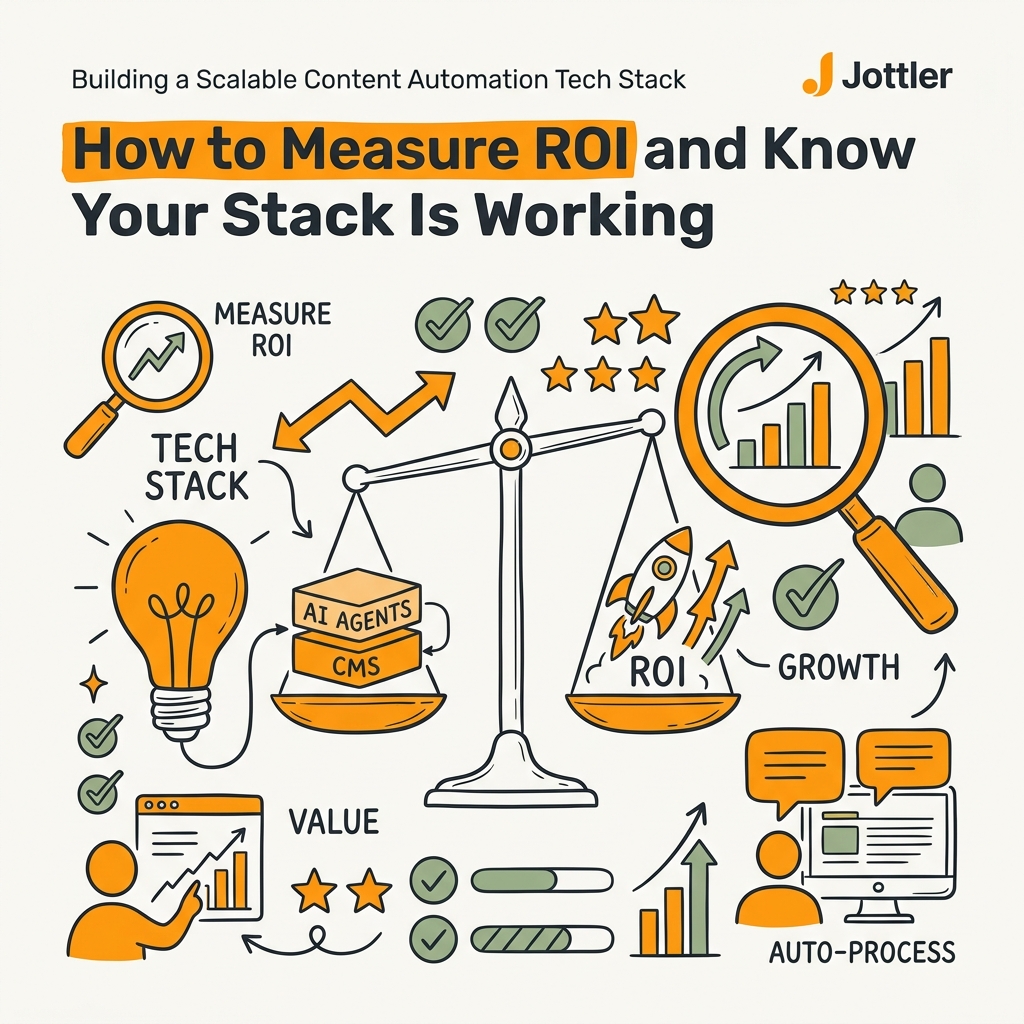
A scalable content automation stack compounds organic traffic, but you need clear metrics to know if your specific stack is actually working. The primary benchmark is: Marketing automation returns $5.44 per $1 invested. Your stack should exceed that. Secondary metrics include content production velocity (how many articles per week), quality consistency (how many pass the first approval gate), and downstream impact (pipeline influence and revenue attribution).
- Content production velocity: Measure articles per week published vs. your target. Scalable stacks should push velocity from 2–3 articles/week to 10–20+ without proportional increase in headcount.
- First-gate approval rate: Track what percentage of AI-generated drafts pass editorial review without major revisions. Above 70% means your generation layer is working well. Below 50% signals weak briefs or misaligned AI training.
- Time-to-publish: Measure days from brief creation to live article. Scalable stacks should compress this to 3–5 days. Manual workflows typically take 10–14 days or longer.
- Organic traffic attribution: Track which content pieces drive traffic and conversions. Calculate cost per article vs. incremental revenue generated. Median B2B teams attribute 23% of marketing-sourced revenue to automated workflowsbenchmark against this.
- Internal link coverage: Measure how many internal links each article includes and whether they're contextually relevant. Scalable stacks should achieve 3–5 internal links per article automatically.
Common Pitfalls and How to Avoid Them
Building a scalable content automation stack is hard, but the failures are predictable. Most teams stumble on one of these five rocks.
Starting With Generation Before Intelligence
This is the most common mistake. Founders buy an AI writer (ChatGPT, Jasper) before building their keyword research and content strategy. The AI then produces topically incoherent, strategically misaligned content that nobody searches for. The fix: Invest in your intelligence layer first. Map your keyword landscape, identify topic clusters, and build content briefs before you write a single line of AI copy. This front-loads work but prevents months of wasted output.
Skipping the Quality Layer
The temptation to bypass human review and publish directly from AI is strong. Resist it. Your brand credibility and ranking potential depend on quality gates. You don't need a full editorial teamyou need one skilled editor and one SEO person. The $1,000–2,000/month you spend on fractional reviewers is trivial compared to the damage one factually wrong or off-brand article does to your domain authority.
Failing to Connect Your Layers
Teams often treat intelligence, generation, quality, and distribution as separate silos. Research data lives in a spreadsheet. Briefs get emailed. Drafts land in Google Docs. Approvals happen via Slack. And somehow the final article ends up in WordPress with half the metadata missing. Invest in orchestration: Use Zapier or Make to automate data flow between tools. Build APIs to connect your research tool to your project management system. Use CMS APIs to publish content programmatically. The more manual handoffs you eliminate, the more reliably you scale.
Over-Investing in Tools, Under-Investing in Process
A common trap is buying five different tools and expecting them to magically work together. You end up paying $5,000/month in SaaS fees and still managing data manually. Instead, pick two or three core tools and integrate them obsessively. A $29/month research tool + a $50/month project management system + an integrated content platform can outperform a six-tool stack that's poorly connected. Process beats breadth.
Neglecting to Iterate Based on Performance Data
Set up your measurement system from day one. Track which content drives traffic, what types of articles get the best approval rates, and which keywords convert to customers. Feed this data back into your intelligence layer. If long-form articles outperform short-form, brief your AI to write longer. If how-to content converts better than listicles, cluster more how-to keywords. Your stack should get smarter every month based on accumulated performance data.
Why Integrated Platforms Beat Point-Solution Stacks
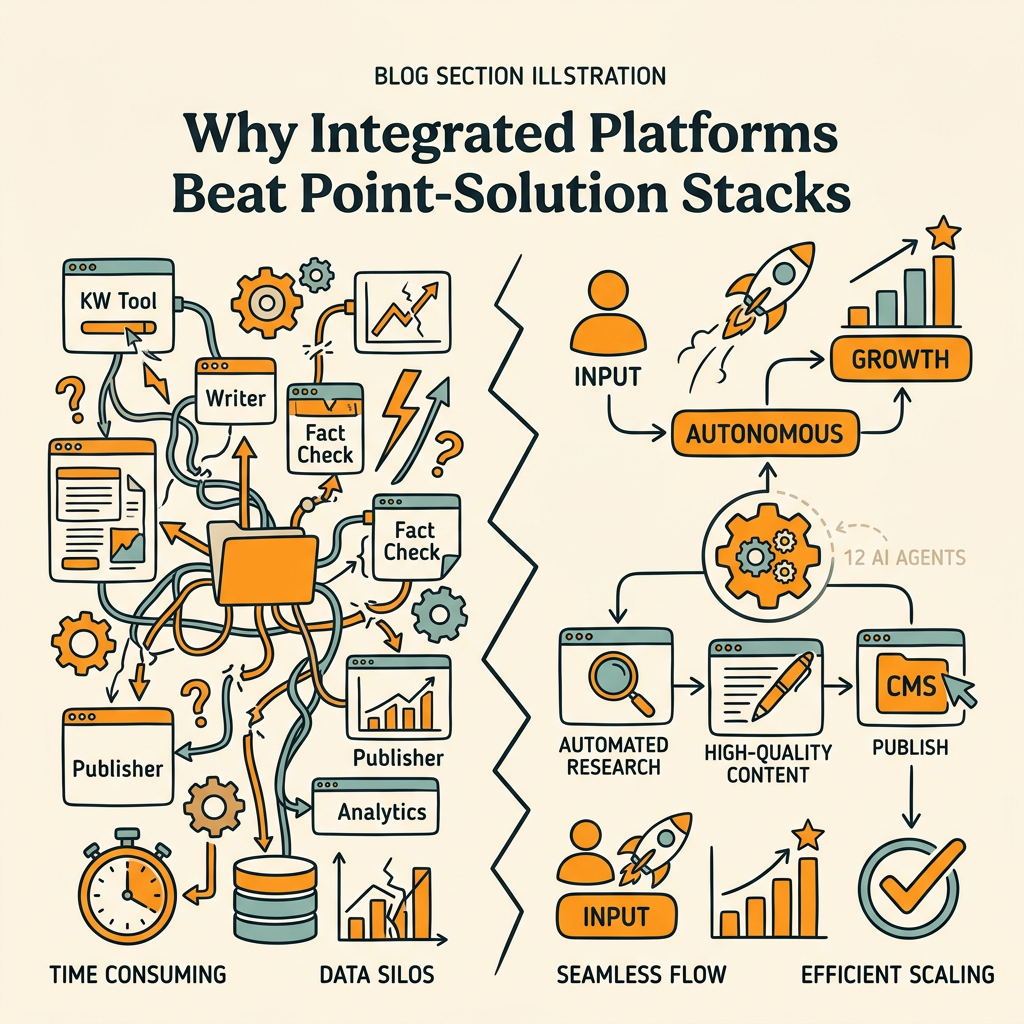
A founder or small team can theoretically build a scalable stack from five separate tools, but the orchestration overhead is immense. This is why integrated platforms designed for content automation are increasingly winning market share. An integrated platform handles research, writing, fact-checking, and publishing in one system, eliminating the need to manage data across platforms. For founders at growing companies with limited engineering or operations bandwidth, this compounds into a significant advantage: You go from thinking about content infrastructure to thinking about content strategy.
When your research feeds directly into your AI agents, your AI agents output structured metadata, your metadata populates your CMS, and your CMS automatically generates social snippetsyou've eliminated the entire middle layer of manual coordination. Teams using integrated platforms report 27% faster campaign build times and faster time-to-publish than teams manually orchestrating point solutions. That speed advantage translates into more content, higher iteration velocity, and more opportunities to rank.
Your Next Move: Building Phase by Phase
You don't need to build your entire stack overnight. Phase 1 (Month 1–2): Audit your current tool usage and identify your biggest bottleneck. If you're not doing keyword research systematically, fix that first. If you're writing manually, automate generation. If you're publishing without quality gates, add human review. Pick the single biggest leak and plug it.
Phase 2 (Month 3–4): Connect your intelligence layer to your generation layer. Feed your keyword research into a structured brief. Make sure your AI writer can access those briefs without manual copy-paste. Phase 3 (Month 5–6): Build your quality gates. Add human review and establish approval workflows. Phase 4 (Month 7+): Automate distribution. Integrate your CMS so approved content publishes automatically with metadata and internal links.
By month seven, you should have a functional four-layer system. By month twelve, you should be publishing 10–20+ articles per month with half the manual effort of your previous workflow. At that velocity, your organic traffic compounds. This is how winners in your space are building their engines in 2026.
Conclusion
Building a scalable content automation tech stack is not about buying the most tools. It's about architecting a system where Intelligence feeds Generation, Generation flows to Quality, Quality hands to Distribution, and orchestration connects all four layers without human friction. The content automation market is now worth $11.22 billion and growing toward $26.48 billion by 2033, because the winners understand that consistent, strategic, high-quality content compounds organic traffic at a velocity manual teams can never match.
The teams winning in 2026 are not those with the most expensive tools. They're the teams with the clearest processes, the most integrated workflows, and the discipline to measure what actually works. Teams adopting agentic AI systems are delivering 27% faster campaign builds and 19% lower cost per qualified leadbut only if those systems are properly architected with intelligence, generation, quality, and distribution as integrated pillars.
Start with your intelligence layer. Build your quality gates. Connect your tools. Measure your impact. Your organic traffic will scale faster than you expect. Start your SEO agent today and begin compounding your content advantage.
FAQs
What is the most important layer in a content automation stack?
The intelligence layer is the most important because it determines what content you create. Without strategic keyword research, competitive gap analysis, and audience insights feeding your system, your AI will generate content that nobody searches for. A scalable stack always starts with intelligenceresearch and planning discipline before any word is drafted. Many teams skip this and wonder why their automated content doesn't rank. Your intelligence layer is your strategy; everything else executes it.
Can I build a scalable content automation stack on a tight budget?
Yes, if you prioritize integration over breadth. You don't need six toolsyou need two or three tools that talk to each other. A $29/month keyword research tool, a free project management platform (Asana has a free tier), a $100/month AI writing platform, and a CMS with good API support is a functional, scalable stack for under $200/month. The biggest cost savings come from integrating via no-code tools like Zapier to eliminate manual handoffs. Budget is not your bottleneck; process is.
How long does it take to see ROI from content automation?
Most teams see ROI within 3–6 months if they start with a clear intelligence layer and measure correctly. Month 1–2, you're building processes and publishing your first 5–10 automated articles. Month 3–4, you have 15–20 pieces published and starting to track which drive traffic. Month 5–6, you have enough data to see which content clusters convert and you can optimize your intelligence layer accordingly. The benchmark is $5.44 in return per $1 invested in automationif you're not hitting that by month 6, your quality gates or intelligence layer needs work.