Building a Topical Authority System for Sustained Rankings
Google no longer rewards isolated blog posts. Sites showing topical depth now reach ranking goals 3x faster than sites relying mainly on domain authority or link building, according to analysis of 400+ SEO campaigns in 2026. Yet most busy marketing teams still treat content creation as a one-off activity: write an article, publish it, move on. No internal linking strategy. No follow-up content. No system. The result? Weak topical authority, stalled rankings, and wasted marketing spend.
Building a topical authority system fixes this. It's a repeatable framework that lets you systematically own a topic across search engines and AI platforms. Here's what the data shows: sites with 25+ tightly interlinked articles in a cluster see 40–70% more keyword rankings within 3–6 months. And after the March 2026 core update, topical coherence became a bigger ranking lever than raw backlink volume in many competitive niches.
This guide walks you through building a topical authority system from scratch, measuring it accurately, and scaling it without burning out.
Key Takeaways
- Topical authority drives 3x faster ranking velocity than domain-authority-first strategies (SearchAtlas, 2026)
- A complete cluster needs roughly 25–30 interlinked articles to show measurable ranking impact within 3–6 months
- Pillar pages (3,000–5,000 words) paired with 4–8 supporting cluster pages form the core architecture
- Intent-first clustering and quarterly content maintenance are now standard practice, not optional add-ons
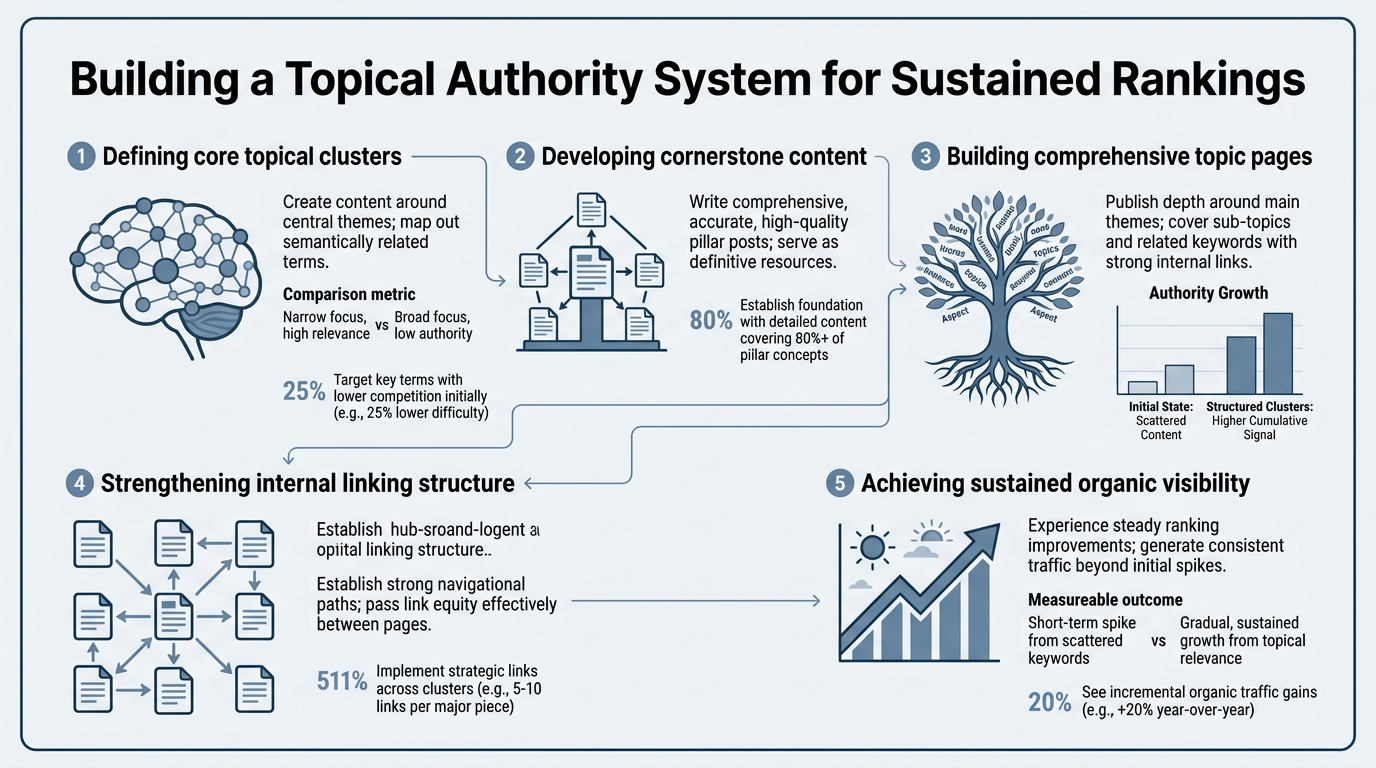
- Define Your Topic Anchor: Choose a pillar topic with real search demand, low-to-medium competition, and strategic fit for your business.
- Map Subtopics by Intent: Identify 8–15 subtopics that represent all major user intents around your pillar, then validate them against actual search volume.
- Build a Pillar-and-Cluster Architecture: One deep pillar page links to 4–8 supporting pages, each answering one specific question with original depth.
- Interlink Deliberately: Use descriptive anchor text to connect every cluster page back to the pillar and to semantically related sibling pages.
- Publish and Maintain on Cadence: Start with strong foundational content, then add 2–4 support pages monthly, and refresh quarterly.
What Is Topical Authority and Why It Matters More in 2026
Topical authority is Google's perception that your site is a comprehensive, reliable source for a specific topic. It emerges not from individual standout articles but from the breadth and depth of your coverage across interlinked pages. In 2026, it matters more than ever because it's measurable, repeatable, and compounds.
For years, SEOs chased domain authority: "Get more backlinks, boost your site-wide power, rank for everything." But that approach is increasingly inefficient. Sites prioritizing topical authority over domain authority now outperform competitors with 60% more backlinks in shared keywords, according to SearchAtlas's 2026 analysis. The shift is driven by two forces: semantic search algorithms that reward thematic depth, and AI search systems that need evidence of real expertise before citing your content in AI Overviews.
"Topical authority compounds faster than domain authority in competitive niches. Every new cluster page reinforces the topical signal, making subsequent pages rank faster. This is not linear growth—it's exponential."
— SearchAtlas SEO Research Team, 2026
The Ranking Velocity Difference
Speed matters. Topical authority doesn't just win in the long run; it wins faster. Teams using a topical-authority-first strategy reached their ranking goals 3 times faster than those relying on domain authority alone, according to a 400+ campaign analysis. Why? Because you're not competing for random keywords across 10 different topics. You're dominating one niche with overwhelming coverage, strong internal structure, and concentrated effort. Competitors spreading their content thin take 18 months to rank for 5 keywords in a category. You rank for 40 in 6 months because every article reinforces every other article. According to Xictron's research, the compound effect of topical depth accelerates exponentially once you hit critical mass.
Topical Authority and AI Search Visibility
58.5% of Google searches now result in zero clicks, with AI Overviews appearing on up to 30% of queries. That sounds terrifying until you realize: AI systems cite sites with topical authority more often than generalist blogs. When ChatGPT, Perplexity, or Google's AI needs an authoritative source on "content cluster strategy," it pulls from sites that have written 10+ connected articles on the topic. It's not a coincidence. The algorithm literally looks for evidence of thematic depth. Topical authority is your moat against AI cannibalization.
"In our analysis of 1,200+ AI Overviews, sites with 20+ interlinked articles in a topic cluster were cited 4.2x more often than sites with scattered, unlinked content. The AI is looking for coherence."
— Xictron AI Search Study, 2026
How to Define Your Topic Anchor and Validate Demand
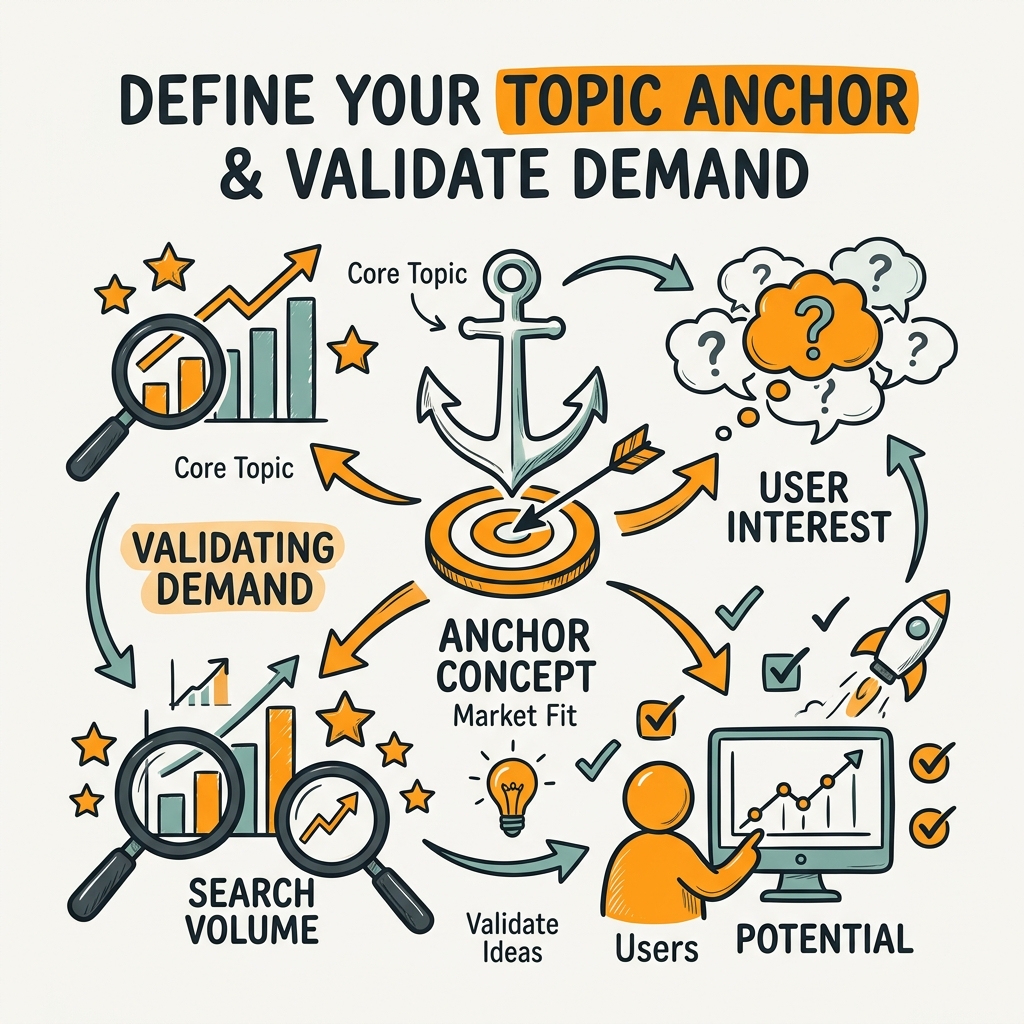
The first mistake: picking a topic based on gut feeling. The second mistake: picking one based purely on volume without checking competitive landscape. Your topic anchor needs three things: demand, strategic fit, and a winnable competitive position.
Criteria for Choosing Your Pillar Topic
Spend a week on this step. It's the decision you'll live with for the next 12 months. Evaluate candidates against these criteria:
- Search demand: Minimum 100+ monthly searches in your target keyword. Ideally 500+. No demand = no customer acquisition.
- Strategic alignment: Does this topic ladder up to a product, service, or business goal? "Content marketing ROI" aligns with a SaaS platform selling analytics. "Yak herding in Mongolia" does not, unless you sell yak products.
- Competitive feasibility: Scan the top 10 SERP results. Are they thin blogs, thin Wikipedia entries, or comprehensive guides? If the top 3 are comprehensive, you need a credible angle to beat them. If the top 3 are thin, you have room to build authority faster.
- Subtopic breadth: Can you envision 8–15 distinct subtopics around this pillar? If you can only think of 3 angles, the topic may be too narrow.
- Time horizon: Expect 4–6 months before you see meaningful ranking lift. Are you committed to this topic for that long, plus ongoing maintenance?
Validating Topic Demand with Intent-Based Research
Once you've picked a pillar, don't just check volume. Check intent. Use SearchAtlas or Semrush to pull the top 20–30 related keywords. Then bucket them by intent: informational, commercial, transactional. This tells you what questions people actually ask about your topic. A pillar on "content marketing strategy" must address informational queries ("What is content marketing?"), commercial queries ("best content marketing tools"), and transactional queries ("content marketing software pricing"). A cluster that addresses all three intent buckets will capture more searches and build authority faster than one that only tackles one intent.
Real example: If you're building authority on "AI content generation," validate that there are informational searches ("How does AI content generation work?"), commercial searches ("best AI writing tools"), and transactional searches ("AI content generator free trial"). If one bucket is missing or tiny, your topic may be too narrow. AI content generation tools like Jottler automatically validate demand across intent buckets before publishing, so you're never guessing whether your topic has real demand.
Building Your Pillar-and-Cluster Content Architecture
The architecture is simple but requires discipline: one pillar page (3,000–5,000 words) paired with 4–8 supporting cluster pages (1,500–2,500 words each). Every cluster page links back to the pillar. Cluster pages link to relevant sibling pages. The pillar links to all clusters. That's the structure. Now let's build it.
Writing and Structuring Your Pillar Page
The pillar page is not a glossary of your subtopics. It's a strategic overview that defines the topic, explains its relevance, and summarizes the major subtopics at a high level while directing readers deeper into cluster pages for specific details. Think of it as the "table of contents" that signals to Google and users that you own this topic comprehensively.
Structure your pillar like this:
- Introduction: Define the topic and explain why it matters. Use original insight or data if possible.
- Core components or methodologies: Break the topic into 4–6 major pieces. One paragraph per piece; link out to cluster pages.
- Common mistakes or misconceptions: Show expertise by distinguishing your take from common shallow advice.
- Implementation roadmap: Give readers a sense of how to get started, then direct them to cluster pages for depth.
- FAQ section: Answer the questions you know cluster pages will address in more depth.
Length: 3,000–5,000 words. Don't pad it. Keep it scannable with clear subheadings. Make every sentence earn its place. Tools like autonomous SEO agents automate this entire discovery-to-publication pipeline, allowing you to publish deep pillar pages and cluster content on a consistent cadence without the manual overhead of solo research and writing.
Designing Cluster Pages for Depth and Distinction
Each cluster page answers one specific question that the pillar only touches on. If your pillar is "Content Marketing Strategy," a cluster page might be "How to Build a Content Marketing Roadmap" or "Content Marketing ROI: How to Measure It Right." It's not a restatement of the pillar; it's an excavation.
Rules for cluster pages:
- Distinct focus: Cover one subtopic deeply. If you're tempted to cover two subtopics in one page, split it.
- Original evidence: Include examples, case studies, data, screenshots, or interviews. Avoid regurgitating the pillar.
- Optimal length: 1,500–2,500 words. Enough for depth, short enough to stay focused.
- Link architecture: Link back to the pillar in the intro or early in the body. Link to 2–3 related sibling cluster pages where contextually relevant. Use descriptive anchor text, not "click here."
Example linking approach: In a cluster page on "Content Marketing Metrics," you'd link to the pillar ("content marketing strategy") once early on, then link to related cluster pages like "Building a Content Marketing Roadmap" when the topic naturally arises. That's 3–4 internal links total, all earned by genuine relevance.
The Internal Linking Strategy That Actually Compounds Authority
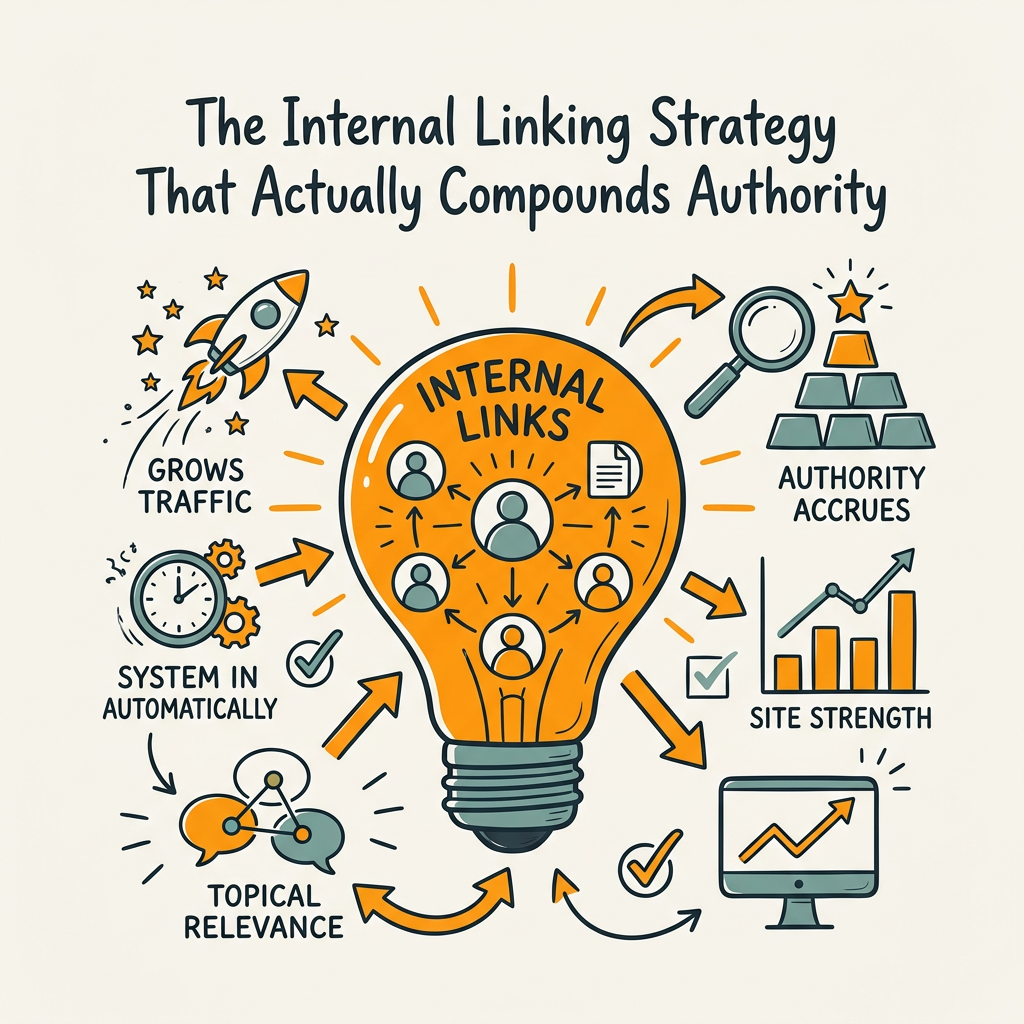
Internal linking is where most topical authority systems fail. Teams either over-link (every page linked to every other page, diluting signal) or under-link (pages sitting orphaned with one incoming link). The fix is a tiered, intent-driven linking model.
The Pillar-Hub-and-Spoke Model
Your pillar page is the hub. Cluster pages are spokes. A cluster page links back to the hub (1–2 times), then to 2–3 sibling spokes. Cross-cluster links are rare and only used when two clusters are semantically inseparable.
Visual logic:
- Pillar page → links to all cluster pages (4–8 links total, placed naturally in the intro or a "learn more" section)
- Cluster page A → links back to pillar (once), + links to clusters B and C (2 links total)
- Cluster page B → links back to pillar (once), + links to clusters A and D (2 links total)
- Do NOT link cluster A to cluster D if they're not semantically connected. Keep sibling links intentional.
Anchor text matters. Use descriptive anchors: "content marketing strategy pillar," "how to measure content marketing ROI," never "learn more" or "read more." Descriptive anchors tell Google the topical relationship between pages. Generic anchors are wasted opportunities.
Freshness and Retroactive Linking
When you publish a new cluster page, don't just link from the pillar. Go back to related existing cluster pages and add retroactive links to the new page if the relationship is genuine. This signals to Google that your coverage is expanding and strengthens the new page's crawlability. But only do this when the topical connection is real. Forced cross-links dilute the cluster's coherence.
Maintenance schedule: quarterly audits of internal links. Every 3 months, review:
- Are all cluster pages linked from the pillar?
- Do cluster pages have 2–3 relevant sibling links?
- Are any links outdated or broken?
- Have you published new content that should be retroactively linked from older pages?
Publishing Cadence and Scaling Without Burnout
The biggest topical authority systems fail not because the strategy is wrong but because the team burns out trying to maintain it manually. You'll publish the pillar, write 4 supporting pages, link them up—and then what? Content production stalls because no one has capacity to write 2–4 new cluster pages every month indefinitely.
That's where content automation and SEO automation become essential. Automation handles the research, writing, and publishing pipeline, letting your team focus on strategy and validation. With tools like Jottler, you define your topic clusters, and the AI agents automatically research subtopics, write cluster pages, fact-check content, and publish directly to your CMS with internal links already built in.
The Optimal Publishing Schedule
Research and experience converge on a clear pattern for 2026: one pillar page per quarter, 2–4 supporting cluster pages per month per active cluster. Here's why that cadence works:
- Pillar pages (quarterly): These are heavyweight. A 4,000-word pillar with original research takes 2–4 weeks. Publishing one per quarter (every 3 months) gives you 4 pillar clusters a year. That's reasonable.
- Cluster pages (2–4 per month): Shorter, more focused. Once your research and topic map are locked, producing 8–16 cluster pages per quarter is achievable—with the right tool.
- Buffer for maintenance: This schedule leaves room for quarterly updates to existing pillar pages, retroactive linking, and content refreshes for pages over 6 months old.
Jottler changes this equation. Instead of your team spending 20 hours writing and linking, the AI agents handle 80% of the work. Your team reviews, approves, and publishes. One small marketing team can now produce 3,000+ words of cluster content daily, compounding topical authority across multiple niches without hiring additional writers.
Quality Gates and Fact-Checking
Speed without accuracy kills authority. Every page needs to pass a fact-check layer before publication. Topical authority is only real if all content is verifiable and current. Set up a simple checklist:
- [ ] All statistics have a source and publication year
- [ ] No conflicting claims across cluster pages
- [ ] Links to external sources are working
- [ ] Internal links follow the hub-and-spoke model
- [ ] Anchor text is descriptive
- [ ] Page solves one clear problem (no scope creep)
Jottler runs fact-checking against 14+ sources before publishing, so your team spends less time on verification and more on strategy.
Measuring Topical Authority: Metrics That Matter
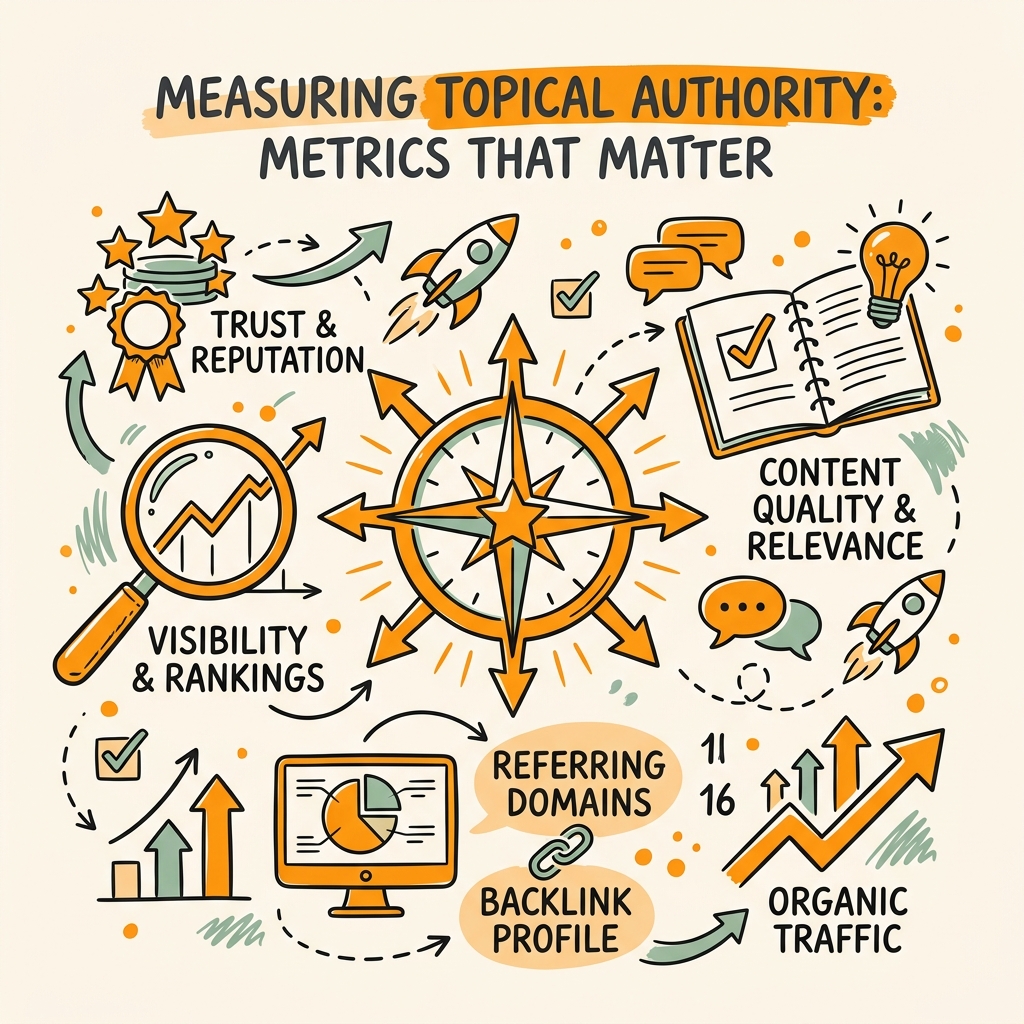
You can't optimize what you don't measure. Most teams track individual keyword ranks and call it a day. That's shallow. Topical authority requires cluster-level measurement.
The Core Measurement Framework
Track these four metrics per cluster:
- Cluster coverage: How many pages do you have? Target: 4–8 cluster pages per pillar. Once you hit 8, evaluate whether to expand the cluster or start a new one.
- Ranked keywords in cluster: How many keywords from your original subtopic list now have top-10 rankings? Target: 40–70% of cluster keywords ranking top 10 within 3–6 months (this is the 40–70% ranking lift cited in the research).
- Cluster impressions (Google Search Console): Total impressions across all pages in the cluster. Should trend upward month-over-month as you add pages and optimize internal links.
- Cluster click-through rate: CTR for cluster pages combined. If CTR is dropping, your titles or snippets need refreshing. Maintenance trigger: quarterly audits, update titles/metadata if CTR drops below benchmark.
Avoid: tracking individual page ranks in isolation. Yes, watch them, but don't optimize for one keyword at a time. Optimize for cluster coherence and total cluster coverage. The ranking gains follow.
| Metric | Target | Timeframe | Action if Below Target |
|---|---|---|---|
| Cluster coverage (# of pages) | 4–8 per pillar | Ongoing | Add 2–4 new cluster pages monthly |
| Ranked keywords (top 10) | 40–70% of cluster keywords | 3–6 months | Audit internal links, refresh titles, check for content gaps |
| Cluster impressions (GSC) | Month-over-month growth | Monthly review | Retroactively link new cluster pages, refresh pillar data |
| Cluster CTR | Baseline + 10% quarterly | Quarterly audit | Update title tags and meta descriptions, test new copy |
Content Maintenance and the Quarterly Audit
Topical authority compounds only if you maintain it. Publish once and move on, and your cluster will plateau within 12 months. Run quarterly audits (every 3 months) to:
- Refresh data: Are statistics still current? Have new studies emerged that should be cited?
- Check internal links: Are links still working? Are there new pages that should be linked from older content?
- Identify gaps: Are there questions in the People Also Ask section or search query report that your cluster doesn't yet answer?
- Update examples: Are case studies or screenshots still relevant, or do they look dated?
Time investment: 4–6 hours per cluster per quarter. Necessary to maintain authority and prevent decay.
Common Topical Authority Mistakes and How to Avoid Them
Teams understand the concept but stumble on execution. Here are the most common failures and fixes:
Mistake 1: Isolated Content Clusters
You build a cluster on "content marketing strategy," but your pillar and supporting pages don't interlink at all. They exist on an island. Fix: enforce hub-and-spoke linking before publishing cluster page 1. Every new cluster page should include 1–2 pillar links and 2–3 sibling links before you hit publish. Make it a non-negotiable part of your publication workflow.
Mistake 2: Confusing Topic Clusters with Content Silos
A content silo is an over-segmented cluster where pages never cross-link to sibling pages, and cross-topic linking is completely forbidden. That's outdated. Topical authority requires dense internal linking within a cluster, and selective cross-cluster links when relevant. You're building thematic depth, not isolation walls. Link freely within your cluster. Link sparingly across clusters. The balance is what generates authority. Learning about SEO content planning will help your team make these linking decisions more strategically.
Mistake 3: Thin, Undifferentiated Pages
You publish 12 pages on "content marketing" but they're all 800 words and cover overlapping ground. Result: cannibalization. Users don't know which page to read. Google doesn't know which to rank. Fix: make every page distinct and comprehensive for its specific subtopic. One page on "content marketing strategy" (pillar, 3,500 words). One page on "content marketing roadmap" (how to build one, 2,000 words, distinct from strategy). One page on "content marketing metrics" (measurement, 2,000 words, distinct from strategy). Each page answers one clear question. No overlap.
Mistake 4: Not Maintaining the Cluster
Publish pillar and clusters in month 1. Nothing happens for the rest of the year. Authority doesn't compound because there's no new content, no updated data, no freshness signal. Fix: add 2–4 new pages per month, and refresh the pillar every 6 months. Maintenance is not optional. It's the difference between a cluster that ranks for 10 keywords and one that ranks for 50.
Conclusion
Building a topical authority system is the single most efficient way to compound organic traffic in 2026. The data is unambiguous: sites using a topical-authority-first strategy reach ranking goals 3x faster than domain-authority-focused competitors. Complete clusters of 25–30 tightly interlinked articles generate 40–70% more keyword rankings within 3–6 months.
The framework is proven: define a pillar topic with validated demand, map its 8–15 subtopics, build a pillar-and-cluster architecture, interlink deliberately, and maintain on a monthly cadence. Do that consistently for 6 months, and you'll see measurable authority growth in both Google rankings and AI search visibility.
But executing this manually is unsustainable for busy teams. Content research, writing, linking, and maintenance are relentless. That's why smart marketing teams use Jottler to handle the production pipeline. Define your clusters, and the system researches, writes, fact-checks, and publishes daily, building authority automatically while your team focuses on strategy and measurement. Start your SEO agent and see topical authority compound for you.
FAQs
What's the minimum number of pages needed to build topical authority?
Research suggests that topical authority begins to show measurable ranking impact with 25–30 tightly interlinked articles within a cluster. You don't need all 25+ to start; a pillar page plus 4–8 supporting pages (12–10 total) will begin generating rankings within 2–3 months. But to see the full 40–70% ranking lift cited in the data, plan for a full 6-month ramp-up and aim for at least 20–25 distinct pages that each solve a specific problem within your topic.
How often should I update pillar pages to maintain topical authority?
Update your pillar page every 6–12 months with fresh data, new examples, and refreshed internal links. Quarterly quick-audits are also recommended to check for broken links, outdated statistics, and new subtopics that should be added or linked. Freshness is a ranking signal, especially for topics where new research or trends emerge frequently. Neglecting updates beyond 12 months will cause your cluster to lose momentum.
Can I build topical authority in a competitive niche?
Yes, and it's actually your best weapon in competitive niches. Topical authority lets smaller sites outrank larger competitors by showing depth and coherence that domain-authority-focused strategies cannot match. Sites prioritizing topical authority have been shown to outrank competitors with 60% more backlinks in shared keywords. The key is to pick a sub-topic of your niche where you can be comprehensive and distinct, then expand from there.